
Life, 1915-12-16 · page 38 of 44
Life — December 16, 1915 — page 38: what you’re looking at
What you’re looking at
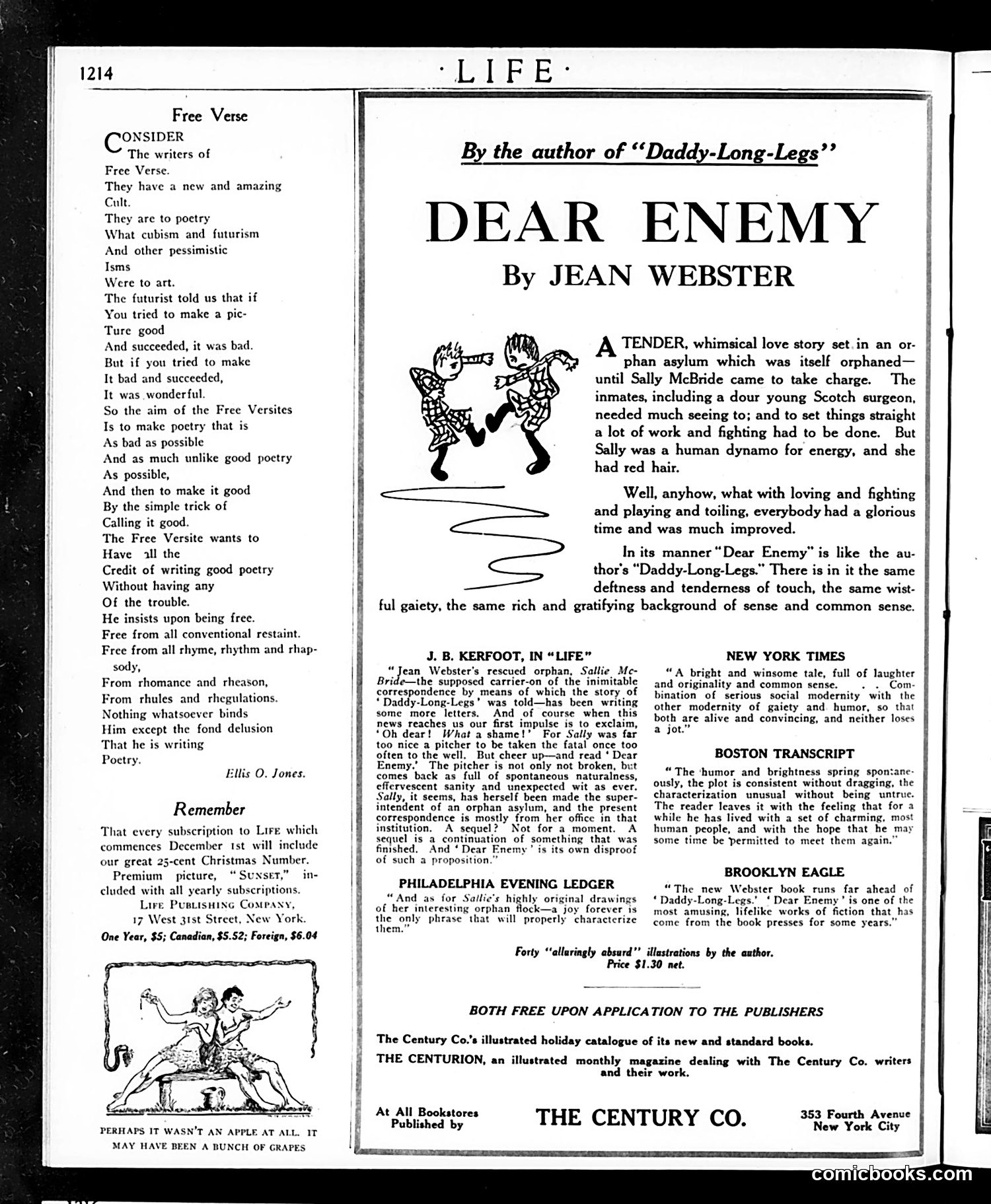
This page combines literary criticism with book advertising. **Left column:** A satirical essay attacking the "Free Verse" movement in poetry. The author (Ellis O. Jones) mocks modernist poets who rejected traditional rules (rhyme, rhythm, meter) as following a contradictory philosophy: they aim to write poetry "as bad as possible," then call it good through mere assertion rather than craft. The satire suggests free versists want credit for writing poetry without the actual work of mastering poetic form—they're "free from all conventional restraint" but have nothing binding them except self-delusion. **Right side:** An advertisement for Jean Webster's novel *Dear Enemy*, a sequel to her popular *Daddy-Long-Legs*. The ad includes enthusiastic reviews from major newspapers praising the book's humor, originality, and social awareness. A small illustration shows two playful figures. **Context for modern readers:** This page reveals early-20th-century literary gatekeeping—establishment critics dismissing experimental modernism as lazy pretension. The juxtaposition with commercial fiction advertising suggests tension between "serious" literary criticism and popular entertainment.
📄 Transcribed text from this page (OCR, searchable)
Machine-transcribed from the original scan — historical spelling and the odd misread are preserved.
Free Verse ONSIDER The writers of Free Verse. They have a new and amazing Cult. They are to poetry What cubism and futurism And other pessimistic Isms Were to art. The futurist told us that if You tried to make a pic- Ture good And succeeded, it was bad. But if you tried to make It bad and succeeded, It was wonderful. So the aim of the Free Versites Is to make poetry that is As bad as possible And as much unlike good poctry As possible, And then to make it good By the simple trick of Calling it good. The Free Versite wants to Have ll the Credit of writing good poetry Without having any Of the trouble. He insists upon being free. Free from all conventional restaint. Free from all rhyme, rhythm and rhap- sody, From rhomance and rheason, From rhules and rhegulations. Nothing whatsoever binds Him except the fond delusion That he is writing Poetry. Ellis O. Jones. Remember That every subscription to Lire which commences December tst will include our great 25-cent Christmas Number. Premium picture, “ Sunset,” in- cluded with all y subscriptions. Lire Pustisninc Company, 17 West 31st Street, New York. One Year, $5; Canadian, $5.52; Foreign, $6.04 PERHAPS IT WASN’T AN APPLE AT ALL. IT MAY HAVE BEEN A BUNCH OF GRAPES By the author of ‘‘Daddy-Long-Legs’’ DEAR ENEMY By JEAN WEBSTER TENDER, whimsical love story set.in an or- phan asylum which was itself orphaned— until Sally McBride came to take charge. The inmates, including a dour young Scotch surgeon, needed much seeing to; and to set things straight a lot of work and fighting had to be done. But Sally was a human dynamo for energy, and she had red hair. Well, anyhow, what with loving and fighting and playing and toiling, everybody had a glorious time and was much improved. In its manner “Dear Enemy” is like the au- thor’s “Daddy-Long-Legs.” There is in it the same deftness and tenderness of touch, the same wist- ful gaiety, the same rich and gratifying background of sense and common sense. J. B. KERFOOT, IN “LIFE” “Jean Webster's rescued orphan, Sallie Mc- Bride—the supposed carrier-on of the inimitable correspondence by means of which the story of *Daddy-Long-Legs’ was told—has been writing some more letters. And of course when this news reaches us our first impulse is to exclaim, ‘Oh dear! What a shame!’ For Sally was far too nice a pitcher to be taken the fatal once too often to the well. But cheer up—and read ‘ Dear Enemy.’ The pitcher is not only not broken, but comes back as full of spontaneous naturalness, effervescent sanity and unexpected wit as ever. Sally, it seems, has herself been made the super- intendent of an orphan asylum, and the present correspondence is mostly from her office in that institution, A sequel? Not for a moment. A sequel is a continuation of something that was finished. And ‘ Dear Enemy’ is its own disproof of such’ a proposition.” PHILADELPHIA EVENING LEDGER “And as for Sallie's highly original drawings of her interesting orphan flock—a joy forever 1s the only phrase that will properly characterize them.” NEW YORK TIMES “A bright and winsome tale, full of laughter and originality and common sense... Com- bination of serious social modernity with the other modernity of gaicty and. humor, so that both are alive and convincing, and neither loses a jot.” BOSTON TRANSCRIPT “The ‘humor and brightness spring spontane- ously, the plot is consistent without dragging, the characterization unusual without being untrue. The reader leaves it with the feeling that for a while he has lived with a set of charming, most human people, and with the hope that he may some time be permitted to meet them again.” BROOKLYN EAGLE “The new Webster book runs far ahead of “ Daddy-Long-Legs.’. ‘ Dear Enemy’ is one of the most amusing, lifelike works of fiction that has come from the book presses for some years.” Forty “‘allaringly absurd’? illastrations by the author. Price $1.30 net. BOTH FREE UPON APPLICATION TO THE PUBLISHERS The Century Co.’s illustrated holiday catalogue of its new and standard books. THE CENTURION, an illustrated monthly magazine dealing with The Century Co. writers and their work. At All Bookstores Published by THE CENTURY CO. 353 Fourth Avenue New York City 5 SS ARS SW AA