
Life, 1915-12-16 · page 14 of 44
Life — December 16, 1915 — page 14: what you’re looking at
What you’re looking at
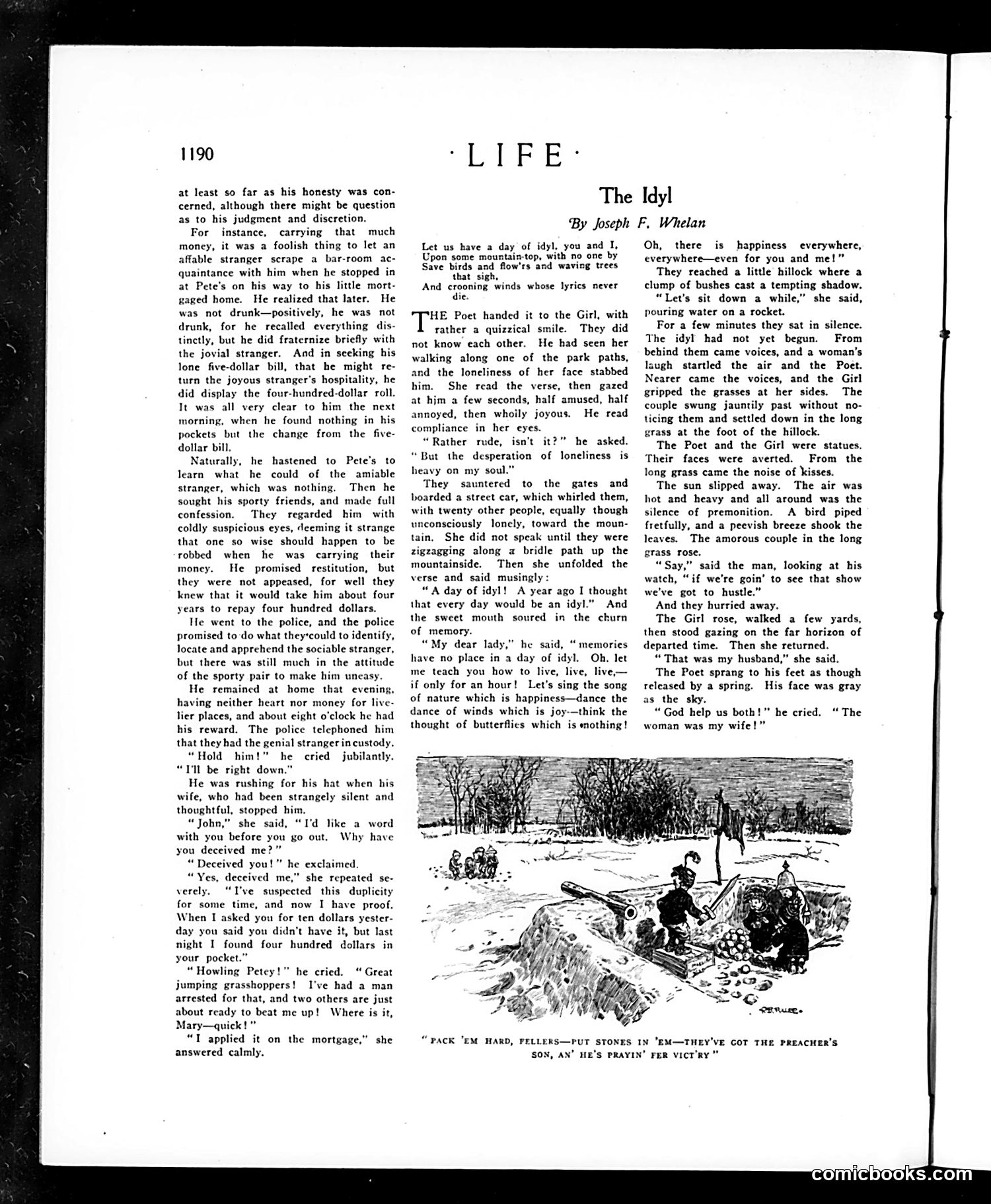
This is a short story, not a political cartoon. The narrative describes a poet and a girl meeting on a mountain, sharing romantic verses about escaping to an idyllic day free from worldly concerns. The couple later returns to ordinary life where the man discovers he's been robbed of four hundred dollars—money he'd apparently left in his pocket during their romantic interlude. The illustration shows them in a pastoral landscape. The story's satire targets the contrast between romantic idealism and harsh reality: the couple's poetic escape into nature and love is undercut by practical, mundane consequences. The irony suggests that romantic notions, however beautiful, cannot protect one from life's actual hardships and losses.
📄 Transcribed text from this page (OCR, searchable)
Machine-transcribed from the original scan — historical spelling and the odd misread are preserved.
1190 at least so far as his honesty was con- cerned, although there might be question as to his judgment and discretion. For instance, carrying that much money, it was a foolish thing to let an affable stranger scrape a bar-room ac- quaintance with him when he stopped in at Pete's on his way to his little mort- gaged home. He realized that later. He was not drunk—positively, he was not drunk, for he recalled everything dis tinctly, but he did fraternize briefly with the jovial stranger. Aad in seeking his lone five-dollar bill, that he might re- turn the joyous stranger's hospitality, he did display the four-hundred-dollar roll. It was all very clear to him the next morning, when he found nothing in his pockets but the change from the five- dollar bill. Naturally, he hastened to Pete's to learn what he could of the amiable stranger, which was nothing. Then he sought his sporty friends, and made full confession. They regarded him with coldly suspicious eyes, deeming it strange that one so wise should happen to be robbed when he was carrying their money. He promised restitution, but they were not appeased, for well they knew that it would take him about four years to repay four hundred dollars. He went to the police, and the police promised to-do what they‘could to identify, locate and apprehend the sociable stranger, but there was still much in the attitude of the sporty pair to make him uneasy. He remained at home that even’ having neither heart nor money for | lier places, and about eight o'clock he had his reward. The police telephoned him that they had the genial stranger in custody. “Hold him!” he cried jubilantly. “Tl be right down.” He was rushing for his hat when his wife, who had been strangely silent and thoughtful, stopped him. “John,” she said, “I'd like a word with you before you go out. Why have you deceived me?” “ Deceived you!" he exclaimed. “Yes, deceived me,” she repeated se- verely. “I've suspected this duplicity for some time, and now I have proof. When I asked you for ten dollars yester- day you said you didn’t have it, but last night I found four hundred dollars in your pocket.” “Howling Petey!" he cried. “Great jumping grasshoppers! I've had a man arrested for that, and two others are just about ready to beat me up! Where is it, Mary—quick!” “I applied it on the mortgage,” she answered calmly. ‘LIFE? The Idyl By Joseph F, Whelan Let us have a day of idyl, you and I, Upon some mountain-top, with no one by Save birds and flow'rs and waving trees that sigh, . And erpenlog winds whose lyrics never ie. HE Poet handed it to the Girl, with rather a quizzical smile. They did not know each other. He had seen her walking along one of the park paths, and the loneliness of her face stabbed him. She read the verse, then gazed at him a few seconds, half amused, half annoyed, then whoily joyous. He read compliance in her eyes. “Rather rude, isn’t he asked. “But the desperation of loneliness is heavy on my soul.” They sauntered to the gates and boarded a street cat, which whirled them, with twenty other people, equally though unconsciously lonely, toward the moun- tain, She did not speak until they were zigzagging along a bridle path up the mountainside. Then she unfolded the verse and said musingly : “A day of idyl! A year ago I thought that every day would be an idyl.” And the sweet mouth soured in the churn of memory. “My dear lady,” he said, “ memories have no place in a day of idyl. Oh, let me teach you how to live, live, live— if only for an hour! Let's sing the song of nature which is happiness—dance the dance of winds which is joy-—think the thought of butterflies which is nothing! in?” be 2 Oh, there is happiness everywhere, everywhere—even for you and me!” They reached a little hillock where a clump of bushes cast a tempting shadow. “Let's sit down a while,” she said, pouring water on a rocket. For a few minutes they sat in silence. The idyl had not yet begun. From behind them came voices, and a woman's laugh startled the air and the Poet. Nearer came the voices, and the Girl gripped the grasses at her sides. The couple swung jauntily past without no- ticing them and settled down in the long grass at the foot of the hillock. The Poet and the Girl were statues. Their faces were averted. From the long grass came the noise of kisses. The sun slipped away. The air was hot and heavy and all around was the silence of premonition. A bird piped fretfully, and a peevish breeze shook the leaves. The amorous couple in the long grass rose. “Say,” said the man, looking at his watch, “if we're goin’ to see that show we've got to hustle.” And they hurried away. The Girl rose, walked a few yards, then stood gazing on the far horizon of departed time. Then she returned. “That was my husband,” she said. The Poet sprang to his feet as though released by a spring. His face was gray as the sky. “God help us both!” he cried. woman was my wife!” “The i 3 <= SS rey SNe SIey wZog , PBR. “PACK 'EM HARD, PELLERS—PUT STONES IN "EM—THEY'VE COT THE PREACHER'S SON, AN’ HE'S PRAYIN’ FER VICT'RY ”