
A complete issue · 44 pages · 1915
Life — October 14, 1915
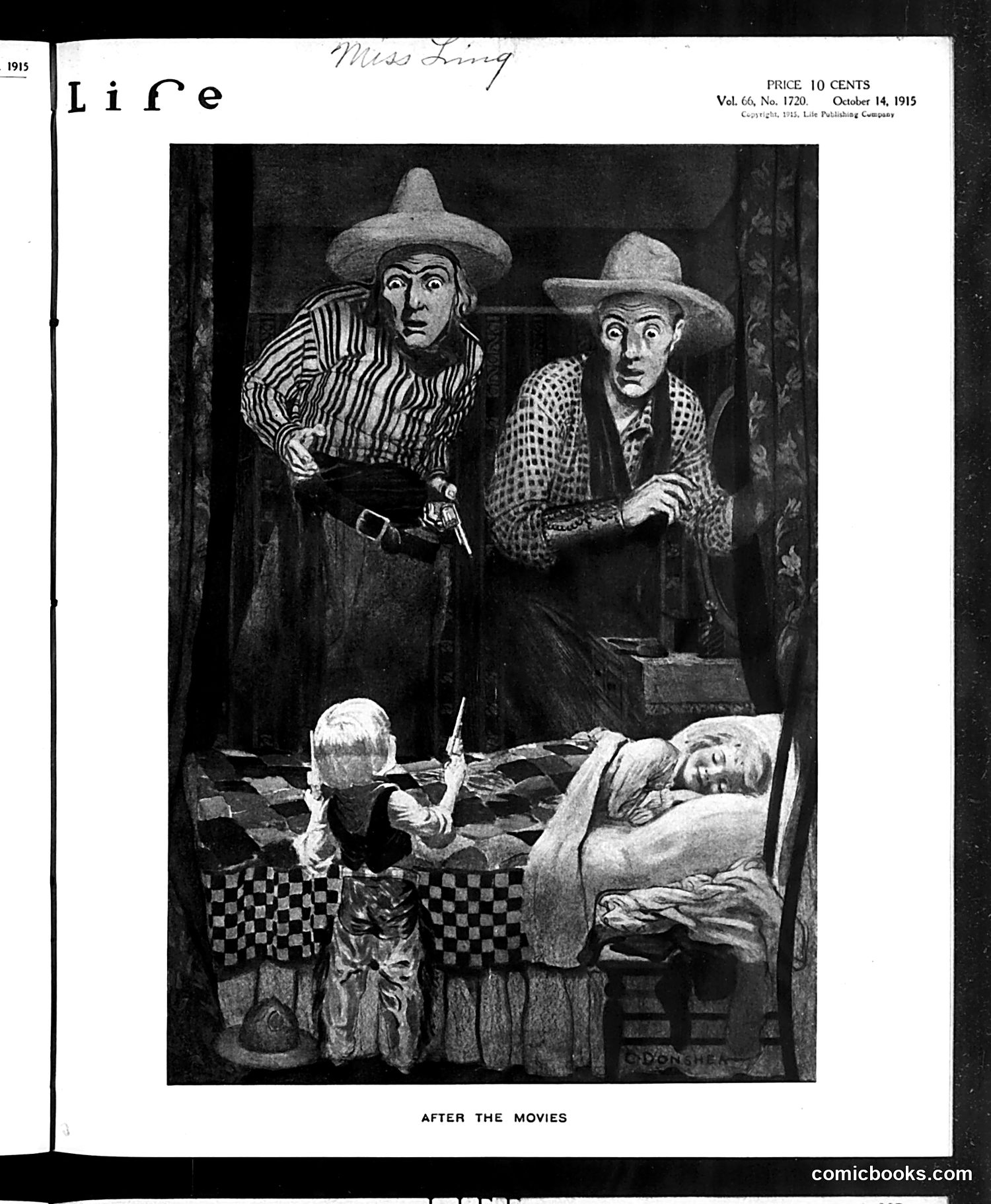
This illustration satirizes the behavior of young couples leaving movie theaters in the early 1910s. The image shows two men in cowboy hats (likely imitating Western film heroes they just watched) acting out dramatic scenarios they'd seen onscreen. One appears to be drawing a gun while the other gestures dramatically. Meanwhile, a small child plays with toys and a woman sleeps, oblivious to the men's antics. The satire targets how movies—particularly action-adventure and Western films—influenced audience behavior, encouraging imitation of cinematic violence and dramatics. The contrast between the absorbed, childlike men and the indifferent woman suggests criticism of adult male susceptibility to movie fantasies, portraying cinema's influence as potentially absurd or even infantilizing.
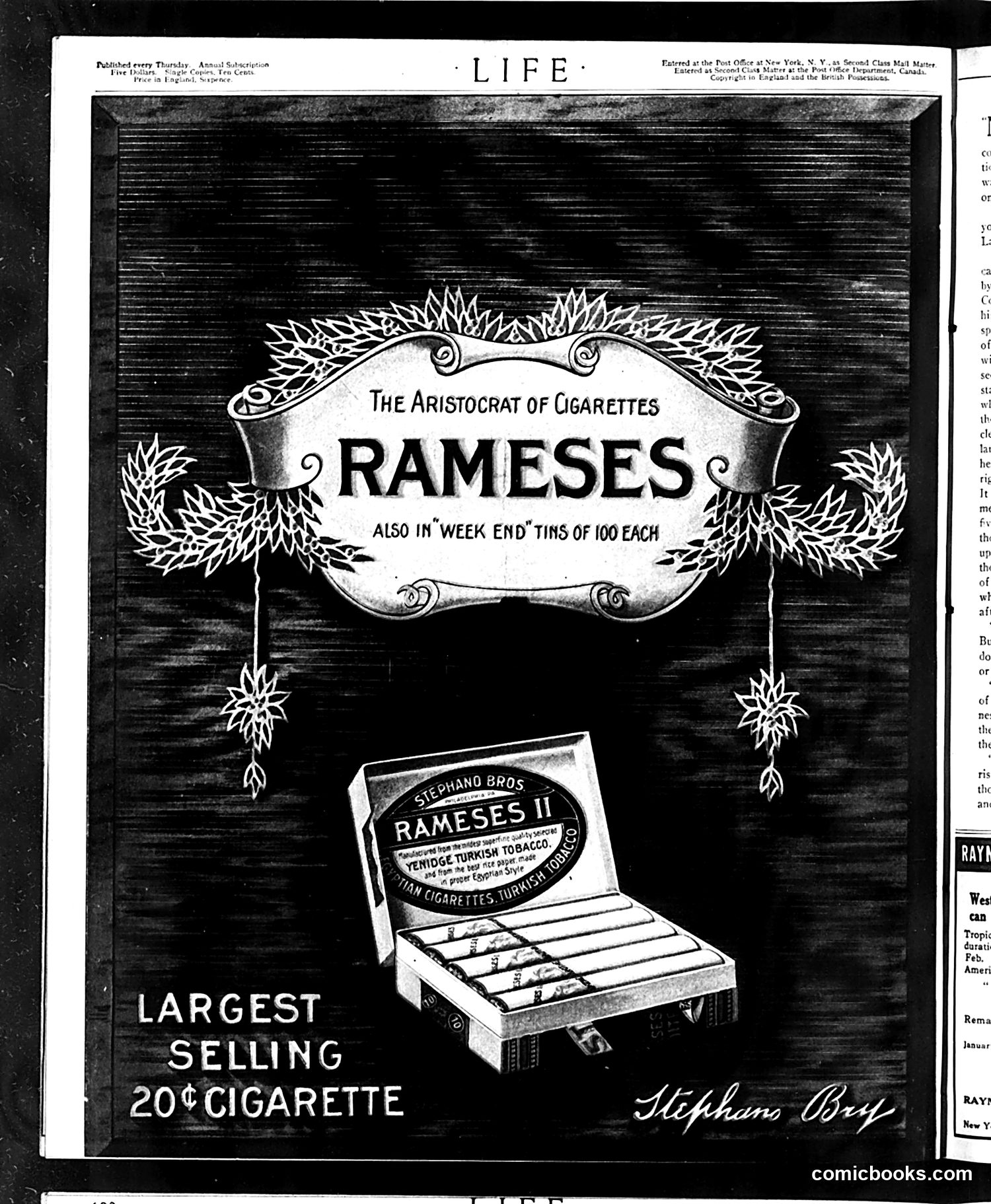
This page is primarily **advertising, not satire or political commentary**. It contains a full-page advertisement for Rameses II cigarettes by Stephano Bros, promoting them as "The Aristocrat of Cigarettes" and noting they're the "Largest Selling 20¢ Cigarette." The ad features decorative Art Deco-style design with laurel wreaths and an illustration of an open cigarette box. The text mentions "week end tins of 100 each" as an additional packaging option. There is no political cartoon or satirical content visible on this page. It appears to be a straightforward early 20th-century tobacco advertisement placed in Life magazine, likely during an era when such advertising was common in publications.
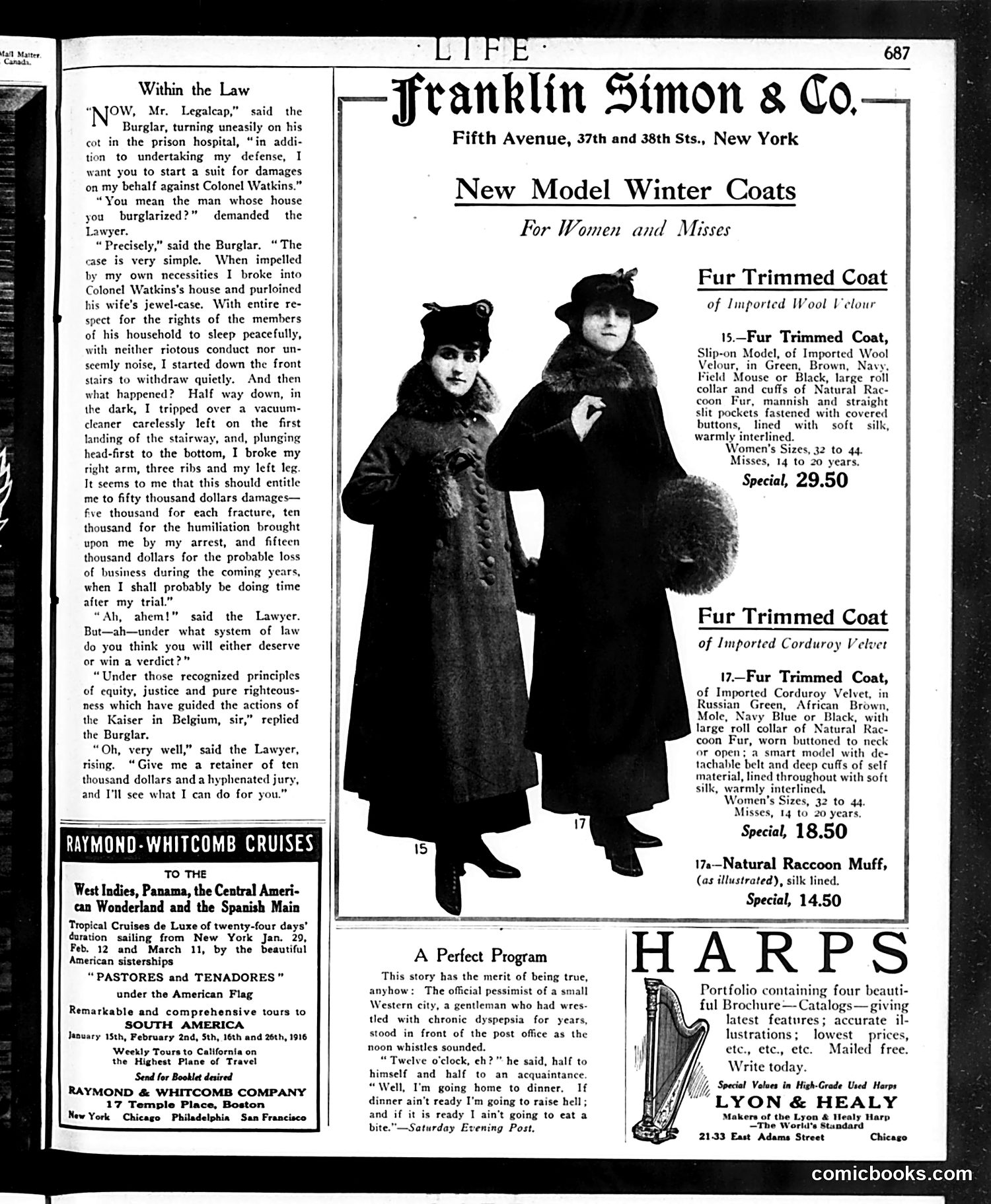
This page is **primarily advertising**, not satirical content. The left column contains "Within the Law," a prose story about a burglar's legal case—likely serialized fiction rather than satire. The dominant right side features **Franklin Simon & Co. winter coat advertisements** for women and misses, showcasing fur-trimmed designs with prices ($29.50-$18.50). Below that are ads for Raymond-Whitcomb Cruises and Lyon & Healy Harps. The small section titled "A Perfect Program" appears to be a humorous anecdote about office life and pessimism, but lacks clear political content. **This is a commercial magazine page blending fiction with department-store advertisements**—typical of early 20th-century Life magazine format. No significant political satire or cartooning is evident.
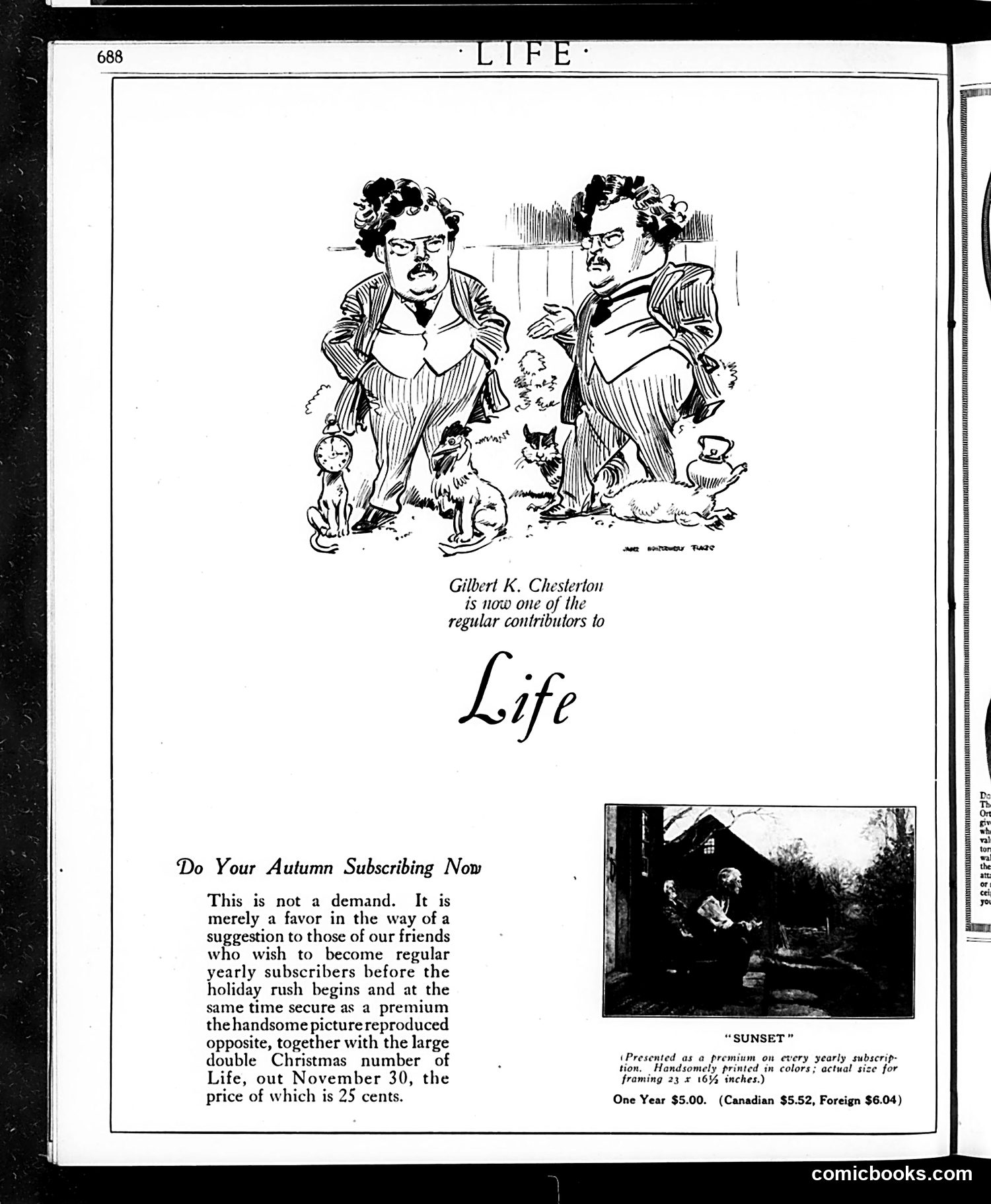
This page primarily advertises Life magazine's subscription offer rather than presenting satirical content. The top cartoon appears to be a caricature by a contributor named Gilbert K. Chesterton (identified in the text), showing two portly figures with exaggerated features flanked by small dogs—likely a humorous illustration typical of Life's satirical style, though the specific subject is unclear from the image alone. The main content is a subscription promotion encouraging autumn subscriptions at $5.00 annually, with a premium "Sunset" picture included in the November 30 Christmas issue. The accompanying photograph shows two figures in what appears to be a rural or domestic setting, presented as the premium artwork subscribers would receive. This is primarily advertising rather than political satire.
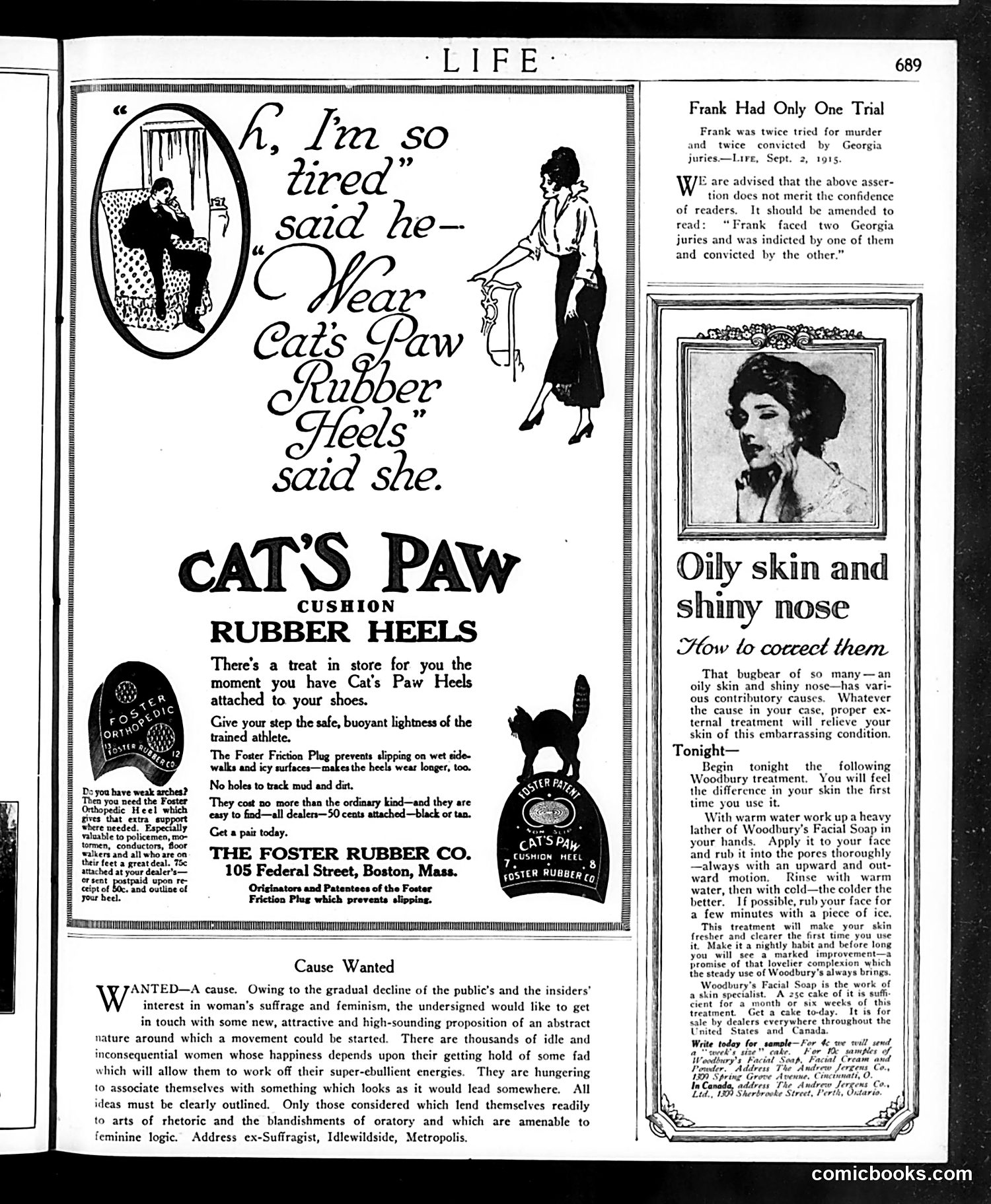
This page is primarily **advertising and advice columns** rather than political satire. The main content includes: - A **Cat's Paw Cushion Rubber Heels advertisement** featuring a tired man and woman, promoting comfortable shoe heels made by The Foster Rubber Co. of Boston - A **beauty advice column** about treating "oily skin and shiny nose," recommending Woodbury's Facial Soap - A brief **"Cause Wanted" section** soliciting support for women's suffrage and feminism, seeking volunteers for an abstract movement around these causes The suffrage notice is the only overtly political content, appealing to readers' interest in women's rights. However, the page's primary purpose is commercial—promoting consumer products and beauty treatments to female readers.
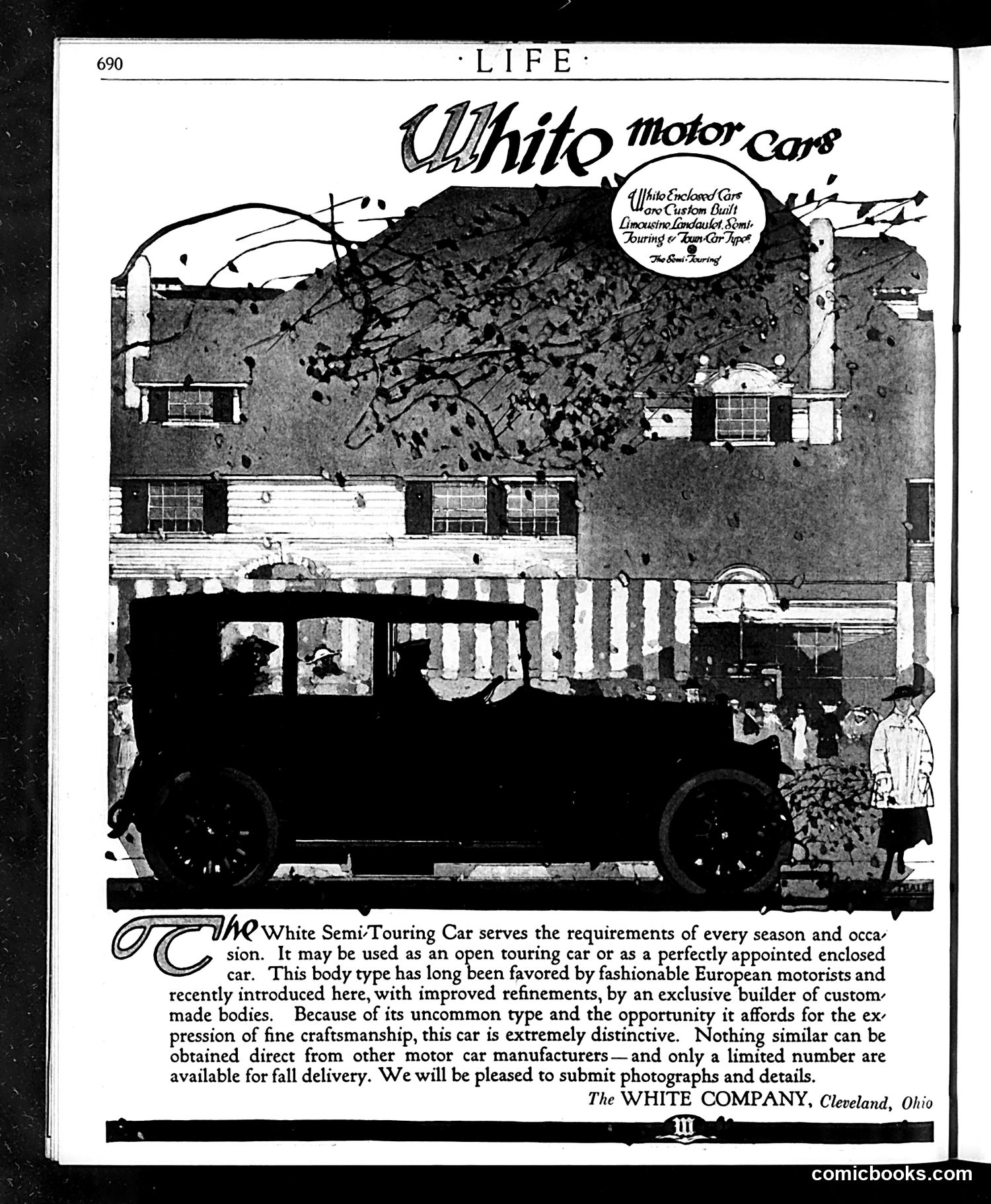
This page is **primarily an advertisement**, not editorial satire. It promotes White Motor Cars, specifically their "Semi-Touring Car" model. The advertisement uses an illustration showing a White automobile parked in front of a residential building with ivy-covered walls. People stand nearby, apparently admiring the vehicle. The text emphasizes the car's versatility—it functions both as an open touring car and an enclosed vehicle, suited for different seasons. The ad highlights that this body style, favored by "fashionable Europeans and motorists," is custom-built and available only in limited quantities from The White Company of Cleveland, Ohio. There is no apparent political or social satire here. This is straightforward early automotive marketing using lifestyle imagery to convey luxury and exclusivity.
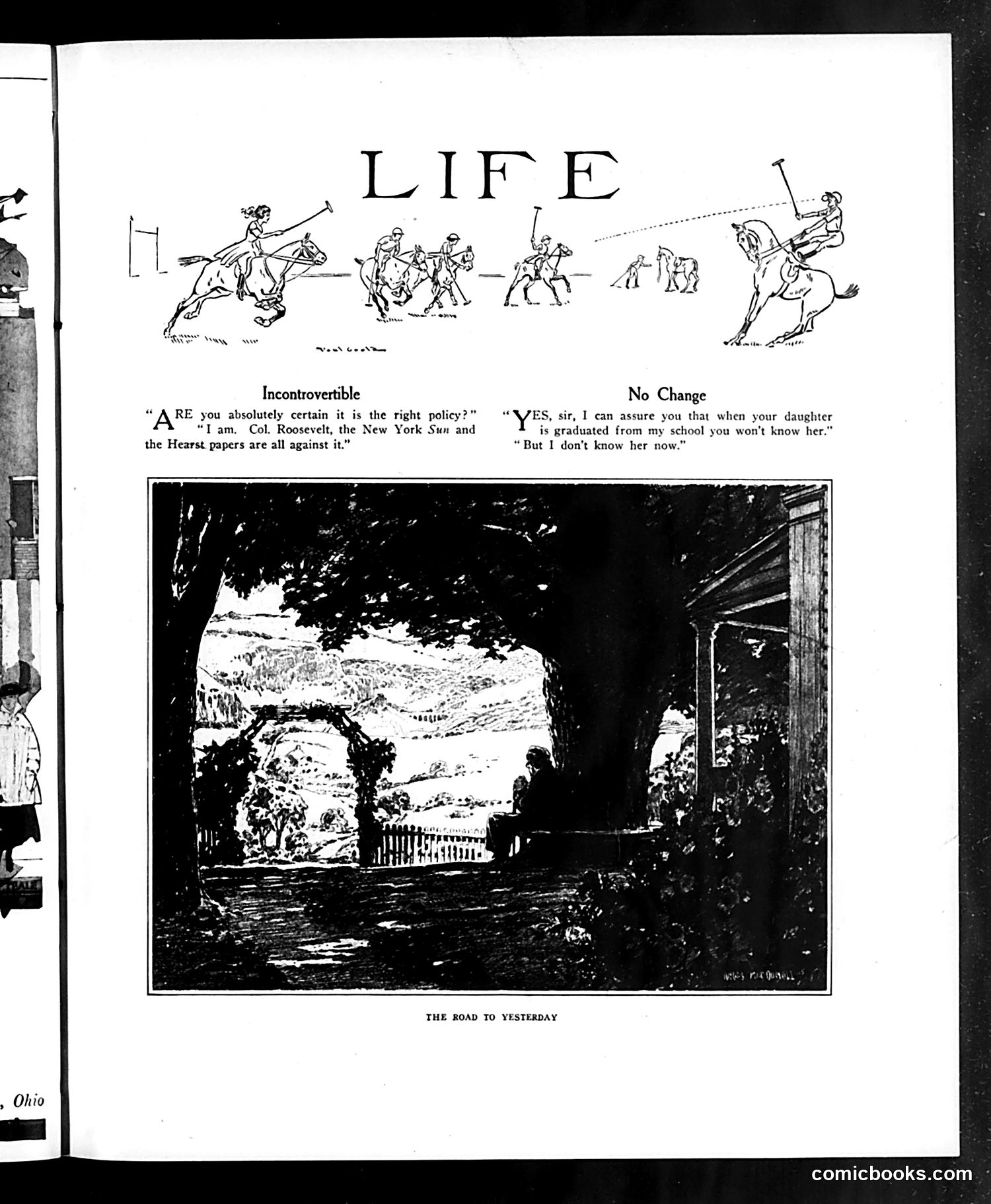
This page contains two satirical vignettes about constancy and change: **"Inconvertible"** references Colonel Roosevelt and the New York *Sun* and *Hearst* papers' editorial positions—likely about Theodore Roosevelt's political stance or policies that these publications opposed. **"No Change"** presents a social joke: a father asserts he won't recognize his daughter after her school graduation, implying she'll change so dramatically. The humor lies in the father's certainty that education will transform her beyond recognition. The page's decorative polo/sporting header ("LIFE") and the illustration titled "The Road to Yesterday" suggest themes of nostalgia and transformation. The overall page juxtaposes political inflexibility with inevitable personal change—a commentary on how people and institutions resist or accept change differently.
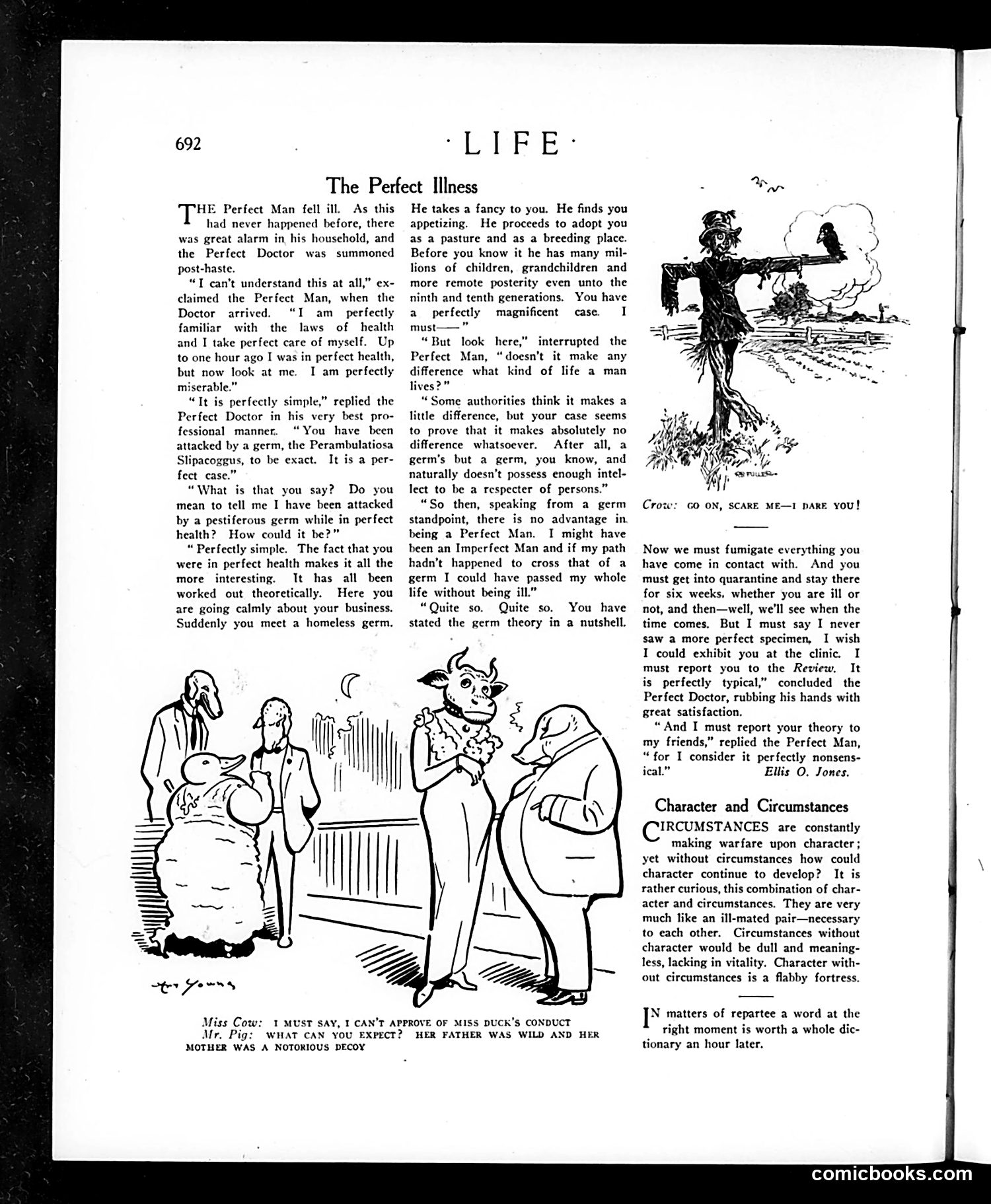
This satirical story mocks the "Perfect Man"—a self-proclaimed paragon of health who claims perfect immunity to illness. When he falls sick, he rationalizes it as merely being "attacked by a germ," insisting this doesn't contradict his perfection. A skeptical doctor counters that being perfectly healthy requires *never* being ill, exposing the Perfect Man's circular logic as absurd. The lower cartoon depicts social commentary: a cow and pig criticize Miss Duck's conduct, noting her parents' questionable morality. This satirizes how people judge others' character based on heredity. Both pieces target self-delusion and hypocrisy—specifically, how people construct elaborate justifications to maintain false self-images rather than confronting reality.
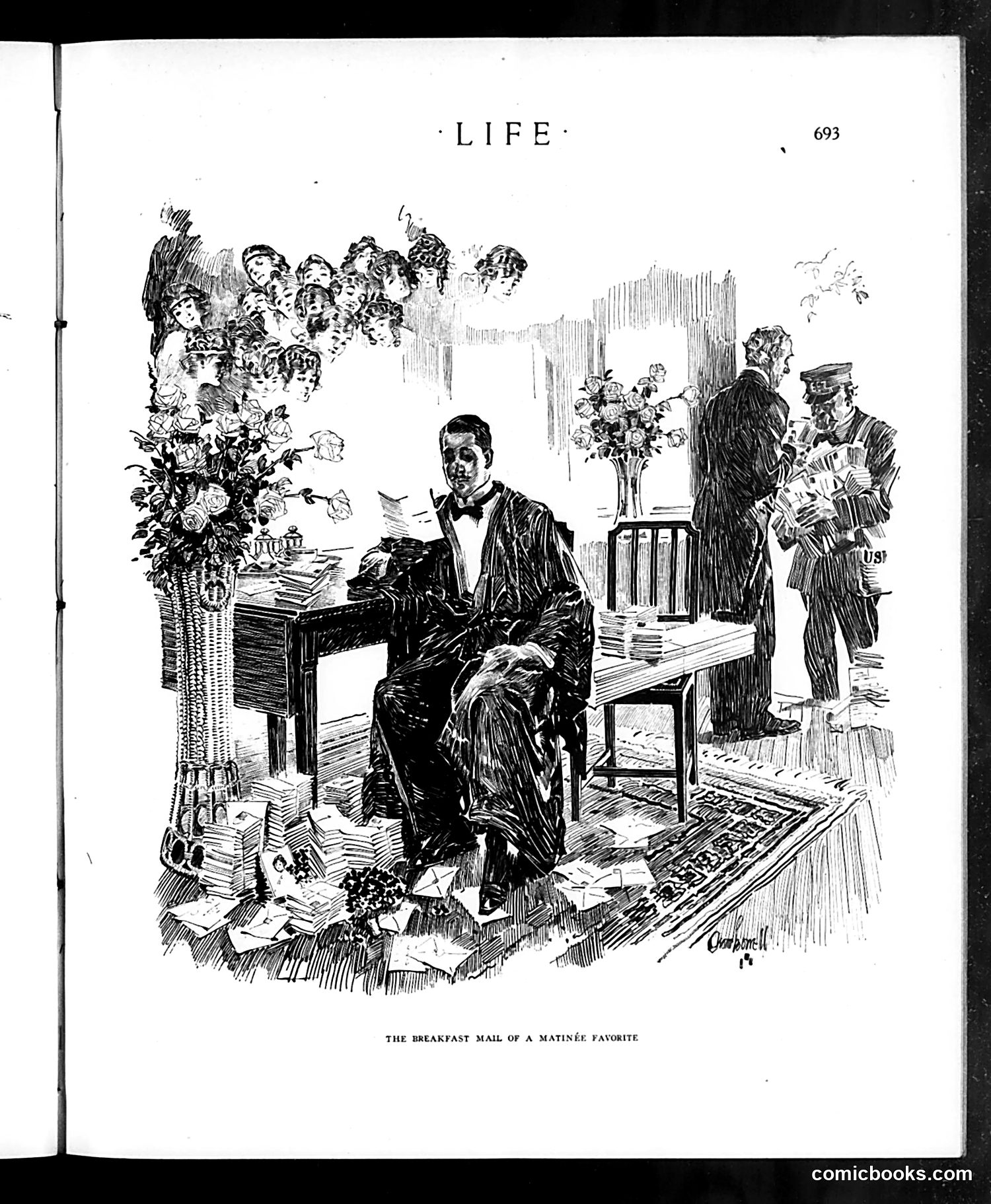
This satirical illustration depicts a successful theater performer receiving an overwhelming volume of fan mail at breakfast. The central figure—a well-dressed man in formal attire sitting at his desk—is buried under stacks of letters and papers, while admirers' faces literally sprout from a large flower vase behind him like blooms. The joke targets the celebrity culture surrounding popular stage actors, particularly those who performed afternoon matinée shows. It satirizes both the obsessive devotion of theater fans and the impractical chaos of fame—suggesting that a matinée favorite's morning routine is completely disrupted by adoring correspondence. The exaggerated visual metaphor (faces as flowers) mocks the romanticization of celebrity worship.
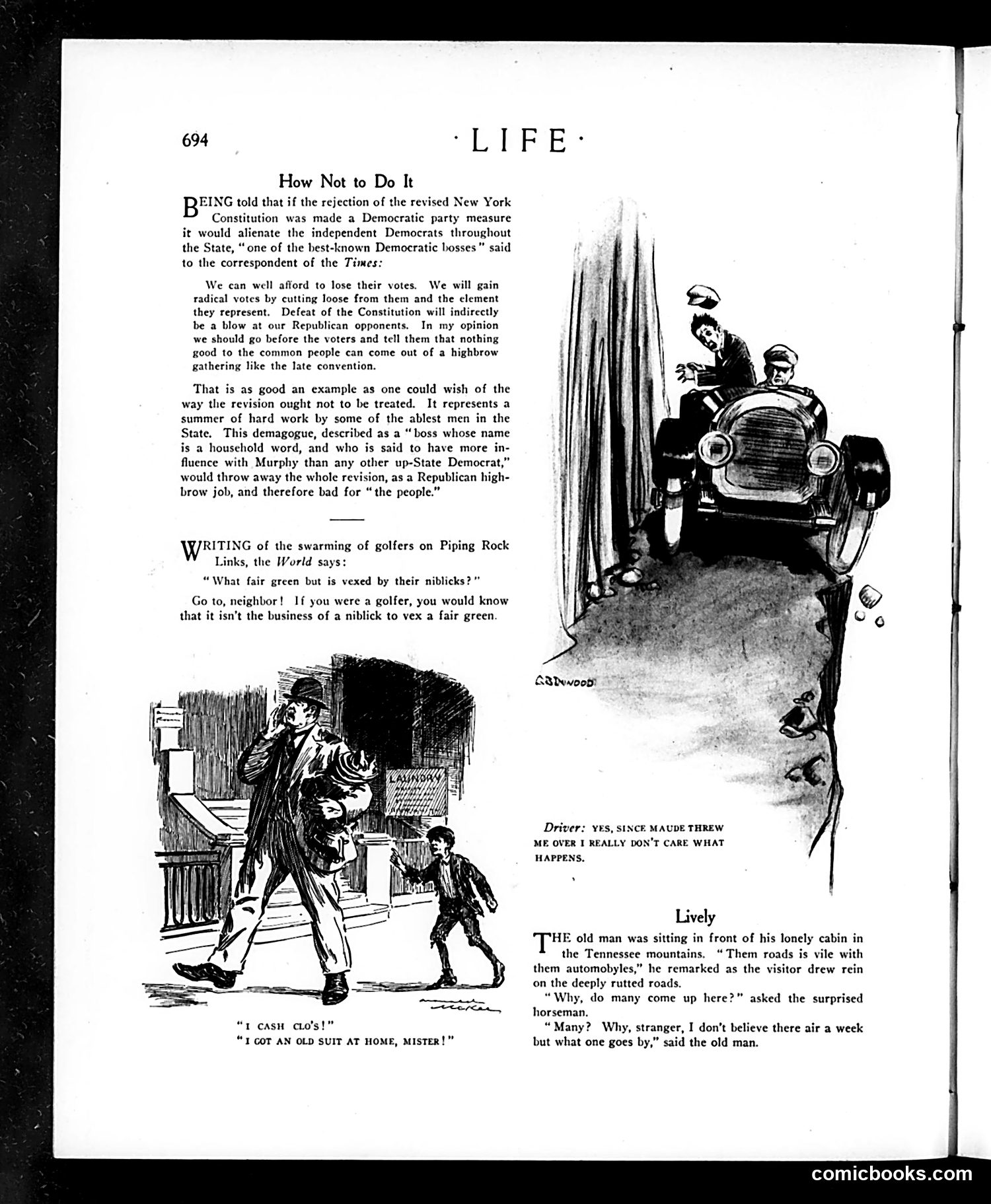
This page contains political and humorous commentary. The top section criticizes Democratic Party strategy regarding New York's revised Constitution, quoting a Democratic operative warning that rejection would alienate independent Democrats—suggesting the party should avoid this "highbrow" approach. The left cartoon depicts a man aggressively confronting someone about cashing checks, saying "I CASH CLO'S! I GOT AN OLD SUIT AT HOME, MISTER!"—apparently satirizing aggressive debt collection or financial desperation during economic hardship. The right cartoon shows a reckless automobile driver ("Driver: YES, SINCE MAUDE THREW ME OVER I REALLY DON'T CARE WHAT HAPPENS") careening dangerously, titled "Lively." Below is an anecdote about Tennessee mountain roads and automobiles, humorously depicting rural unfamiliarity with cars.
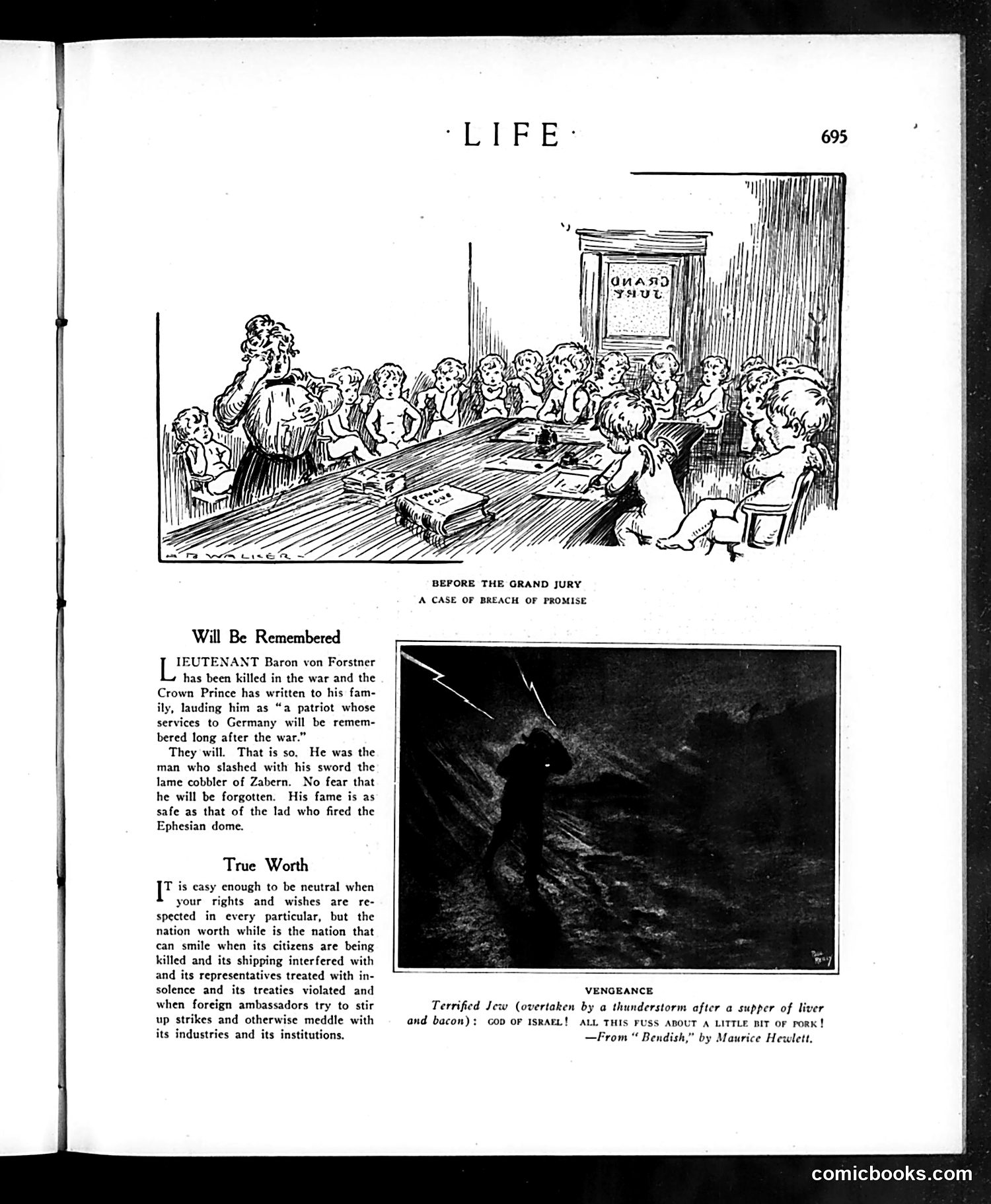
This page contains two distinct items from *Life* magazine: 1. **"Before the Grand Jury"** (top): A courtroom sketch satirizing a breach of promise case—a legal action for breaking an engagement or romantic commitment. The crowded scene suggests public interest in such trials. 2. **"Will Be Remembered"** and **"True Worth"** (left column): Two brief editorials about Lieutenant Baron von Forstner, a German military officer killed in WWI. The text praises him as a patriot whose fame is secure, comparing his legacy to historical figures. The second section defends national neutrality while condemning nations that violate treaties and harm citizens. 3. **"Vengeance"** (bottom right): A dark illustration attributed to Maurice Hewlett's "Bendish," depicting a terrified Jewish figure during a thunderstorm—referencing antisemitic violence and pogroms, likely responding to wartime atrocities. The page reflects WWI-era concerns about honor, national conduct, and persecution.
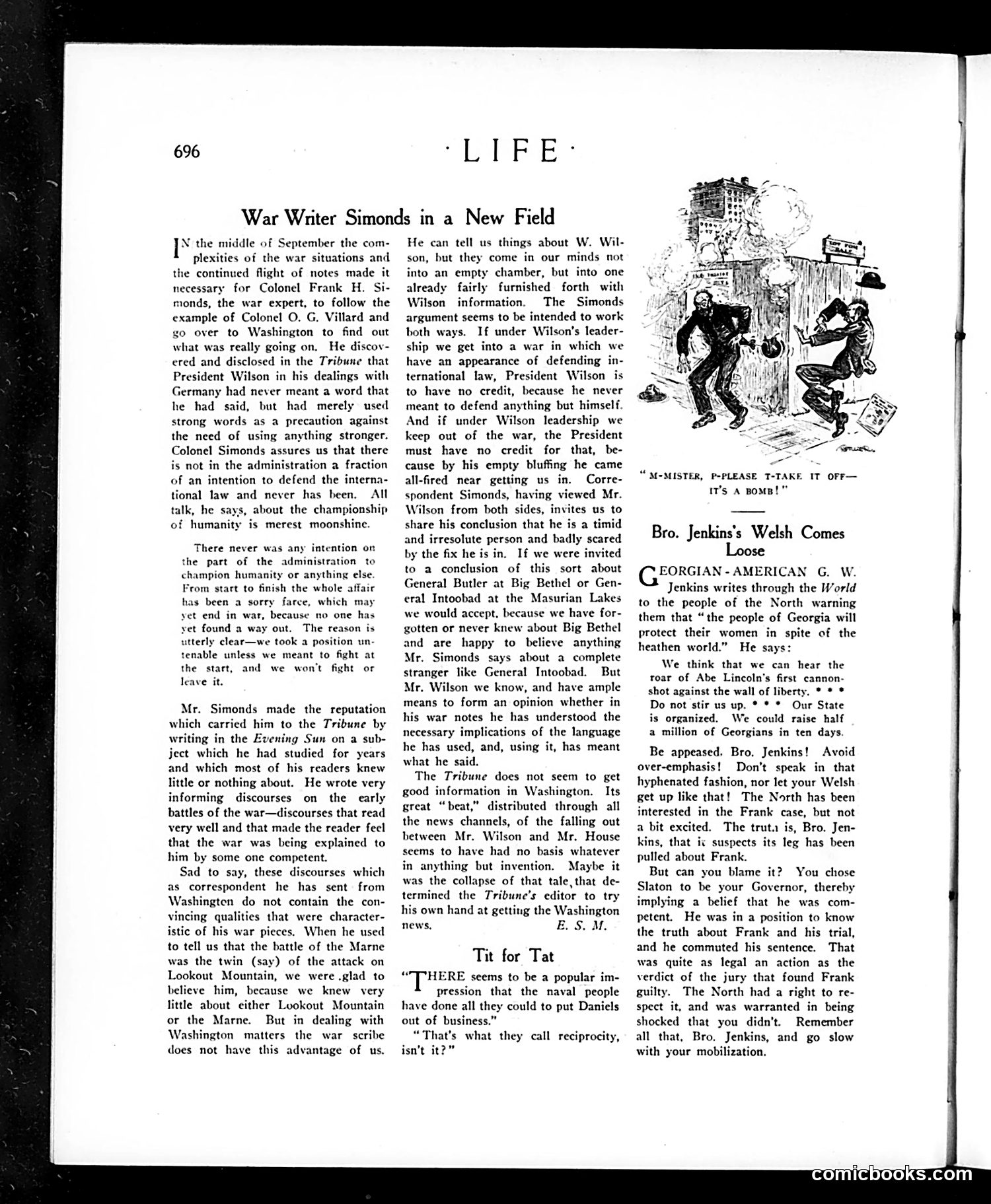
The cartoon depicts a figure labeled "M'MISTER, P'LEASE T'TAKE IT OFF—IT'S A BOMB!" showing someone frantically trying to remove what appears to be an explosive device. This illustrates articles criticizing Colonel Frank H. Simonds' war commentary. The text argues Simonds' writing in the *Tribune* contained inflammatory language about President Wilson's war leadership, suggesting Wilson bore no responsibility for military outcomes. The satire implies Simonds' heated rhetoric is dangerous—a "bomb" of incendiary prose. A second article by "Bro. Jenkins" addresses Georgia's mobilization efforts during what appears to be World War I, warning against complacency regarding women's safety during wartime. The page reflects early-20th-century debates over war journalism, presidential accountability, and home-front anxieties.
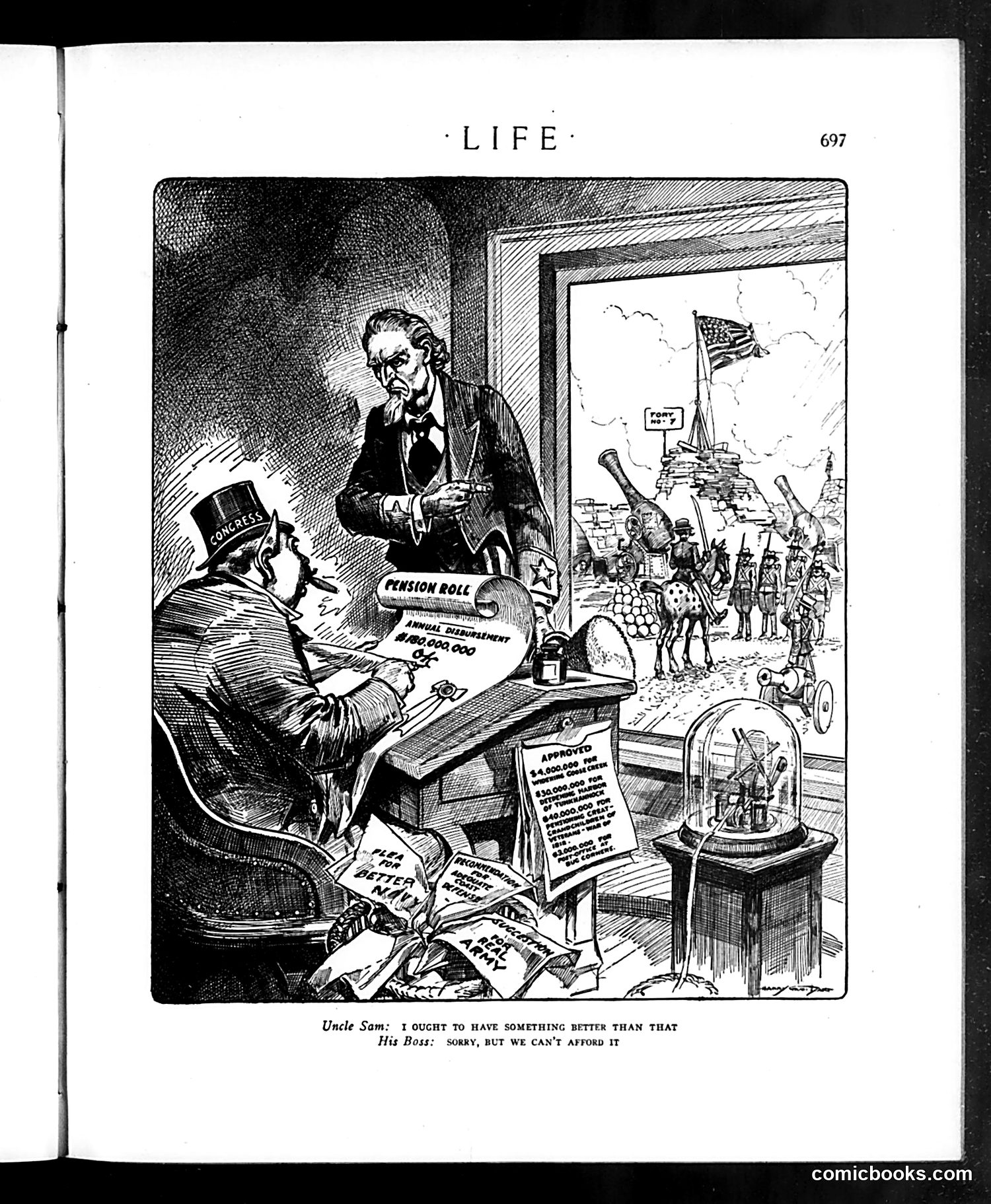
This cartoon satirizes Congressional spending priorities during what appears to be the early 20th century. A figure labeled "Congress" sits at a desk reviewing budget documents, while a boss-like figure (likely representing fiscal constraints or the President) stands behind him. The cartoon contrasts two visions: Congress dreams of ambitious military/infrastructure projects (shown through a window—fortifications, cannons, an American flag, and soldiers), represented by a "Pension Roll" document showing "$2,000,000" in annual disbursement. However, the boss dismisses these aspirations, saying they "can't afford it." The satire critiques the gap between Congressional ambitions for grand national projects and budgetary reality, suggesting fiscal irresponsibility or unrealistic government spending proposals.
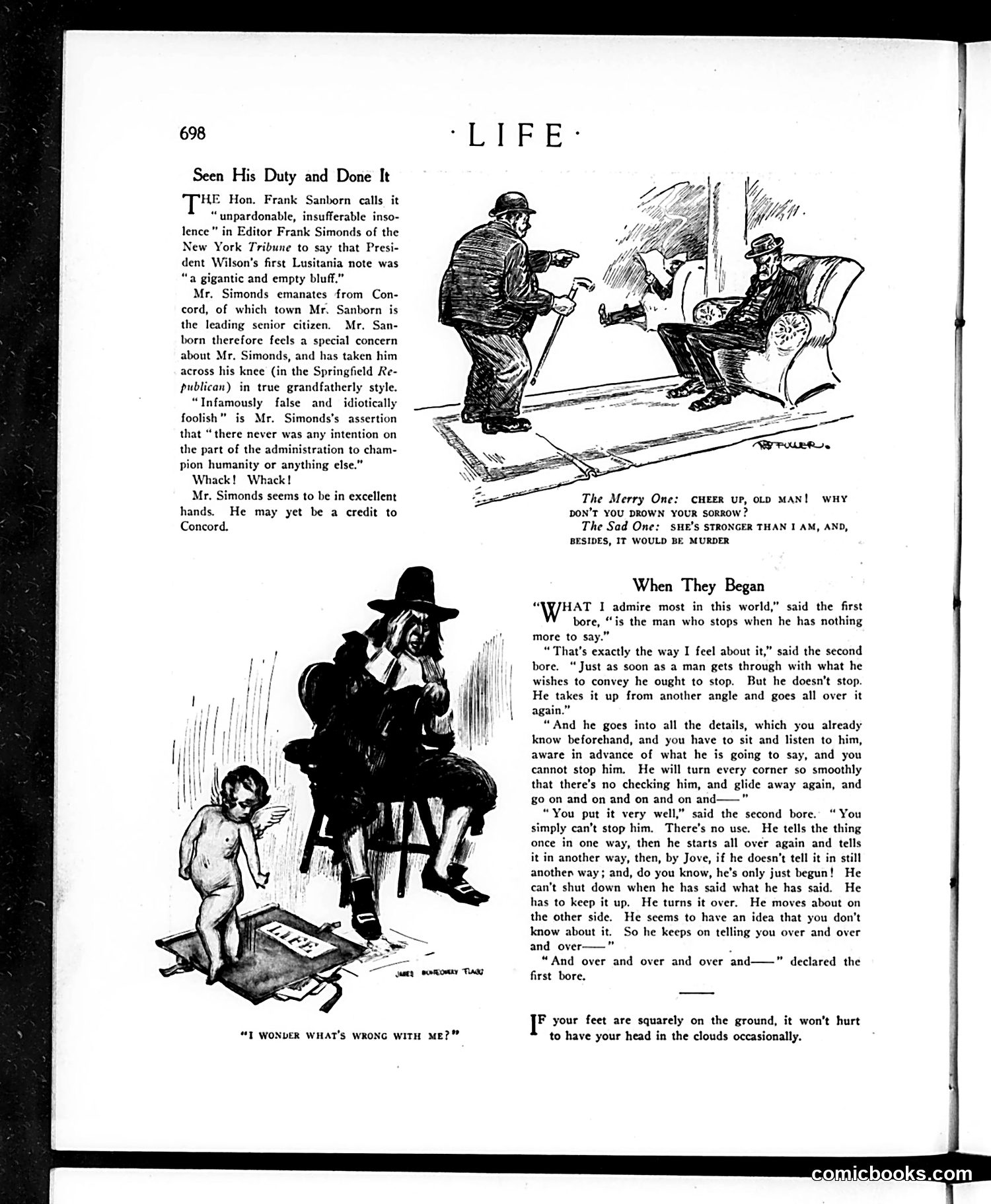
This page contains commentary on **Frank Simonds**, a prominent editor of the *New York Tribune*, criticizing President Wilson's handling of the Lusitania crisis. The Hon. Frank Sanborn calls Simonds's editorial an "unpardonable insolence," while the *Springfield Republican* labels his claims "infamously false and idiotically foolish." The top cartoon depicts a confrontation between two figures, with dialogue about drowning sorrow—likely satirizing responses to the ship's sinking and the administration's diplomatic response. The lower illustration shows a man (possibly representing a bored or frustrated speaker) with Cupid, captioned "I wonder what's wrong with me?"—suggesting commentary on public indifference or fatigue. The "When They Began" section is a humorous dialogue about compulsive talkers.
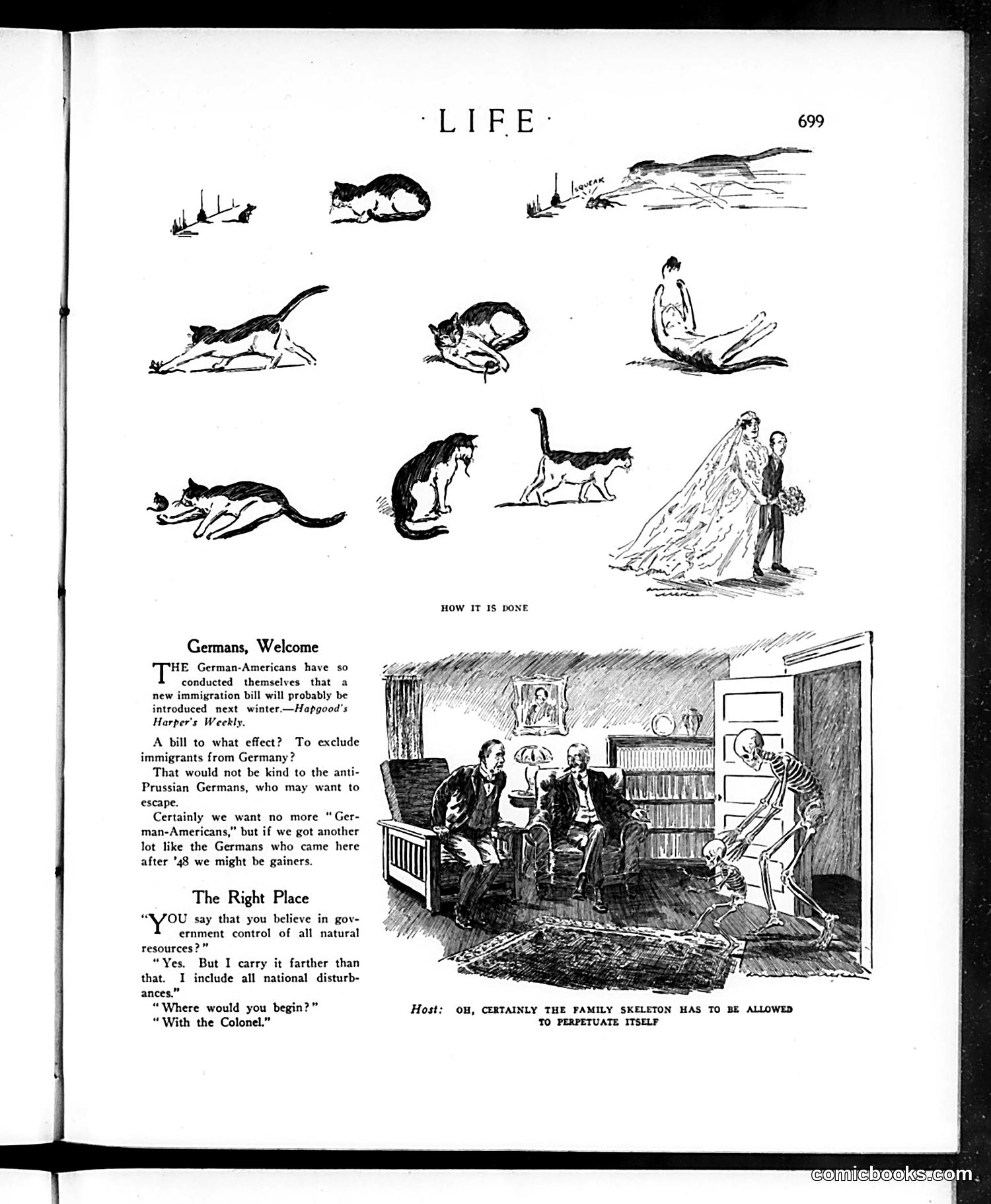
**Top Section ("How It Is Done"):** Cartoon illustrations depicting cats in various stretching and contorted positions, followed by images of a human woman stretching and a couple (bride and groom). This appears to be a humorous visual comparison suggesting humans imitate cat behavior, or commentary on physical flexibility/contortion. **Bottom Section ("Germans, Welcome"):** Political satire criticizing a proposed immigration bill targeting Germans. The text debates whether exclusionary legislation would prevent "German-Americans" from conducting themselves improperly, referencing Germans who arrived after 1848. **"The Right Place" Dialogue:** A satirical exchange about government control of natural resources and "national disturbances," with a punchline about a skeleton family ("the family skeleton has to be allowed to perpetuate itself"). The cartoon illustrates these concepts with a domestic interior scene, likely mocking government overreach or hypocrisy regarding immigration policy.
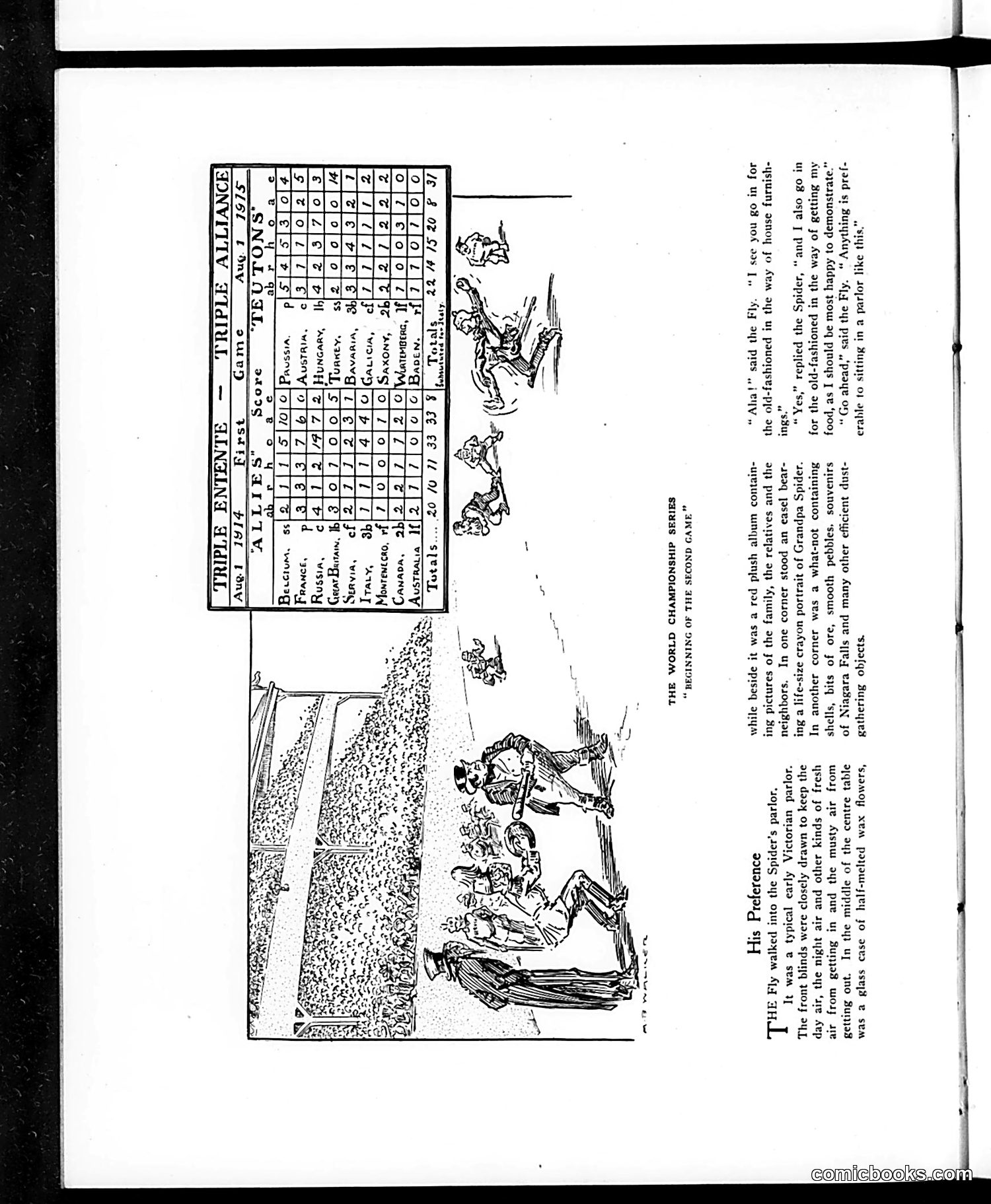
This page contains a satirical article titled "THE WORD CHAMPAGNE AROUSES GREAT ENTHUSIASM AT" (text cut off), accompanied by illustrations showing what appears to be a dining or social scene. The OCR text is heavily garbled and largely illegible, making precise interpretation difficult. However, the visible elements suggest this is **social satire about wine snobbery or champagne culture** — a common target of Life magazine's humor. The illustrated figures appear to be engaged in some form of pretentious behavior related to champagne consumption, with the article's text (though corrupted in OCR) likely mocking affected attitudes toward this luxury beverage. **Without clearer text or better image resolution, I cannot identify specific individuals being caricatured or pinpoint the exact satirical target** — whether this comments on wealthy elites, particular social groups, or broader consumer pretension of the era. The general thrust appears to be commentary on class affectation and conspicuous consumption.
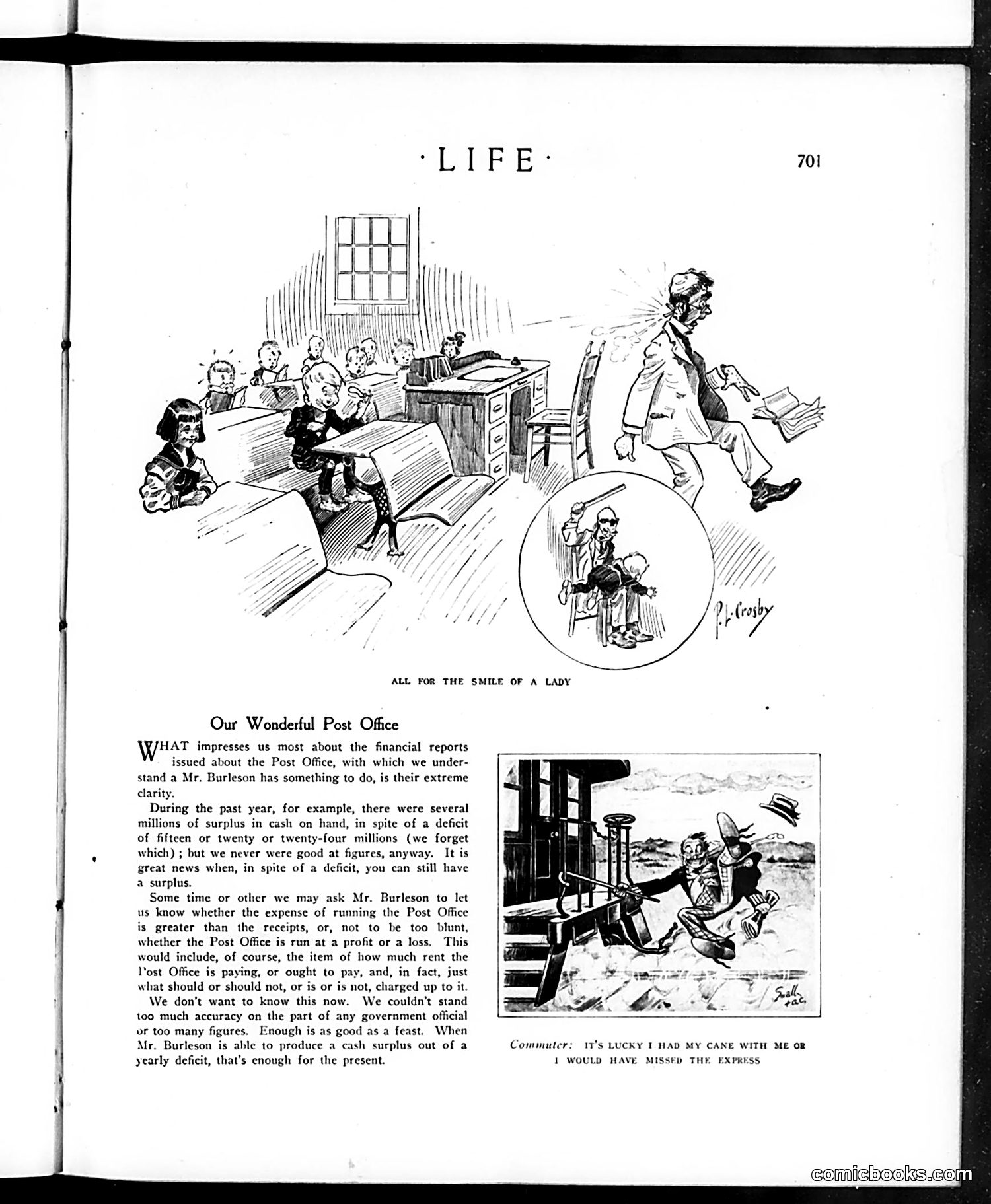
This satirical piece mocks Postmaster General Albert Burleson's financial reports on the U.S. Post Office. The main cartoon depicts a chaotic schoolroom where a teacher instructs students while maintaining obvious contradictions—likely representing the absurdity of Burleson's simultaneously reporting both a cash surplus AND a deficit of millions of dollars. The article sarcastically praises this "clarity" while highlighting the logical impossibility: how can an operation run at a deficit yet have a surplus? The writer ironically suggests they don't want "too much accuracy" from government officials, implying Burleson's figures are deliberately confusing or misleading. The secondary cartoon about a commuter and his cane appears unrelated, offering comic relief. The satire targets early 1900s Post Office mismanagement and the government's opaque accounting practices, suggesting officials like Burleson used confusing financial language to obscure poor performance.
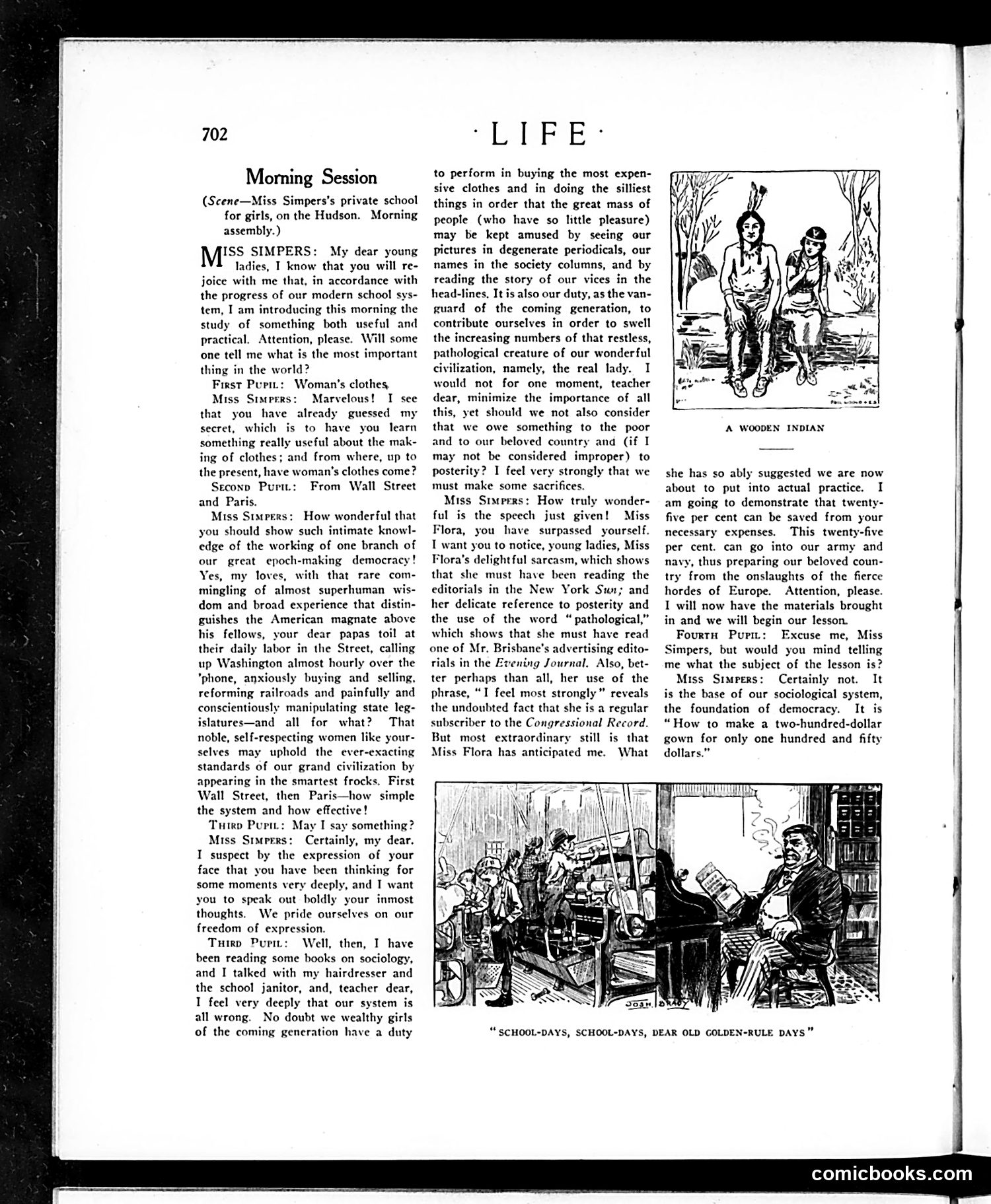
This satirical piece mocks the education of wealthy girls at an elite finishing school. Miss Simpers teaches that women's primary importance is wearing expensive clothes funded by fathers' Wall Street dealings—presented as a patriotic duty to amuse the masses through society pages and scandals. A student named Flora, however, disrupts this with sarcasm, citing sociology books and questioning whether wealthy girls owe something to the poor and posterity. Miss Simpers praises Flora's "delightful sarcasm" while ironically crediting her insights to reading the *New York Sun*, *Evening Journal*, and *Congressional Record*—implying Flora has simply absorbed progressive rhetoric without genuine understanding. The cartoon satirizes both the vapid materialism of wealthy women's education and the shallow adoption of socialist/progressive ideas by the privileged class. The humor targets upper-class hypocrisy: girls taught that consumption serves the poor, while radical critiques become mere fashionable talk.
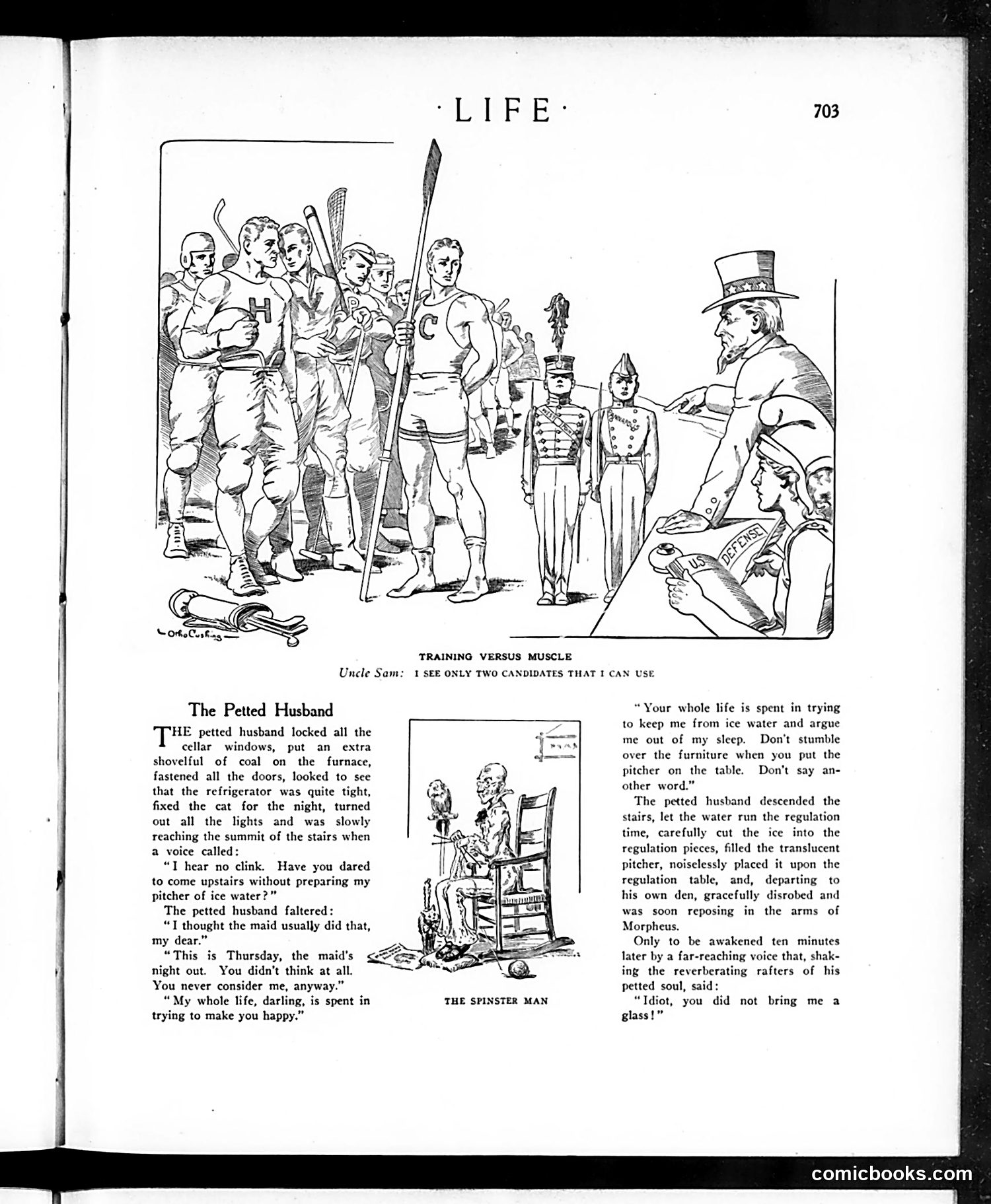
This 1910s-era *Life* magazine page satirizes changing gender dynamics through two cartoons: **"Training Versus Muscle"** (top): Uncle Sam observes military recruits, noting only two are "usable." This likely comments on American military preparedness or recruitment standards of the era. **"The Petted Husband"** (main story): The satire inverts traditional domestic roles—the wife tyrannically demands service (ice water, precise preparations) while the husband obsequiously complies, sacrificing sleep and comfort. His complaints go unheeded; she finds fault regardless (forgetting the glass). The joke targets both parties: the emasculated husband who tolerates domestic tyranny, and the demanding, unreasonable wife who exploits her power. For 1910s readers, this represented anxieties about shifting marital power as women gained social influence. The satire suggests that "petted" wives have become domestic despots, while supposedly strong men have become servile—reversing expected hierarchies in ways the magazine's audience apparently found both comic and troubling.
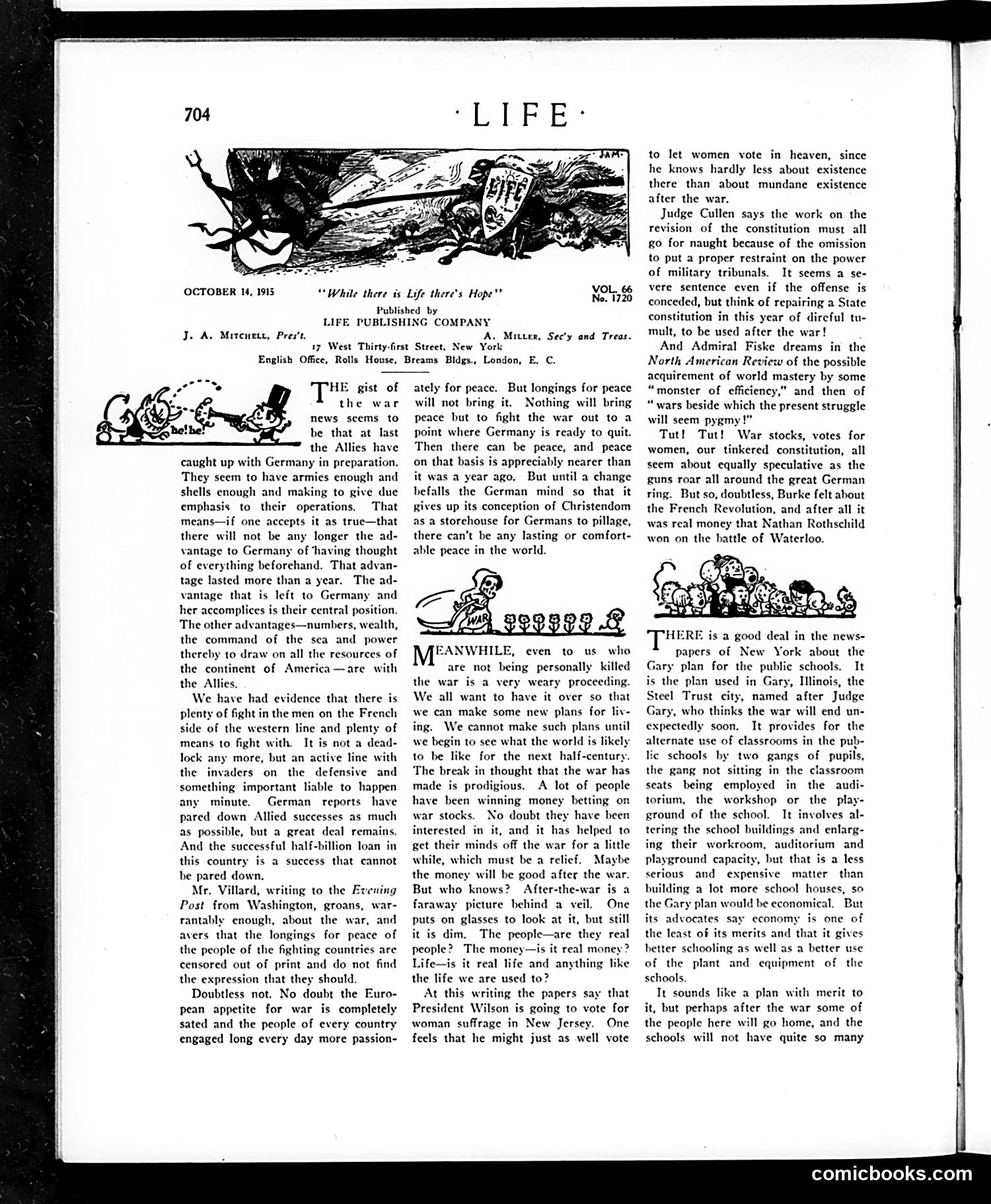
This page contains editorial commentary on World War I. The main cartoon at top depicts a devil or demon figure amid chaos—likely representing Germany or the forces of war—with the caption "While there is Life there's Hope." The text discusses the Allied forces finally matching German military preparation after over a year of disadvantage. The editor argues that lasting peace is impossible until Germany abandons its aggressive ideology; merely wishing for peace won't end the war. A secondary satirical jab targets President Wilson, mocking his support for women's suffrage in New Jersey as nearly as pointless as "letting women vote in heaven"—suggesting the post-war world will be so transformed and unknowable that current political reforms seem irrelevant. The overall tone reflects American wartime pessimism and exhaustion, while maintaining that Germany must be militarily defeated before any meaningful peace can occur.
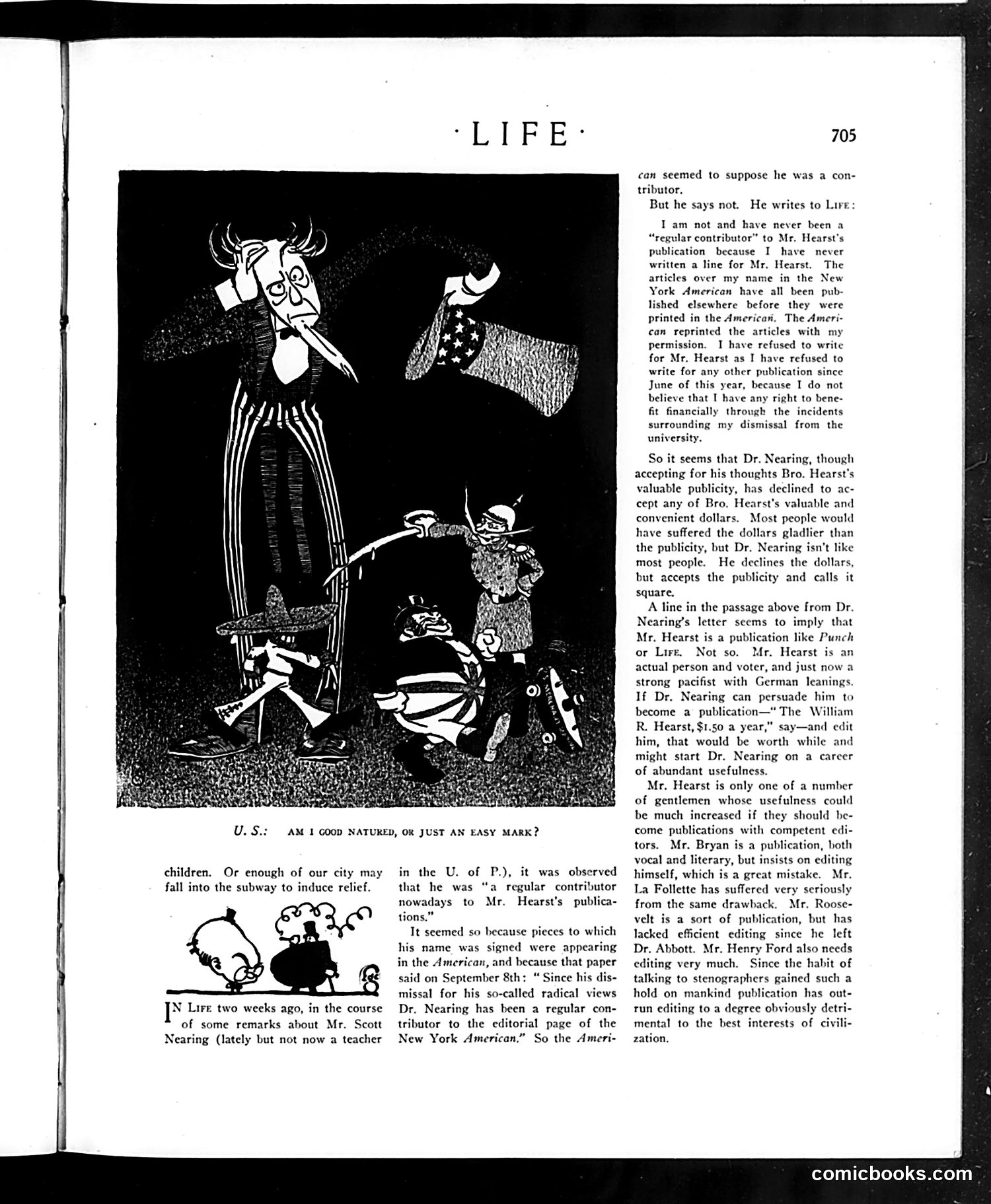
This *Life* magazine page satirizes a controversy involving **Scott Nearing**, a radical professor dismissed from the University of Pennsylvania. The *New York American* (owned by William Randolph Hearst, a powerful media mogul) claimed Nearing was a "regular contributor," but Nearing denied this—saying his articles were reprinted with permission, not commissioned, and he'd refused payment on principle, not wanting to profit from his university dismissal. The top cartoon depicts Uncle Sam (representing America) as a grotesque figure, likely mocking the hypocrisy of the situation. *Life*'s satire is multilayered: it mocks both Hearst's opportunistic use of Nearing's name for publicity and Nearing's self-righteousness. The magazine sarcastically suggests Hearst should become "a publication" himself with proper editing—a dig at powerful men (Hearst, Bryan, Roosevelt, Ford) who control media empires but lack objective editorial oversight, corrupting public discourse.
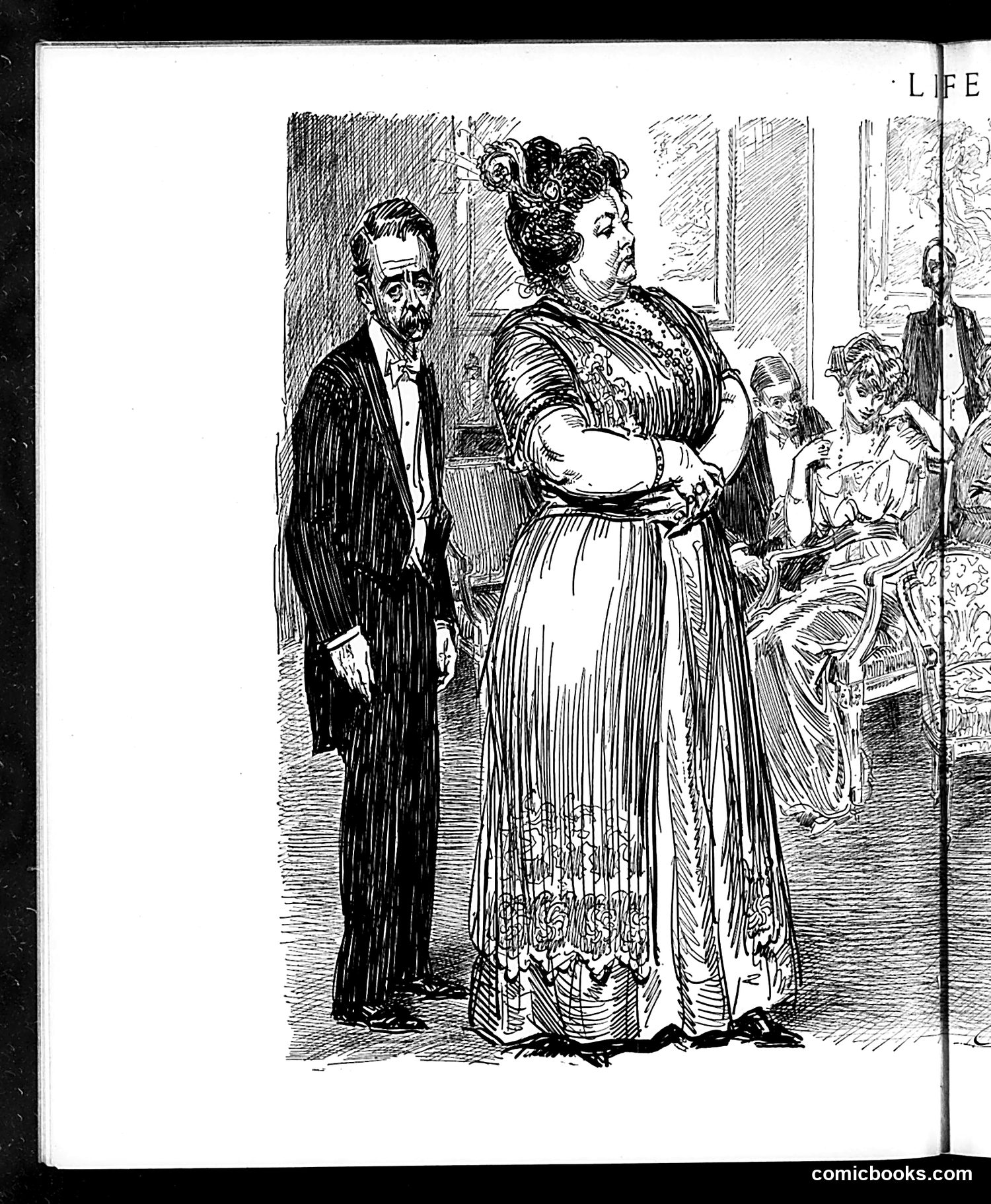
This is a satirical sketch from *Life* magazine showing a social scene. A formally dressed man in a pinstriped suit stands beside a stout, elaborately dressed woman wearing an ornate gown and jewels. She appears to be the focal point, positioned prominently in the center of what seems to be a formal gathering or reception, with other figures visible in the background. The satire likely targets upper-class social pretension and excessive materialism—common themes in *Life*'s humor. The woman's oversized figure and showy attire, contrasted with the man's more subdued appearance, suggests mockery of nouveau riche affectation or conspicuous consumption among the wealthy. However, without visible text identifying specific figures or dates, the precise social commentary remains unclear. The artistic style is consistent with early-to-mid 20th century editorial illustration.
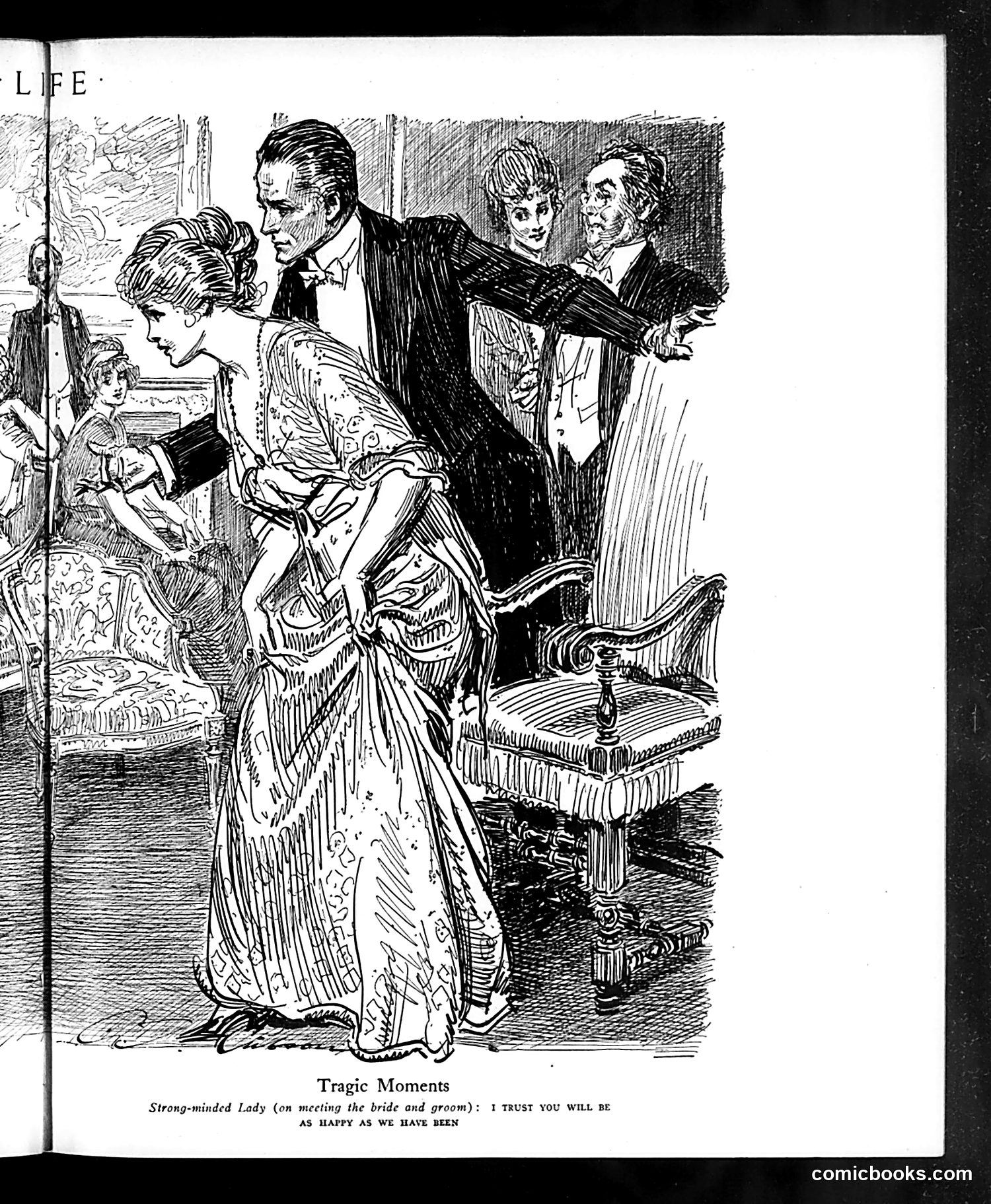
This cartoon satirizes a "strong-minded lady"—likely a feminist or women's rights advocate of the early 20th century—offering a wedding blessing with dark irony. Her comment "I trust you will be as happy as we have been" implies her own marriage was unhappy, contradicting the social expectation that newlyweds should receive encouraging wishes. The joke targets the emerging "New Woman" figure: independent-minded women who challenged conventional femininity and domestic roles. By having her inadvertently curse the couple with her own marital misery rather than offer proper congratulations, the cartoon mocks both her social awkwardness and suggests that pursuing women's independence leads to unhappy marriages. The title "Tragic Moments" underscores this cynical view of matrimony.
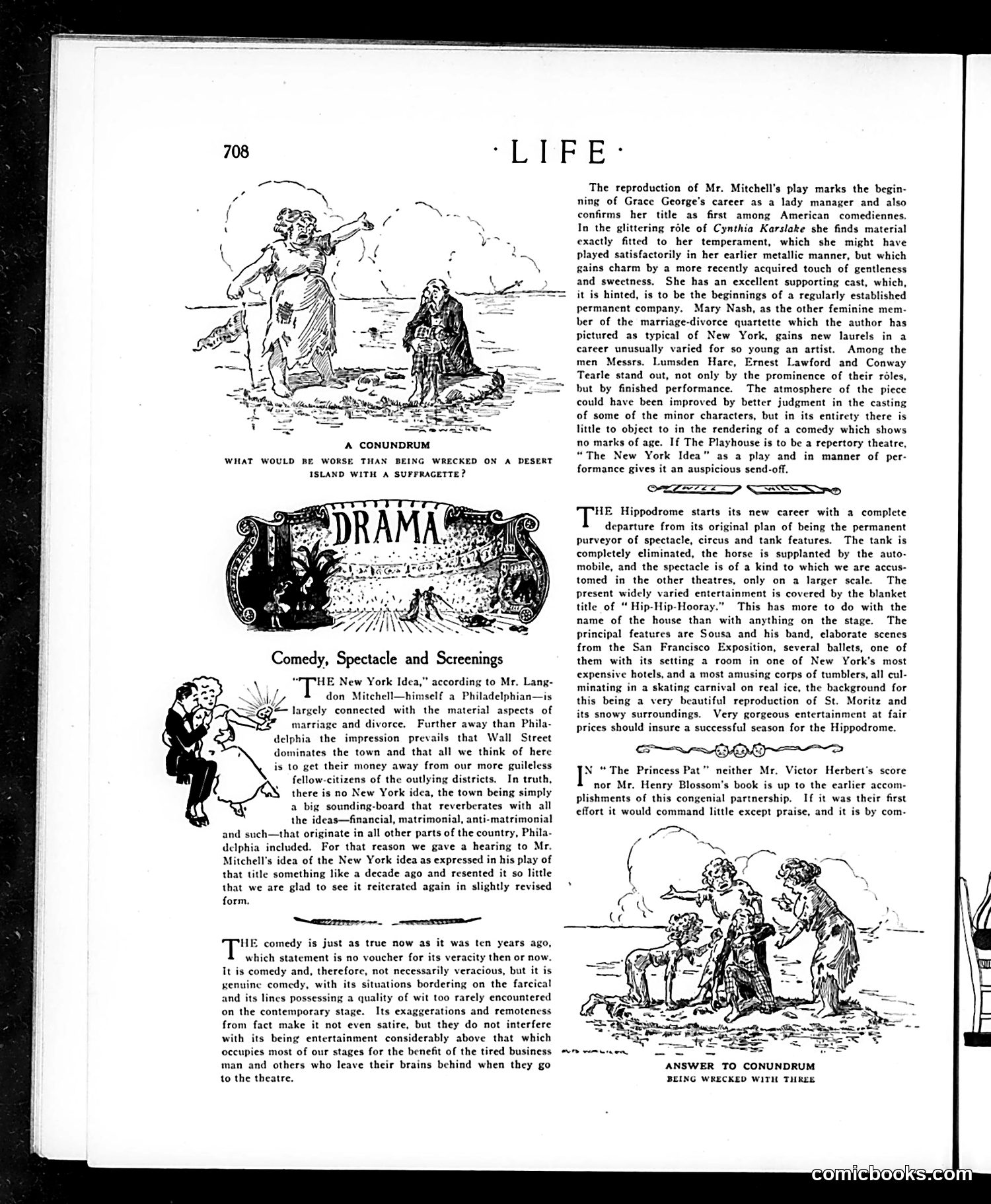
## The Conundrum Cartoon The top illustration presents a visual joke about **suffragettes**—women fighting for voting rights. The cartoon asks: "What would be worse than being wrecked on a desert island with a suffragette?" The answer (shown below) depicts three figures on an island, suggesting the punchline involves the woman's aggressive or domineering behavior. This reflects early-20th-century anti-suffrage sentiment. Opponents of women's voting rights often caricatured suffragettes as combative, emasculating, or otherwise socially disruptive. The "conundrum" format was common satirical fare in *Life*, which frequently mocked the women's suffrage movement through mockery of suffragettes' supposed personality flaws rather than engaging their actual arguments. The cartoon reveals period attitudes: voting rights for women were presented as a subject for ridicule rather than serious political debate.
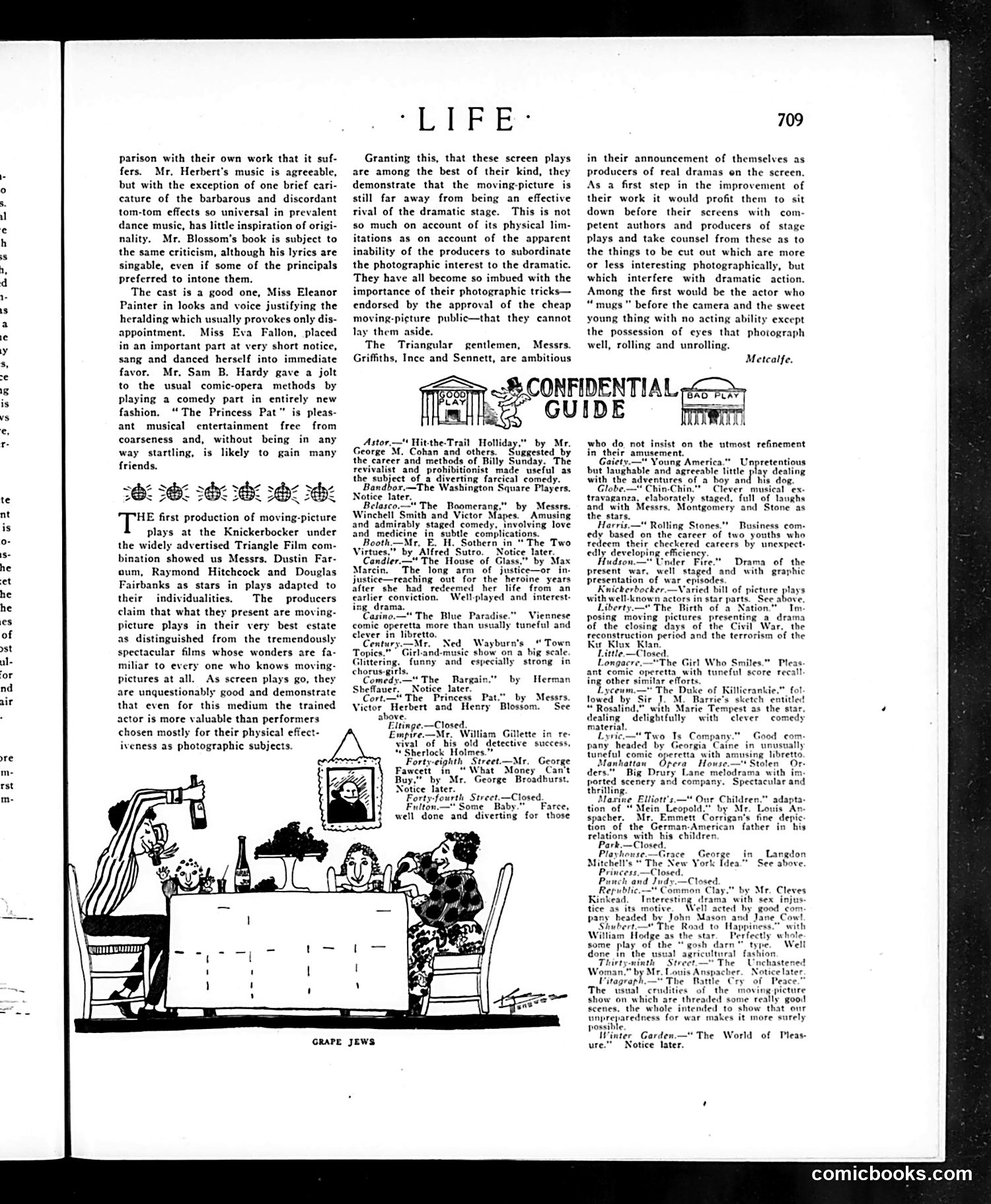
This page primarily contains theater reviews rather than political cartoons. The main illustrated element is labeled "GRAPE JEWS" — a cartoon showing a figure at a movie projector watching performers on a screen, satirizing early cinema. The page's central argument concerns the emerging film industry's limitations compared to stage drama. The critic argues that while Triangle Film Company productions (starring Dustin Farnum, Raymond Hitchcock, and Douglas Fairbanks) represent "moving-picture plays in their very best estate," cinema remains inferior to theater. The critique focuses on producers' obsession with "photographic tricks" and visual spectacle over dramatic substance—they cannot "subordinate the photographic interest to the dramatic." The reviews discuss Broadway productions, evaluating actors like Eleanor Painter and Sam B. Hardy favorably for bringing theatrical discipline to new entertainment forms. The "Grape Jews" cartoon appears to satirize audience consumption of cinema's visual entertainment, though the specific meaning of that title remains unclear from the visible context.
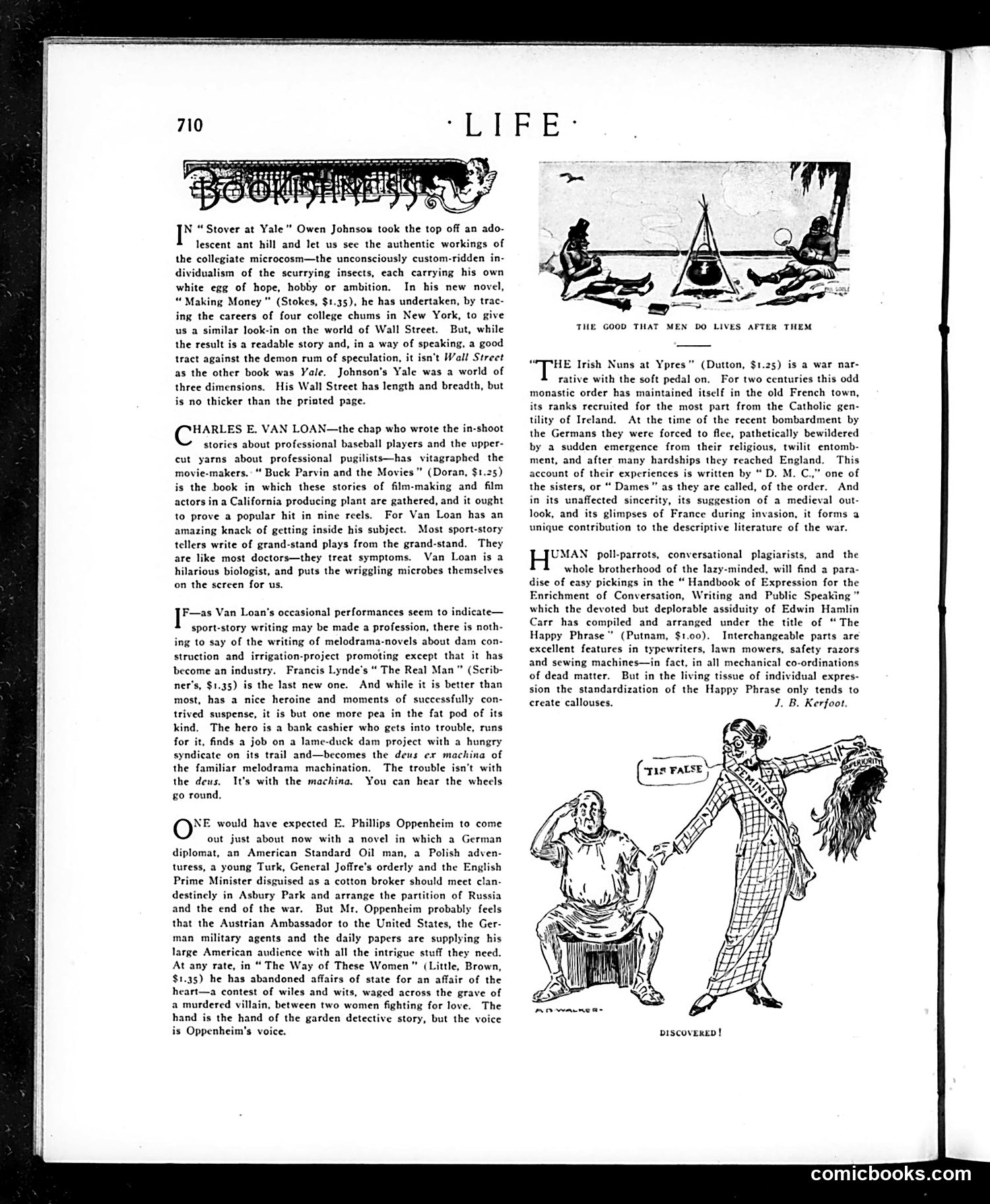
This page from *Life* magazine contains two cartoons mocking a charlatan or fraud. The larger cartoon shows a man being exposed—his false beard is being pulled away, revealing his deception. The smaller figure represents the con artist caught red-handed. The satire targets someone engaged in deliberate deception, likely a con man, charlatan, or impostor. The word "DISCOVERED!" emphasizes the moment of exposure. The cartoonist ridicules not just the fraud itself but the absurdity of the disguise—the exaggerated false beard suggests the deception was obvious to anyone paying attention. Without additional context from the magazine's cover or surrounding advertisements, the specific target remains unclear, though the cartoons appear designed to mock public figures or widespread frauds of the era. The humor relies on the universal satisfaction of exposing fakery.
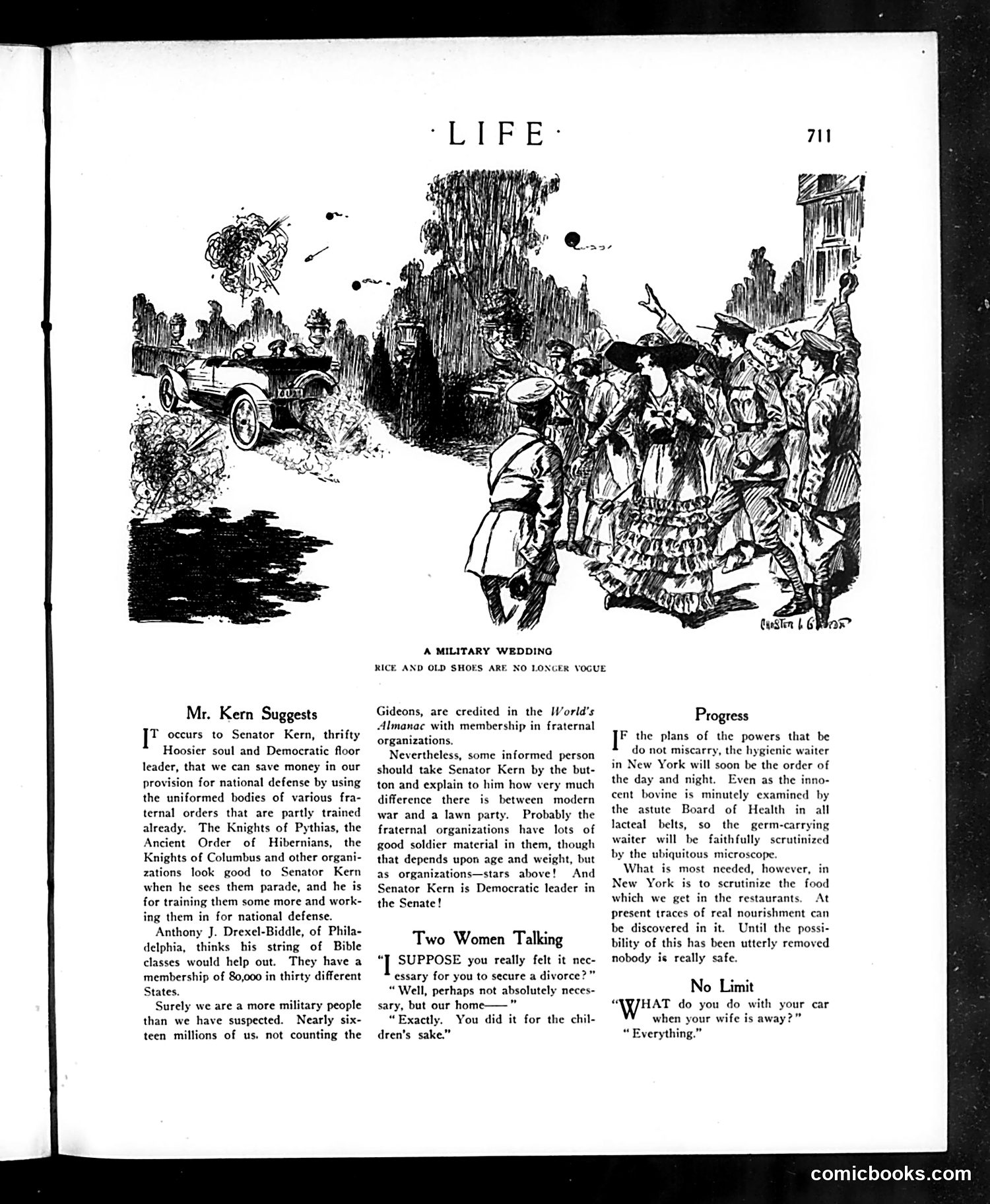
This page contains several satirical pieces mocking American social and political absurdities circa the 1910s-1920s. **"Mr. Kern Suggests"** ridicules Senator John Worth Kern's proposal to use uniformed fraternal organizations (Knights of Pythias, Knights of Columbus, etc.) for national defense training. The satire argues these social clubs—numbering roughly 16 million members—are fundamentally unsuited for modern warfare, conflating "lawn parties" with military preparedness. The cartoon depicts a lavish society wedding, suggesting the frivolous nature of such organizations. **"Two Women Talking"** sarcastically comments on divorce rationalization, where a woman claims she divorced "for the children's sake" despite admitting her home life wasn't truly intolerable. **"Progress"** ironically celebrates proposals to hygienically inspect restaurant waiters for germs while ignoring that the actual food served in New York restaurants contains no real nourishment whatsoever. **"No Limit"** is a brief joke about marital freedom—a husband claims he does "everything" with his car when his wife is away.
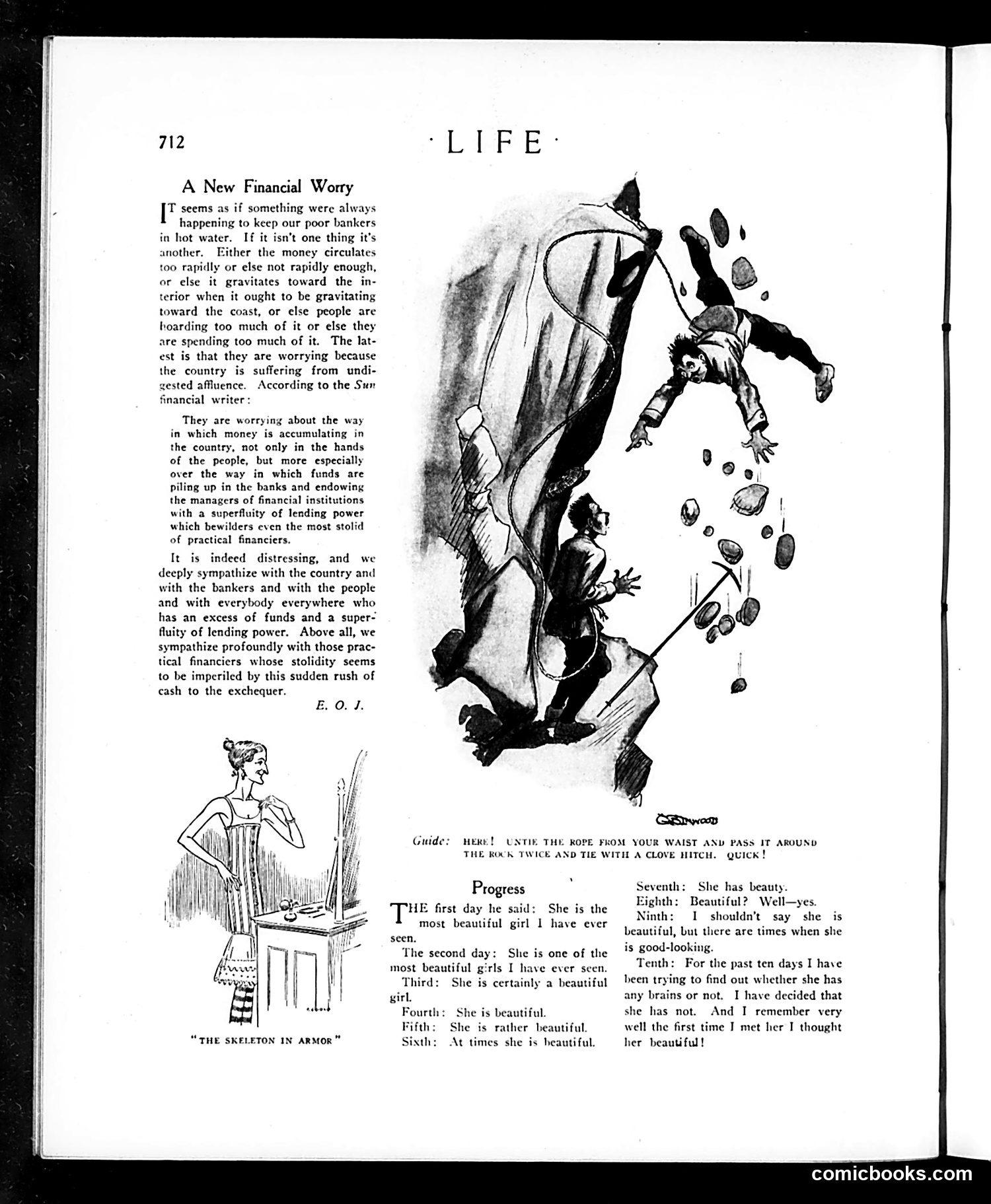
**Main Cartoon: "A New Financial Worry"** The large illustration depicts bankers being overwhelmed by cascading money—coins and bills pouring down upon them. The satire mocks bankers' perpetual complaints: they worry money circulates too fast or too slow, concentrates in wrong regions, or people hoard/spend excessively. Now they're distressed by "undigested affluence"—too much money accumulating in banks, giving financial managers confusing excess lending power. The cartoon's irony is sharp: it ridicules bankers for complaining about *having too much money*, treating this as a genuine hardship worthy of sympathy. **Secondary Content:** "The Skeleton in Armor" shows a woman being dressed, accompanying a humorous "Progress" piece about a man's changing assessment of a woman's beauty over ten days—from "most beautiful" to "at times she is beautiful"—suggesting disillusionment or shifting romantic perception. The page satirizes both financial anxiety and human nature through visual and textual humor typical of Life's social commentary.
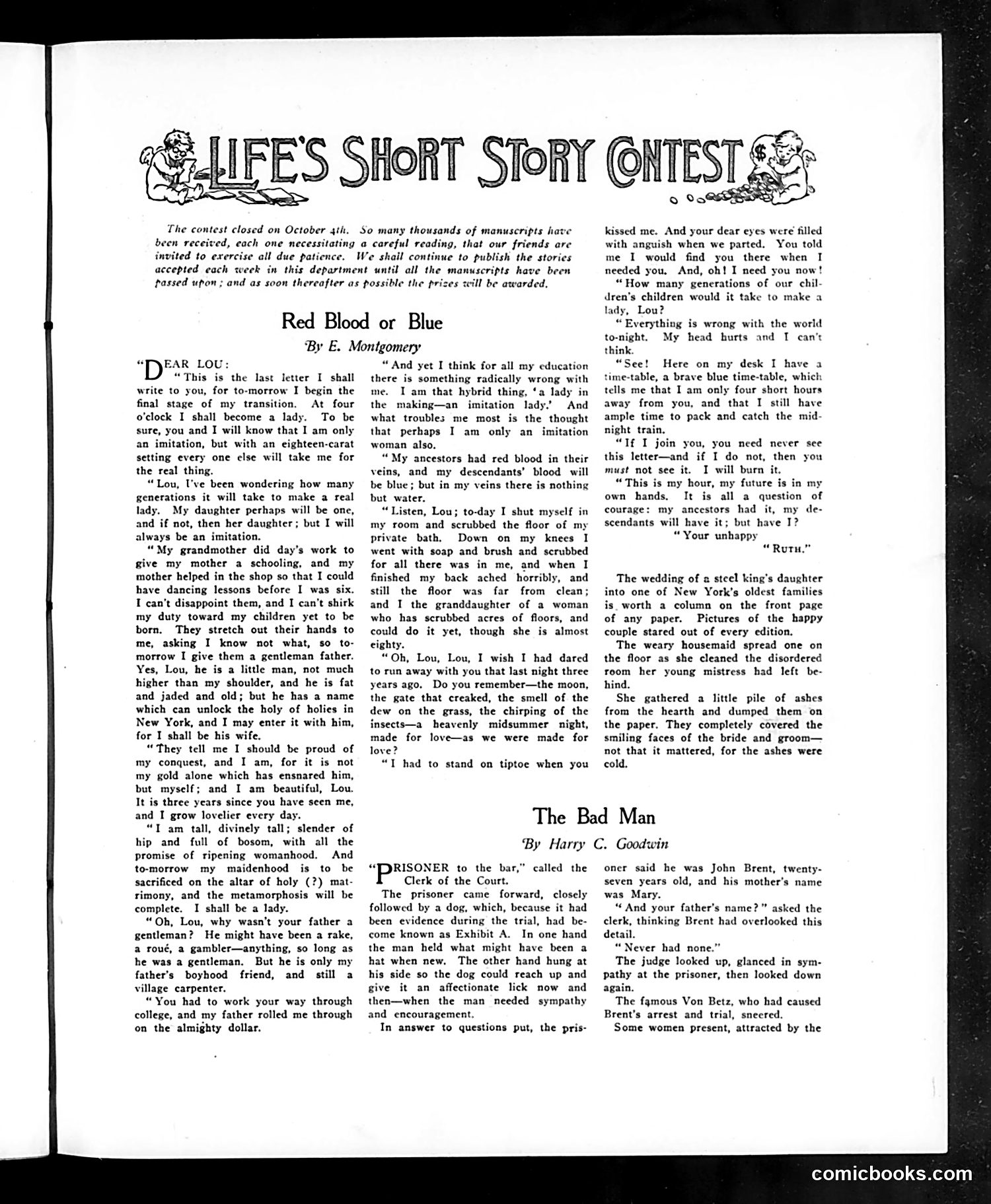
This page presents **two literary submissions** to Life magazine's short story contest, not political cartoons. **"Red Blood or Blue" by E. Montgomery:** A woman writes to her lover Lou, confessing she's marrying a wealthy but physically unattractive gentleman tomorrow—not for love, but for social status and to provide her future children with aristocratic legitimacy. She's conflicted: her working-class grandmother and mother sacrificed so she could ascend socially, yet she feels like a fraud—"an imitation lady" with "nothing but water" in her veins instead of the "blue blood" of true aristocracy. The title's tension reflects her anxiety about this class transition. **"The Bad Man" by Harry C. Goodwin:** Begins a story about a prisoner awaiting trial, apparently for serious crimes, with a judge and courtroom observers present. Both stories explore **early 20th-century American class anxieties**—specifically, social mobility's psychological cost and the perceived authenticity gap between inherited and achieved status. The satire targets pretension and the hollow nature of climbing social hierarchies.
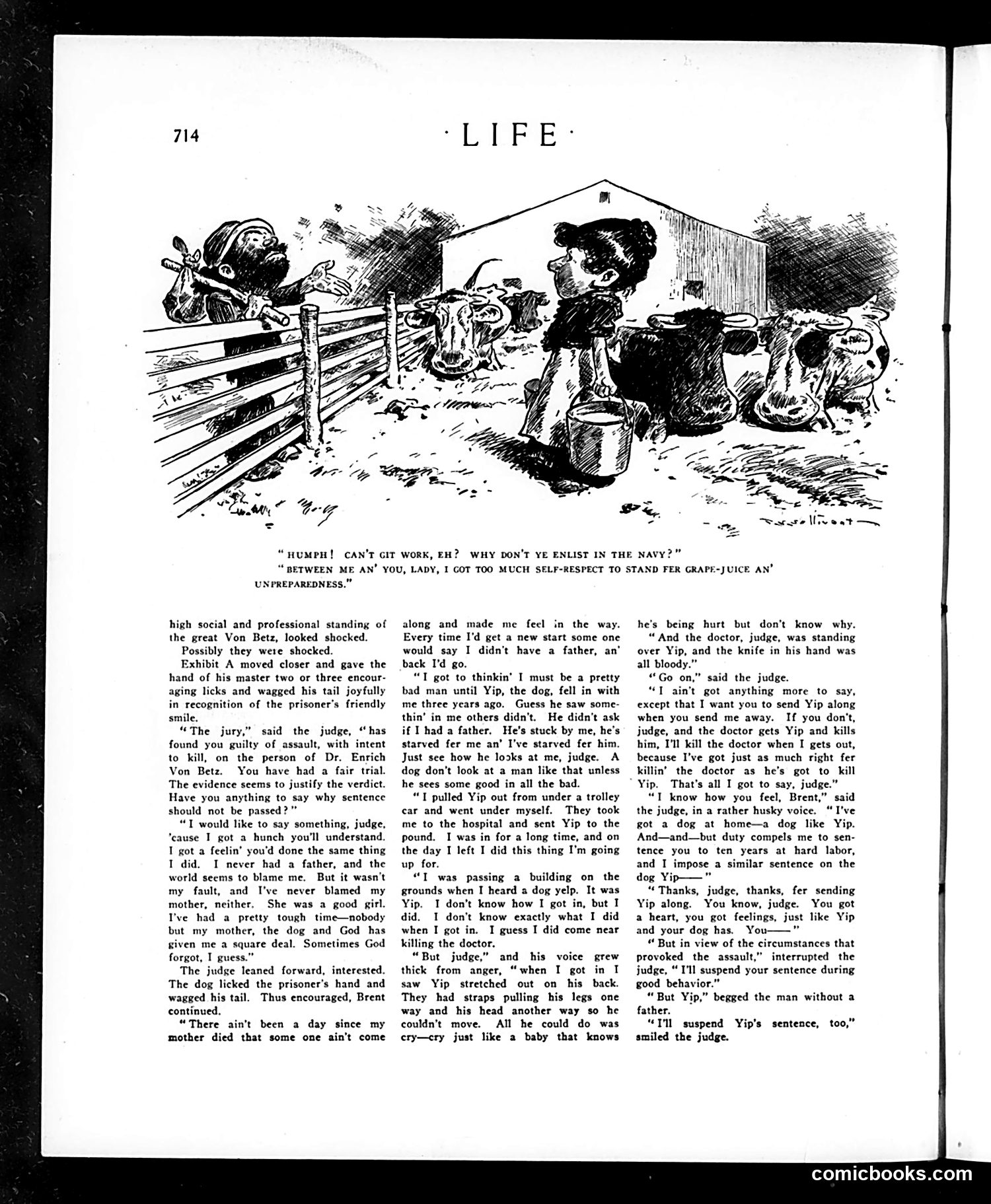
## The Cartoon (Top) The illustration depicts a jobless man refusing naval recruitment from a woman, claiming he has "too much self-respect to stand fer grape-juice an' unpreparedness." This references the temperance/prohibition movement and criticizes preparedness initiatives (likely pre-WWI military buildup). The satire mocks both unemployed men's pride and government recruitment messaging. ## The Story (Main Text) The narrative describes a man convicted of assaulting Dr. Enrich Von Betz—a prominent German-American figure (the surname suggests German heritage). The defendant's crime stems from discovering the doctor experimenting on his dog "Yip" using restraints. His emotional plea emphasizes that only his dog showed him unconditional kindness and respect. The judge, moved by the story and his own dog-ownership, suspends the sentence, implying sympathy for violence against a German-American during a period of rising anti-German sentiment. The German name and the doctor's apparent cruelty may reflect broader wartime anxieties about "foreign" elements.
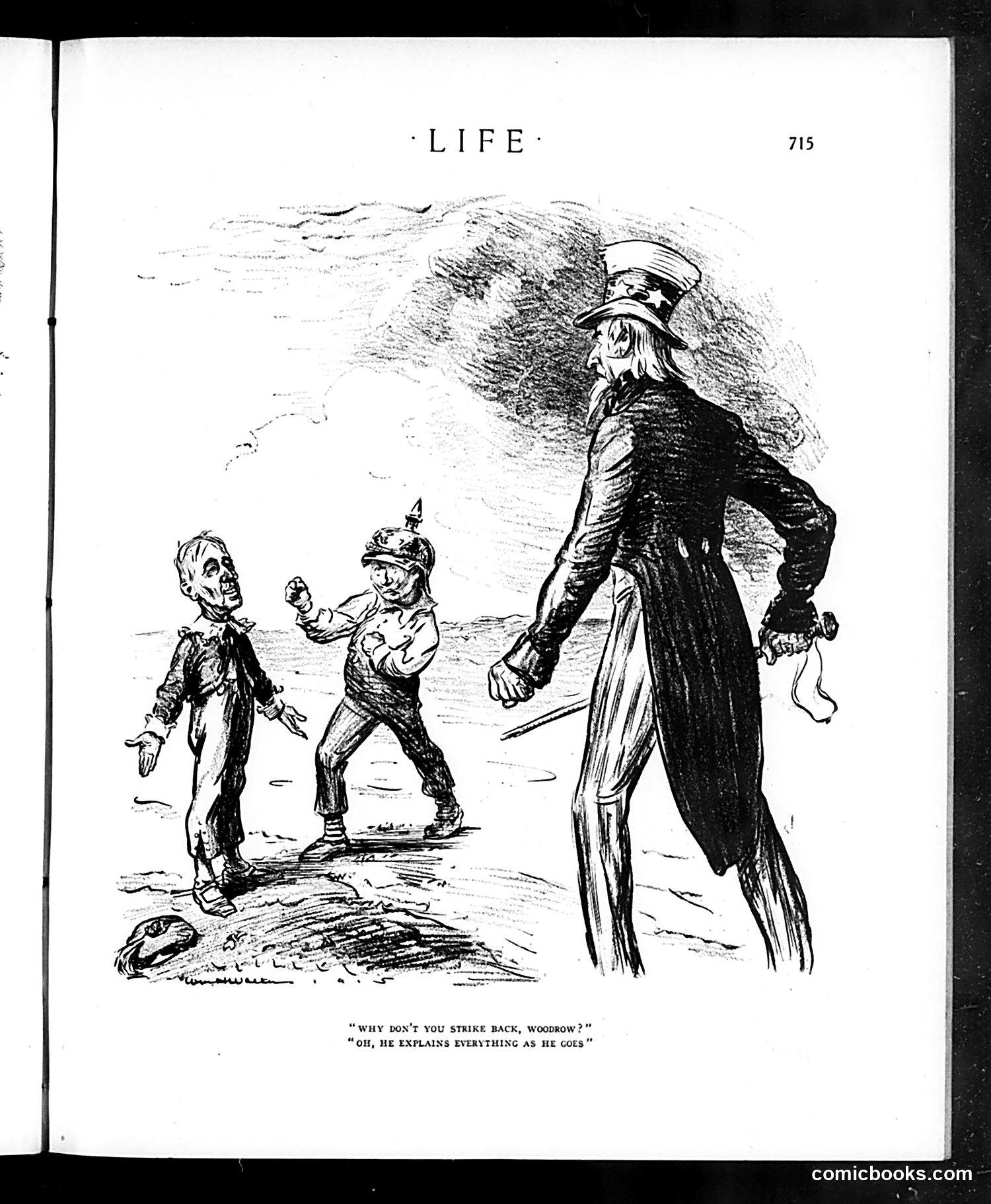
This satirical cartoon from *Life* magazine depicts a figure labeled "Woodrow" (clearly President Woodrow Wilson) being physically attacked or confronted by two aggressive figures while a tall gentleman in formal dress with a top hat stands nearby. The caption reveals the joke's point: when asked why "Woodrow" doesn't fight back, the response is "Oh, he explains everything as he goes"—satirizing Wilson's tendency to intellectualize or verbally justify his positions rather than take decisive action. The cartoon mocks Wilson as passive and overly philosophical when faced with opposition or criticism. The aggressive figures likely represent political opponents or critics, while Wilson's passivity through explanation becomes the target of ridicule.
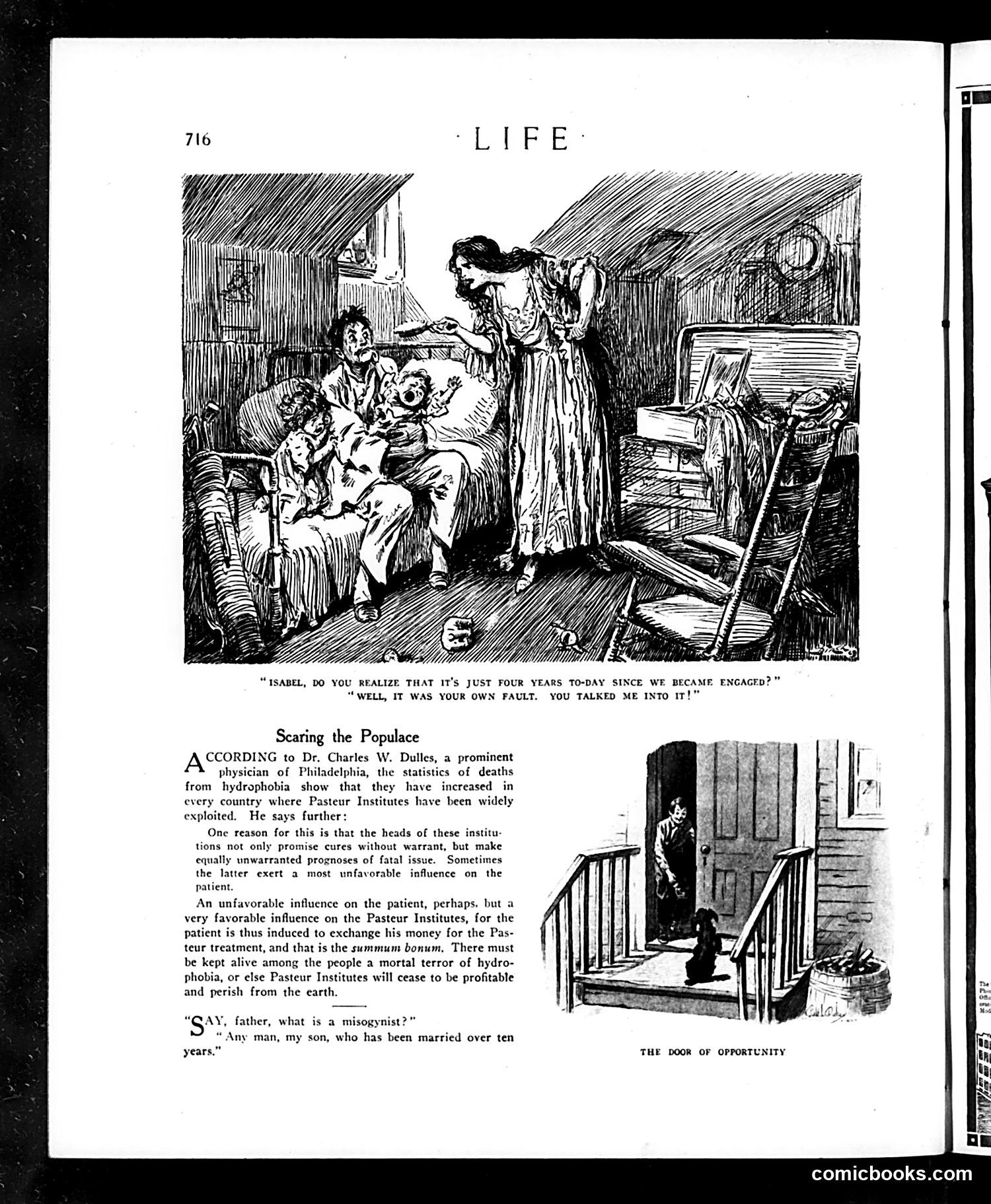
This Life magazine page contains two satirical pieces: **Top cartoon**: A domestic dispute where a woman (Isabel) blames her fiancé for their four-year engagement delay, saying "you talked me into it"—a joke about male persuasiveness in romance backfiring. **Main article ("Scaring the Populace")**: Critiques Pasteur Institutes for exploiting public fear of rabies. Dr. Dulles argues these institutions deliberately amplify hydrophobia panic to drum up paying patients, making unwarranted cure promises and dire prognoses. The satire suggests the institutes profit from fear itself rather than genuine treatment. **Bottom joke**: Defines a "misogynist" as any man married over ten years—typical period cynicism about marriage. The Pasteur Institute critique reflects genuine late-19th/early-20th century tension between emerging scientific medicine and commercial exploitation of medical fears.
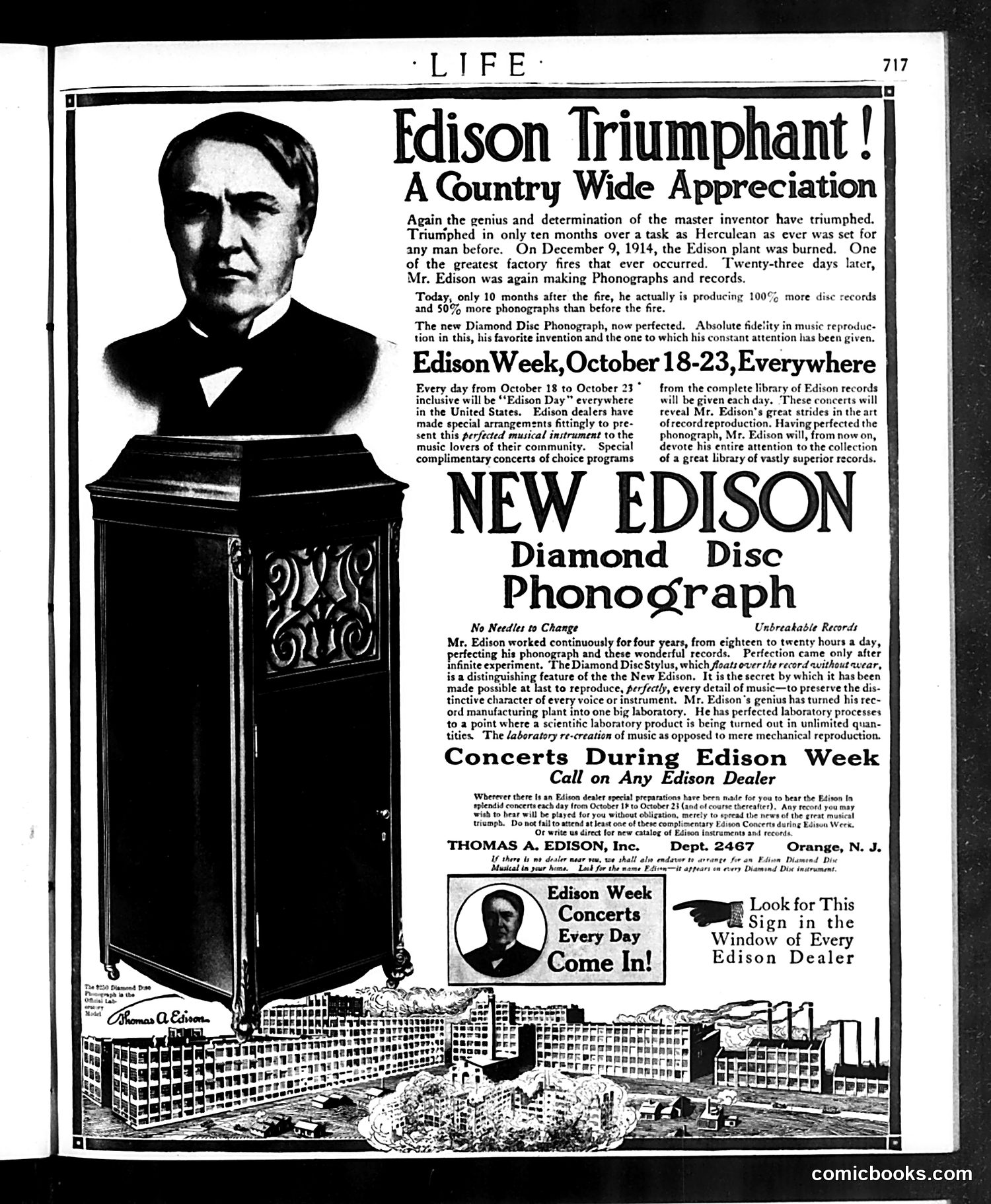
This is primarily **advertising, not satire**—a full-page promotional piece for Thomas Edison's phonograph company, not a political cartoon. The content celebrates Edison's recovery from a factory fire that destroyed his plant on December 9, 1914. The narrative emphasizes his determination: within 23 days he resumed production, and within 10 months he was manufacturing **100% more records and 50% more phonographs** than before the fire. The advertisement promotes Edison's newly perfected **Diamond Disc Phonograph**, featuring a needle-less stylus that allegedly preserves sound fidelity without wear. The page announces "Edison Week" (October 18-23), when dealers nationwide would host concerts showcasing the improved technology. The portrait shows Edison as a dignified figure of American industrial genius. The accompanying factory illustration depicts Edison's manufacturing plant as a beacon of American progress and ingenuity. This reflects early-20th-century American values celebrating industrial achievement and entrepreneurial resilience rather than satirizing them.
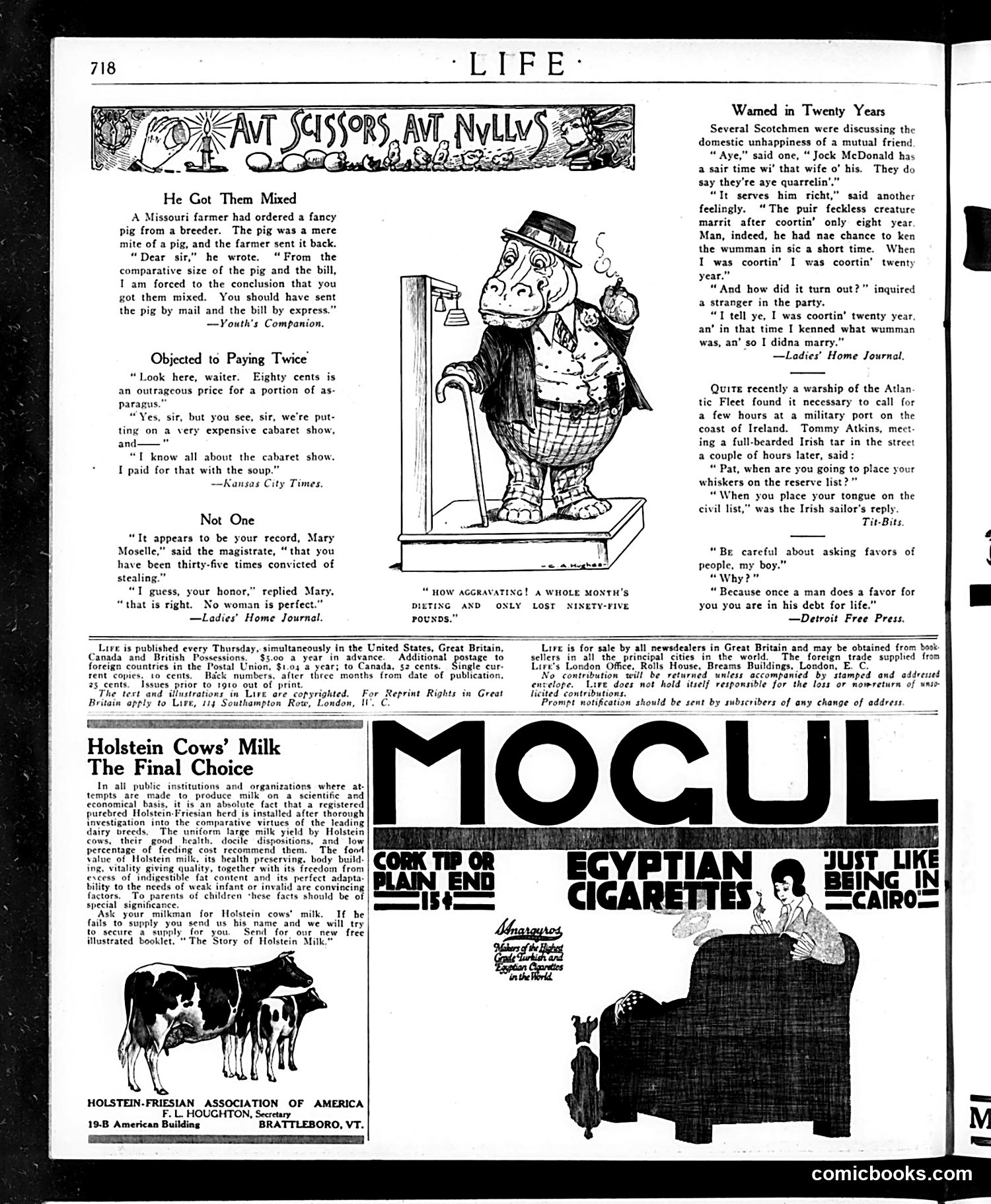
This page contains several brief humorous anecdotes typical of Life's satirical format: **"He Got Them Mixed"** jokes about a farmer receiving an undersized pig with an oversized bill, suggesting the breeder confused which should be mailed and which express-shipped. **"Objected to Paying Twice"** satirizes expensive cabaret entertainment, where a waiter charges high prices for food while claiming expensive entertainment justifies the cost—the diner replies he already paid for the "show" with his soup course. **"Not One"** presents a woman convicted 35 times for theft claiming "no woman is perfect"—dark humor about repeat criminal behavior. The **cartoon illustration** (center) shows an anthropomorphic pig in formal dress on a pedestal, likely accompanying "He Got Them Mixed." The remaining text includes brief jokes about Scottish courtship customs and military banter between British and Irish sailors, representing period ethnic humor. The page is primarily **humorous short-form content** rather than political satire, representing Life's role as a general satirical weekly publication.
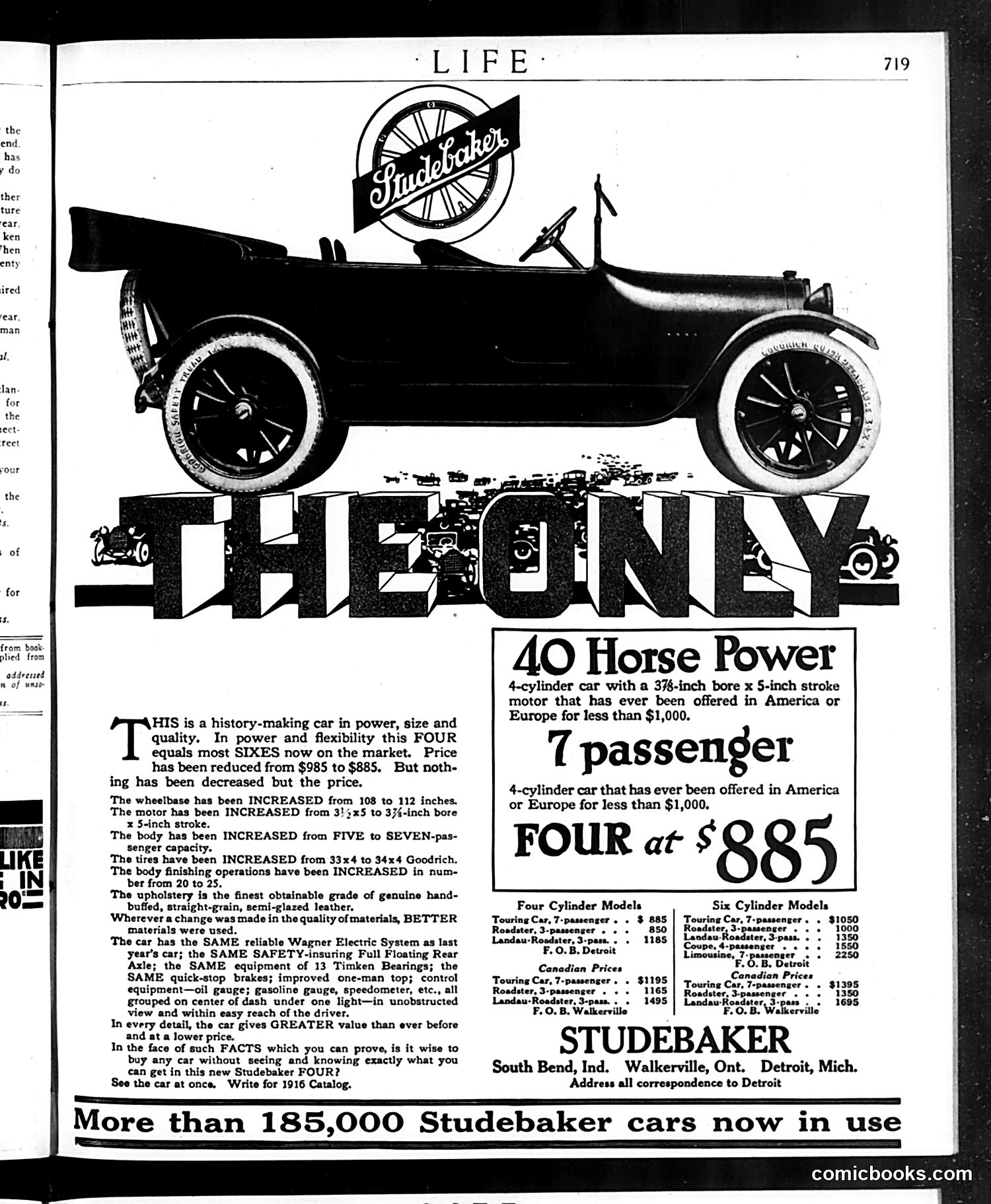
This is primarily a **car advertisement**, not political satire. The Studebaker company is marketing their "Four" model—a 4-cylinder automobile priced at $885. The ad's rhetorical strategy emphasizes value through paradox: the price has *decreased* from $985 to $885, yet virtually everything else has *increased*—wheelbase, engine bore, passenger capacity, tire size, and upholstery quality. The repetitive use of "INCREASED" contrasts with the lowered price to argue consumers get more for less. The imagery shows a side-profile silhouette of the car beneath the Studebaker wheel logo. The ad positions this four-cylinder vehicle as competitive with six-cylinder models, claiming it matches their power while costing significantly less. The tagline "More than 185,000 Studebaker cars now in use" appeals to popularity as proof of reliability. This represents early 1910s automotive marketing—emphasizing technical specs and value proposition rather than lifestyle branding.
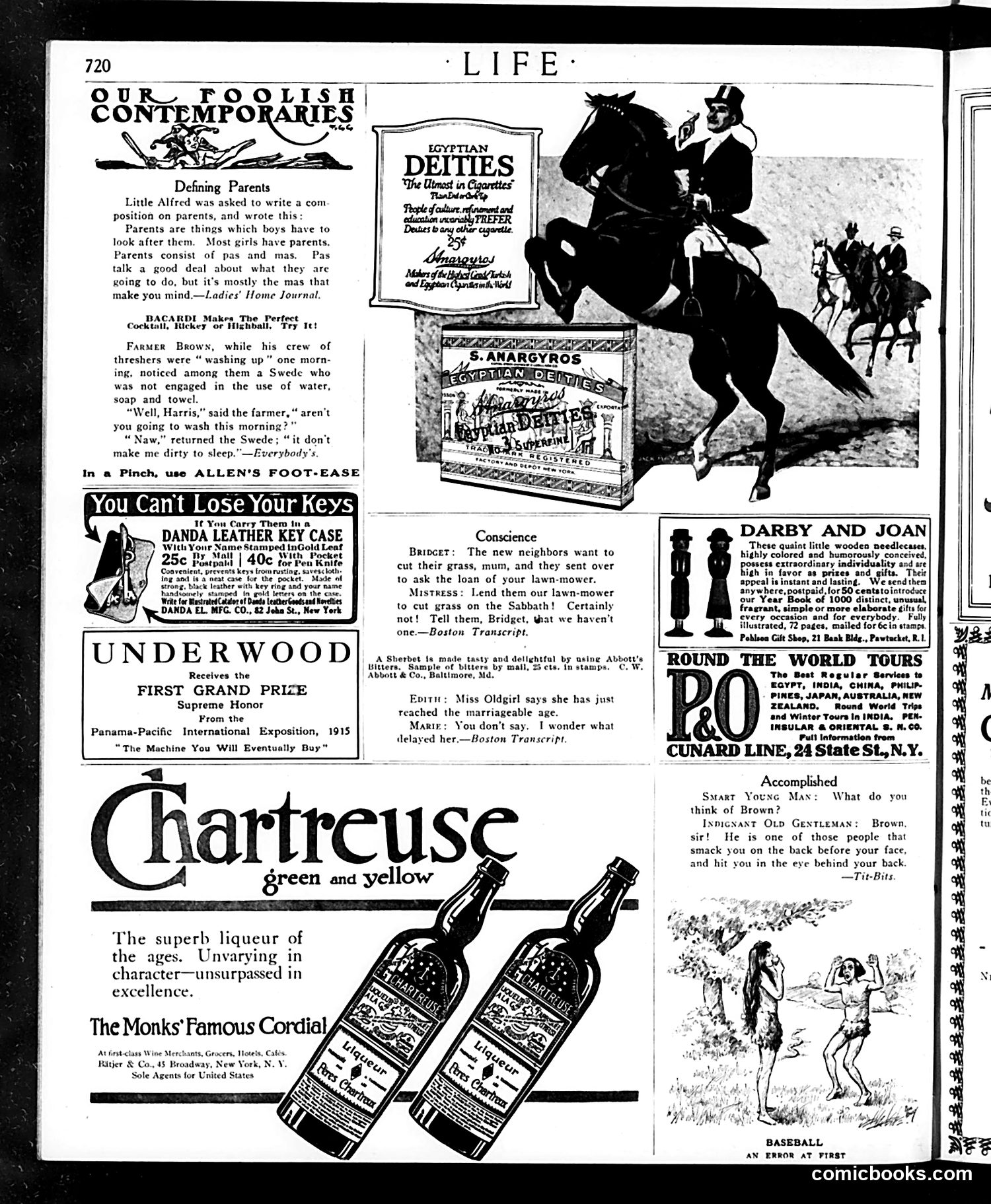
This is primarily an **advertising and humor page** from Life magazine, not a political cartoon. The page contains several brief jokes and product advertisements typical of early 20th-century magazines. The humor pieces include: - **"Defining Parents"**: A child's naive essay where he defines parents as things boys "look after," noting fathers talk about what they'll do but mothers actually enforce discipline. - **"Conscience"**: A maid asks to borrow her mistress's lawnmower; the mistress refuses because cutting grass on the Sabbath violates religious observance—a dig at Victorian religious propriety. - **"Accomplished"**: A joke about an untrustworthy person who's friendly to your face but backstabs you. The majority of the page features **period advertisements** for liqueur (Chartreuse), leather goods, foot powder, and world travel services—standard commercial content of the era. The bottom cartoon ("Baseball: An Error at First") appears to be a visual gag, though details are unclear from this reproduction.
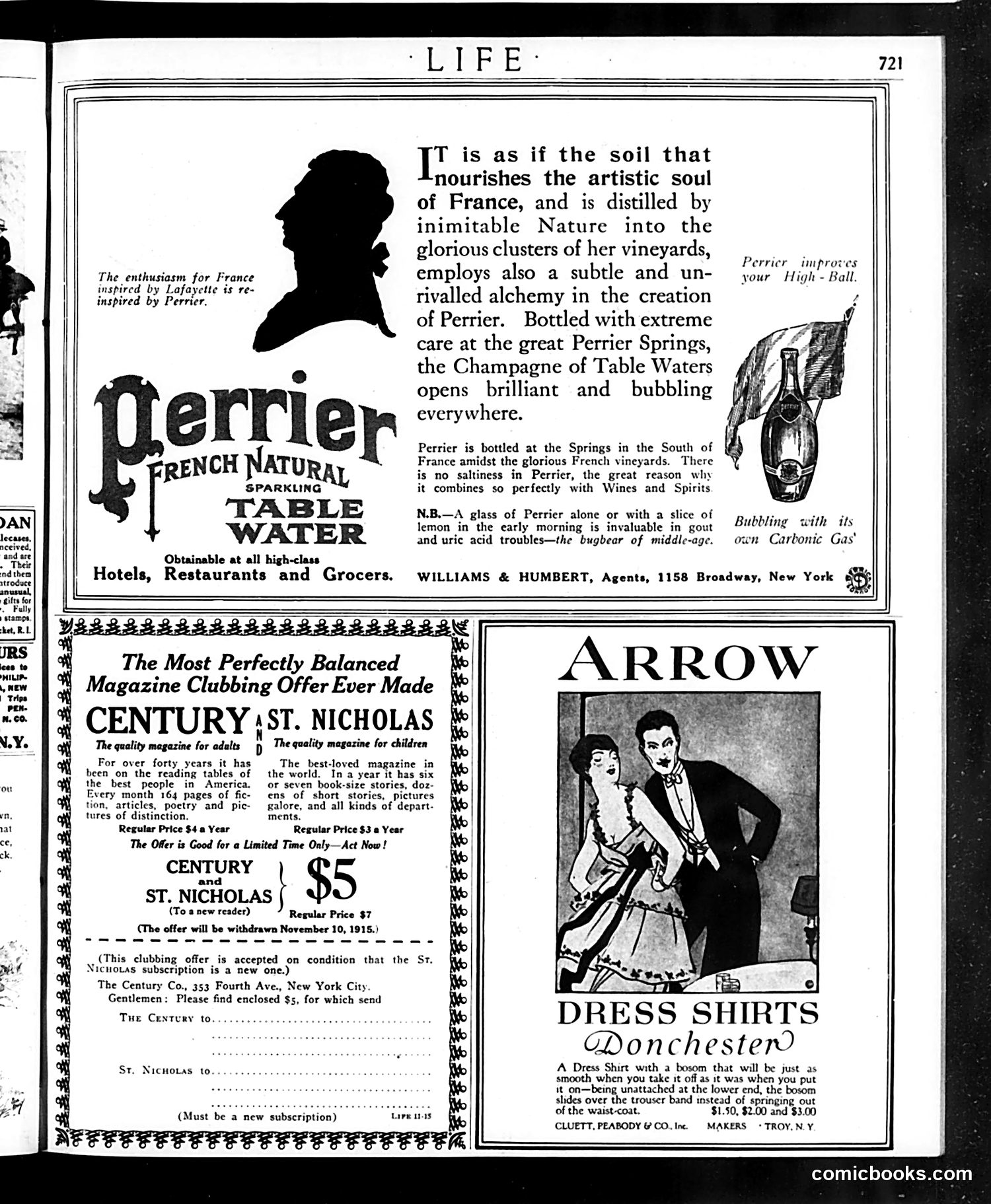
This page is primarily **advertising**, not political satire. It contains three major ads: 1. **Perrier Water** (top): A French sparkling water ad featuring a silhouette portrait, emphasizing the product's French origins and mineral purity. The text poetically connects it to French vineyards and claims it aids digestion (particularly for gout and uric acid—"the bugbear of middle-age"). 2. **Century/St. Nicholas Magazine Bundle** (bottom left): A subscription offer combining two magazines—one for adults, one for children—at a discounted rate, with an expiration date of November 10, 1915. 3. **Arrow Dress Shirts** (bottom right): An advertisement for "Donchester" dress shirts featuring an illustration of a couple, highlighting an innovative detachable bosom that won't wrinkle or spring out. The page reflects early 20th-century consumer culture and advertising aesthetics, with no apparent political cartoon or satire present.
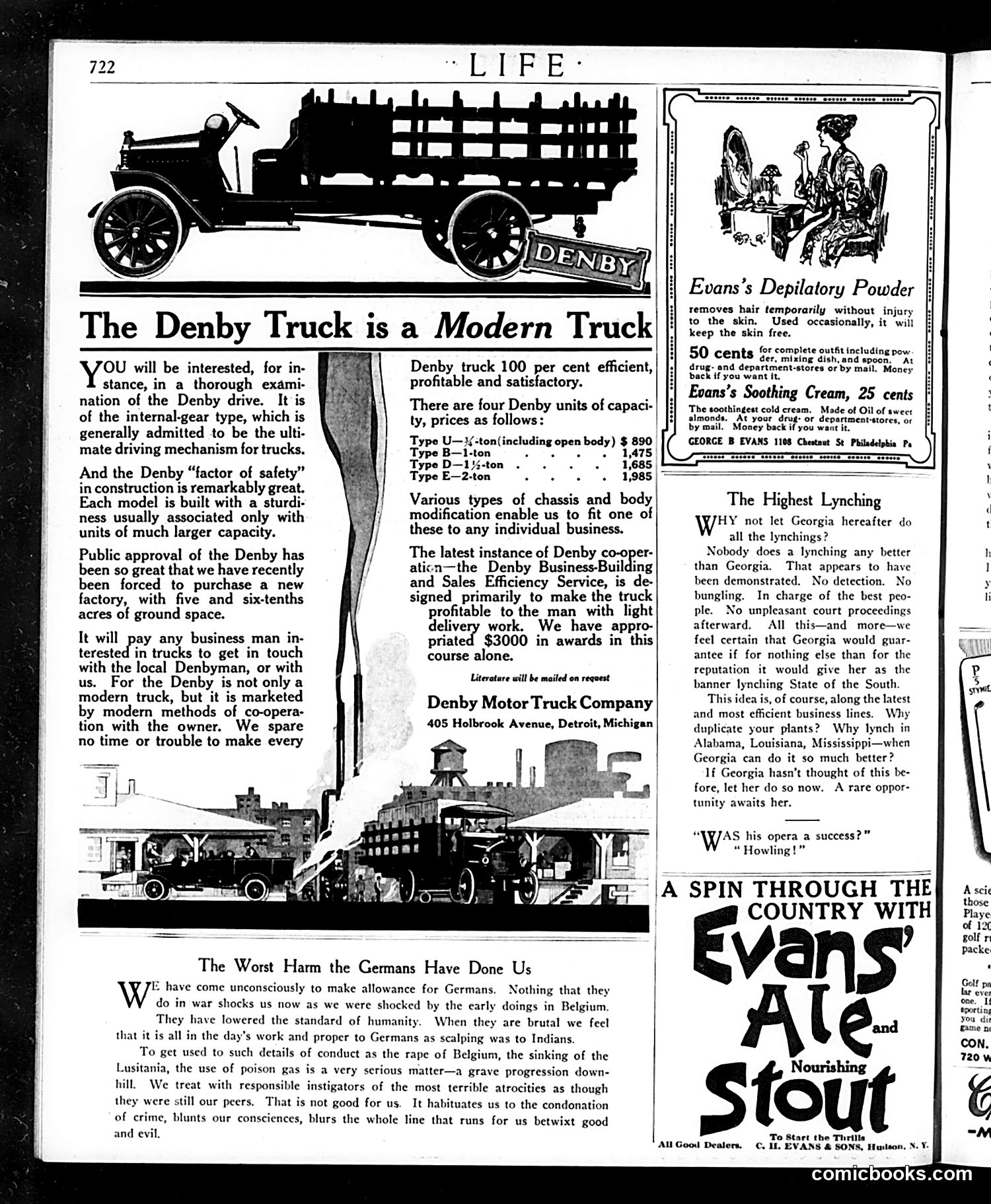
This page contains primarily **advertisements** (Denby trucks, Evans's beauty products, Evans's Ale) interspersed with **two satirical editorial pieces**. ## "The Worst Harm the Germans Have Done Us" This is a serious editorial critique, likely from **World War I era** (references to Belgium atrocities, Lusitania sinking, poison gas). The satire argues that repeated exposure to German brutality has morally corrupted American society—we've become desensitized to war crimes and now treat perpetrators as "peers" rather than criminals. The piece warns this habituation to atrocity "blunts our consciences." ## "The Highest Lynching" This is **viciously sarcastic** commentary on racial violence in the American South, specifically Georgia. Using grotesque "efficiency" language, it sarcastically proposes Georgia become the nation's official lynching center, mocking both Southern racial terrorism and the era's obsession with "scientific" business optimization. The satire exposes how casually Americans discussed—even joked about—systematic murder of Black citizens. Both pieces reflect Life's role as a publication addressing serious moral crises of its time.
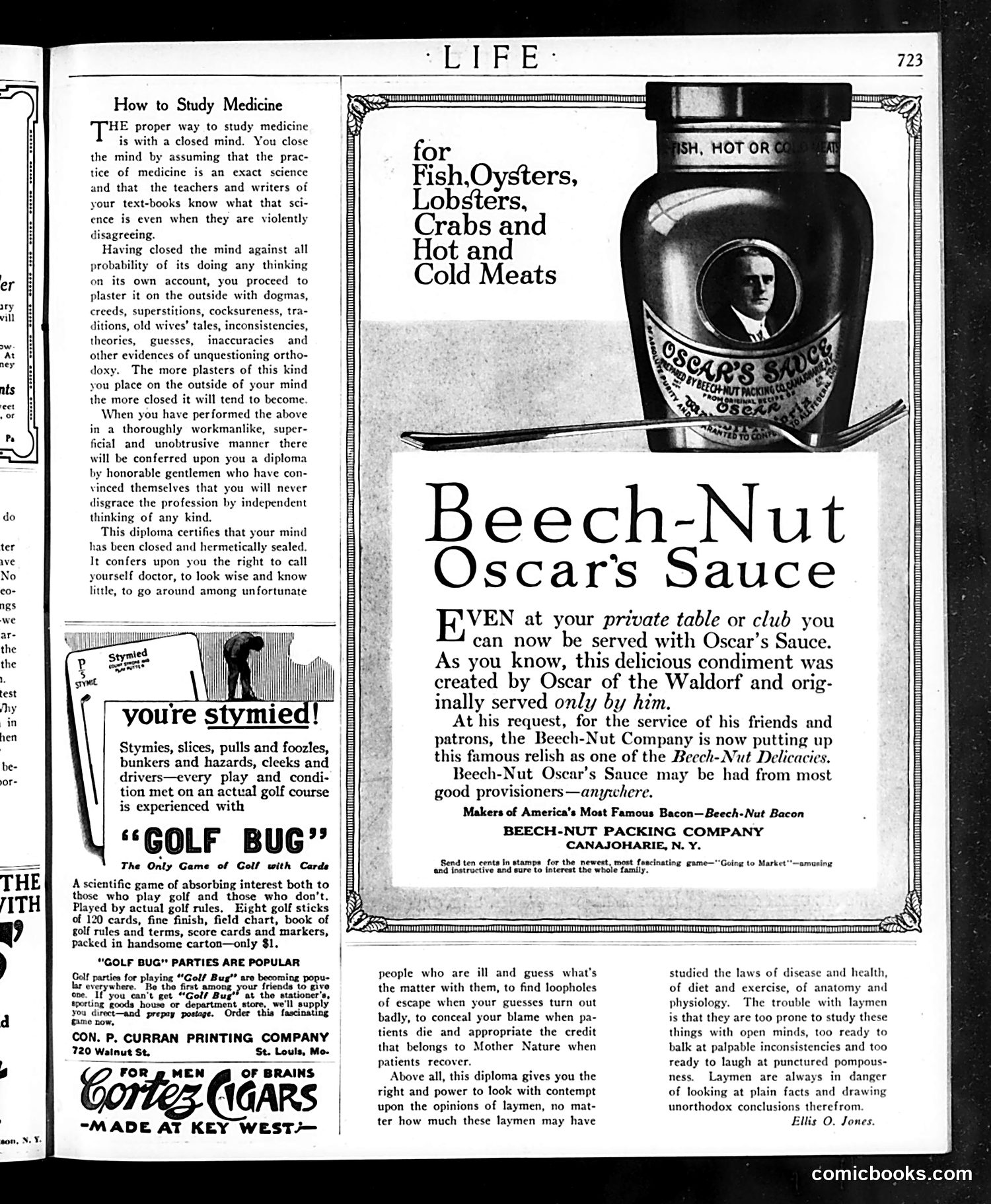
This page contains primarily **advertisements** rather than editorial cartoons. The main content is a satire titled "How to Study Medicine," which mocks medical education by ironically praising the practice of closing one's mind to independent thought, accepting contradictory dogma uncritically, and gaining a diploma that certifies intellectual rigidity. The satire attacks medical professionals who discourage patients from questioning doctors' authority. The advertisements include: - **"Golf Bug"** — a card game simulating golf - **Cortez Cigars** — marketed to intellectuals - **Beech-Nut Oscar's Sauce** — a condiment originally served exclusively at the Waldorf hotel The medical education satire reflects early 20th-century frustration with authoritarian medical practice and the profession's resistance to informed patient input or scientific skepticism.
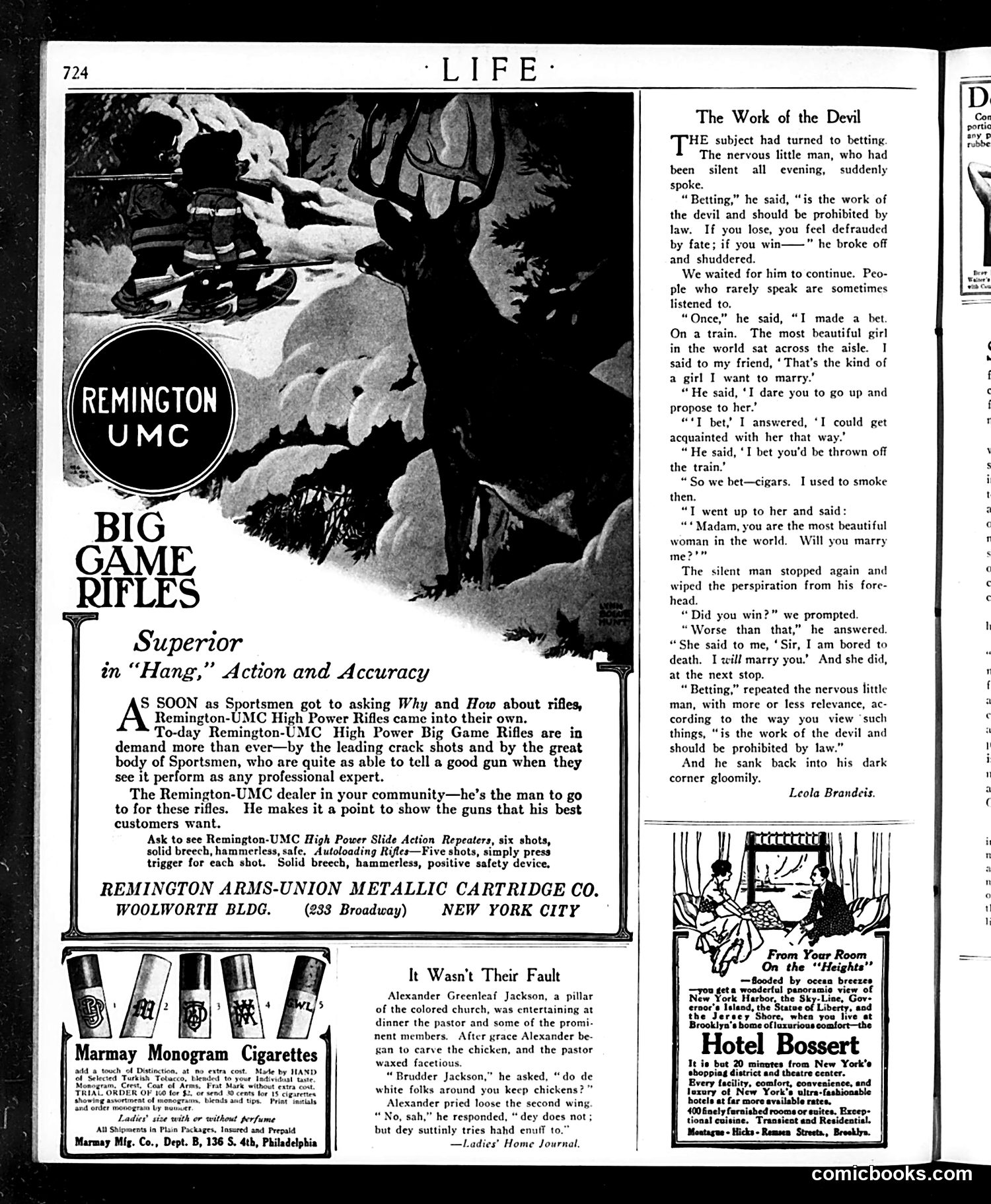
This page contains **three separate pieces of content**: a rifle advertisement, a brief humorous anecdote, and a hotel advertisement. **"It Wasn't Their Fault"** is a short joke playing on racial stereotypes common to early 20th-century American humor. It features a Black church deacon named Alexander Greenleaf Jackson who, when asked if white neighbors keep chickens, responds that they don't—but "suttinly tries hahd enuff to," implying they steal his. The humor relies on dialect humor and the stereotype of petty theft, presented as witty repartee. **"The Work of the Devil"** is a longer anecdote about a nervous man who warns against betting as sinful, then recounts how a bet led him to propose to a beautiful stranger on a train—and she accepted, trapping him in an unwanted marriage. The moral irony is the punchline: betting indeed proved devilish in his case. The advertisements (Remington rifles and Hotel Bossert) are straightforward commercial appeals to contemporary readers.

This page mixes advertisements with satire. The main cartoon, "Segregation," uses ironic role-reversal to critique wealth inequality. Multimillionaires petition the President, claiming their self-imposed isolation from common people makes them "selfish, more vulgar and more ignorant." The President refuses, declaring multimillionaires an "inferior class" whose contact would harm ordinary citizens more than help the wealthy—inverting social hierarchies to expose the absurdity of actual class segregation. The anecdote about conductor Hans Richter adds related social commentary through humor: he criticizes violoncellists for playing "like married men, not like lovers," mocking bourgeois emotional restraint. The advertisements—for weight-reduction garments ("Don't Stay Too Fat"), Resinol Soap, and horseshoe nails—represent typical period consumer culture, offering appearance improvement and practical goods to readers.
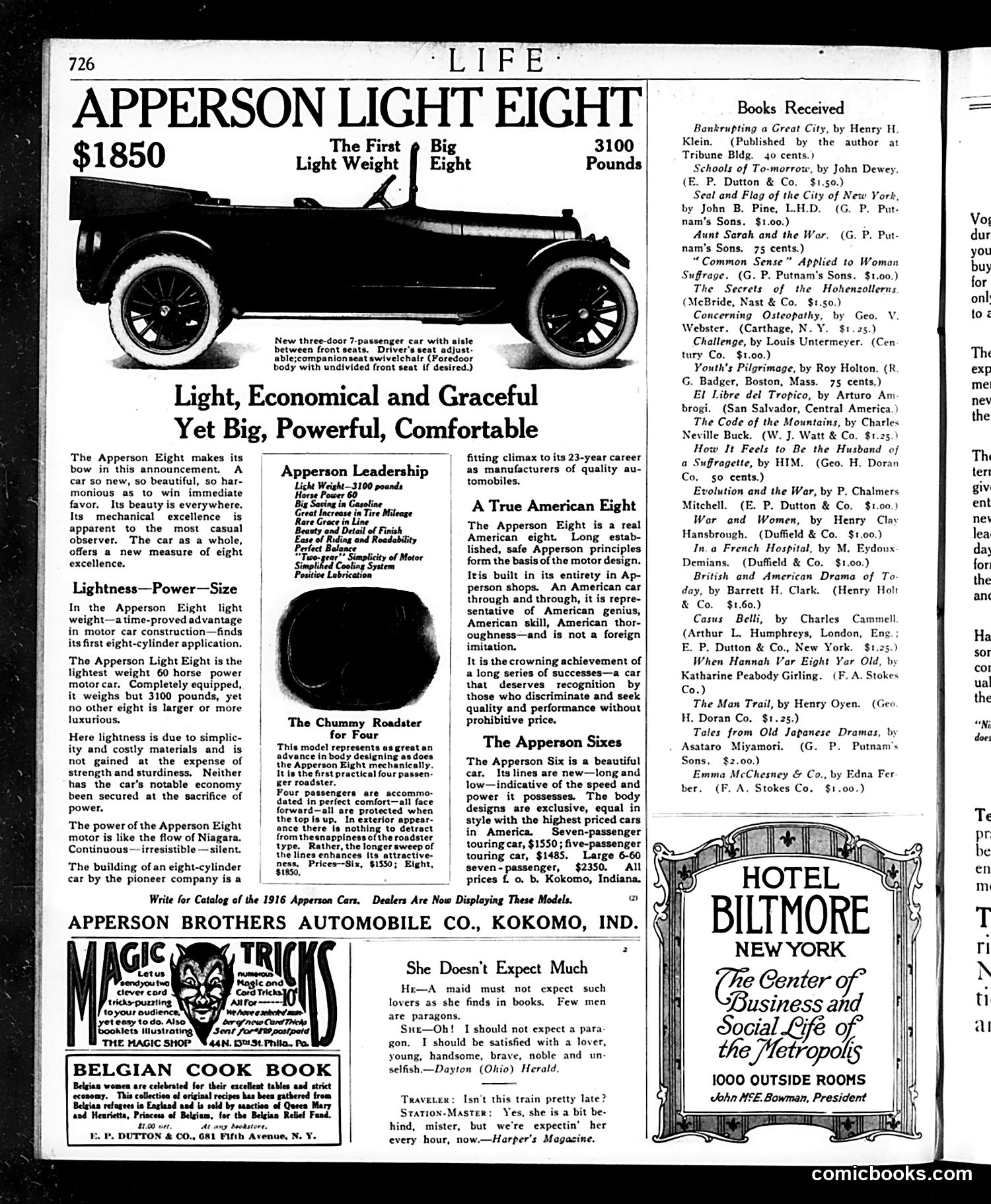
This page is primarily advertising for the Apperson automobile company's new "Light Eight" model, with minimal editorial content. The main advertisement emphasizes that this eight-cylinder car combines lightness (3,100 pounds) with power (60 horsepower), a competitive advantage in 1916. The ad repeatedly stresses that it's a "True American Eight"—manufactured entirely in American factories by an established American company, not a "foreign imitation." This reflects period concerns about buying American products. The car features an innovative "Chummy Roadster" design that accommodates four passengers comfortably in an open body. Supporting the ad are minor humorous items: one small joke about a maid with unrealistic romantic expectations, and another joke about a late train. These appear to be typical filler content for the magazine. The page also lists recently received books and advertisements for a Belgian cookbook and the Hotel Biltmore in New York.
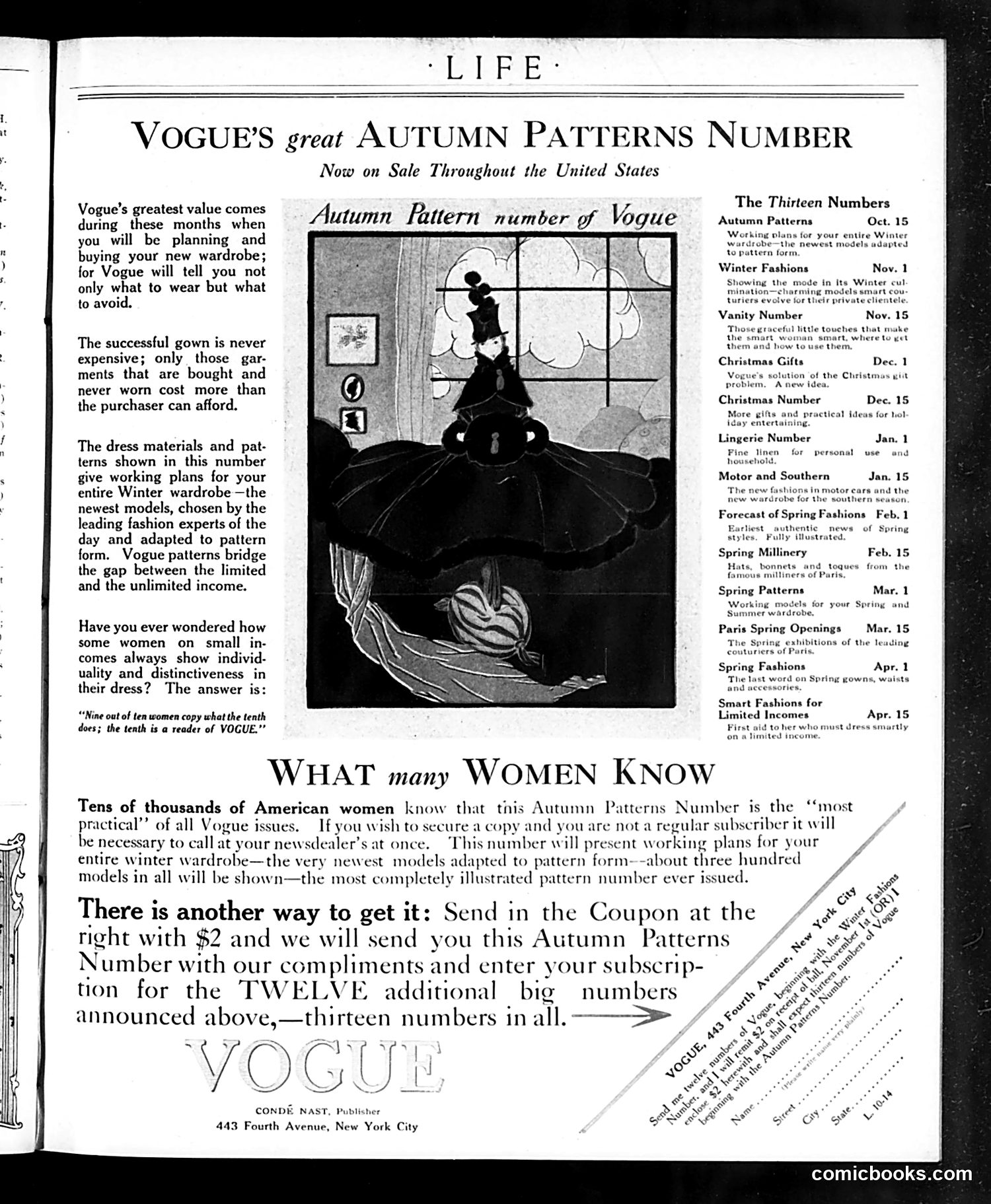
This is primarily a **fashion magazine advertisement**, not political satire. The page promotes Vogue's Autumn Patterns Number (a sewing pattern issue) to American women. The central illustration shows a **silhouetted woman in fashionable 1910s-era clothing**, depicted elegantly against a stylized background—a typical fashion advertisement image meant to inspire desire for the magazine's content. The accompanying text makes a telling social argument: the famous quote "Nine out of ten women copy what the tenth does; the tenth is a reader of VOGUE" suggests that Vogue readers are *trendsetters* while others merely follow. The implicit satire is gentle—it flatters readers' vanity while subtly mocking non-subscribers as mere copycats. The broader pitch targets women of **limited means**, claiming Vogue helps them dress stylishly affordably by bridging "the gap between the limited and the unlimited income"—essentially offering aspirational fashion guidance to middle-class women who cannot afford haute couture. This reflects early 20th-century consumer culture aimed at expanding the female market for fashion magazines and patterns.
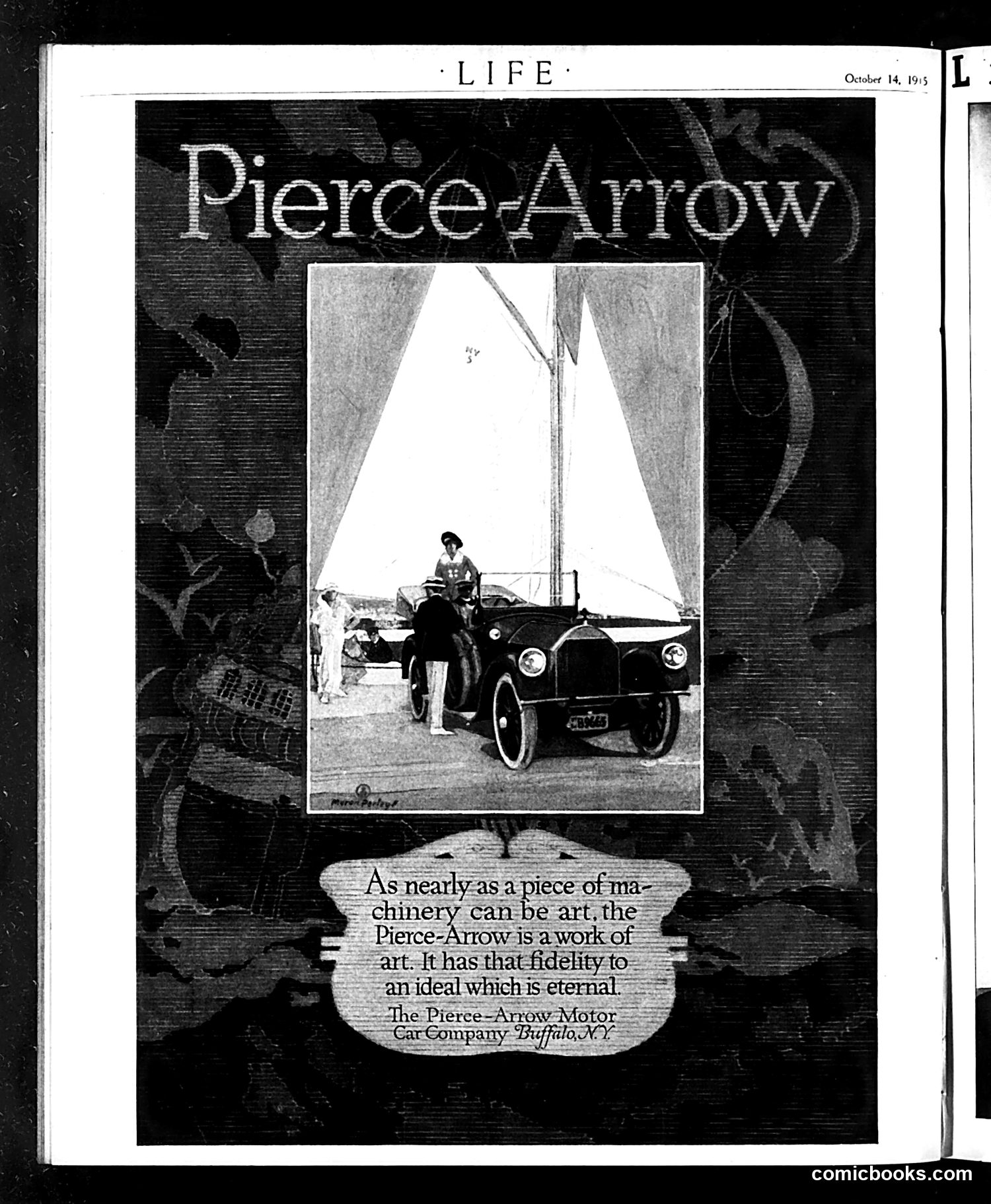
This is a **full-page advertisement**, not political satire. It promotes the Pierce-Arrow Motor Car Company of Buffalo, New York, dated October 14, 1915. The ad features a photograph of an elegant automobile with well-dressed passengers beneath a large tent or awning. The accompanying text claims: "As nearly as a piece of machinery can be art, the Pierce-Arrow is a work of art. It has that fidelity to an ideal which is eternal." This is **luxury car marketing** targeting wealthy readers of *Life* magazine. The automobile is presented as a status symbol and aesthetic achievement—not a mere machine but an artistic expression. The exotic setting (tent, yacht-like backdrop) emphasizes exclusivity and refinement. No satire is present; this reflects early 20th-century automotive advertising strategies emphasizing craftsmanship and prestige.