
Life, 1915-10-14 · page 26 of 44
Life — October 14, 1915 — page 26: what you’re looking at
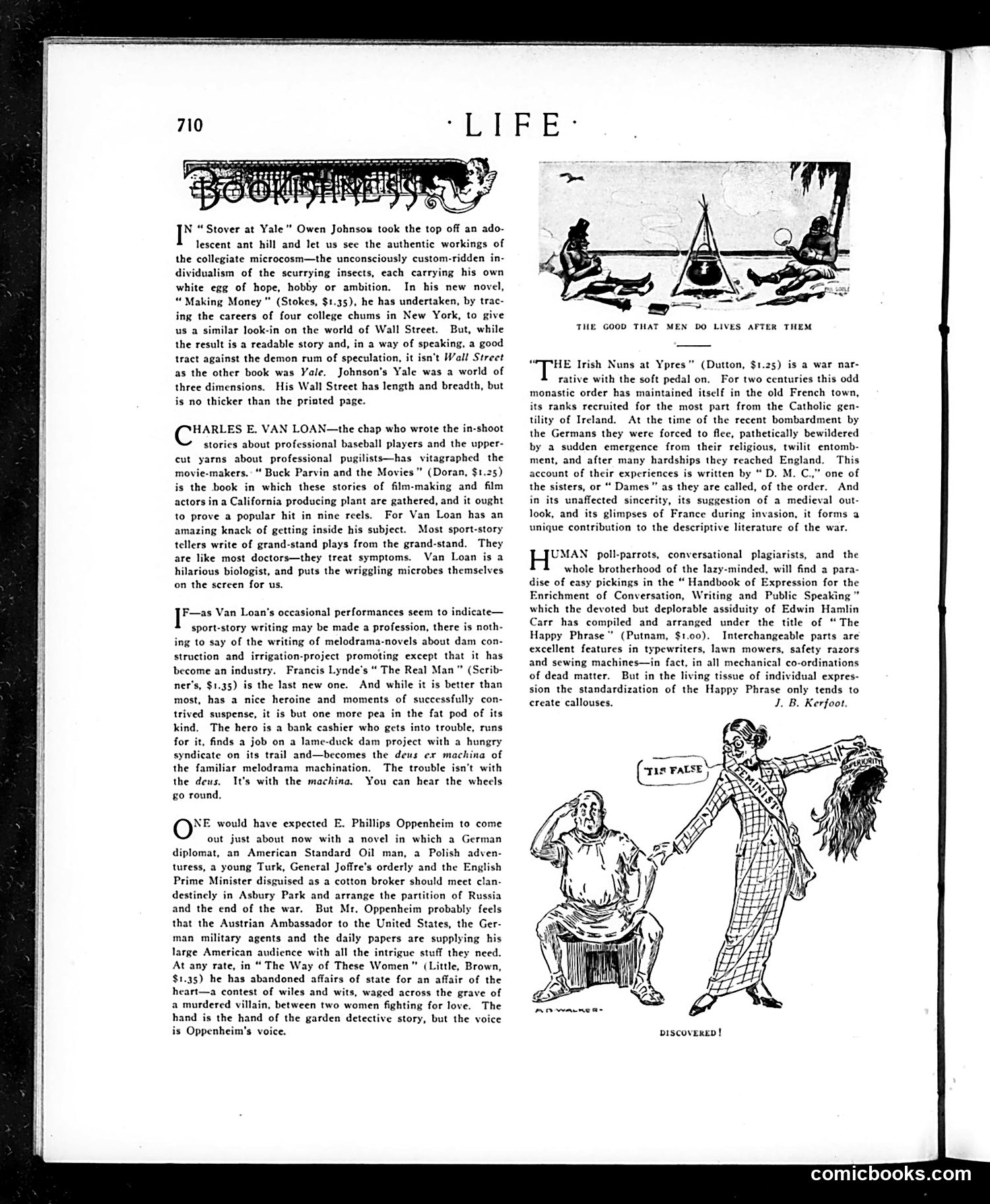
What you’re looking at
This page from *Life* magazine contains two cartoons mocking a charlatan or fraud. The larger cartoon shows a man being exposed—his false beard is being pulled away, revealing his deception. The smaller figure represents the con artist caught red-handed. The satire targets someone engaged in deliberate deception, likely a con man, charlatan, or impostor. The word "DISCOVERED!" emphasizes the moment of exposure. The cartoonist ridicules not just the fraud itself but the absurdity of the disguise—the exaggerated false beard suggests the deception was obvious to anyone paying attention. Without additional context from the magazine's cover or surrounding advertisements, the specific target remains unclear, though the cartoons appear designed to mock public figures or widespread frauds of the era. The humor relies on the universal satisfaction of exposing fakery.
📄 Transcribed text from this page (OCR, searchable)
Machine-transcribed from the original scan — historical spelling and the odd misread are preserved.
i “Stover at Yale Owen Johnsow took the top off an ado- lescent ant hill and let us see the authentic workings of the collegiate microcosm—the unconsciously custom-ridden in- dividualism of the scurrying insects, each carrying his own white egg of hope, hobby or ambition. In his new novel, “Making Money” (Stokes, $1.35), he has undertaken, by trac- ing the careers of four college chums in New York, to give us a similar look-in on the world of Wall Street. But, while the result is a readable story and, in a way of speaking, a good tract against the demon rum of speculation, it isn't Wall Street as the other book was Yale. Johnson’s Yale was a world of three dimensions. His Wall Street has length and breadth, but is no thicker than the printed page. HARLES E. VAN LOAN—the chap who wrote the in-shoot stories about professional baseball players and the upper- cut yarns about professional pugilists—has vitagraphed the movie-makers.“ Buck Parvin and the Movies” (Doran, $1.25) is the book in which these stories of film-making and film actors in a California producing plant are gathered, and it ought to prove a popular hit in nine reels. For Van Loan has an amazing knack of getting inside his subject. Most sport-story tellers write of grand-stand plays from the grand-stand. They are like most doctors—they treat symptoms. Van Loan is a hilarious biologist, and puts the wriggling microbes themselves on the screen for us. F—as Van Loan’s occasional performances seem to indicate— sport-story writing may be made a profession, there is noth- ing to say of the writing of melodrama-novels about dam con- struction and irrigation-project promoting except that it has become an industry. Francis Lynde’s “ The Real Man" (Scrib- ner’s, $1.35) is the last new one. And while it is better than most, has a nice heroine and moments of successfully con- trived suspense, it is but one more pea in the fat pod of its kind. The hero is a bank cashier who gets into trouble, runs for it, finds a job on a lame-duck dam project with a hungry syndicate on its trail and—becomes the deus ex machina of the familiar melodrama machination. The trouble isn't with the deus, It's with the machina. You can hear the whecls go round, NE would have expected E. Phillips Oppenheim to come out just about now with a novel in which a German diplomat, an American Standard Oil man, a Polish adven- turess, a young Turk, General Jofire’s orderly and the English Prime Minister disguised as a cotton broker should meet clan- destinely in Asbury Park and arrange the partition of Russia and the end of the war. But Mr. Oppenheim probably feels that the Austrian Ambassador to the United States, the Ger- man military agents and the daily papers are supplying his large American audience with all the intrigue stuff they need. At any rate, in “ The Way of These Women” (Little, Brown, $1.35) he has abandoned affairs of state for an affair of the heart—a contest of wiles and wits, waged across the grave of a murdered villain, between two women fighting for love. The hand is the hand of the garden detective story, but the voice is Oppenheim's voice. THE GOOD THAT MEN DO LIVES AFTER THEM HE Irish Nuns at Ypres” (Dutton, $1.25) is a war nar- rative with the soft pedal on. For two centuries this odd monastic order has maintained itself in the old French town, its ranks recruited for the most part from the Catholic gen- tility of Ireland, At the time of the recent bombardment by the Germans they were forced to flee, pathetically bewildered by a sudden emergence from their religious, twilit entomb- ment, and after many hardships they reached England. This account of their experiences is written by “ D. M. C.,” one of the sisters, or “ Dames" as they are called, of the order. And in its unaffected sincerity, its suggestion of a medieval out- look, and its glimpses of France during invasion, it forms a unique contribution to the descriptive literature of the war. Hoxss poll-parrots, conversational plagiarists, and the whole brotherhood of the lazy-minded, will find a para- dise of easy pickings in the “ Handbook of Expression for the Enrichment of Conversation, Writing and Public Speaking ” which the devoted but deplorable assiduity of Edwin Hamlin Carr has compiled and arranged under the title of “The Happy Phrase” (Putnam, $1.00). Interchangeable parts are excellent features in typewriters, lawn mowers, safety razors and sewing machines—in fact, in all mechanical co-ordinations of dead matter. But in the living tissue of individual expres- sion the standardization of the Happy Phrase only tends to create callouses. J. B. Kerfoot. DISCOVERED! comicbooks.com