
Life, 1915-10-14 · page 25 of 44
Life — October 14, 1915 — page 25: what you’re looking at
What you’re looking at
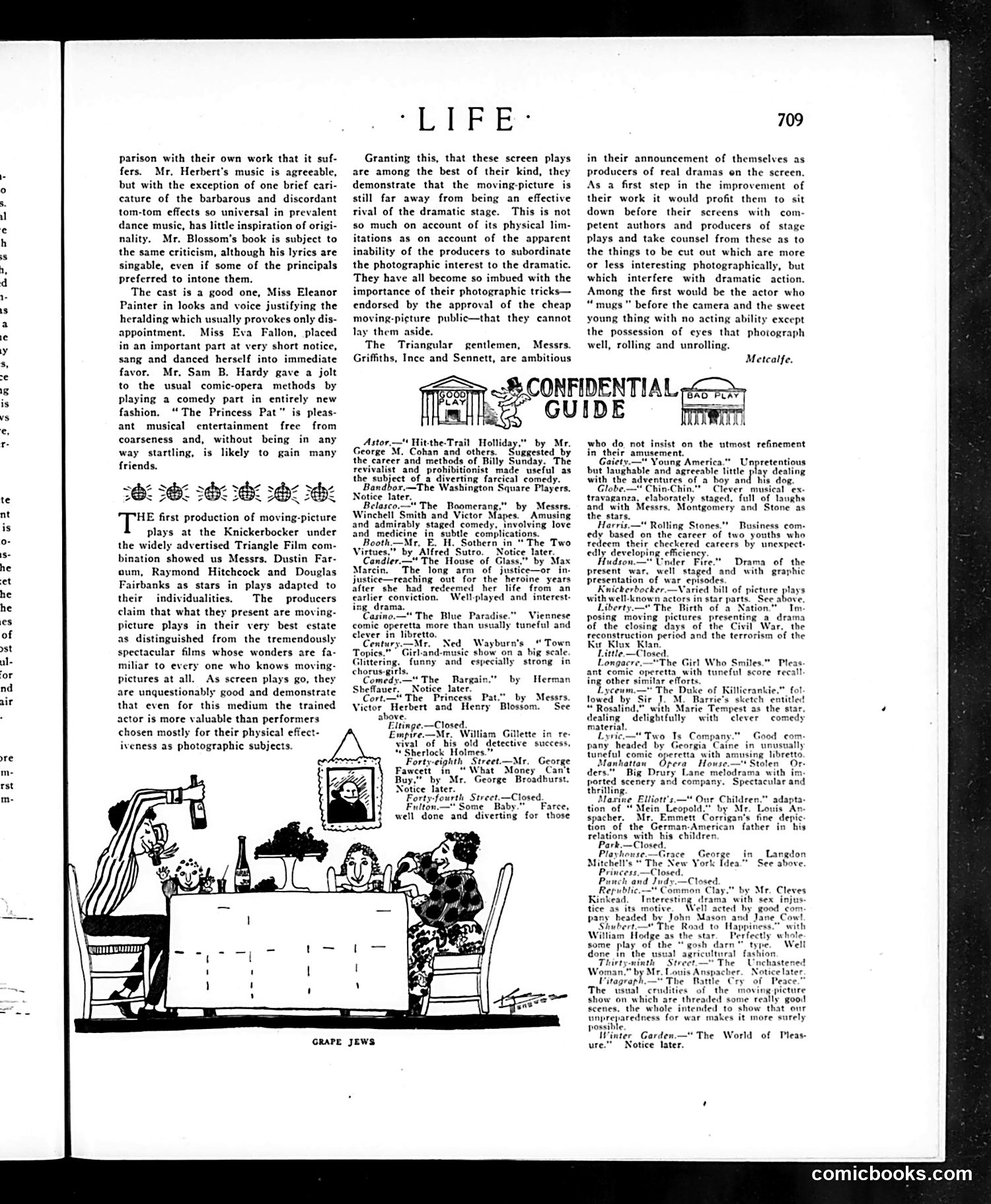
This page primarily contains theater reviews rather than political cartoons. The main illustrated element is labeled "GRAPE JEWS" — a cartoon showing a figure at a movie projector watching performers on a screen, satirizing early cinema. The page's central argument concerns the emerging film industry's limitations compared to stage drama. The critic argues that while Triangle Film Company productions (starring Dustin Farnum, Raymond Hitchcock, and Douglas Fairbanks) represent "moving-picture plays in their very best estate," cinema remains inferior to theater. The critique focuses on producers' obsession with "photographic tricks" and visual spectacle over dramatic substance—they cannot "subordinate the photographic interest to the dramatic." The reviews discuss Broadway productions, evaluating actors like Eleanor Painter and Sam B. Hardy favorably for bringing theatrical discipline to new entertainment forms. The "Grape Jews" cartoon appears to satirize audience consumption of cinema's visual entertainment, though the specific meaning of that title remains unclear from the visible context.
📄 Transcribed text from this page (OCR, searchable)
Machine-transcribed from the original scan — historical spelling and the odd misread are preserved.
parison with their own work that it suf- fers. Mr. Herbert's music is agreeable, but with the exception of one brief ca: cature of the barbarous and discordant tom-tom effects so universal in prevalent dance music, has little inspiration of orij nality. Mr. Blossom’s book is subject to the same criticism, although his lyrics are singable, even if some of the principals preferred to intone them. The cast is a good one, Miss Eleanor Painter in looks and voice justifying the heralding which usually provokes only dis- appointment. Miss Eva Fallon, placed in an important part at very short notice, sang and danced herself into immediate favor. Mr. Sam B. Hardy gave a jolt to the usual comic-opera methods by playing a comedy part in entirely new fashion. “The Princess Pat” is pleas- ant musical entertainment free from coarseness and, without being in any way startling, is likely to gain many friends. Ot 3 30% Bind sabe see 2B: ABs TEs LEDS AS ES 'HE first production of moving-picture plays at the Knickerbocker under the widely advertised Triangle Film com- bination showed us Messrs, Dustin Far- oum, Raymond Hitchcock and Douglas Fairbanks as stars in plays adapted to their individualities. The producers claim that what they present are moving- picture plays in their very best estate as distinguished from the tremendously spectacular films whose wonders are fa- miliar to every one who knows moving- pictures at all. As screen plays go, they are unquestionably good and demonstrate that even for this medium the trained actor is more valuable than performers chosen mostly for their physical effect- iveness as photographic subjects. iE [AEAB} Granting this, that these screen plays are among the best of their kind, they demonstrate that the moving-picture is still far away from being an effective rival of the dramatic stage. This is not so much on account of its physical lim- itations as on account of the apparent inability of the producers to subordinate the photographic interest to the dramatic. They have all become so imbued with the importance of their photographic tricks— endorsed by the approval of the cheap moving-picture public—that they cannot lay them aside. The Triangular gentlemen, Messrs. Griffiths, Ince and Sennett, are ambitious Astor.—" Hit-the-Trail Holliday,” by Mr. George M. Cohan and others. Suggested by the career and methods of Billy Sunday. The revivalist and probibitionist’ made useful as the subject of a diverting farcical comedy. Bandbor.—The Washington Square Players, Notice later, Belasco.—" The Boomerang,” by Messrs. Winchell Smith and Victor Mapes. Amusing and admirably staged comedy, involving love and medicine in subtle complications. Booth.—Mr. E. H. Sothern in" The Two Virtues,” by Alfred Sutro. Notice, later. Candier.—" The House of Glass.” by Max Marcin. “The long arm of justice—or in- justice—reaching out for the heroine years after she had redeemed her life from an earlier conviction. Well-played and interest- Casino.— The Blue Paradise.” Viennese comic operetta more than usually tuneful and —Mr. Ned Wayburn's |" Town Girl-and-music show on a big scale Glittering, funny and especially strong. in i Bargain,” by Herman Notice later. Cort.—* The Princess Pat.” by Messrs. Victor’ Herbert and Henry Blossom. See above. Eltinge.—Closed . Empire —Mr. William Gillette in re- vival of his old detective success, herlock Holmes.” Forty-eighth Street-—Mr. George Fawcett. in “What Money Can't Buy,” by Mr. George Broadhurst. Notice later. Forty-fourth Street.—Closed. Fulton.—" Some Baby.” Farce, well done and diverting for those GRAPE JEWS 709 in their announcement of themselves as producers of real dramas on the screen. As a first step in the improvement of their work it would profit them to sit down before their screens with com- petent authors and producers of stag plays and take counsel from these as to the things to be cut out which are more or less interesting photographically, but which interfere with dramatic action. Among the first would be the actor who “ mugs" before the camera and the sweet young thing with no acting ability except the possession of eyes that photograph well, rolling and unrolling. Metcalfe. who do. not insist on the utmost refinement in their amusement. Gaiety.—" Young America.” Unpretentious but laughable and agreeable little play dealing with the adventures of a boy and his dog Globe.—" Chin-Cl Clever musical ex- travaganza, elaborately staged, full of laughs and with Messrs, Montgomery and Stone as the stars. Harris.—" Rolling Stones." Business com: edy based on the career of two youths who redeem their checkered careers by unexpect: edly developing efficiency Hudson.—" Under Fire." Drama of the present war, well staged and with graphic Presentation of war episodes Knickerbocker.—Varied bill of picture plays with well-known actors in star parts. See above. Liberty.—* The Birth of a nT. posing moving pictures presenting a drama of the closing days of the Civil War, the reconstruction peried and the terrorism of the Ku Klux Klan. Little —Closed. Longacre,—"'The Gir! Who Smiles.” Pleas ant comi retta with tuneful score recall. ing other similar efforts Lyceum.—" The Duke of Killicrankie.” fot lowed by Sir J. M. Rarrie’s sketch entitled Rosalind.” with Marie Tempest as the star. dealing delightfully with clever comedy material Lyric-—"" Two Is Company." Good com: pany headed by Georgia Caine in unusually tuneful comic operetta with amusing libretto Manhattan Opera Howse.—"* Stolen Or- ders." Big Drury Lane melodrama with im. ported scenery and company. Spectacular and thrilling, jarine Eliiott’s—* Our Children.” adapta- n of Mein Leopold.” by Mr. Louis An- spacher. Mr, Emmett Corrigan’s fine depic tion of the German-American father in his relations with his children. Park.—Closed. Play se.—-Grace George Mitchell’s * The New York Idea.” Princess.—Cl Punch and Judy.—Closed Repub “Common Clay.” by Mr. Cleves Kinkead. Interesting drama with sex in; tice as its motive. Well acted hy good com pany headed by Jol Mason and Jane Cow! Shubert.—" The Road to Happiness.” with iam Hodge as the star. erfectly whole. some play of the “gosh darn” type. Well done in the usual agricultural fashion The Unchastene Notice late " The of Peace The usual crudities oving picture show on which are threaded s; really good scenes, the whole intended to show that our unpreparedness for war makes it more surely possible, MiPinter Garden.—" The World of Pleas. Notice later. Langdon See above. comicbooks.com