
Life, 1915-10-14 · page 18 of 44
Life — October 14, 1915 — page 18: what you’re looking at
What you’re looking at
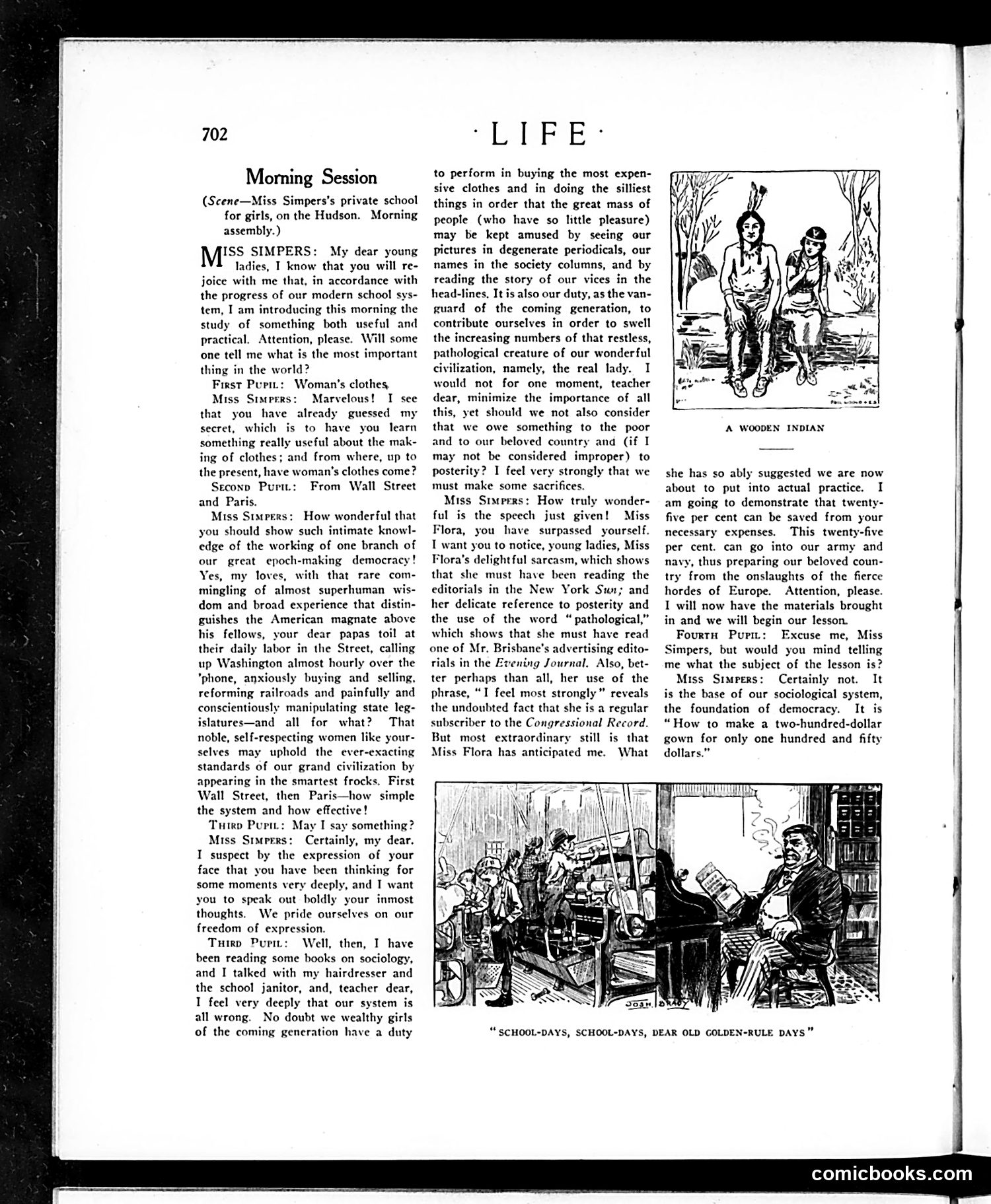
This satirical piece mocks the education of wealthy girls at an elite finishing school. Miss Simpers teaches that women's primary importance is wearing expensive clothes funded by fathers' Wall Street dealings—presented as a patriotic duty to amuse the masses through society pages and scandals. A student named Flora, however, disrupts this with sarcasm, citing sociology books and questioning whether wealthy girls owe something to the poor and posterity. Miss Simpers praises Flora's "delightful sarcasm" while ironically crediting her insights to reading the *New York Sun*, *Evening Journal*, and *Congressional Record*—implying Flora has simply absorbed progressive rhetoric without genuine understanding. The cartoon satirizes both the vapid materialism of wealthy women's education and the shallow adoption of socialist/progressive ideas by the privileged class. The humor targets upper-class hypocrisy: girls taught that consumption serves the poor, while radical critiques become mere fashionable talk.
📄 Transcribed text from this page (OCR, searchable)
Machine-transcribed from the original scan — historical spelling and the odd misread are preserved.
Morning Session (Scene—Miss Simpers’s private school for girls, on the Hudson. Morning assembly.) ISS SIMPERS: My dear young ladies, I know that you will re- joice with me that, in accordance with the progress of our modern school sys- tem, I am introducing this morning the study of something both useful and practical. Attention, please. Will some one tell me what is the most important thing in the world? First Puri: Woman's clothes Miss Sipe Marvelous! TI see that you have already guessed my secret, which is to have you learn something really useful about the mak- ing of clothes; and from where, up to the present, have woman’s clothes come? Seconp Puri: From Wall Street and Paris. Miss Sttrers: How wonderful that you should show such intimate knowl- edge of the working of one branch of our great epoch-making democracy! Yes, my loves, with that rare com- mingling of almost superhuman wis- dom and broad experience that distin- guishes the American magnate above his fellows, your dear papas toil at their daily labor in the Street, calling up Washington almost hourly over the "phone, anxiously buying and selling, reforming railroads and painfully and conscientiously manipulating state leg- islatures—and all for what? That noble, self-respecting women like your- selves may uphold the ever-exacting standards of our grand civilization by appearing in the smartest frocks. First Wall Street, then Paris—how simple the system and how effective! Tutro Puri: May I say something? Miss Srtpers: Certainly, my dear. I suspect by the expression of your face that you have been thinking for some moments very deeply, and I want you to speak out boldly your inmost thoughts. We pride ourselves on our freedom of expression. Tuirp Puri: Well, then, I have been reading some books on sociology, and I talked with my hairdresser and the school janitor, and, teacher dear, I feel very deeply that our system is all wrong. No doubt we wealthy girls of the coming generation have a duty "LDPE * to perform in buying the most expen- sive clothes and in doing the silliest things in order that the great mass of people (who have so little pleasure) may be kept amused by seeing our pictures in degenerate periodicals, our names in the society columns, and by reading the story of our vices in the head-lines, It is also our duty, as the van- guard of the coming generation, to contribute ourselves in order to swell the increasing numbers of that restless, pathological creature of our wonderful civilization, namely, the real lady. I would not for one moment, teacher dear, minimize the importance of all this, yet should we not also consider that we owe something to the poor and to our beloved country and (if I may not be considered improper) to posterity? I feel very strongly that we must make some sacrifices. Miss Simpers: How truly wonder- ful is the speech just given! Miss Flora, you have surpassed yourself. I want you to notice, young ladies, Miss Flora’s delightful sarcasm, which shows that she must have been reading the editorials in the New York Sun; and her delicate reference to posterity and the use of the word “ pathological,” which shows that she must have read one of Mr. Brisbane's advertising edito- rials in the Evening Journal. Also, bet- ter perhaps than all, her use of the phrase, “I feel most strongly” reveals the undoubted fact that she is a regular subscriber to the Congressional Record. But most extraordinary still is that Miss Flora has anticipated me. What A WOODEN INDIAN she has so ably suggested we are now about to put into actual practice. I am going to demonstrate that twenty- five per cent can be saved from your necessary expenses. This twenty-five per cent. can go into our army and navy, thus preparing our beloved coun- try from the onslaughts of the fierce hordes of Europe. Attention, please. I will now have the materials brought in and we will begin our lesson. Fourth Pupit: Excuse me, Miss impers, but would you mind telling me what the subject of the lesson is? Miss Simpers: Certainly not. It is the base of our sociological system, the foundation of democracy. It is “How to make a two-hundred-dollar gown for only one hundred and fifty “ SCHOOL-DAYS, SCHOOL-DAYS, DEAR OLD GOLDEN-RULE DAYS” comicbooks.com