
Life, 1915-10-14 · page 20 of 44
Life — October 14, 1915 — page 20: what you’re looking at
What you’re looking at
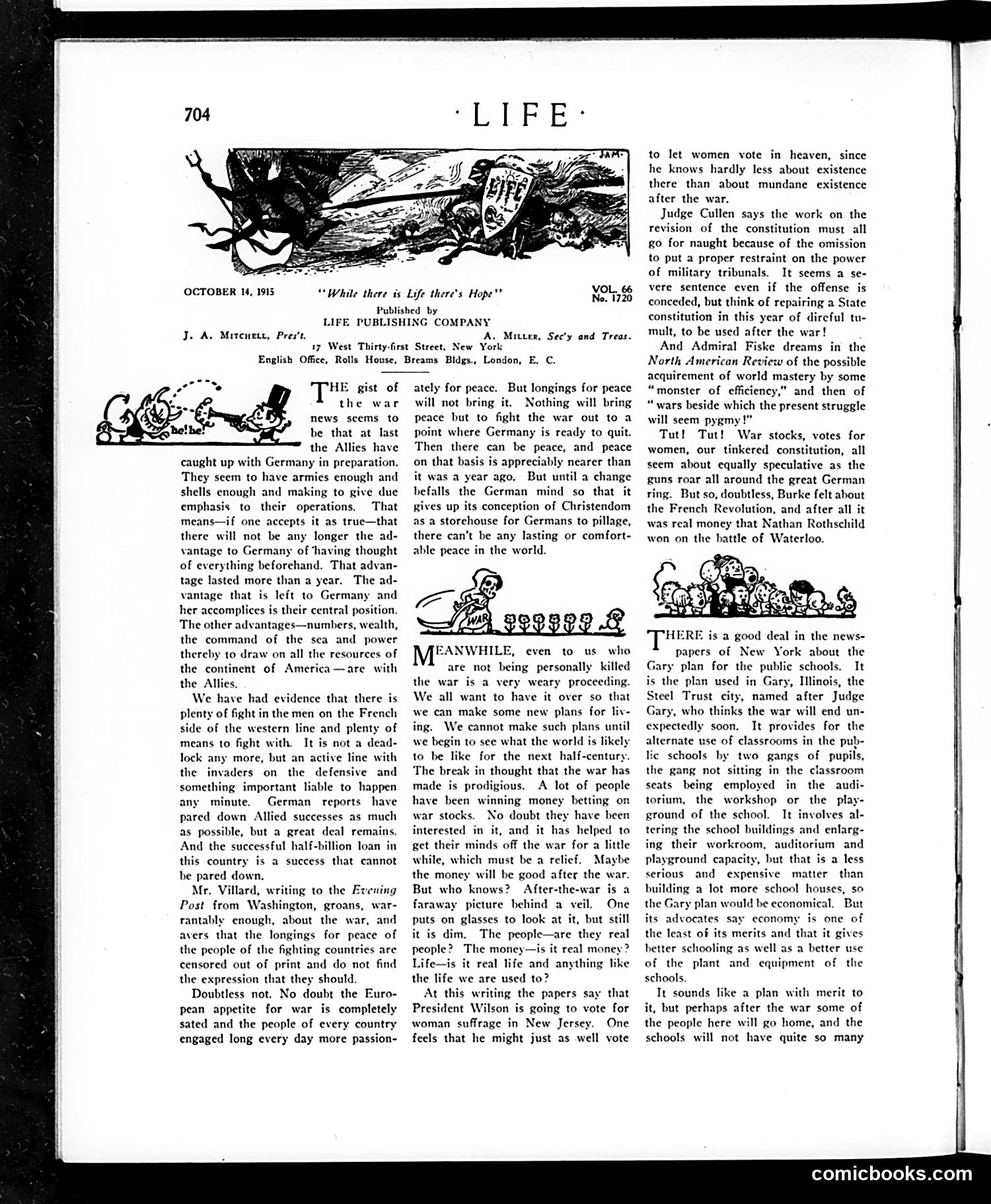
This page contains editorial commentary on World War I. The main cartoon at top depicts a devil or demon figure amid chaos—likely representing Germany or the forces of war—with the caption "While there is Life there's Hope." The text discusses the Allied forces finally matching German military preparation after over a year of disadvantage. The editor argues that lasting peace is impossible until Germany abandons its aggressive ideology; merely wishing for peace won't end the war. A secondary satirical jab targets President Wilson, mocking his support for women's suffrage in New Jersey as nearly as pointless as "letting women vote in heaven"—suggesting the post-war world will be so transformed and unknowable that current political reforms seem irrelevant. The overall tone reflects American wartime pessimism and exhaustion, while maintaining that Germany must be militarily defeated before any meaningful peace can occur.
📄 Transcribed text from this page (OCR, searchable)
Machine-transcribed from the original scan — historical spelling and the odd misread are preserved.
OCTOBER 14, 1915 “While there ts Life there's Hope"’ Published by PUBLISHING COMPANY A. Mutter, Sec’y and Treas. 17 West Thirty-first Street, New York English Office, Rolls House, Breams Bldgs., London, E. C. LIFE J. A. Mitcuett, Pres't. HE gist of the war news scems to be that at last the Allies have caught up with Germany in preparation. They seem to have armies enough and shells enough and making to give due emphasis to their operations. That means—if one accepts it as true—that there will not be any longer the ad- vantage to Germany of ‘having thought of everything beforehand. That advan- tage lasted more than a year. The ad- vantage that is left to Germany and her accomplices is their central position. The other advantages—numbers, wealth, the command of the sea and power thereby to draw on all the resources of the continent of America—are with the Allies. We have had evidence that there is plenty of fight in the men on the French side of the western line and plenty of means to fight with. It is not a dead- lock any more, but an active line with the invaders on the defensive and something important liable to happen any minute. German reports have pared down Allied successes as much as possible, but a great deal remains. And the successful half-billion loan in this country is a success that cannot be pared down, Mr. Villard, writing to the Evening Post from Washington, groans, war- rantably enough, about the war, and avers that the longings for peace of the people of the fighting countries are censored out of print and do not find the expression that they should. Doubtless not. No doubt the Euro- pean appetite for war is completely sated and the people of every country engaged long every day more passion- ately for peace. But longings for peace will not bring it. Nothing will bring peace but to fight the war out to a point where Germany is ready to quit. Then there can be peace, and peace on that basis is appreciably nearer than it was a year ago. But until a change befalls the German mind so that it gives up its conception of Christendom as a storehouse for Germans to pillage, there can’t be any lasting or comfort- able peace in the world. EANWHILE, even to us who are not being personally killed the war is a very weary proceeding. We all want to have it over so that we can make some new plans for liv- ing. We cannot make such plans until we begin to see what the world is likely to be like for the next half-century. The break in thought that the war has made is prodigious. A lot of people have been winning money betting on war stocks. No doubt they have been interested in it, and it has helped to get their minds off the war for a little while, which must be a relief. Maybe the money will be good after the war. But who knows? After-the-war is a faraway picture behind a veil. One puts on glasses to look at it, but still it is dim. The people—are they real people? The money—is it real money? Life—is it real life and anything like the life we are used to? At this writing the papers say that President Wilson is going to vote for woman suffrage in New Jersey. One feels that he might just as well vote to let women vote in heaven, since he knows hardly less about existence there than about mundane existence after the war. Judge Cullen says the work on the revision of the constitution must all go for naught because of the omission to put a proper restraint on the power of military tribunals. It seems a se- vere sentence even if the offense is conceded, but think of repairing a State constitution in this year of direful tu- mult, to be used after the war! And Admiral Fiske dreams in the North American Review of the possible acquirement of world mastery by some “monster of efficiency,” and then of “wars beside which the present struggle will seem pygmy!” Tut! Tut! War stocks, votes for women, our tinkered constitution, all seem about equally speculative as the guns roar all around the great German ring. But so, doubtless, Burke felt about the French Revolution, and after all it was real money that Nathan Rothschild won on the battle of Waterloo. HERE is a good deal in the news- papers of New York about the Gary plan for the public schools. It is the plan used in Gary, Illinois, the Steel Trust city, named after Judge Gary, who thinks the war will end un- expectedly soon. It provides for the alternate use of classrooms in the pub- lic schools by two gangs of pupils, the gang not sitting in the classroom seats being employed in the audi- torium, the workshop or the play- ground of the school. It involves al- tering the school buildings and enlarg- ing their workroom, auditorium and playground capacity, but that is a less serious and expensive matter than building a lot more school houses, so the Gary plan would be economical. But its advocates say economy is one of the least of its merits and that it gives better schooling as well as a better use of the plant and equipment of the schools. Tt sounds like a plan with merit to it, but perhaps after the war some of the people here will go home, and the schools will not have quite so many comicbooks.com