
Life, 1915-10-14 · page 21 of 44
Life — October 14, 1915 — page 21: what you’re looking at
What you’re looking at
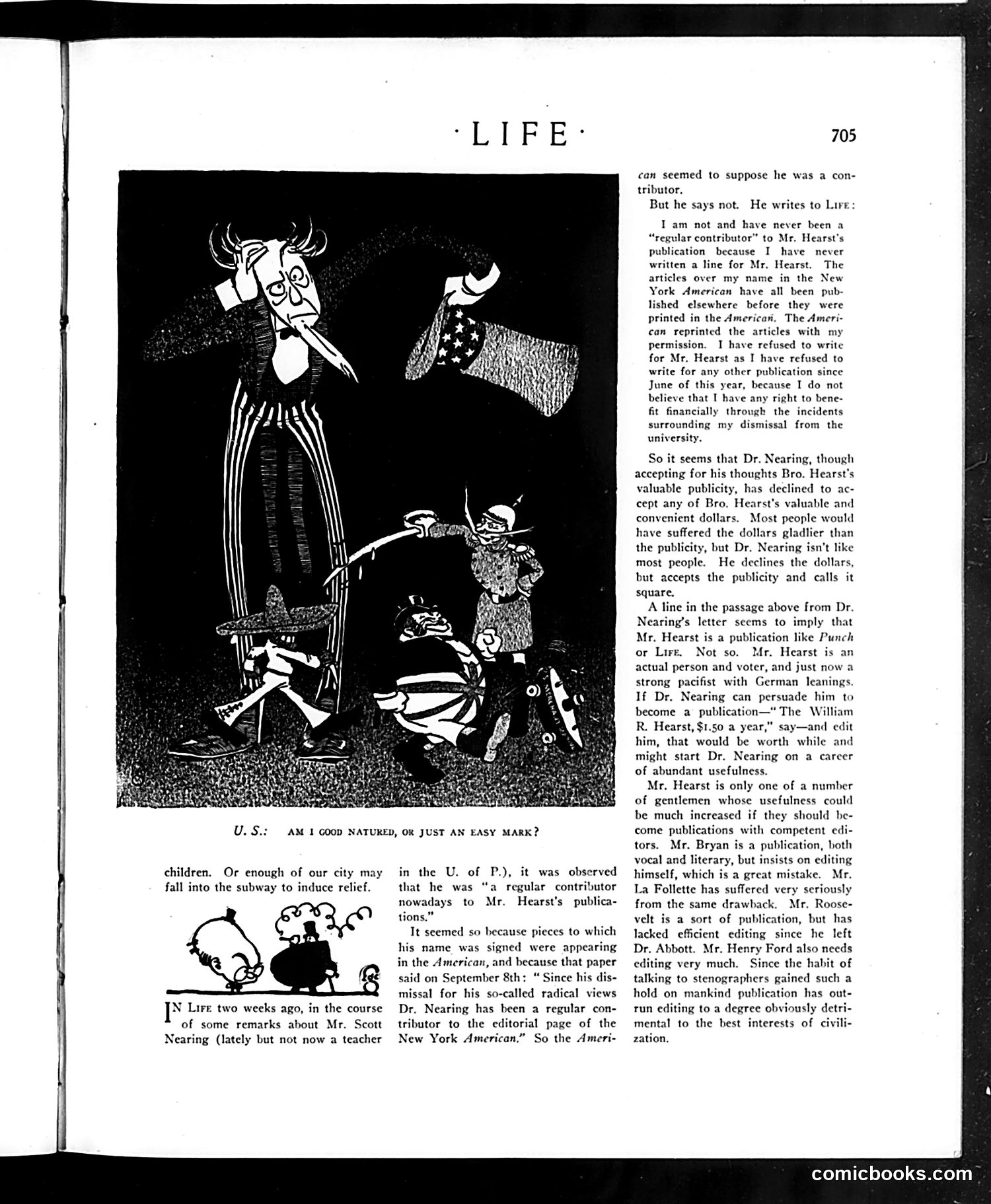
This *Life* magazine page satirizes a controversy involving **Scott Nearing**, a radical professor dismissed from the University of Pennsylvania. The *New York American* (owned by William Randolph Hearst, a powerful media mogul) claimed Nearing was a "regular contributor," but Nearing denied this—saying his articles were reprinted with permission, not commissioned, and he'd refused payment on principle, not wanting to profit from his university dismissal. The top cartoon depicts Uncle Sam (representing America) as a grotesque figure, likely mocking the hypocrisy of the situation. *Life*'s satire is multilayered: it mocks both Hearst's opportunistic use of Nearing's name for publicity and Nearing's self-righteousness. The magazine sarcastically suggests Hearst should become "a publication" himself with proper editing—a dig at powerful men (Hearst, Bryan, Roosevelt, Ford) who control media empires but lack objective editorial oversight, corrupting public discourse.
📄 Transcribed text from this page (OCR, searchable)
Machine-transcribed from the original scan — historical spelling and the odd misread are preserved.
children. Or enough of our city may fall into the subway to induce relief. Cane he N Lire two weeks ago, in the course of some remarks about Mr. Scott Nearing (lately but not now a teacher in the U. of P.), it was observed that he was “a regular contributor nowadays to Mr. Hearst's publica- tions.” It seemed so because pieces to which his name was signed were appearing in the American, and because that paper said on September 8th: “ Since his dis- missal for his so-called radical views Dr. Nearing has been a regular con- tributor to the editorial page of the New York American.” So the Ameri- 705 can seemed to suppose he was a con- tributor, But he says not. He writes to Lire: I am not and have never been a “regular contributor” to Mr. Hearst's publication because I have never written a line for Mr. Hearst. The articles over my name in the New York American have all been pub- lished elsewhere before they were printed in the Americar, The Ameri- can reprinted the articles with my permission. I have refused to write for Mr. Hearst as I have refused to write for any other publication since June of this year, because I do not believe that I have any right to bene- fit financially through the incidents surrounding my dismissal from the university. So it seems that Dr. Nearing, though accepting for his thoughts Bro. Hearst's valuable publicity, has declined to ac- cept any of Bro. Hearst's valuable and convenient dollars. Most people would have suffered the dollars gladlier than the publicity, but Dr. Nearing isn’t like most people. He declines the dollars, but accepts the publicity and calls it square. A line in the passage above from Dr. Nearing’s letter seems to imply that Mr. Hearst is a publication like Punch or Lire. Not so. Mr. Hearst is an actual person and voter, and just now a strong pacifist with German leanings. If Dr. Nearing can persuade him to become a publication—* The William R. Hearst, $1.50 a year,” say—and edit him, that would be worth while and might start Dr. Nearing on a career of abundant usefulness. Mr. Hearst is only one of a number of gentlemen whose usefulness could be much increased if they should be- come publications with competent edi- tors. Mr. Bryan is a publication, both vocal and literary, but insists on editing himself, which is a great mistake. Mr. La Follette has suffered very seriously from the same drawback. Mr. Roose- velt is a sort of publication, but has lacked efficient editing since he left Dr. Abbott. Mr. Henry Ford also needs editing very much. Since the habit of talking to stenographers gained such a hold on mankind publication has out- run editing to a degree obviously detri- mental to the best interests of civili- zation. comicbooks.com