
Life, 1915-10-14 · page 29 of 44
Life — October 14, 1915 — page 29: what you’re looking at
What you’re looking at
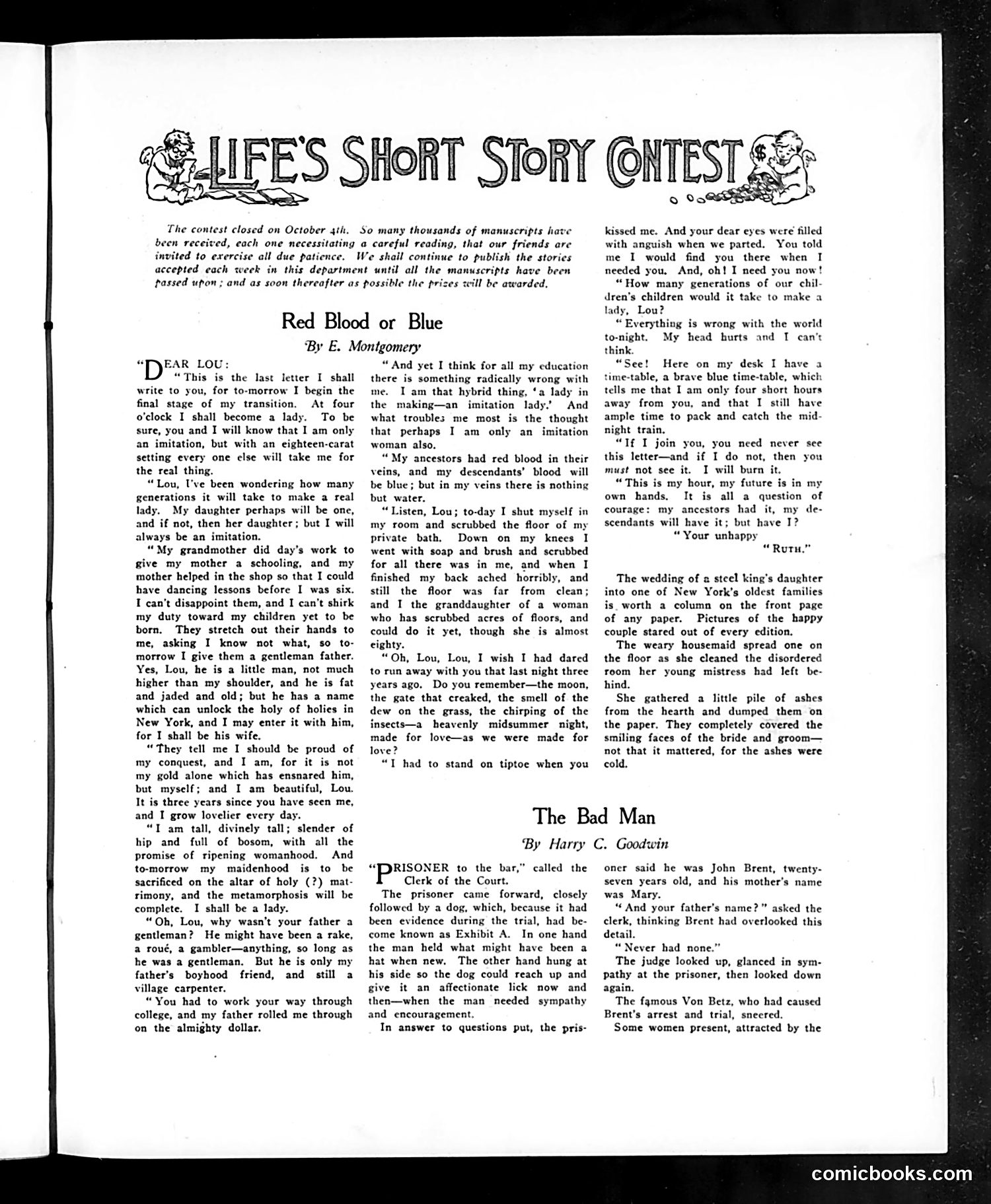
This page presents **two literary submissions** to Life magazine's short story contest, not political cartoons. **"Red Blood or Blue" by E. Montgomery:** A woman writes to her lover Lou, confessing she's marrying a wealthy but physically unattractive gentleman tomorrow—not for love, but for social status and to provide her future children with aristocratic legitimacy. She's conflicted: her working-class grandmother and mother sacrificed so she could ascend socially, yet she feels like a fraud—"an imitation lady" with "nothing but water" in her veins instead of the "blue blood" of true aristocracy. The title's tension reflects her anxiety about this class transition. **"The Bad Man" by Harry C. Goodwin:** Begins a story about a prisoner awaiting trial, apparently for serious crimes, with a judge and courtroom observers present. Both stories explore **early 20th-century American class anxieties**—specifically, social mobility's psychological cost and the perceived authenticity gap between inherited and achieved status. The satire targets pretension and the hollow nature of climbing social hierarchies.
📄 Transcribed text from this page (OCR, searchable)
Machine-transcribed from the original scan — historical spelling and the odd misread are preserved.
ES SHORT STORY GNTEST The contest closed on October 4th. been received, each one necessitating invited to exercise all due patience. accepted each week in this departmer passed upon; and as soon thereafter as possible the py So many thousands of manuscripts hav a careful reading, that our friends are We shail continue to publish the stories nt until all the manuscripts have been ill be awarded, Red Blood or Blue ‘By E. Montgomery “This is the last letter I shall write to you, for to-morrow I begin the final stage of my transition, At four o'clock I shall become a lady. To be sure, you and I will know that I am only an imitation, but with an eighteen-carat setting every one else will take me for the real thing. “Lou, I've been wondering how many generations it will take to make a real lady. My daughter perhaps will be one, and if not, then her daughter; but I will always be an imitation. “My grandmother did day’s work to give my mother a schooling, and my mother helped in the shop so that I could have dancing lessons before I was six. T can’t disappoint them, and I can’t shirk my duty toward my children yet to be born. They stretch out their hands to me, asking I know not what, so to- morrow I give them a gentleman father. Yes, Lou, he is a little man, not much higher than my shoulder, and he is fat and jaded and old; but he has a name which can unlock the holy of holies in New York, and I may enter it with him, for I shall be his wife. “They tell me I should be proud of my conquest, and I am, for it is not my gold alone which has ensnared him, but myself; and I am beautiful, Lou. It is three years since you have seen me, and I grow lovelier every day. “T am tall, divinely tall; slender of hip and full of bosom, with all the promise of ripening womanhood. And to-morrow my maidenhood is to be sacrificed on the altar of holy (?) mat- rimony, and the metamorphosis will be complete. I shall be a lady. “Oh, Lou, why wasn’t your father a gentleman? He might have been a rake, a roué, a gambler—anything, so long as he was a gentleman. But he is only my father’s boyhood friend, and still a village carpenter. “You had to work your way through college, and my father rolled me through on the almighty dollar. “And yet I think for all my education there is something radically wrong with me. I am that hybrid thing, ‘a lady in the making—an imitation lady.” And what troubles me most is the thought that perhaps I am only an_ imitation woman also. “My ancestors had red blood in their veins, and my descendants’ blood will be blue; but in my veins there is nothing but water. “Listen, Lou; to-day I shut myself in my room and scrubbed the floor of my private bath, Down on my knees I went with soap and brush and scrubbed for all there was in me, and when I finished my back ached horribly, and still the floor was far from clean; and I the granddaughter of a woman who has scrubbed acres of floors, and could do it yet, though she is almost eighty. “Oh, Lou, Lou, I wish I had dared to run away with you that last night three years ago, Do you remember—the moon, the gate that creaked, the smell of the dew on the grass, the chirping of the insects—a heavenly midsummer night, made for love—as we were made for love? “T had to stand on tiptoe when you Q So kissed me. And your dear eyes were filled with anguish when we parted. You told me I would find you there when I needed you. And, oh! I need you now! “How many generations of our chil- dren's children would it take to make a lady, Lou? “Everything is wrong with the world to-night. My head hurts and T can’t think. “See! Here on my desk I have a time-table, a brave blue time-table, which tells me that I am only four short hours away from you, and that I still have ample time to pack and catch the mid- night train, “If I join you, you need never see this letter—and if I do not, then you must not see it. I will burn it, “This is my hour, my future is in my own hands, It is all a question of courage: my ancestors had it, my de- scendants will have it; but have I? “Your unhappy “Ruru.” The wedding of a steel king's daughter into one of New York’s oldest families is. worth a column on the front page of any paper. Pictures of the happy couple stared out of every edition. The weary housemaid spread one on the floor as she cleaned the disordered room her young mistress had left be- hind. She gathered a little pile of ashes from the hearth and dumped them on the paper. They completely covered the smiling faces of the bride and groom— not that it mattered, for the ashes were cold. The Bad Man By Harry C. Goodwin “DDRISONER to the bar,” called the Clerk of the Court. The prisoner came forward, closely followed by a dog, which, because it had been evidence during the trial, had be- come known as Exhibit A. In one hand the man held what might have been a hat when new, The other hand hung at his side so the dog could reach up and give it an affectionate lick now and then—when the man needed sympathy and encouragement. In answer to questions put, the pris- oner said he was John Brent, twenty- seven years old, and his mother’s name was Mary. “And your father's name?” asked the clerk, thinking Brent had overlooked this detail. “Never had none.” The judge looked up, glanced in sym- pathy at the prisoner, then looked down again. The famous Von Betz, who had caused Brent’s arrest and trial, sneered. Some women present, attracted by the comicbooks.com