
Life, 1915-10-14 · page 12 of 44
Life — October 14, 1915 — page 12: what you’re looking at
What you’re looking at
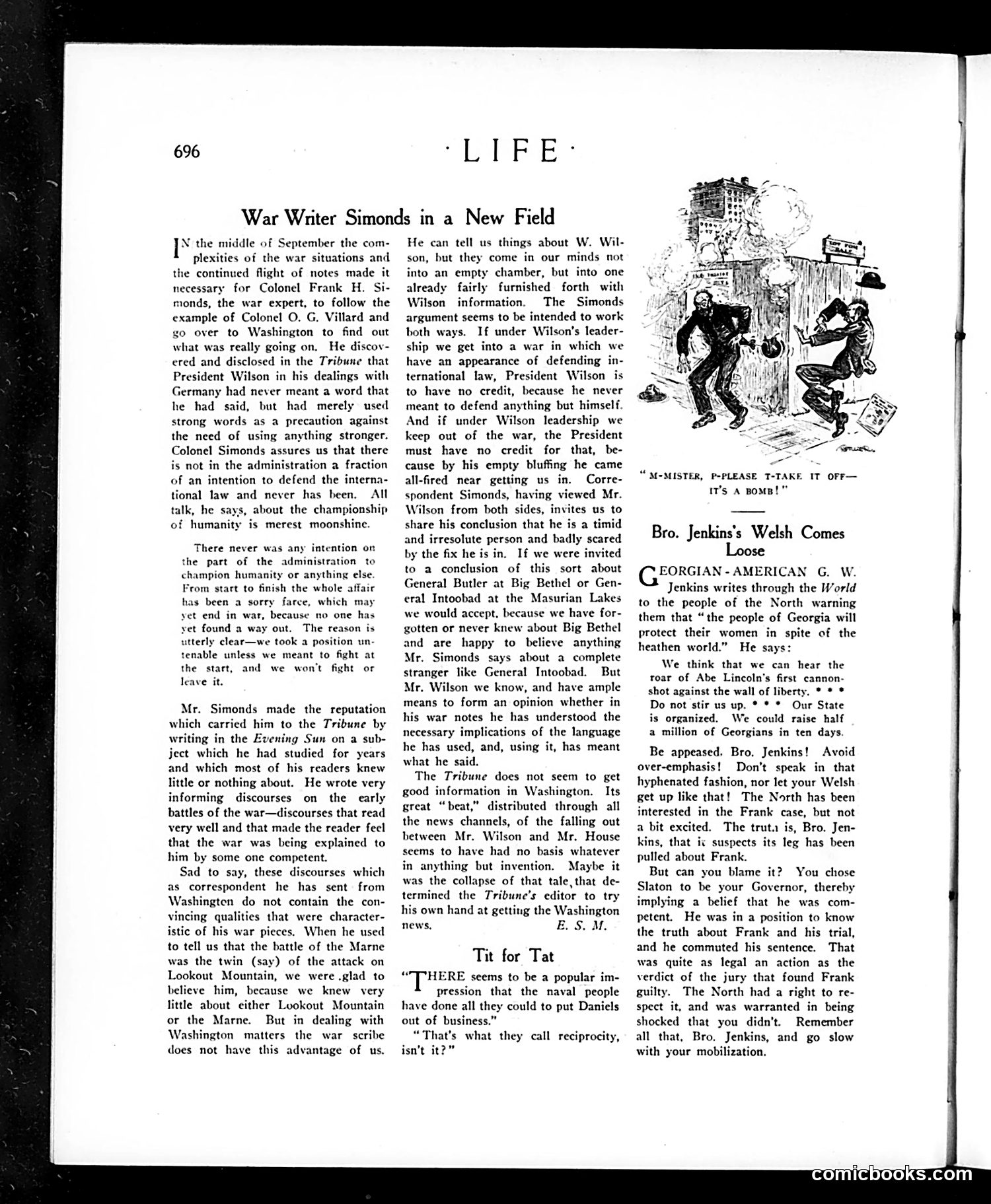
The cartoon depicts a figure labeled "M'MISTER, P'LEASE T'TAKE IT OFF—IT'S A BOMB!" showing someone frantically trying to remove what appears to be an explosive device. This illustrates articles criticizing Colonel Frank H. Simonds' war commentary. The text argues Simonds' writing in the *Tribune* contained inflammatory language about President Wilson's war leadership, suggesting Wilson bore no responsibility for military outcomes. The satire implies Simonds' heated rhetoric is dangerous—a "bomb" of incendiary prose. A second article by "Bro. Jenkins" addresses Georgia's mobilization efforts during what appears to be World War I, warning against complacency regarding women's safety during wartime. The page reflects early-20th-century debates over war journalism, presidential accountability, and home-front anxieties.
📄 Transcribed text from this page (OCR, searchable)
Machine-transcribed from the original scan — historical spelling and the odd misread are preserved.
"LYPE War Writer Simonds in a New Field IX the middle of September the com- plexities of the war situations and the continued flight of notes made it necessary for Colonel Frank H. Si- monds, the war expert, to follow the example of Colonel O. G. Villard and go over to Washington to find out what was really going on. He discov- ered and disclosed in the Tribune that President Wilson in his dealings with Germany had never meant a word that he had said, but had merely used strong words as a precaution against the need of using anything stronger. Colonel Simonds assures us that there is not in the administration a fraction of an intention to defend the interna- tional law and never has been, All talk, he says, about the championship of humanity is merest moonshine. There never was any intention on the part of the administration to champion humanity or anything else From start to finish the whole affair has been a sorry farce, which may yet end in war, because no one has yet found a way out. The reason is utterly clear—we took a position un- tenable unless we meant to fight at the start, and we won't fight or leave it. Mr. Simonds made the reputation which carried him to the Tribune by writing in the Evening Sun on a sub- ject which he had studied for years and which most of his readers knew little or nothing about. He wrote very informing discourses on the early battles of the war—discourses that read very well and that made the reader feel that the war was being explained to him by some one competent. Sad to say, these discourses which as correspondent he has sent from Washingten do not contain the con- vincing qualities that were character- istic of his war pieces. When he used to tell us that the battle of the Marne was the twin (say) of the attack on Lookout Mountain, we were .glad to Delieve him, because we knew very little about cither Lookout Mountain or the Marne. But in dealing with Washington matters the war scribe does not have this advantage of us. He can tell us things about W. Wil- son, but they come in our minds not into an empty chamber, but into one already fairly furnished forth with Wilson information. The Simonds argument seems to be intended to work both ways. If under Wilson's leader- ship we get into a war in which we have an appearance of defending in- ternational law, President Wilson is to have no credit, because he never meant to defend anything but himself, And if under Wilson leadership we keep out of the war, the President must have no credit for that, be- cause by his empty bluffing he came all-fired near getting us in. Corre- spondent Simonds, having viewed Mr. Wilson from both sides, invites us to share his conclusion that he is a timid and irresolute person and badly scared by the fix he is in. If we were invited to a conclusion of this sort about General Butler at Big Bethel or Gen- eral Intoobad at the Masurian Lakes we would accept, because we have for- gotten or never knew about Big Bethel and are happy to believe anything Mr. Simonds says about a complete stranger like General Intoobad. But Mr. Wilson we know, and have ample means to form an opinion whether in his war notes he has understood the necessary implications of the language he has used, and, using it, has meant what he said. The Tribune does not seem to get good information in Washington. Its great “beat,” distributed through all the news channels, of the falling out between Mr. Wilson and Mr. House seems to have had no basis whatever in anything but invention. Maybe it was the collapse of that tale, that de- termined the Tribune’s editor to try his own hand at getting the Washington news, ELS. M. Tit for Tat a Fa RE seems to be a popular im- pression that the naval people have done all th out of business. “That's what they call reciprocity, isn’t it?” y could to put Daniels “M-MISTER, P-PLEASE T-TAKE IT OFF— 11’s A BoMB!" Bro. Jenkins’s Welsh Comes Loose EORGIAN-AMERICAN G. W. Jenkins writes through the World to the people of the North warning them that “the people of Georgia will protect their women in spite of the heathen world.” He says: We think that we can hear the roar of Abe Lincoln's first cannon, shot against the wall of liberty. * * * Do not stir us up. * * * Our State is organized. We could raise half a million of Georgians in ten days. Be appeased. Bro. Jenkins! Avoid over-emphasis! Don’t speak in that hyphenated fashion, nor let your Welsh get up like that! The North has been interested in the Frank case, but not a bit excited. The truta is, Bro. Jen- kins, that ic suspects its leg has been pulled about Frank. But can you blame it? You chose Slaton to be your Governor, thereby implying a belief that he was com- petent. He was in a position to know the truth about Frank and his trial, and he commuted his sentence. That was quite as legal an action as the verdict of the jury that found Frank guilty. The North had a right to re- spect it, and was warranted in being shocked that you didn’t. Remember all that, Bro. Jenkins, and go slow with your mobilization.