
Life, 1915-10-14 · page 24 of 44
Life — October 14, 1915 — page 24: what you’re looking at
What you’re looking at
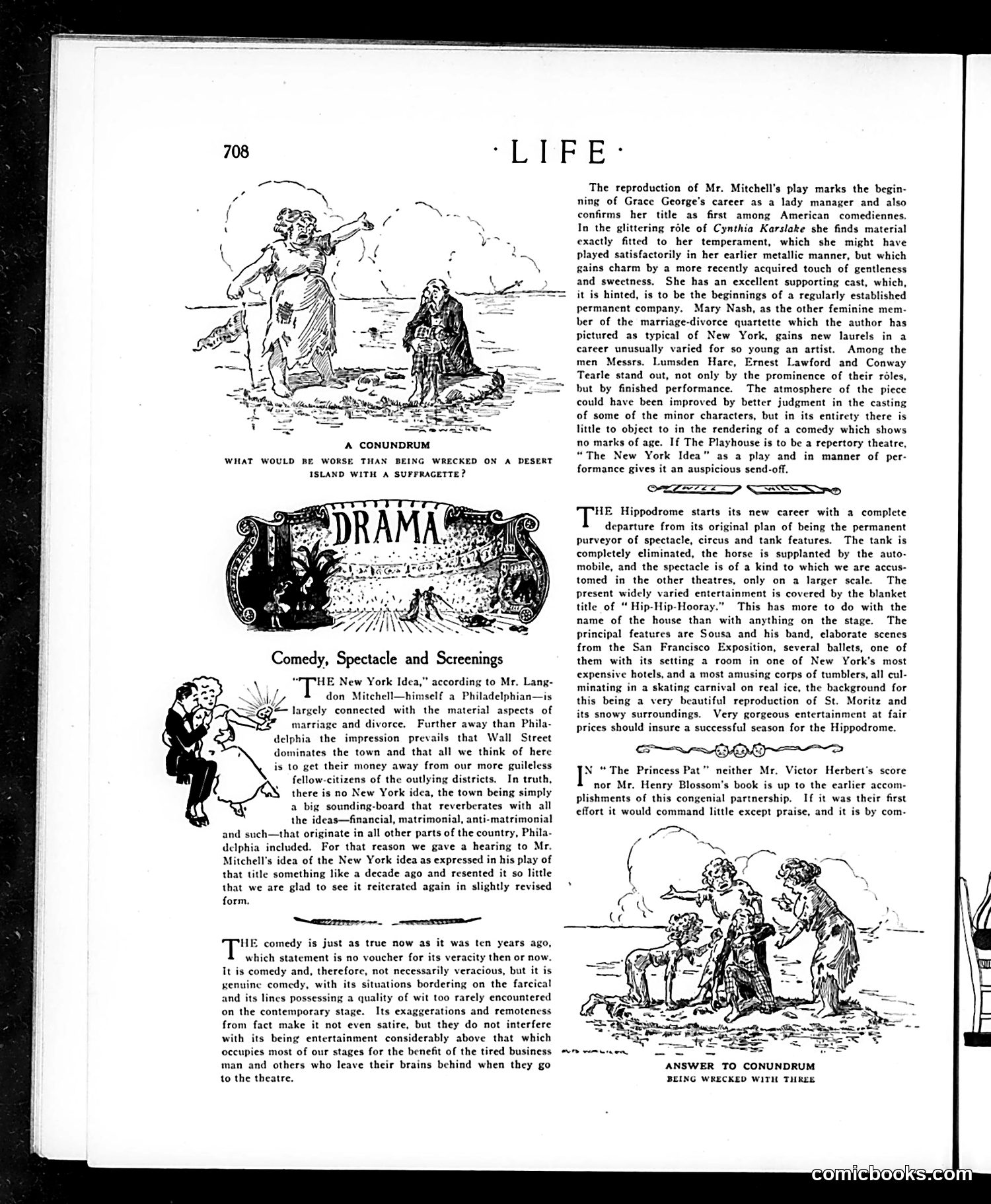
## The Conundrum Cartoon The top illustration presents a visual joke about **suffragettes**—women fighting for voting rights. The cartoon asks: "What would be worse than being wrecked on a desert island with a suffragette?" The answer (shown below) depicts three figures on an island, suggesting the punchline involves the woman's aggressive or domineering behavior. This reflects early-20th-century anti-suffrage sentiment. Opponents of women's voting rights often caricatured suffragettes as combative, emasculating, or otherwise socially disruptive. The "conundrum" format was common satirical fare in *Life*, which frequently mocked the women's suffrage movement through mockery of suffragettes' supposed personality flaws rather than engaging their actual arguments. The cartoon reveals period attitudes: voting rights for women were presented as a subject for ridicule rather than serious political debate.
📄 Transcribed text from this page (OCR, searchable)
Machine-transcribed from the original scan — historical spelling and the odd misread are preserved.
“LIFE: ‘A CONUNDRUM WHAT WOULD BE WORSE THAN BEING WRECKED ON A DESERT ISLAND WITH A SUFFRAGETTE? Comedy, Spectacle and Screenings \ “THE New York Idea,” according to Mr. Lang- \si/ don Mitchell—himself a Philadelphian—is “y& largely connected with the material aspects of marriage and divorce. Further away than Phila- delphia the impression prevails that Wall Street dominates the town and that all we think of here is to get their money away from our more guileless fellow-citizens of the outlying districts. In truth, there is no New York idea, the town being simply a big sounding-board that reverberates with all the ideas—financial, matrimonial, anti-matrimonial and such—that originate in all other parts of the country, Phila- delphia included. For that reason we gave a hearing to Mr. Mitchell's idea of the New York idea as expressed in his play of that title something like a decade ago and resented it so little that we are glad to see it reiterated again in slightly revised form. errs. eee HE comedy is just as true now as it was ten years ago, which statement is no voucher for its veracity then or now. It is comedy and, therefore, not necessarily veracious, but it is xenuine comedy, with its situations bordering on the farcical and its lines possessing a quality of wit too rarely encountered ‘on the contemporary stage. Its exaggerations and remoteness from fact make it not even satire, but they do not interfere with its being entertainment considerably above that which The reproduction of Mr. Mitchell's play marks the begin- ning of Grace George's career as a lady manager and also confirms her title as first among American comediennes. In the glittering role of Cynthia Karslake she finds material exactly fitted to her temperament, which she might have played satisfactorily in her earlier metallic manner, but which gains charm by a more recently acquired touch of gentleness and swectness, She has an excellent supporting cast, which, it is hinted, is to be the beginnings of a regularly established permanent company. Mary Nash, as the other feminine mem- ber of the marriage-divorce quartette which the author has pictured as typical of New York, gains new laurels in a career unusually varied for so young an artist. Among the men Messrs. Lumsden Hare, Ernest Lawford and Conway Tearle stand out, not only by the prominence of their rdles, but by finished performance. The atmosphere of the piece could have been improved by better judgment in the casting of some of the minor characters, but in its entirety there is little to object to in the rendering of a comedy which shows no marks of age. If The Playhouse is to be a repertory theatre, “The New York Idea” as a play and in manner of per- formance gives it an auspicious send-off. Ome SSS > HE Hippodrome starts its new career with a complete departure from its original plan of being the permanent purveyor of spectacle, circus and tank features. The tank is completely eliminated, the horse is supplanted by the auto- mobile, and the spectacle is of a kind to which we are accus- tomed in the other theatres, only on a larger scale. The present widely varied entertainment is covered by the blanket title of “ Hip-Hip-Hooray.” This has more to do with the name of the house than with anything on the stage. The principal features are Sousa and his band, elaborate scenes from the San Francisco Exposition, several ballets, one of them with its setting a room in one of New York's most expensive hotels, and a most amusing corps of tumblers, all cul- minating in a skating carnival on real ice, the background for this being a very beautiful reproduction of St. Moritz and its snowy surroundings. Very gorgeous entertainment at fair prices should insure a successful season for the Hippodrome. IX “The Princess Pat” neither Mr. Victor Herbert's score nor Mr. Henry Blossom’s book is up to the earlier accom- plishments of this congenial partnership. If it was their first effort it would command little except praise, and it is by com- occupies most of our stages for the benefit of the tired business 7 ~=+~ man and others who leave their brains behind when they go to the theatre. ANSWER TO CONUNDRUM BEING WRECKED WITH THREE