
Life, 1915-10-14 · page 14 of 44
Life — October 14, 1915 — page 14: what you’re looking at
What you’re looking at
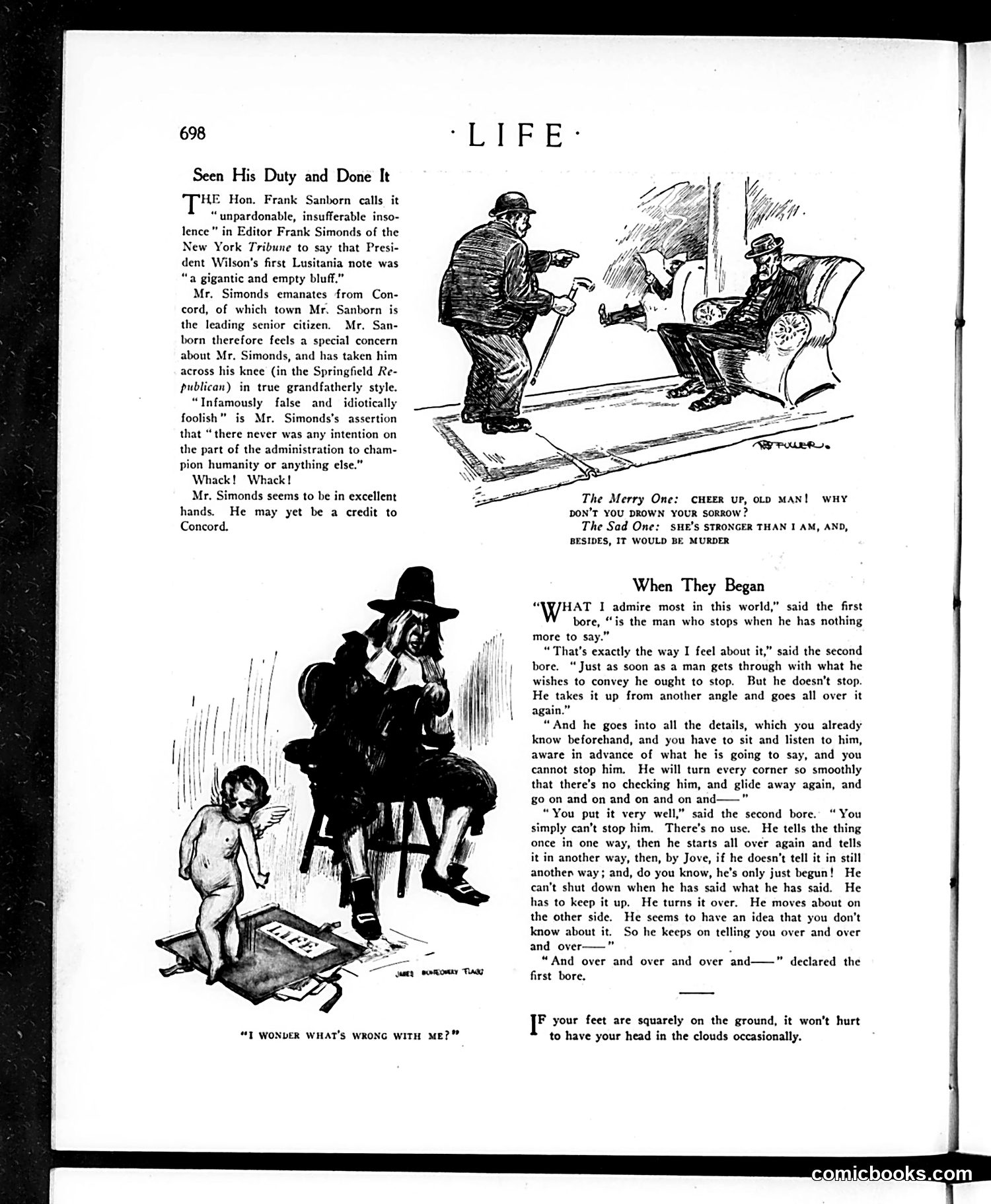
This page contains commentary on **Frank Simonds**, a prominent editor of the *New York Tribune*, criticizing President Wilson's handling of the Lusitania crisis. The Hon. Frank Sanborn calls Simonds's editorial an "unpardonable insolence," while the *Springfield Republican* labels his claims "infamously false and idiotically foolish." The top cartoon depicts a confrontation between two figures, with dialogue about drowning sorrow—likely satirizing responses to the ship's sinking and the administration's diplomatic response. The lower illustration shows a man (possibly representing a bored or frustrated speaker) with Cupid, captioned "I wonder what's wrong with me?"—suggesting commentary on public indifference or fatigue. The "When They Began" section is a humorous dialogue about compulsive talkers.
📄 Transcribed text from this page (OCR, searchable)
Machine-transcribed from the original scan — historical spelling and the odd misread are preserved.
698 Seen His Duty and Done It HE Hon. Frank Sanborn calls it “unpardonable, insufferable inso- lence” in Editor Frank Simonds of the New York Tribune to say that Presi- dent Wilson's first Lusitania note was “a gigantic and empty bluff.” Mr. Simonds emanates from Con- cord, of which town Mr. Sanborn is the leading senior citizen. Mr, San- born therefore feels a special concern about Mr. Simonds, and has taken him across his knee (in the Springfield Re- publican) in true grandfatherly style. “Infamously false and idiotically foolish” is Mr. Simonds’s assertion that “there never was any intention on the part of the administration to cham- pion humanity or anything else.” Whack! Whack! . Mr. Simonds seems to be in excellent : The Merry One: CHEER UP, OLD MAN! WHY hands. He may yet be a credit to DON’T YOU DROWN YOUR SORROW? Concord. The Sad One: sHe's STRONGER THAN I AM, AND, BESIDES, IT WOULD BE MURDER When They Began “VY/HAT I admire most in this world,” said the first bore, “is the man who stops when he has nothing more to say.” “That's exactly the way I feel about it,” said the second bore. “Just as soon as a man gets through with what he wishes to convey he ought to stop. But he doesn’t stop. He takes it up from another angle and goes all over it again.” “And he goes into all the details, which you already know beforehand, and you have to sit and listen to him, aware in advance of what he is going to say, and you cannot stop him. He will turn every corner so smoothly that there’s no checking him, and glide away again, and go on and on and on and on and——” “You put it very well,” said the second bore. “You simply can’t stop him. There’s no use. He tells the thing once in one way, then he starts all over again and tells it in another way, then, by Jove, if he doesn’t tell it in still anothen way; and, do you know, he's only just begun! He can't shut down when he has said what he has said. He has to keep it up. He turns it over. He moves about on the other side. He seems to have an idea that you don’t know about it. So he keeps on telling you over and over and over——” “And over and over and over and——” declared the first bore. F your feet are squarely on the ground, it won't hurt “T WONDER WHAT'S WRONG WITH ME?" to have your head in the clouds occasionally.