
A complete issue · 48 pages · 1915
Life — September 16, 1915
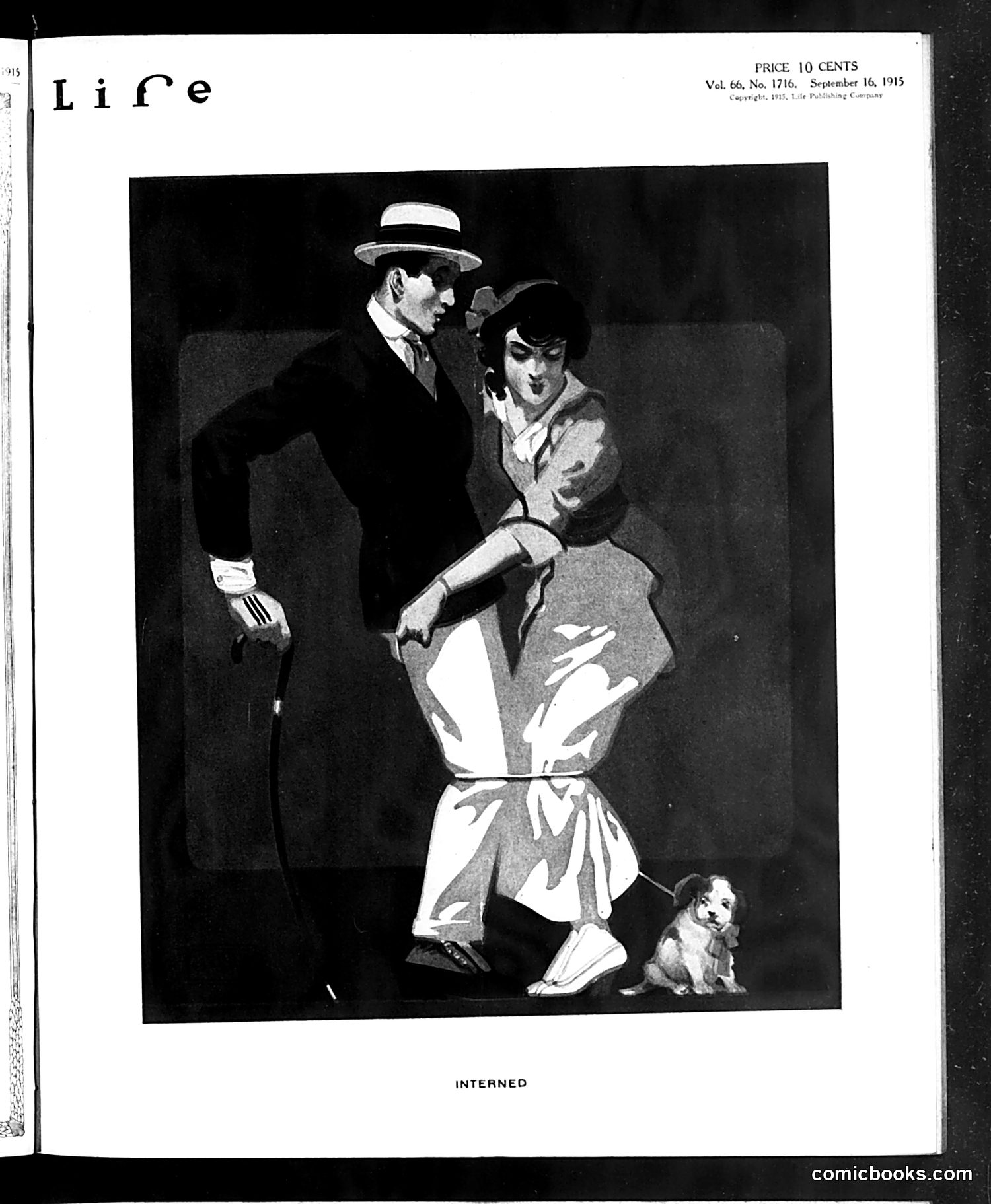
This cartoon satirizes the internment of aliens during World War I. The illustration depicts a well-dressed man and woman being "interned"—confined or restricted—while a small dog observes. The title "Interned" appears below. In 1915, the U.S. remained officially neutral but tensions were high. The cartoon likely mocks the treatment of foreign nationals, particularly Germans and Austro-Hungarians, who faced suspicion and restrictions. The couple's formal attire suggests they were respectable citizens, yet they're being confined like the small dog at their feet—suggesting the indignity and absurdity of treating civilians as potential enemies based solely on national origin. The satire critiques both wartime hysteria and the loss of freedoms for innocent people.
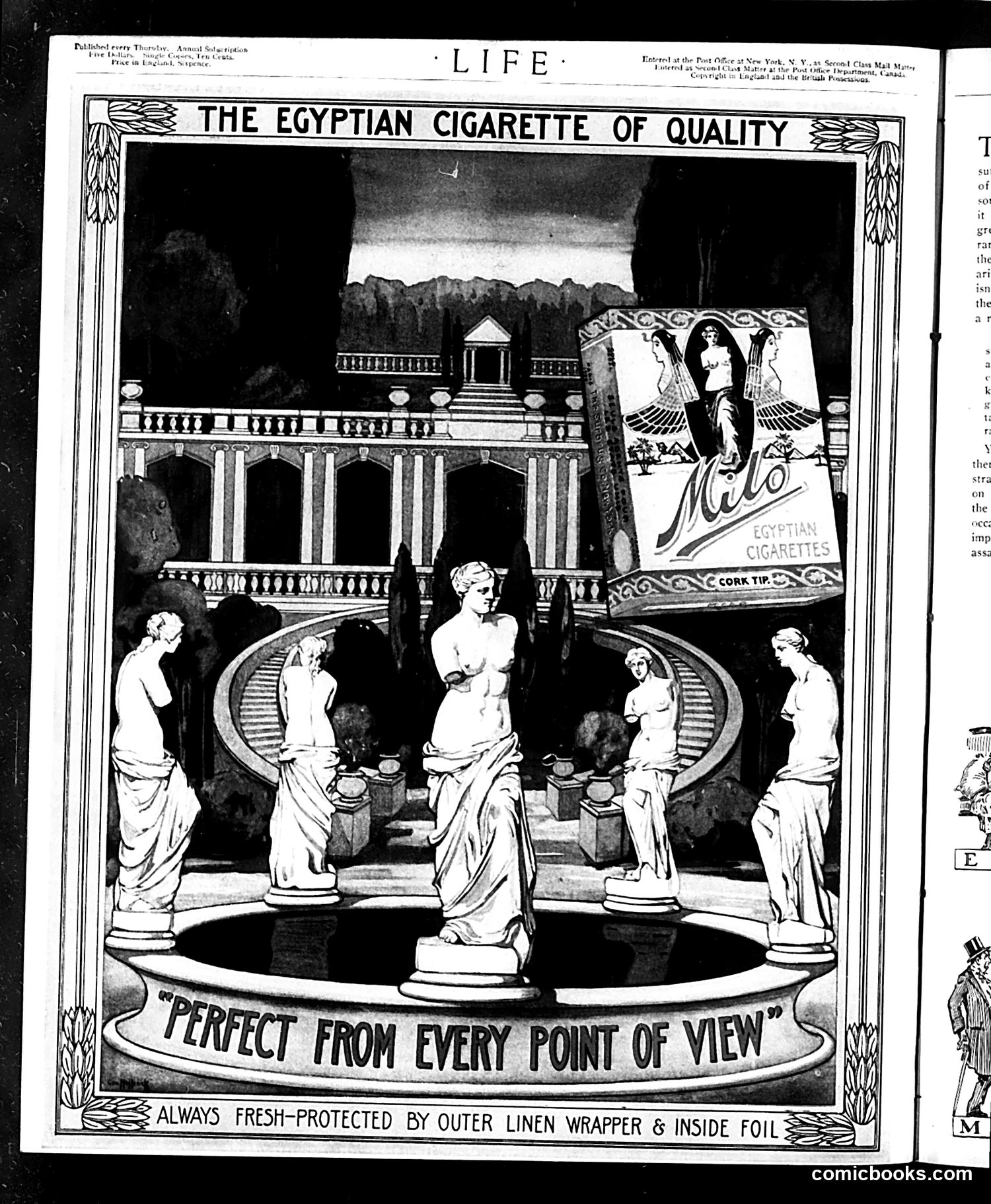
This page is primarily an advertisement for Malo Egyptian cigarettes, not political satire. The advertisement shows classical nude female statues arranged in a Roman or Greek bath setting, with the tagline "Perfect From Every Point of View." The imagery uses Greco-Roman classical aesthetics to market cigarettes by associating them with sophistication and beauty. The "cork tip" detail and emphasis on freshness ("Always Fresh—Protected by Outer Linen Wrapper & Inside Foil") highlight product features. The Malo brand name appears on a banner with winged figures, suggesting luxury and elegance. This is typical early 20th-century cigarette advertising that leveraged classical imagery and aesthetic ideals to appeal to consumers, particularly men, by connecting the product to refinement and timeless beauty.
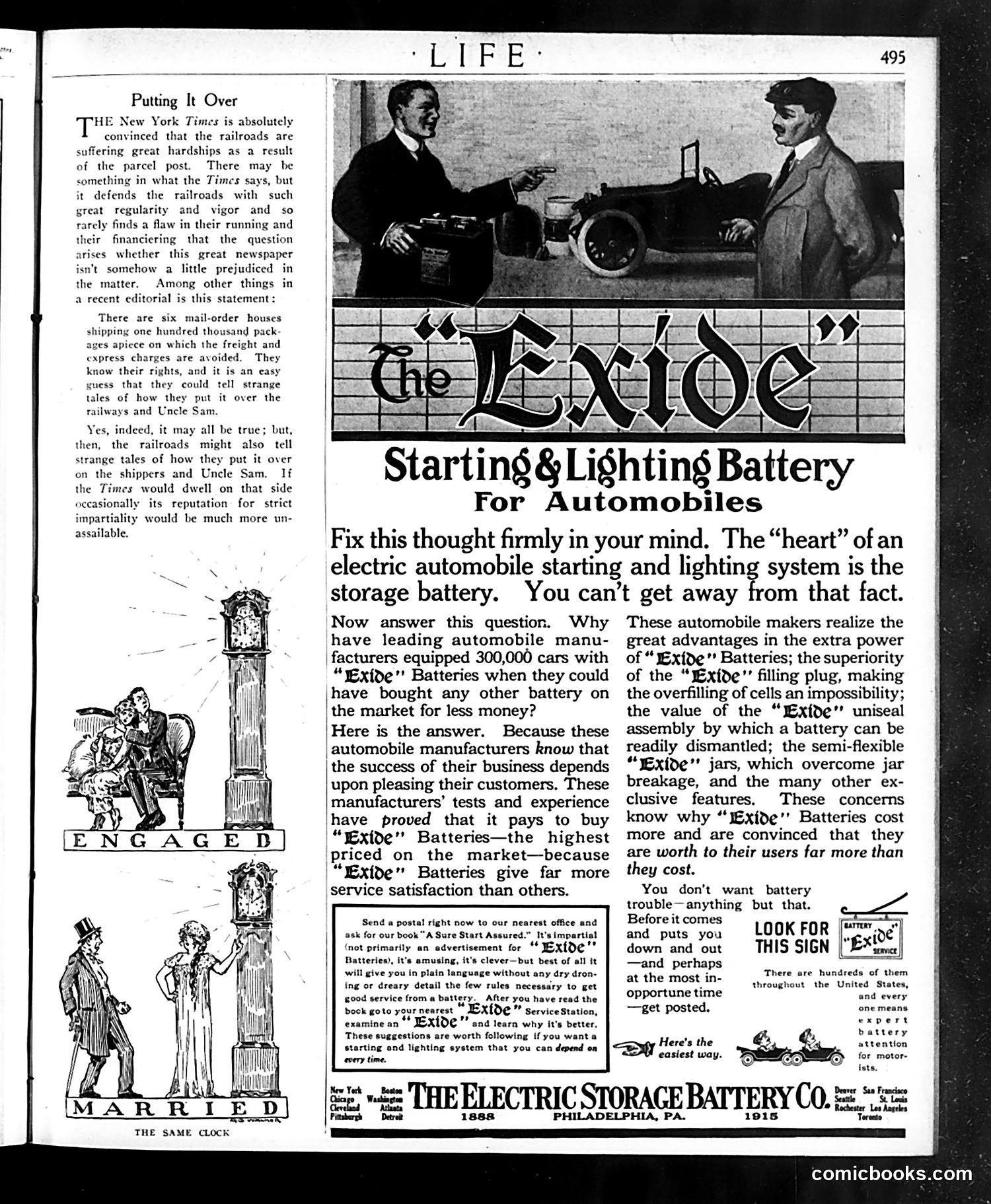
This page is primarily **advertising for Exide batteries**, with a small editorial section on the left about railroad shipping practices. The left column's "Putting It Over" discusses whether the *New York Times* unfairly criticizes railroads' parcel-post handling, suggesting the Times may have prejudged the issue. The main content features a humorous illustrated sequence titled "The Same Clock" showing figures labeled "ENGAGED" and "MARRIED," apparently contrasting states before and after marriage—a common satirical theme in Life magazine about how circumstances change. The Exide advertisement dominates, promoting automobile batteries by explaining why manufacturers choose premium batteries despite cheaper alternatives, emphasizing reliability and customer satisfaction as business priorities. The ad uses rhetorical questions and benefits-focused messaging typical of early automotive marketing.
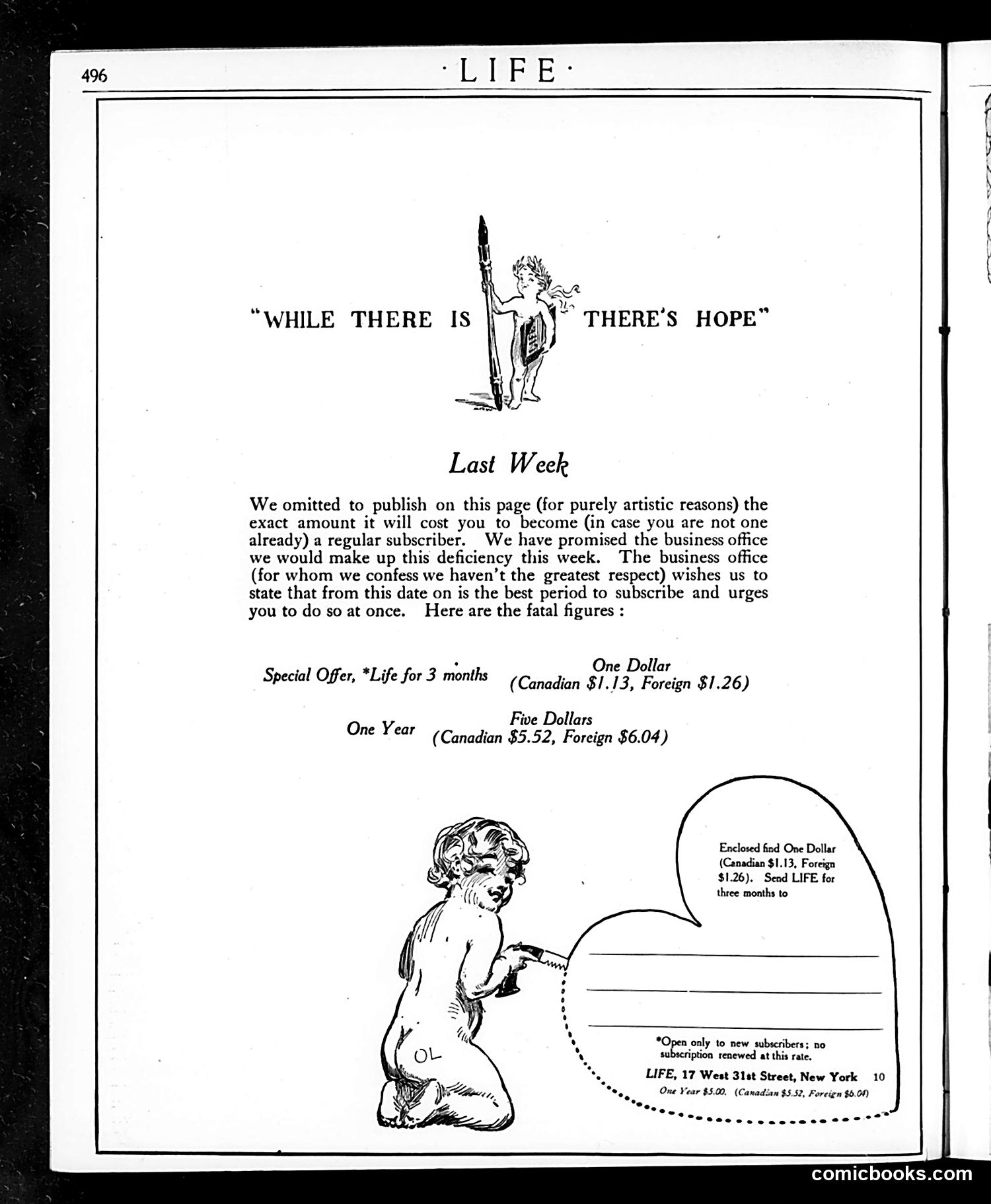
This is primarily a **subscription advertisement** for *Life* magazine rather than a political cartoon. The page uses two classical cherub/putto figures—common decorative elements in early 20th-century design—as visual hooks. The top cherub holds a torch alongside the motto "While There Is Life, There's Hope," a play on the magazine's title. The bottom section features a nude cherub in a subscription offer format, with a dotted-line speech bubble for the reader to fill in their address. This mixing of classical imagery with commercial messaging was typical of *Life's* satirical brand identity. The "Last Week" text explains that pricing information was previously omitted "for purely artistic reasons" and promises subscription rates: one dollar for three months or five dollars yearly (with Canadian and foreign variations listed). This is commercial messaging employing artistic elements rather than political satire.
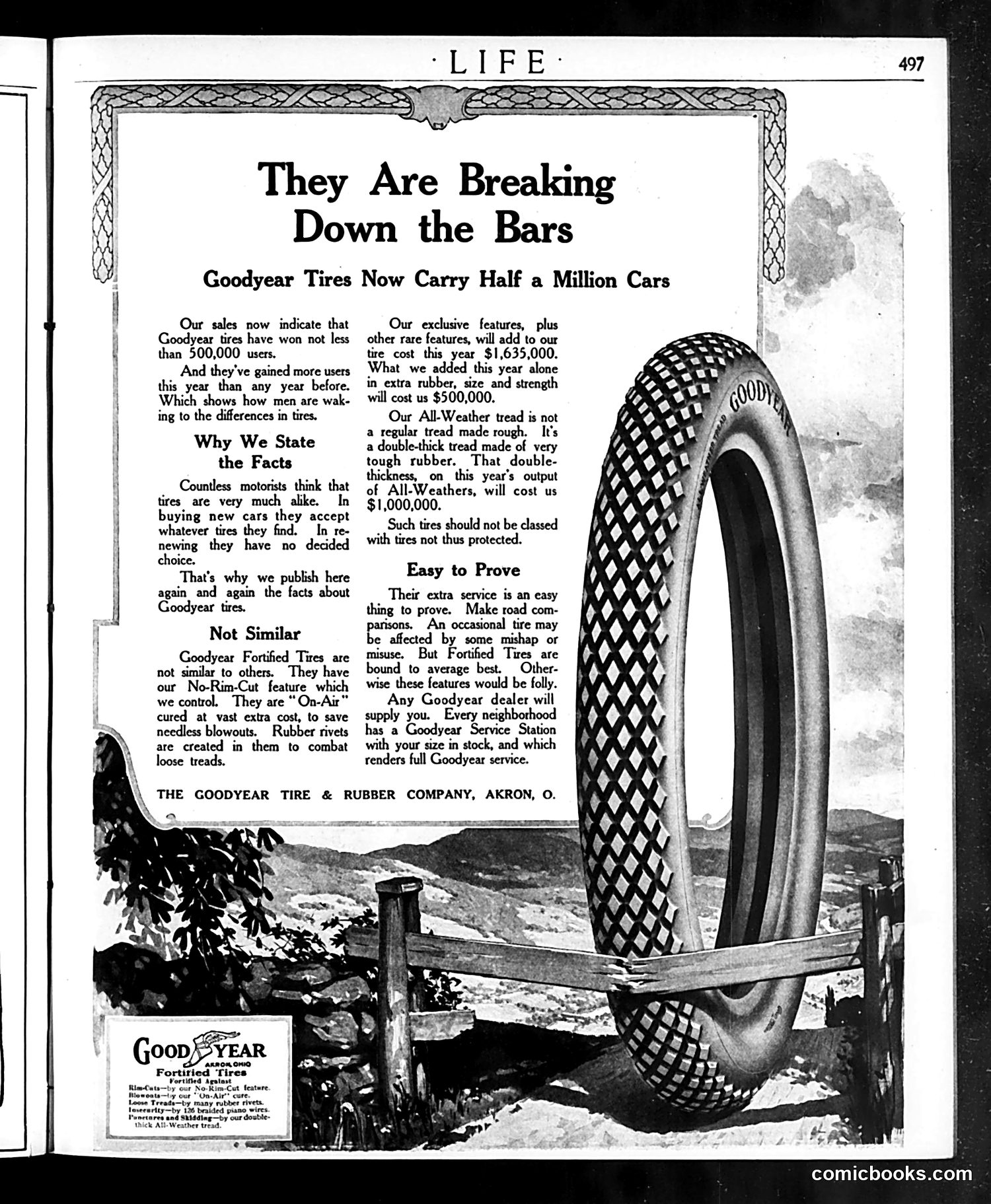
This is **not a political cartoon or satire**—it's a straightforward **product advertisement** for Goodyear Fortified Tires, published in *Life* magazine (page 497). The ad makes competitive claims about Goodyear's market dominance: they've captured 500,000 cars and gained more users than any competitor. It emphasizes unique features like their "No-Rim-Cut" design and "On-Air" curing process, plus double-thick treads for durability. The large image shows a tire mounted on a rural fence, demonstrating the product's robustness. The copy stresses that Goodyear tires are "not similar to others" and invites readers to make "road comparisons" to prove superiority. This represents early automotive advertising's focus on technical specifications and reliability claims to build consumer trust in a competitive market.
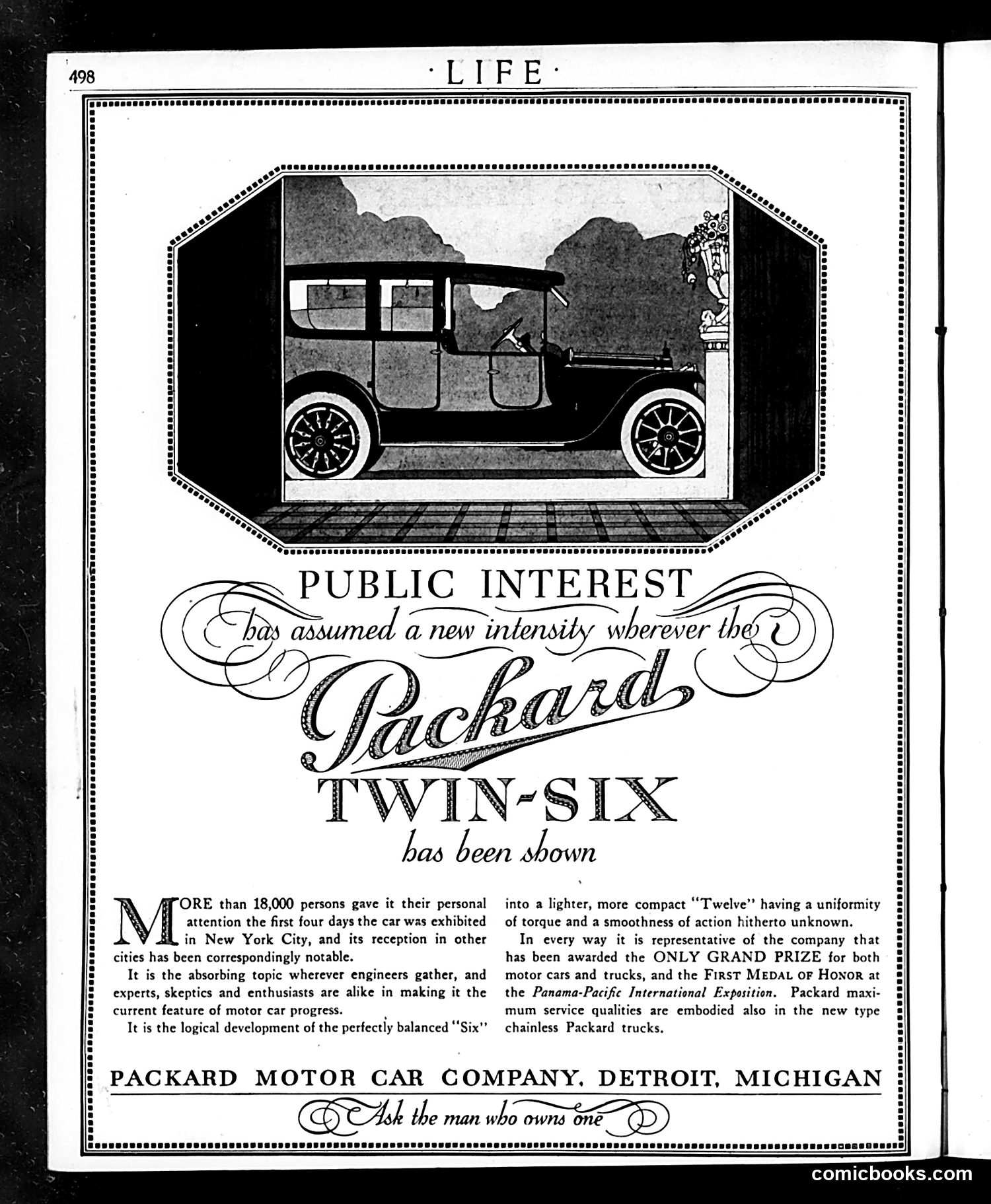
This is **not a political cartoon but an automobile advertisement** from Life magazine (page 498). It promotes the Packard Twin-Six motorcar, manufactured by Packard Motor Car Company in Detroit, Michigan. The ad emphasizes that over 18,000 people attended the car's exhibition in New York City during its first four days. It highlights the vehicle's technical achievements—described as a "perfectly balanced" design representing logical development—and notes it won the "only grand prize" and "first medal of honor" at the Panama-Pacific International Exposition. The illustration shows a side view of the enclosed automobile with multiple windows and spoke wheels, typical of 1910s design. The ad targets affluent readers by emphasizing engineering excellence and prestigious awards rather than price or affordability.
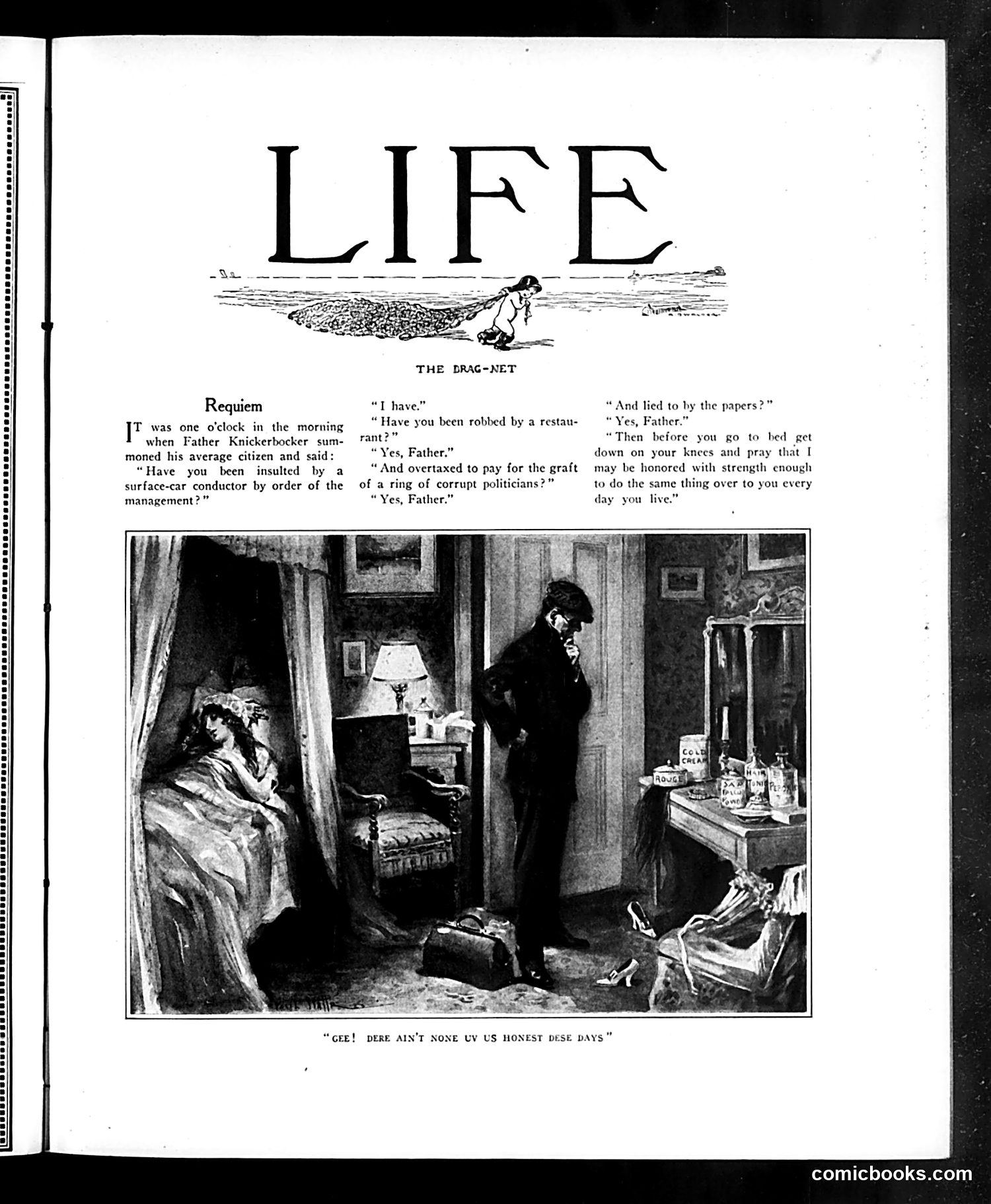
This page satirizes corruption among public officials and the moral compromises of ordinary citizens. The dialogue between Father Knickerbocker (representing New York City) and an "average citizen" reveals systemic graft: the citizen admits to being cheated by a corrupt surface-conductor (streetcar operator), paying bribes to dishonest politicians, and lying to newspapers about it. The illustration depicts a deathbed scene—suggesting civic morality is dying. The satire's point: corruption has become so normalized that citizens participate in and accept dishonest practices as routine. The title "Requiem" and final caption ("Gee! Dere ain't none uv us honest dese days") emphasize how widespread corruption has infected all levels of society, from officials to ordinary people.
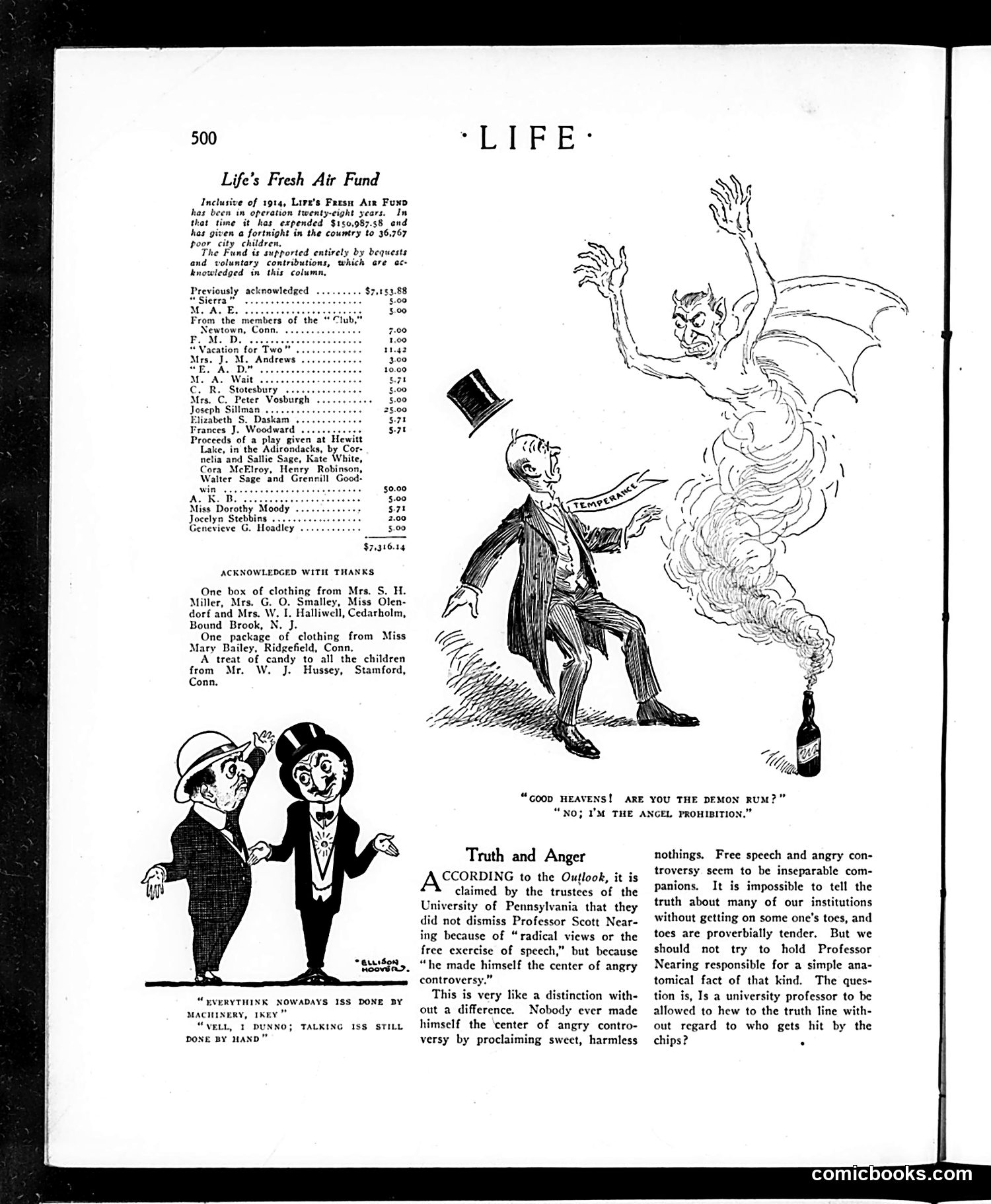
This page satirizes a controversy at the University of Pennsylvania regarding Professor Scott Nearing. The text explains that university trustees dismissed Nearing not for "radical views or free exercise of speech," but because he made himself "the center of angry controversy." The main cartoon depicts a man labeled "Temperance" attempting to control a demon (representing anger or unrest) emerging from a bottle—a visual metaphor for prohibition-era tensions. The accompanying article argues that universities shouldn't hold professors responsible merely for sparking controversy. The satire suggests the trustees' claim to defend free speech while firing someone for causing anger is hypocritical and anatomically impossible—you can't be hit by chips if no one gets angry.
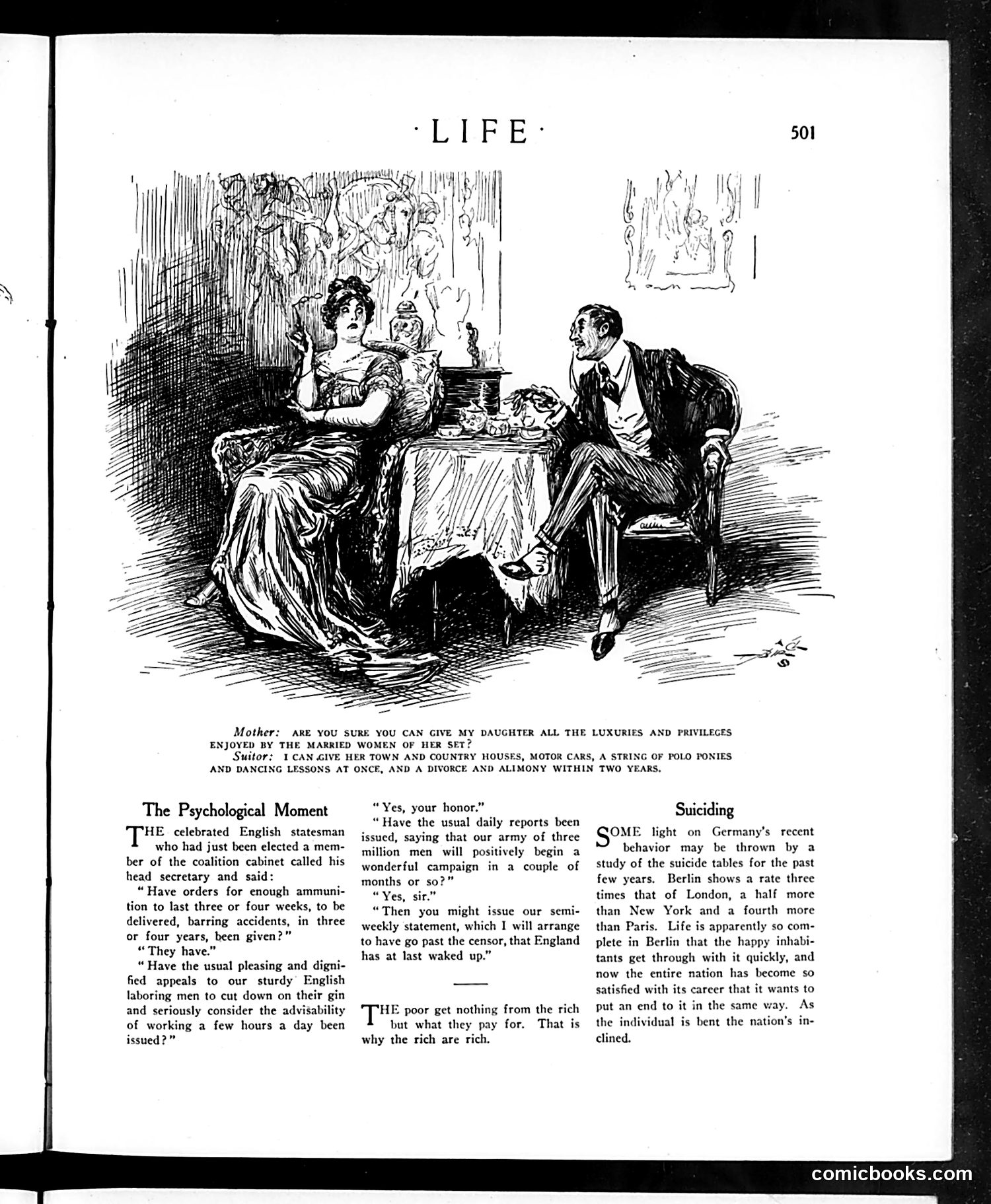
**The Main Cartoon** depicts a conversation between a mother and sailor about marriage prospects. The mother asks if he can provide luxuries for her daughter; the sailor boasts he can offer "town and country houses, motor cars, a string of polo ponies and dancing lessons" plus "a divorce and alimony within two years." This satirizes early 20th-century marriage instability among the wealthy—specifically the ease and prevalence of divorce, which was becoming more socially acceptable but remained scandalous. The joke mocks both the sailor's cynical assumptions and the mother's mercenary focus on material goods. **The text sections** address unrelated topics: cabinet communications delays, labor hours debates, and German suicide rates. These appear to be separate satirical commentary pieces typical of Life's format.
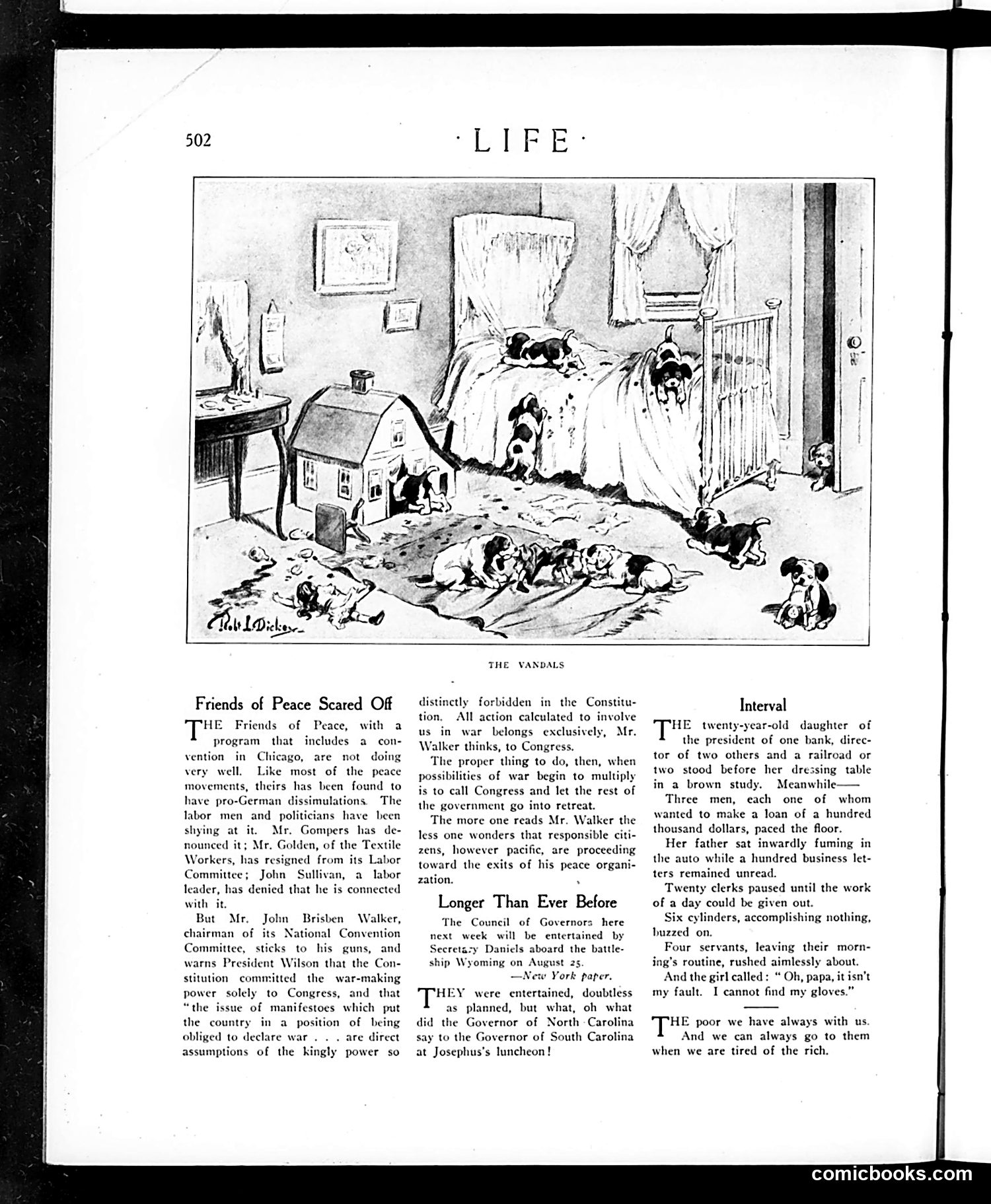
This satirical cartoon depicts multiple small dogs destroying a bedroom—overturning furniture, scattering items, and creating chaos. The image is labeled "THE VANDALS." The accompanying text discusses the Friends of Peace organization and their concerns about war powers. John Birsten Walker, chairman of the National Convention Committee, warns President Wilson that the Constitution granted war-making power to Congress, not the President alone, arguing this represents an unconstitutional assumption of power. The "vandals" metaphor appears to criticize those perceived as recklessly destructive to constitutional governance—likely referring to pro-war advocates or government overreach during the World War I era. The dogs' mindless destruction parallels the text's warning about constitutional violations.
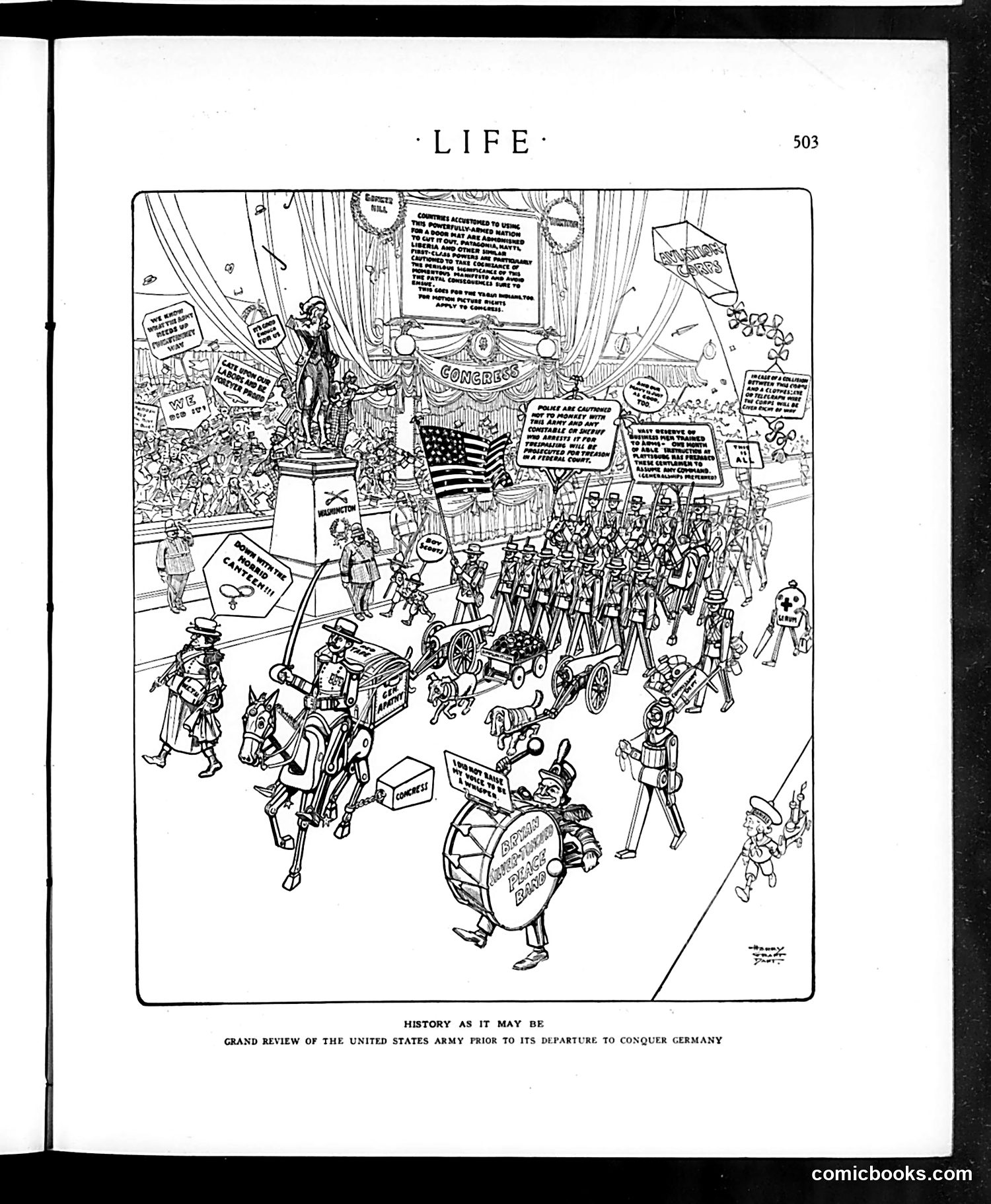
This is a satirical cartoon titled "Grand Review of the United States Army Prior to Its Departure to Conquer Germany." The image depicts a massive military parade in what appears to be a grand government building or auditorium, with Congress meeting in session above. The satire seems to mock American military ambitions and congressional enthusiasm for war with Germany. The scene shows soldiers, military equipment, and what appears to be political figures observing or endorsing military expansion. The cartoon's critical tone suggests skepticism about war plans or the romanticization of military conquest. The text boxes throughout contain dialogue, though specific details are difficult to read clearly in this reproduction. The overall message appears cynical about how history would later remember this moment.
This page presents two short stories submitted to Life's fiction contest. "The Man Who Told" by John Cutter concerns a murder mystery aboard a trans-Atlantic liner—a wealthy New Yorker dies from a stab wound, and a crucial clue (a stiletto) goes missing until being located years later. "The Arm at Gravelotte" by William Athwood Wolf, Jr. depicts a WWI scene where an elderly German village patriarch, Hans Schmidt, has his house commandeered as Great Headquarters Staff during the war. The story focuses on the military occupation and Schmidt's experience witnessing the movement of troops and the general wartime operations around him. Both are straightforward fiction entries, not political satire.
This page contains a short story titled "Nemesis" by Mary Clark, not political satire or cartoons. The narrative describes a struggling mule ("the Little White Mare") working hauling freight in Mexico and the American Southwest. The story depicts the animal's harsh labor—carrying goods across difficult terrain, enduring poor treatment from handlers, and suffering deprivation. The plot culminates when a man named Estevan mistreats the mule severely. The "nemesis" appears to be the mule's ultimate revenge or vindication, hinted at in the final lines suggesting the animal has been "avenged." This is period fiction illustrating animal welfare themes rather than political commentary or satire.
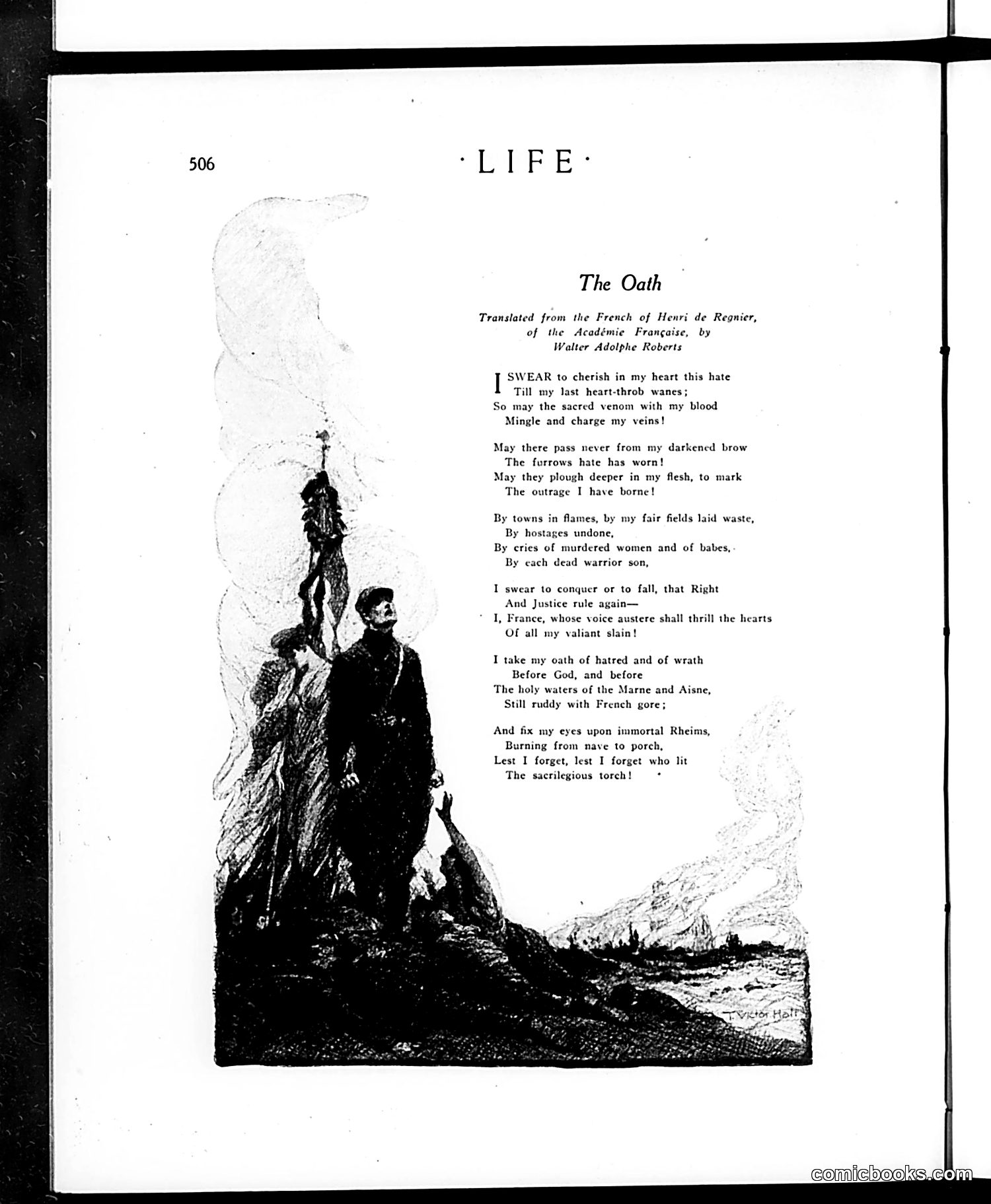
This page presents a poem translated from French by Henri de Regnier, rendered into English by Walter Adolphe Roberts. The illustration depicts a soldier or military figure standing on a rocky outcrop, raising what appears to be a flag or torch, with dramatic cloudy skies above. The poem is a vow of vengeance and hatred, swearing to cherish "sacred venom" and "hate," referencing destruction of towns, hostages, murdered women and children. The oath culminates in fixing "eyes upon immortal Rheims, / Burning from nave to porch." This appears to reference World War I atrocities—specifically the German bombardment of Rheims Cathedral in 1914. The poem transforms personal witness testimony into a solemn vow of retribution, using classical oath-taking imagery to justify continued warfare against Germany.
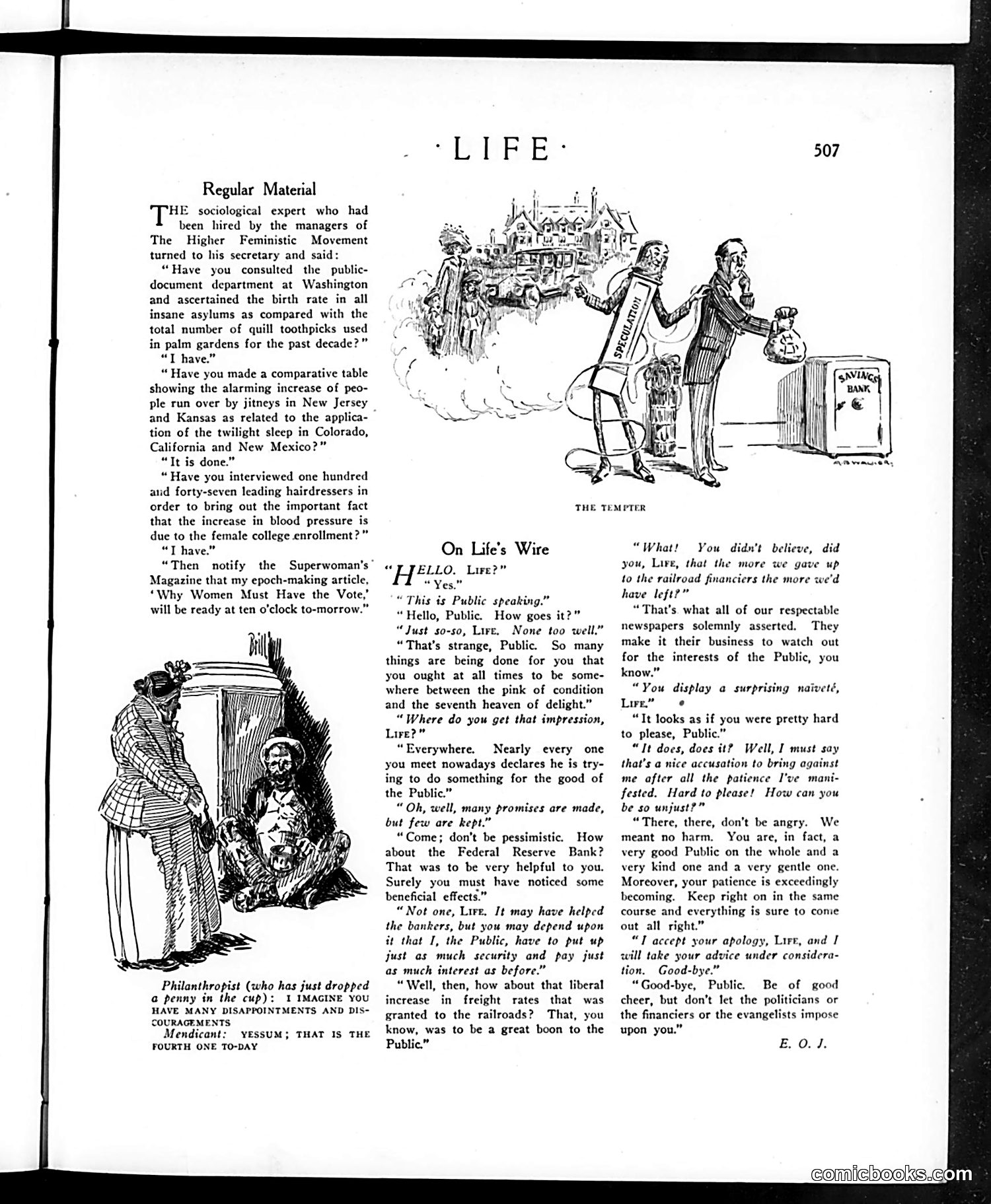
This page satirizes bureaucratic absurdity and public relations. The left cartoon mocks a "Philanthropist" who dropped a penny in a cup, imagining grand social reforms (asylums, toothpick usage, gardens). The caption notes "MANY DISAPPOINTMENTS AND DISCOURAGEMENTS" attend such modest charity. The main dialogue, "On Life's Wire," features LIFE speaking with the PUBLIC about newspapers' self-appointed role as guardians of public interest. PUBLIC complains newspapers exploit causes (Federal Reserve Bank, railroad rates) for moral authority while serving political/financial interests. LIFE defends journalism's role while PUBLIC expresses skepticism about press motives. The satire targets both shallow philanthropy and newspapers' conflation of profit with public service—issues of press credibility that remain relevant today.
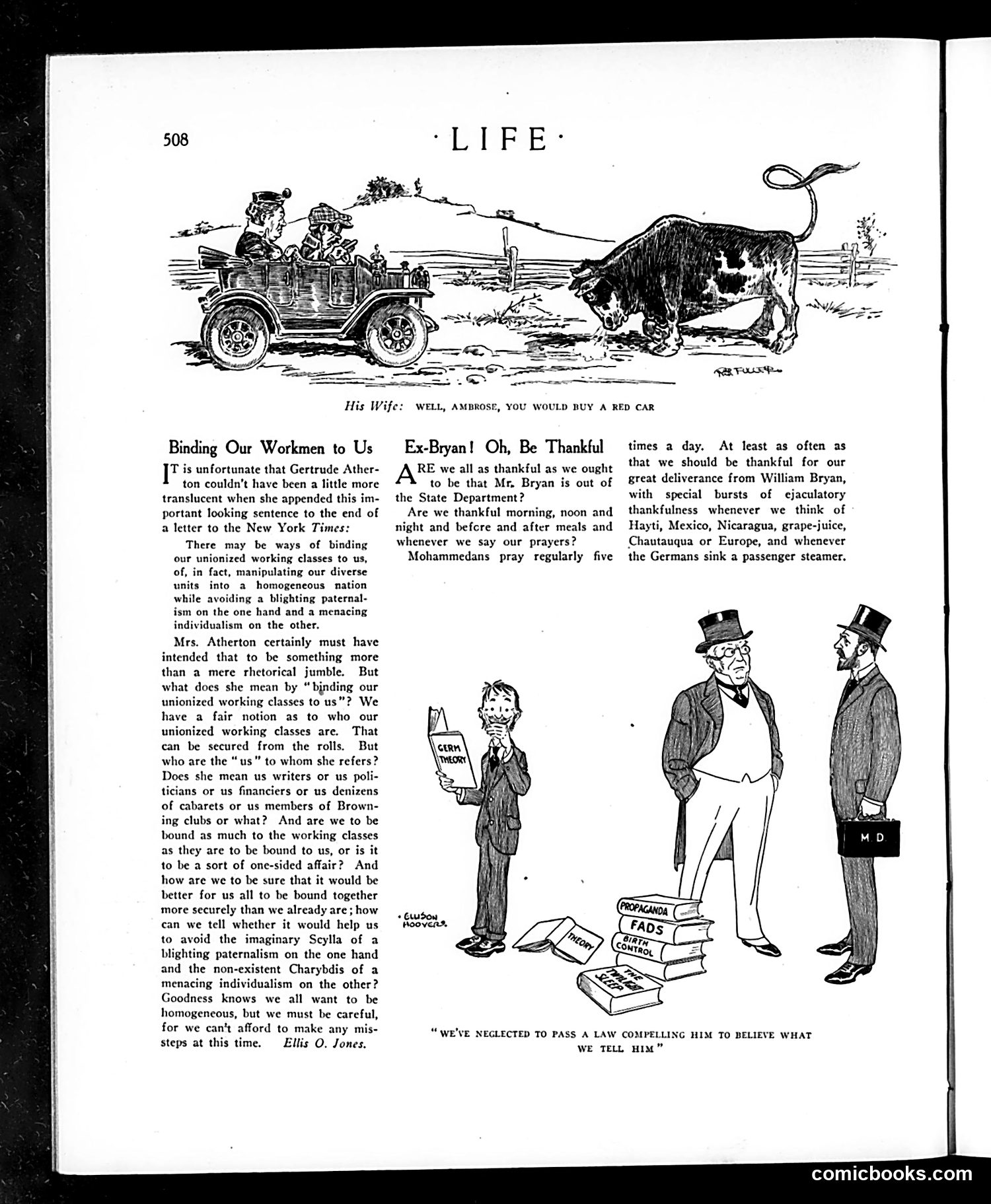
This page contains three distinct satirical pieces: **Top cartoon**: A husband and wife in a red automobile are being pulled by a cow with an elaborate tail knot. The wife's caption suggests the husband bought an impractical vehicle. The joke appears to mock conspicuous consumption or poor automotive choices. **"Binding Our Workmen to Us"**: This article critiques writer Gertrude Atherton's vague proposal about unifying unionized workers with the upper classes. The author (Ellis O. Jones) sarcastically deconstructs her letter to the *New York Times*, questioning who "us" refers to and whether such binding would be reciprocal or paternalistic. It's social commentary on class relations and rhetoric about labor unity. **"Ex-Bryan! Oh, Be Thankful"**: This satirizes excessive gratitude toward William Jennings Bryan's departure from the State Department. The author mocks the zealous thankfulness expressed toward his removal, comparing it to religious devotion, while sarcastically listing controversial foreign policy issues (Haiti, Mexico, Nicaragua) presumably associated with Bryan. **Bottom cartoon**: Shows two gentlemen observing a boy with propaganda materials, lamenting they haven't legally compelled belief in their messaging—social satire about propaganda and indoctrination.
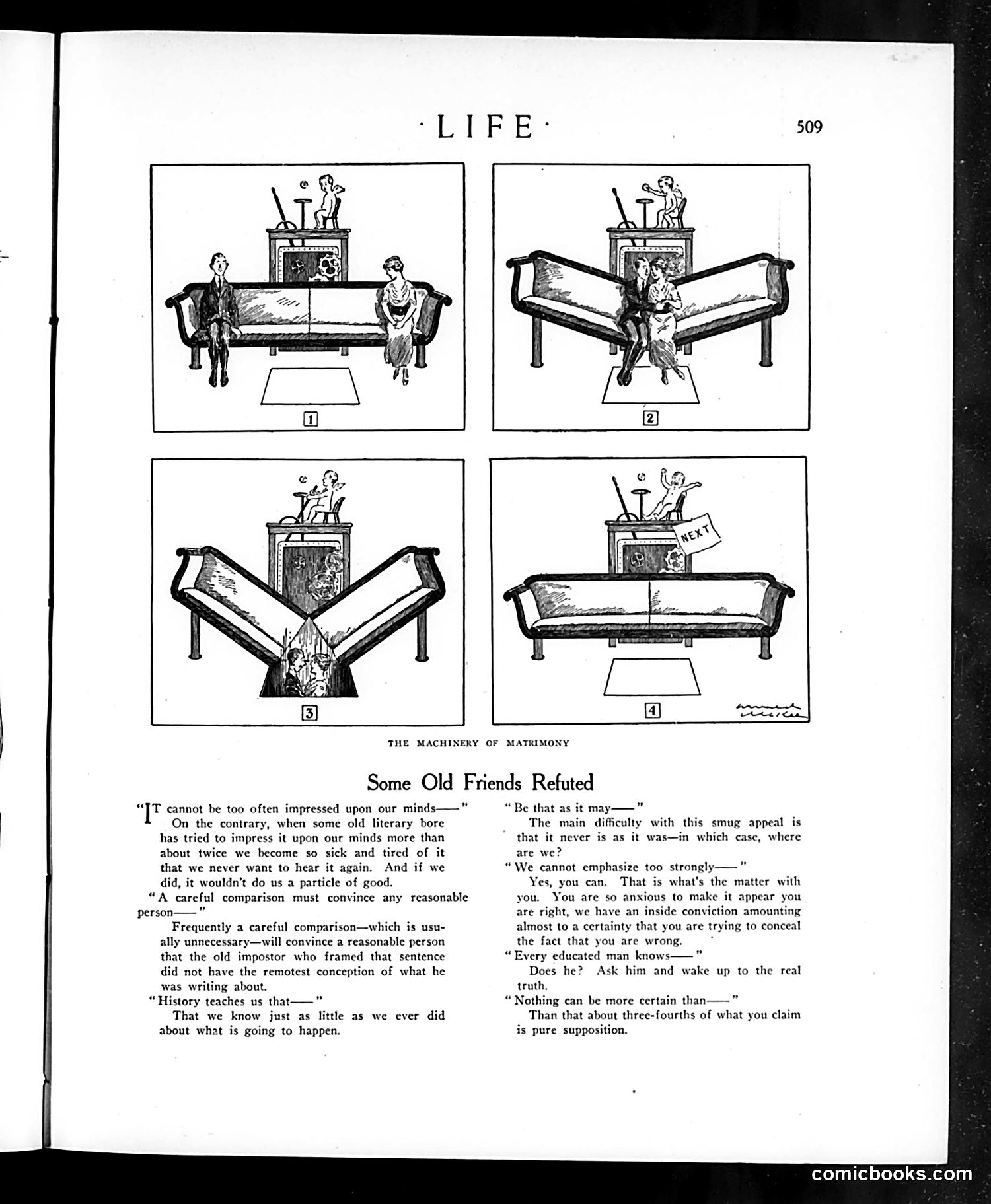
The top half shows four sequential cartoon panels titled "The Machinery of Matrimony," depicting a couple on a sofa being mechanically compressed and manipulated by apparatus above them—a visual metaphor for how marriage processes or reshapes people. The bottom half, "Some Old Friends Refuted," is satirical commentary on pretentious rhetoric and empty argumentation. It mocks six common literary and rhetorical clichés—phrases like "It cannot be too often impressed," "A careful comparison," and "History teaches us"—by identifying how these constructions are actually used to obscure truth, conceal uncertainty, or manipulate audiences. The piece argues these familiar phrases don't actually convince through logic but rather through smugness and repetition. For a modern reader: this is essentially an early critique of corporate-speak, academic jargon, and political rhetoric—showing how authoritative-sounding language often masks ignorance or dishonesty.
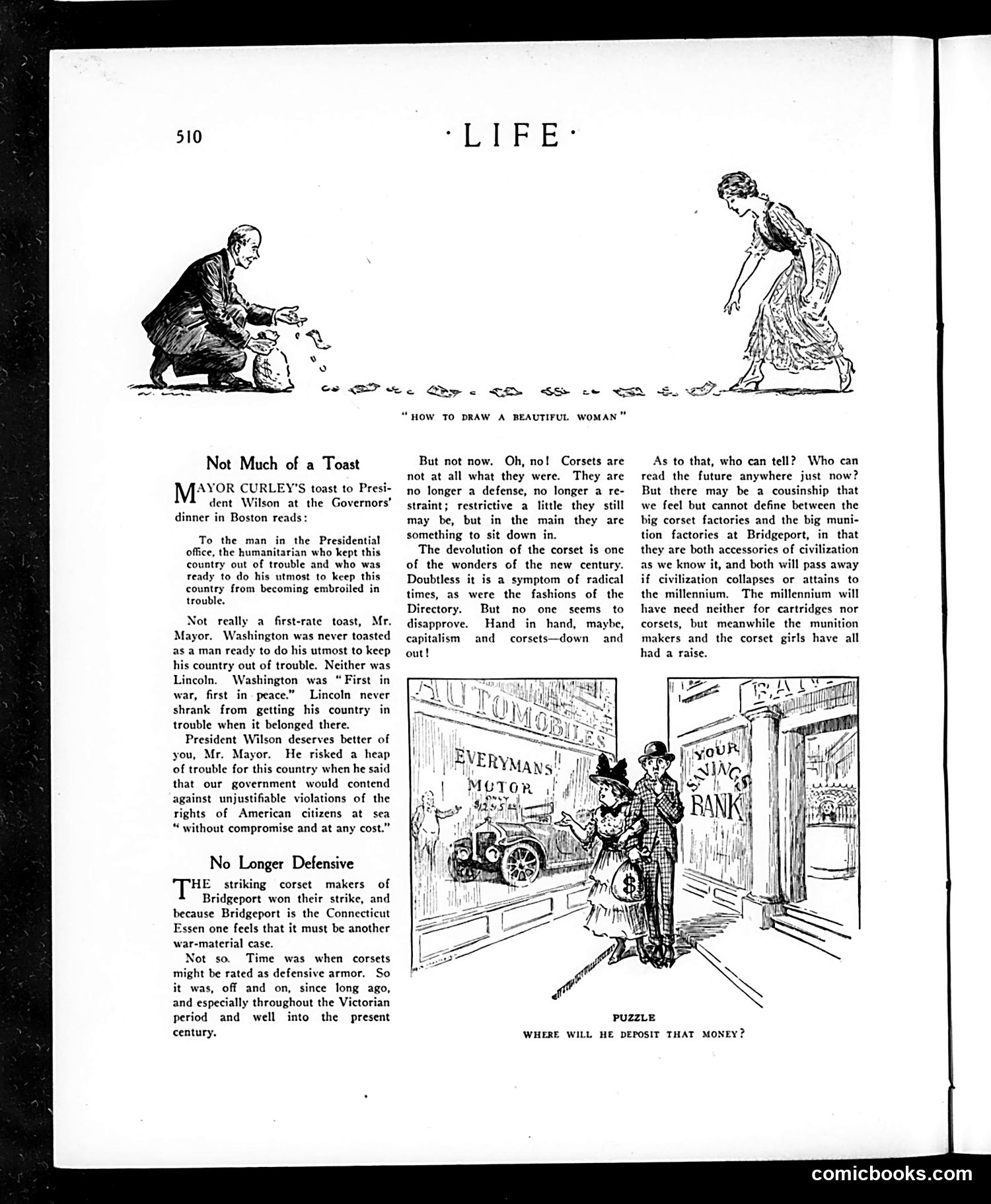
This page contains three distinct pieces of political and social commentary: **"Not Much of a Toast"** mocks Mayor Curley's praise of President Wilson for keeping America out of trouble. The writer argues Wilson deserves credit for taking *risks*—specifically threatening action over violations of American citizens' rights at sea—not for passive avoidance. The comparison to Washington and Lincoln implies true leadership requires courage, not caution. **"No Longer Defensive"** satirizes the Bridgeport corset makers' strike victory, using corsets as metaphor for changing society. The writer suggests corsets once served a genuine "defensive" purpose but now are merely ornamental—paralleling how modern fashion and social norms have shifted. The piece ironically notes munition and corset factories are equally dependent on current civilization; both would become obsolete in peacetime or utopia. **The cartoon "How to Draw a Beautiful Woman"** shows a man scattering money while a woman follows, suggesting women are attracted to wealth—a commentary on gender relations and materialism. **The puzzle illustration** depicts someone contemplating where to deposit money at a savings bank, likely reflecting economic anxiety of the era.
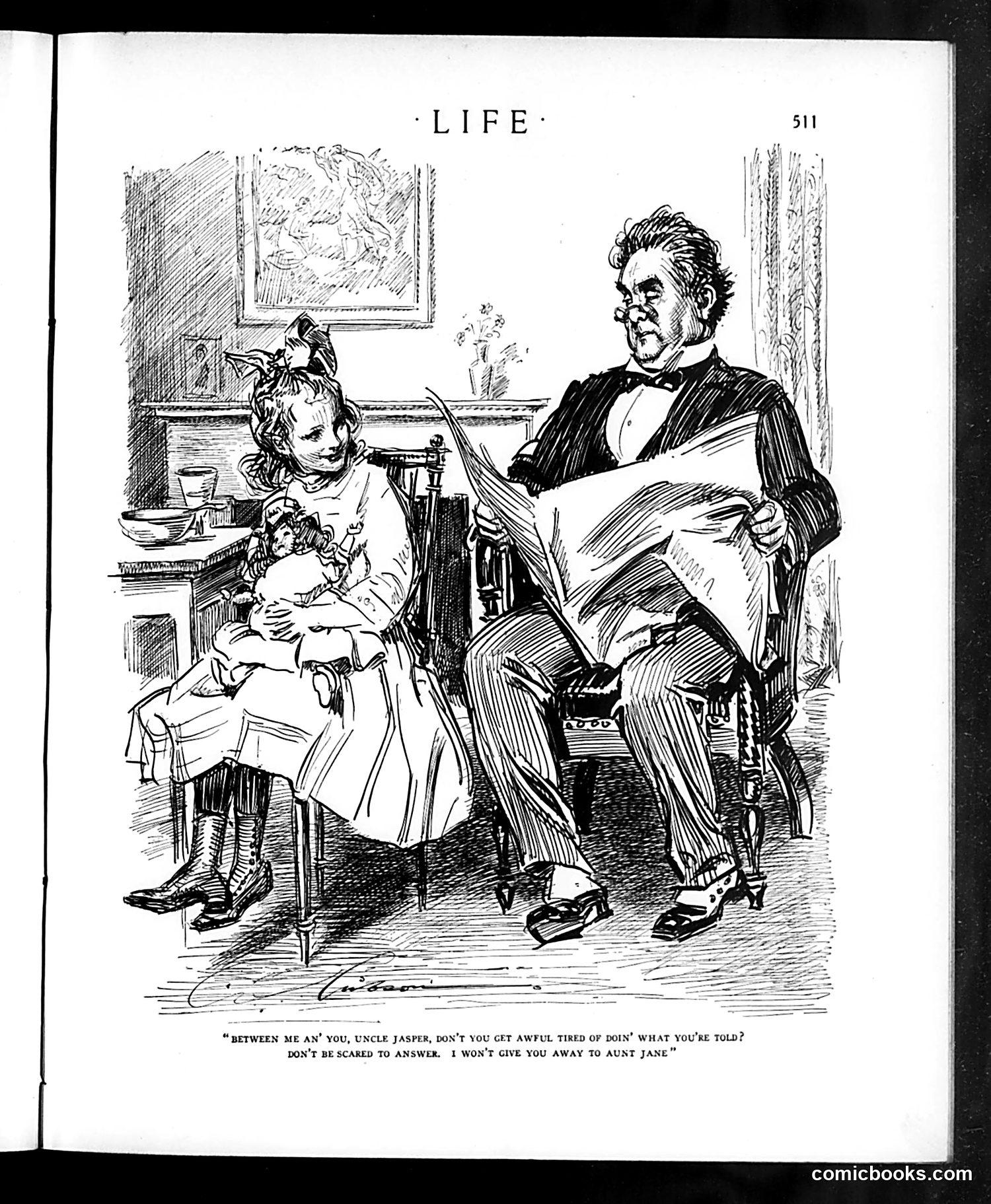
This is a domestic humor cartoon from *Life* magazine (page 511). It depicts a young girl speaking confidentially to an older man identified as "Uncle Jasper," asking if he grows tired of following orders from his wife ("Aunt Jane"). The joke targets the common domestic dynamic where husbands appear subordinate to their wives' authority. The girl's conspiratorial tone—promising secrecy—suggests this is a relatable, unspoken family tension. The cartoon satirizes masculine loss of autonomy within marriage, presenting it as so universal that even a child recognizes and sympathizes with the uncle's predicament. This reflects early-to-mid 20th-century American attitudes about marital power dynamics, where hen-pecked husbands were stock comic figures.
This editorial page discusses WWI peace prospects and U.S. neutrality. The cartoons and text critique the current diplomatic situation: **Main Arguments:** - Peace is impossible while Germany remains militarily strong; only submission terms would work - Cardinal Gibbons's Vatican-backed peace mission to President Wilson is well-intentioned but futile - The German submarine concession (likely the Sussex Pledge) represents only a minor diplomatic victory, achieved through U.S. economic and military posturing rather than force - Admiral Von Tirpitz's reported illness suggests Germany may finally recognize it's unwise to provoke American entry into the war **Key Reference:** Colonel Villard's praise of Wilson winning "without rattling a sword" is sardonically reframed—Wilson succeeded because Germany feared U.S. industrial capacity and potential military intervention, not from moral suasion. The page reflects American debate about whether neutrality serves U.S. interests while the war continues.
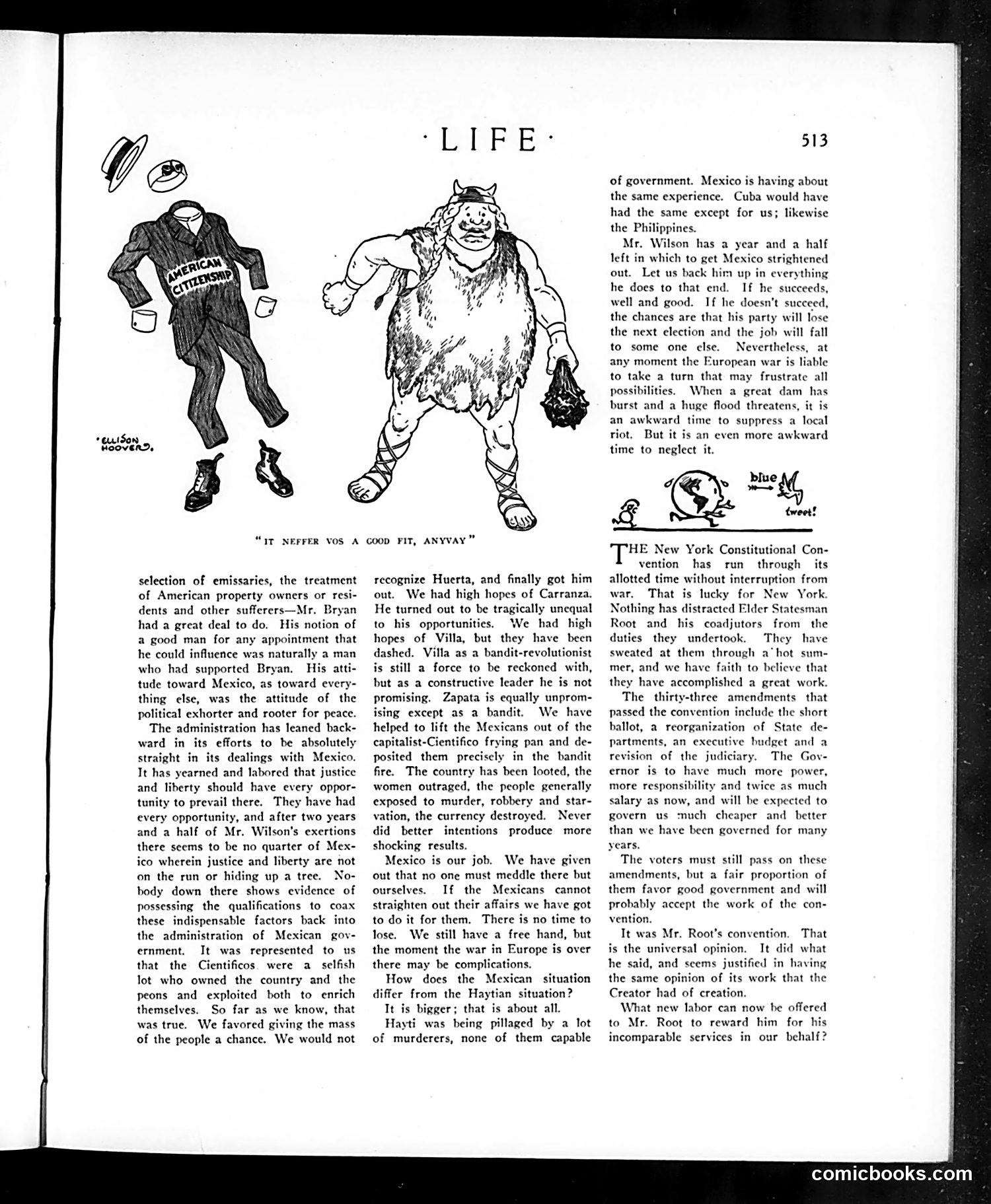
The cartoon depicts two figures fleeing—one labeled "American Citizenship" and a horned devil-like creature. The caption, rendered in dialect, suggests incompatibility. **Context:** This satirizes President Wilson's Mexican policy (circa 1913-1916). The accompanying text chronicles U.S. interventions under Secretary of State William Jennings Bryan, discussing failed support for various Mexican leaders: Huerta, Carranza, Villa, and Zapata. The article criticizes how American efforts to promote justice and democracy in Mexico produced chaos—looting, violence, and currency destruction. **The satire's point:** The cartoon mocks the notion that American democratic values can be "fitted" onto Mexico's political situation. The fleeing "American Citizenship" suggests these ideals cannot survive the Mexican upheaval. The dialect speech reinforces stereotyping common in period satire. The author argues Wilson should complete stabilization before Europe's war complications worsen the situation—framing Mexico as America's responsibility but acknowledging the impossibility of exporting American governance.
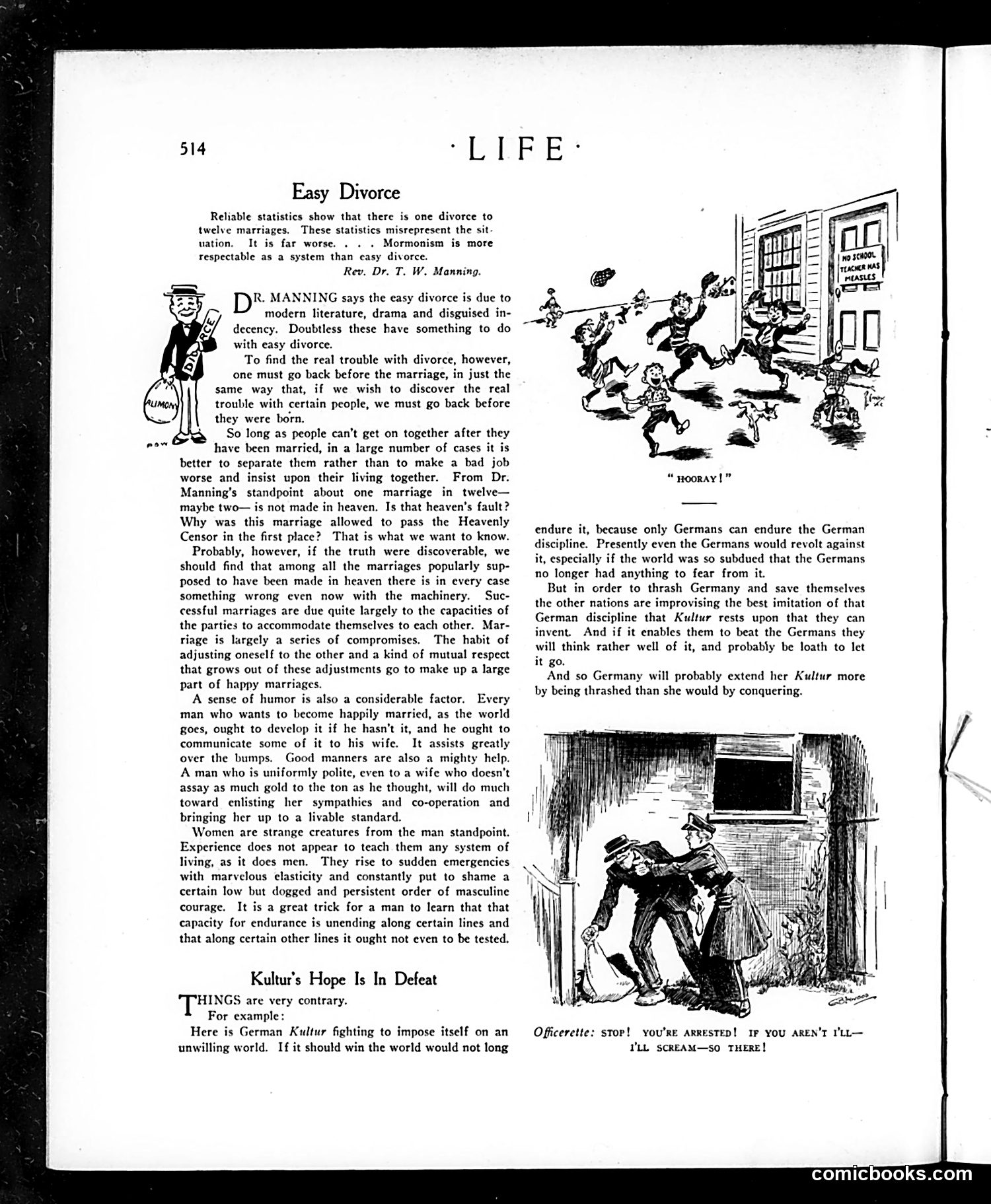
This page contains two distinct pieces of satire from Life magazine, likely published during World War I. **"Easy Divorce"** critiques the moral panic over rising divorce rates. The author ironically argues that blaming modern literature and "indecency" misses the point—the real issue is incompatible people staying married. The piece advocates for pragmatic separation over miserable cohabitation, countering religious figures like Rev. Dr. Manning who opposed divorce. **"Kultur's Hope Is In Defeat"** satirizes German militarism. It argues that German "Kultur" (discipline/culture) is so oppressive that even Germans resent it, and the world would reject it if Germany won. Paradoxically, the Allies are adopting similar authoritarian discipline to defeat Germany—meaning Germany's philosophy spreads through losing. The cartoon showing a woman threatening an officer ("I'll scream!") appears to reference wartime "Officerettes"—women taking civilian police or civil service roles—mocking both the unconventional employment and gender anxieties of the era.
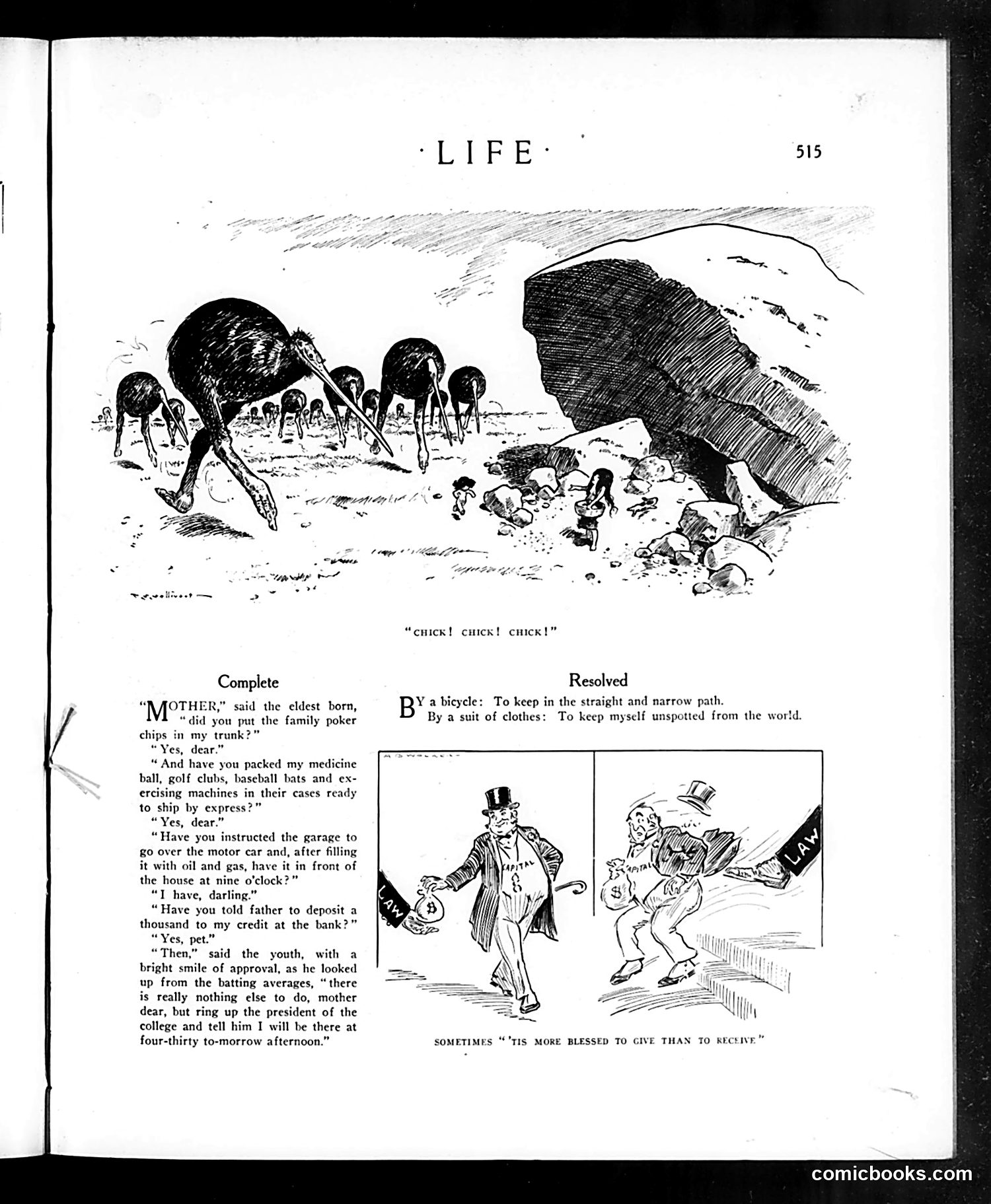
**Top Cartoon ("chick! chick! chick!"):** Shows large birds (apparently ostriches or similar) sheltering smaller chicks under their wings from what appears to be harsh weather. This is a straightforward nature illustration with no evident satire. **Bottom Section ("Complete/Resolved"):** A satirical dialogue between a mother and her son preparing for college. The joke mocks entitled young men of leisure: the youth obsesses over packing luxury items (golf clubs, baseball bats, medicine balls, exercising machines) and securing a thousand-dollar bank deposit, but regards actually *attending* college as almost an afterthought—casually mentioning he'll "ring up the president" to confirm his arrival. The caption "Sometimes 'tis more blessed to give than to receive" and the accompanying cartoon of two men exchanging money sardonically emphasizes the satire: the real business of college is financial and social positioning, not education. **Context:** This reflects early 20th-century anxiety about wealthy, idle youth prioritizing leisure and money over actual intellectual engagement.
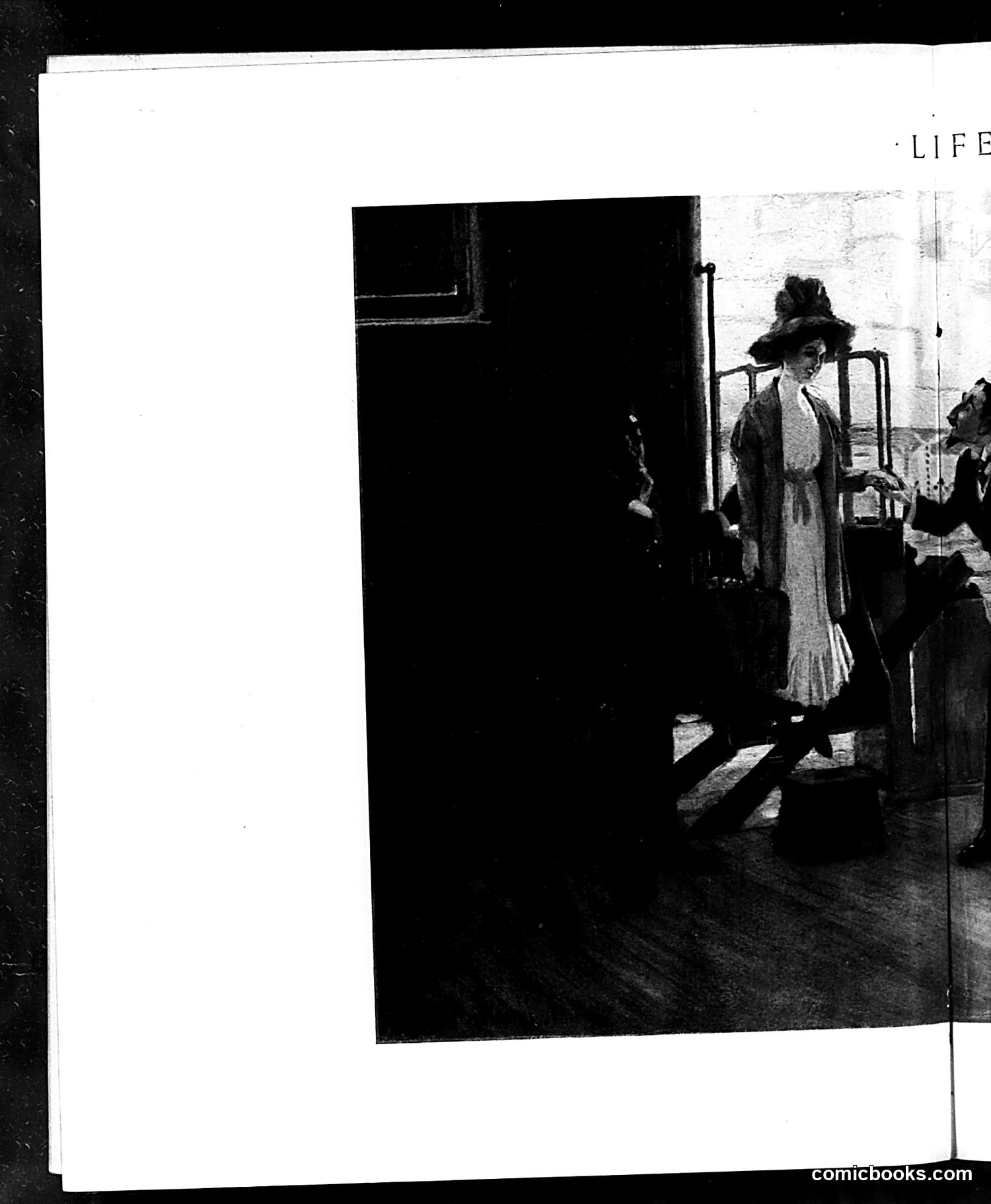
This appears to be a page from *Life* magazine showing a black and white photograph rather than a traditional cartoon. The image depicts a woman in early 20th-century dress (featuring a hat and long coat) standing in a doorway, with other figures visible in the background on what seems to be a street or institutional setting. However, the OCR text provides only "comicbooks.com" as source attribution, with no actual article text or caption visible on the page itself. Without accompanying text explaining the photograph's context, figures, or satirical intent, I cannot reliably identify who is pictured, what event is depicted, or what social or political commentary this image was meant to convey to contemporary readers. The page header shows "LIFE," confirming the publication.
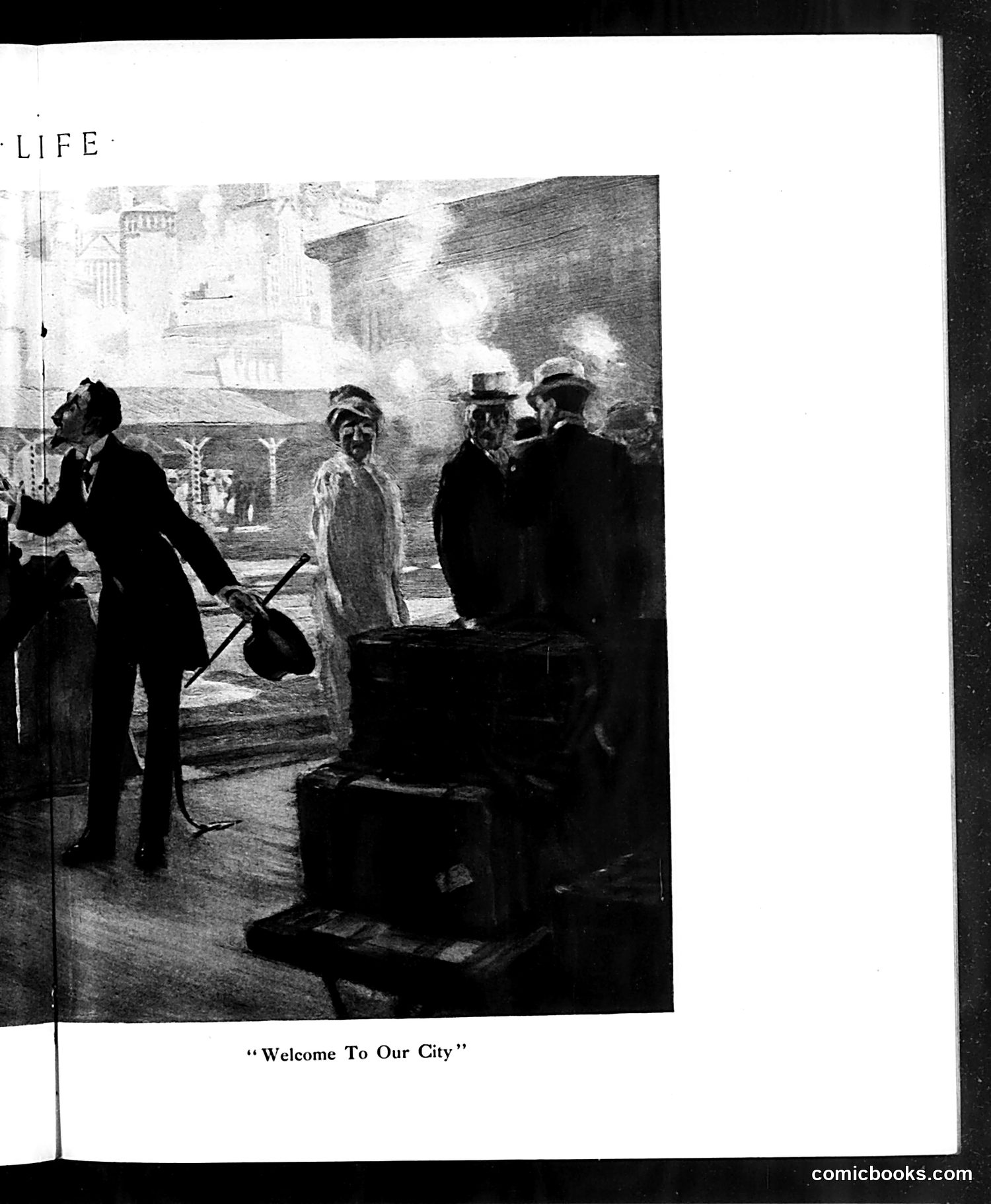
This Life magazine page depicts what appears to be a satirical scene of urban industrial life. The image shows formally dressed men in hats gathered around what seems to be industrial equipment or machinery in a city setting, with factory buildings and smokestacks visible in the background. The caption "Welcome To Our City" suggests ironic commentary on industrial urban conditions. The scene likely satirizes how cities promoted themselves to visitors or newcomers while obscuring the harsh realities of industrial work, pollution, and labor conditions. The contrast between the well-dressed men's formal presentation and the smoky, industrial backdrop emphasizes this disconnect—a "welcome" that masks the grimier aspects of urban industrial life that workers actually experienced. The specific context and publication date remain unclear from this image alone.
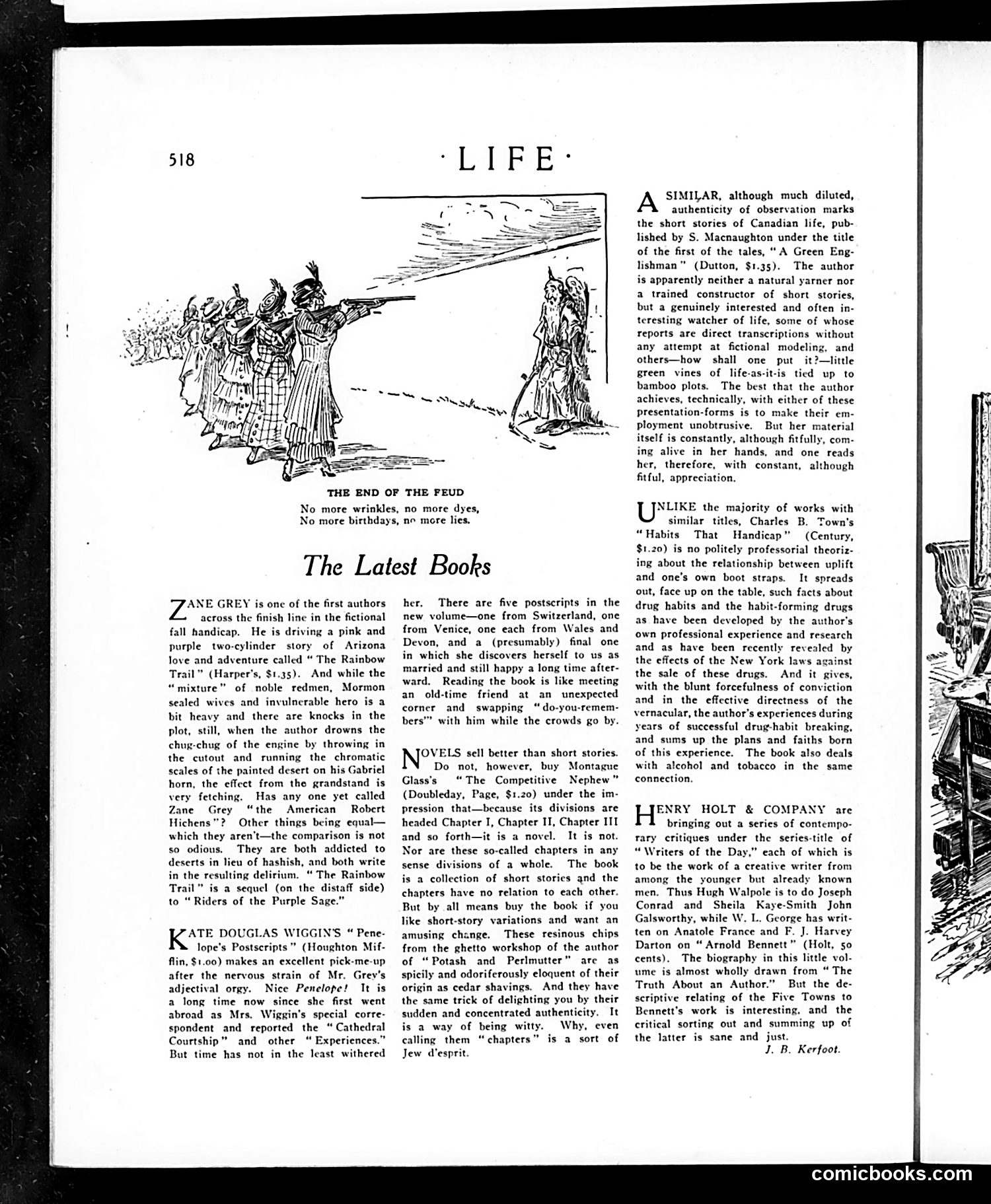
This page from *Life* magazine contains literary reviews rather than political cartoons. The illustration at top—titled "The End of the Feud"—shows figures in period dress with the caption "No more wrinkles, no more dyes, / No more birthdays, no more lies," likely a satirical commentary on aging or mortality, though its specific reference is unclear. The bulk of the page reviews contemporary fiction, including Zane Grey's *The Rainbow Trail*, Kate Douglas Wiggin's *Penelope's Postscripts*, Montague Glass's *The Competitive Nephew*, and S. Macnaughton's *A Green Englishman*. The reviews employ *Life*'s characteristic witty, sometimes caustic tone—praising some works while criticizing others for overwrought prose or structural flaws. The references to "hashish," "the ghetto," and ethnic humor reflect period attitudes now considered outdated.
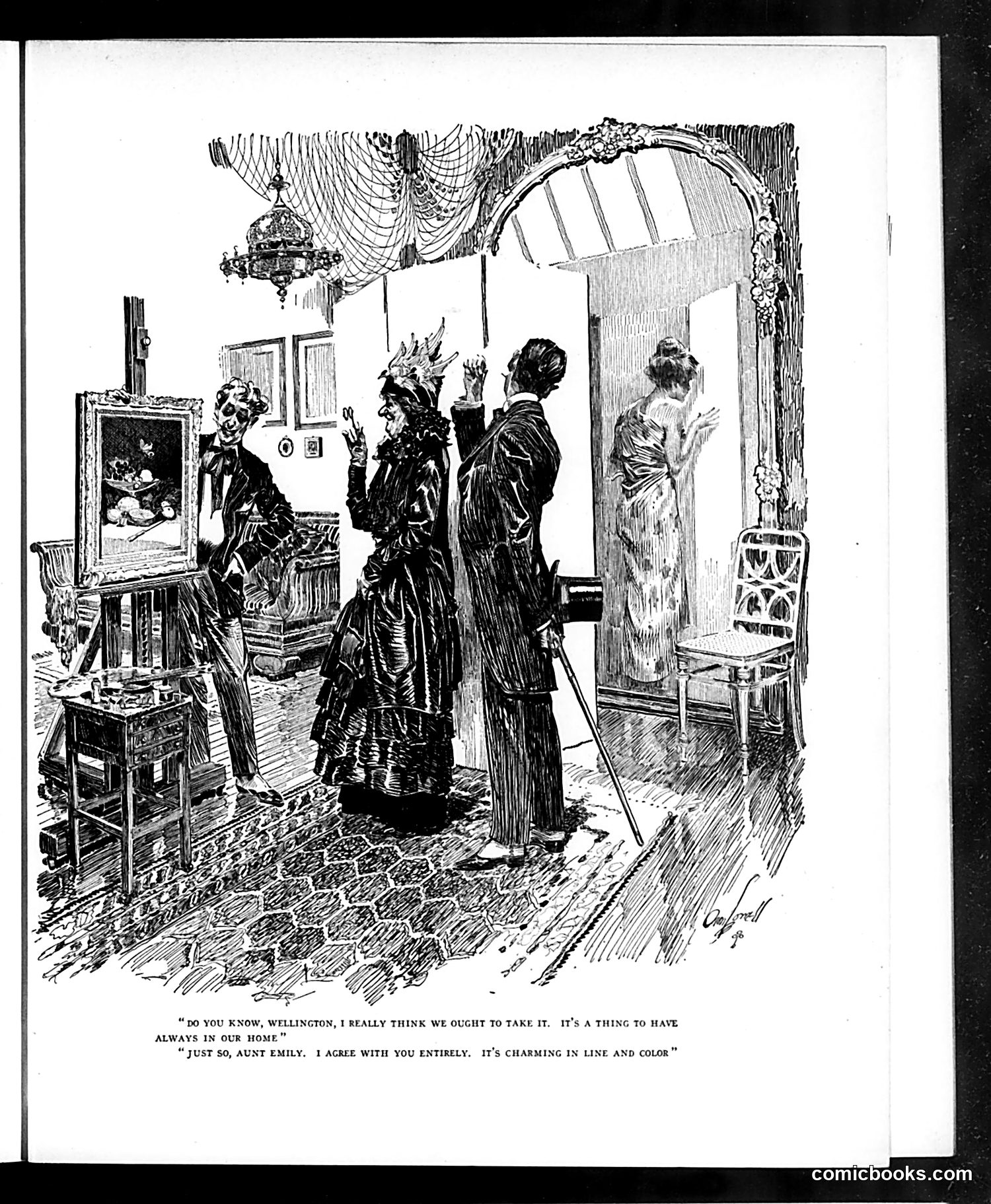
This appears to be a domestic comedy sketch from *Life* magazine depicting a Victorian-era interior scene. Two characters—seemingly a young woman named Wellington and an older woman (Aunt Emily)—are examining what appears to be a piece of art or decorative object, likely a painting visible on the left side of the room. The dialogue suggests they're considering purchasing it for their home. The satire targets upper-class pretension and consumer culture: the characters use affected language ("charming in line and color") to justify an aesthetic purchase, implying empty sophistication or mere status-seeking. The ornate interior setting—with elaborate drapery, chandelier, and fashionable furnishings—reinforces this critique of wealthy society's superficial materialism and their concern with proper home decoration as a marker of refinement.
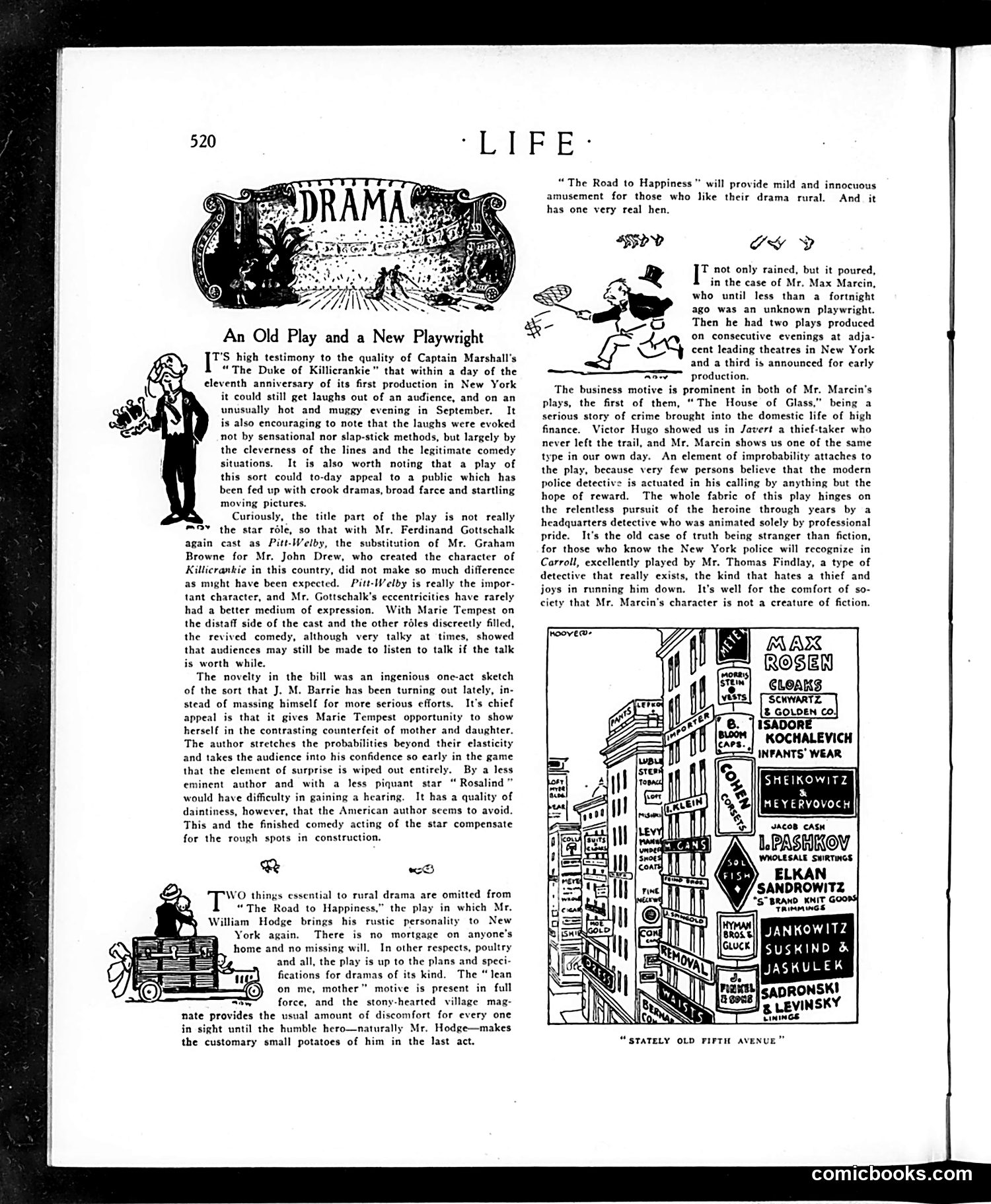
This page reviews three theatrical productions from early 20th-century Broadway: **"The Duke of Killicrankie"** — A revival of a decades-old comedy praised for succeeding through clever dialogue and legitimate humor rather than slapstick, appealing to audiences tired of sensational drama and moving pictures. **"The Road to Happiness"** — A rural comedy starring William Hodge, following the predictable formula of agrarian drama: no mortgages, missing wills, or complex plot devices. The reviewer notes it's competent but formulaic, with "one very real hen" as its actual asset. **Max Marcin's plays** — Two newly produced plays by a previously unknown playwright, including "The House of Glass," featuring crime in high-finance domestic settings. The cartoons (left margin) appear to be decorative editorial illustrations typical of the era. The right side contains an advertisement for "Stately Old Fifth Avenue," listing various Jewish and Eastern European surnames of shop owners—reflecting New York's immigrant commercial landscape of the period. The reviews emphasize sophisticated audiences preferring intelligent dialogue over spectacle.
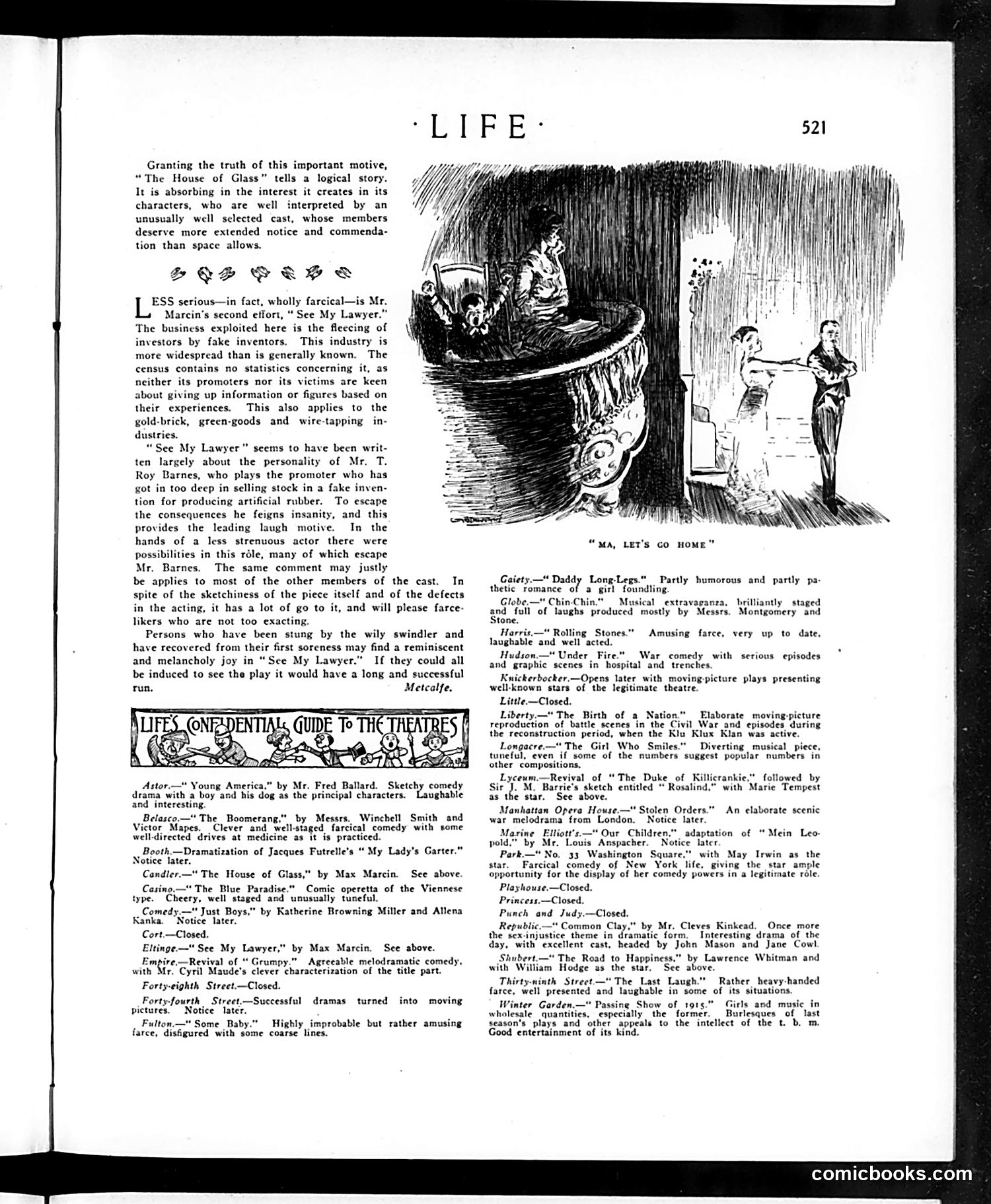
This page reviews theatrical productions and includes a cartoon titled "MA, LET'S GO HOME" showing what appears to be a domestic scene—likely depicting a husband and wife at odds, with the caption suggesting tension over leaving an event or location. The text discusses two plays by Max Marcin: "The House of Glass" (a serious drama about absorbing characters) and "See My Lawyer" (a farce about investors defrauded by fake inventors). The reviewer notes that con schemes like fake inventions, gold-brick scams, and wire-tapping were widespread but undocumented. The play "See My Lawyer" centers on actor T. Roy Barnes playing a promoter who fakes insanity to escape consequences of selling fraudulent artificial-rubber stock. The reviewer finds the sketch entertaining for farce-lovers, suggesting audiences "stung by swindlers" might enjoy its satirical treatment of confidence schemes—a timely topic given early 20th-century fraud's prevalence. The page also lists other theatrical offerings of the era.
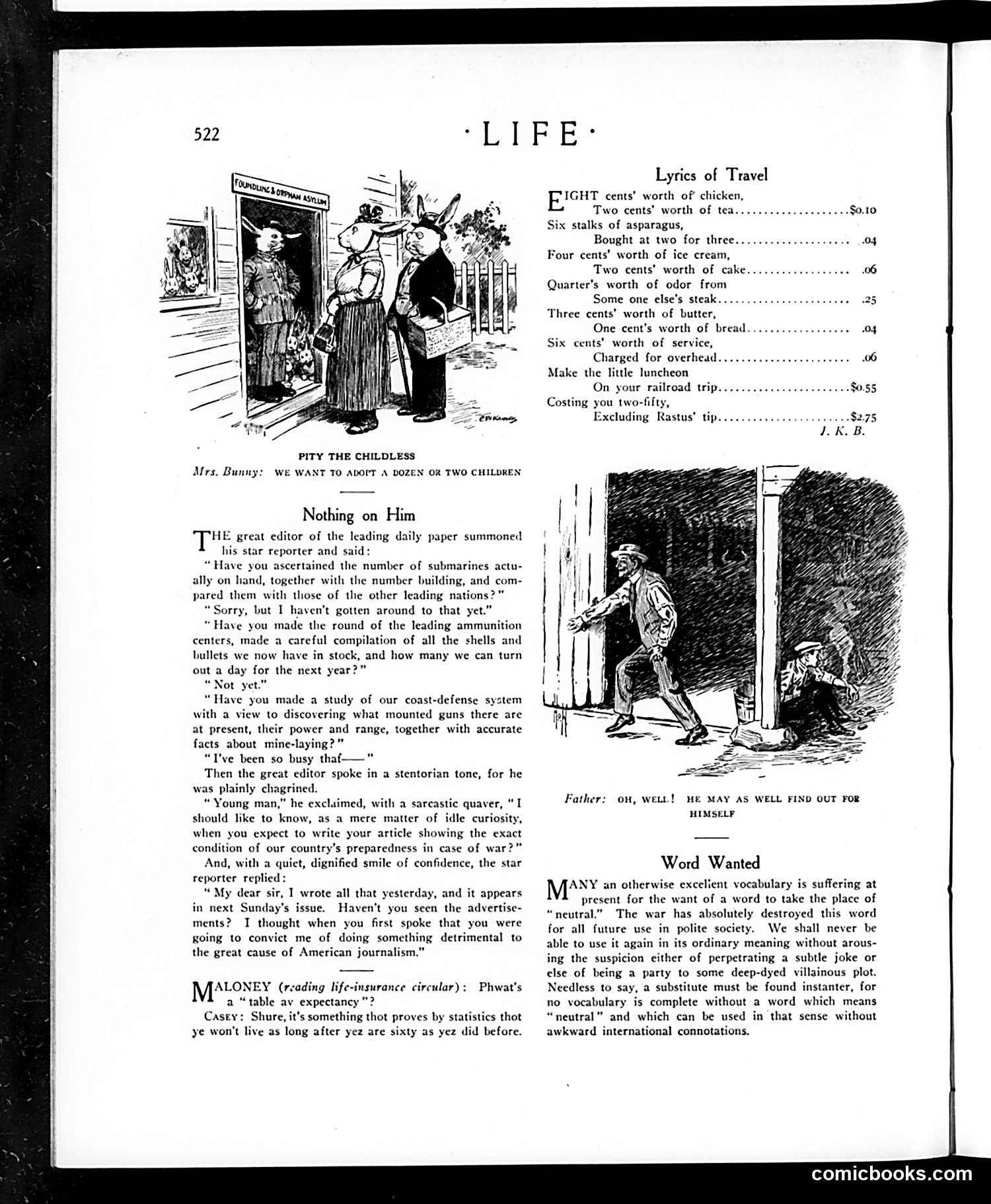
This page contains three satirical pieces from an era of American military preparedness debates (likely WWI period): **"Nothing on Him"** mocks sensationalist journalism. A newspaper editor demands his star reporter investigate sensitive military secrets—submarine counts, ammunition stockpiles, coastal defenses—only to learn the reporter already published everything as advertisements in Sunday's paper. The satire targets both yellow journalism's invasion of national security and the absurdity of publishing classified military information openly. **"Pity the Childless"** (cartoon): Mrs. Bunny's desire to adopt "a dozen or two children" is dark humor about rapid rabbit reproduction, mocking families who had many children. **"Lyrics of Travel"** is price satire about inflated railroad dining car costs—cheap ingredients marked up enormously, with a tip for "Rastus" (a racial stereotype), totaling $2.55 for a simple lunch. **"Word Wanted"** argues "neutral" became unusable politically during wartime, now implying either jokes about neutrality or villainous intent. The piece satirizes how war rhetoric poisoned ordinary vocabulary.
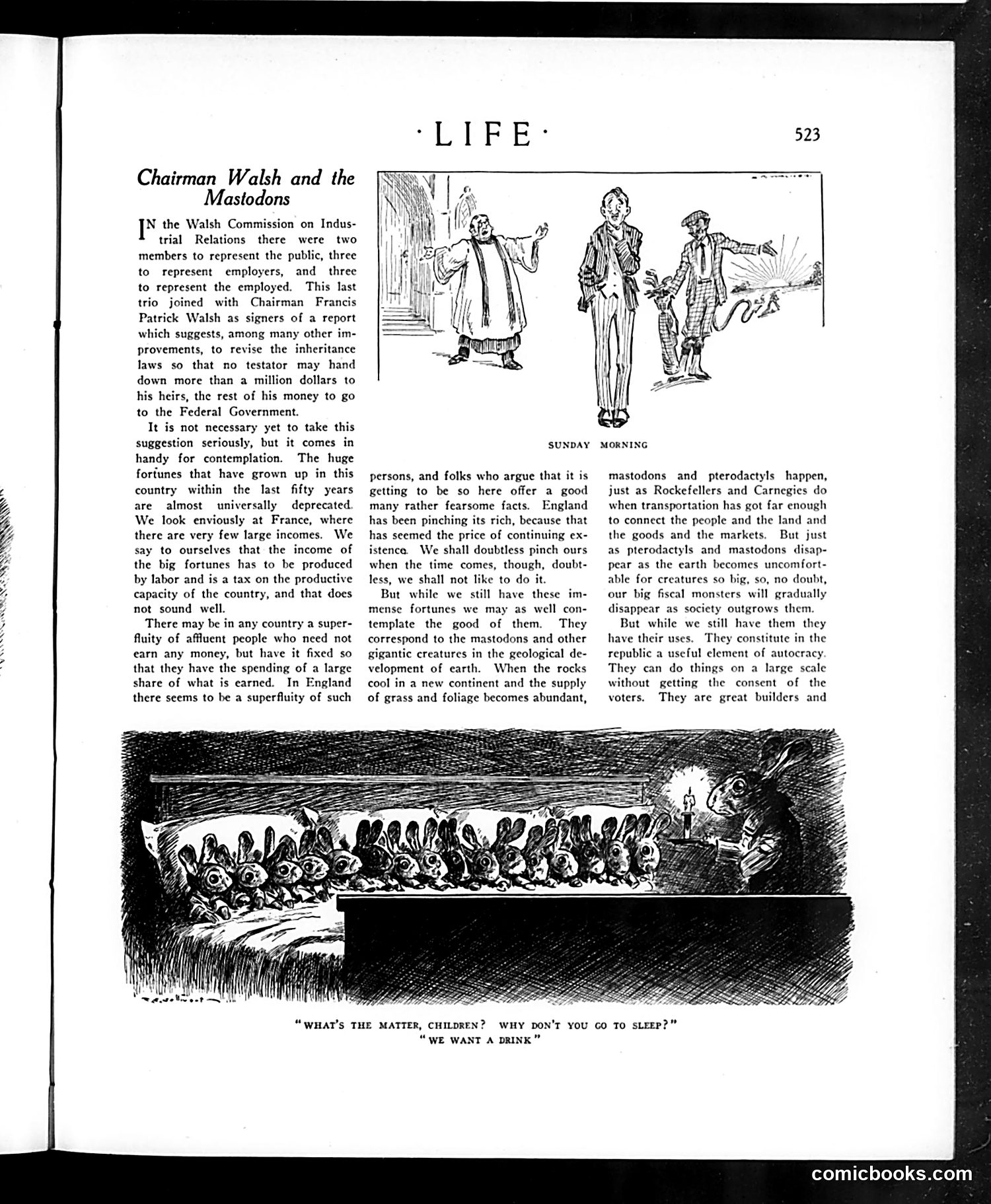
This satirical piece comments on a 1912 Walsh Commission proposal to cap inheritance at $1 million, with excess wealth going to the Federal Government. The article compares massive American fortunes (Rockefeller, Carnegie) to extinct mastodons—evolutionary relics suited to their environment but destined to disappear as conditions change. The cartoons illustrate the point: the top sketch shows well-dressed figures (wealthy industrialists), while the bottom cartoon depicts children asking "Why don't you go to sleep?" and demanding "We want a drink"—likely representing labor/working-class demands that the wealthy cannot ignore indefinitely. The satire's dual message: huge fortunes are natural but temporary products of American industrial development, yet currently serve a purpose as autocratic power that accomplishes large-scale projects without democratic consent. However, society will eventually "outgrow" them, as the mastodon became obsolete.
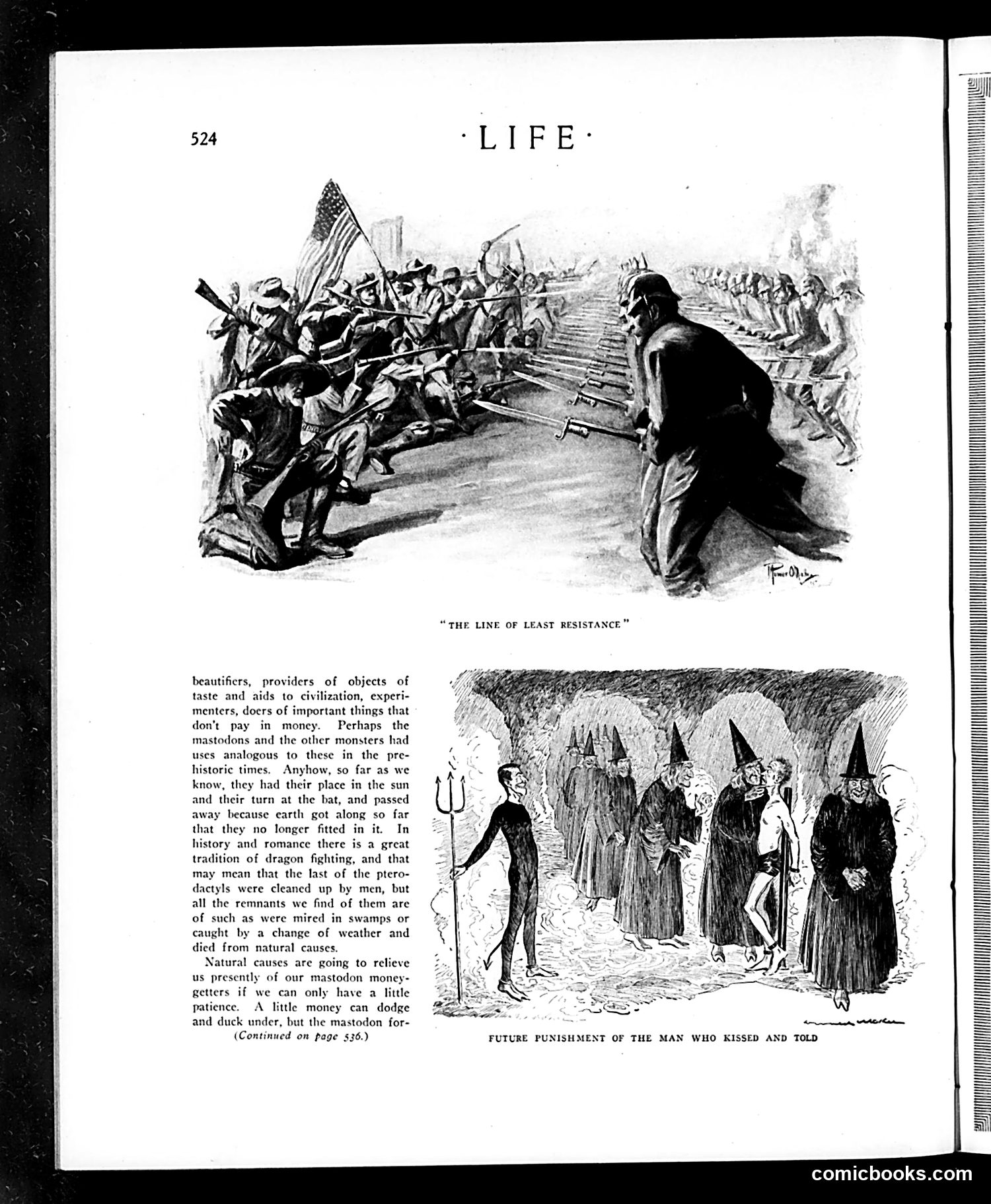
The top cartoon, "The Line of Least Resistance," depicts soldiers advancing in formation with an American flag, apparently taking the easiest path rather than the most strategic one. This satirizes military decision-making during wartime—likely WWI era based on the style—mocking commanders who choose comfort over effective tactics. The bottom illustration, "Future Punishment of the Man Who Kissed and Told," shows a man being punished (likely damnation) for revealing romantic secrets. This is social satire about gossip and betrayal of confidentiality in relationships—a common humor theme about masculine indiscretion. The accompanying text compares economic "money-getters" (wealthy industrialists/robber barons) to extinct prehistoric creatures like mastodons and pterodactyls. The author suggests these financial powerhouses will naturally disappear as society evolves, arguing patience rather than direct action will eliminate them. This reflects Progressive Era criticism of unchecked capitalism and economic consolidation.
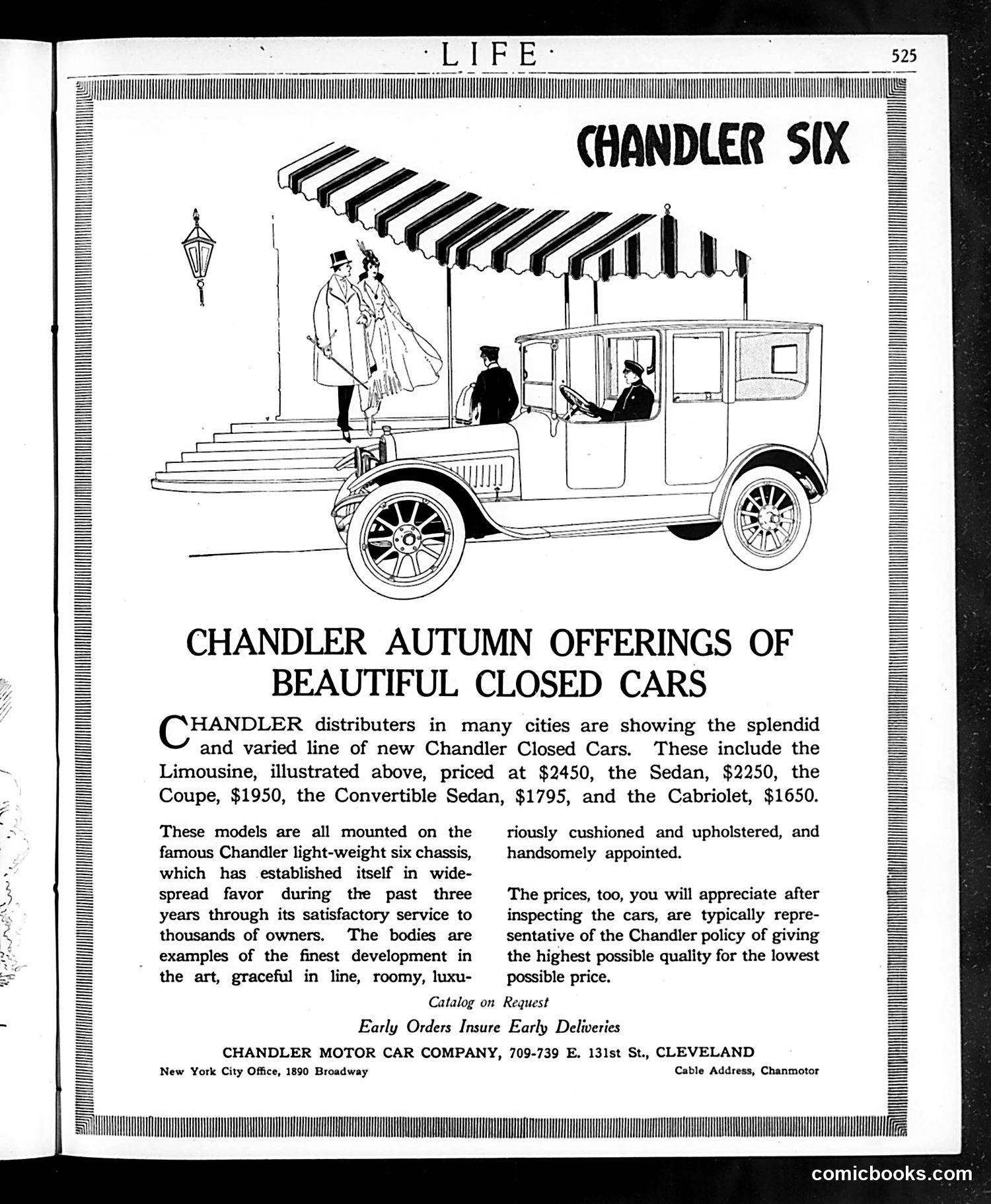
This is not a cartoon or satirical content—it's a straightforward automobile advertisement. The page promotes the Chandler Six, a closed-car line from the Chandler Motor Car Company of Cleveland. The illustration shows a luxury sedan with a striped awning, depicting well-dressed passengers and attendants to suggest upscale appeal. The ad lists five models with prices ranging from $1,650 to $2,450, emphasizing the "light-weight six chassis" and quality construction. The advertising pitch centers on Chandler's market position: providing "the highest possible quality for the lowest possible price." This reflects 1920s automobile marketing, when closed cars (as opposed to open vehicles) represented a premium feature. The "Early Orders Insure Early Deliveries" tagline suggests strong demand. There is no satire or political commentary—this is period advertising for a now-defunct American automaker.
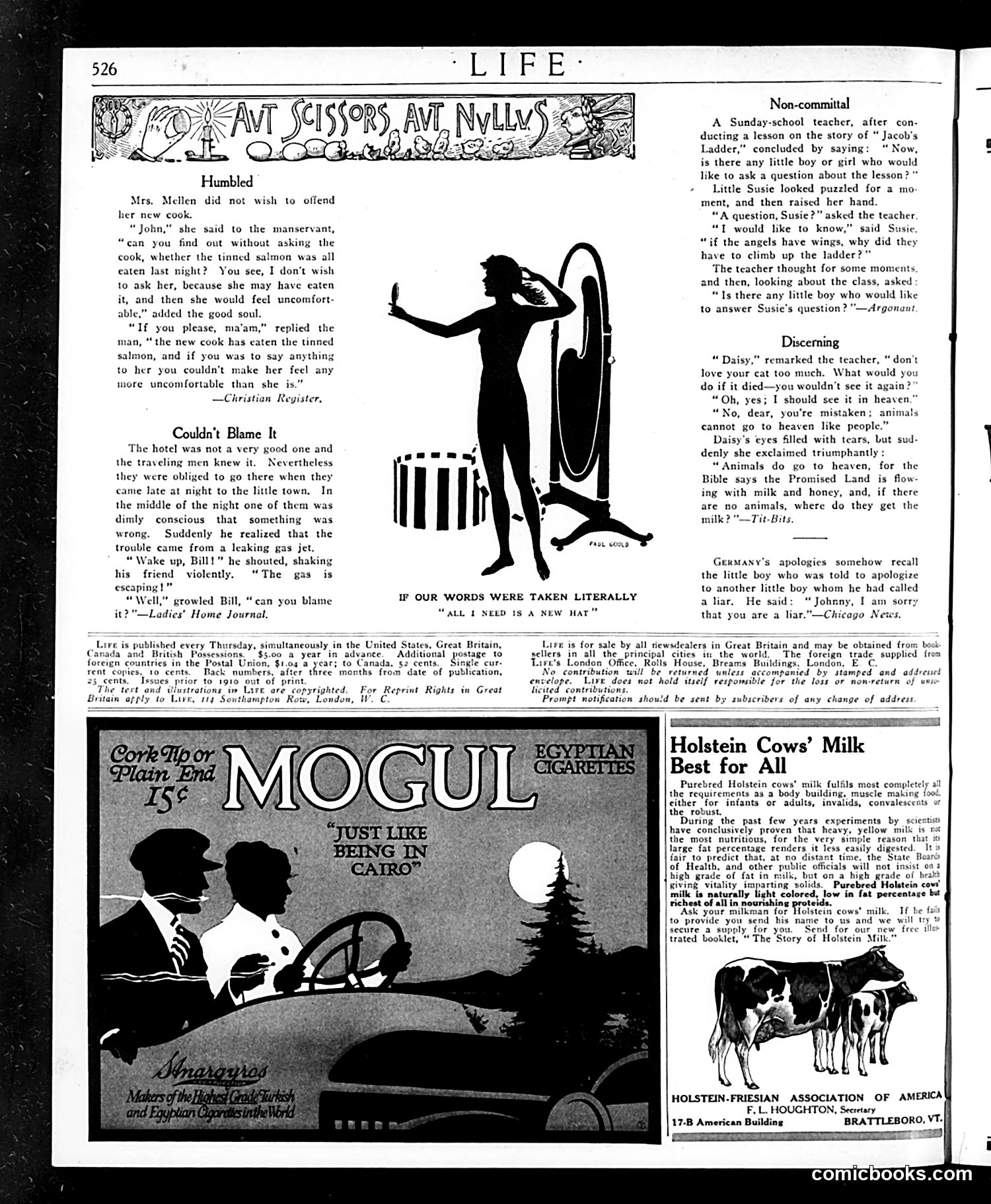
This page contains several humorous anecdotes satirizing social awkwardness and misunderstandings in early 20th-century America: **"Humbled"** mocks excessive politeness: A mistress so anxious not to offend her new cook that she sends a servant to investigate instead, only to learn the cook ate the salmon anyway—making the situation worse through her delicacy. **"Couldn't Blame It"** is a pun-based joke about a leaking gas jet in a hotel room; a guest wakes his friend about escaping gas, and his friend cynically replies the gas itself is trying to escape the terrible hotel. **"If Our Words Were Taken Literally"** shows a woman saying "I need a new hat"—illustrated with a silhouetted figure removing her actual head like a hat. The remaining anecdotes ("Non-committal," "Discerning," etc.) are brief jokes about children's literal-minded interpretations of adult statements. The page satirizes the gap between polite social conventions and practical reality, and children's logical thinking exposing adult hypocrisy or imprecision. The humor targets middle-class social pretension and communication failures.
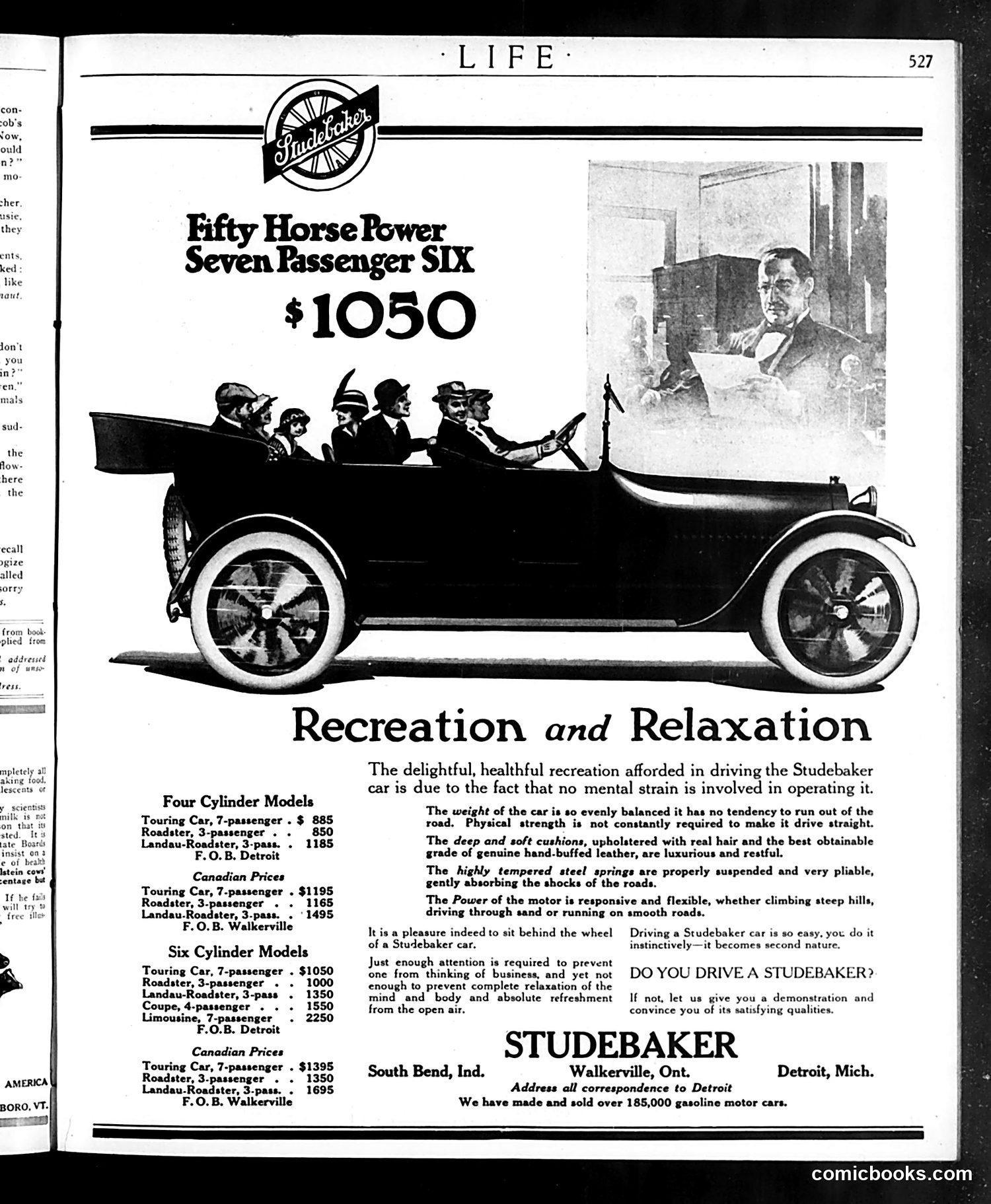
This page is primarily a **Studebaker automobile advertisement**, not satirical content. It appears in *Life* magazine (page 527) and showcases the company's 1910s car models. The ad features an illustration of well-dressed passengers in an open-air touring car, with a businessman reading documents in an inset image—suggesting that driving a Studebaker is so effortless it allows one to conduct business without distraction. The marketing pitch emphasizes "Recreation and Relaxation," claiming the car requires minimal mental or physical strain to operate. This reflects early automotive advertising's appeal to middle-class buyers by positioning car ownership as both practical and leisurely. Pricing ranges from $850–$2,250 depending on model and configuration. Canadian prices are listed separately, indicating this was a cross-border market. The advertisement includes the notable claim: "We have made and sold over 185,000 gasoline motor cars"—a sales figure meant to establish credibility in a competitive emerging industry.
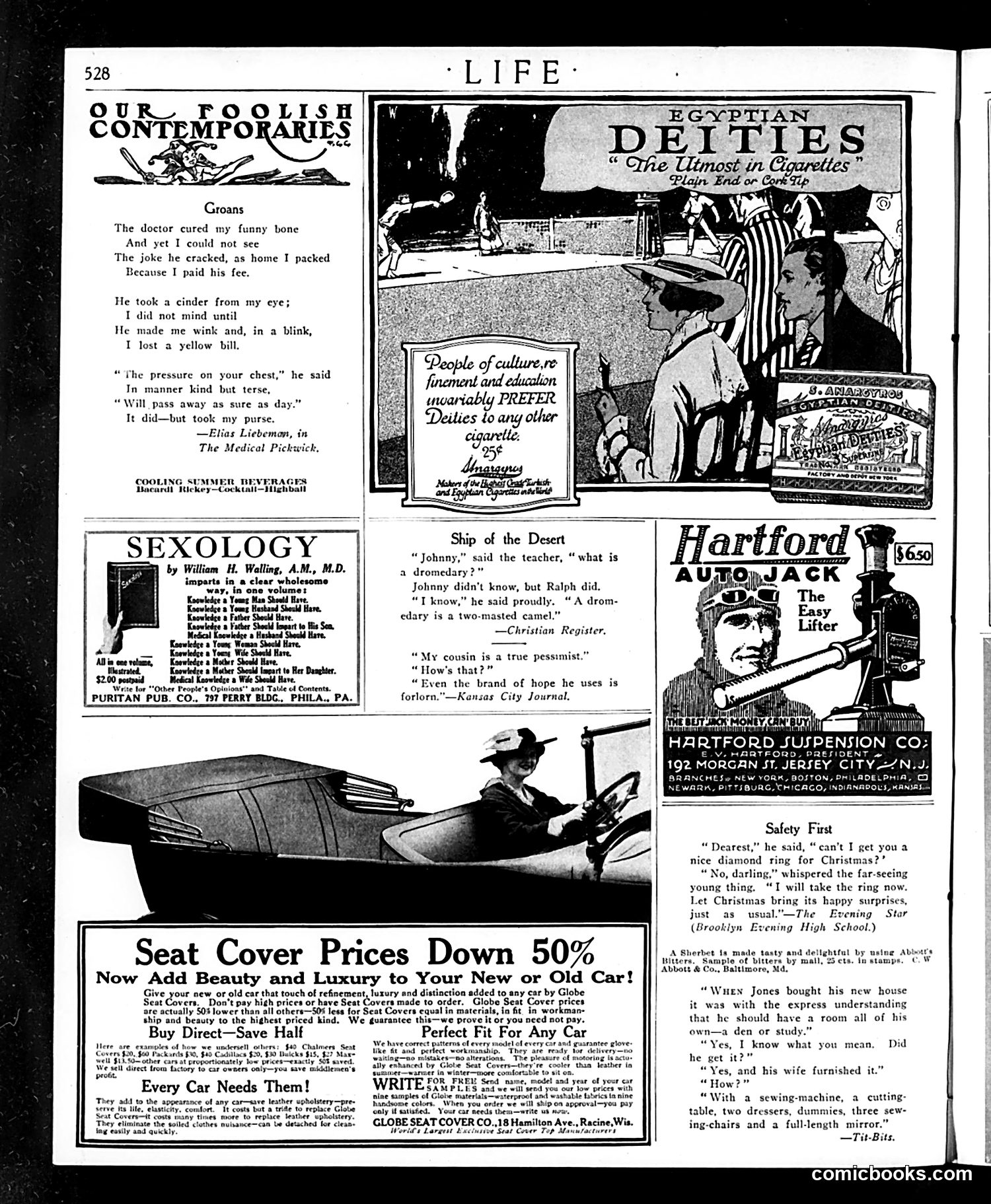
This page combines **humorous short jokes** with period **advertisements**. The satirical content targets common annoyances of early 20th-century life: **"Groans"** (top left): A poem mocking doctors who charge exorbitant fees while delivering dubious care—the speaker loses money rather than gaining health. The humor relies on the relatable frustration of medical billing. **School jokes** (center): Simple children's humor about misunderstandings ("dromedary is a two-masted camel") and pessimism. **"Safety First"** (right): A woman refuses an engagement ring, preferring immediate gratification—satirizing both female materialism and changing courtship norms. **The final joke**: A husband's "den" is colonized by his wife's sewing equipment, mocking the pretense of male domestic autonomy. The **advertisements** (Egyptian Deities cigarettes, Hartford Auto Jack, Globe Seat Covers) represent typical magazine commerce of the era. Overall, the page reflects *satirical coverage of everyday middle-class frustrations*: medical costs, education, consumer goods, marriage dynamics, and gender relations—standard Life magazine fare for this period.
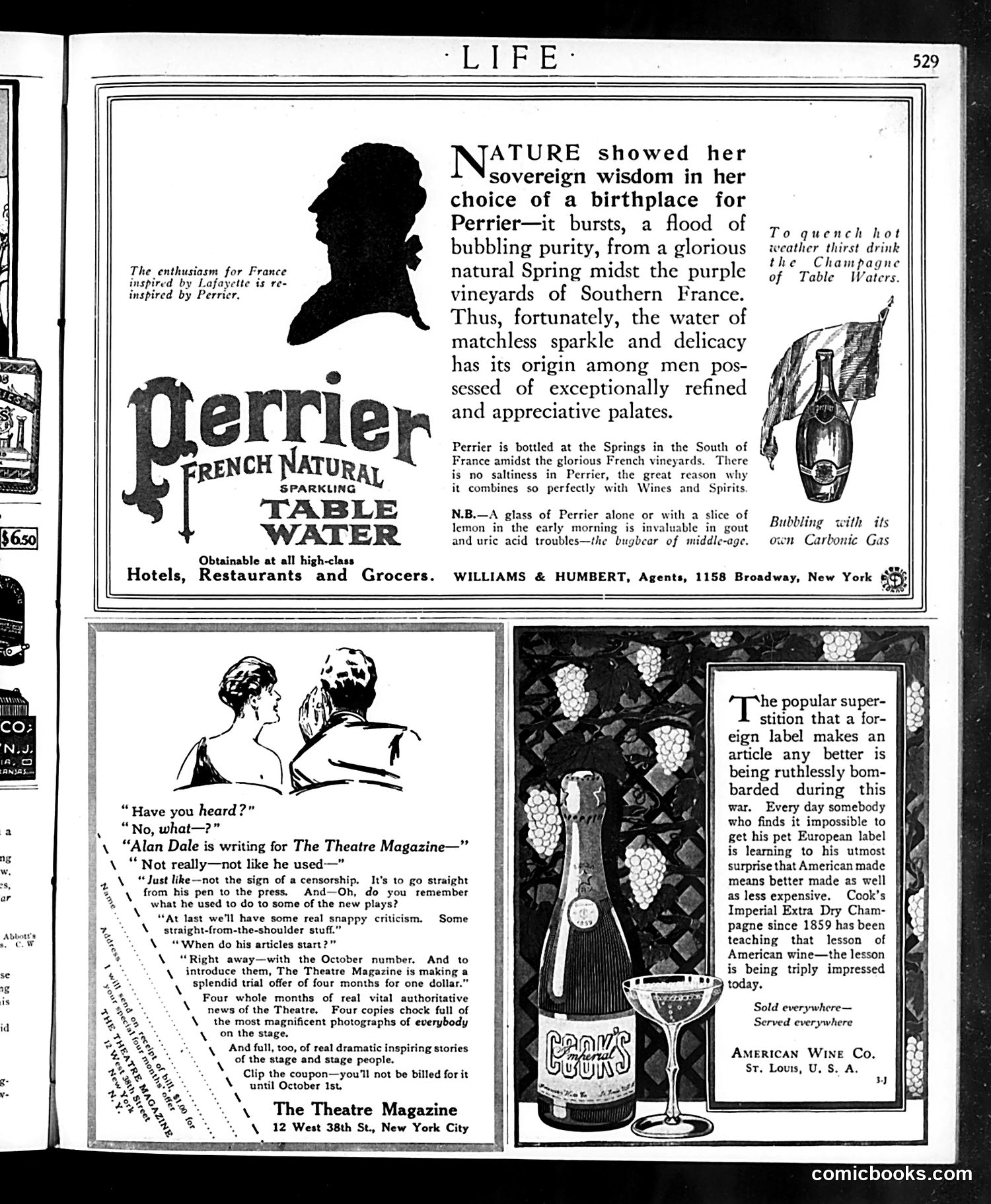
This page consists primarily of **advertisements**, not editorial cartoons. The top ad promotes **Perrier water**, a French sparkling beverage, using flowery language about its natural spring origin in Southern France to market it as a refined product for discerning palates. It also includes a health claim about treating gout and uric acid troubles. The lower left advertises **The Theatre Magazine**, featuring a dialogue joke about critic Alan Dale. The humor rests on the implication that Dale's harsh reviewing style ("straight-from-the-shoulder") was previously being censored or softened—now readers will finally get his "real snappy criticism." The right ad for **Cook's Imperial Extra Dry Champagne** (American-made) directly addresses wartime sentiment. It mocks the "popular superstition" that foreign labels are superior, arguing that American wine is actually better *and* cheaper. This reflects **WWI-era economic nationalism**—encouraging American consumers to buy domestic products over European imports. All three ads exploit contemporary consumer anxieties: taste/refinement, entertainment quality, and patriotic purchasing during wartime.
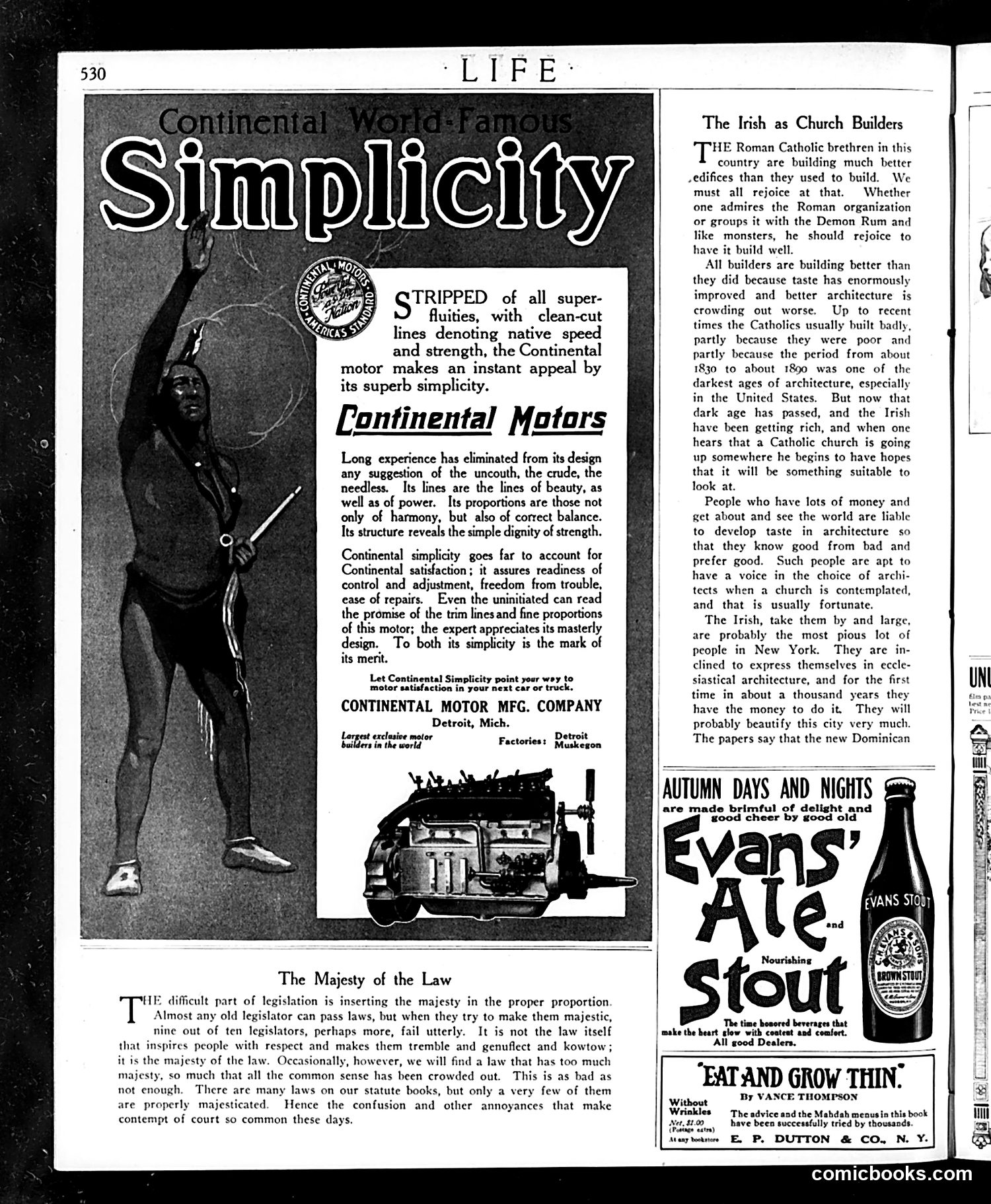
This page consists primarily of advertisements and opinion pieces rather than traditional cartoons. The main content includes a **Continental Motors ad** using modernist rhetoric about "simplicity" and clean design to market automobiles—typical 1920s marketing linking industrial products to aesthetic virtue. The **"Majesty of the Law"** essay satirizes legislators who create laws with excessive pomp and "majesty" that actually obscure common sense, making law confusing and contemptuous. It's a mild critique of governmental pomposity. The **"Irish as Church Builders"** essay praises Irish Catholics for finally having wealth to build architecturally respectable churches. It contains paternalistic commentary—acknowledging Irish poverty and poor taste from 1830-1890, but now approving their improved aesthetic choices as they've become wealthy and "worldly." The piece is simultaneously congratulatory and subtly condescending about Irish-American assimilation and social climbing through religious architecture. The **Evans' Ale advertisement** occupies the lower right.
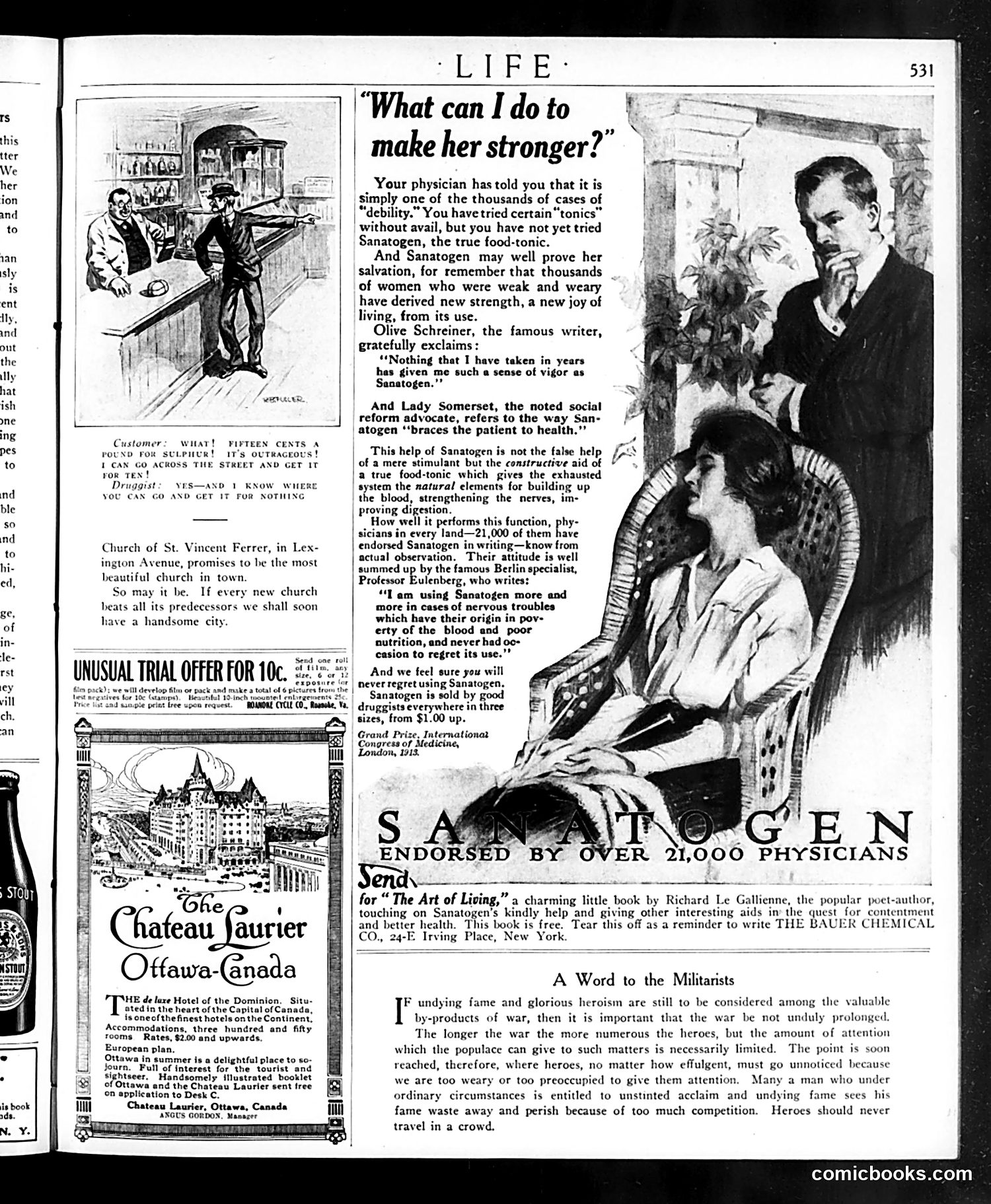
**The Small Cartoon (upper left):** A brief satirical exchange between a customer and druggist about sulphur prices. The customer complains about paying fifteen cents a pound, claiming it's outrageous. The druggist knows where to get it cheaper—"for nothing"—a joke implying sulphur occurs naturally and freely in certain undesirable locations (likely a reference to hell or other vulgar implications). **Primary Content:** The page is dominated by advertisement for Sanatogen, a "food-tonic" marketed to treat female "debility" (weakness). The ad endorses the product through celebrity testimonials from writer Olive Schreiner and social reformer Lady Somerset, and claims endorsement by 21,000 physicians. **"A Word to the Militarists" (bottom):** Satirical commentary on WWI hero-worship. The piece argues that if prolonged war creates many heroes, public attention becomes diluted—heroes get lost in the crowd and fail to receive proper acclaim. It's gentle mockery of both military glorification and society's short attention span.
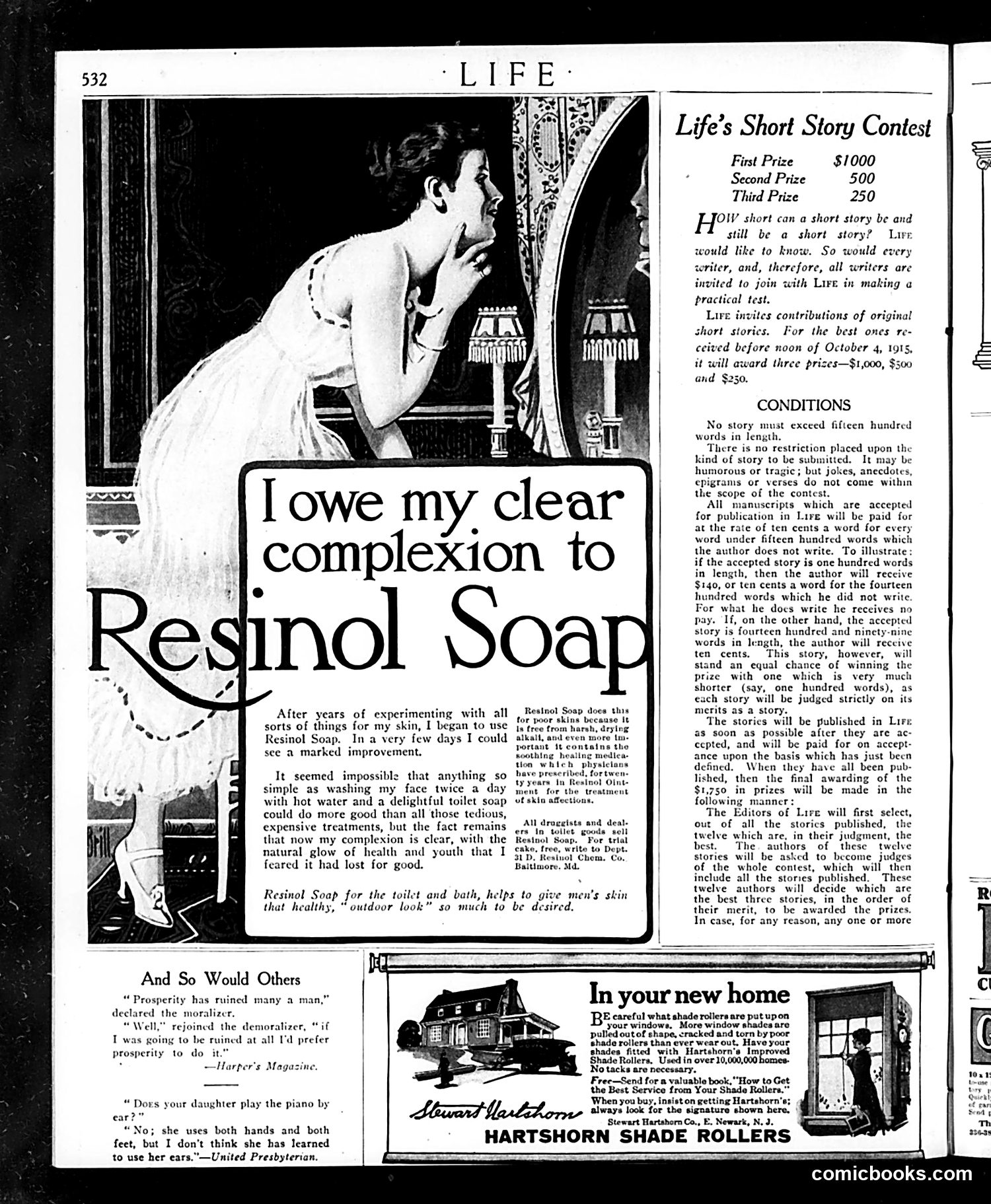
This page is primarily **advertising and editorial content** rather than political satire. The main feature is a **Resinol Soap advertisement** using testimonial format—a woman claims the soap improved her complexion dramatically. This reflects early-20th-century beauty marketing, when soap manufacturers made medicinal claims (Resinol contained actual healing compounds prescribed by physicians, per the ad). Below that are two brief humor quotes under "And So Would Others," presenting contrasting moral philosophies—one valorizing prosperity over morality, another mocking a daughter's musical pretensions. These are standard magazine filler jokes, not satire. The right column announces **Life's Short Story Contest** (deadline October 4, 1915), with an unusual payment structure: writers receive ten cents per word they *didn't* write (up to 1,500 words), incentivizing brevity rather than compensation for actual work—a clever editorial joke about literary economics. The bottom features **Hartshorn Shade Rollers** advertising—standard product promotion. This page contains no political cartoons or significant satire.
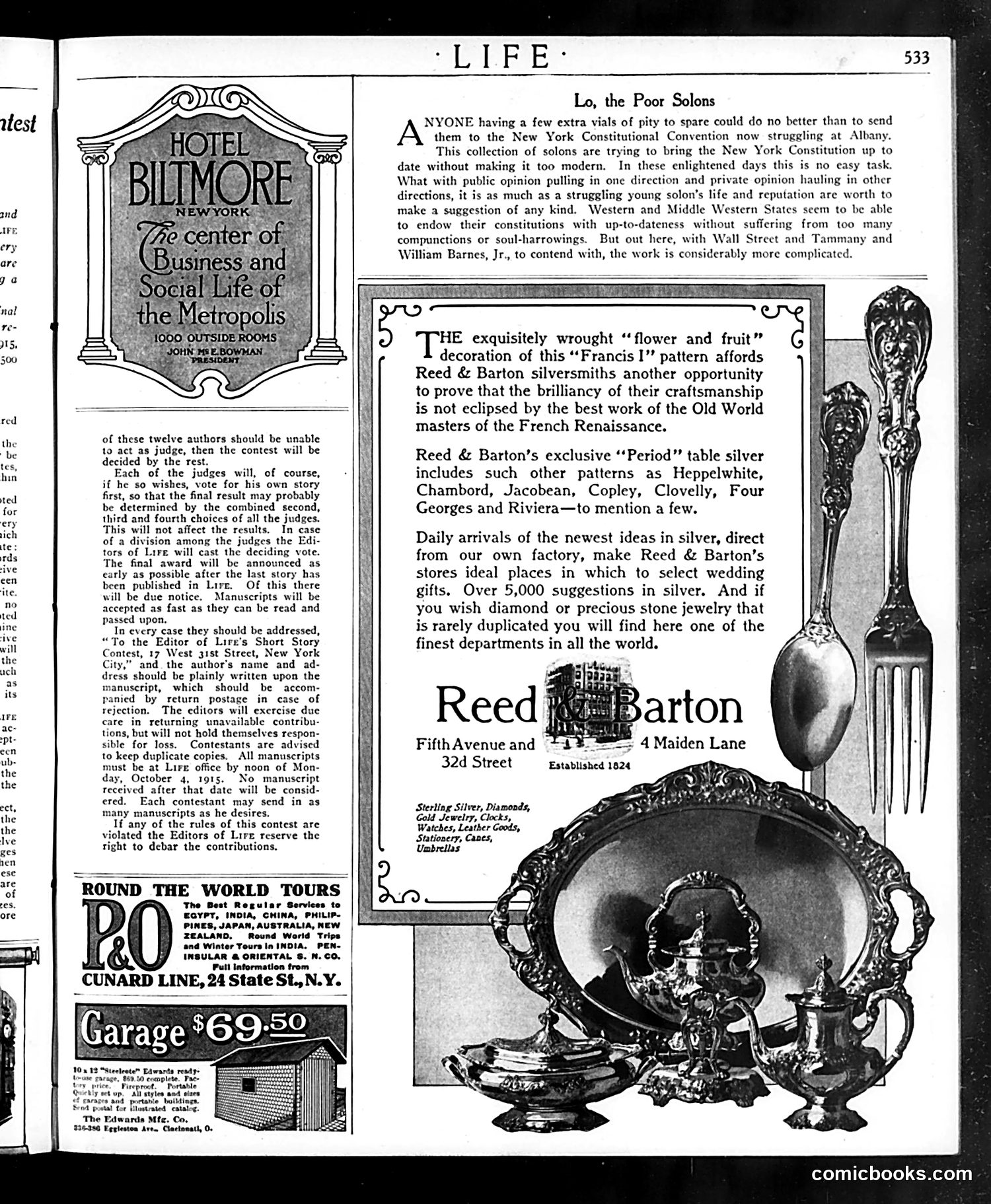
This brief editorial cartoon/commentary mocks the New York Constitutional Convention struggling in Albany to modernize the state constitution. "Solons" (a classical reference to ancient Greek lawgivers) is used ironically—these politicians face impossible pressure: public opinion pulls them toward modernization, while private interests (Wall Street, Tammany Hall political machine, and William Barnes Jr., a conservative Republican boss) pull backward. The satire's point: unlike Western and Midwestern states that successfully updated their constitutions, New York's legislators are paralyzed by competing forces. The piece suggests these politicians deserve "pity" because their reputations suffer regardless of their choices—a damned-if-you-do situation. The title sarcastically elevates them as "solons" while the text reveals them as helpless, caught between progressive reform and entrenched power brokers. The page is otherwise advertising (Hotel Biltmore, Reed & Barton silverware, travel tours).
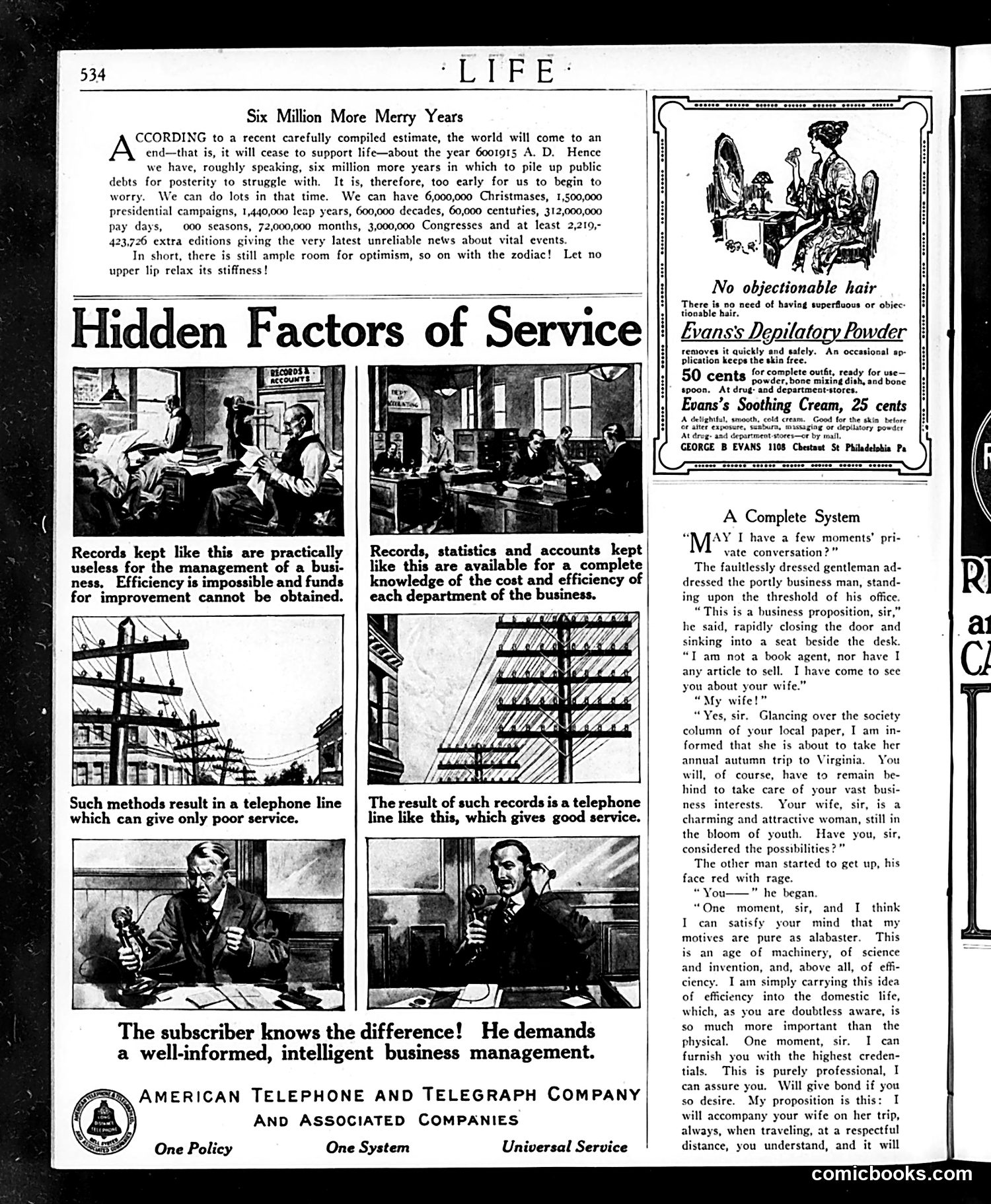
This page contains two separate pieces of satire. **"Six Million More Merry Years"** is a tongue-in-cheek editorial responding to a contemporary scientific estimate that Earth will remain habitable for approximately six million more years. The joke targets public anxiety about government debt and fiscal responsibility: since we have six million years ahead, why worry about budgetary problems now? The satirist lists absurd accumulations (6 million Christmases, 2.2 billion newspaper editions) to mock the fatalistic resignation of policymakers who treat long-term consequences as someone else's problem. **"A Complete System"** is a comedic short story about a con man who approaches a businessman with a proposition: the con man will accompany the businessman's wife on her autumn trip to Virginia as a chaperone—framed as applying "efficiency" principles to domestic life. The businessman, initially outraged, is being manipulated through pseudo-scientific business jargon. The satire mocks both efficiency-obsessed businessmen and predatory schemes dressed in professional language. The AT&T advertisement below ironically juxtaposes organized vs. disorganized record-keeping—itself promoting "efficiency."
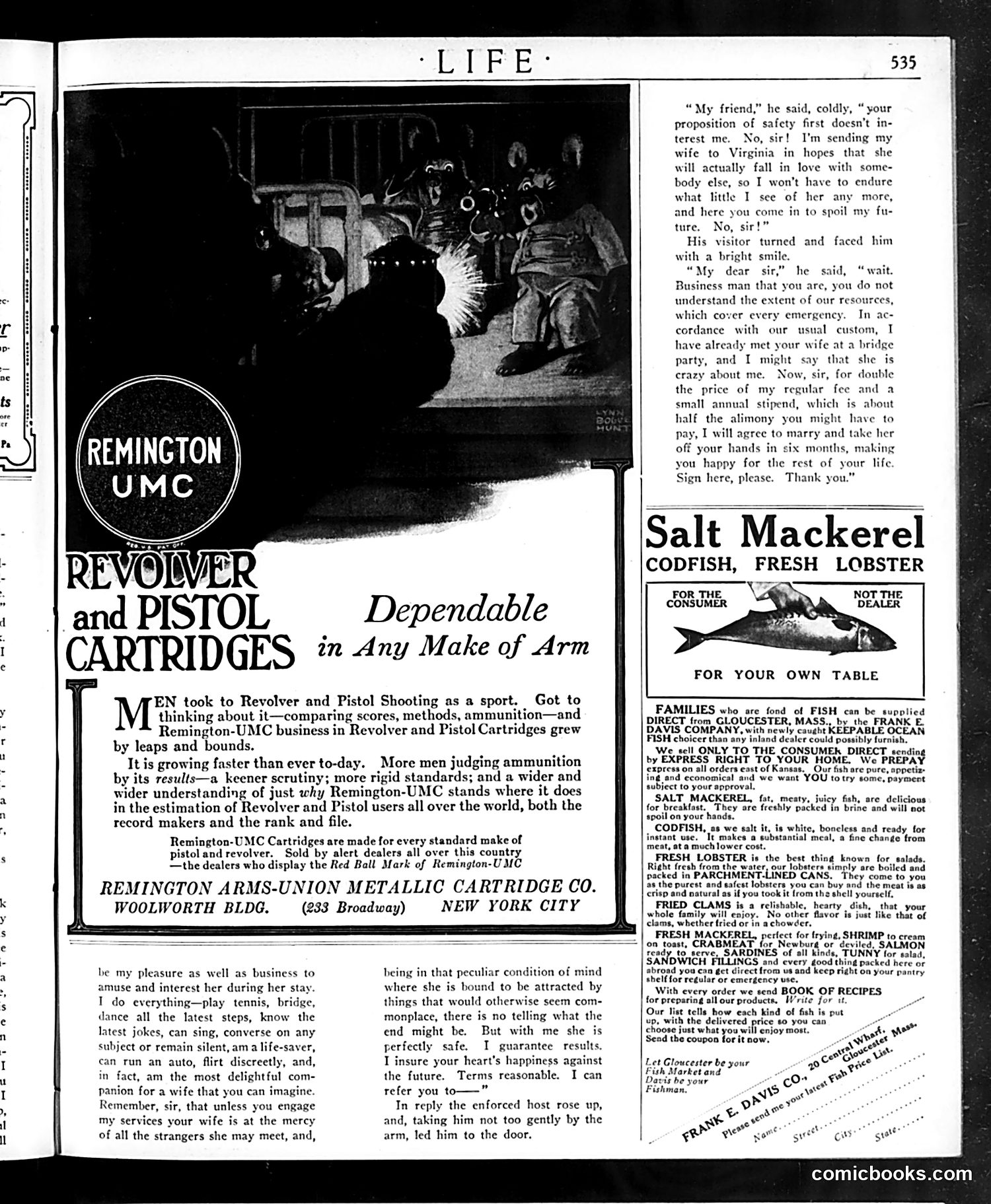
This page contains two distinct satirical pieces: **The Main Cartoon/Story** (right side): A humorous dialogue where a husband, desperate to escape his marriage, hires a "professional companion" to entertain his wife during her Virginia trip—hoping she'll fall in love with someone else and he can divorce without alimony. The visitor brilliantly counters by revealing he's *already* met the wife at a bridge party and she's infatuated with him. He then offers, for double his fee, to marry her himself within six months, solving the husband's problem entirely. The satire targets early 20th-century marriage anxieties, marital dissatisfaction, and the emerging "service economy" where professional facilitators handled social situations—here extended absurdly to matrimonial problems. **The Advertisements** occupy the left side (Remington ammunition) and bottom right (Frank E. Davis fish company), typical of Life's revenue model. The cartoon's humor relies on the unexpected solution: the husband's desperate scheme backfires into an even more perfect arrangement.
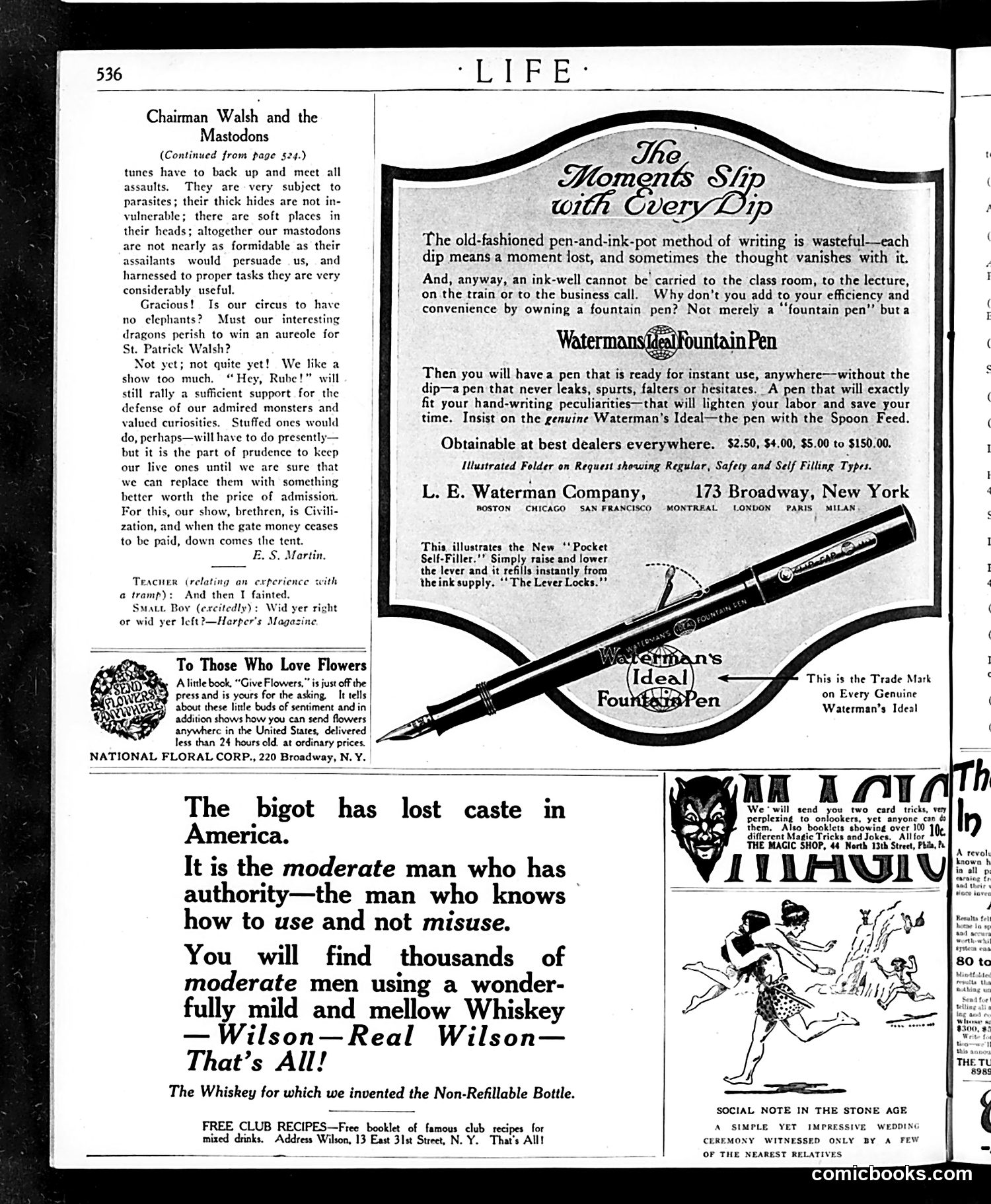
This page contains **primarily advertisements** interspersed with brief satirical content. The main editorial piece concerns "Chairman Walsh and the Mastodons"—a fictional debate about whether a circus should preserve live animals or replace them with stuffed ones. The satire critiques wasteful nostalgia: the author argues that preserving expensive live creatures for admission fees is impractical when civilization advances. The brief humor snippets (a teacher fainting, a boy's question) are standard magazine filler jokes. The advertisements dominate: Waterman's fountain pens (emphasizing modern efficiency), National Floral Corp (delivering flowers), and Wilson whiskey. The whiskey ad notably promotes "moderation" and the "non-refillable bottle"—likely a response to Prohibition-era concerns about alcohol consumption and waste. The cartoon titled "Social Note in the Stone Age" (bottom right) appears to satirize primitive wedding customs with modern pretension—unclear without fuller context. Overall, this is a typical early 20th-century magazine mixing light satire with commercial pitches targeting middle-class consumers.
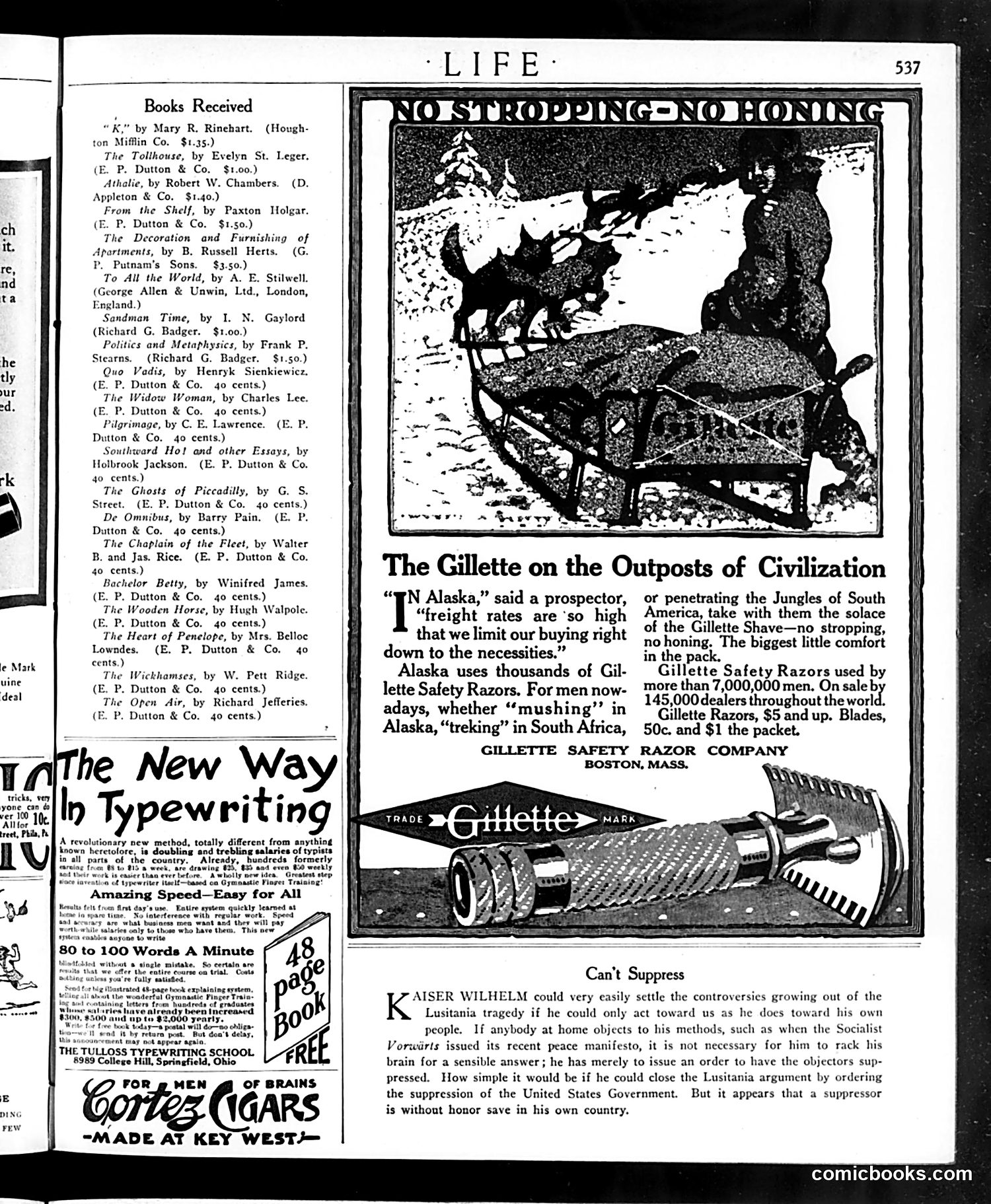
This page contains a **Gillette Safety Razor advertisement** disguised as editorial content, alongside a political commentary piece titled "Can't Suppress." **The Advertisement:** The illustrated cartoon shows a man shaving in harsh frontier conditions (Alaska, South Africa, jungle exploration). The ad's joke is that even in the most remote, uncivilized places on Earth, men maintain grooming standards with Gillette razors—selling the product as essential to masculine dignity regardless of circumstance. **"Can't Suppress" Commentary:** This is satire about **Kaiser Wilhelm II and the Lusitania controversy** (the 1915 sinking of the British ship by German submarines, killing 128 Americans). The piece mocks Wilhelm's authoritarian style: he can suppress domestic critics like the *Vorwärts* newspaper through simple orders, but cannot suppress American government objections to the Lusitania tragedy. The closing line—"a suppressor is without honor save in his own country"—suggests his dictatorial methods work only domestically, not internationally. **Context:** This reflects American public outrage over the Lusitania and rising anti-German sentiment preceding U.S. entry into World War I.
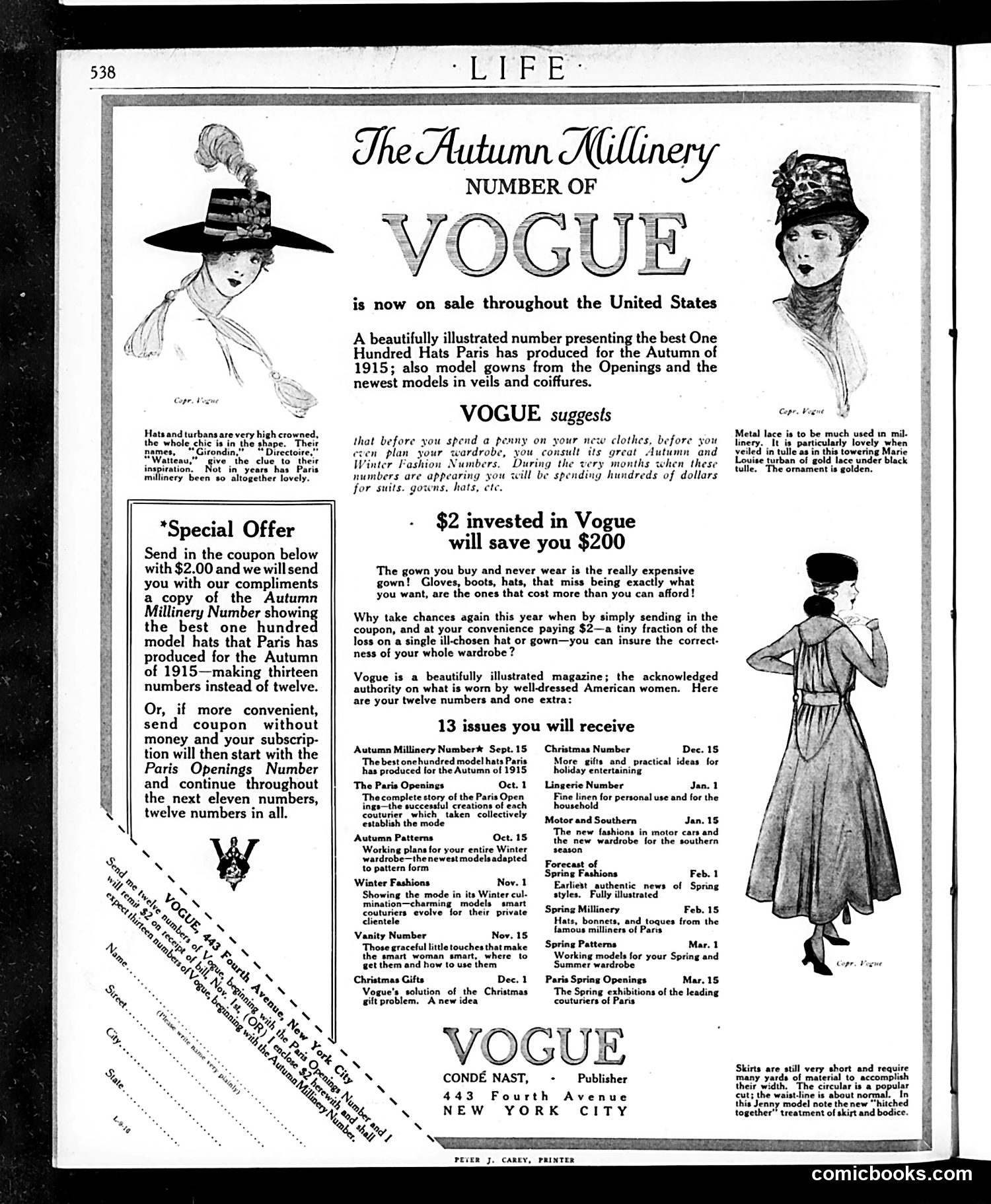
This is primarily a **Vogue magazine advertisement**, not a political cartoon. The page promotes Vogue's "Autumn Millinery Number" subscription offer from 1915. The two illustrated women shown wearing elaborate hats represent fashionable hat styles of the era—notably the high-crowned, heavily decorated designs popular in 1915. The text celebrates Parisian millinery as the height of fashion authority. The "satire" (if present) is subtle: Vogue positions itself as an *essential* purchase by arguing that a $2 subscription will "save you $200" by preventing poor clothing choices. This is marketing humor—the implied joke is that women waste money on ill-fitting garments, so consulting Vogue prevents costly mistakes. The reference to hat styles named "Girondin" and "Directoire" invokes historical French periods, lending prestige to current fashions. There are no political figures or cartoons here—this is a commercial page selling magazine subscriptions by appealing to women concerned with maintaining fashionable wardrobes during World War I (note the "Motor and Southern" issue addressing wartime needs).
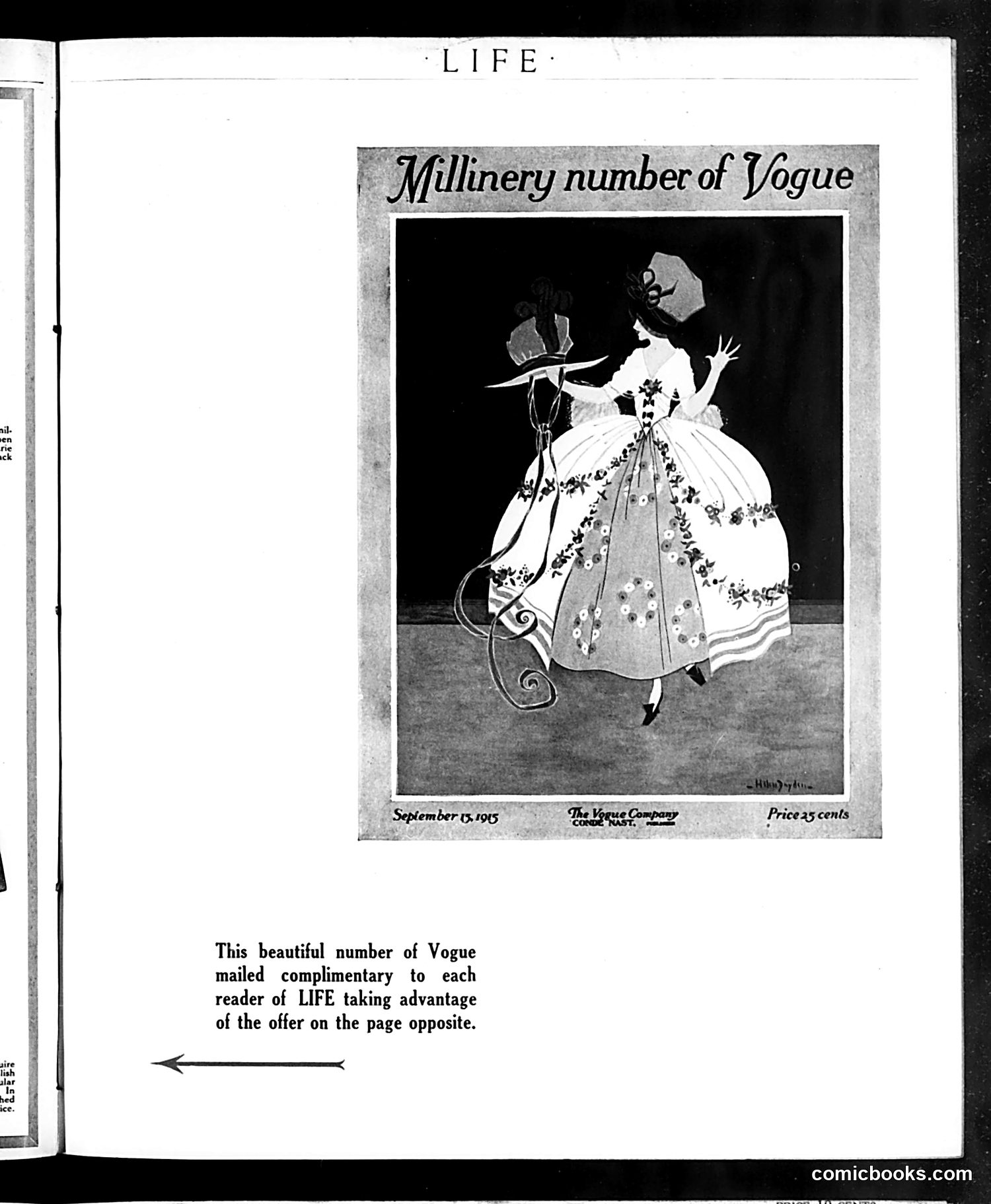
This is primarily an **advertisement page**, not satirical content. It promotes a complimentary copy of *Vogue*'s millinery issue being sent to *Life* readers who respond to an offer on the facing page. The illustration depicts a fashionable woman in an elaborate Edwardian gown, displaying decorative hats—the focus of that *Vogue* issue. The dress features the period's characteristic full skirt with floral embroidery and ornamental details. The advertisement uses the fashion illustration as an incentive, suggesting that *Life* readers interested in current fashion trends should claim the free *Vogue* issue. This cross-promotion between the two publications was a common marketing strategy in early 20th-century periodicals.
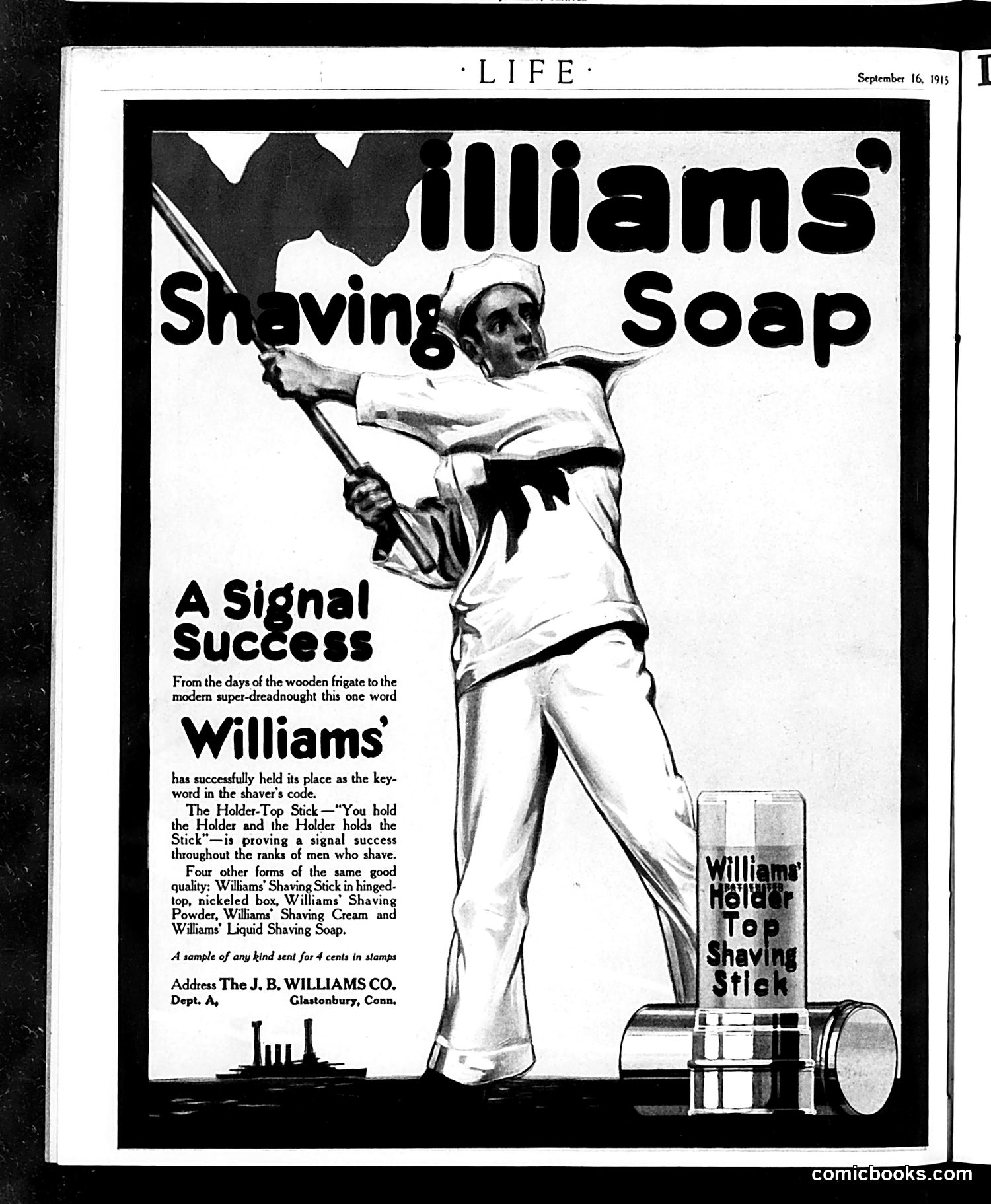
This is a **straightforward product advertisement**, not political satire. The page promotes Williams' Shaving Soap and related products from J.B. Williams Company. The illustration depicts a baseball player mid-swing, using the sport as a metaphor for masculine success and vigor. The "signal success" tagline plays on both baseball terminology and the product's longevity—the ad claims Williams has been "the key-word in the shaver's code" from historical times ("wooden frigate") through the modern "super-dreadnought" era. The baseball imagery appeals to early 20th-century American masculinity, suggesting the product is associated with strength and achievement. The "Holder-Top Stick" design is highlighted as the innovation ensuring the product's continued dominance in the market. This is typical 1915 *Life* magazine advertising—celebratory consumer marketing rather than editorial commentary or political commentary.