
Life, 1915-09-16 · page 28 of 48
Life — September 16, 1915 — page 28: what you’re looking at
What you’re looking at
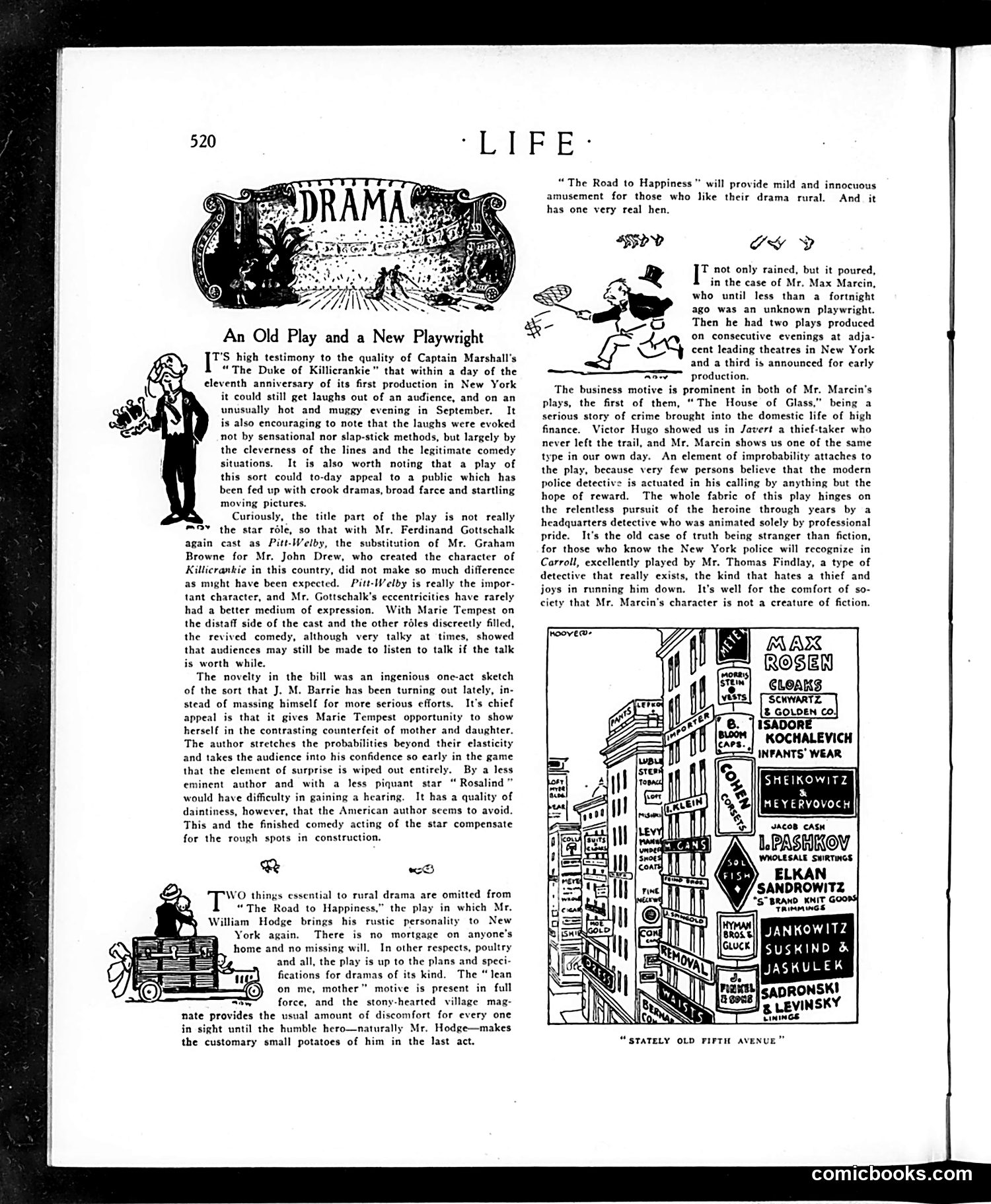
This page reviews three theatrical productions from early 20th-century Broadway: **"The Duke of Killicrankie"** — A revival of a decades-old comedy praised for succeeding through clever dialogue and legitimate humor rather than slapstick, appealing to audiences tired of sensational drama and moving pictures. **"The Road to Happiness"** — A rural comedy starring William Hodge, following the predictable formula of agrarian drama: no mortgages, missing wills, or complex plot devices. The reviewer notes it's competent but formulaic, with "one very real hen" as its actual asset. **Max Marcin's plays** — Two newly produced plays by a previously unknown playwright, including "The House of Glass," featuring crime in high-finance domestic settings. The cartoons (left margin) appear to be decorative editorial illustrations typical of the era. The right side contains an advertisement for "Stately Old Fifth Avenue," listing various Jewish and Eastern European surnames of shop owners—reflecting New York's immigrant commercial landscape of the period. The reviews emphasize sophisticated audiences preferring intelligent dialogue over spectacle.
📄 Transcribed text from this page (OCR, searchable)
Machine-transcribed from the original scan — historical spelling and the odd misread are preserved.
“LIFE : An Old Play and a New Playwright T'S high testimony to the quality of Captain Marshall's “The Duke of Killicrankie” that within a day of the eleventh anniversary of its first production in New York it could still get laughs out of an audience, and on an unusually hot and muggy evening in September. It is also encouraging to note that the laughs were evoked not by sensational nor slap-stick methods, but largely by the cleverness of the lines and the legitimate comedy situations. It is also worth noting that a play of this sort could to-day appeal to a public which has been fed up with crook dramas, broad farce and startling moving pictures. Curiously, the title part of the play is not really 9% the star role, so that with Mr. Ferdinand Gottschalk again cast as Pitt-Welby, the substitution of Mr. Graham Browne for Mr. John Drew, who created the character of Killicrankie in this country, did not make so much difference as might have been expected. Pitt-Welby is really the impor- tant character, and Mr. Gottschalk’s eccentricities have rarely had a better medium of expression. With Marie Tempest on the distaff side of the cast and the other réles discreetly filled, the revived comedy, although very talky at times, showed that audiences may still be made to listen to talk if the talk is worth while. The novelty in the bill was an ingenious one-act sketch of the sort that J. M. Barrie has been turning out lately, in- stead of massing himself for more serious efforts. It’s chief appeal is that it gives Marie Tempest opportunity to show herself in the contrasting counterfeit of mother and daughter. The author stretches the probabilities beyond their elasticity and takes the audience into his confidence so early in the game that the element of surprise is wiped out entirely. By a less eminent author and with a less piquant star “ Rosalind” would have difficulty in gaining a hearing. It has a quality of daintiness, however, that the American author seems to avoid. This and the finished comedy acting of the star compensate for the rough spots in construction. R <S AO things essential to rural drama are omitted from “The Road to Happiness,” the play in which Mr. William Hodge brings his rustic personality to New York again. There is no mortgage on anyone's home and no missing will. In other respects, poultry and all, the play is up to the plans and speci- fications for dramas of its kind. The “lean on me, mother” motive is present in full force, and the stony-hearted village mag- nate provides the usual amount of discomfort for every one in sight until the humble hero—naturally Mr. Hodge—makes the customary small potatoes of him in the last act. “The Road to Happiness” will provide mild and innocuous amusement for those who like their drama rural. And it has one very real hen. Vv oy YD T not only rained, but it poured, in the case of Mr. Max Marcin, who until less than a fortnight ago was an unknown playwright. oO Then he had two plays produced < ‘on consecutive evenings at adja- 5 Sasi cent leading theatres in New York and a third is announced for early —_-___ aa production. The business motive is prominent in both of Mr. Marcin's plays, the first of them, “The House of Glass,” being a serious story of crime brought into the domestic life of high finance. Victor Hugo showed us in Javert a thief-taker who never left the trail, and Mr. Marcin shows us one of the same type in our own day. An element of improbability attaches to the play, because very few persons believe that the modern police detective is actuated in his calling by anything but the hope of reward. The whole fabric of this play hinges on the relentless pursuit of the heroine through years by a headquarters detective who was animated solely by professional pride. It’s the old case of truth being stranger than fiction, for those who know the New York police will recognize in Carroll, excellently played by Mr. Thomas Findlay, a type of detective that really exists, the kind that hates a thief and joys in running him down. It’s well for the comfort of so- ciety that Mr. Marcin’s character is not a creature of fiction. ROSEN GLOAKS SCHWARTZ & GOLDEN Co. TSADOR MOCHALEVICH i KD KNIT berm y JANKOWITZ SUSKIND & JASKULEK “STATELY OLD FIFTH AVENUE” comicbooks.com