
Life, 1915-09-16 · page 31 of 48
Life — September 16, 1915 — page 31: what you’re looking at
What you’re looking at
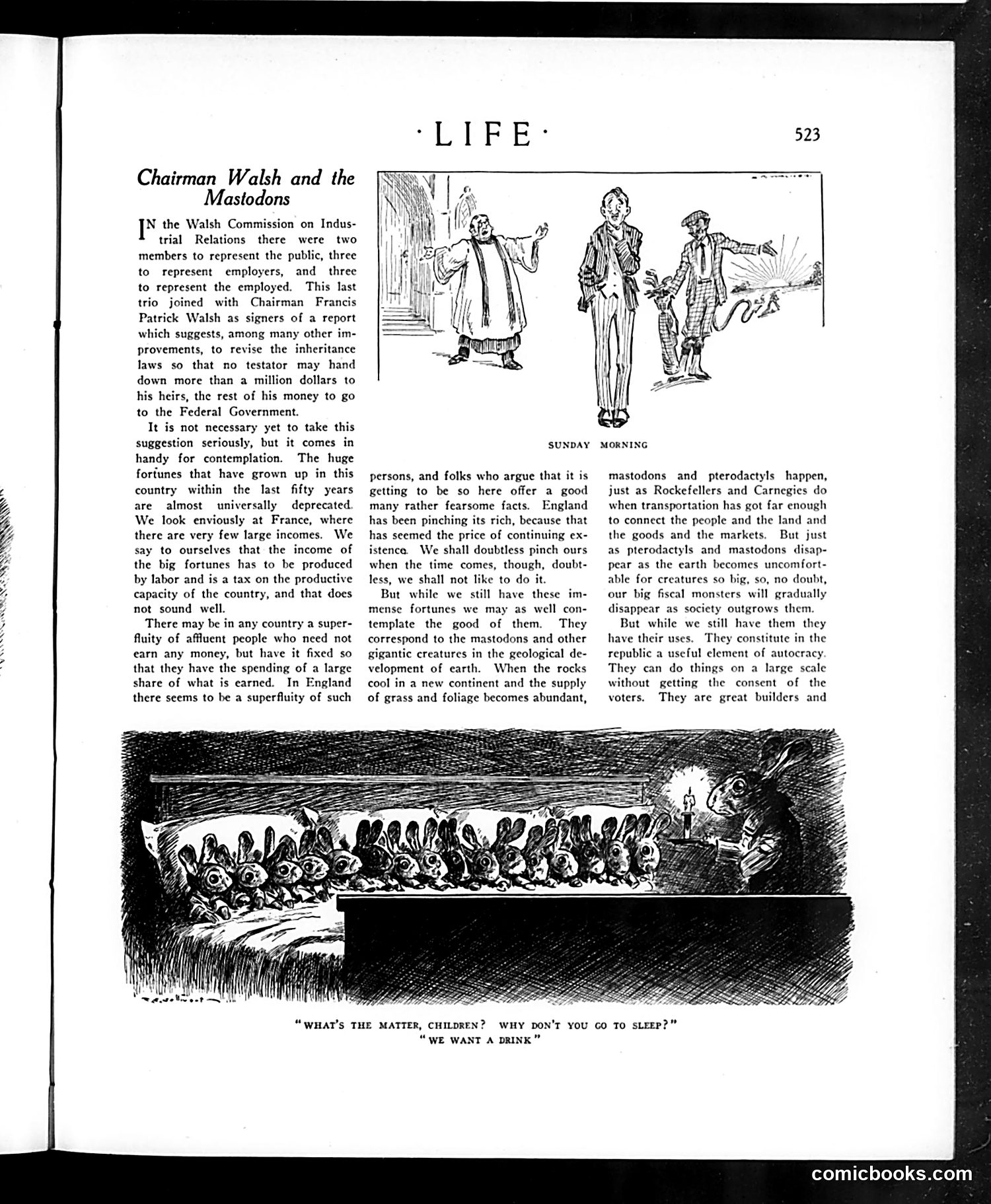
This satirical piece comments on a 1912 Walsh Commission proposal to cap inheritance at $1 million, with excess wealth going to the Federal Government. The article compares massive American fortunes (Rockefeller, Carnegie) to extinct mastodons—evolutionary relics suited to their environment but destined to disappear as conditions change. The cartoons illustrate the point: the top sketch shows well-dressed figures (wealthy industrialists), while the bottom cartoon depicts children asking "Why don't you go to sleep?" and demanding "We want a drink"—likely representing labor/working-class demands that the wealthy cannot ignore indefinitely. The satire's dual message: huge fortunes are natural but temporary products of American industrial development, yet currently serve a purpose as autocratic power that accomplishes large-scale projects without democratic consent. However, society will eventually "outgrow" them, as the mastodon became obsolete.
📄 Transcribed text from this page (OCR, searchable)
Machine-transcribed from the original scan — historical spelling and the odd misread are preserved.
Chairman Walsh and the Mastodons IX the Walsh Commission on Indus- trial Relations there were two members to represent the public, three to represent employers, and three to represent the employed. This last trio joined with Chairman Francis Patrick Walsh as signers of a report which suggests, among many other im- provements, to revise the inheritance laws so that no testator may hand down more than a million dollars to his heirs, the rest of his money to go to the Federal Government. It is not necessary yet to take this suggestion seriously, but it comes in handy for contemplation. The huge fortunes that have grown up in this country within the last fifty years are almost universally deprecated. We look enviously at France, where there are very few large incomes. We say to ourselves that the income of the big fortunes has to be produced by labor and is a tax on the productive capacity of the country, and that does not sound well. There may be in any country a super- fluity of affluent people who need not earn any money, but have it fixed so that they have the spending of a large share of what is earned. In England there seems to be a superfluity of such “WHAT'S THE MATTER, CHILDREN? SUNDAY persons, and folks who argue that it is getting to be so here offer a good many rather fearsome facts. England has been pinching its rich, because that has seemed the price of continuing ex- istence. We shall doubtless pinch ours when the time comes, though, doubt- less, we shall not like to do it. But while we still have these im- mense fortunes we may as well con- template the good of them. They correspond to the mastodons and other gigantic creatures in the geological de- velopment of earth. When the rocks cool in a new continent and the supply of grass and foliage becomes abundant, “WE WANT A DRINK” MORNING mastodons and pterodactyls happen, just as Rockefellers and Carnegies do when transportation has got far enough to connect the people and the land and the goods and the markets. But just as pterodactyls and mastodons disap- pear as the earth becomes uncomfort- able for creatures so big, so, no doubt, our big fiscal monsters will gradually disappear as society outgrows them. But while we still have them they have their uses. They constitute in the republic a useful element of autocracy. They can do things on a large scale without getting the consent of the voters. They are great builders and WHY DON'T YOU GO TO SLEEP?” comicbooks.com