
Life, 1915-09-16 · page 22 of 48
Life — September 16, 1915 — page 22: what you’re looking at
What you’re looking at
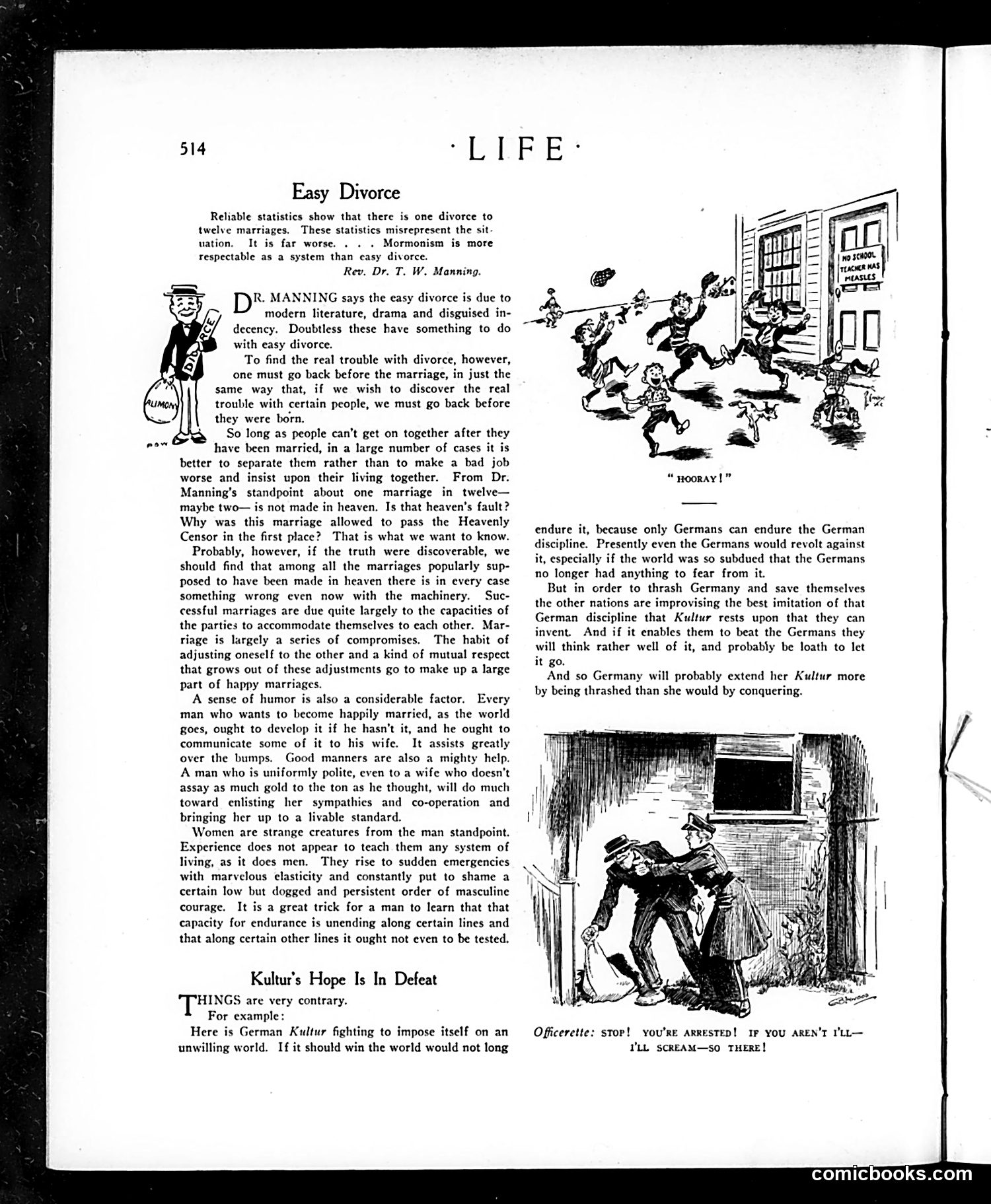
This page contains two distinct pieces of satire from Life magazine, likely published during World War I. **"Easy Divorce"** critiques the moral panic over rising divorce rates. The author ironically argues that blaming modern literature and "indecency" misses the point—the real issue is incompatible people staying married. The piece advocates for pragmatic separation over miserable cohabitation, countering religious figures like Rev. Dr. Manning who opposed divorce. **"Kultur's Hope Is In Defeat"** satirizes German militarism. It argues that German "Kultur" (discipline/culture) is so oppressive that even Germans resent it, and the world would reject it if Germany won. Paradoxically, the Allies are adopting similar authoritarian discipline to defeat Germany—meaning Germany's philosophy spreads through losing. The cartoon showing a woman threatening an officer ("I'll scream!") appears to reference wartime "Officerettes"—women taking civilian police or civil service roles—mocking both the unconventional employment and gender anxieties of the era.
📄 Transcribed text from this page (OCR, searchable)
Machine-transcribed from the original scan — historical spelling and the odd misread are preserved.
row GB OS oi Easy Divorce Reliable statistics show that there is one divorce to twelve marriages, These statistics misrepresent the sit uation. It is far worse. . Mormonism is more respectable as a system than easy divorce. Rev. Dr. T, W. Manning. D® MANNING says the easy divorce is due to modern literature, drama and disguised in- decency. Doubtless these have something to do with easy divorce. To find the real trouble with divorce, however, one must go back before the marriage, in just the same way that, if we wish to discover the real trouble with certain people, we must go back before they were born. So long as people can’t get on together after they have been married, in a large number of cases it is better to separate them rather than to make a bad job worse and insist upon their living together. From Dr. Manning’s standpoint about one marriage in twelve— maybe two— is not made in heaven. Is that heaven's fault? Why was this marriage allowed to pass the Heavenly Censor in the first place? That is what we want to know. Probably, however, if the truth were discoverable, we should find that among all the marriages popularly sup- posed to have been made in heaven there is in every case something wrong even now with the machinery. Suc- cessful marriages are due quite largely to the capacities of the parties to accommodate themselves to each other. Mar- riage is largely a series of compromises. The habit of adjusting oneself to the other and a kind of mutual respect that grows out of these adjustments go to make up a large part of happy marriages. A sense of humor is also a considerable factor. Every man who wants to become happily married, as the world goes, ought to develop it if he hasn't it, and he ought to communicate some of it to his wife. It assists greatly over the bumps. Good manners are also a mighty help. A man who is uniformly polite, even to a wife who doesn’t assay as much gold to the ton as he thought, will do much toward enlisting her sympathics and co-operation and bringing her up to a livable standard. Women are strange creatures from the man standpoint. Experience does not appear to teach them any system of living, as it does men. They rise to sudden emergencies with marvelous elasticity and constantly put to shame a certain low but dogged and persistent order of masculine courage. It is a great trick for a man to learn that that capacity for endurance is unending along certain lines and that along certain other lines it ought not even to be tested. Kultur’s Hope Is In Defeat 'HINGS are very contrary. For example: Here is German Kultur fighting to impose itself on an unwilling world. If it should win the world would not long endure it, because only Germans can endure the German discipline. Presently even the Germans would revolt against it, especially if the world was so subdued that the Germans no longer had anything to fear from it. But in order to thrash Germany and save themselves the other nations are improvising the best imitation of that German discipline that Kultur rests upon that they can invent. And if it enables them to beat the Germans they will think rather well of it, and probably be loath to let it go. And so Germany will probably extend her Kultur more by being thrashed than she would by conquering. YOU'RE ARRESTED! IF YOU AREN'T I'LL— TLL SCREAM—SO THERE! Officerette: stor! comicbooks.com