
Life, 1915-09-16 · page 26 of 48
Life — September 16, 1915 — page 26: what you’re looking at
What you’re looking at
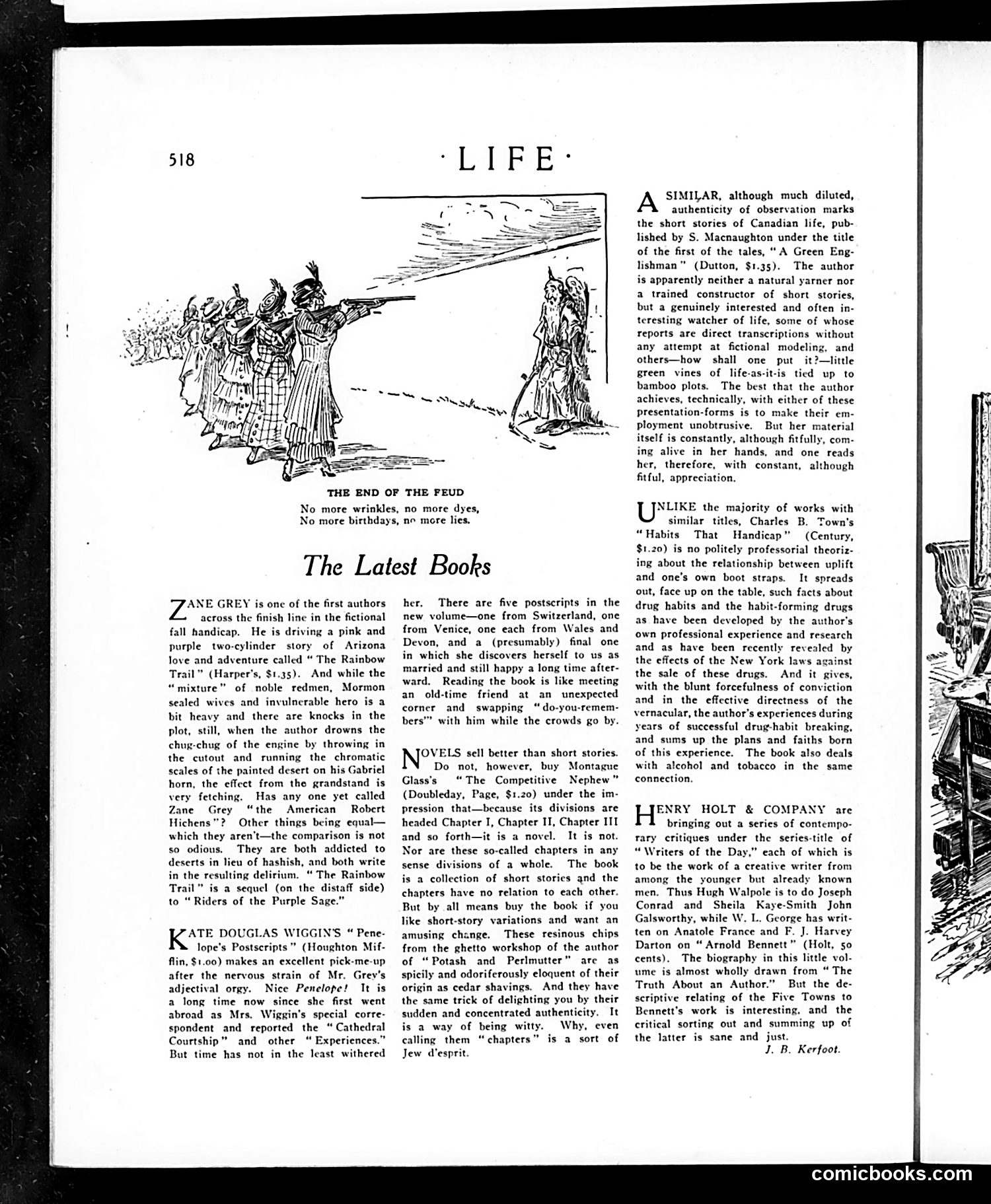
This page from *Life* magazine contains literary reviews rather than political cartoons. The illustration at top—titled "The End of the Feud"—shows figures in period dress with the caption "No more wrinkles, no more dyes, / No more birthdays, no more lies," likely a satirical commentary on aging or mortality, though its specific reference is unclear. The bulk of the page reviews contemporary fiction, including Zane Grey's *The Rainbow Trail*, Kate Douglas Wiggin's *Penelope's Postscripts*, Montague Glass's *The Competitive Nephew*, and S. Macnaughton's *A Green Englishman*. The reviews employ *Life*'s characteristic witty, sometimes caustic tone—praising some works while criticizing others for overwrought prose or structural flaws. The references to "hashish," "the ghetto," and ethnic humor reflect period attitudes now considered outdated.
📄 Transcribed text from this page (OCR, searchable)
Machine-transcribed from the original scan — historical spelling and the odd misread are preserved.
THE END OF THE FEUD No more wrinkles, no more dyes, No more birthdays, no more lies. The Latest Books ANE GRE one of the first authors across the finish line in the fictional fall handicap. He is driving a pink and purple two-cylinder story of Arizona Jove and adventure called “ The Rainbow Trail” (Harper's, $1.35). And while the “mixture” of noble redmen, Mormon sealed wives and invulnerable hero is a bit heavy and there are knocks in the plot, still, when the author drowns the chug-chug of the engine by throwing in the cutout and running the chromat scales of the painted desert on his Gabriel horn, the effect from the grandstand is very fetching. Has any one yet called Zane Grey “the American Robert Hichens"? Other things ing equal— which they aren’t—the comparison is not so odious, They are both addicted to deserts in lieu of hashish, and both write in the resulting delirium, “ The Rainbow Trail” is a sequel (on the distaff side) to “Riders of the Purple Sage.” ATE DOUGLAS WIGGIN'S “ Pene- lope's Postscripts”” (Houghton Mif- flin, $1.00) makes an excellent pick-me-up after the nervous strain of Mr. Grey's adjectival orgy. Nice Penelope! It is a long time now since she first went abroad as Mrs. Wiggin’s special corre- spondent and reported the “ Cathedral Courtship” and other “ Experiences.” But time has not in the least withered her, There are five postscripts in the new volume—one from Switzerland, one from Venice, one each from Wales and Devon, and a (presumably) final one in which she discovers herself to us as married and still happy a long time after- ward. Reading the book is like meeting an old-time friend at an unexpected corner and swapping “do-you-remem- bers” with him while the crowds go by. OVELS sell better than short stories. Do not, however, buy Montague Glass’s “The Competitive Nephew” (Doubleday, Page, $1.20) under the im- pression that—because its divisions are headed Chapter I, Chapter I], Chapter IIT and so forth—it is a novel, It is not. Nor are these so-called chapters in any sense divisions of a whole. The book is a collection of short stories and the chapters have no relation to each other. But by all means buy the book if you like short-story variations and want an amusing change. These resinous chips from the ghetto workshop of the author of “Potash and Perlmutter” are as spicily and odoriferously eloquent of their origin as cedar shavings. And they have the same trick of delighting you by their sudden and concentrated authenticity. It is a way of being witty. Why, even calling them “chapters” is a sort of Jew d’esprit. A SIMILAR, although much diluted, authenticity of observation marks the short stories of Canadian life, pub- lished by S. Macnaughton under the title of the first of the tales, “A Green Eng- lishman” (Dutton, $1.35). The author is apparently neither a natural yarner nor a trained constructor of short stories, but a genuinely interested and often in- teresting watcher of life, some of whose reports are direct transcriptions without any attempt at fictional modeli and others—how shall one put it?—little green vines of life-as-it-is tied up to bamboo plots. The best that the author achieves, technically, with either of these presentation-forms is to make their em- ployment unobtrusive. But her material itself is constantly, although fitfully, com- ing alive in her hands, and one reads her, therefore, with constant, although fitful, appreciation. NLIKE the majority of works with similar titles, Charles B. Town's “Habits That Handicap” (Century, $1.20) is no politely professorial theori ing about the relationship between uplift and one’s own boot straps. It spreads out, face up on the table, such facts about drug habits and the habit-forming drugs as have been developed by the author's own professional experience and research and as have been recently revealed by the effects of the New York laws against the sale of these drugs. And it gives, with the blunt forcefulness of conviction and in the effective directness of the vernacular, the author’s experiences during years of successful drug-habit breaking, and sums up the plans and faiths born of this experience. The book also deals with alcohol and tobacco in the same connection. NRY HOLT & COMPANY are bringing out a series of contempo- rary critiques under the series-title of “Writers of the Day,” each of which is to be the work of a creative writer from among the younger but already known men, Thus Hugh Walpole is to do Joseph Conrad and Sheila Kaye-Smith John Galsworthy, while W. L. George has writ- ten on Anatole France and F. J. Harvey Darton on “Arnold Bennett” (Holt, so cents). The biography in this little vol- ume is almost wholly drawn from “ The Truth About an Author.” But the de- scriptive relating of the Five Towns to Bennett's work is interesting, and the critical sorting out and summing up of the latter is sane and just. J. B. Kerfoot. comicbooks.com