
Life, 1915-09-16 · page 17 of 48
Life — September 16, 1915 — page 17: what you’re looking at
What you’re looking at
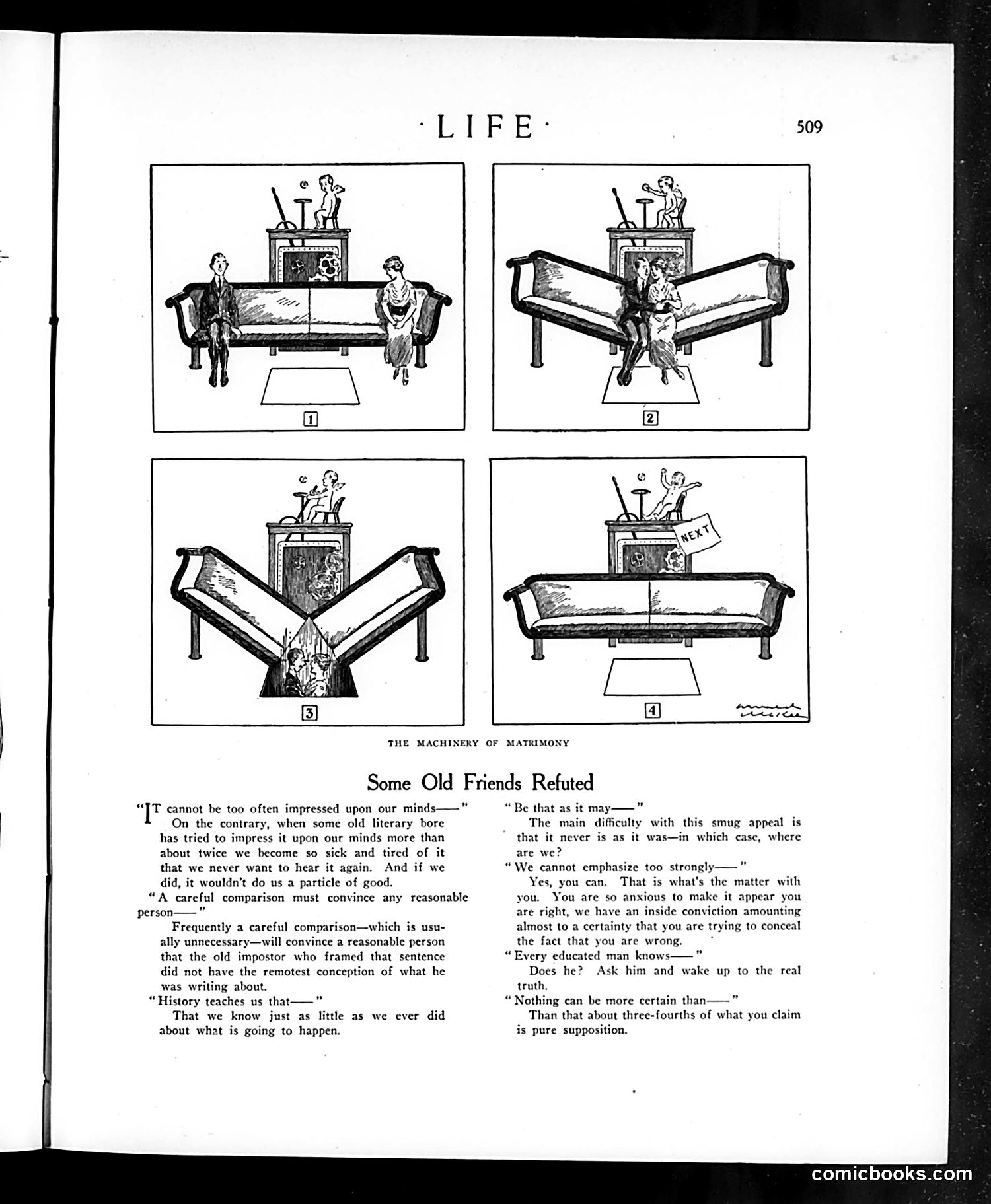
The top half shows four sequential cartoon panels titled "The Machinery of Matrimony," depicting a couple on a sofa being mechanically compressed and manipulated by apparatus above them—a visual metaphor for how marriage processes or reshapes people. The bottom half, "Some Old Friends Refuted," is satirical commentary on pretentious rhetoric and empty argumentation. It mocks six common literary and rhetorical clichés—phrases like "It cannot be too often impressed," "A careful comparison," and "History teaches us"—by identifying how these constructions are actually used to obscure truth, conceal uncertainty, or manipulate audiences. The piece argues these familiar phrases don't actually convince through logic but rather through smugness and repetition. For a modern reader: this is essentially an early critique of corporate-speak, academic jargon, and political rhetoric—showing how authoritative-sounding language often masks ignorance or dishonesty.
📄 Transcribed text from this page (OCR, searchable)
Machine-transcribed from the original scan — historical spelling and the odd misread are preserved.
THE MACHINERY OF MATRIMONY Some Old Friends Refuted “TT cannot be too often impressed upon our minds—" On the contrary, when some old literary bore has tried to impress it upon our minds more than about twice we become so sick and tired of it that we never want to hear it again. And if we did, it wouldn't do us a particle of good. “A careful comparison must convince any reasonable person—” Frequently a careful comparison—which is usu- ally unnecessary—will convince a reasonable person that the old impostor who framed that sentence did not have the remotest conception of what he was writing about. “History teaches us that——” That we know just as little as we ever did about what is going to happen. “Be that as it may——” The main difficulty with this smug appeal is that it never is as it was—in which case, where are we? “We cannot emphasize too strongly — Yes, you can, That is what's the matter with you. You are so anxious to make it appear you are right, we have an inside conviction amounting almost to a certainty that you are trying to conceal the fact that you are wrong. “Every educated man knows—" Does he? Ask him and wake up to the real truth, “Nothing can be more certain than——" Than that about three-fourths of what you claim is pure supposition. comicbooks.com