
Life, 1915-09-16 · page 16 of 48
Life — September 16, 1915 — page 16: what you’re looking at
What you’re looking at
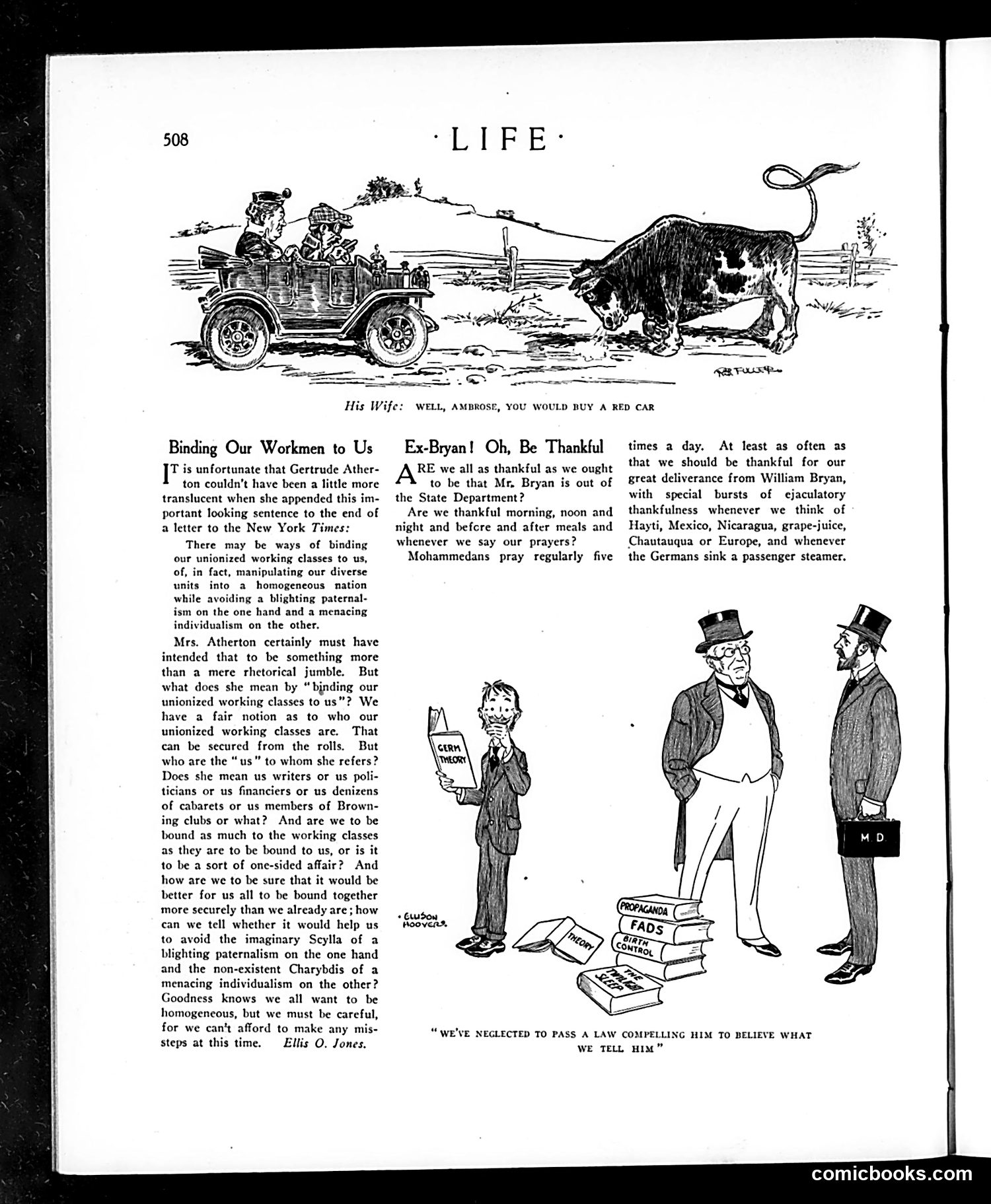
This page contains three distinct satirical pieces: **Top cartoon**: A husband and wife in a red automobile are being pulled by a cow with an elaborate tail knot. The wife's caption suggests the husband bought an impractical vehicle. The joke appears to mock conspicuous consumption or poor automotive choices. **"Binding Our Workmen to Us"**: This article critiques writer Gertrude Atherton's vague proposal about unifying unionized workers with the upper classes. The author (Ellis O. Jones) sarcastically deconstructs her letter to the *New York Times*, questioning who "us" refers to and whether such binding would be reciprocal or paternalistic. It's social commentary on class relations and rhetoric about labor unity. **"Ex-Bryan! Oh, Be Thankful"**: This satirizes excessive gratitude toward William Jennings Bryan's departure from the State Department. The author mocks the zealous thankfulness expressed toward his removal, comparing it to religious devotion, while sarcastically listing controversial foreign policy issues (Haiti, Mexico, Nicaragua) presumably associated with Bryan. **Bottom cartoon**: Shows two gentlemen observing a boy with propaganda materials, lamenting they haven't legally compelled belief in their messaging—social satire about propaganda and indoctrination.
📄 Transcribed text from this page (OCR, searchable)
Machine-transcribed from the original scan — historical spelling and the odd misread are preserved.
His Wife: Binding Our Workmen to Us T is unfortunate that Gertrude Ather- ton couldn't have been a little more translucent when she appended this im- portant looking sentence to the end of a letter to the New York Times: There may be ways of binding our unionized working classes to us, of, in fact, manipulating our diverse units into a homogeneous nation wi avoiding a blighting paternal- ism on the one hand and a menacing individualism on the other. Mrs. Atherton certainly must have intended that to be something more than a mere rhetorical jumble. But what does she mean by “bjnding our unionized working classes to us"? We have a fair notion as to who our unionized working classes are. That can be secured from the rolls. But who are the “us” to whom she refers? Does she mean us writers or us poli- ticians or us financiers or us denizens of cabarets or us members of Brown- ing clubs or what? And are we to be bound as much to the working classes as they are to be bound to us, or is it to be a sort of one-sided affair? And how are we to be sure that it would be better for us all to be bound together more securely than we already are ; how can we tell whether it would help us to avoid the imaginary Scylla of a blighting paternalism on the one hand and the non-existent Charybdis of a menacing individualism on the other? Goodness knows we all want to be homogeneous, but we must be careful, for we can't afford to make any mis- steps at this time. Ellis O. Jones. Ex-Bryan! Oh, Be Thankful RE we all as thankful as we ought to be that Mr, Bryan is out of the State Department? Are we thankful morning, noon and night and befcre and after meals and whenever we say our prayers? Mohammedans pray regularly five WELL, AMBROSE, YOU WOULD BUY A RED CAR times a day. At least as often as that we should be thankful for our great deliverance from William Bryan, with special bursts of ejaculatory thankfulness whenever we think of Hayti, Mexico, Nicaragua, grape-juice, Chautauqua or Europe, and whenever the Germans sink a passenger steamer. “WE'VE NEGLECTED TO PASS A LAW COMPELLING HIM TO BELIEVE WHAT WE TELL HIM” comicbooks.com