
Life, 1915-09-16 · page 20 of 48
Life — September 16, 1915 — page 20: what you’re looking at
What you’re looking at
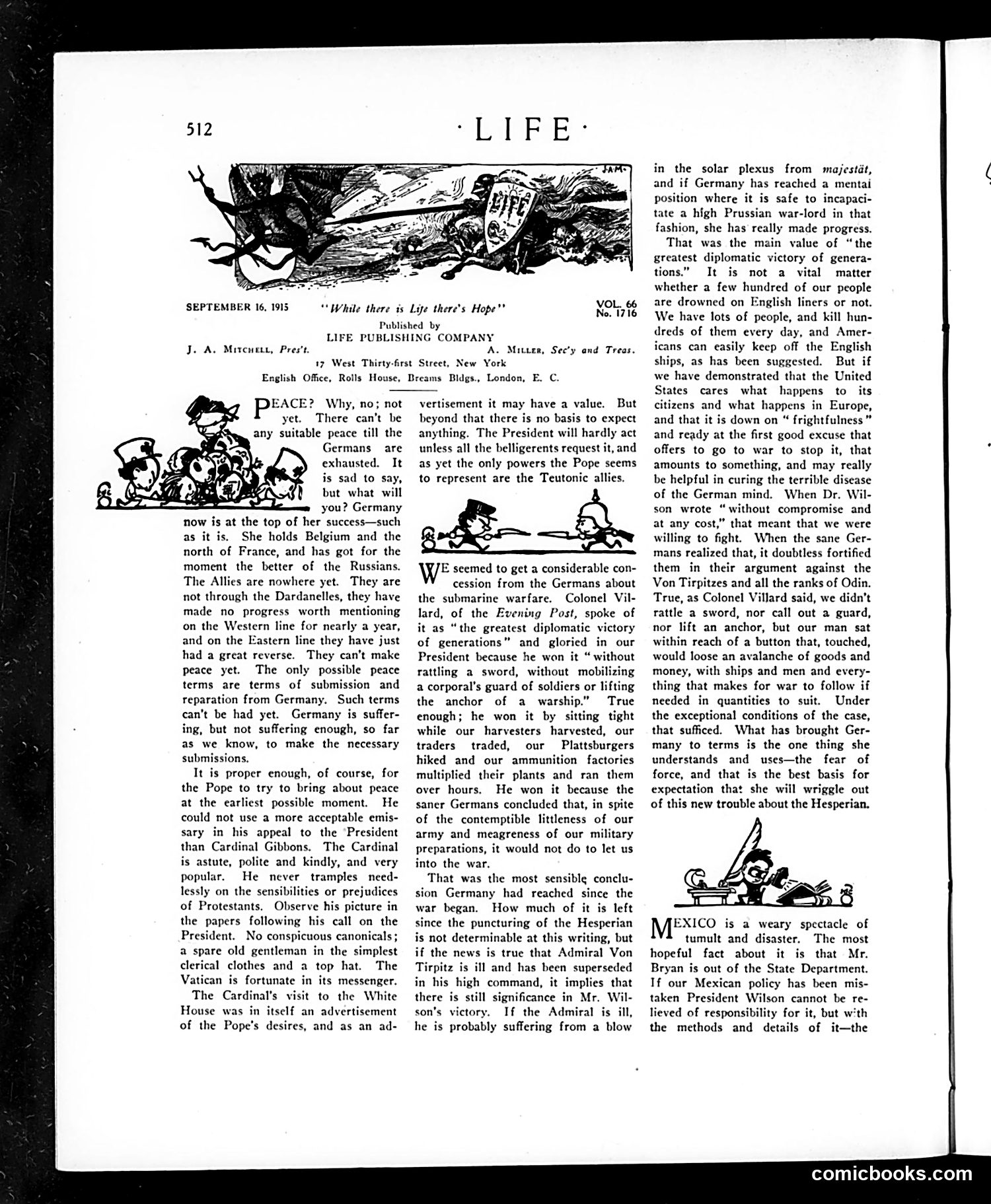
This editorial page discusses WWI peace prospects and U.S. neutrality. The cartoons and text critique the current diplomatic situation: **Main Arguments:** - Peace is impossible while Germany remains militarily strong; only submission terms would work - Cardinal Gibbons's Vatican-backed peace mission to President Wilson is well-intentioned but futile - The German submarine concession (likely the Sussex Pledge) represents only a minor diplomatic victory, achieved through U.S. economic and military posturing rather than force - Admiral Von Tirpitz's reported illness suggests Germany may finally recognize it's unwise to provoke American entry into the war **Key Reference:** Colonel Villard's praise of Wilson winning "without rattling a sword" is sardonically reframed—Wilson succeeded because Germany feared U.S. industrial capacity and potential military intervention, not from moral suasion. The page reflects American debate about whether neutrality serves U.S. interests while the war continues.
📄 Transcribed text from this page (OCR, searchable)
Machine-transcribed from the original scan — historical spelling and the odd misread are preserved.
SEPTEMBER 16, 1915 “While there is Lie there's Hope" VOL. 66 No. 1716 Published by LIFE PUBLISHING COMPANY J. A. Mircnett, Pres’t. A. Mutter, Sec’y and Treas. 17 West Thirty-first Street, New York English Office, Rolls House, Breams Bldgs, London, E. C. ZACE? Why, no; not yet. There can’t be any suitable peace till the Germans are exhausted. It is sad to say, but what will you? Germany now is at the top of her success—such She holds Belgium and the north of France, and has got for the moment the better of the Russians. The Allies are nowhere yet. They are not through the Dardanelles, they have made no progress worth mentioning on the Western line for nearly a year, and on the Eastern line they have just had a great reverse. They can’t make peace yet. The only possible peace terms are terms of submission and reparation from Germany. Such terms can’t be had yet. Germany is suffer- ing, but not suffering enough, so far as we know, to make the necessary submissions, It is proper enough, of course, for the Pope to try to bring about peace at the earliest possible moment. He could not use a more acceptable emis- sary in his appeal to the ‘President than Cardinal Gibbons. The Cardinal is astute, polite and kindly, and very popular. He never tramples need- lessly on the sensibilities or prejudices of Protestants. Observe his picture in the papers following his call on the President. No conspicuous canonicals ; a spare old gentleman in the simplest clerical clothes and a top hat. The Vatican is fortunate in its messenger. The Cardinal's visit to the White House was in itself an advertisement of the Pope's desires, and as an ad- vertisement it may have a value. But beyond that there is no basis to expect anything. The President will hardly act unless all the belligerents request it, and as yet the only powers the Pope seems to represent are the Teutonic allies. WE seemed to get a considerable con- cession from the Germans about the submarine warfare. Colonel Vil- lard, of the Evening Post, spoke of it as “the greatest diplomatic victory of generations” and gloried in our President because he won it “without rattling a sword, without mobilizing a corporal’s guard of soldiers or lifting the anchor of a warship.” True enough; he won it by sitting tight while our harvesters harvested, our traders traded, our Plattsburgers hiked and our ammunition factories multiplied their plants and ran them over hours, He won it because the saner Germans concluded that, spite of the contemptible littleness of our army and meagreness of our military preparations, it would not do to let us into the war. That was the most sensiblg conclu- sion Germany had reached since the war began. How much of it is left since the puncturing of the Hesperian is not determinable at this writing, but if the news is true that Admiral Von Tirpitz is ill and has been superseded in his high command, it implies that there is still significance in Mr. Wil- son’s victory. If the Admiral is ill, he is probably suffering from a blow in the solar plexus from majestét, and if Germany has reached a mentai position where it is safe to incapaci- tate a high Prussian war-lord in that fashion, she has really made progress. That was the main value of “the greatest diplomatic victory of genera- tions.” It is not a vital matter whether a few hundred of our people are drowned on English liners or not. We have lots of people, and kill hun- dreds of them every day, and Amer- icans can easily keep off the English ships, as has been suggested. But if we have demonstrated that the United States cares what happens to its citizens and what happens in Europe, and that it is down on “ frightfulness” and ready at the first good excuse that offers to go to war to stop it, that amounts to something, and may really be helpful in curing the terrible disease of the German mind. When Dr. Wil- son wrote “without compromise and at any cost,” that meant that we were willing to fight. When the sane Ger- mans realized that, it doubtless fortified them in their argument against the Von Tirpitzes and all the ranks of Odin. True, as Colonel Villard said, we didn’t rattle a sword, nor call out a guard, nor lift an anchor, but our man sat within reach of a button that, touched, would loose an avalanche of goods and money, with ships and men and every- thing that makes for war to follow if needed in quantities to suit. Under the exceptional conditions of the case, that sufficed. What has brought Ger- many to terms is the one thing she understands and uses—the fear of force, and that is the best basis for expectation that she will wriggle out of this new trouble about the Hesperian. M XICO is a weary spectacle of tumult and disaster. The most hopeful fact about it is that Mr. Bryan is out of the State Department. If our Mexican policy has been mis- taken President Wilson cannot be re- lieved of responsibility for it, but wth the methods and details of it—the comicbooks.com