
Life, 1915-09-16 · page 29 of 48
Life — September 16, 1915 — page 29: what you’re looking at
What you’re looking at
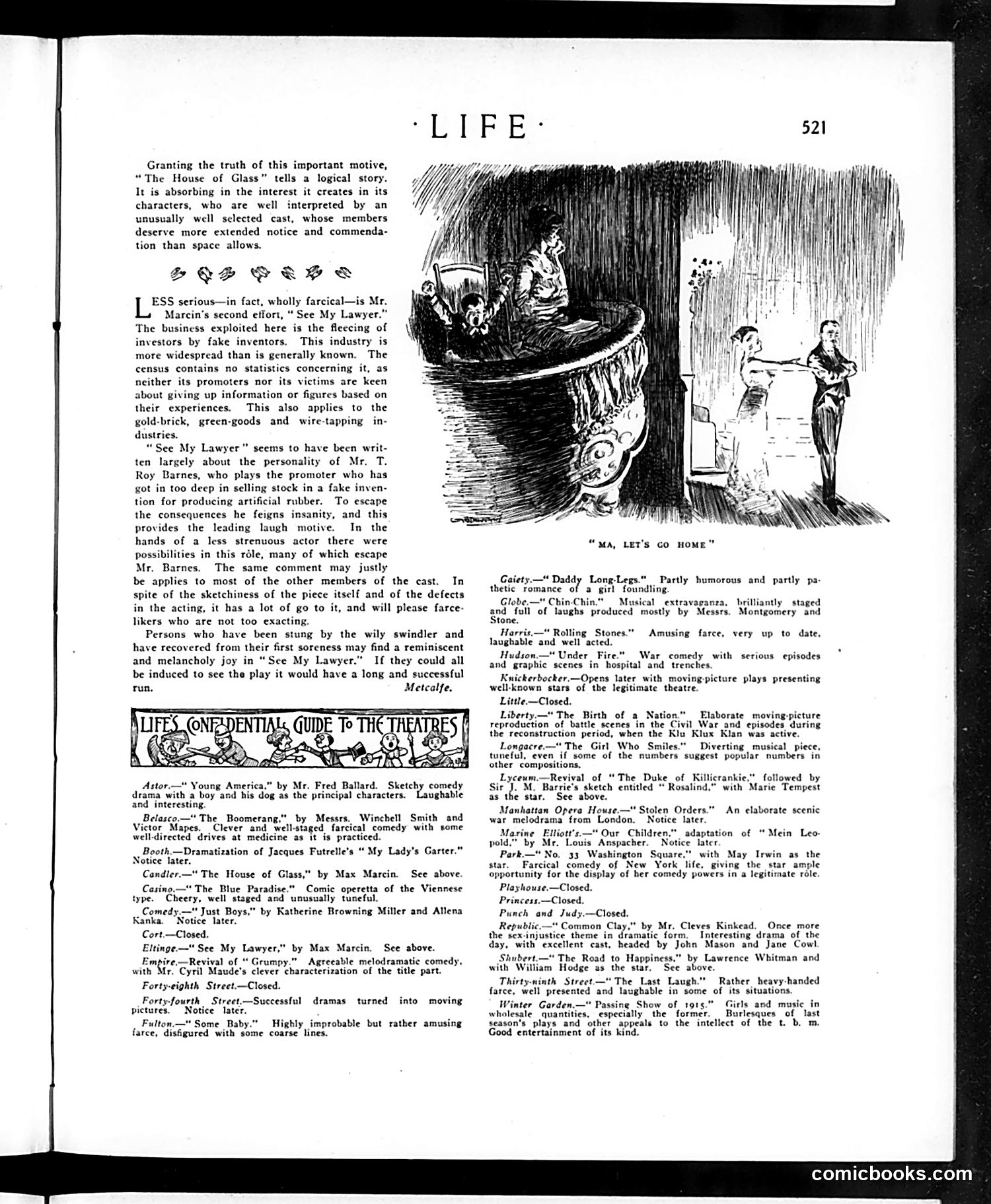
This page reviews theatrical productions and includes a cartoon titled "MA, LET'S GO HOME" showing what appears to be a domestic scene—likely depicting a husband and wife at odds, with the caption suggesting tension over leaving an event or location. The text discusses two plays by Max Marcin: "The House of Glass" (a serious drama about absorbing characters) and "See My Lawyer" (a farce about investors defrauded by fake inventors). The reviewer notes that con schemes like fake inventions, gold-brick scams, and wire-tapping were widespread but undocumented. The play "See My Lawyer" centers on actor T. Roy Barnes playing a promoter who fakes insanity to escape consequences of selling fraudulent artificial-rubber stock. The reviewer finds the sketch entertaining for farce-lovers, suggesting audiences "stung by swindlers" might enjoy its satirical treatment of confidence schemes—a timely topic given early 20th-century fraud's prevalence. The page also lists other theatrical offerings of the era.
📄 Transcribed text from this page (OCR, searchable)
Machine-transcribed from the original scan — historical spelling and the odd misread are preserved.
Granting the truth of this important motive, “The House of Glass” tells a logical story. It is absorbing in the interest it creates its characters, who are well interpreted by an unusually well selected cast, whose members deserve more extended notice and commenda- tion than space allows. BES SRBHS L ESS serious—in fact, wholly farcical—is Mr. Marcin’s second effort, “ See My Lawyer.” The business exploited here is the fleecing of investors by fake inventors. This industry is more widespread than is generally known. The census contains no statistics concerning it, as neither its promoters nor its victims are keen about giving up information or figures based on their experiences. This also applies to the gold-brick, green-goods and wire-tapping in- dustries. “See My Lawyer” seems to have been writ- ten largely about the personality of Mr. T. Roy Barnes, who plays the promoter who has got in too deep in selling stock in a fake inven- tion for producing artificial rubber. To escape the consequences he feigns insanity, and this provides the leading laugh motive. In the hands of a less strenuous actor there were possibilities in this rdle, many of which escape Mr. Barnes. The same comment may justly be applies to most of the other members of the cast. In spite of the sketchiness of the piece itself and of the defects in the acting, it has a lot of go to it, and will please farce- likers who are not too exacting. Persons who have been stung by the wily swindler and have recovered from their first soreness may find a reminiscent and melancholy joy in “See My Lawyer.” If they could all be induced to see the play it would have a long and successful Metcalfe, * Young America.” by Mr. Fred Ballard. Sketchy drama with a boy and his dog as the principal characters. and interesting. Belasco.— The, Boomerang,” by Messrs. Winchell Smith and Victor Mapes. Clever and well-staged farcical comedy with some well-directed drives at medicine as it is practiced. Booth.—Dramatization of Jacques Futrelle’s “ My Lady's Garter.” Notice later. Candle: The House of Glass," by Max Marcin. See above. Casino.—"* The Blue Paradise.” Comic operetta of the Viennese type. Cheery, well staged and unusually tuneful. Comedy just Boys,” by Katherine Browning Miller and Allena Kanka. Notice later. Cort.—Closed. Eltinge. See My Lawyer," by Max Marcin. See above. Empire-—Revival of “Grumpy.” Agreeable melodramatic comedy, with Mr. Cyril Maude's clever characterization of the title part. Forty-eighth Street.—Closed. Forty-fourth _ Street.—Successful pictures. Notice later. _ Fulton.—" Some Baby.” Highly improbable but rather amusing farce, disfigured with some coarse lines. comedy ughable dramas turned into moving “MA, LET'S Go HOME” Gaiety.—“ Daddy Long-Legs." Partly humorous and partly pa- thetic romance of a girl foundling Globe.—" Chin-Chin.” | Musical extravaganza, brilliantly staged and full of laughs produced mostly by Messrs. Montgomery and Stone. Harris.—"' Rolling Stones.” laughable and well acted. Hudson.—" Under Fire." War comedy with serious episodes and graphic scenes in hospital and trenches. Knickerbocker.—Opens later with moving-picture plays presenting well-known stars of the legitimate theatre. Little.—Closed. Liberty—" The Birth of ‘ation. Elaborate _moving-picture reproduction of battle scenes in the Civil War and episodes during the reconstruction period, when the Klu Klux Klan was active. Longacre.—" The Girl Who Smiles."" Diverting musical piece, tuneful, even if some of the numbers suggest popular numbers in other compositions. Lyceum.—Revival of The Duke of Killicrant followed by Sir ‘J. M. Barrie's sketch entitled “ Rosalind,” with Marie Tempest as the star, See above. Manhattan Opera House —" Stolen Orders.” war melodrama from London. Notice later Marine Eltiott's.—" Our Children.” adaptation of “ pold.” by Mr. Louis Anspacher. Notice later Park.—"No. 33 Washington Square.” with May Irwin as the star. Farcical comedy of New York life, giving the star ample opportunity for the display of her comedy powers in a legitimate réle. Playhouse.—Closed. Princess.—Closed. Punch and Judy.—Closed. Republic.—" Common Clay," by Mr. Cleves Kinkead. Once more the sex-injustice theme in dramatic form, Interesting drama of the day, with excellent cast, headed by John Mason and Jane Cowl. Shubert.—" The Road to Happiness." by Lawrence Whitman and with William Hodge as the star. See above. Thirty-ninth Street—" The Last Laugh." Rather heavy-handed farce, well presented and laughable in some of its situations. Winter Garden.—" Passing Show of 191s." Girls and music in wholesale quantities, especially the former. Burlesques of last season's plays and other appeals to the intellect of the t. b. m. Good entertainment of its kind. Amusing farce, very up to date, An elaborate scenic ein Leo comicbooks.com