
Life, 1915-09-16 · page 12 of 48
Life — September 16, 1915 — page 12: what you’re looking at
What you’re looking at
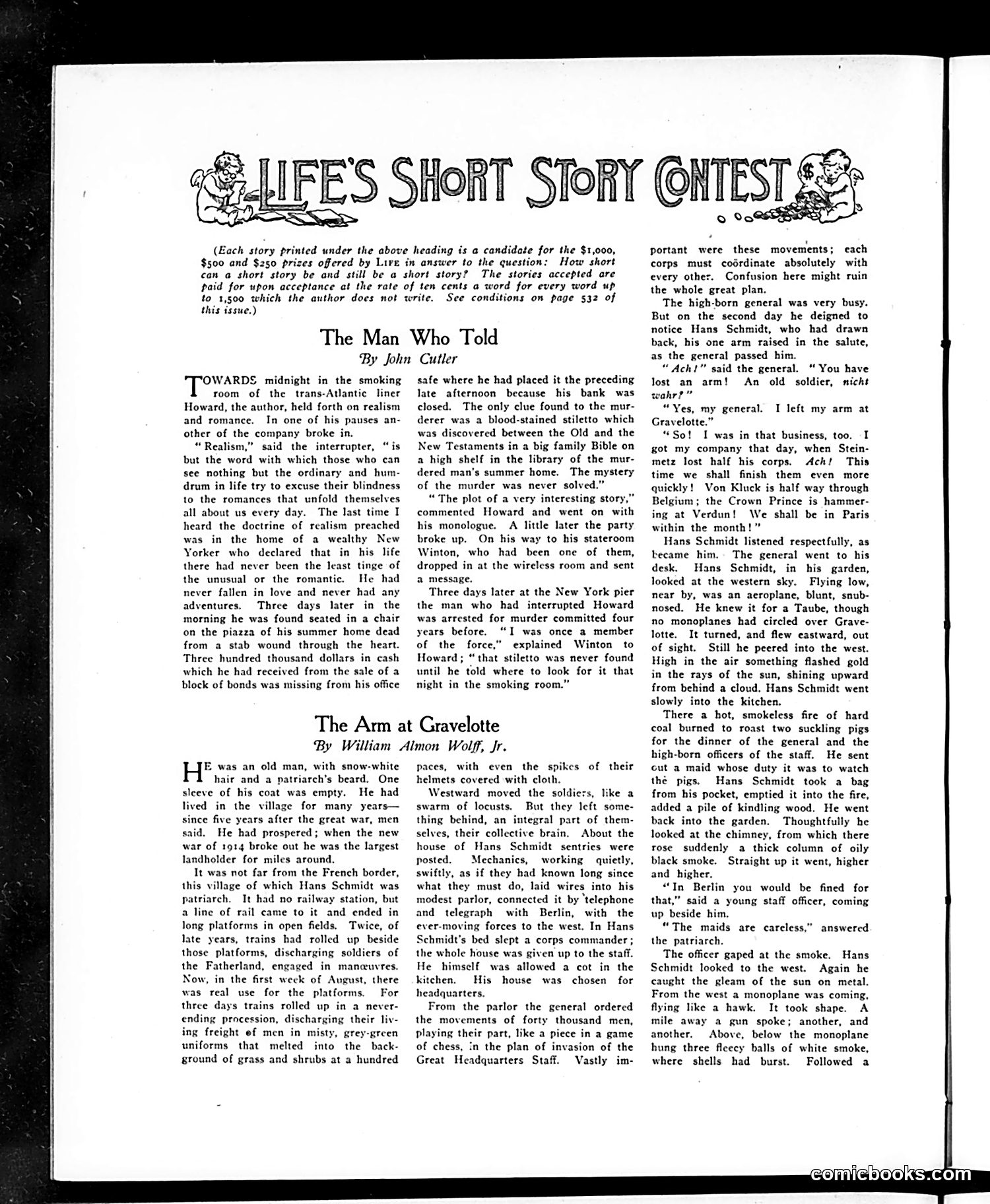
This page presents two short stories submitted to Life's fiction contest. "The Man Who Told" by John Cutter concerns a murder mystery aboard a trans-Atlantic liner—a wealthy New Yorker dies from a stab wound, and a crucial clue (a stiletto) goes missing until being located years later. "The Arm at Gravelotte" by William Athwood Wolf, Jr. depicts a WWI scene where an elderly German village patriarch, Hans Schmidt, has his house commandeered as Great Headquarters Staff during the war. The story focuses on the military occupation and Schmidt's experience witnessing the movement of troops and the general wartime operations around him. Both are straightforward fiction entries, not political satire.
📄 Transcribed text from this page (OCR, searchable)
Machine-transcribed from the original scan — historical spelling and the odd misread are preserved.
(Each story printed under the above heading is a candidate for the $1,000, $500 and $250 prizes offered by Live in answer to the question: can a short story be and still be a short story? How short The stories accepted are paid for upon acceptance at the rate of ten cents a word for every word up See conditions on page 532 of to 1,500 which the author does not write, this issue.) The Man Who Told By John Cutler Towarns midnight in the smoking room of the trans-Atlantic liner Howard, the author, held forth on realism and romance. In one of his pauses an- other of the company broke in. “Realism,” said the interrupter, “is but the word with which those who can see nothing but the ordinary and hum- drum in life try to excuse their blindness to the romances that unfold themselves all about us every day. The last time I heard the doctrine of realism preached vas in the home of a wealthy Ne Yorker who declared that in his life there had never been the least tinge of the unusual or the romantic. He had never fallen in love and never had any adventures. Three days later in the morning he was found seated in a chair on the piazza of his summer home dead from a stab wound through the heart. Three hundred thousand dollars in cash which he had received from the sale of a block of bonds was missing from his office safe where he had placed it the preceding late afternoon because his bank was closed. The only clue found to the mur- derer was a blood-stained stiletto which was discovered between the Old and the New Testaments in a big family Bible on a high shelf in the library of the mur- dered man’s summer home. The mystery of the murder was never solved.” “The plot of a very interesting stor: commented Howard and went on with his monologue. A little later the party broke up. On his way to his stateroom Winton, who had been one of them, dropped in at the wireless room and sent a message. Three days later at the New York pier the man who had interrupted Howard was arrested for murder committed four years before. “I was once a member of the force,” explained Winton to Howard; “that stiletto was never found until he told where to look for it that night in the smoking room.” The Arm at Gravelotte By William Almon Wolff, Jr. H® was an old man, with snow-white hair and a patriarch’s beard. One sleeve of his coat was empty. He had lived in the village for many years— since five years after the great war, men said, He had prospered; when the new war of 1914 broke out he was the largest landholder for miles around. It was not far from the French border, this village of which Hans Schmidt was patriarch. It had no railway station, but a line of rail came to it and ended in long platforms in open fields. Twice, of late years, trains had rolled up beside those platforms, discharging soldiers of the Fatherland, engaged in mancuvres. Now, in the first week of August, there was real use for the platforms, For three days trains rolled up in a never- ending procession, discharging their liv- ing freight ef men in misty, grey-green uniforms that melted into the back- ground of grass and shrubs at a hundred paces, with even the spikes of their helmets covered with cloth. Westward moved the soldiezs, like a swarm of locusts. But they left some- thing behind, an integral part of them- selves, their collective brain, About the house of Hans Schmidt sentries were posted. Mechanics, working quietly, swiftly, as if they had known long since what they must do, laid wires into his modest parlor, connected it by ‘telephone and telegraph with Berlin, with the ever-moving forces to the west. In Hans Schmidt's bed slept a corps commander ; the whole house was given up to the staff. He himself was allowed a cot in the kitchen, His house was chosen for headquarters. From the parlor the general ordered the movements of forty thousand men, playing their part, like a piece in a game of chess, in the plan of invasion of the Great Headquarters Staff. Vastly im- se portant were these movements; each corps must codrdinate absolutely with every other. Confusion here might ruin the whole great plan. The high-born general was very busy. But on the second day he deigned to notice Hans Schmidt, who had drawn back, his one arm raised in the salute, as the general passed him. “ Ach?” said the general. “ You have lost an arm! An old soldier, nicht wahr?” “Yes, my general. Gravelotte.” “So! I was in that business, too. I got my company that day, when Stein- metz lost half his corps. Ach! This time we shall finish them even more quickly! Von Kluck is half way through Belgium; the Crown Prince is hammer- ing at Verdun! We shall be in Paris within the month!” Hans Schmidt listened respectfully, as became him, The general went to his desk. Hans Schmidt, in his garden, looked at the western sky. Flying low, near by, was an aeroplane, blunt, snub- nosed. He knew it for a Taube, though no monoplanes had circled over Grave- lotte. It turned, and flew eastward, out of sight. Still he peered into the west. High in the air something flashed gold in the rays of the sun, shining upward from behind a cloud. Hans Schmidt went slowly into the kitchen. There a hot, smokeless fire of hard coal burned to roast two suckling pigs for the dinner of the general and the high-born officers of the staff. He sent cut a maid whose duty it was to watch the pigs. Hans Schmidt took a bag from his pocket, emptied it into the fire, added a pile of kindling wood. He went back into the garden. Thoughtfully he looked at the chimney, from which there rose suddenly a thick column of oily black smoke. Straight up it went, higher and higher. “In Berlin you would be fined for that,” said a young staff officer, coming up beside him. “The maids are careless,” answered the patriarch. The officer gaped at the smoke. Hans Schmidt looked to the west. Again he caught the gleam of the sun on metal. From the west a monoplane was coming, flying like a hawk. It took shape. A mile away a gun spoke; another, and another. Above, below the monoplane hung three ficecy balls of white smoke, where shells had burst. Followed a T left my arm at