
A complete issue · 44 pages · 1915
Life — April 8, 1915
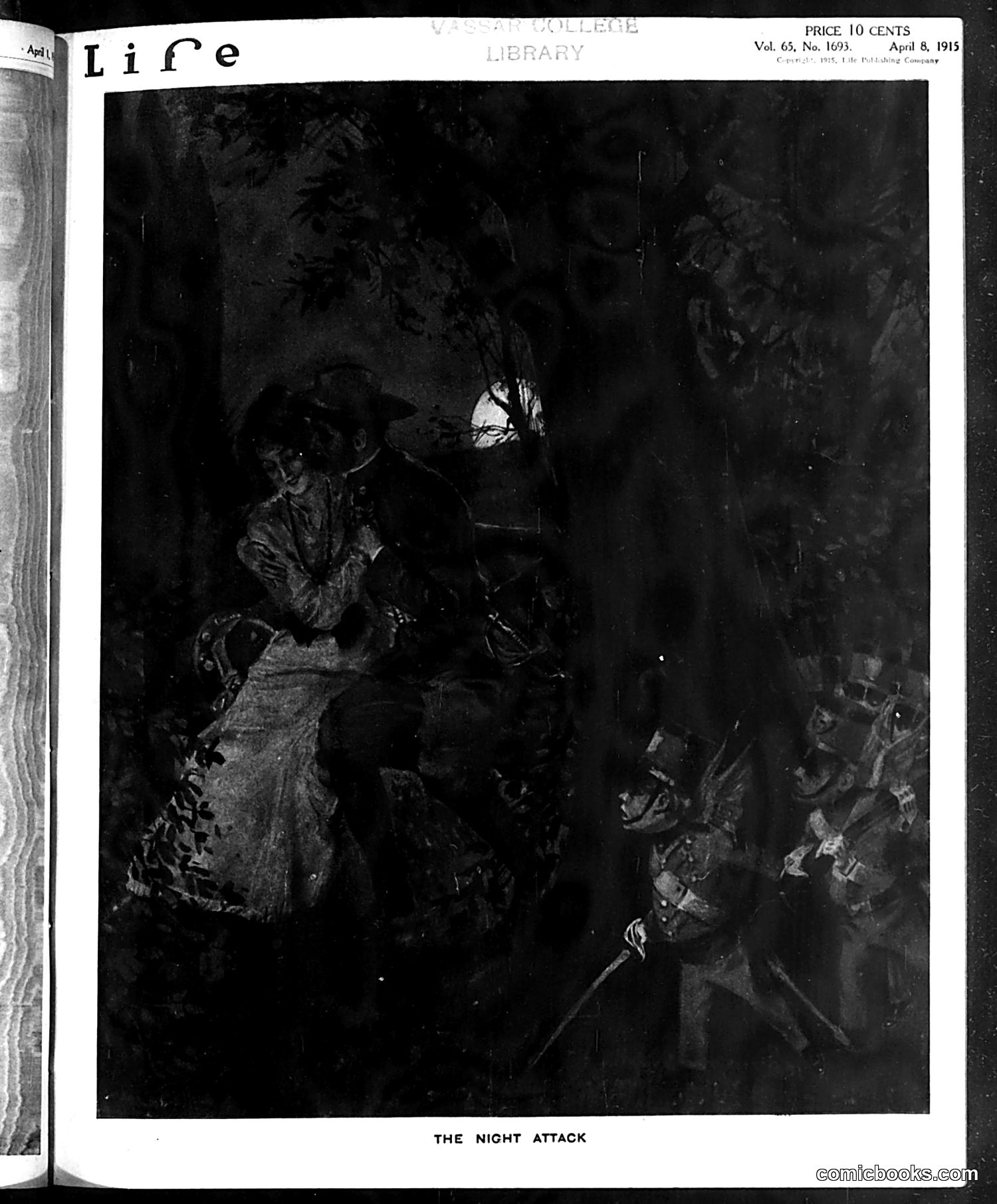
This page from *Life* magazine (April 8, 1915) features an illustration titled "The Night Attack." The image depicts a dramatic nighttime scene with armored soldiers or knights engaged in combat, rendered in dark, high-contrast photography or artwork. Given the 1915 publication date and title, this likely references World War I combat operations, specifically nighttime trench raids or attacks that were increasingly common on the Western Front. The medieval knight imagery may represent either a deliberate archaism (comparing modern soldiers to historical warriors) or possibly a theatrical/literary illustration. Without additional text or captions on this page, the exact satirical intent remains unclear, though *Life's* typical approach would critique either military tactics, wartime propaganda, or the brutality of modern warfare.
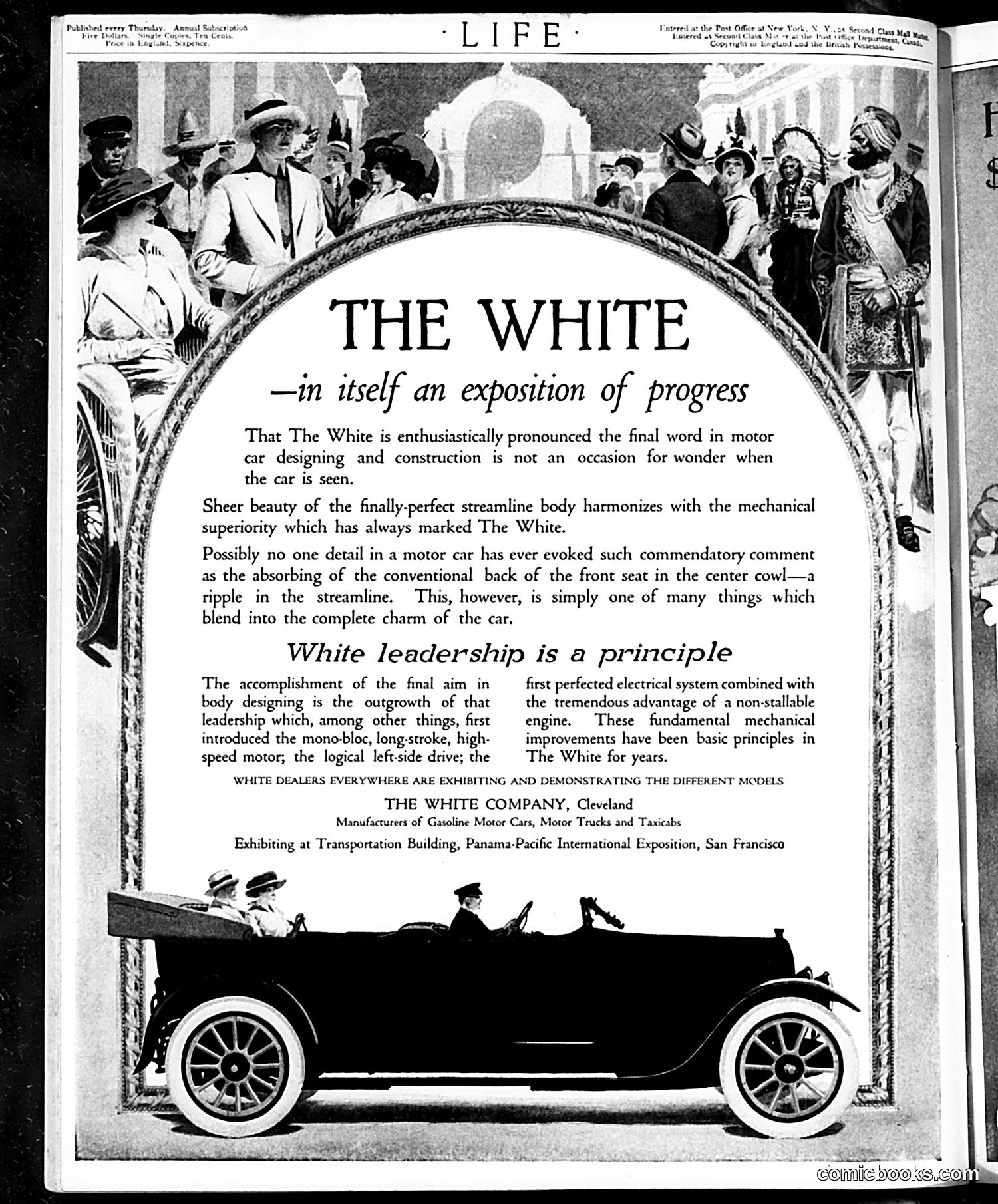
This is primarily an **advertisement**, not satirical content. The White Company (Cleveland, Ohio) is promoting their motor cars as embodying "progress" in automotive design and manufacturing. The decorative border depicts a classical or fairground setting with well-dressed figures observing the displayed vehicle—a common advertising trope suggesting the car as a marvel worthy of public admiration. The text emphasizes The White's technical innovations: streamlined body design, electrical systems, mono-bloc engine, and left-side drive. The phrase "White leadership is a principle" frames these mechanical advances as evidence of the company's design superiority. The ad notes the car was being exhibited at the 1915 Panama-Pacific International Exposition in San Francisco, a major world's fair showcasing technological progress. This is straightforward period marketing, not satire or commentary.
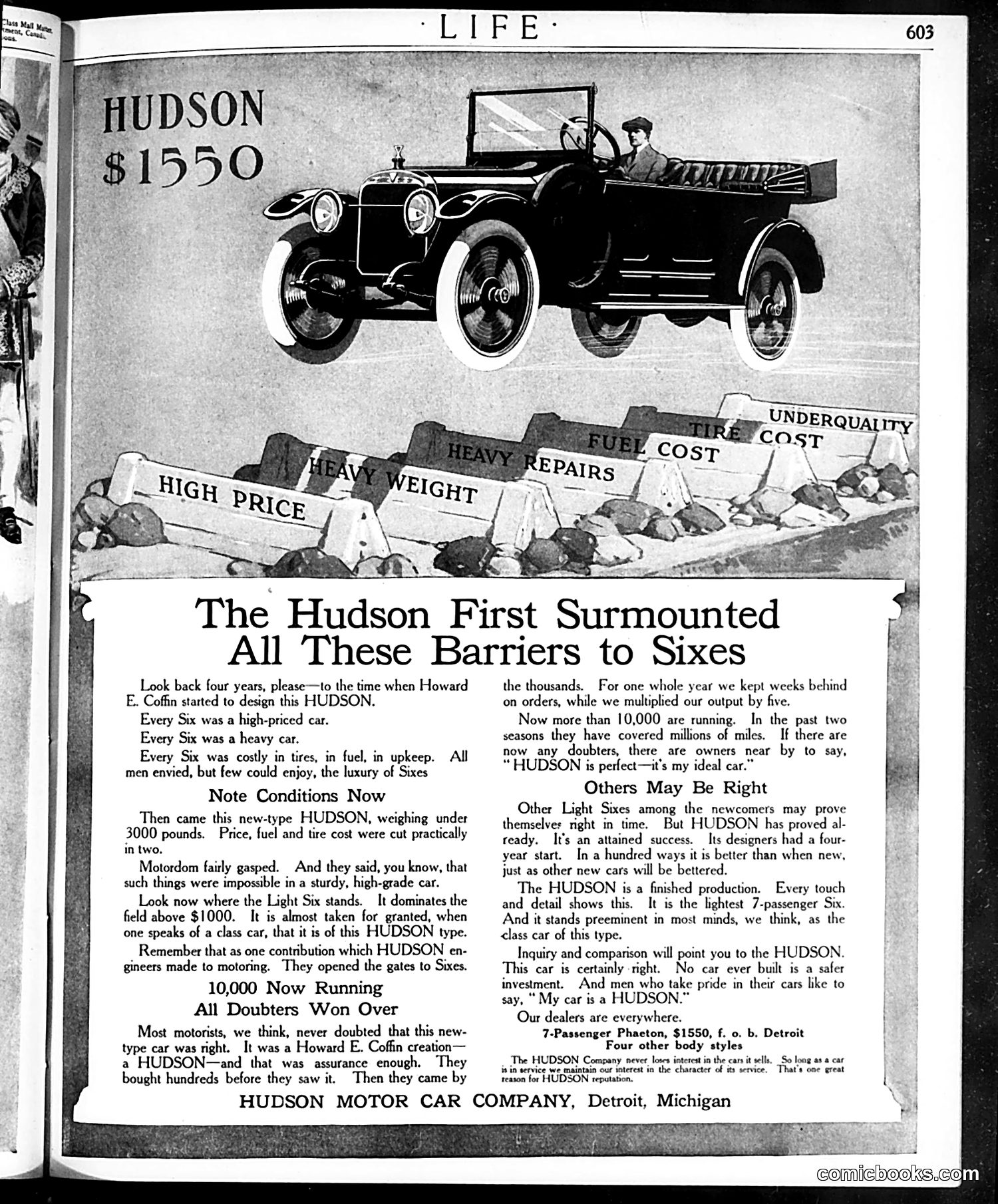
This is primarily a **car advertisement**, not political satire. It promotes the Hudson automobile at $1,550, emphasizing that their new "Light Six" model successfully overcame previous barriers—high price, heavy weight, expensive repairs, and tire costs—that had plagued earlier Six-cylinder cars. The satirical element is visual: rocks labeled with these complaints form a literal barrier that the Hudson automobile jumps over, suggesting the car has triumphed where competitors failed. The ad references Howard E. Coffin's design and claims 10,000 Hudsons are running successfully, with dealer availability nationwide. This represents early 1910s automotive marketing, when manufacturers competed vigorously on reliability and value propositions to an expanding middle-class car market.
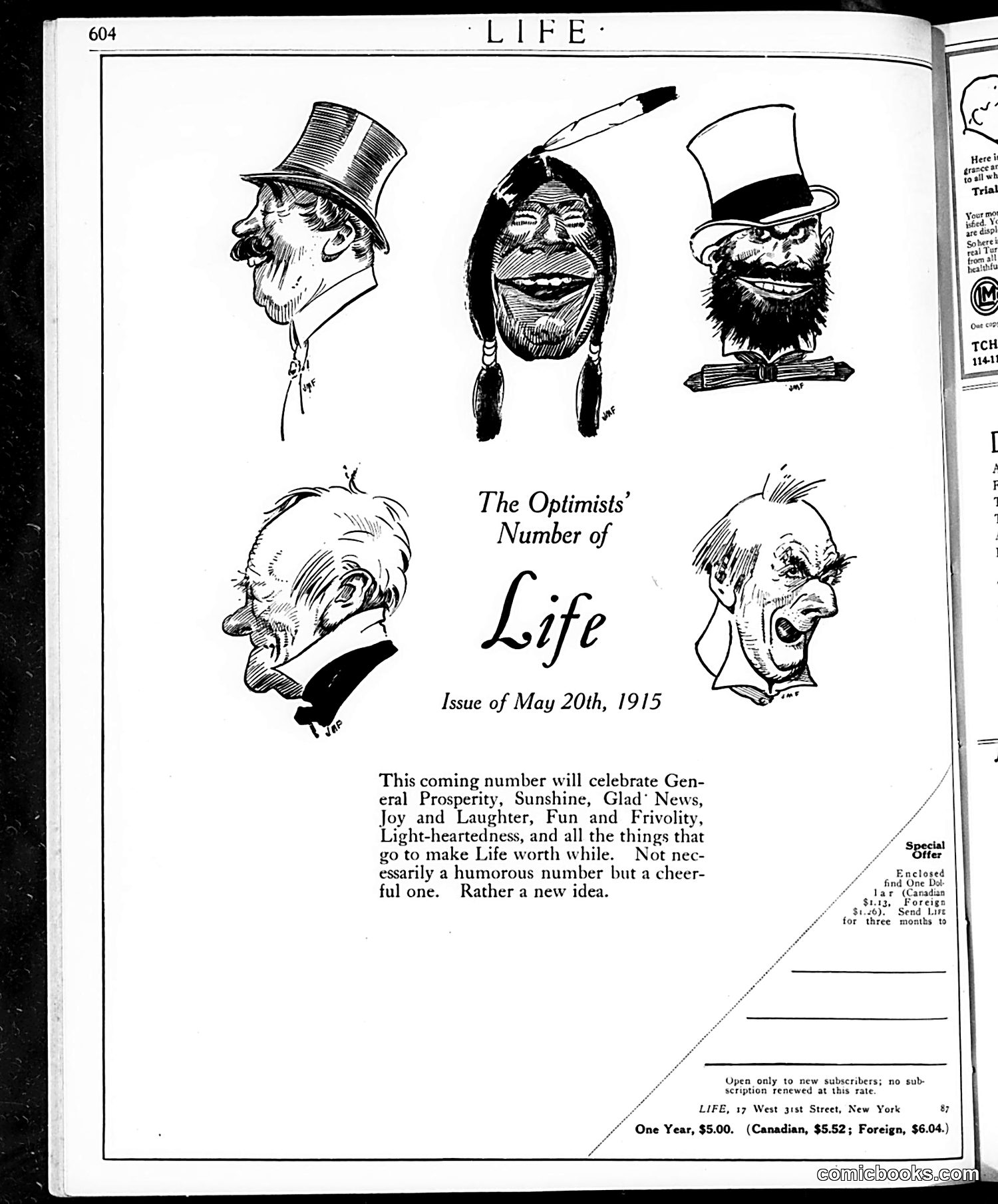
This is a promotional page announcing an upcoming "Optimists' Number" celebrating "General Prosperity, Sunshine, Glad News, Joy and Laughter." The page features five caricatured male heads displaying exaggerated facial features and expressions—a common cartooning technique of the era. The specific identities of these figures are unclear from the image alone. However, the style suggests they may represent political figures, celebrities, or social types associated with optimism or prosperity circa 1915. The exaggerated features and expressions are typical of satirical portraiture from this period. The advertisement emphasizes this will be a "cheerful" rather than "humorous" issue—focusing on positive news and lightness rather than traditional satire. Subscription details and pricing are listed at bottom.
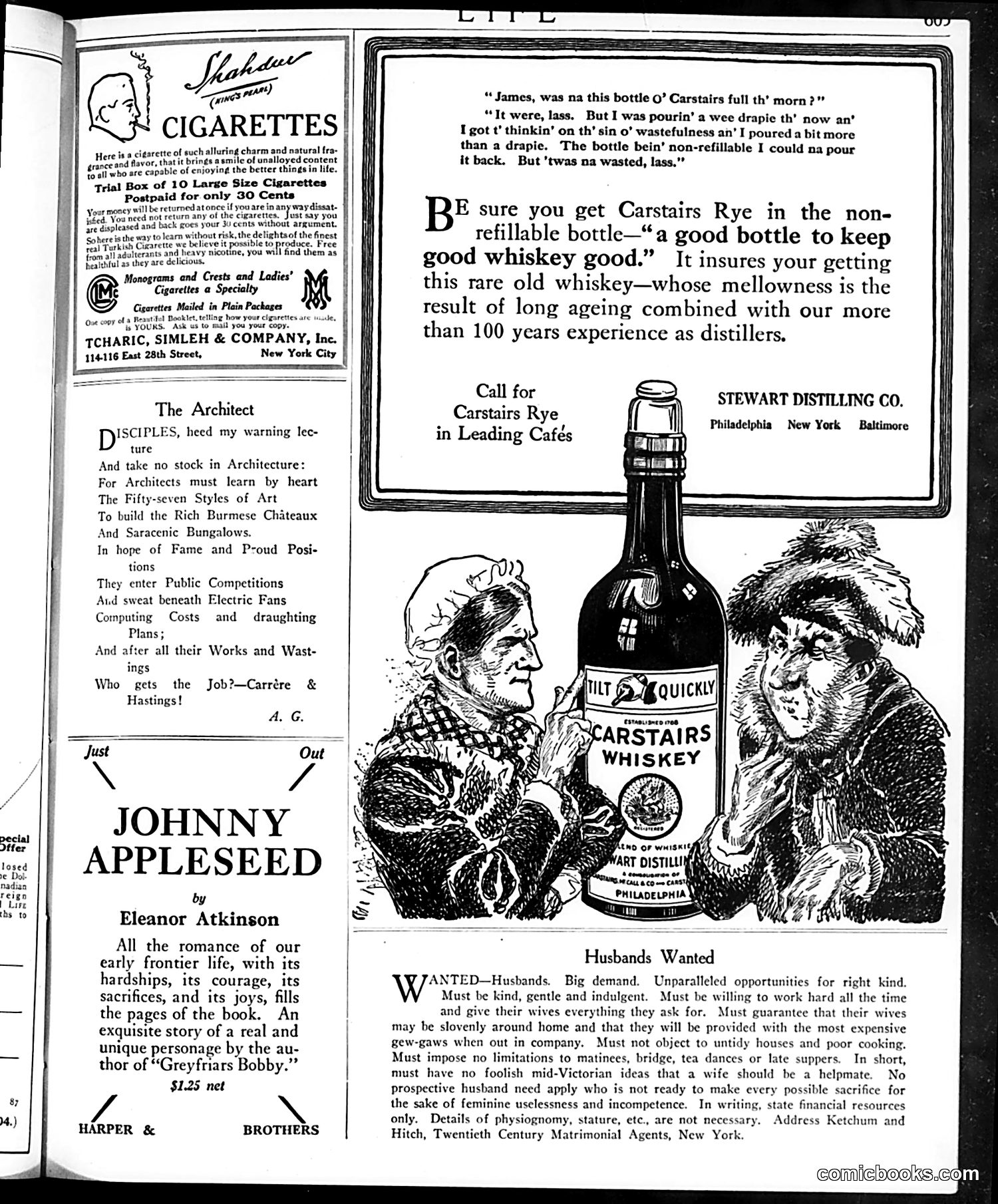
This page is primarily **advertising and literary content**, not political satire. The advertisements include: - **Cigarettes** (Tcharic, Simleh & Company) promoting a trial box - **Carstairs Rye Whiskey** featuring a Scottish figure and what appears to be a Native American caricature, emphasizing the product's age and quality - **Johnny Appleseed** book promotion by Eleanor Atkinson The poem "The Architect" mocks architects' pretensions through satirical verse about their education and competition for commissions. The "Husbands Wanted" classified ad is satirical commentary on matrimonial expectations, humorously listing exacting demands wives must meet while providing specific "physiognomy" requirements—reflecting early-20th-century attitudes toward gender roles and marriage markets.
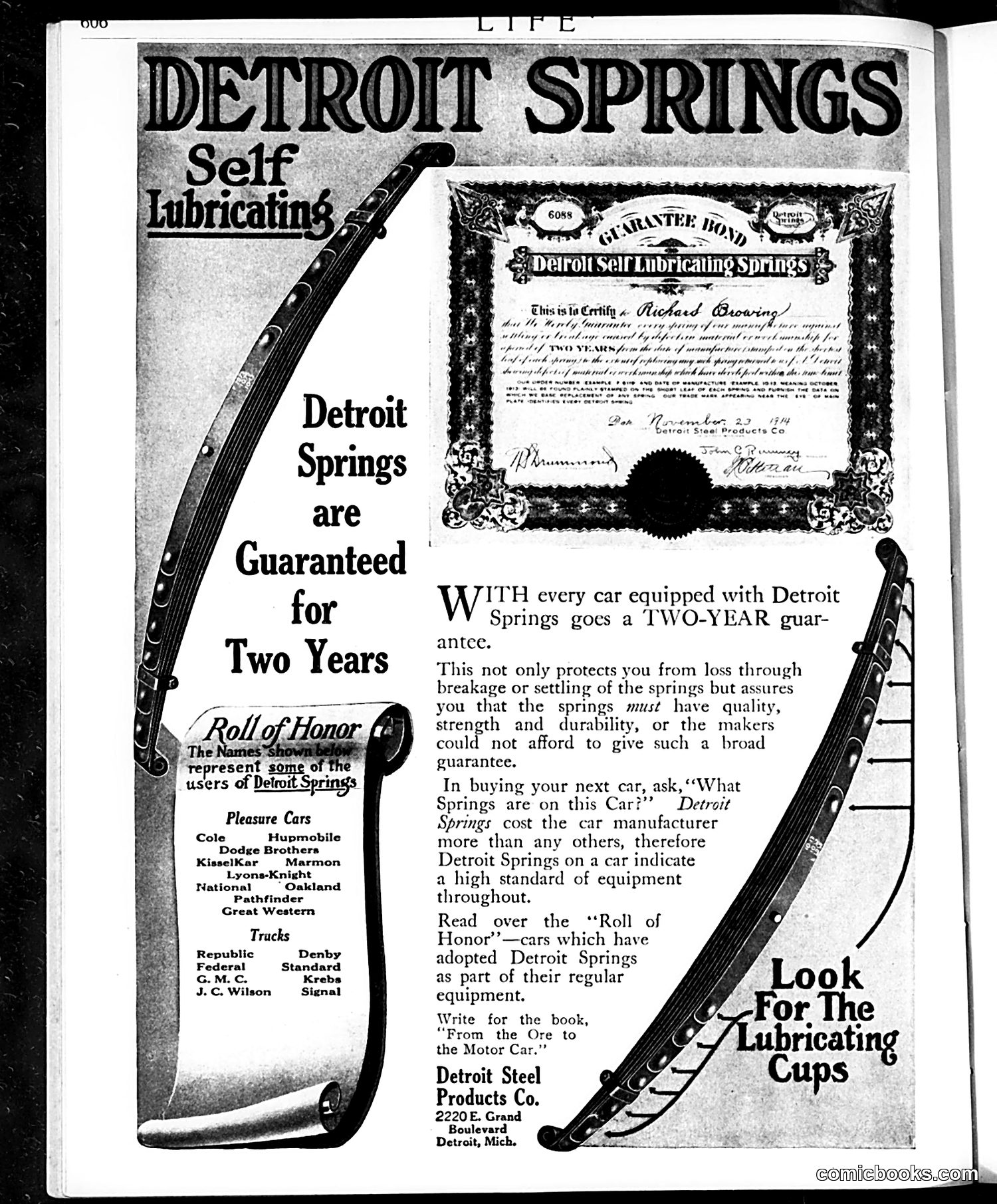
This page is **primarily an advertisement**, not satirical content. It promotes Detroit Springs' self-lubricating automobile springs, guaranteed for two years. The ad emphasizes product credibility through a "Roll of Honor"—a list of major car manufacturers (Cadillac, Dodge, Packard, etc.) and truck makers (Republic, Federal, G.M.C.) that use Detroit Springs as standard equipment. This functions as a testimonial strategy: if prestigious manufacturers trust these springs, consumers should too. The two spring illustrations and "Look For The Lubricating Cups" messaging highlight the product's technical feature. A guarantee bond is displayed to reinforce reliability claims. There is no cartoon or political satire present—this is straightforward early automotive-industry marketing leveraging manufacturer endorsements to build consumer confidence.
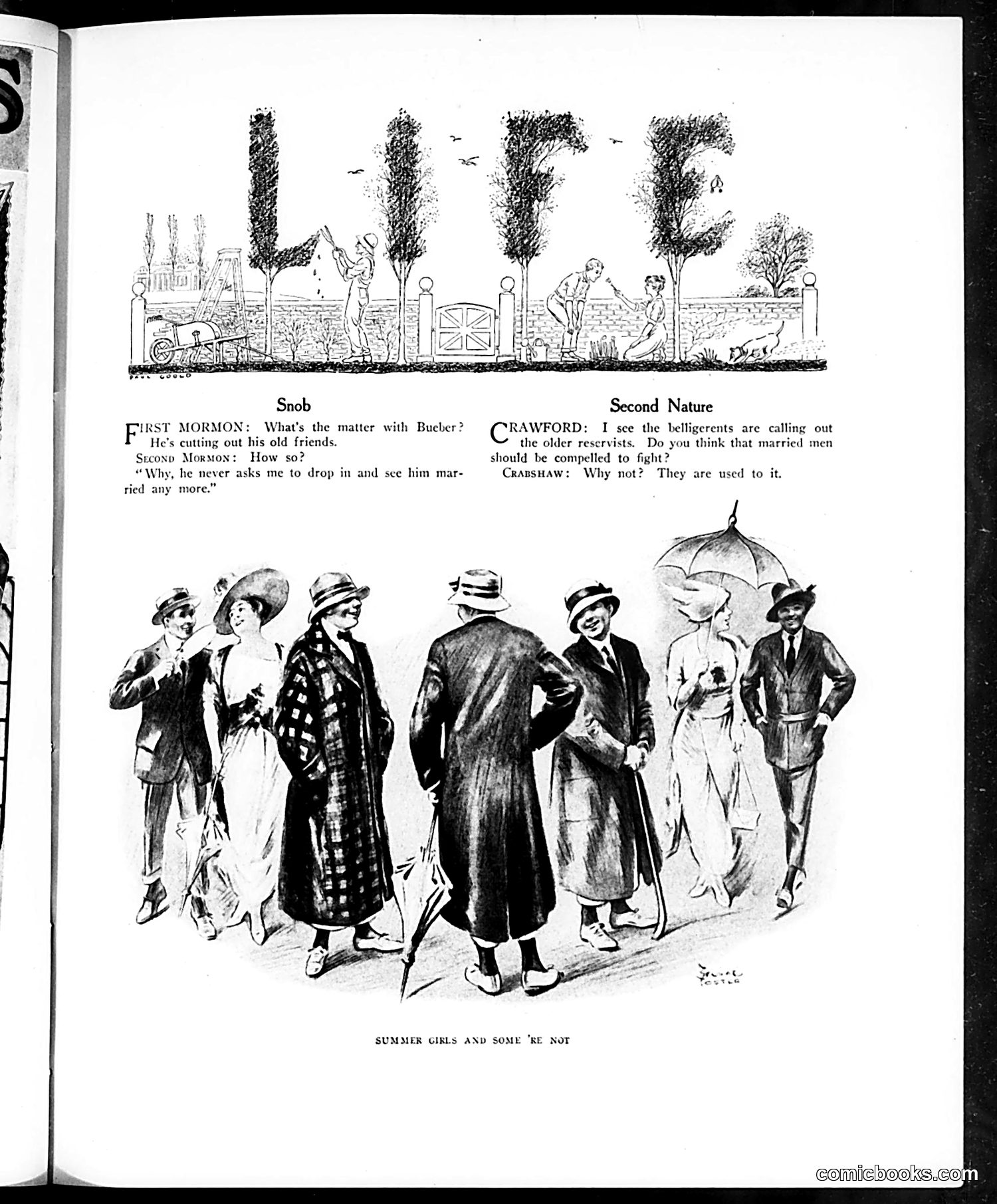
This page contains two separate satirical cartoons from *Life* magazine: **Top cartoon ("Snob"):** Two Mormon men discuss a friend named Bueler who's cutting off old friends after marriage. The joke plays on Mormon culture and social climbing—the implication being that marriage causes some men to abandon their past. **Bottom cartoon ("Summer Girls and Some're Not"):** Shows a mixed group of people during what appears to be rainy weather. The dialogue between Crawford and Crabshaw discusses whether married men should be conscripted for military service, with Crabshaw arguing they're "used to it"—suggesting marriage is comparable to warfare, a common early-20th-century satirical trope about matrimony. Both cartoons use humor to critique social attitudes toward marriage and changing social status.
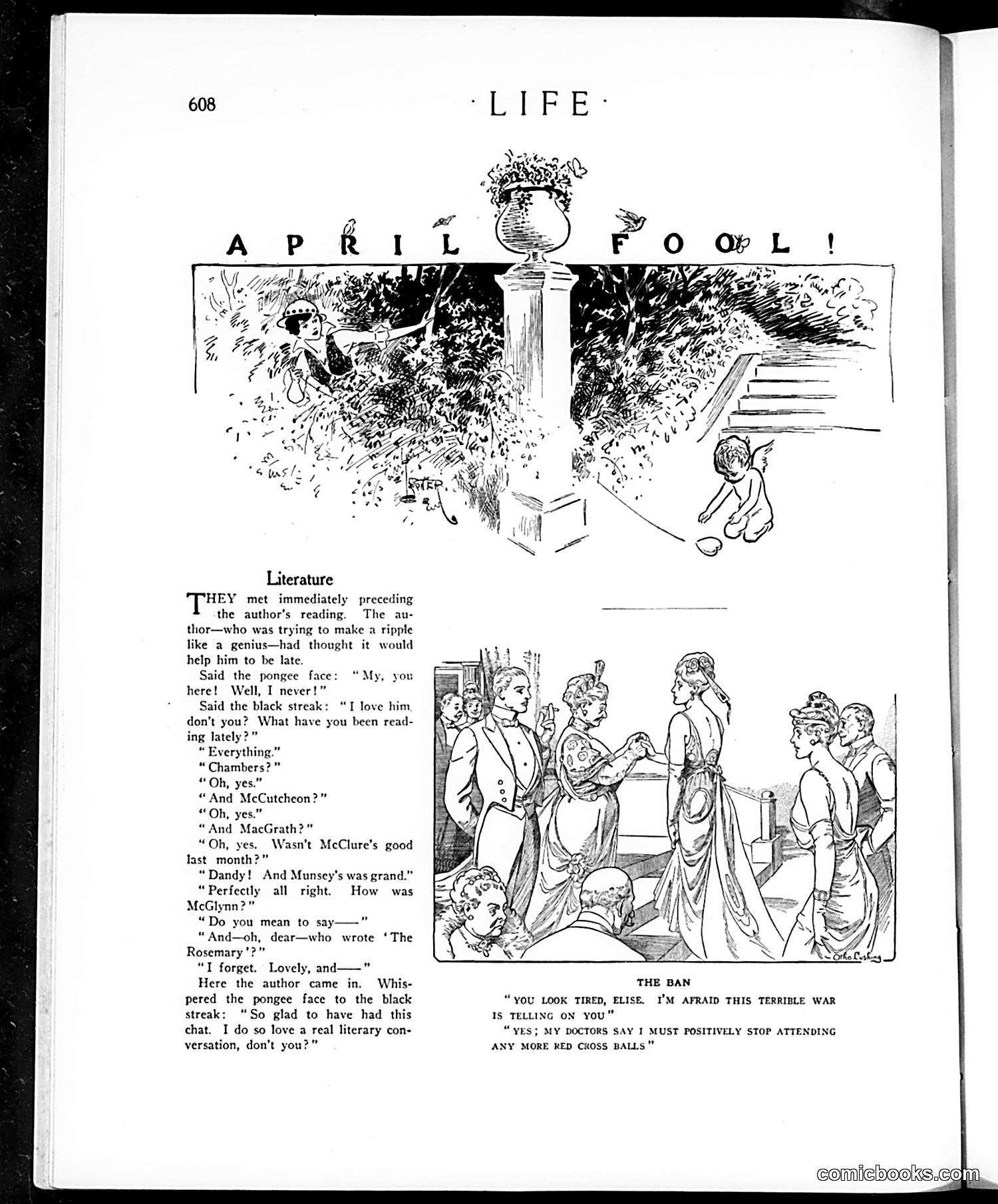
This page satirizes literary pretension during wartime. The top illustration shows an April Fool's prank involving a decorative urn in a garden setting. The main cartoon, titled "The Ban," depicts a social gathering where a woman named Elise, looking fatigued, tells her companions she must stop attending Red Cross balls due to doctor's orders. This appears to satirize upper-class women's wartime social obligations—the irony being that charitable Red Cross fundraising events, meant to support the war effort, have become so frequent and demanding that they're exhausting participants. The "Literature" section above mocks pretentious book-club discussions among socialites, where readers discuss popular works like Chambers and McGlynn while name-dropping literary titles. The satire targets shallow engagement with serious literature.
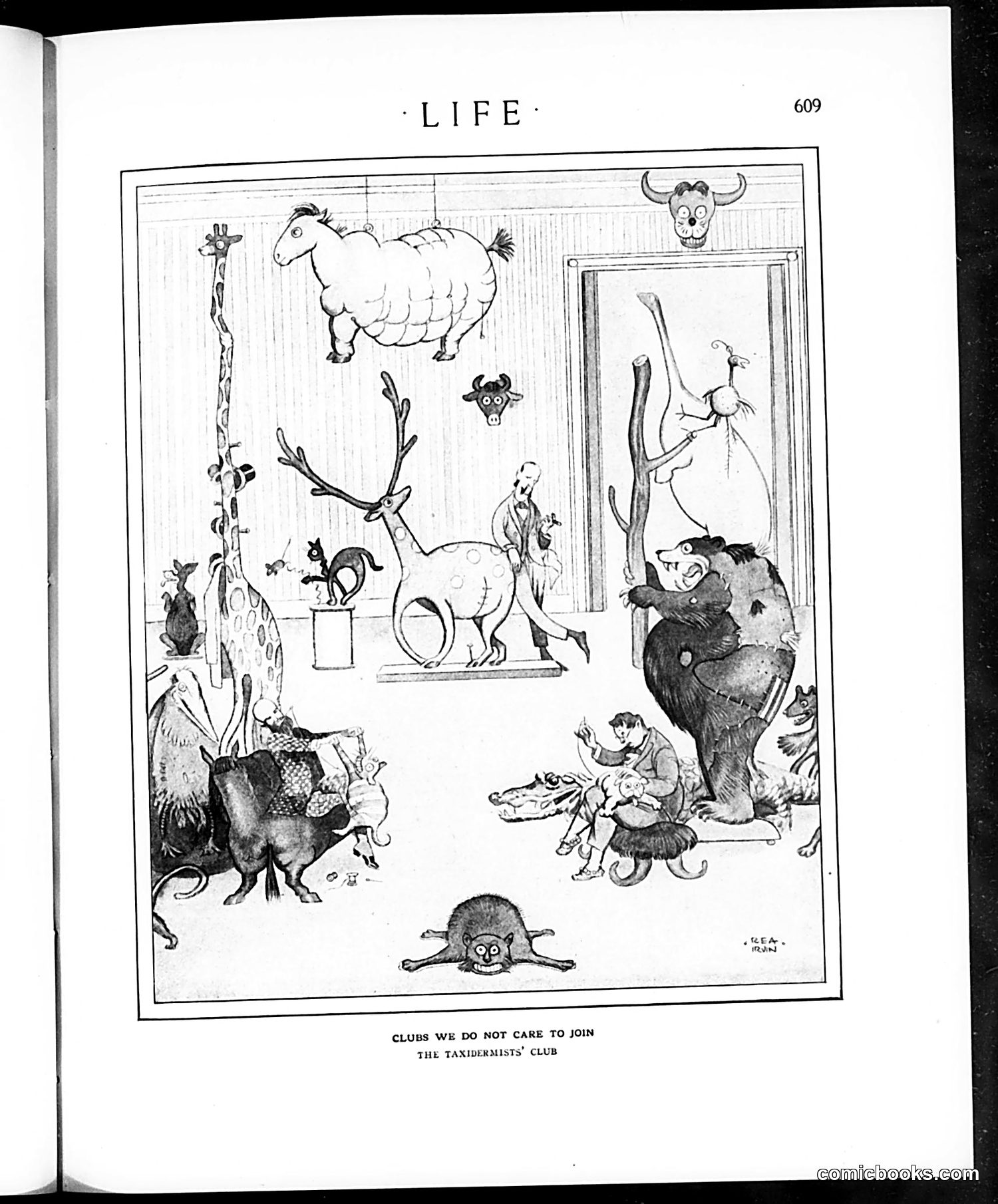
This satirical cartoon depicts a grotesque "club" of stuffed and mounted animal specimens arranged in a gallery-like space. The title reads "CLUBS WE DO NOT CARE TO JOIN: THE TAXIDERMISTS' CLUB." The humor relies on visual grotesquerie—various animals (giraffe, llama, bulls, bears, monkeys, and others) are displayed as taxidermied specimens, some posed absurdly or unnaturally. The joke mocks exclusive social clubs by suggesting membership would mean being literally "stuffed"—dead and mounted like museum pieces. This reflects early 20th-century satire on wealthy men's clubs, presenting club membership as a fate worse than death, rendered through darkly comedic animal imagery. The cartoon's tone suggests disdain for pretentious social institutions.
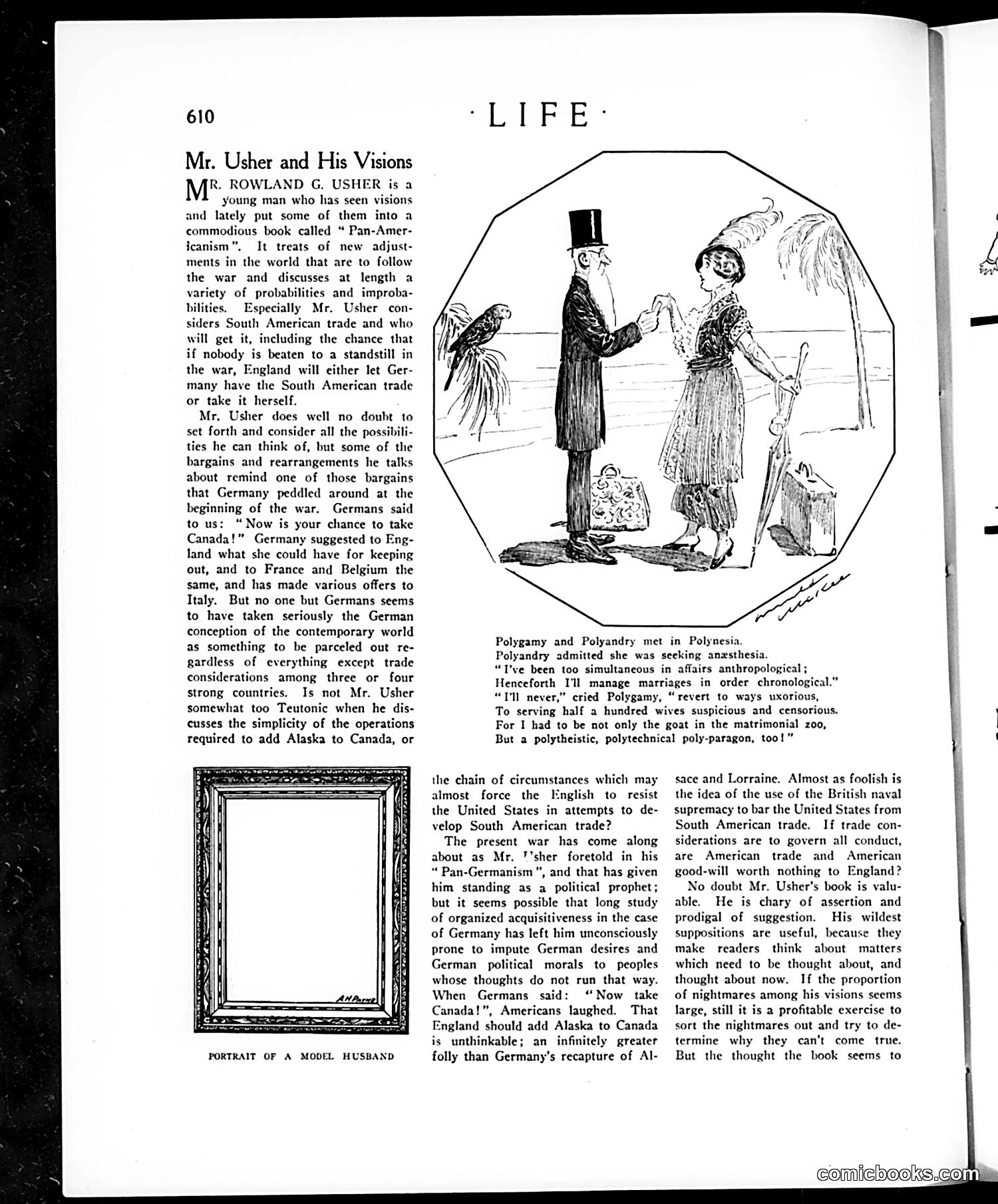
This page satirizes Rowland G. Usher's book "Pan-Americanism," which discusses post-WWI geopolitical possibilities. The main cartoon depicts a man in a top hat presenting marriage proposals to a woman (labeled "Polyandry"), while she considers multiple suitors—a visual metaphor for competing nations' trade arrangements and alliances. The satire mocks Usher's elaborate theorizing about which nations might control South American trade after the war. The "Model Husband" portrait below is apparently ironic commentary. The text suggests Usher's predictions are overly complex and somewhat absurd—comparing Germany's wartime offers to Canada, France, and Belgium to farcical romantic entanglements. The joke is that serious geopolitical analysis becomes ridiculous when presented as matrimonial chaos.
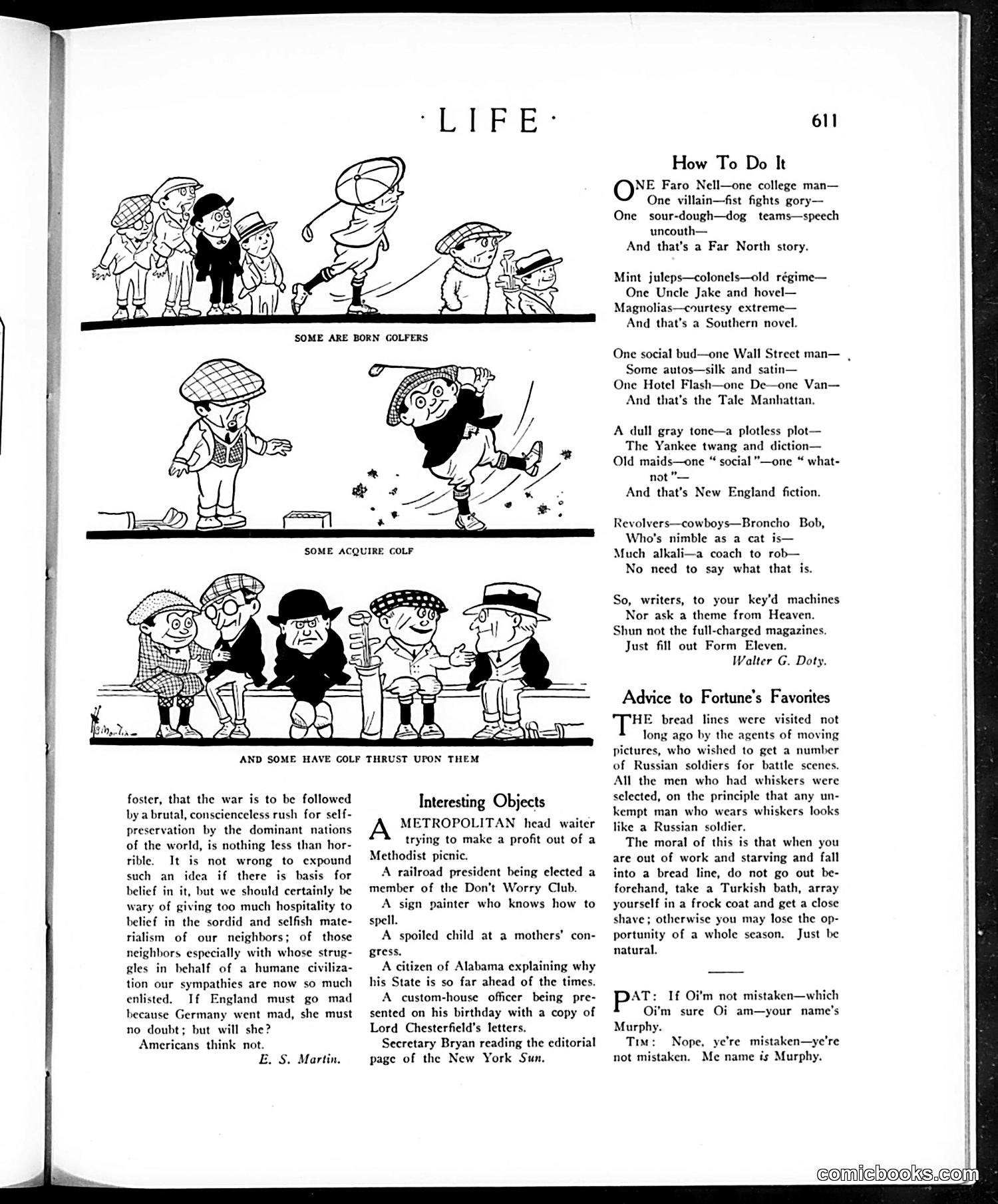
This page satirizes American literary types and their fictional subject matter. The top cartoon, "Some Are Born Golfers," depicts various character archetypes—a "Faro Nell" (frontier woman), a villain, and a "sour dough" prospector—representing popular pulp fiction genres. The subsequent panels mock different literary categories: Southern novels (with "Magnolias"), Manhattan tales, New England fiction, and Western stories featuring "Broncho Bob." Walter G. Doty's accompanying poem mocks writers for chasing commercial success rather than artistic merit, advising them to simply "fill out Form Eleven"—suggesting formulaic writing reduced to bureaucratic process. The satirical "Advice to Fortune's Favorites" section below ridicules both popular fiction tropes and wartime sensationalism in entertainment media.
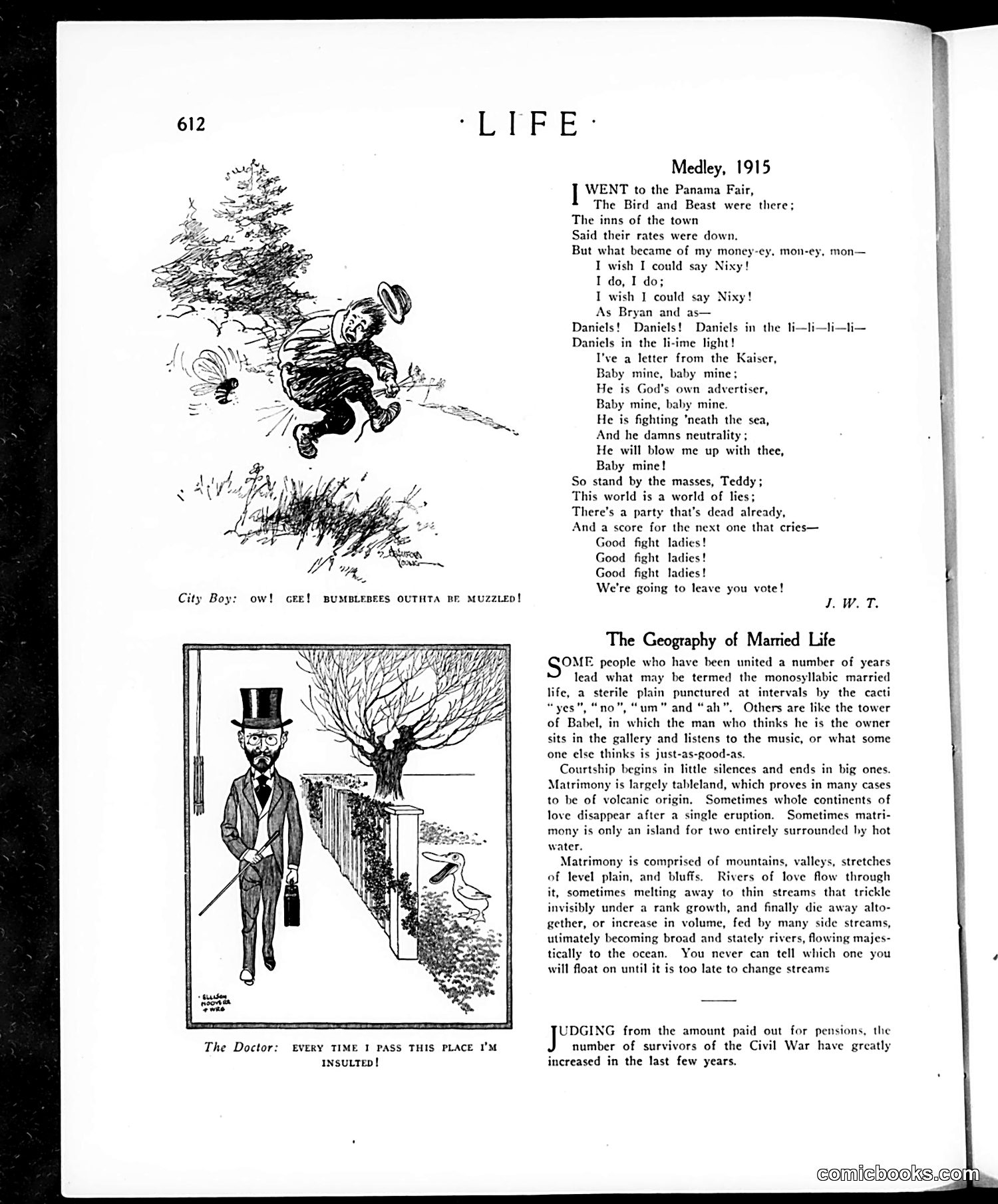
**"City Boy" cartoon (top)**: A city boy is being chased by bumblebees after disturbing their nest, appearing to lose his hat. The caption "OW! GEE! BUMBLEBEES OUTTA BE MUZZLED!" is humorous—the boy is complaining the bees should be controlled, missing the irony that *he* provoked them. **"The Doctor" cartoon (bottom)**: A well-dressed man in a top hat walks past a bare, damaged tree. The caption reads "EVERY TIME I PASS THIS PLACE I'M INSULTED!"—likely satirizing hypersensitivity or suggesting the tree's poor appearance offends him aesthetically. **"The Geography of Married Life"** (prose): This uses geographical metaphors for marriage stages—courtship as "little silences," matrimony as "volcanic" terrain with mountains and valleys, and love as flowing rivers that may disappear. It's satirical commentary on married life's unpredictability.
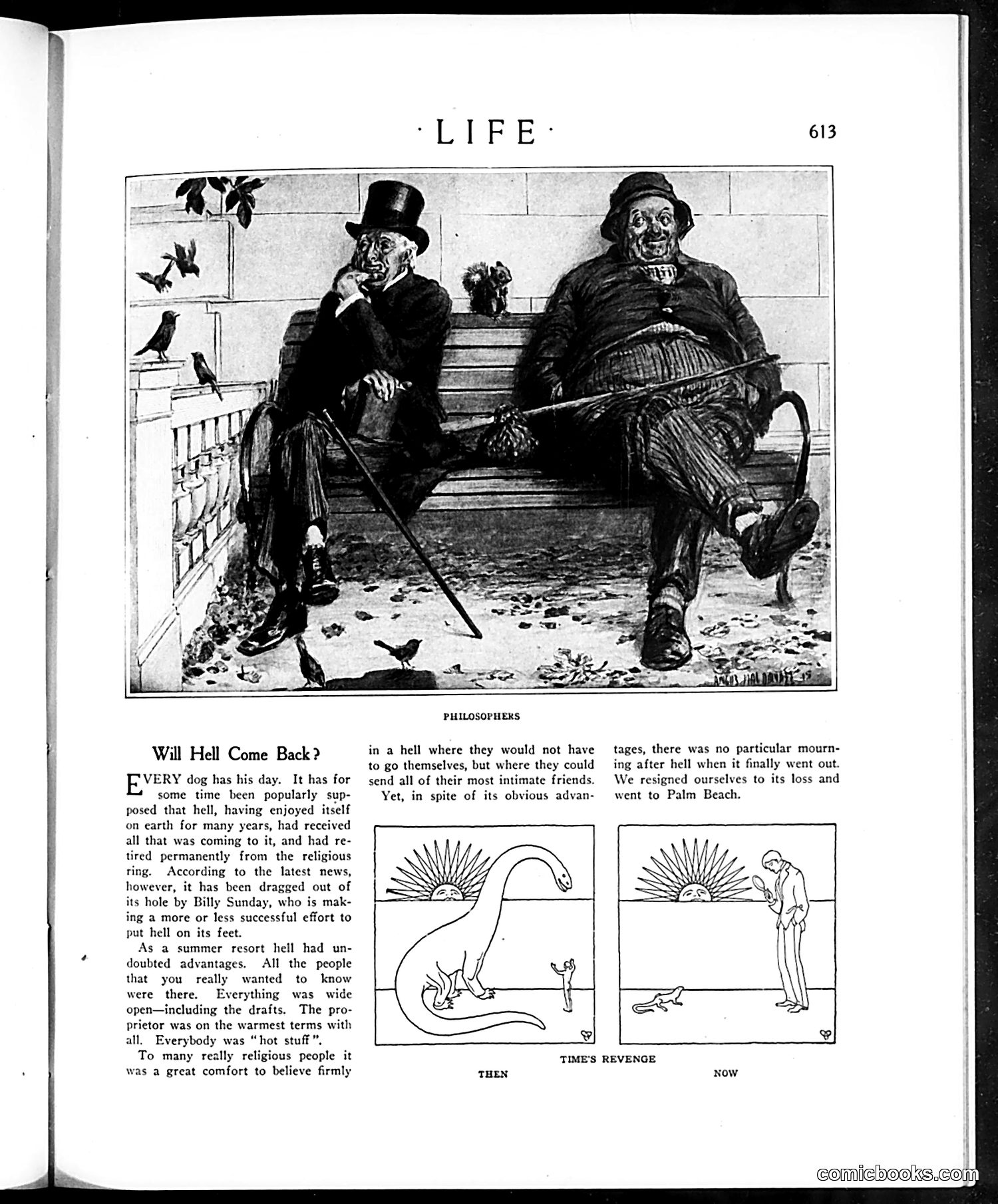
This page satirizes the 1920s popularity of spiritualism and afterlife tourism. The top cartoon shows two elderly men on a park bench—labeled "Philosophers"—discussing whether hell has become obsolete. The article proposes that hell has been "dragged out of its hole by Billy Sunday" (a famous evangelical preacher of that era), turning damnation into a tourist attraction with "wide open" access, including drafts and heat. The joke: hell became so commercialized and comfortable as a "summer resort" that religious people lost their fear of it. The bottom cartoon, "Time's Revenge," contrasts prehistoric humans fleeing dinosaurs with a modern golfer calmly ignoring a dinosaur—suggesting humanity's anxieties have shifted from primal fears to modern social concerns.
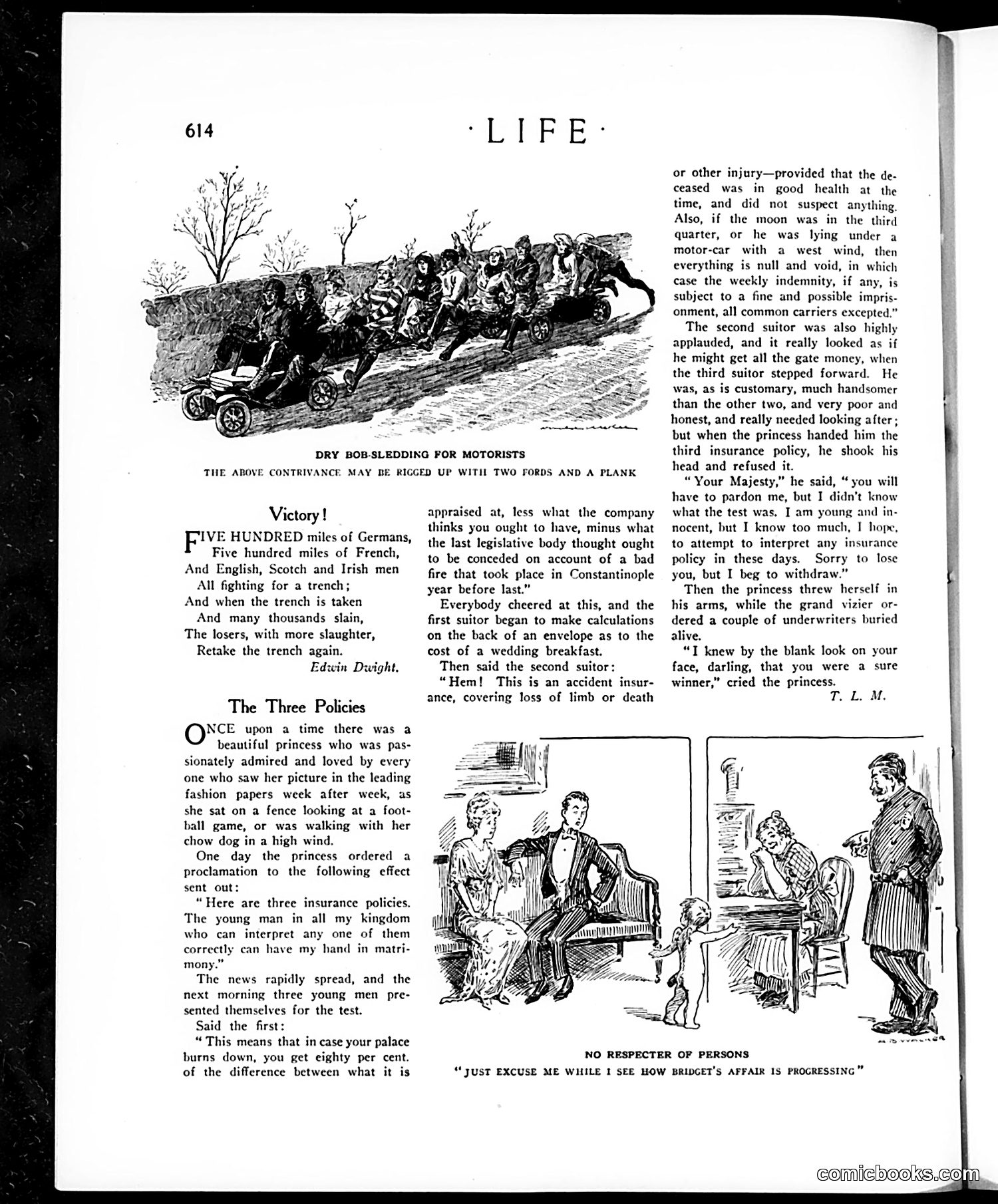
This page contains two distinct pieces of satirical content: 1. **"Victory!" poem** by Edna St. Vincent Millay celebrates Allied military success in WWI, referencing "Five hundred miles of Germans" and soldiers retaking trenches. 2. **"The Three Policies" story** satirizes insurance industry absurdity. A beautiful princess announces three insurance policies to suitors—the joke hinges on the third suitor's refusal to interpret the policy, calling it dishonest. The cartoon below shows a man interrupting social gatherings, desperate to discuss "Bridget's affair." The humor targets both insurance companies' opaque language and social etiquette violations. The accompanying sketches illustrate the awkward interruption of polite society by someone obsessed with gossip or business matters—a commentary on changing social priorities and corporate culture.
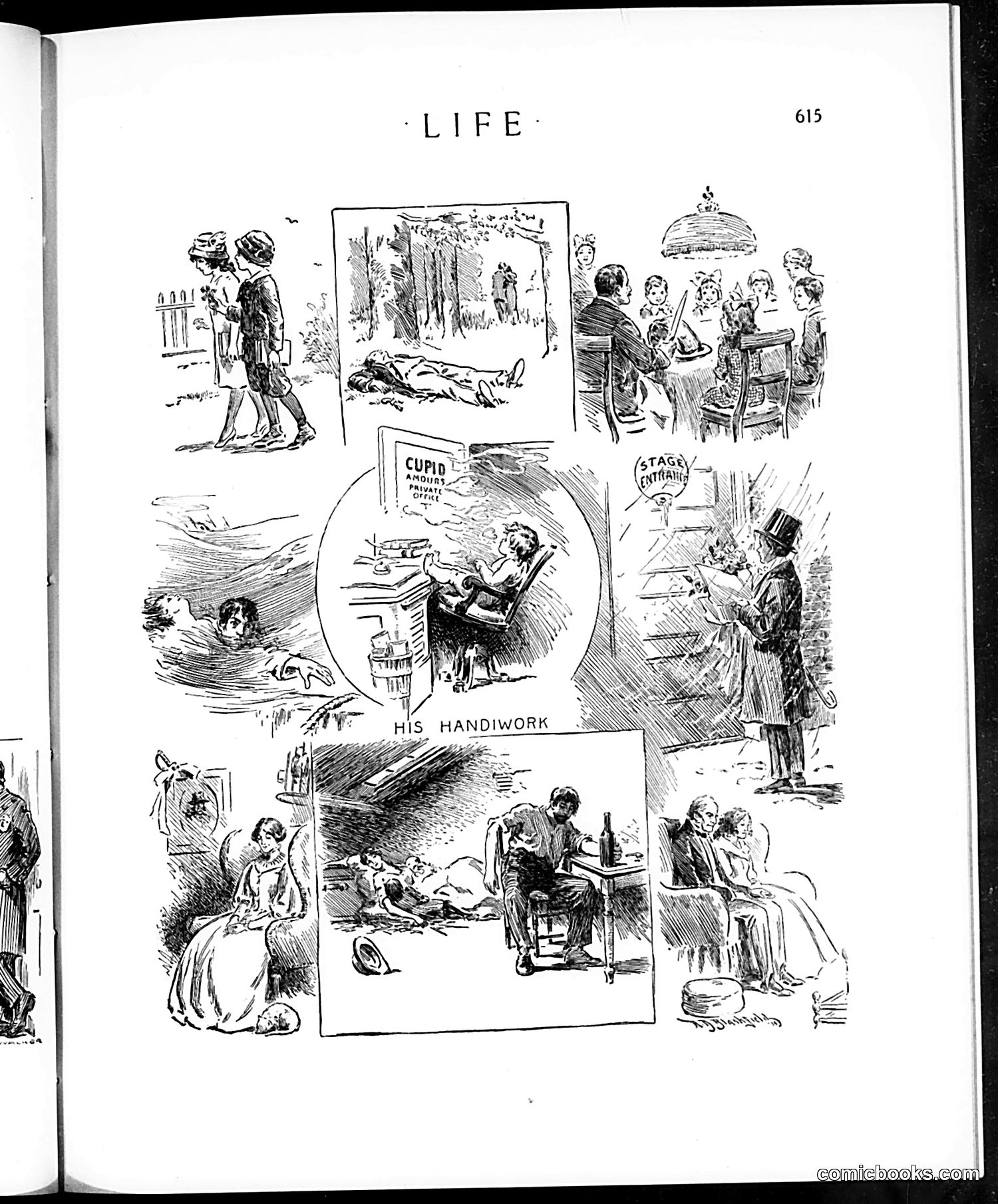
This page presents a series of sketch-based satirical vignettes labeled "His Handiwork," depicting various scenes of social vice and moral decay. The central circular panel shows a man at a desk labeled "Cupid" with bottles, suggesting he's profiting from romance or seduction. Surrounding scenes illustrate consequences: poverty, drunkenness, theatrical debauchery (marked "Stage Entrance"), and domestic despair. The satire targets a manipulative figure—likely a seducer, con artist, or exploiter—whose schemes damage vulnerable people: working-class women, drunkards, and families. The cumulative visual narrative critiques social predation and moral corruption in late 19th/early 20th-century urban America, presenting a cautionary tale about vice's ripple effects through society.
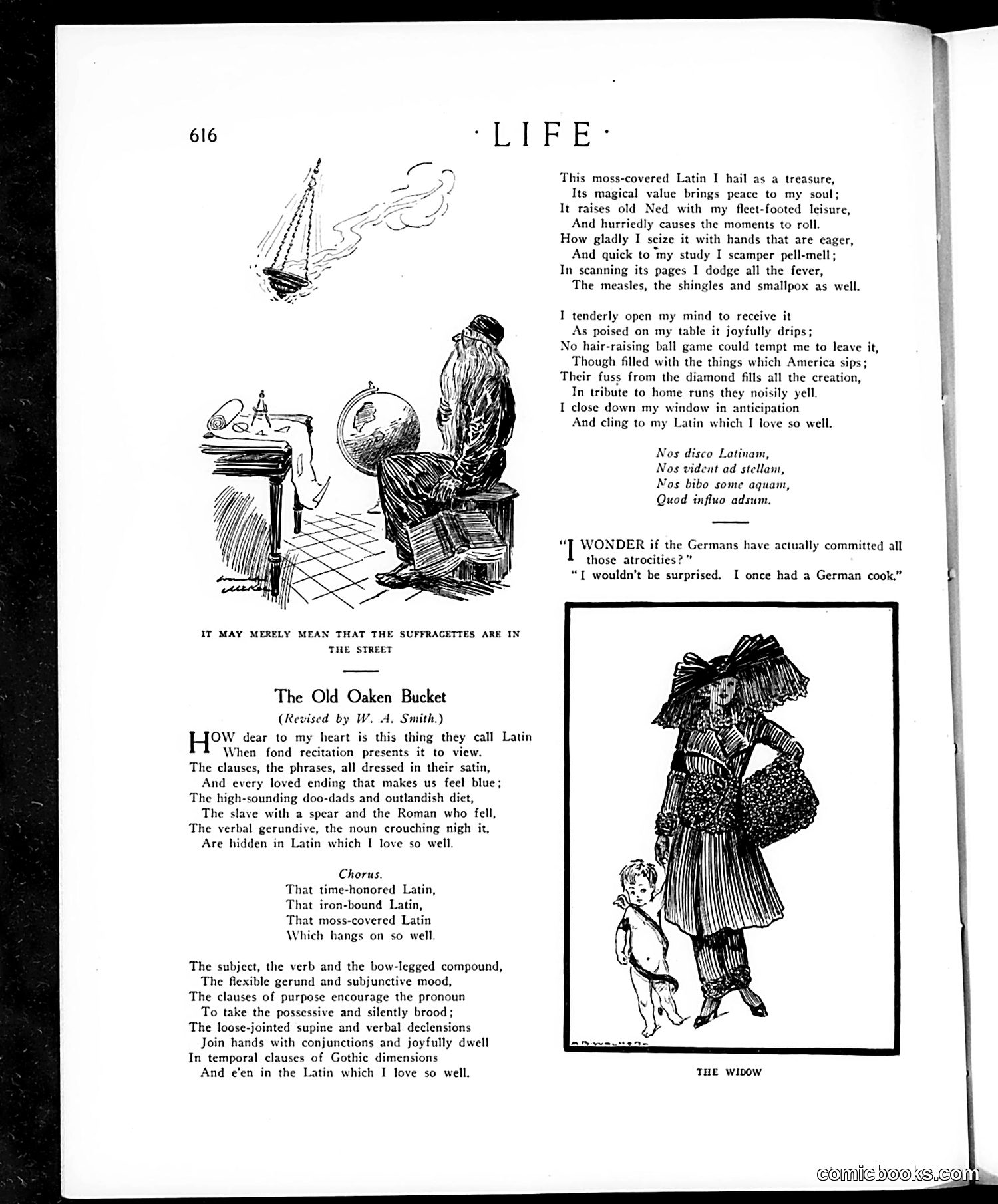
This page satirizes the obsessive study of Latin grammar among American students. The poems parody "The Old Oaken Bucket," a sentimental American hymn, by replacing nostalgia for home with absurd devotion to Latin conjugations and declensions. The humor targets the tedious, arcane nature of classical language instruction—students treasure "moss-covered Latin" and dodge real-world activities (sports, social life) to study grammatical minutiae like "bow-legged compounds" and "verbal gerundives." The small cartoon at top right appears to mock German stereotypes following World War I atrocities. The "Widow" illustration likely references wartime loss. The "Suffragettes in the street" caption suggests dismissive contemporary attitudes toward women's voting rights activism. Overall, this is genteel satirical humor targeting academic pedantry and era-specific social anxieties.
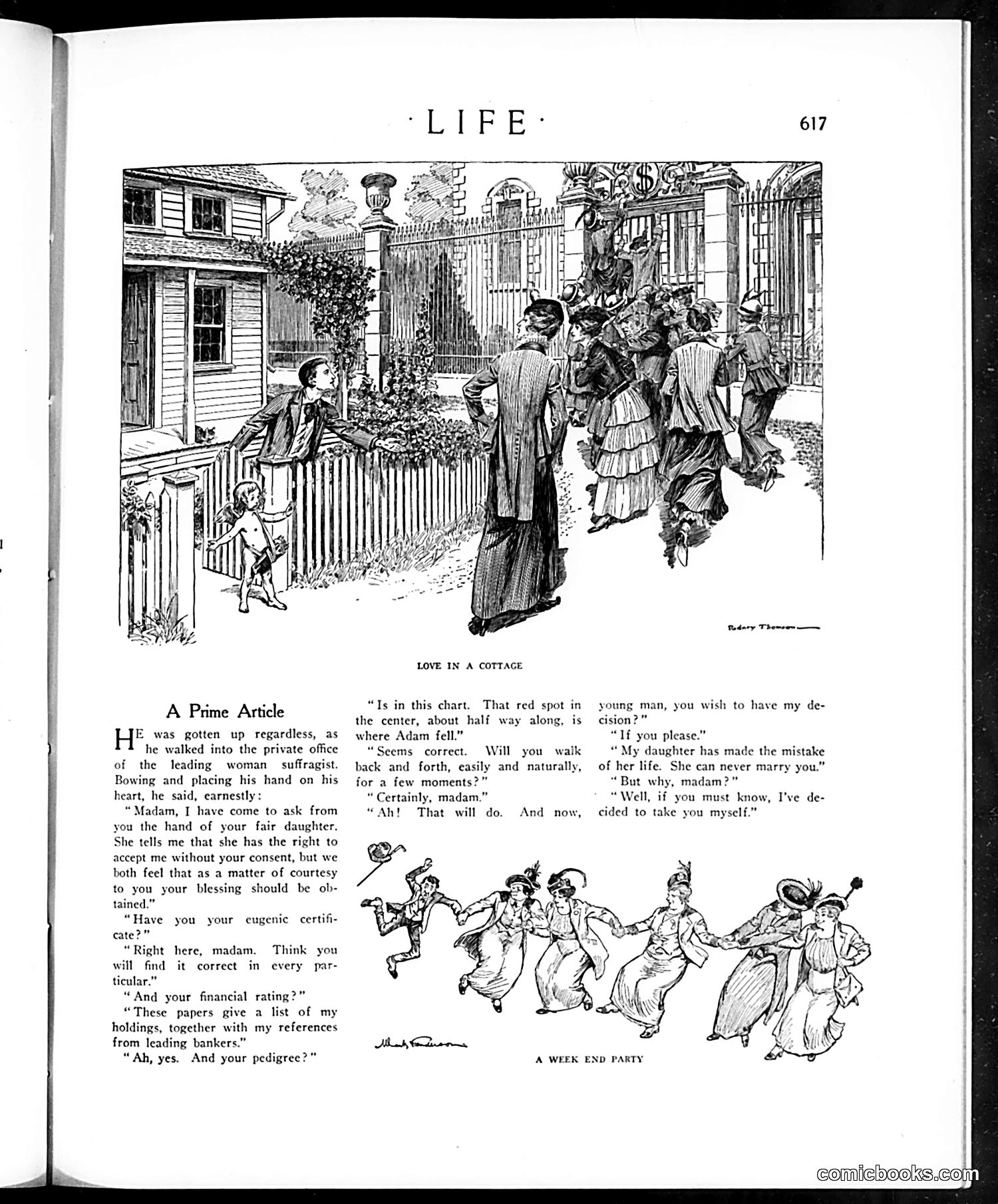
This satirical piece mocks the early 20th-century women's suffrage movement by imagining a suffragist mother subjecting a suitor to absurd "scientific" scrutiny. The joke: A young man seeking to marry a suffragist's daughter must provide eugenic certificates, financial records, and pedigree documentation—the language of eugenics and scientific management applied to courtship. The suffragist mother examines him like a specimen, checking his "eugenic certificate" and having him walk "easily and naturally" as if evaluating breeding stock. The punchline lampoons both suffragists and contemporary eugenic pseudoscience: the rational, demanding suffragist mother—presented as domineering and emasculating—ultimately decides to marry the young man herself, undercutting the daughter's autonomy the mother supposedly champions. The accompanying illustration "A Week End Party" shows carefree socialites, contrasting with the cartoon's mockery of serious-minded suffragists as humorless, controlling figures.
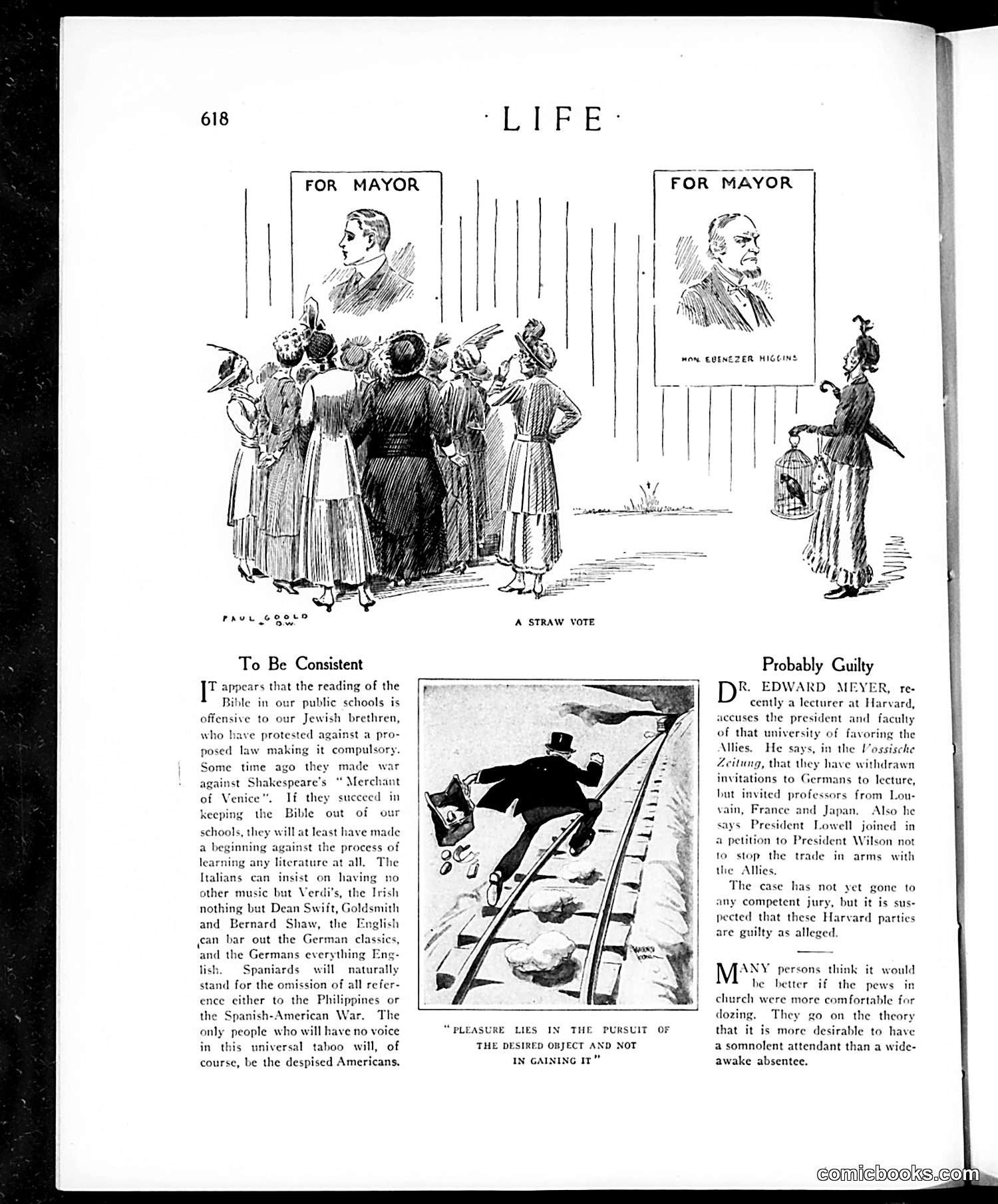
**Top Cartoons - "A Straw Vote":** The left cartoon shows women gathered before two "FOR MAYOR" posters, illustrating a humorous take on women's suffrage and voting rights. The right cartoon depicts a fashionable woman with a birdcage, labeled "A STRAW VOTE"—a pun suggesting women voters are frivolous or easily swayed, like straw blowing in the wind. **"To Be Consistent":** This satirical article mocks the idea of religious/cultural exclusion. After noting Jewish objections to mandatory Bible-reading in schools (and earlier protests against Shakespeare's *Merchant of Venice*), the author sarcastically proposes that other groups should logically exclude *their* unwanted cultures too—Italians banning non-Verdi music, Irish excluding non-Irish writers, etc. The joke: only Americans would have nothing left to claim, making them the "despised" group. It's anti-censorship satire attacking identity-based cultural gatekeeping. **"Probably Guilty":** Discusses accusations against Harvard President Lowell for allegedly favoring German lecturers while inviting professors from Allied nations, and for supporting continued arms sales to the Allies during WWI. The tone is skeptical of the charges.
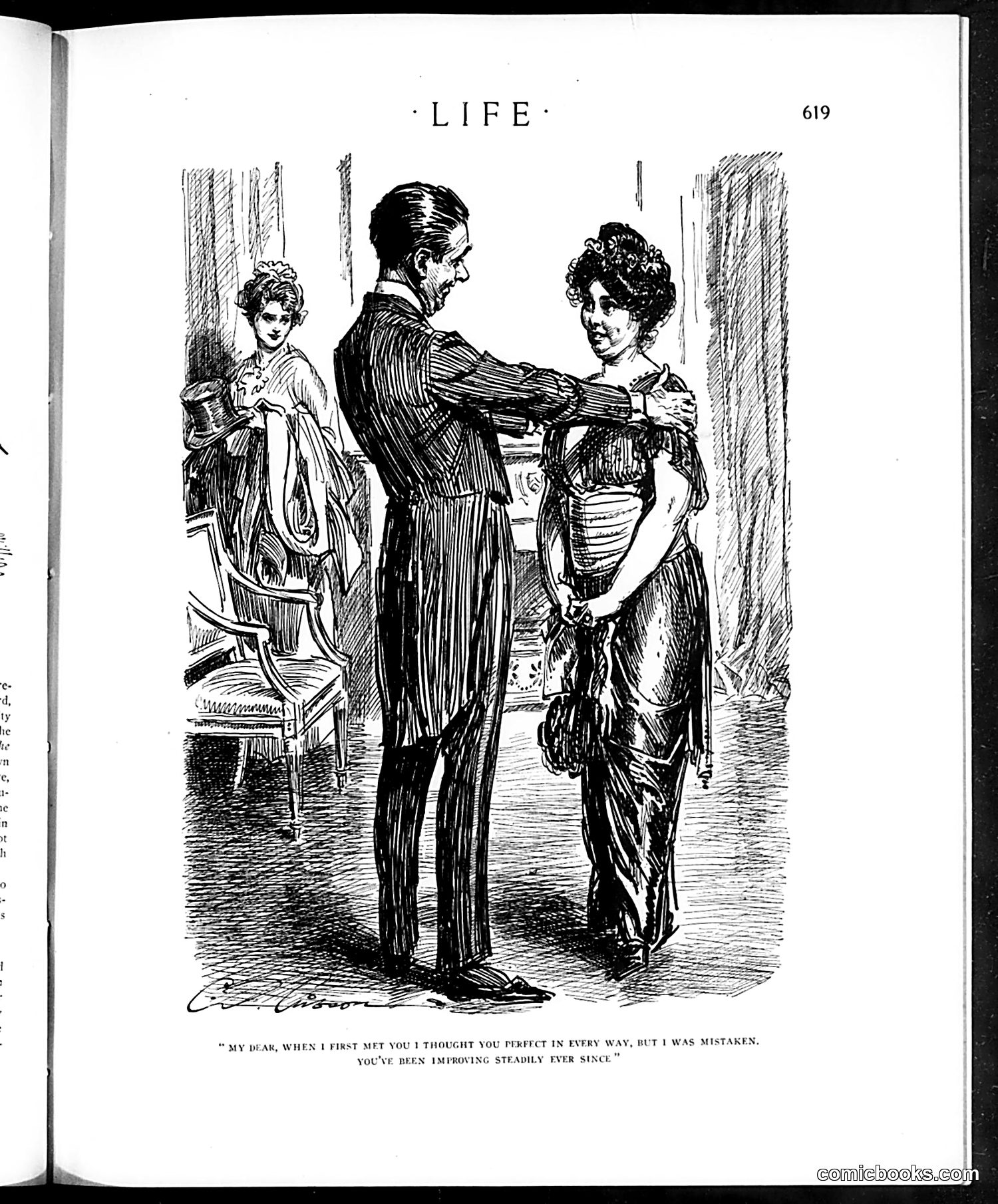
This single-panel cartoon depicts a man complimenting a woman in what appears to be an elegant interior setting, with another woman visible in the background. The caption presents the man's backhanded compliment: he initially thought her perfect but was "mistaken"—she's only improved since their first meeting. The satire targets romantic courtship conventions of the early 20th century. The joke inverts typical flattery: rather than claiming she was always perfect, he admits his initial judgment was wrong, suggesting either his taste was poor or her actual improvement validates his current appreciation. This pokes fun at both male vanity (claiming superior judgment retrospectively) and the social expectation that women should continuously work to improve themselves for male approval. The drawing style is characteristic of *Life* magazine's sophisticated social commentary on contemporary manners.
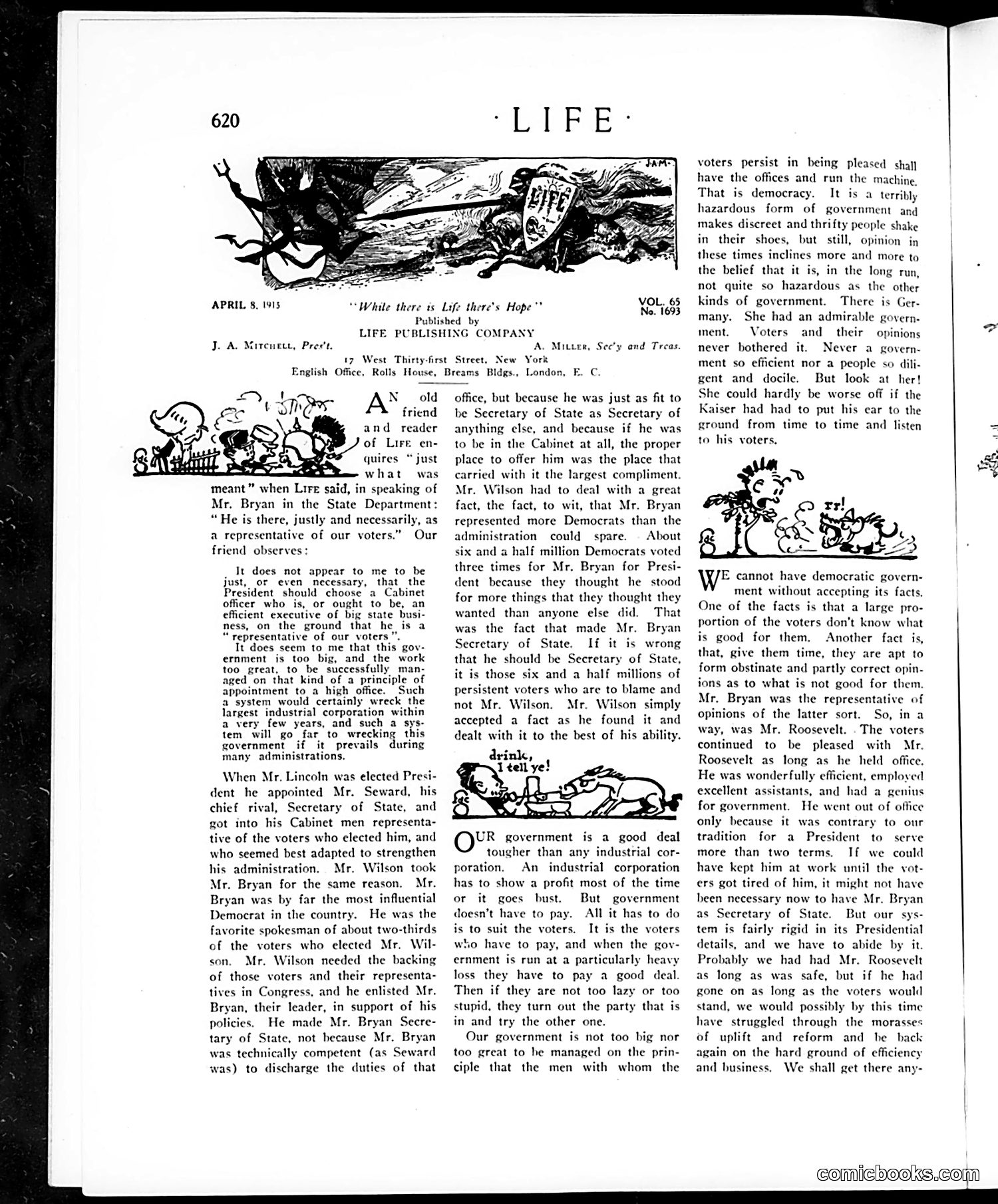
This page defends President Wilson's appointment of William Jennings Bryan as Secretary of State—a controversial choice because Bryan lacked diplomatic experience. The satirical magazine argues that while this seems inefficient by business standards, it reflects democratic reality. The central point: Bryan represented the political interests of approximately 6.5 million Democratic voters who had supported him three times for President. Wilson appointed him not for competence but political necessity—to maintain support from Bryan's constituency in Congress and among voters. The text contrasts this with Lincoln's appointment of rival Seward (who *was* competent) but acknowledges government differs from business: it must satisfy voters, not show profits. Democracy, the author argues, is "terribly hazardous" but legitimate—voters choose who runs the machine, and if dissatisfied, they vote the party out. The cartoons (unclear in detail) appear to illustrate this democratic principle humorously.
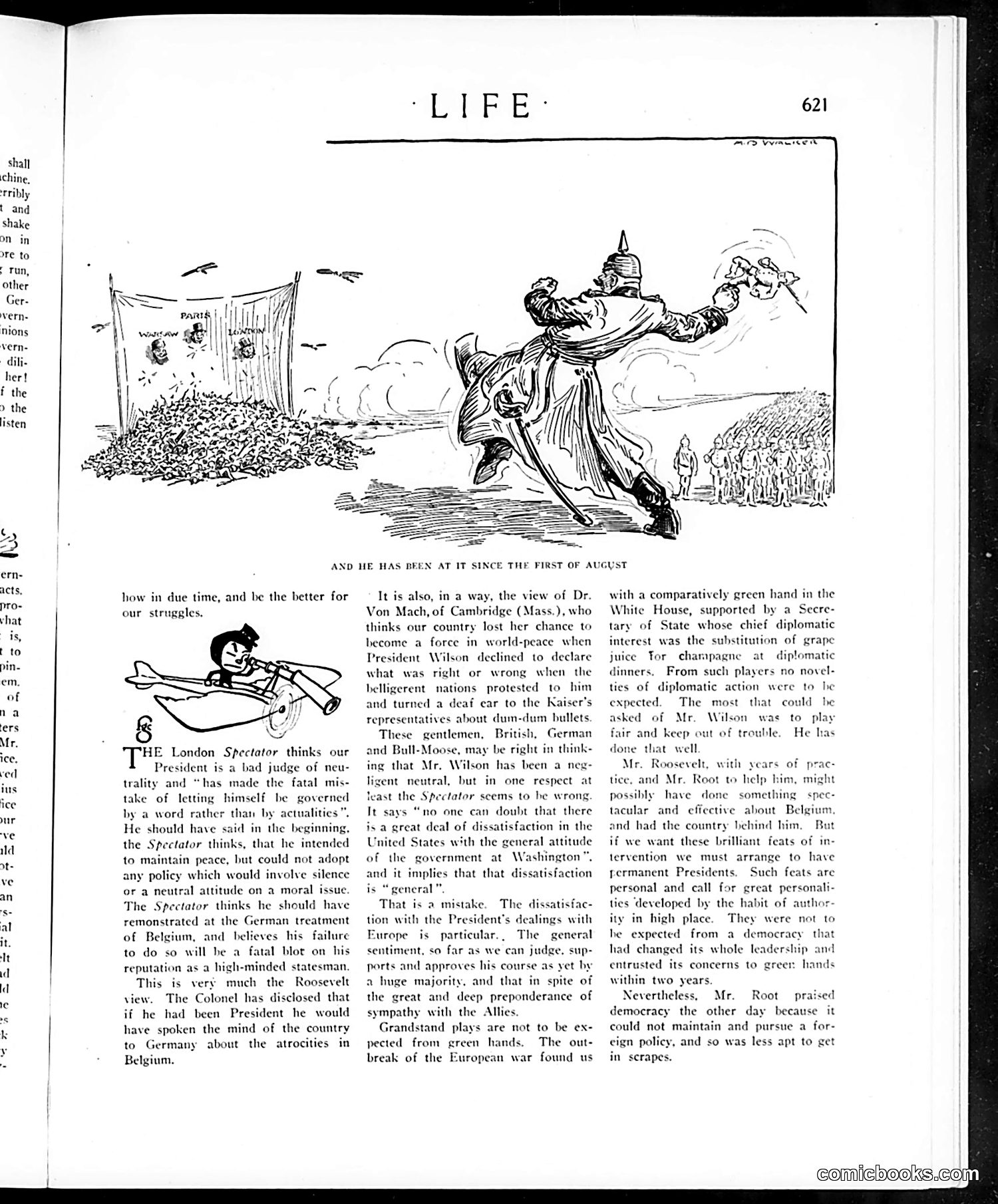
**The Cartoon:** The top illustration depicts a figure (likely representing President Wilson or U.S. diplomacy) juggling multiple objects while balancing precariously—a visual metaphor for managing competing demands during WWI. **The Context:** This page critiques American neutrality in World War I (the "European war" referenced). British, German, and American critics—including Theodore Roosevelt ("Bull-Moose") and Dr. Von Mach—attacked President Wilson for insufficient moral condemnation of German atrocities in Belgium and for not taking stronger diplomatic stances. **The Satire's Point:** The article defends Wilson against these critics, arguing that expecting brilliant diplomatic maneuvering from a relatively inexperienced administration is unreasonable. The phrase "green hands" appears repeatedly—Wilson and his Secretary of State lacked diplomatic experience compared to figures like Roosevelt and Elihu Root. The satire suggests critics demanding dramatic intervention underestimate the constraints of democratic governance with new leadership. **The Irony:** Roosevelt and experienced diplomats critiqued Wilson's caution, yet the author suggests their expectations were unrealistic given the administration's newness.
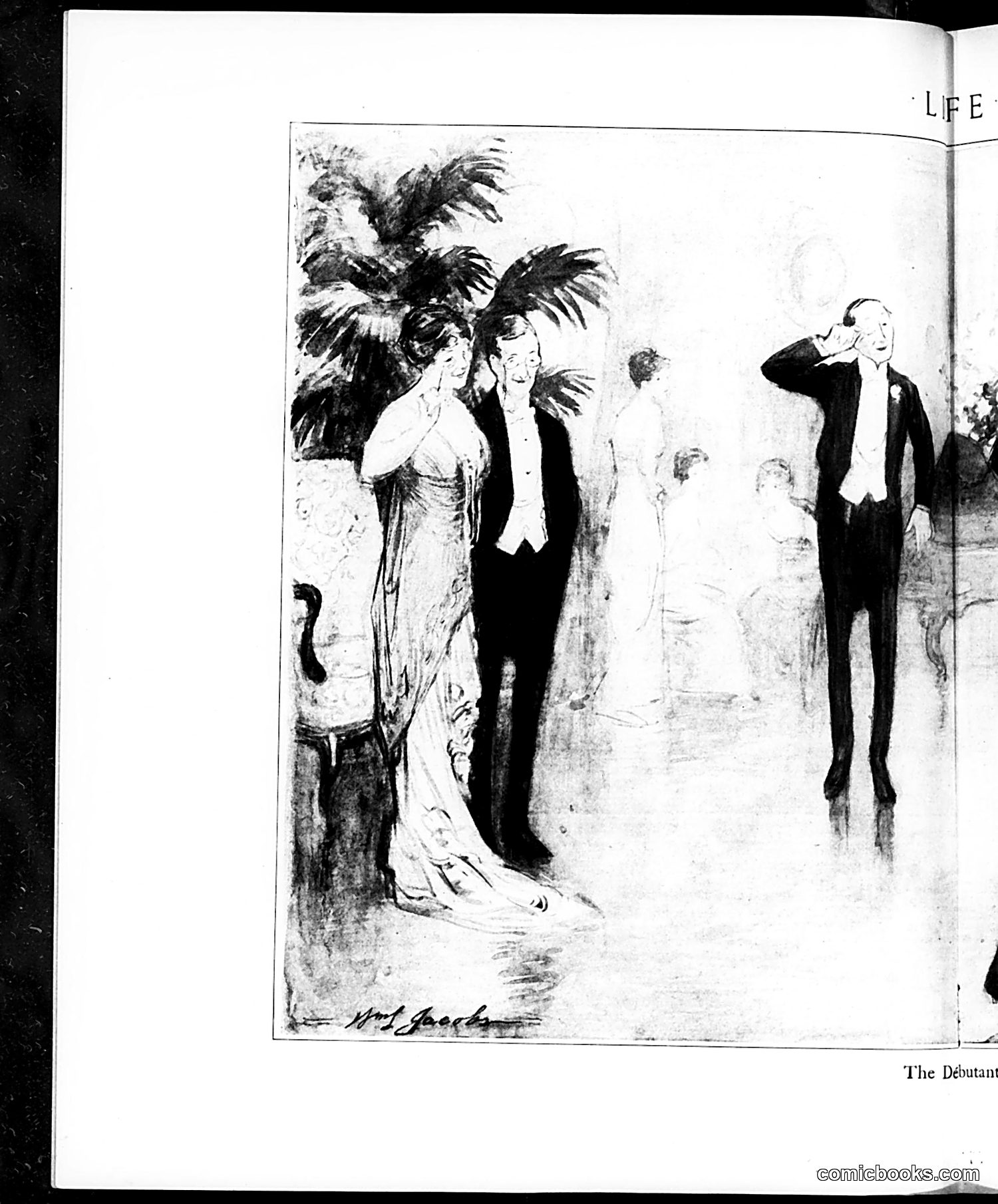
This appears to be a satirical cartoon about high society's debutante tradition—the formal introduction of young women to society. The sketch shows several figures in formal evening wear near a potted palm tree, a typical setting for such social events. The humor likely centers on social pretension and the artificial nature of the debutante ritual. The figures' poses and expressions suggest awkwardness or affected behavior typical of Life magazine's satire of upper-class conventions. The man on the right, scratching his head, may represent confusion or skepticism about the proceedings. Without a visible artist signature legibility or accompanying article text, the specific social critique remains somewhat unclear, though the cartoon clearly mocks the formality and social performance of introducing young women to elite society.
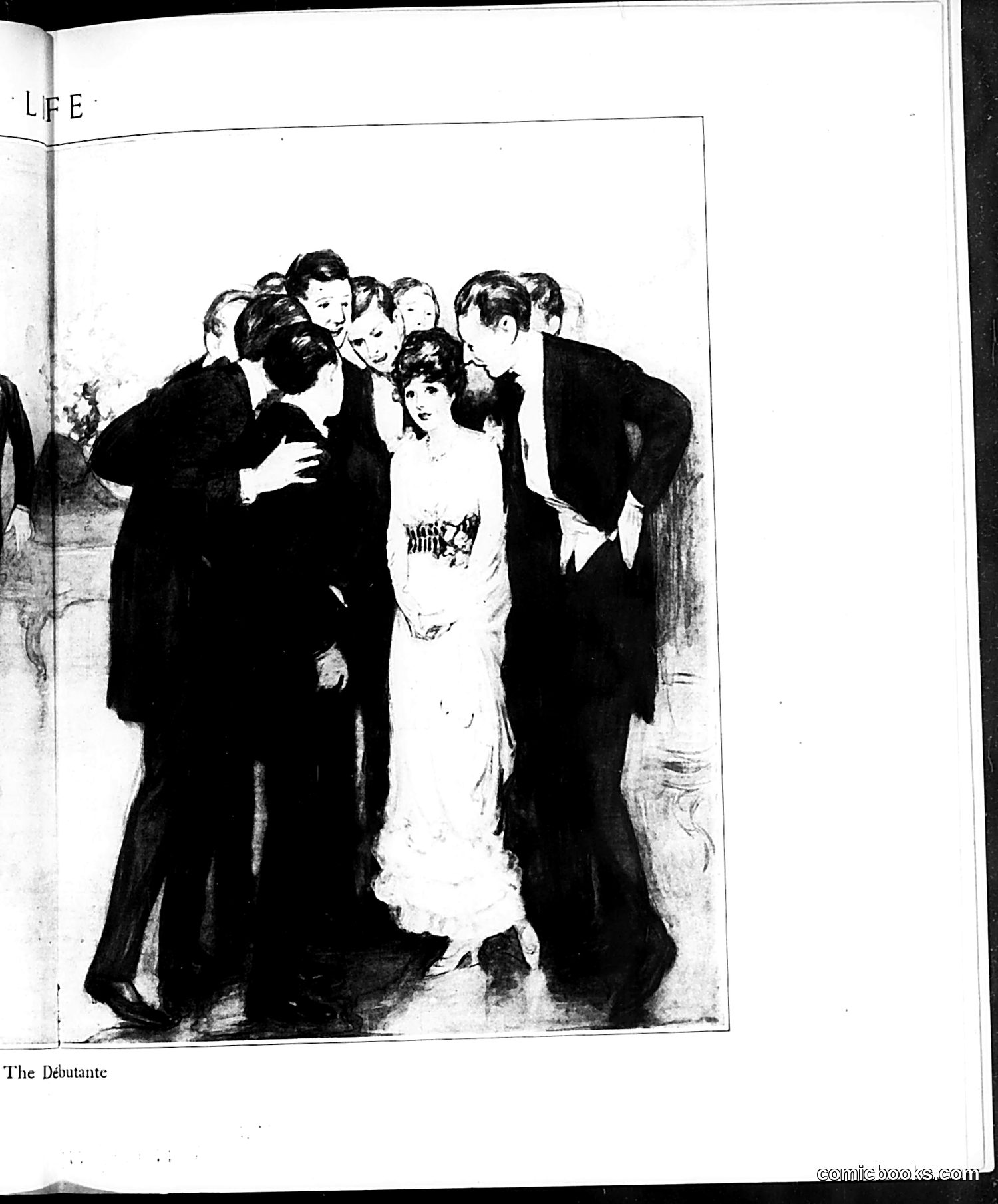
This illustration from *Life* magazine depicts a young woman in a white debutante gown surrounded by several men in dark formal suits who appear to be scrutinizing or crowding around her. The caption "The Débutante" suggests social commentary on the debutante tradition—the formal presentation of upper-class young women into society, typically marking their eligibility for marriage. The cartoon satirizes how debutantes were treated as objects of examination and selection by eligible men and society at large. The woman's isolated position and formal white dress contrast sharply with the dark-suited men encircling her, emphasizing her commodification within the marriage market of high society. The sketch style conveys both the superficiality and the pressure inherent in this tradition.
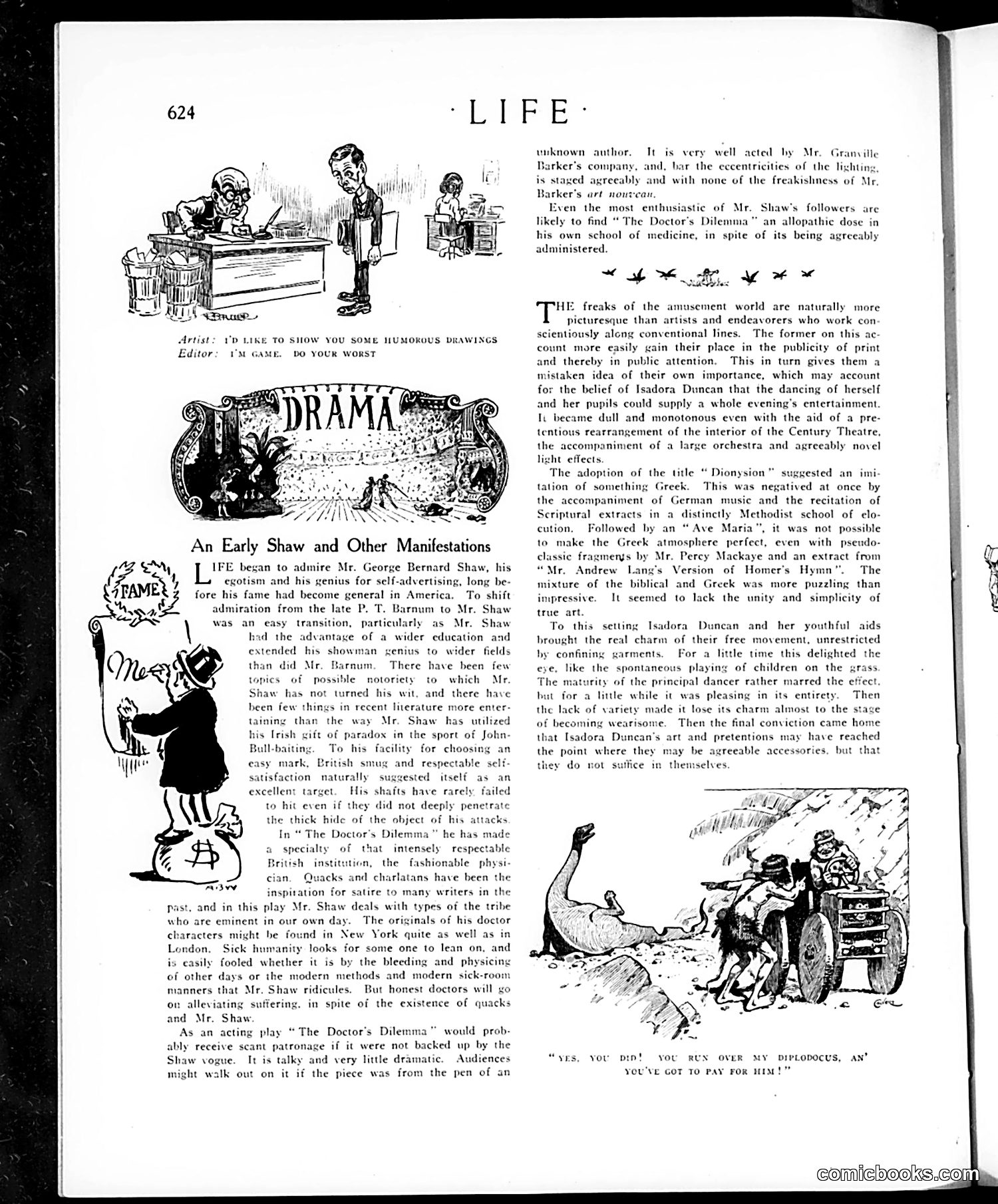
This page critiques George Bernard Shaw's theatrical work and Isadora Duncan's dance performance. **Shaw Section:** The article praises Shaw's wit and satirical genius, particularly his play "The Doctor's Dilemma," which ridicules fashionable physicians and medical quacks. However, Life admits the play is "talky and very little dramatic"—it succeeds only because of Shaw's celebrity reputation, not artistic merit. The cartoon at top humorously depicts an artist-editor exchange about "humorous drawings." **Isadora Duncan Section:** The review dismisses Duncan's evening-length dance performance as "dull and monotonous," despite elaborate staging, orchestra accompaniment, and lighting effects. The critic particularly mocks her pretentious attempt to create a "Greek atmosphere" (titled "Dionysion") while using German music and Biblical scripture recitations—undermining the Greek concept entirely. The bottom cartoon shows Duncan's dancers with a figure complaining about paying for damaged property. **Overall Point:** Both sections satirize how celebrity and pretension can substitute for genuine artistic merit—Shaw's reputation carries weak drama; Duncan's ambitions exceed her actual entertainment value.
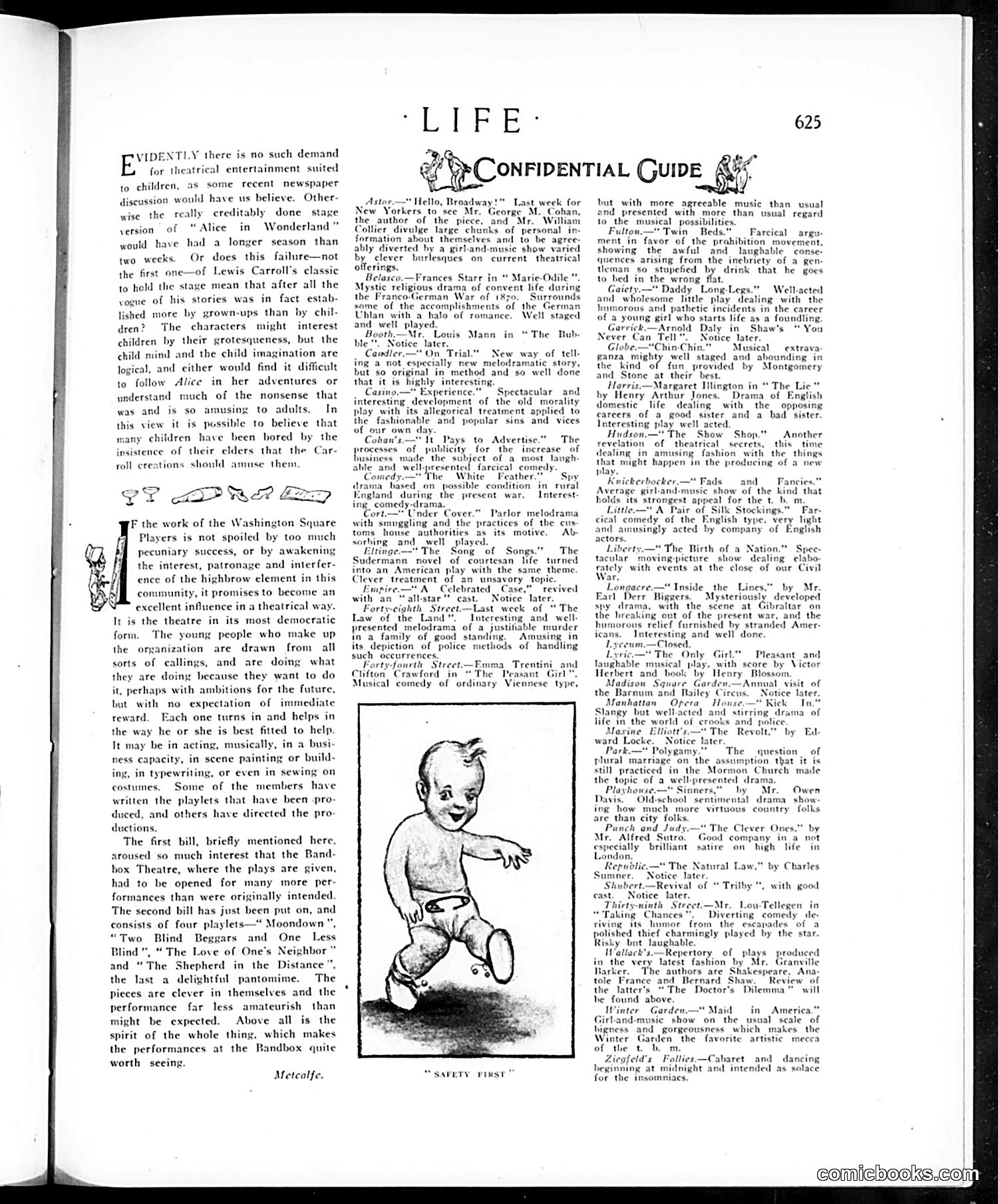
The illustration depicts a nude cherub or baby figure in a dynamic, precarious pose—appearing to step or stumble forward with one leg extended. The caption reads "SAFETY FIRST." This is satirical commentary on the contemporary "Safety First" public health movement, which gained momentum in early 20th-century America to prevent workplace and industrial accidents. The joke lies in the irony: the caption promoting safety accompanies an image of a figure in an extremely *unsafe* position—literally stumbling dangerously. The cartoon mocks either the movement's ineffectiveness or the gap between safety rhetoric and actual practice. By using an innocent baby figure in a perilous pose, the artist emphasizes the absurdity of promoting "safety" while depicting obvious danger. This reflects broader skepticism about corporate or governmental safety campaigns that preached caution while conditions remained hazardous.
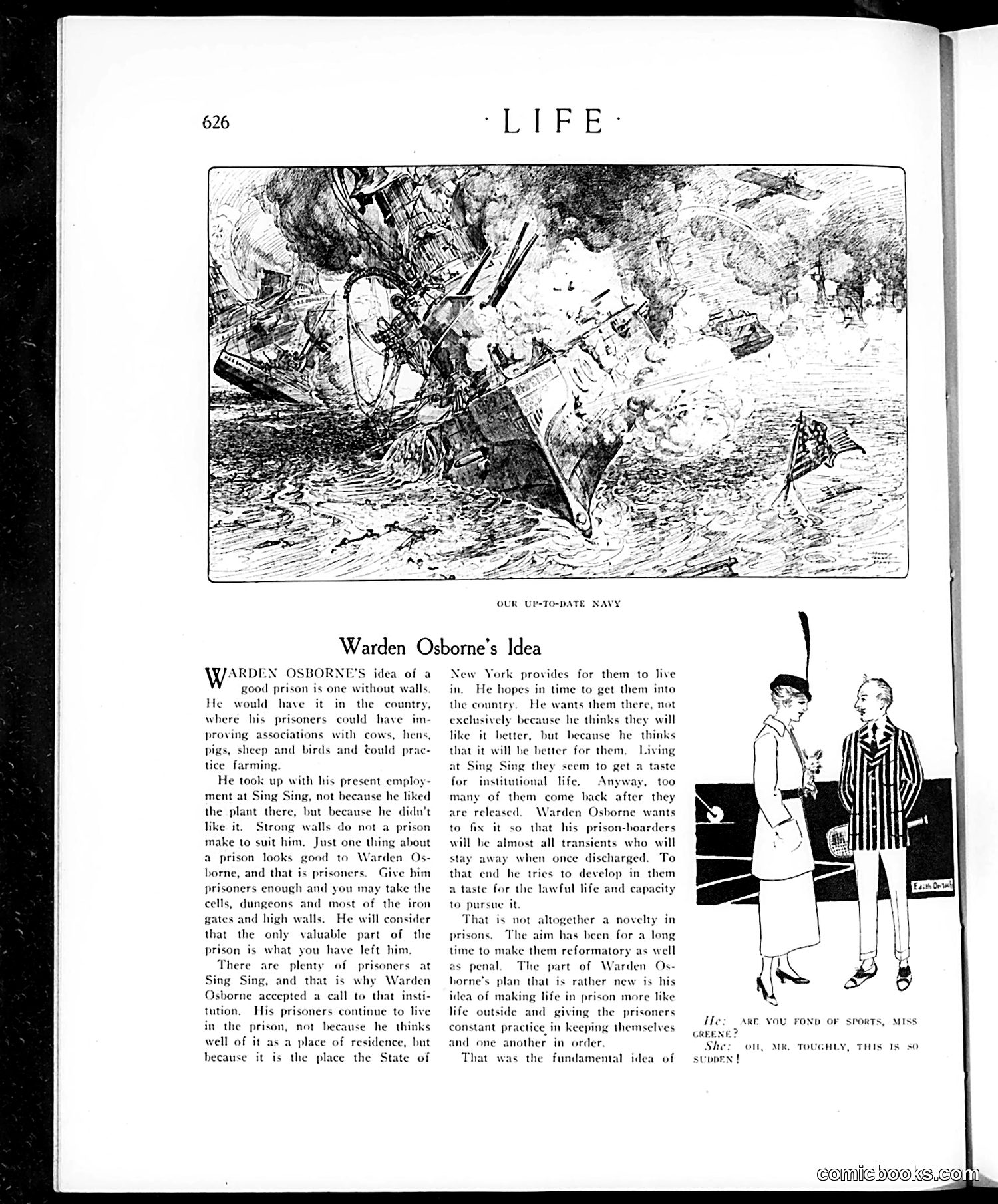
This page discusses **Thomas Mott Osborne**, a real prison reformer who served as warden of Sing Sing Prison. The top illustration depicts the naval wreckage—likely referencing Osborne's naval background or a contemporary naval incident. The article explains Osborne's controversial reform philosophy: prisoners shouldn't be confined by walls and dungeons but given agricultural work and rural life to reform them. He believed institutional life bred recidivism; instead, prisoners should practice "lawful life" through farming and self-governance, becoming "transients" unlikely to reoffend upon release. The satirical cartoon at bottom shows a woman (labeled "Miss Greene") asking a man about sports; his companion responds "Oh, Mr. Toughly, this is so sudden!"—a non-sequitur joke mocking the earnestness of the reform discussion above, typical of *Life* magazine's satirical humor. The satire implies skepticism toward Osborne's idealistic but impractical vision of wall-less prisons.
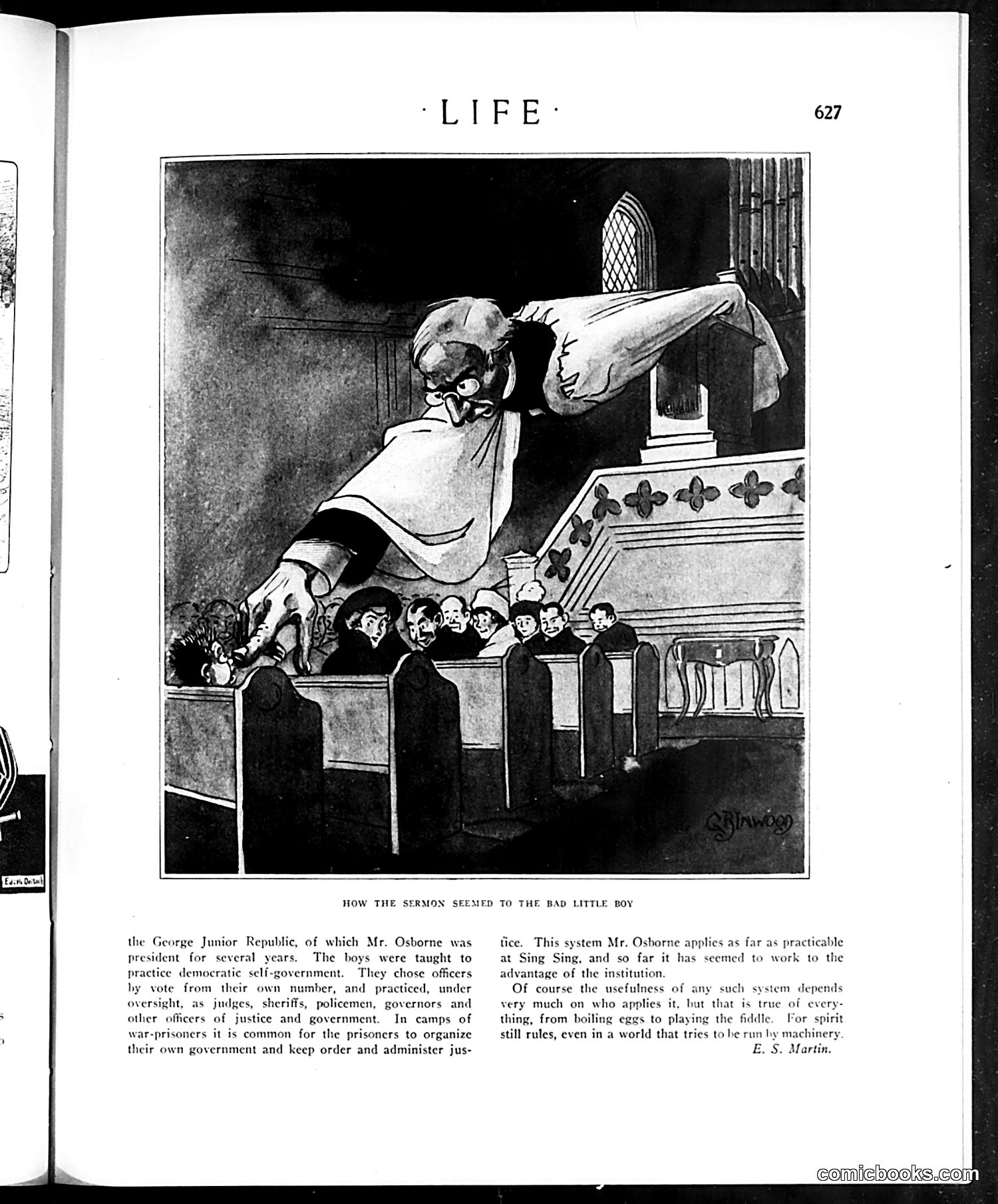
This is a satirical cartoon about prison reform at Sing Sing prison under superintendent Thomas Mott Osborne. The caption "How the Sermon Seemed to the Bad Little Boy" shows an oversized, demonic-looking preacher looming menacingly over young prisoners in chapel—illustrating the disconnect between reformers' good intentions and how harsh institutional punishment actually *feels* to inmates. The accompanying text discusses Osborne's "George Junior Republic" system, which gave prisoners self-governance roles (choosing officers, acting as judges). The satire's point: even well-meaning democratic reforms depend entirely on who implements them. The grotesque preacher figure suggests that no system of rules—however progressive—can overcome the fundamental coerciveness of imprisonment itself. Author E. S. Martin concludes that "spirit still rules" over mere mechanical systems.
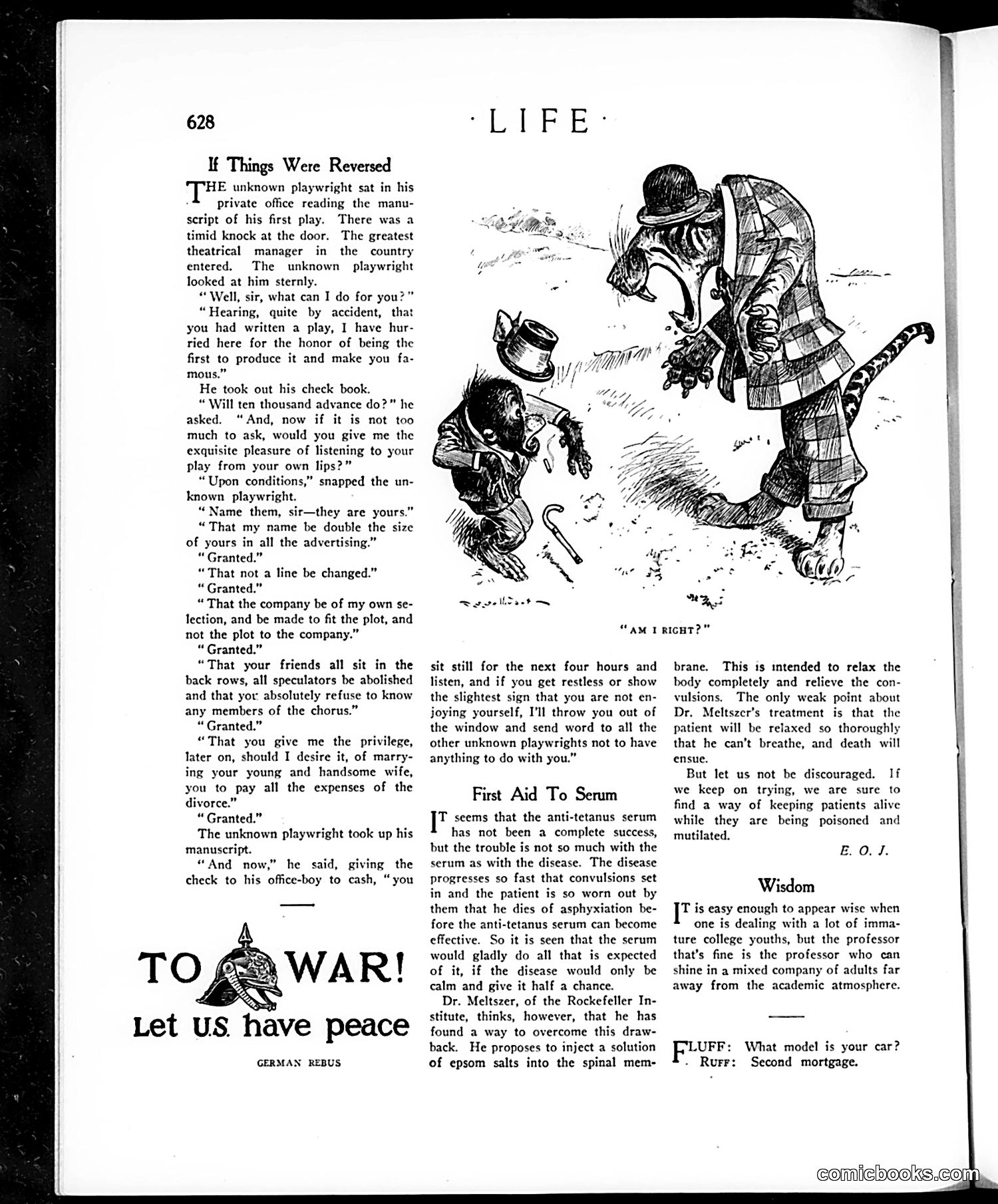
This story inverts the typical Broadway power dynamic. An unknown playwright demands humiliating conditions from a theatrical manager desperate to produce his work—including naming rights, casting control, and a clause allowing him to marry the manager's wife (at the manager's expense). The satire mocks how producers normally exploit playwrights, demanding rewrites and casting unknowns for profit. By reversing roles, the story ridicules the manager's desperation and the absurd demands he'd accept. The accompanying illustration shows anthropomorphic figures (appearing to be animals in human dress), captioned "Am I Right?"—likely reinforcing the satirical commentary on theatrical power dynamics. The page also contains unrelated brief humor pieces about medical treatment complications and car financing, typical of Life's format.
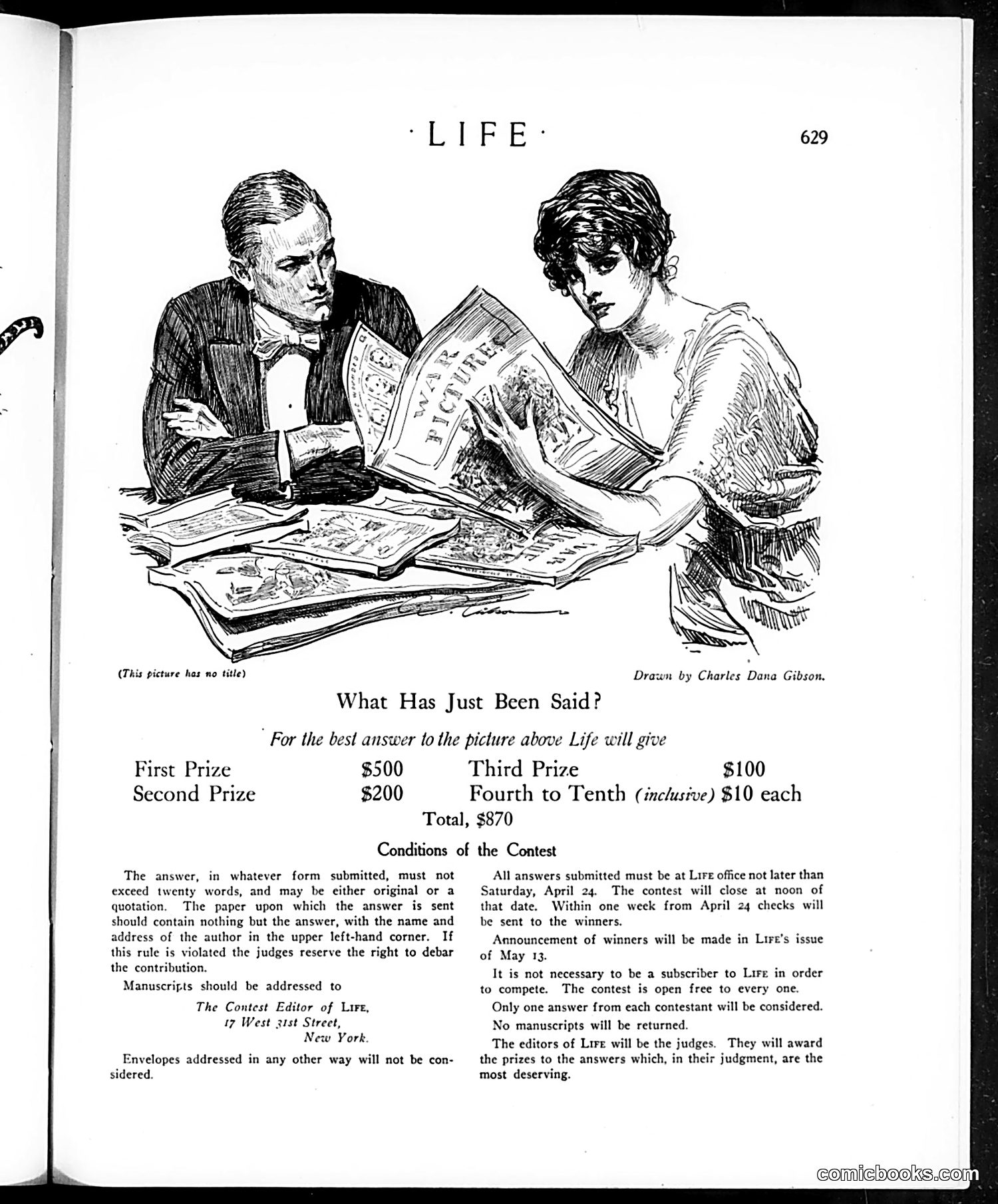
This page presents a **captioned-caption contest** drawn by Charles Dana Gibson, the famous illustrator known for the "Gibson Girl." The drawing shows a well-dressed man and woman examining illustrated magazines or publications together at a table. The contest asks readers to supply a witty caption (maximum 20 words) explaining "What Has Just Been Said?"—likely capturing an overheard conversation or the unspoken subtext between the two figures. The humor likely trades on social dynamics, romance, or the woman's reaction to something in the reading material. Gibson's drawings typically satirized upper-class social interactions and gender relations with gentle wit. This contest was a popular feature of Life magazine, engaging readers as amateur humorists while generating content. The substantial prize pool ($870 total in early 20th-century money) indicates Life's commercial success and the magazine's role as both satirist and entertainment vehicle.
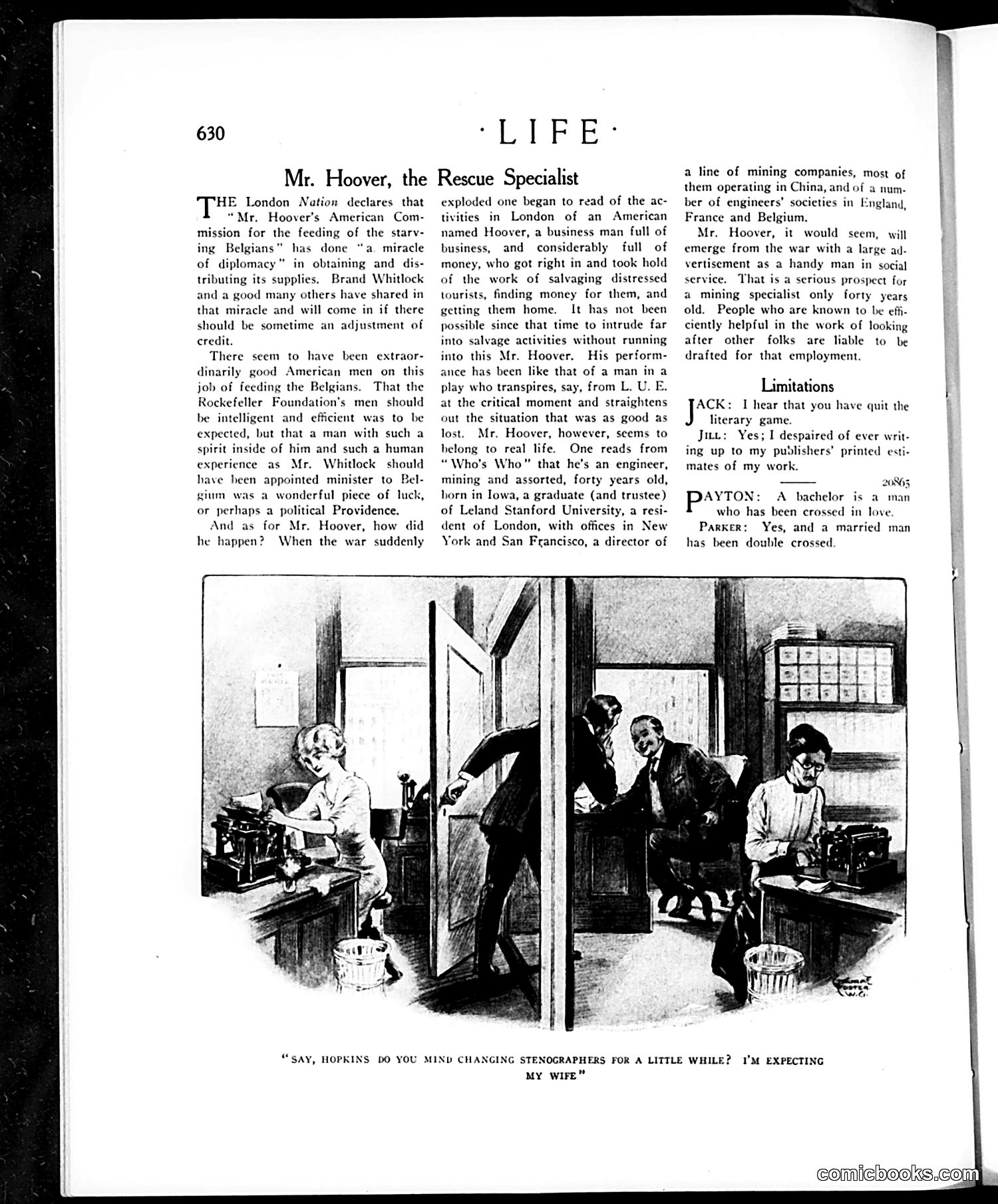
This page profiles Herbert Hoover during World War I, when he led humanitarian relief efforts for starving Belgians. The *Life* article praises his efficiency and organizational skill, noting he's a mining engineer from Iowa who somehow appeared at the critical moment to manage rescue operations—comparing him to a convenient dramatic device in a play. The accompanying cartoon satirizes office life: a man asks his colleague Hopkins to switch stenographers temporarily because he's expecting his wife—implying the stenographer may be attractive and he wants to avoid appearance of impropriety. The "Limitations" section at bottom contains unrelated witticisms about quitting writing and bachelor/married life. The satire positions Hoover as an accidental hero whose post-war reputation in social service may inadvertently draft him into further volunteer work—a lighthearted commentary on how wartime success creates expectations.
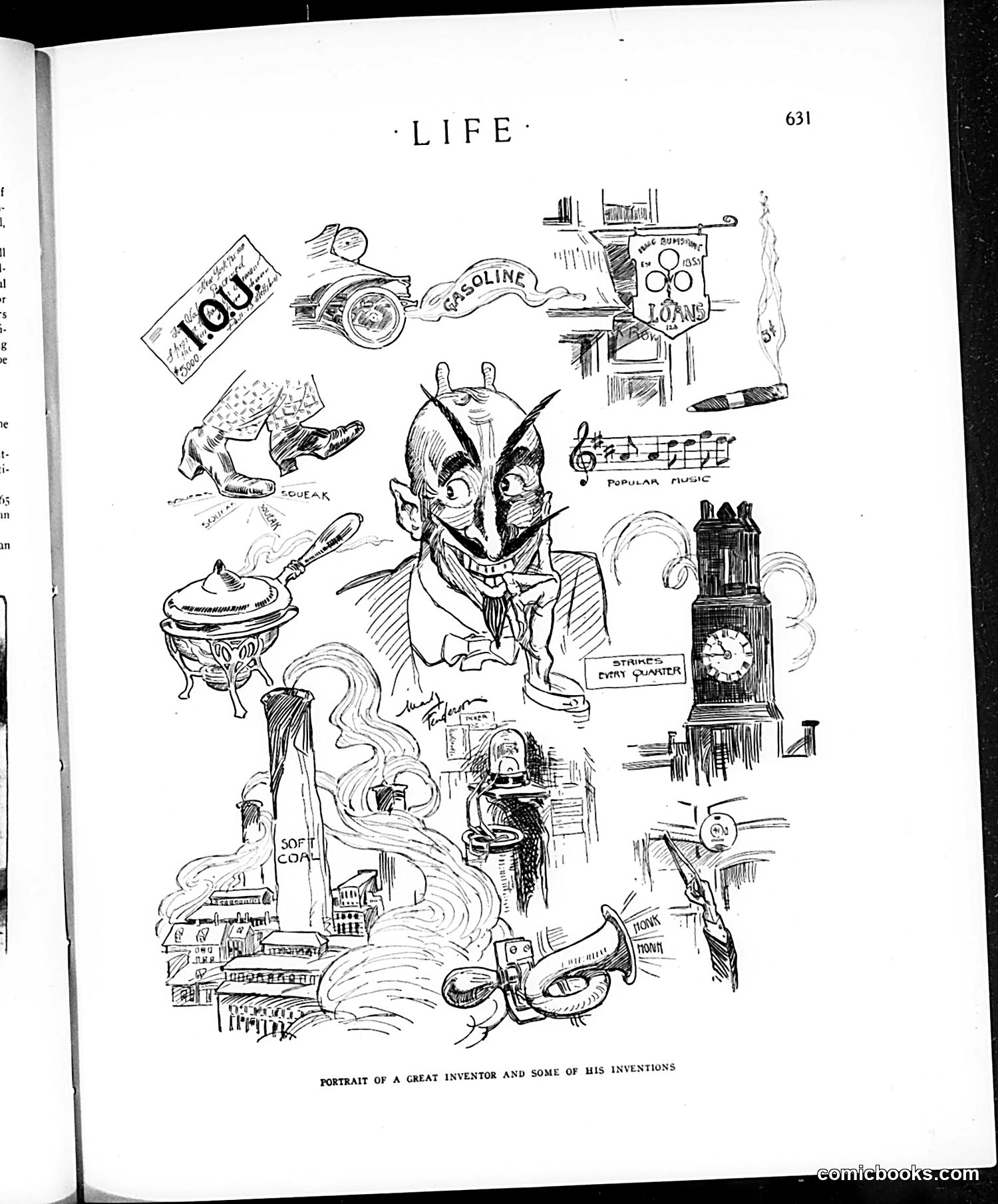
This is a satirical cartoon titled "Portrait of a Great Inventor and Some of His Inventions." The central figure is a caricatured man with exaggerated demonic or imp-like features, surrounded by various objects representing modern inventions and conveniences of the early 20th century. The inventions depicted include: an automobile, gasoline pump, electric light bulb, clock tower, popular music notation, soap, and various other household items. The chaotic arrangement and the grotesque portrayal of the inventor suggest satire about industrialization and mechanization's disruptive impact on society. The demon-like appearance implies criticism that these "modern conveniences" are devilish or corrupting influences on traditional life. This reflects common Progressive Era anxieties about rapid technological change and its social consequences.
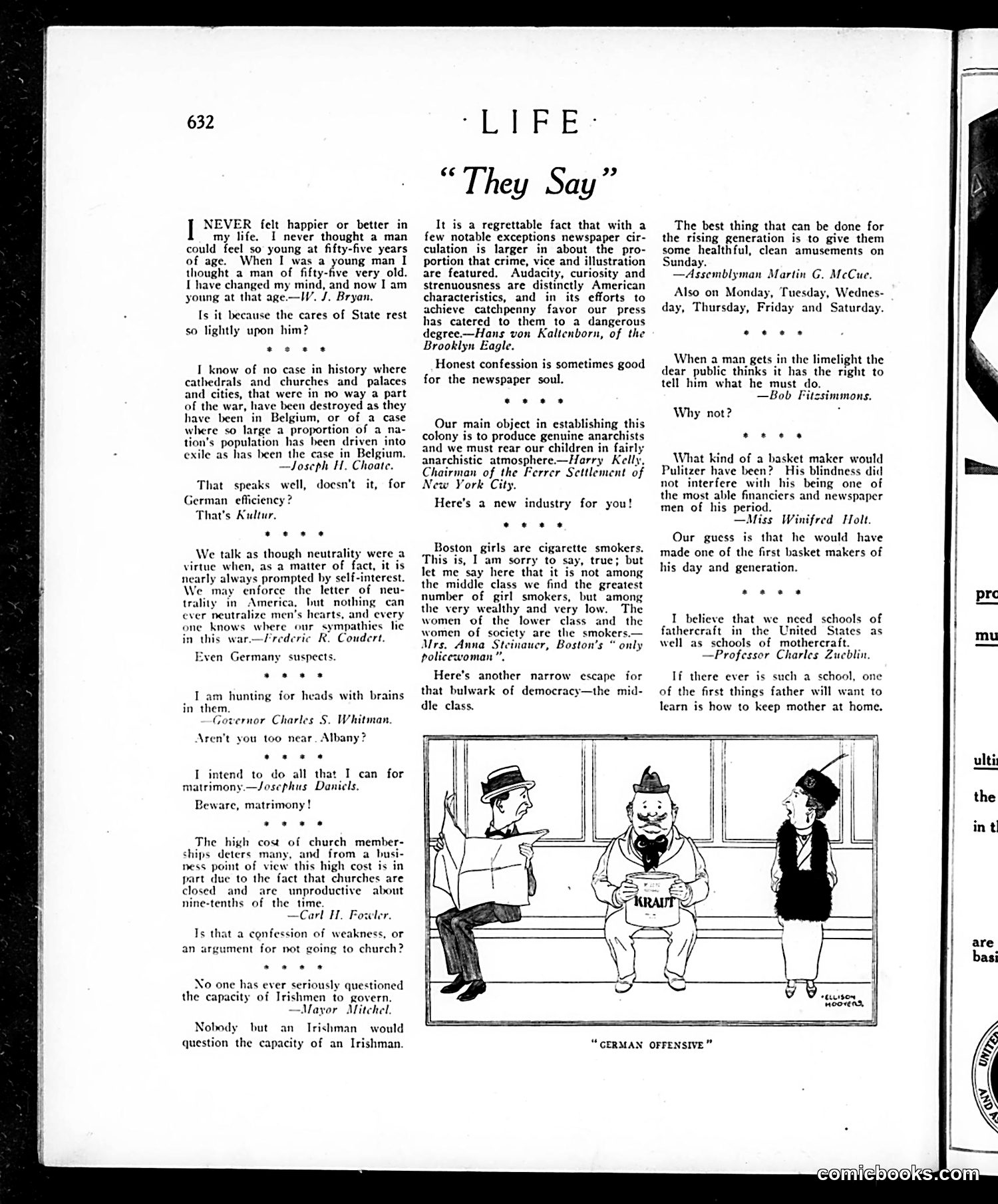
This is a "They Say" column—Life's satirical commentary on public statements from prominent figures. The magazine quotes notable people, then adds witty rejoinders to mock their statements. The cartoon at bottom, titled "German Offensive," depicts three figures reading a newspaper labeled "KRAUT" (a derogatory term for Germans). The satire references German military actions in Belgium, which the page's text addresses: Joseph H. Choate condemned the destruction of Belgian cathedrals and mass displacement as unprecedented war crimes, sardonically asking if this demonstrates "German efficiency" or "Kultur" (German culture). The column mocks various American public figures—including Mayor Mitchel, Governor Whitman, and Josephus Daniels—for contradictory or foolish statements. Key context: This page was published during America's pre-WWI neutrality period. Anti-German sentiment was rising due to Belgium's invasion, and Life frequently criticized both German conduct and American figures seen as insufficiently serious about the conflict.
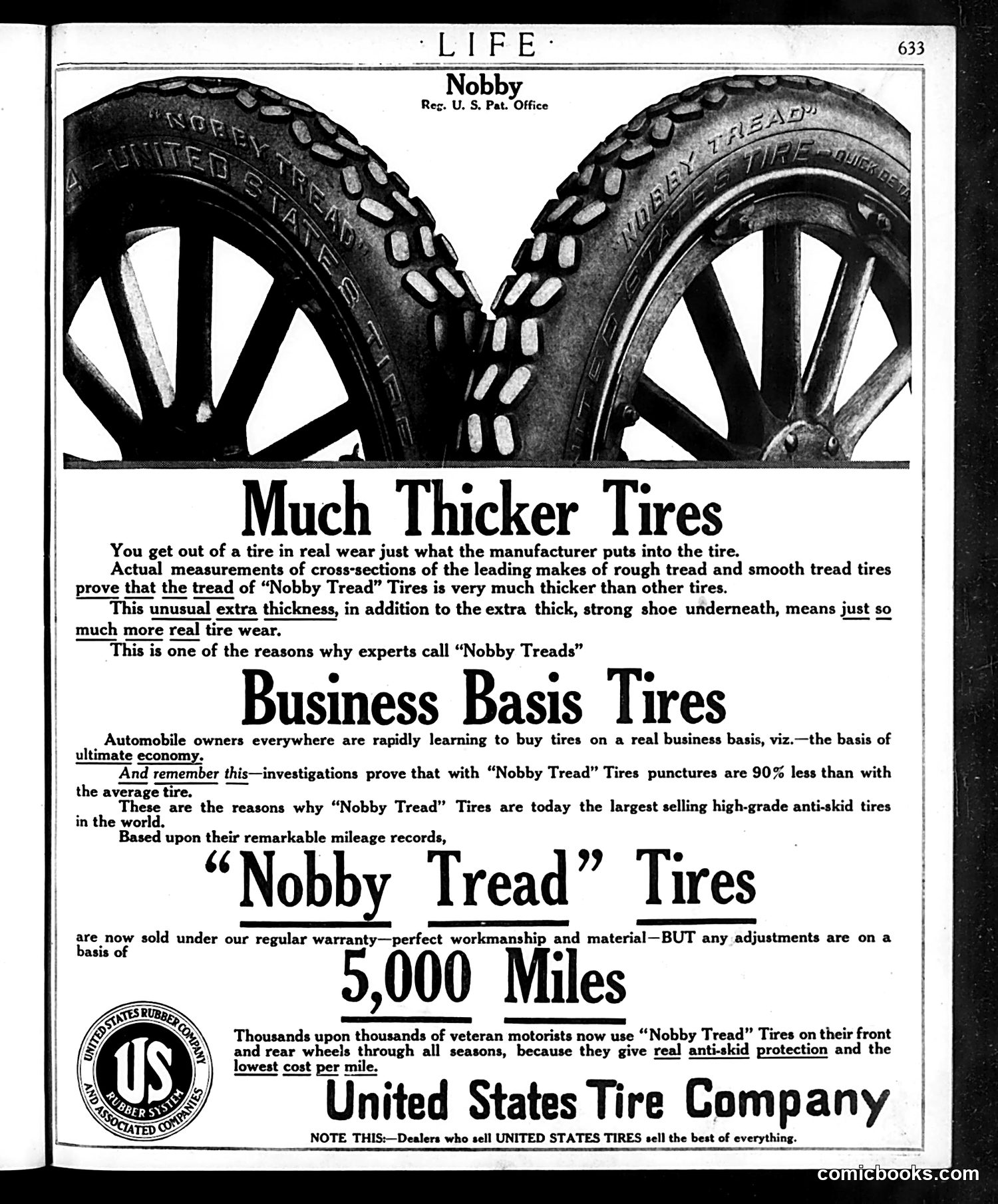
The page contains a full-page ad for "Nobby Tread" tires by United States Tire Company. The two tire cross-sections at top visually demonstrate the product's claimed advantage: thicker tread than competitors. The advertisement's pitch targets early-automobile owners by appealing to "business basis" purchasing—emphasizing practical economy through durability and reduced punctures (claimed 90% fewer than average tires). The 5,000-mile warranty was apparently a notable selling point. This reflects the early 1900s automotive market when tire quality varied significantly and motorists were learning to evaluate durability over initial cost. The ad ran in *Life* magazine, which accepted advertisements alongside satirical content. There is no cartoon or joke here—simply a manufacturer's promotional claims about tire thickness, longevity, and value.
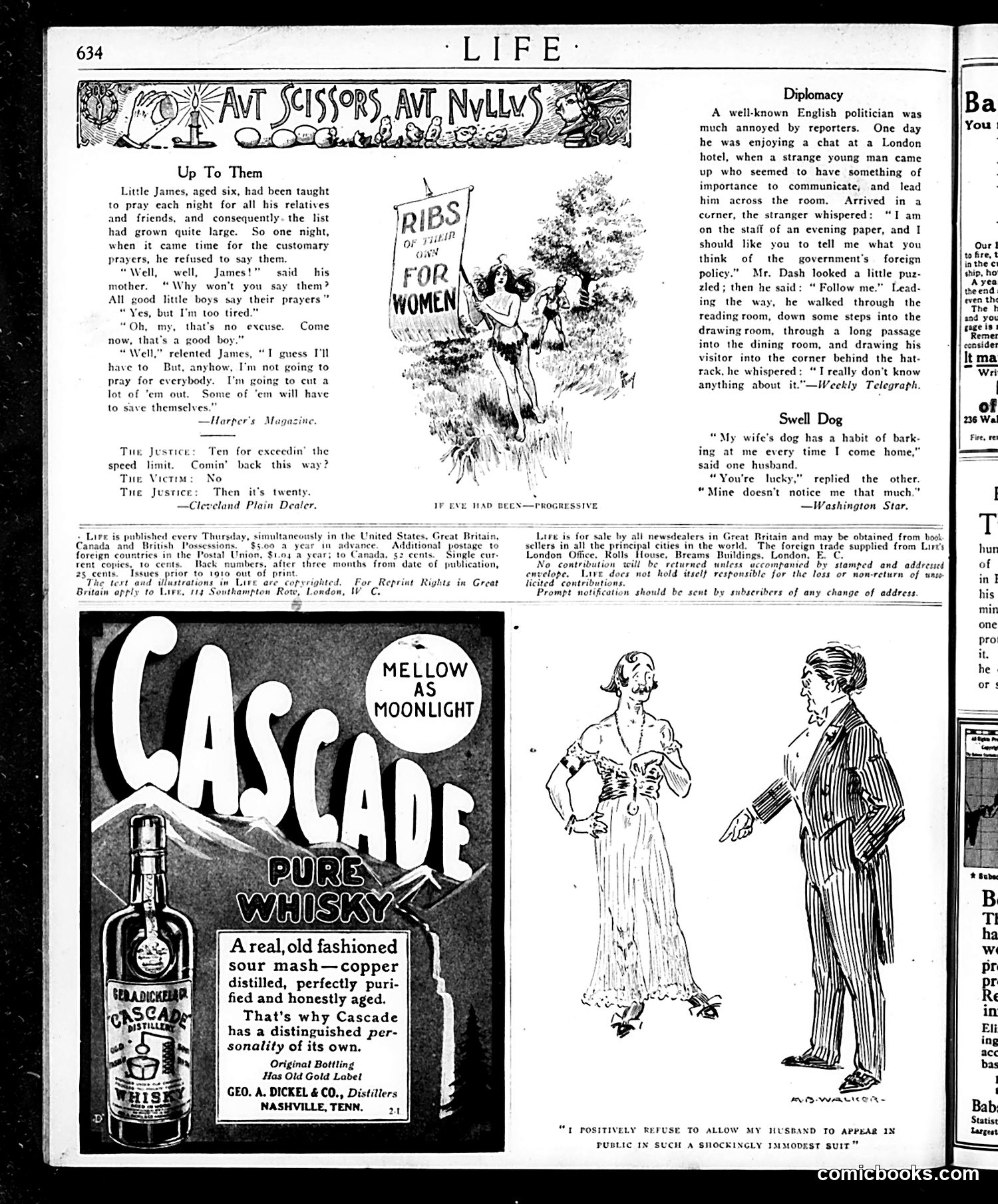
This page contains several brief humorous anecdotes and a cartoon: **"Up To Them"**: A child refuses to say his nightly prayers because the list of relatives has grown too long and he's tired. He compromises by saying he'll only pray for some people—others "will have to save themselves." The joke satirizes both childhood logic and perhaps the exhausting nature of obligation. **"Diplomacy"**: An English politician cleverly avoids answering a reporter's question about foreign policy by leading him on an elaborate detour through a hotel, ultimately whispering that he knows nothing about it. The humor lies in the absurdity of such elaborate evasion for a non-answer. **"Swell Dog"**: A brief exchange where one husband complains his wife's dog barks at him; the other replies his dog doesn't even notice him. Dark marital humor. **The cartoon "If Eve Had Been—Progressive"**: Shows a woman in modern dress refusing to let her husband wear an "immodest suit" in public—inverting traditional gender roles in dress codes for satirical effect. The page also contains a Cascade Whisky advertisement.
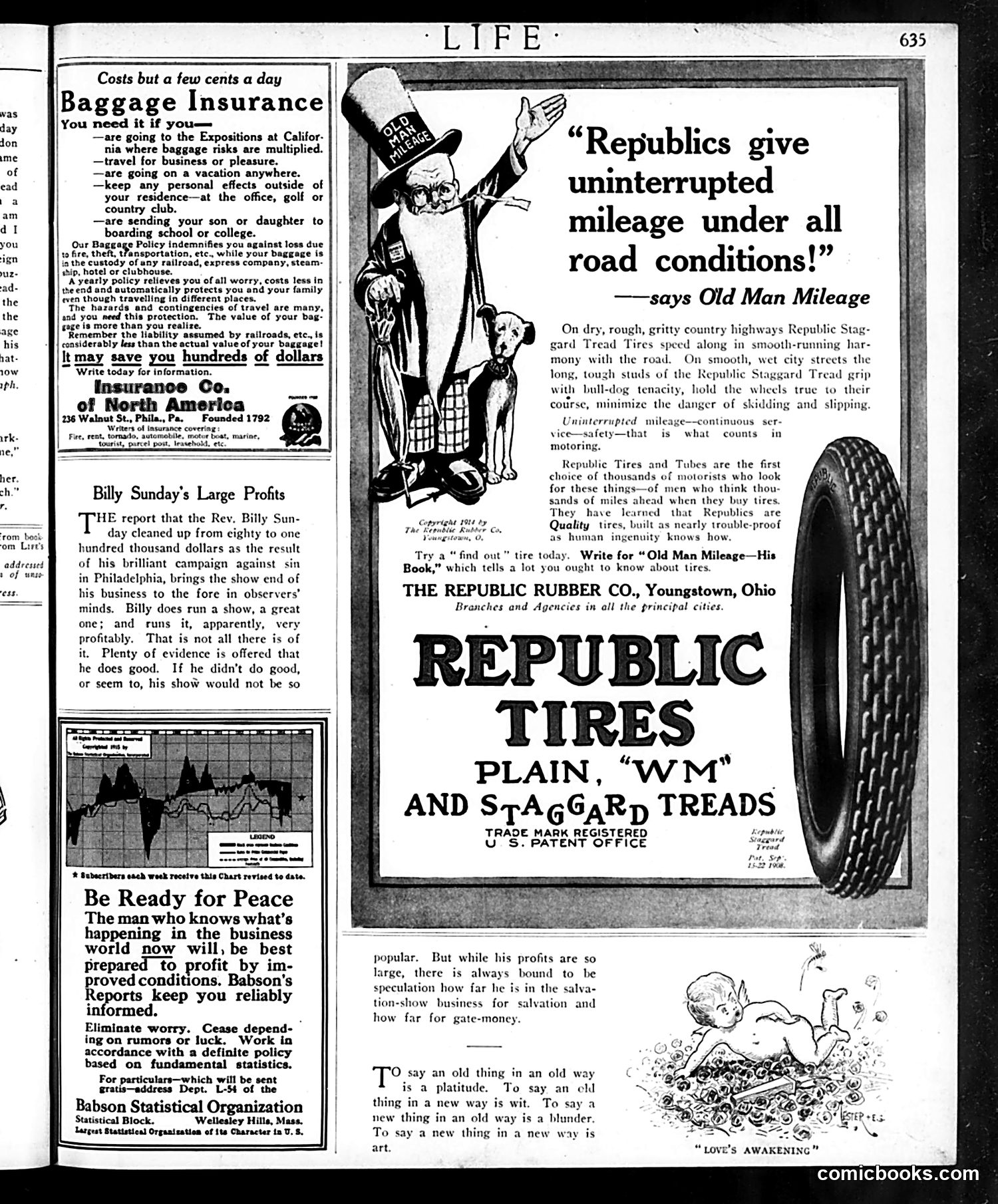
This page is primarily **advertising**, dominated by a Republic Tires ad featuring "Old Man Mileage"—a Santa-like character endorsing the brand's road performance ("uninterrupted mileage under all road conditions"). The tire ad uses a folksy, trusted authority figure to sell a practical product promise. The other advertisements include baggage insurance and Babson Statistical Reports. A small editorial item discusses **Rev. Billy Sunday**, a famous 1910s-20s evangelical preacher who conducted high-profile anti-sin revival campaigns. The writer notes his Philadelphia crusade reportedly cleared $80,000-$100,000, observing dryly that while Sunday does genuine moral good, speculation persists about how much profit he pockets versus how much he genuinely keeps for his "salvation-show business." The page concludes with a brief philosophical note about old and new ways of expression—likely filler content typical of Life's satirical magazine format. **No political cartoons appear on this page.** It's straightforward period advertising and light editorial commentary.
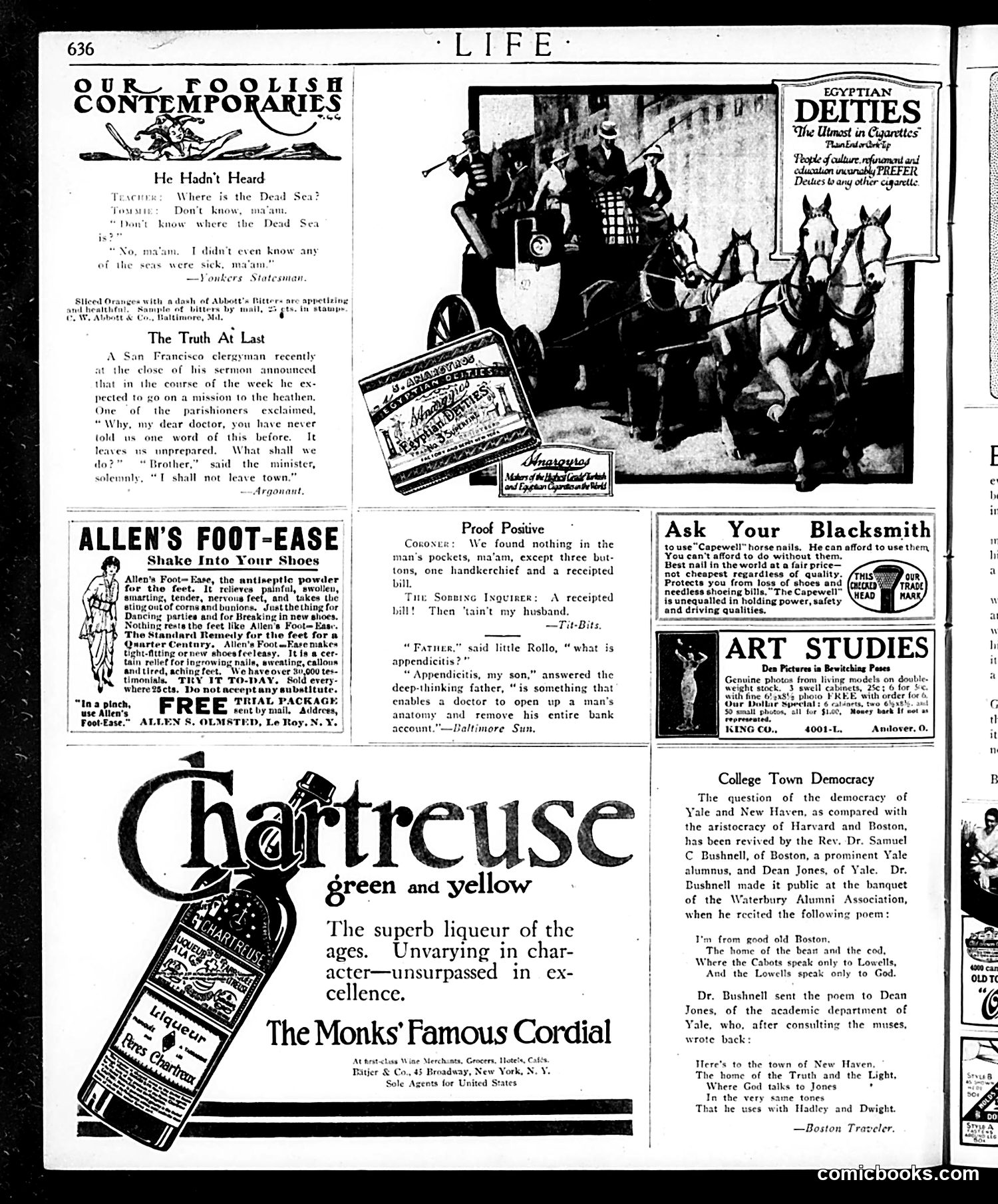
This page is primarily **advertising and humor columns** with no political cartoons. The content includes: **"He Hadn't Heard"** — A brief joke mocking geographical ignorance: a tourist doesn't know where the Dead Sea is, hasn't heard of any seas being sick. It's mild absurdist humor about American ignorance. **"The Truth At Last"** — A clergyman announces a mission to "the heathen," shocking parishioners. When they ask what to do without him, he replies he won't leave town. The satire: clergy allegedly avoid actual missionary work despite their rhetoric. **"College Town Democracy"** — A poem satirizing Boston's social hierarchy. The famous couplet mocks Brahmin exclusivity: "Where the Cabots speak only to Lowells, / And the Lowells speak only to God." It contrasts this with Yale's supposedly more democratic character. This was contemporary Boston social commentary about old-money exclusivity. The page is mostly **product advertisements** (Allen's Foot-Ease, Egyptian Deities cigarettes, art studies).
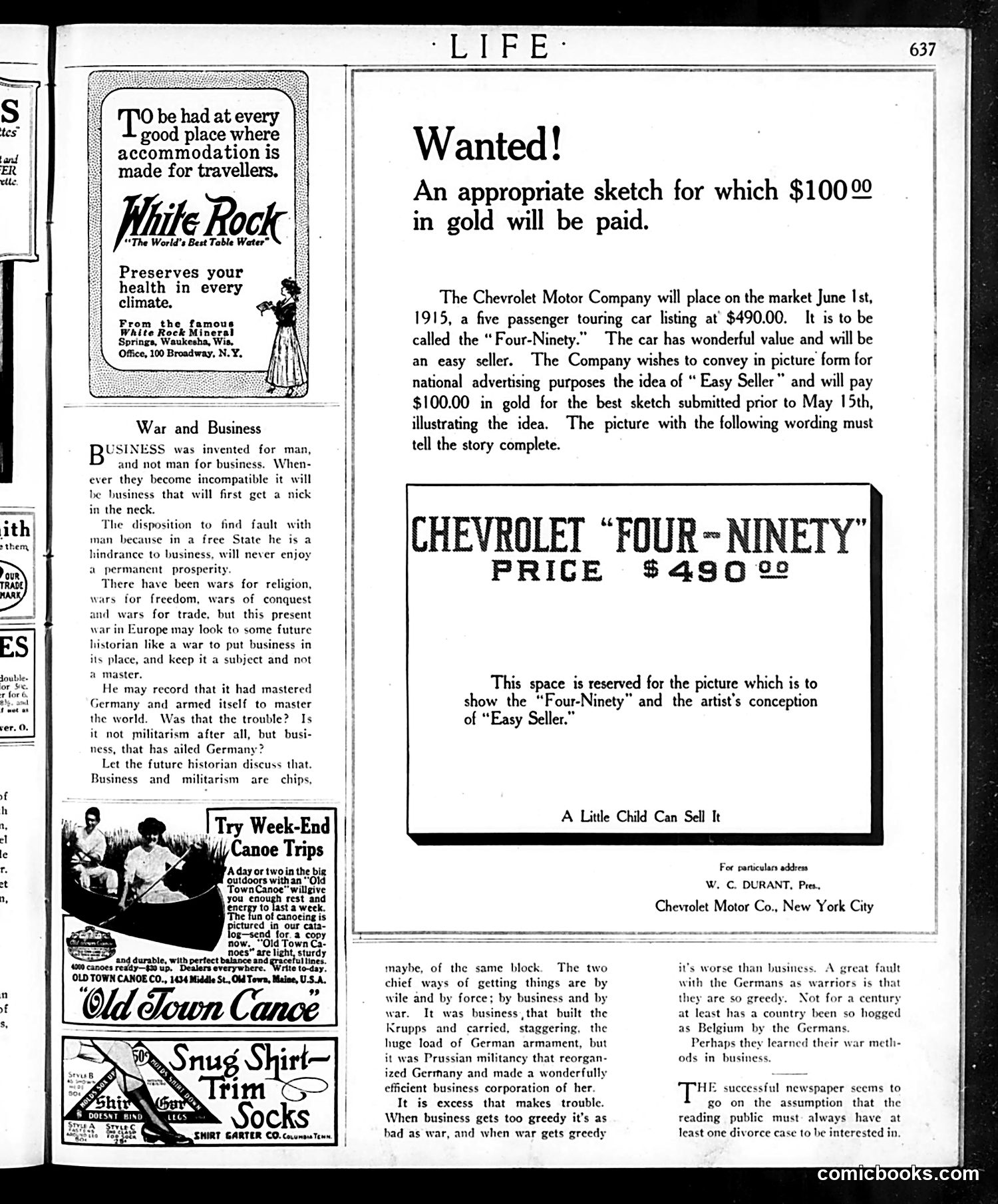
This page contains an editorial essay, not a cartoon, arguing that **business—not militarism—is Germany's true problem**. Written during WWI (1915), it claims excessive greed in German business fueled military expansion. The Krupps steel company is cited as evidence: business built the weapons that enabled Prussian militarism. The essay's central argument: "Business and militarism are chips, maybe, of the same block." Both operate through force and cunning. The real danger emerges when either becomes greedy without restraint—Germany exemplifies this, having "hogged" Belgium. The piece reflects American anxiety about European war and capitalism's role in it. By 1915, the U.S. remained officially neutral but debated whether to intervene. This editorial suggests the conflict stems from unchecked commercial ambition rather than ideological differences. The surrounding advertisements (Chevrolet, canoes, mineral water) represent typical Life magazine content—satire mixed with commercial messaging.
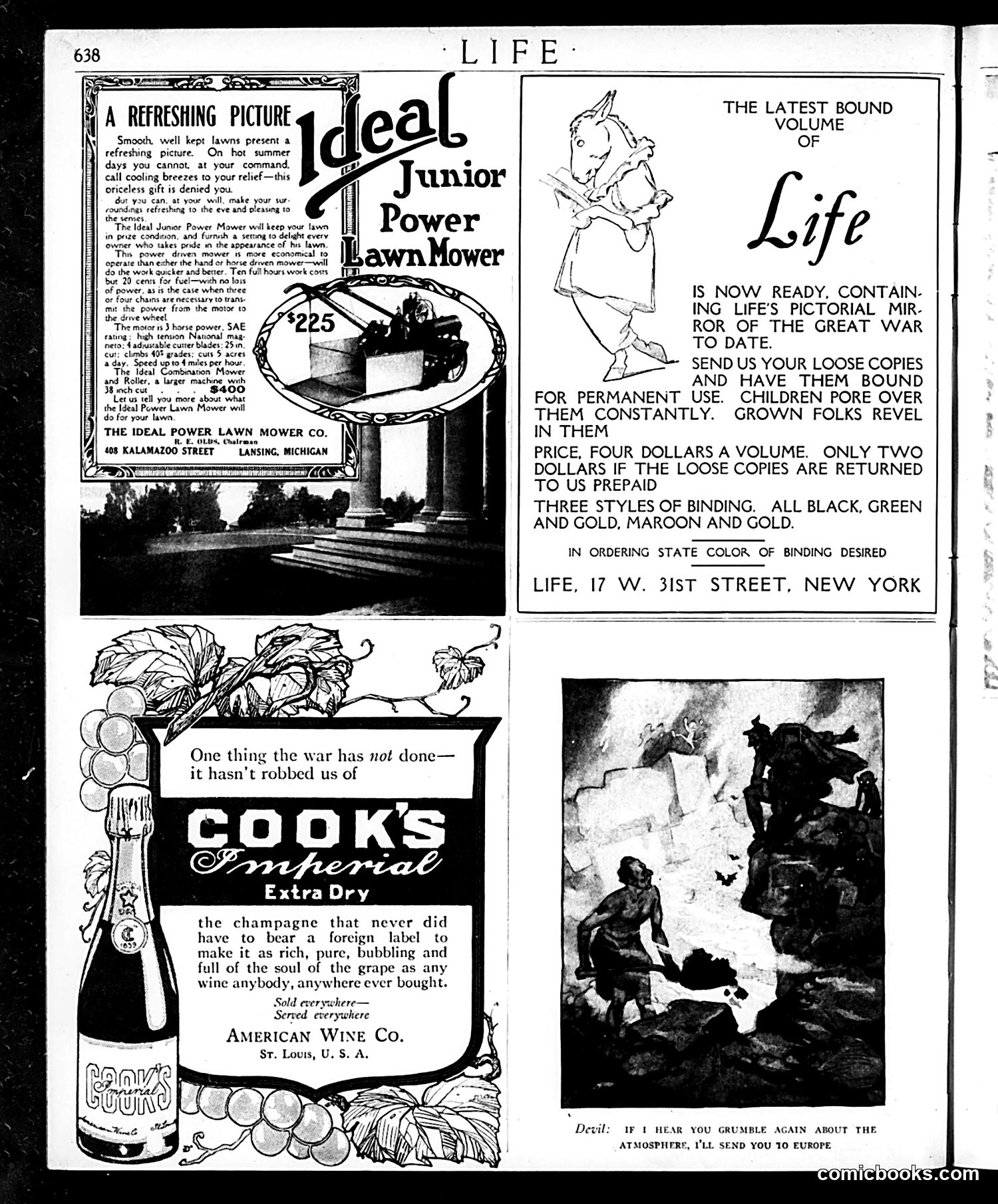
This page primarily contains **advertisements and promotional content**, not political satire. The main ads are: - **Ideal Junior Power Lawn Mower** ($225): emphasizes keeping lawns neat and attractive during wartime - **Cook's Imperial Extra Dry Champagne**: patriotic messaging asserting American wine quality rivals imports, despite WWI disruptions - **Life Magazine bound volumes**: promoting collected war pictorial coverage for families and children The single cartoon element (bottom right) shows a **devil figure threatening to send someone to Europe**, captioned as commentary on wartime conditions. This is a dark joke about Europe's devastated war zones—implying even hell would be preferable to current European conditions. The **wartime context** (likely 1917-1918) pervades even the advertisements: the lawn mower ad emphasizes peacetime normalcy; the wine ad defensively promotes American products; Life's promotion highlights war documentation as valuable family content. These are **advertisements using patriotic and war-related messaging** rather than satirical commentary.
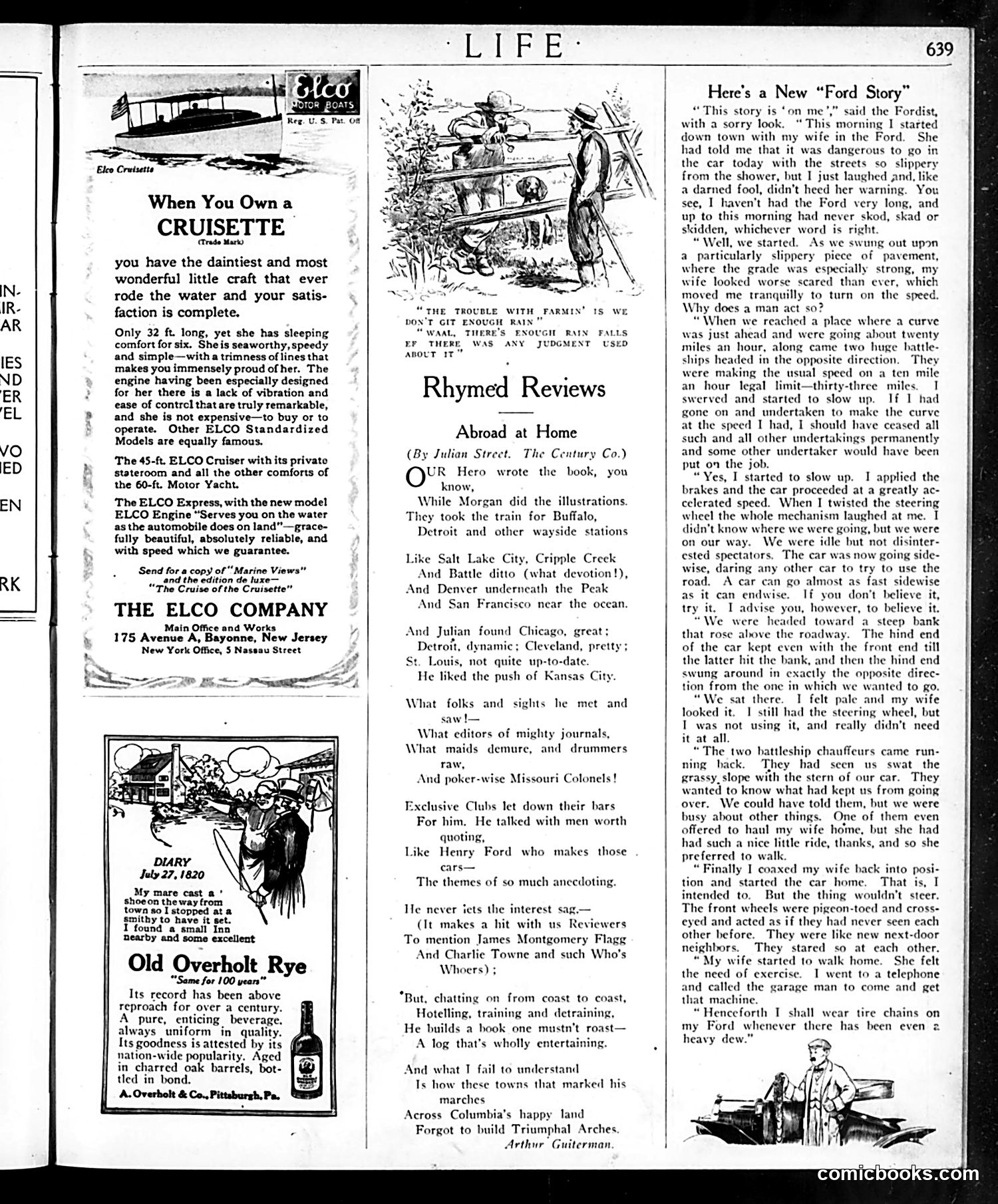
This page combines advertisements with literary content typical of 1920s Life magazine. **Main Content:** "Rhymed Reviews: Abroad at Home" is a humorous poem by Arthur Guiterman reviewing Julian Street's travel book. The verse satirizes American cities and notable figures Street encountered, particularly **Henry Ford** (referenced as a celebrity businessman worth interviewing). The poem gently mocks both Street's journey and American civic pride—suggesting towns should have built "Triumphal Arches" to commemorate his visit. **The "Ford Story":** A prose anecdote mockingly illustrates Ford automobile ownership. A foolish driver ignores his wife's safety warnings on slippery roads, accelerating recklessly—satirizing masculine overconfidence and early automotive danger. **Advertisements:** Prominent ads promote luxury boats (ELCO Cruisette) and Old Overholt Rye whiskey, reflecting Jazz Age consumer culture and pre-Prohibition indulgence. The page reflects 1920s American optimism about industry (Ford), travel, and consumption, while gently satirizing masculine behavior and civic boosterism.
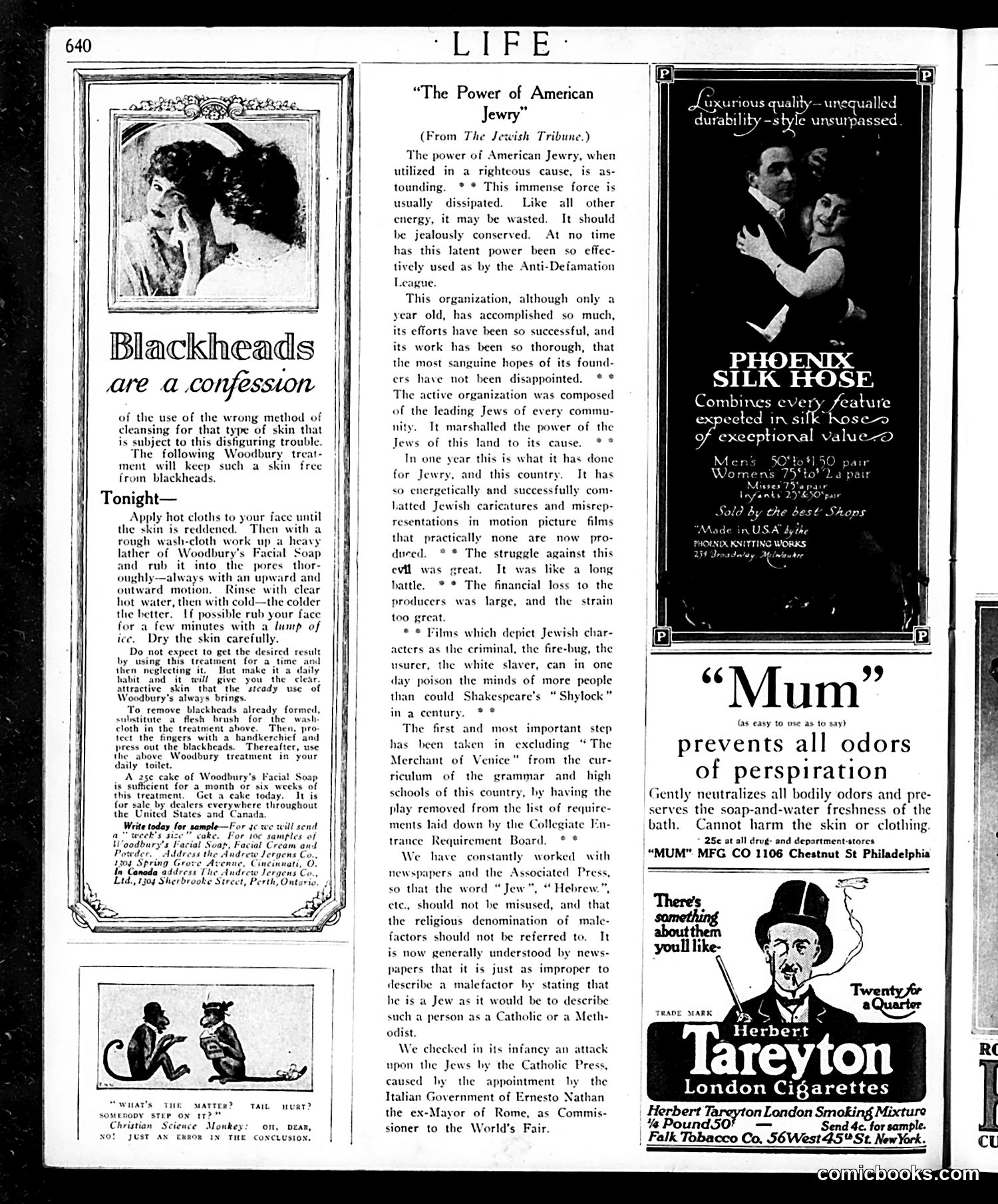
This page contains primarily **advertisements and articles**, not political cartoons. The main content is an article titled "The Power of American Jewry" from *The Jewish Tribune*, praising the Anti-Defamation League's one-year campaign against antisemitic stereotypes in motion pictures and literature. The article celebrates efforts to remove *The Merchant of Venice* from school curricula and to prevent Jewish characters from being depicted as criminals or usurers in films. The small cartoon at bottom-left shows two monkeys conversing, captioned "What's the matter? Tail hurt? Somebody step on it?" The Christian Science Monitor response joke is unclear without full context. The remaining content comprises product advertisements for blackhead treatments, silk hose, deodorant, and cigarettes—typical of 1920s magazine pages. These ads contain period-specific imagery and marketing language but carry no apparent political significance.
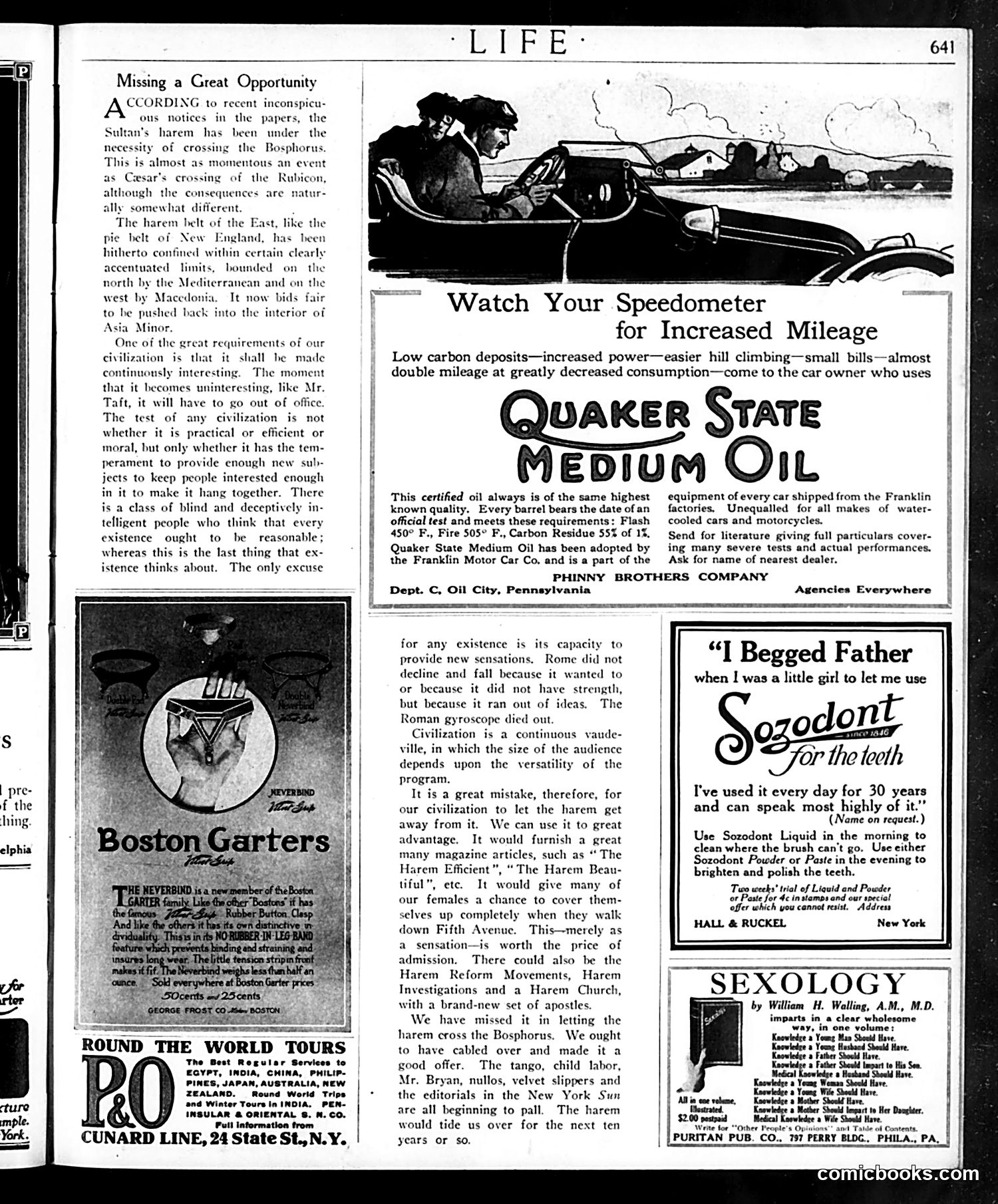
This page is primarily **advertising and satirical commentary**, not a political cartoon. The main text, "Missing a Great Opportunity," is a satirical essay by Life's editors mocking American culture's need for constant novelty. The author references the **Ottoman Sultan's harem crossing the Bosphorus** (a real 1909 historical event) as a metaphor. The satire suggests American civilization is a "continuous vaudeville" that requires fresh sensations to survive—comparing Rome's fall to cultural stagnation. The editors humorously argue America should have capitalized on the harem's relocation as entertainment/scandal fodder for magazines and social movements. The piece takes jabs at **President Taft** (calling him "uninteresting") and American obsession with manufactured controversy. The page also contains period advertisements for **Quaker State Motor Oil**, **Boston Garters**, **Sozodont toothpaste**, and **Cunard Line cruises**—typical of early 1900s Life magazine.
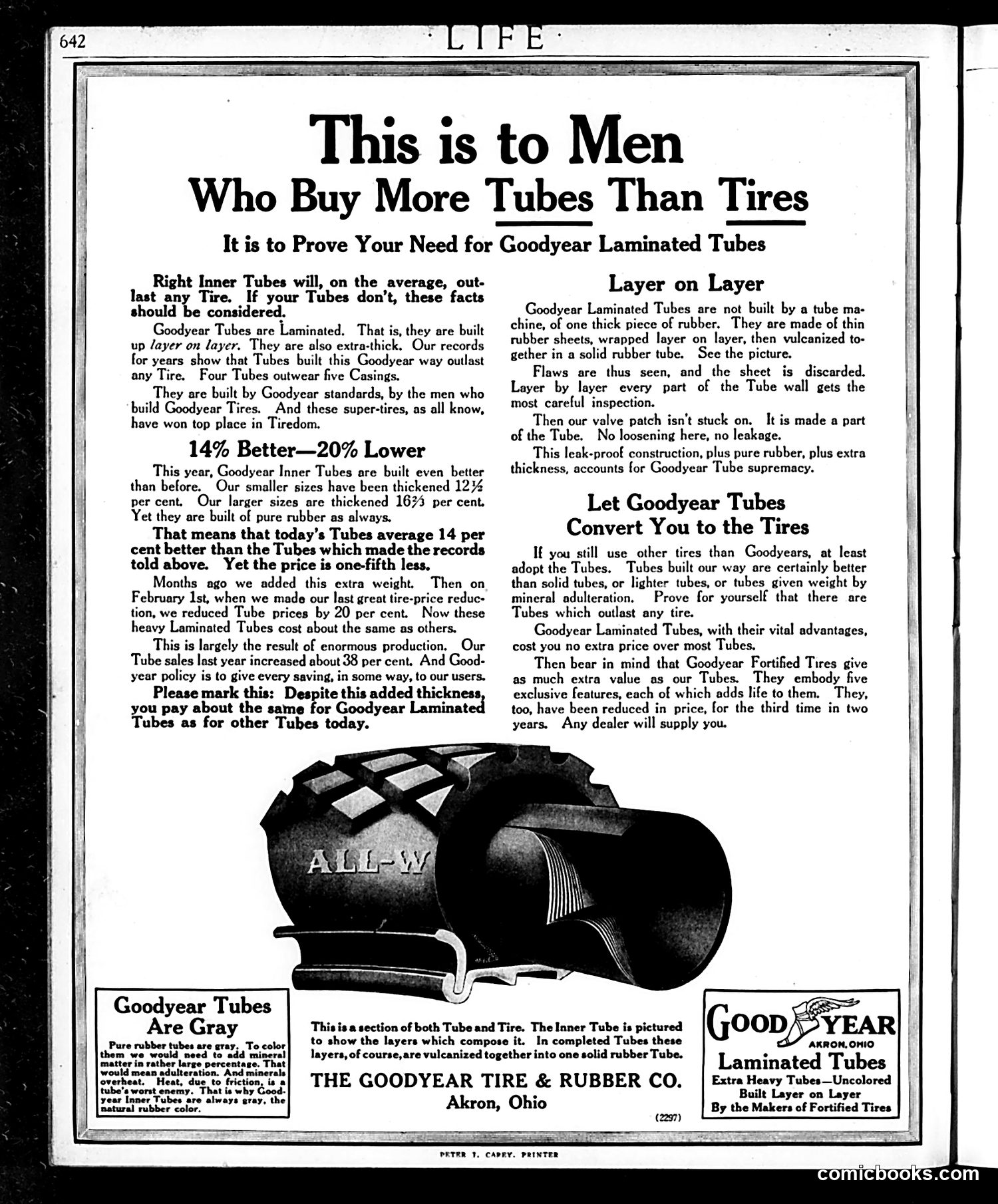
This is **not a cartoon or satire**—it's a straightforward **Goodyear tire tube advertisement** from Life magazine (page 642). The ad targets motorists who replace inner tubes more frequently than tires, arguing they should switch to Goodyear's superior "laminated tubes" (built layer-by-layer rather than from a single rubber piece). The copy makes commercial claims: Goodyear tubes allegedly outlast competitors' tires, are now 14% thicker yet cost 20% less due to increased production and recent price reductions (dated February 1st). The cutaway diagram shows the tube's construction. The ad concludes by pitching Goodyear's "Fortified Tires" as equally valuable. This represents early-20th-century automotive marketing: technical product differentiation, cost-benefit messaging, and appeals to both economy and durability. No satire or political content is present—it's commercial persuasion aimed at budget-conscious car owners.
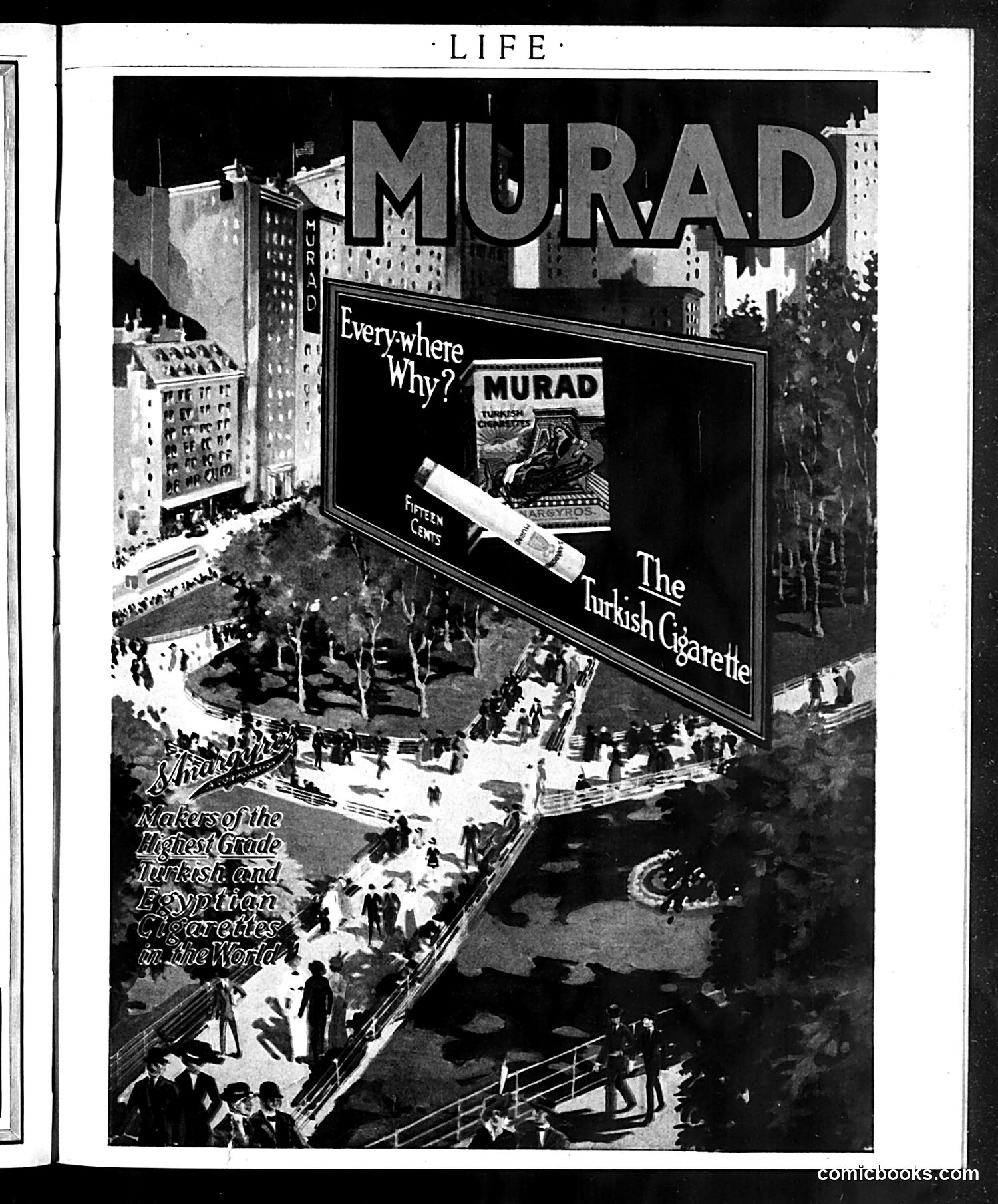
This is primarily a **Murad cigarette advertisement** rather than political satire. The ad uses a dramatic urban cityscape scene to promote "The Turkish Cigarette." The marketing strategy claims Murad cigarettes are "Makers of the Highest Grade Turkish and Egyptian Cigarettes in the World" and costs "Fifteen Cents." The tagline "Everywhere Why?" suggests these cigarettes' widespread popularity and ubiquity in American markets. The visual emphasizes scale and modernity—showing tall buildings and crowds of urban consumers—to convey the product's success and appeal. This reflects early 20th-century advertising conventions that associated cigarette consumption with cosmopolitan sophistication and city life. The page demonstrates how Life magazine, despite its satirical reputation, carried substantial commercial advertising to fund operations.
This is a full-page advertisement for Pall Mall Famous Cigarettes from the April 8, 1915 issue of Life magazine. The design uses Art Deco styling with dramatic radiating lines emanating from a cigarette package positioned in the lower right. The bold geometric composition and "W" shape created by the white lines emphasize the product prominently. The advertisement makes no satirical or political statement—it's straightforward commercial promotion. For modern readers, it's notable primarily as a historical artifact showing how cigarettes were openly advertised in mainstream publications nearly a century ago, before health warnings or advertising restrictions existed. The sleek, modern aesthetic reflects early-20th-century design trends.