
Life, 1915-04-08 · page 30 of 44
Life — April 8, 1915 — page 30: what you’re looking at
What you’re looking at
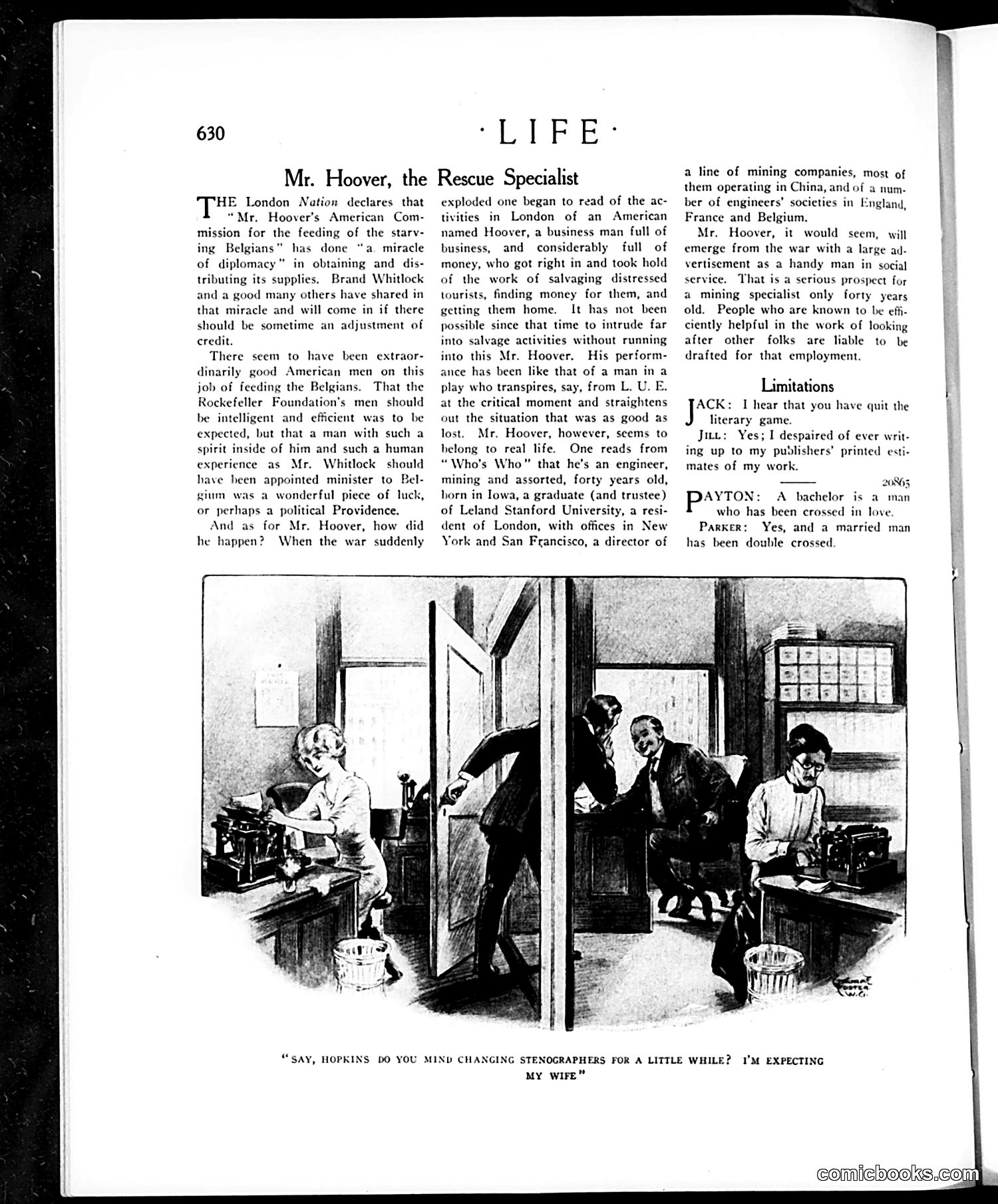
This page profiles Herbert Hoover during World War I, when he led humanitarian relief efforts for starving Belgians. The *Life* article praises his efficiency and organizational skill, noting he's a mining engineer from Iowa who somehow appeared at the critical moment to manage rescue operations—comparing him to a convenient dramatic device in a play. The accompanying cartoon satirizes office life: a man asks his colleague Hopkins to switch stenographers temporarily because he's expecting his wife—implying the stenographer may be attractive and he wants to avoid appearance of impropriety. The "Limitations" section at bottom contains unrelated witticisms about quitting writing and bachelor/married life. The satire positions Hoover as an accidental hero whose post-war reputation in social service may inadvertently draft him into further volunteer work—a lighthearted commentary on how wartime success creates expectations.
📄 Transcribed text from this page (OCR, searchable)
Machine-transcribed from the original scan — historical spelling and the odd misread are preserved.
630 Mr. Hoover, the THE London Nation declares that “Mr. Hoover’s American Com- mission for the feeding of the starv- ing Belgians” has done “a. miracle of diplomacy” in obtaining and dis- tributing its supplies. Brand Whitlock and a good many others have shared in that miracle and will come in if there should be sometime an adjustment of credit. There seem to have been extraor- dinarily good Ameri men on this job of feeding the Belgians. That the Rockefeller Foundation’s men should be intelligent and efficient was to be expected, but that a man with such a spirit inside of him and such a human experience Mr. Whitlock should have heen appointed minister to Bel- gium was a wonderful piece of luck, or perhaps a political Providence. And as for Mr. Hoover, how did he happen? When the war suddenly “LIFE: Rescue Specialist exploded one began to read of the ac- tivities in London of an American named Hoover, a business man full of business, and considerably full of money, who got right in and took hold of the work of salvaging distressed tourists, finding money for them, and getting them home. It has not been possible since that time to intrude far into salvage activities without running into this Mr. Hoover. His perform- ance has been like that of a man in a play who transpires, say, from L. U. E. at the critical moment and straightens out the situation that was as good as lost. Mr. Hoover, however, seems to helong to real life. One reads from “Who's Who" that he’s an engineer, mining and assorted, forty years old, horn in Iowa, a graduate (and trustee) of Leland Stanford University, a res dent of London, with offices in New York and San Francisco, a director of “SAY, HOPKINS DO YOU MIND CHANGING STENOGRAPHERS FOR A LITTLE WHILE? MY WIFE” a line of mining companies, most of them operating in China, and of a num. ber of engineers’ societies in England, France and Belgium, Mr. Hoover, it would seem, will emerge from the war with a large ad- vertisement as a handy man in social service. That is a serious prospect for a mining specialist only forty years old. People who are known to be efii- ciently helpful in the work of looking after other folks are liable to be drafted for that employment. Limitations sae I hear that you have quit the literary game. Ju: Yes; 1 despaired of ever writ- ing up to my publishers’ printed esti- mates of my work. 2086: péyto: A bachelor is a man who has been crossed in love. Parker: Yes, and a married man has been double crossed I'M EXPECTING comichooks.