
Life, 1915-04-08 · page 10 of 44
Life — April 8, 1915 — page 10: what you’re looking at
What you’re looking at
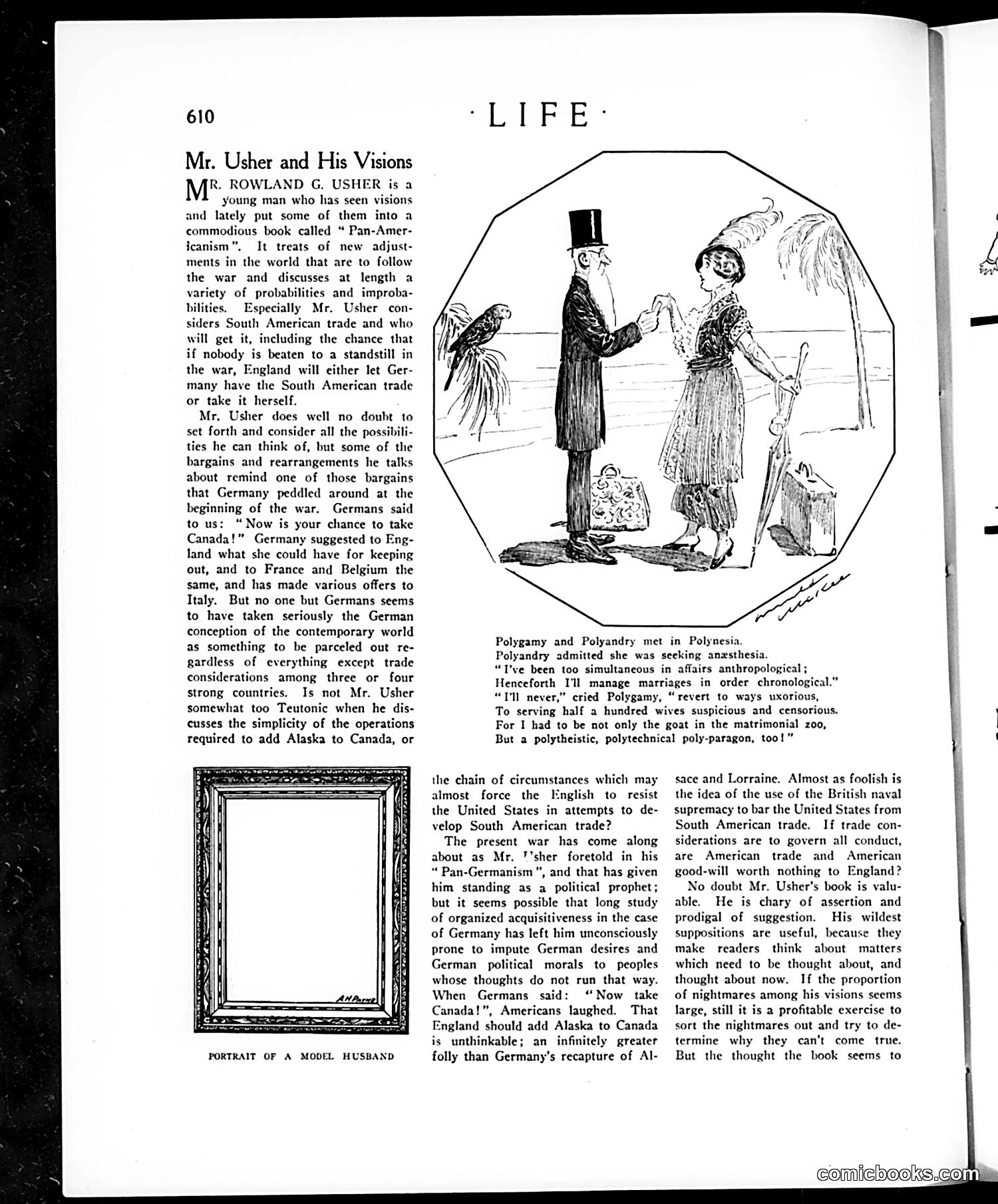
This page satirizes Rowland G. Usher's book "Pan-Americanism," which discusses post-WWI geopolitical possibilities. The main cartoon depicts a man in a top hat presenting marriage proposals to a woman (labeled "Polyandry"), while she considers multiple suitors—a visual metaphor for competing nations' trade arrangements and alliances. The satire mocks Usher's elaborate theorizing about which nations might control South American trade after the war. The "Model Husband" portrait below is apparently ironic commentary. The text suggests Usher's predictions are overly complex and somewhat absurd—comparing Germany's wartime offers to Canada, France, and Belgium to farcical romantic entanglements. The joke is that serious geopolitical analysis becomes ridiculous when presented as matrimonial chaos.
📄 Transcribed text from this page (OCR, searchable)
Machine-transcribed from the original scan — historical spelling and the odd misread are preserved.
610 Mr. Usher and His Visions R. ROWLAND G. USHER is a young man who has seen visions and lately put some of them into a commodious book called “ Pan-Amer- icanism”. It treats of new adjust- ments in the world that are to follow the war and discusses at length a variety of probabilities and improba- bilities. Especially Mr. Usher con- siders South American trade and who will get it, including the chance that if nobody is beaten to a standstill in the war, England will either let Ger- many have the South American trade or take it herself. Mr. Usher does well no doubt to set forth and consider all the possibili- ties he can think of, but some of the bargains and rearrangements he talks about remind one of those bargains that Germany peddled around at the beginning of the war. Germans said to us: “Now is your chance to take Canada!" Germany suggested to Eng- land what she could have for keeping out, and to France and Belgium the same, and has made various offers to Italy. But no one but Germans seems to have taken seriously the German conception of the contemporary world as something to be parceled out re- gardless of everything except trade considerations among three or four strong countries. Is not Mr. Usher somewhat too Teutonic when he dis- cusses the simplicity of the operations required to add Alaska to Canada, or PORTRAIT OF A MODEL HUSBAND *LIPE: Polygamy and Polyandry met in Polynesia. Polyandry admitted she was seeking anzsthesia. “T’'ve been too simultaneous in affairs anthropological ; Henceforth I'll manage marriages in order chronological.” “Tl never,” cried Polygamy, “revert to ways uxorious, To serving half a hundred wives suspicious and censorious. For I had to be not only the goat in the matrimonial z00, the chain of circumstances which may almost force the English to resist the United States in attempts to de- velop South American trade? The present war has come along about as Mr. ’'sher foretold in his “ Pan-Germanism”, and that has given him standing as a political prophet; but it seems possible that long study of organized acquisitiveness in the case of Germany has left him unconsciously prone to impute German desires and German political morals to peoples whose thoughts do not run that way. When Germans said: ‘Now take Canada!”, Americans laughed. That England should add Alaska to Canada is unthinkable; an infinitely greater folly than Germany’s recapture of Al- But a polytheistic, polytechnical poly-paragon, too!” sace and Lorraine. Almost as foolish is the idea of the use of the British naval supremacy to bar the United States from South American trade. If trade con- siderations are to govern all conduct, are American trade and American good-will worth nothing to England? No doubt Mr. Usher’s book is valu- able. He is chary of assertion and prodigal of suggestion. His wildest suppositions are useful, because they make readers think about matters which need to be thought about, and thought about now. If the proportion of nightmares among his visions seems large, still it is a profitable exercise to sort the nightmares out and try to de- termine why they can’t come true. But the thought the book seems to comichooks.