
Life, 1915-04-08 · page 24 of 44
Life — April 8, 1915 — page 24: what you’re looking at
What you’re looking at
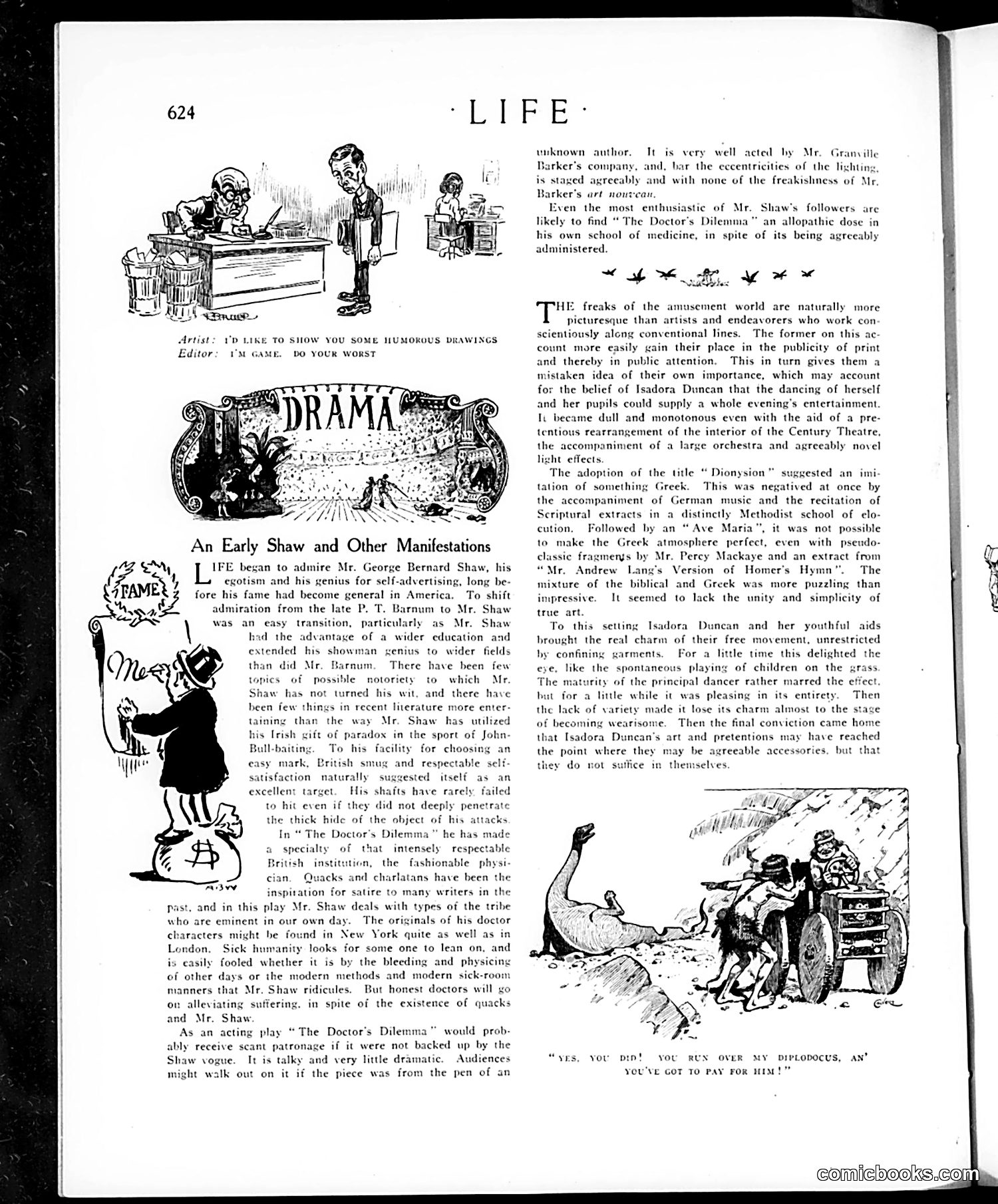
This page critiques George Bernard Shaw's theatrical work and Isadora Duncan's dance performance. **Shaw Section:** The article praises Shaw's wit and satirical genius, particularly his play "The Doctor's Dilemma," which ridicules fashionable physicians and medical quacks. However, Life admits the play is "talky and very little dramatic"—it succeeds only because of Shaw's celebrity reputation, not artistic merit. The cartoon at top humorously depicts an artist-editor exchange about "humorous drawings." **Isadora Duncan Section:** The review dismisses Duncan's evening-length dance performance as "dull and monotonous," despite elaborate staging, orchestra accompaniment, and lighting effects. The critic particularly mocks her pretentious attempt to create a "Greek atmosphere" (titled "Dionysion") while using German music and Biblical scripture recitations—undermining the Greek concept entirely. The bottom cartoon shows Duncan's dancers with a figure complaining about paying for damaged property. **Overall Point:** Both sections satirize how celebrity and pretension can substitute for genuine artistic merit—Shaw's reputation carries weak drama; Duncan's ambitions exceed her actual entertainment value.
📄 Transcribed text from this page (OCR, searchable)
Machine-transcribed from the original scan — historical spelling and the odd misread are preserved.
Artist: VP LIke TO SHOW YOU SOME HUMOKOUS DRAWINGS Editor: VM Game. DO YOUR woRST Za An Early Shaw and Other Manifestations IFE began to admire Mr. George Bernard Shaw, his egotism and his genius for self-advertising, long be- fore his fame had become general in America. To shift admiration from the late P, T. Barnum to Mr. Shaw was an easy transition, particularly as Mr. Shaw \ had the advantage of a wider education and * extended his showman genius to wider fields than did Mr. Barnum. There have been few topics of possible notoriety to which Mr. Shaw has not turned his wit, and there have been few things in recent literature more enter taining than the way Mr. Shaw has utilized his Irish gift of paradox in the sport of John- Bull-baiting. To his facility for choosing an easy mark, British smug and respectable self satisfaction naturally suggested itself as an excellent target. His shafts have rarely failed to hit even if they did not deeply penetrate Vi, the thick hide of the object of his attacks In “ The Doctor's Dilemma” he has made | a specialty of that intensely respectable % British titttion, the fashionable physi- cian. Quacks and charlatans have been the inspitation for satire to many writers in the past, and in this play Mr. Shaw deals with types of the tribe © are eminent in our own day. The originals of his doctor characters might be found in New York quite as well as in London, Sick humanity looks for some one to lean on, and easily fooled whether it is by the bleeding and physicing of other days or the modern methods and modern sick-room manners that Mr. Shaw ridicules. But honest doctors will so | on alleviating suffering. in spite of the existence of quacks and Mr. Shaw: As an acting play “The Doctor's Dilemma” would prob- ly receive scant patronage if it were not backed up by the Shaw vogue. It is talky and very little dramatic. Audiences alk out on it if the piece was from the pen of an tsa “LIFE- uiknown author. It is very well acted by Mr. Granyitle Barker's company, and, bar the eccentricities of the lizhting is staged agreeably and with none of the freakishness of Mr. Barker's art no Even the most enthusiastic of Mr. Shaw's followers likely to find “The Doctor's Dilemma” an allopathic dose his own school of medicine, in spite of its being agre administered. Hb of rant re ably HE freaks of the amusement world are naturally more picturesque than artists and endeavorers who work con scientiously along conventional lines. The former on this ac- count more easily gain their place in the publicity of print and thereby in public attention. This in turn gives them a mistaken idea of their own importance, which may account for the belief of Isadora Duncan that the dancing of herself and her pupils could supply a whole evening's entertainment Ik became dull and monotonous even with the aid of a pre- tentious rearrangement of the interior of the Century Theatre, the accompaniment of a large orchestra and agreeably novel light effects. The adoption of the title “ Dionysion” suggested an imi tation of something Greek. This was negatived at once by the accompaniment of German music and the recitation of criptural extracts in a dist t school of clo- cution, Followed by an “ ", it was not possible to make the Greek atmosphere perfect, even with psendo- classic fragmergs by Mr. Percy Mackaye and an extract from “Mr. Andrew Lang’s Version of Homer's Hymn”. The mixture of the biblical and Greek was more puzzling than impressive. It seemed to lack the unity and simplicity of true art. To this setting Isadora Duncan and her youthful aids brought the real charm of their free movement, unrestricted by confining garments. For a little time this delighted the ese, like the spontaneous playing of children on the grass The maturity of the principal dancer rather marred the effect. but for a litle while it was pleasing in its entirety. Then the lack of variety made it lose its charm almost to the stage of becoming wearisome, Then the final conviction came home that Isadora Duncan's art and pretentions may have reached the point where they hey do not sutfice say be agreeable accessories, but that themselves. “yes, You pip! vou RUN OVER MY DIPLoDocU: YOU'VE GOT TO PAY FOR MIM comichooks.