
Life, 1915-04-08 · page 20 of 44
Life — April 8, 1915 — page 20: what you’re looking at
What you’re looking at
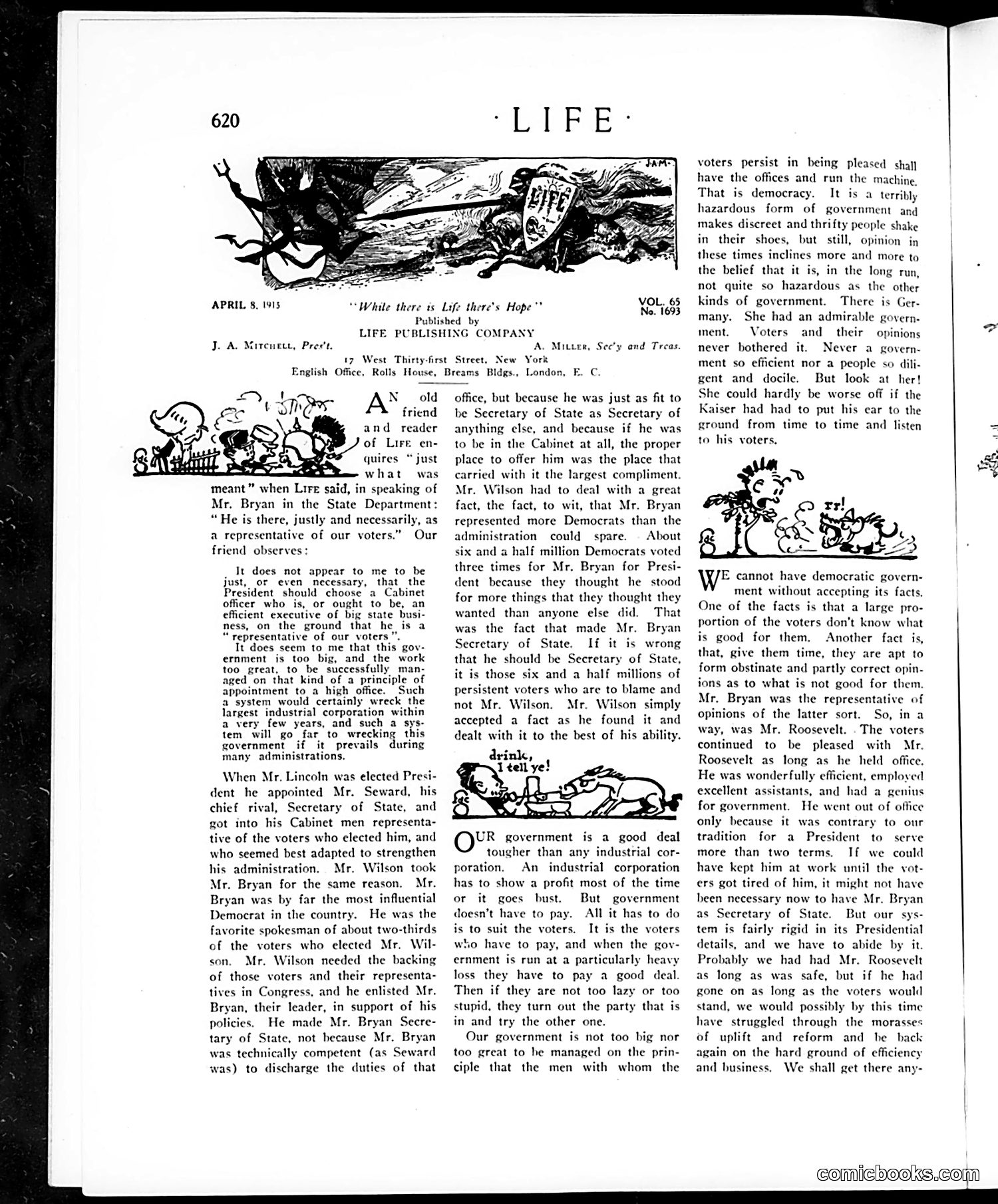
This page defends President Wilson's appointment of William Jennings Bryan as Secretary of State—a controversial choice because Bryan lacked diplomatic experience. The satirical magazine argues that while this seems inefficient by business standards, it reflects democratic reality. The central point: Bryan represented the political interests of approximately 6.5 million Democratic voters who had supported him three times for President. Wilson appointed him not for competence but political necessity—to maintain support from Bryan's constituency in Congress and among voters. The text contrasts this with Lincoln's appointment of rival Seward (who *was* competent) but acknowledges government differs from business: it must satisfy voters, not show profits. Democracy, the author argues, is "terribly hazardous" but legitimate—voters choose who runs the machine, and if dissatisfied, they vote the party out. The cartoons (unclear in detail) appear to illustrate this democratic principle humorously.
📄 Transcribed text from this page (OCR, searchable)
Machine-transcribed from the original scan — historical spelling and the odd misread are preserved.
APRIL 8, 1915 “While there ts L there's Hope” You 65 Published by LIFE PUBLISHING COMPANY J. A. Mitcnece, Preset, 17 West Thirty-first Street, English Office, Rolls House, 2 N old &e ‘ ve 5 A’ friend 2 and reader of Lire en- quires “ just what was when Lire said, in speaking of meant” Mr. Bryan in the State Department: “He is there, justly and necessarily, as a representative of our voters.” Our friend observes: It does not appear to me to be just, or even necessary, that the President should choose a Cabinet officer who is, or ought to be, an efficient executive of big state busi- ness, on the ground that he is a “ representative of our voters”. It does seem to me that this gov- ernment is too big, and the work too great, to be successfully man- aged on that kind of a principle of appointment to a high office. Such a system would certainly wreck the largest industrial corporation within a very few years, and such a sys- tem will go far to wrecking this government it prevails during many administrations. When Mr. Lincoln was elected Presi- dent he appointed Mr. Seward, his chief rival, Secretary of State, and got into his Cabinet men representa- tive of the voters who elected him, and who seemed best adapted to strengthen his administration. Mr. Wilson took Mr. Bryan for the same reason. Mr. Bryan was by far the most influential Democrat in the country. He was the favorite spokesman of about two-thirds of the voters who elected Mr. Wil- son. Mr. Wilson needed the backing of those voters and their representa- tives in Congress, and he enlisted Mr. Bryan, their leader, in support of his policies. He made Mr. Bryan Secre- tary of State, not because Mr. Bryan was technically competent (as Seward was) to discharge the duties of that A. Mittra, Secty and Treas. New York Breams Bldgs., London, E. C. office, but because he was just as fit to be Secretary of State as Secretary of anything else, and because if he was to be in the Cabinet at all, the proper place to offer him was the place that carried with it the largest compliment. Mr. Wilson had to deal with a great fact, the fact, to wit, that Mr. Bryan represented more Democrats than the administration could spare. About six and a half million Democrats voted three times for Mr. Bryan for Presi- dent because they thought he stood for more things that they thought they wanted than anyone else did. That was the fact that made Mr. Bryan Secretary of State. If it is wrong that he should be Secretary of State, it is those six and a half millions of persistent voters who are to blame and not Mr. Wilson. Mr. Wilson simply accepted a fact as he found it and dealt with it to the best of his ability. drink, ae ye! ovr government is a good deal tougher than any industrial cor- poration. An industrial corporation has to show a profit most of the time or it goes bust. But government doesn’t have to pay. All it has to do is to suit the voters. It is the voters who have to pay, and when the gov- ernment is run at a particularly heavy loss they have to pay a good deal. Then if they are not too lazy or too stupid, they turn out the party that is in and try the other one. Our government is not too big nor too great to he managed on the prin- ciple that the men with whom the voters persist in being pleased shall have the offices and run the machine, That is democracy. It is a terribly hazardous form of government and makes discreet and thrifty people shake in their shoes, but still, opinion in these times inclines more and more to the belief that it is, in the long run, not quite so hazardous as the other kinds of government. There is Ger- many. She had an admirable govern. ment. Voters and their opinions never bothered it. Never a govern- ment so efficient nor a people so dil gent and docile. But look at her! She could hardly be worse off if the Kaiser had had to put his car to the ground from time to time and listen to his voters, E cannot have democratic govern- ment without accepting its facts. One of the facts is that a large pro- portion of the voters don’t know what is good for them. Another fact is, that, give them time, they are apt to form obstinate and partly correct opin- ions as to what is not good for them. Mr. Bryan was the representative of opinions of the latter sort. So, in a way, was Mr. Roosevelt. . The voters continued to be pleased with Mr. Roosevelt as long as he held office, He was wonderfully efficient, employed excellent assistants, and had a genius for government. He went out of office only because it was contrary to our tradition for a President to serve more than two terms. If we could have kept him at work until the vot- ers got tired of him, it might not have heen necessary now to have Mr. Bryan as Secretary of State. But our sys- tem is fairly rigid in its Presidential details, and we have to abide by it. Probably we had had Mr. Roosevelt as long as was safe, but if he had gone on as long as the voters would stand, we would possibly by this time have struggled through the morasses of uplift and reform and he back ain on the hard ground of efficiency and business. We shall get there any- comlclooks.com