
Life, 1915-04-08 · page 32 of 44
Life — April 8, 1915 — page 32: what you’re looking at
What you’re looking at
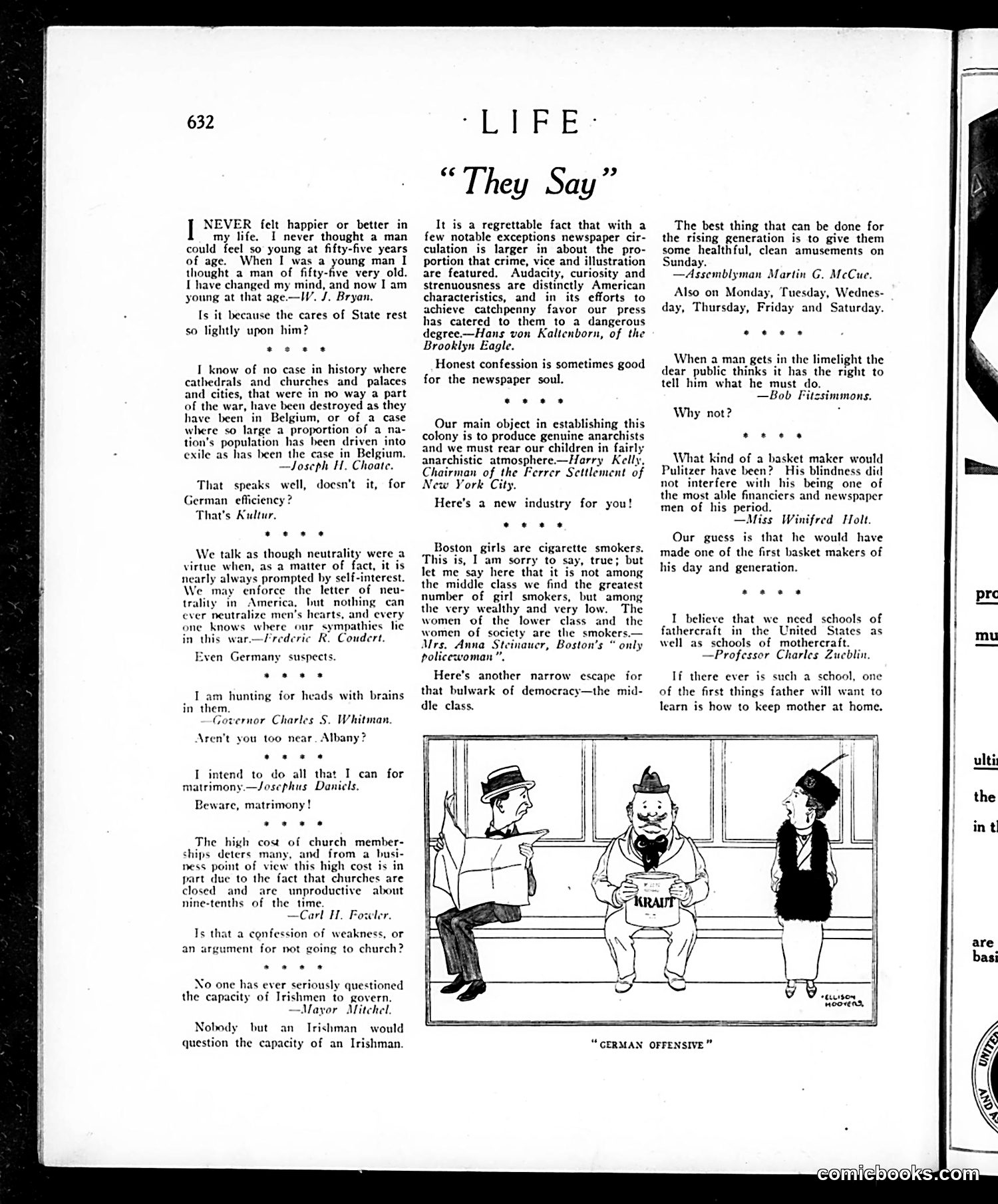
This is a "They Say" column—Life's satirical commentary on public statements from prominent figures. The magazine quotes notable people, then adds witty rejoinders to mock their statements. The cartoon at bottom, titled "German Offensive," depicts three figures reading a newspaper labeled "KRAUT" (a derogatory term for Germans). The satire references German military actions in Belgium, which the page's text addresses: Joseph H. Choate condemned the destruction of Belgian cathedrals and mass displacement as unprecedented war crimes, sardonically asking if this demonstrates "German efficiency" or "Kultur" (German culture). The column mocks various American public figures—including Mayor Mitchel, Governor Whitman, and Josephus Daniels—for contradictory or foolish statements. Key context: This page was published during America's pre-WWI neutrality period. Anti-German sentiment was rising due to Belgium's invasion, and Life frequently criticized both German conduct and American figures seen as insufficiently serious about the conflict.
📄 Transcribed text from this page (OCR, searchable)
Machine-transcribed from the original scan — historical spelling and the odd misread are preserved.
NEVER felt happier or better in my life. I never thought a man could feel so young at fifty-five years of age. When I was a young man I thought a man of fifty-five very old. [have changed my mind, and now I am young at that age.—lW. J. Bryan. Is it because the cares of State rest so lightly upon him? sees I know of no case in history where cathedrals and churches and palaces and cities, that were in no way a part of the war, have been destroyed as they have been in Belgium, or of a case where so large a proportion of a na- tion's population has been driven into exile as has been the case in Belgium. —Joseph H. Choate. That speaks well, docsn't it, for German efficiency ? That's Kultur, sere We talk as though neutrality were a virtue when, as a matter of fact, it is nearly always prompted by self-interest. We may enforce the letter of neu- trality in) America, but nothing can ever neutralize men’s hearts, and every one knows where our sympathies lic in this war.—Frederic R. Condert. Even Germany suspects. I am hunting for heads with brains in then . ; Governor Charles S. Whitman. Aren't you too near. Albany? eee I intend to do all that I can for matrimony.—Josephus Daniels, Beware, matrimony! see e The high cos of church member- ships deters many, and from a busi- ness point of view this high cost is in part due to the fact that churches are closed and are unproductive about nine-tenths of the time. —Carl H. Fowler. Is that a confession of weakness, or an argument for not going to church? No one has ever seriously questioned the capacity of Irishmen to govern. —Mayor Mitchel. Nobody but an Irishman would question the capacity of an Irishman. EN IBSE = “They Say” It is a regrettable fact that with a few notable exceptions newspaper cir- culation is larger in about the pro- portion that crime, vice and illustration are featured. Audacity, curiosity and strenuousness are distinctly American characteristics, and in its efforts to achieve catchpenny favor our press has catered to them to a dangerous degree.—Hans von Kaltenboru, of the Brooklyn Eagle. Honest confession is sometimes good for the newspaper soul. eee Our main object in establishing this colony is to produce genuine anarchists and we must rear our children in fairly anarchistic atmosphere.—Harry Kelly, Chairman of the Ferrer Settlement of New York City. Here's a new industry for you! eens Boston girls are cigarette smokers. This is, I am sorry to say, true; but let me say here that it is not among the middle class we find the greatest number of girl smokers, but among the very wealthy and very low. The women of the lower class and the women of society are the smokers.— Mrs. Anna Steiiauer, Boston’s “ only policewoman”, Here's another narrow escape for that bulwark of democracy—the mid- dle class. The best thing that can be done for the rising generation is to give them some healthful, clean amusements on Sunday. —Assemblyman Martin G. McCue. Also on Monday, Tuesday, Wednes- day, Thursday, Friday and Saturday. When a man gets in the limelight the dear public thinks it has the nght to tell him what he must do. Fitzsimmons, —Bo, Why not? What kind of a basket maker would Pulitzer have been? His blindness did not interfere with his being one of the most able financiers and newspaper men of his period. —Miss Winifred Holt. Our guess is that he would have made one of the first basket makers of his day and generation. se ee I believe that we need. schools of fathercraft in the United States as well as schools of mothercraft. —Professor Charles Zucblin. If there ever is such a school, one of the first things father will want to learn is how to keep mother at home. stuises moons, | “GERMAN OFFENSIVE”