
Life, 1915-04-08 · page 21 of 44
Life — April 8, 1915 — page 21: what you’re looking at
What you’re looking at
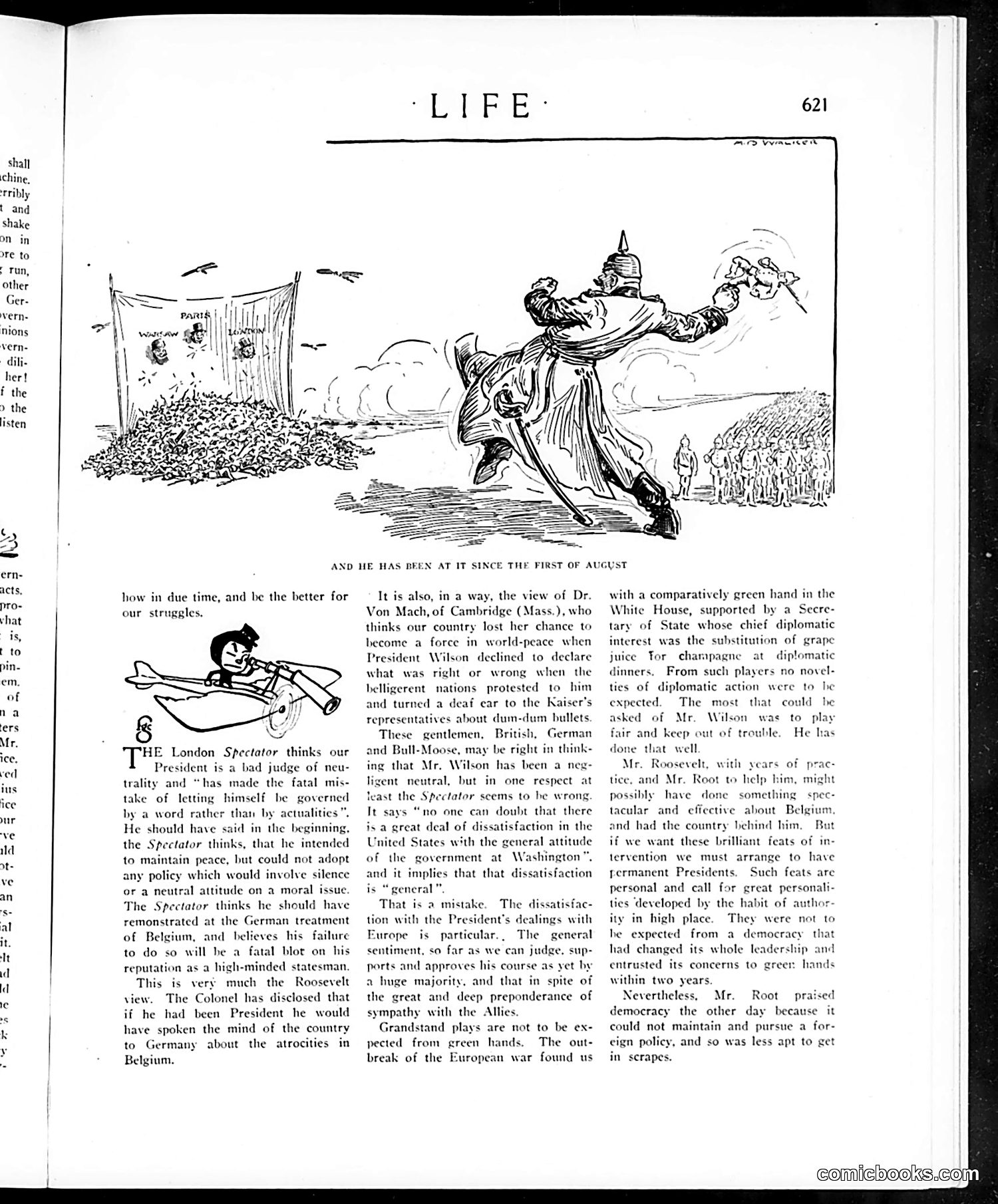
**The Cartoon:** The top illustration depicts a figure (likely representing President Wilson or U.S. diplomacy) juggling multiple objects while balancing precariously—a visual metaphor for managing competing demands during WWI. **The Context:** This page critiques American neutrality in World War I (the "European war" referenced). British, German, and American critics—including Theodore Roosevelt ("Bull-Moose") and Dr. Von Mach—attacked President Wilson for insufficient moral condemnation of German atrocities in Belgium and for not taking stronger diplomatic stances. **The Satire's Point:** The article defends Wilson against these critics, arguing that expecting brilliant diplomatic maneuvering from a relatively inexperienced administration is unreasonable. The phrase "green hands" appears repeatedly—Wilson and his Secretary of State lacked diplomatic experience compared to figures like Roosevelt and Elihu Root. The satire suggests critics demanding dramatic intervention underestimate the constraints of democratic governance with new leadership. **The Irony:** Roosevelt and experienced diplomats critiqued Wilson's caution, yet the author suggests their expectations were unrealistic given the administration's newness.
📄 Transcribed text from this page (OCR, searchable)
Machine-transcribed from the original scan — historical spelling and the odd misread are preserved.
shall chine, tribly t and shake on in re to run, other ( vern- nions vern- dili- her! f the > the jisten “Eee 621 TD Veet AND HE HAS BEEN AT IT SINCE THE FIRST OF AUGYST how in due time, and be the better for our struggles, THe London Spectator thinks our President is a bad judge of neu- trality and “has made the fatal mis- take of letting himself be governed by a word rather than by actualities ”. He should have said in the beginning, the Spectator thinks, that he intended to maintain peace, but could not adopt any policy which would involve silence or a neutral attitude on a moral issue The Spectator thinks he should have remonstrated at the German treatment of Belgium, and believes his failure to do so will he a fatal blot on his reputation as a high-minded statesman. This is very much the Roosevelt view. The Colonel has disclosed that if he had been President he would have spoken the mind of the country to Germany about the atrocities in Belgium. It is also, in a way, the view of Dr. Von Mach, of Cambridge (Mass.), who thinks our country lost her chance to become a force in world-peace when President Wilson declined to declare what was right or wrong when the helligerent nations protested to him and turned a deaf car to the Kaiser's representatives about dum-dum bullets, These gentlemen, British, German and Bull-Moose, may be right in think- ing that Mr. Wilson has been a neg- ligent neutral, but in one respect at least the Spectator seems to he wrong. It says “no one can doubt that there is a great deal of dissatisfaction in the United States with the general attitude of the government at Washington”. and it implies that that dissatisfaction is “general”. That is a mistake. The tion with the President's dealings with Europe is particular., The general sentiment, so far as we can judge, sup- ports and approves his course as yet by a huge majority, and that in spite of the great and deep preponderance of sympathy with the Allies. Grandstand plays are not to be ex- lissatisfac- pected from green hands. The out- break of the European war found us with a comparatively green hand in the White House, supported by a Secre- tary of State whose chief diplomatic interest was the substitution of grape juice Tor champagne at diplomatic dinners, From such players no novel- ties of diplomatic action were to be expected. The most that could he asked of Mr. Wilson was to play fair and keep out of trouble. He has done that well Mr. Roosevelt, with years of prac- and Mr. Root to help possibly have done something tacular and effective about Belgium and had the country behind him. But if we want these brilliant feats of in- lervention we must arrange to have permanent Presidents. Such feats a personal and call for great personali- ties ‘developed by the habit of author- ity in high place. They were not to he expected from a democracy that had changed its whole leadership and entrusted its concerns to green hands within two years. Nevertheless, Mr. Root _ praised democracy the other day because it could not maintain and pursue a for- eign policy, and so was less apt to ge! in scrapes. tic im, © comichooks.