
A complete issue · 44 pages · 1915
Life — January 7, 1915
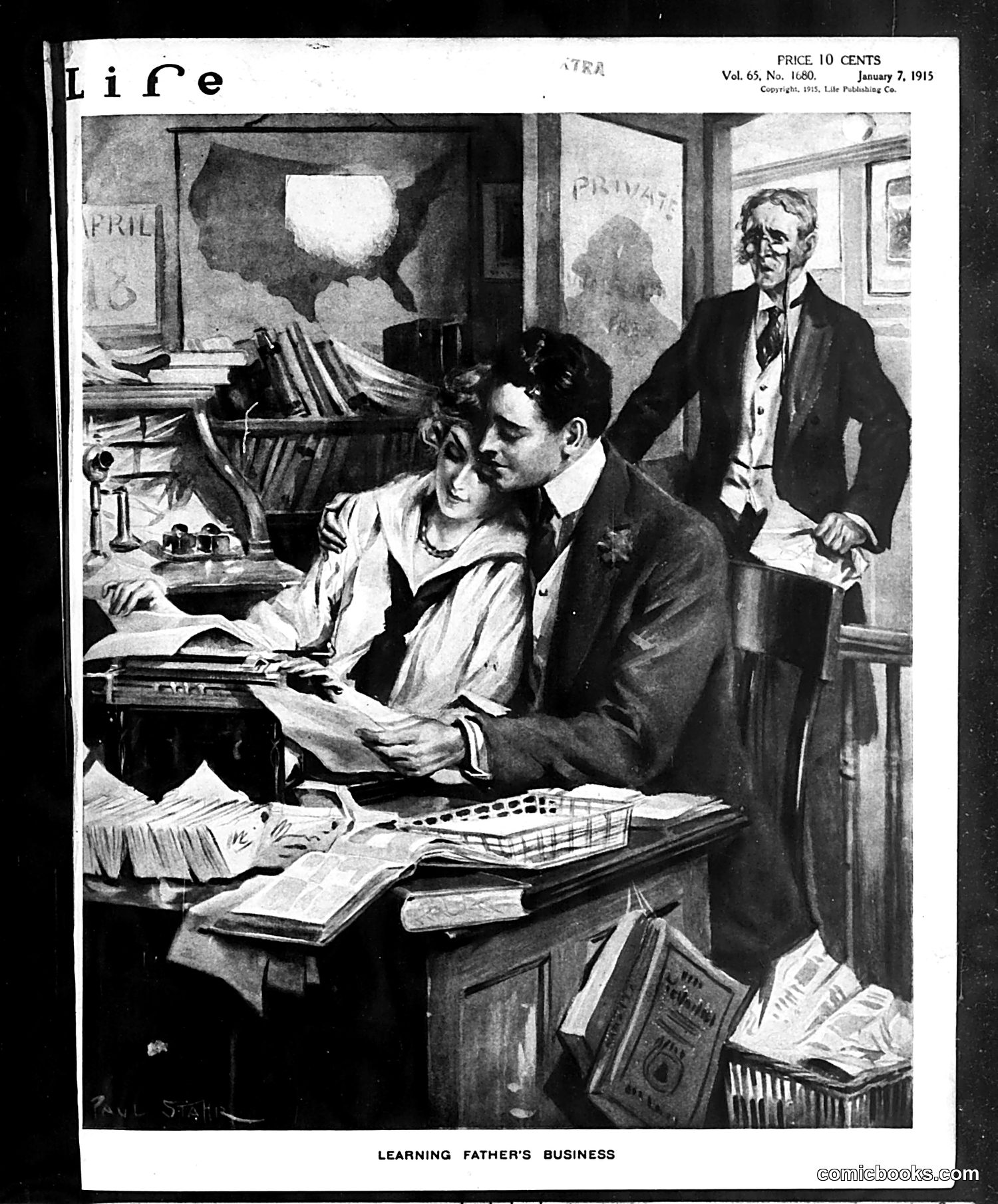
This illustration from Life (January 7, 1915) depicts a young man being instructed in office work by an older businessman, while a third man observes from behind. The caption's title suggests the common practice of sons inheriting and learning their father's trade or business. The satire likely comments on American business succession and the relationship between generations in the workplace. The cluttered desk, scattered papers and ledgers, and maps on the wall suggest an active commercial enterprise—possibly import/export or similar business typical of early 20th-century American commerce. The humor appears to center on the formality and instruction required to transmit business knowledge, reflecting contemporary attitudes about work, family duty, and social class during the Progressive Era.
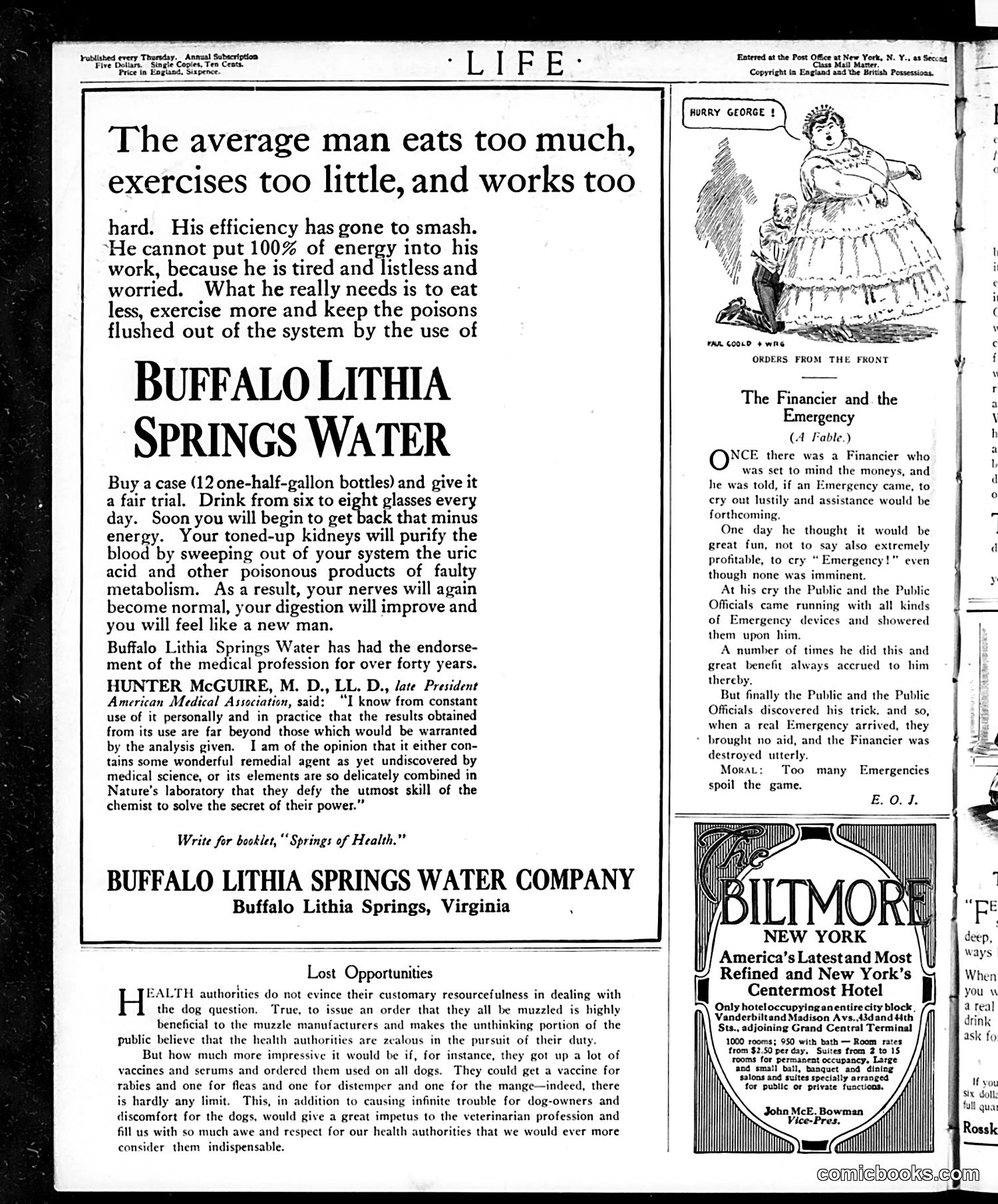
**Main Content:** This page is dominated by an advertisement for Buffalo Lithia Springs Water, a patent medicine claiming to cure ailments caused by overwork and poor diet. The ad endorses the product using a quote from Hunter McGuire, M.D., claiming the water contains undiscovered remedial agents. **The Cartoon:** "Orders from the Front" depicts a man presenting his large wife to a small boy with the caption "Hurry George!" The joke satirizes the advertisement's theme—suggesting the woman's size results from eating too much while exercising too little, the very problem the patent medicine supposedly treats. **Context:** This reflects early 20th-century attitudes about weight, health, and the marketing of dubious "cure-all" products to Americans concerned about modern lifestyle diseases.
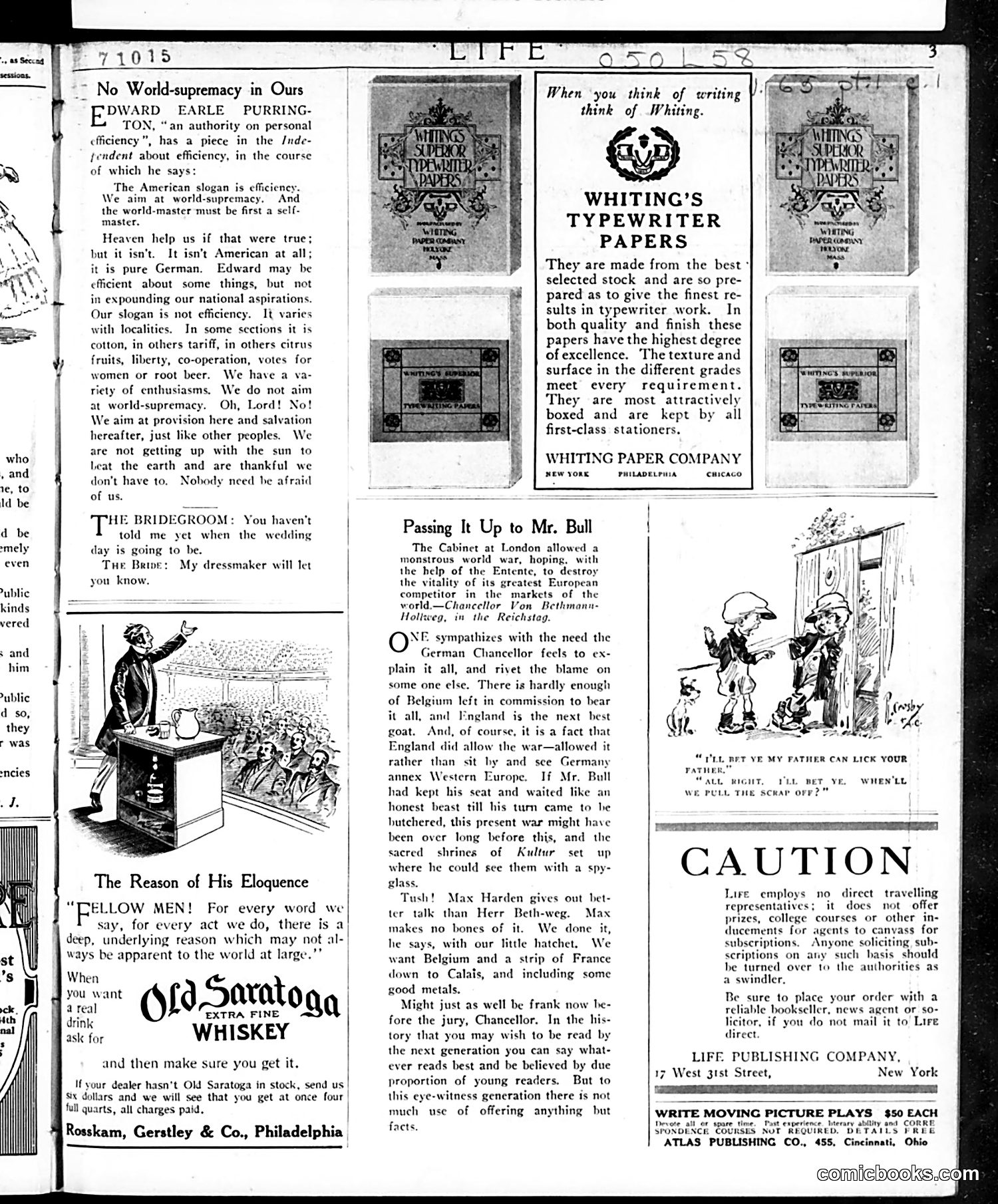
This page is primarily **advertisements and filler content** with minimal political satire. The main cartoon, "The Reason of His Eloquence," depicts a speaker addressing a crowd from a platform, illustrating the caption about "underlying reasons" behind rhetoric—likely generic political humor rather than commentary on a specific figure or event. A second small cartoon, "Passing It Up to Mr. Bull," references **British responsibility** regarding Belgium during WWI (indicated by text mentioning "the Cabinet at London" and Belgium's situation). "Mr. Bull" is the personification of Britain. The cartoon appears to satirize how Britain might shift blame rather than take direct action. The remaining content consists of advertisements for typewriter paper, whiskey, and other products—typical of Life's mixed editorial-advertising format.
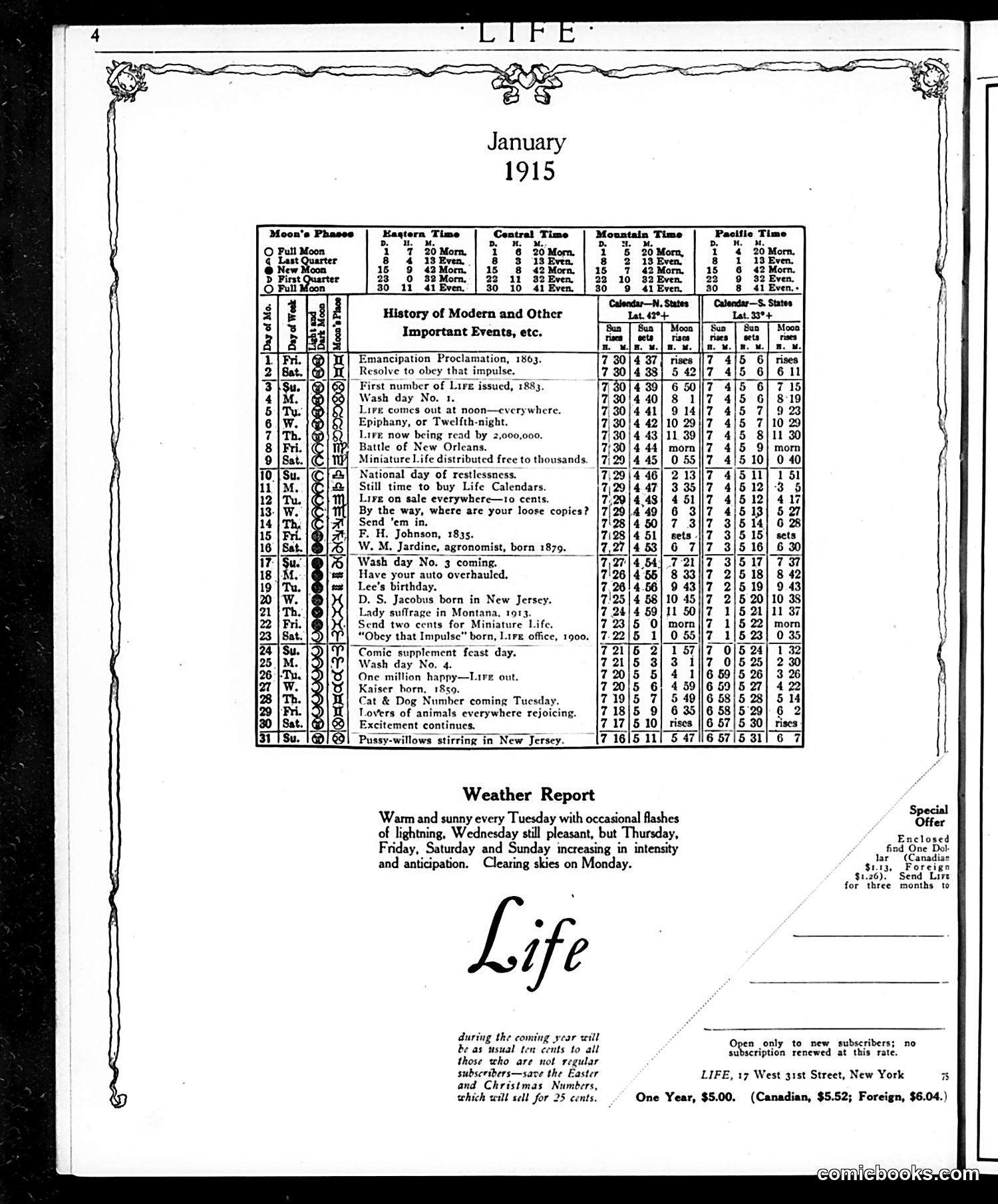
This page is primarily a **calendar and administrative content** for January 1915, not a political cartoon. It includes: - **Moon phases and time zones** for the month - **Historical events list** spanning from the Emancipation Proclamation (1863) through various 19th-century milestones, ending with contemporary 1915 items - **Weather forecast** predicting warm, sunny conditions with increasing storms later in the week - **Subscription information** for Life magazine The page serves as a useful reference tool rather than satirical content. The historical events appear designed to educate readers about American history, while the calendar helps subscribers track the month. This represents Life's role as both entertainment and practical publication for its early 20th-century audience.
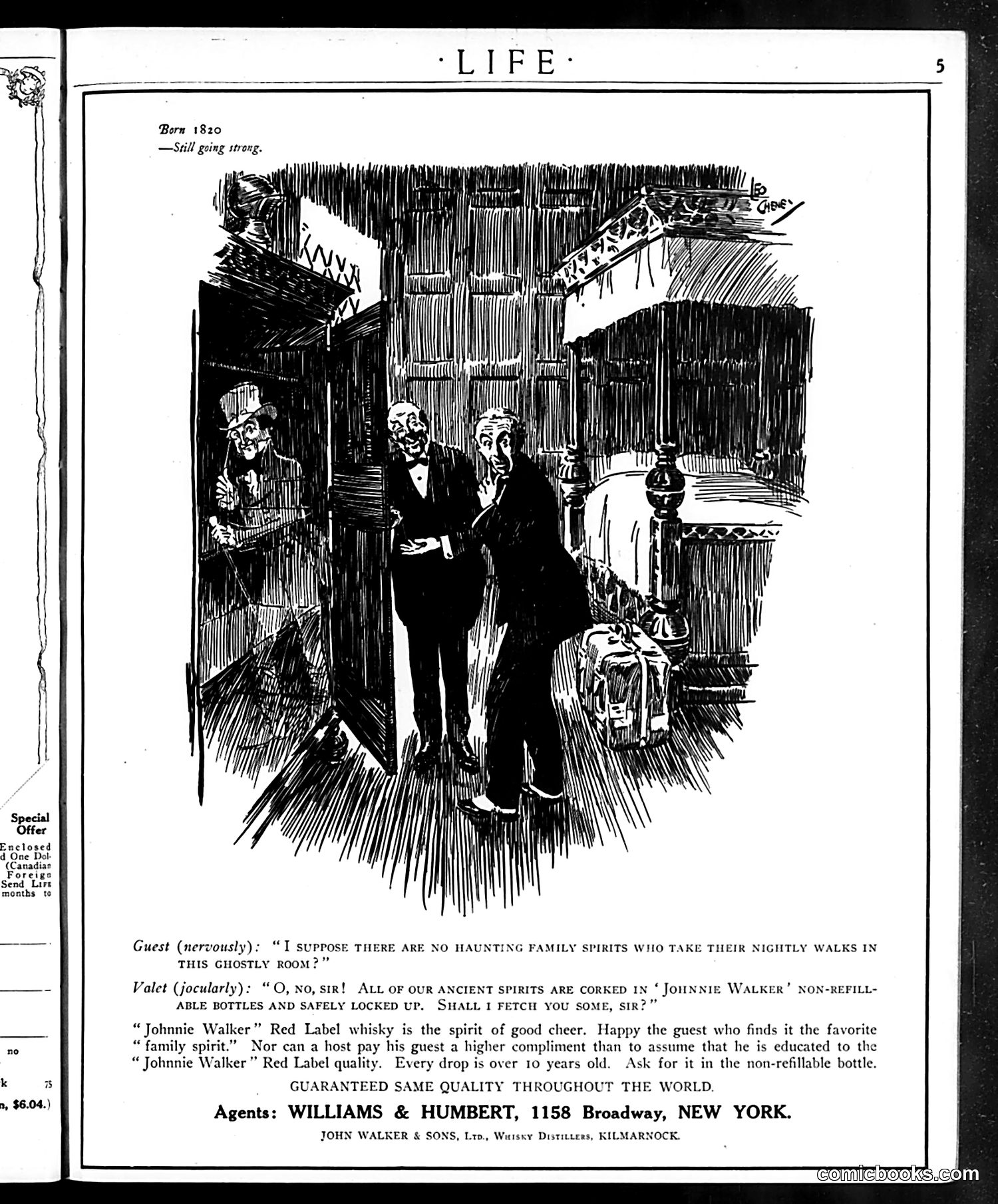
This is primarily a **Johnnie Walker whisky advertisement** disguised as satirical content. The illustration shows two well-dressed men visiting what appears to be a grand manor, greeting a porter at the entrance. The "joke" centers on a guest asking nervously about "haunting family spirits" in this ghostly room. The valet responds that all their "ancient spirits are corked in 'Johnnie Walker' non-refillable bottles"—a pun playing on both supernatural spirits and distilled spirits (whisky). The advertisement emphasizes that Johnnie Walker Red Label is "the spirit of good cheer" and highlights its age (over 10 years old) and guaranteed quality. The satire is mild—essentially equating premium whisky with family tradition and sophistication. This reflects 1920s advertising strategy: wrapping product promotion in humor to make it more palatable to readers.
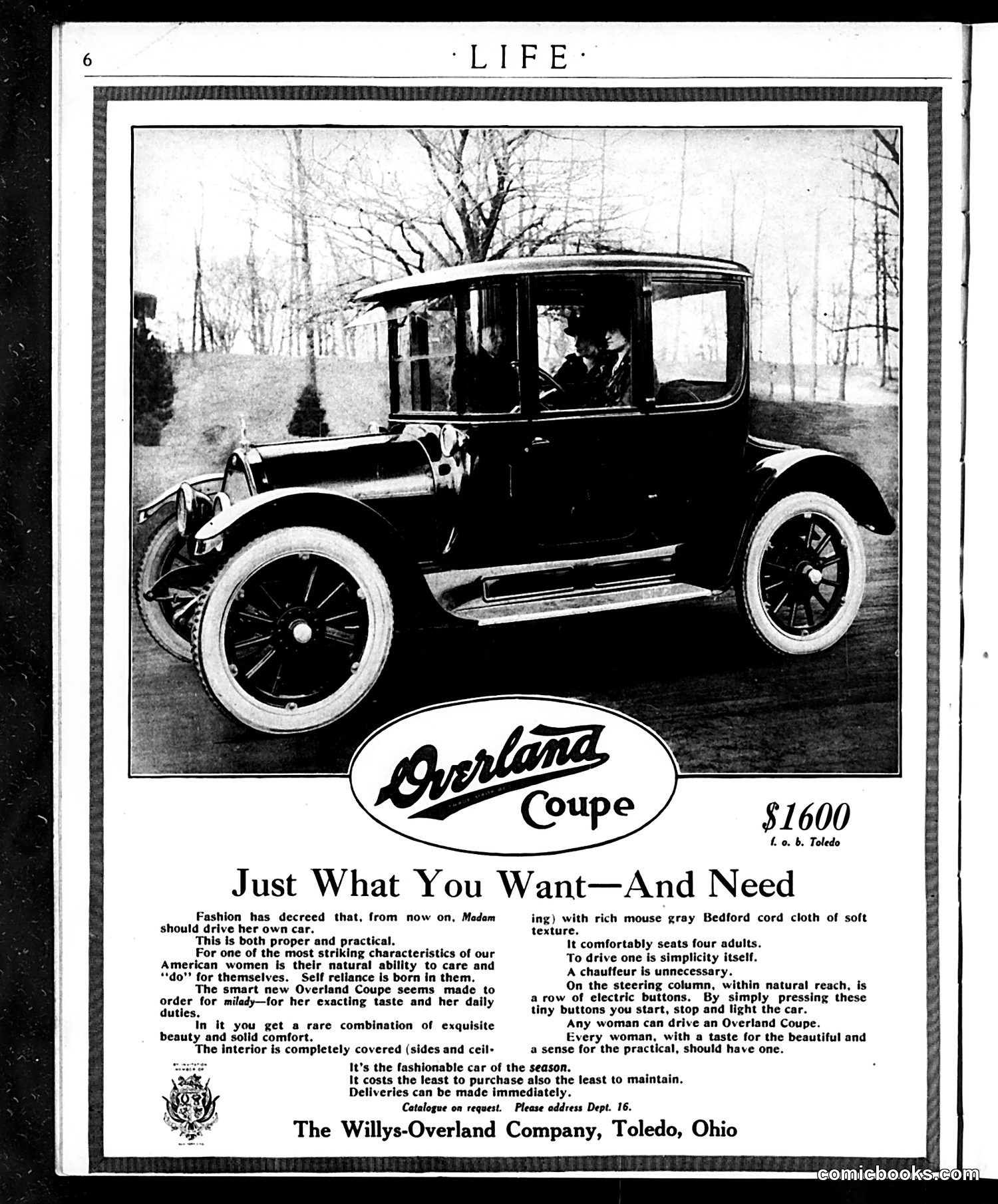
This page is primarily **an advertisement, not satire or political content**. It promotes the Overland Coupe automobile, priced at $1,600, manufactured by the Willys-Overland Company in Toledo, Ohio. The ad's notable feature is its **gender-targeted marketing**. The headline "Just What You Want—And Need" and body text explicitly address women as independent car owners. It emphasizes the vehicle's simplicity ("To drive one is simplicity itself"), comfort, and ease of operation with electric buttons for starting—positioning the Overland as ideal for women drivers. This reflects a **significant social shift** of the era (appears to be 1910s-1920s): automobiles were becoming marketed to women, challenging traditional gender roles regarding technology and mobility.
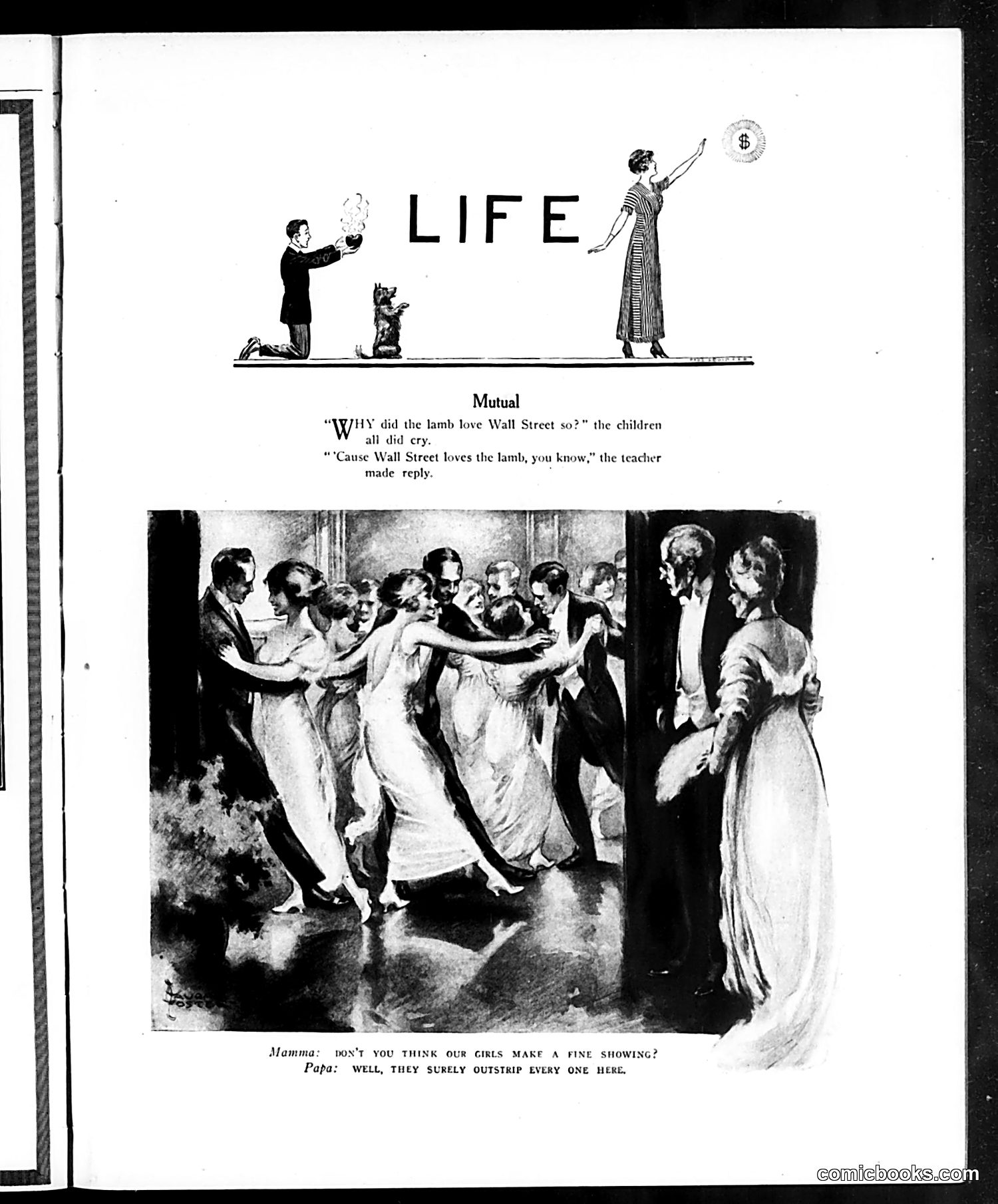
This page contains two satirical pieces about financial institutions and societal values: **Top Illustration ("Mutual")**: A man and woman juggle money and a dollar sign while a child watches between them. The caption presents a cynical exchange where children ask why a lamb loves Wall Street, and a teacher replies "because Wall Street loves the lamb"—meaning Wall Street exploits innocent people for profit. **Bottom Illustration**: Parents observe their daughters at what appears to be a debutante ball or social gathering. The father boasts that their girls "make a fine showing," while the mother notes they "outstrip every one here"—suggesting the daughters' primary value lies in their appearance and ability to attract wealthy suitors, reflecting early-20th-century concerns about materialism and marriage markets. Both pieces critique American capitalism and social priorities.
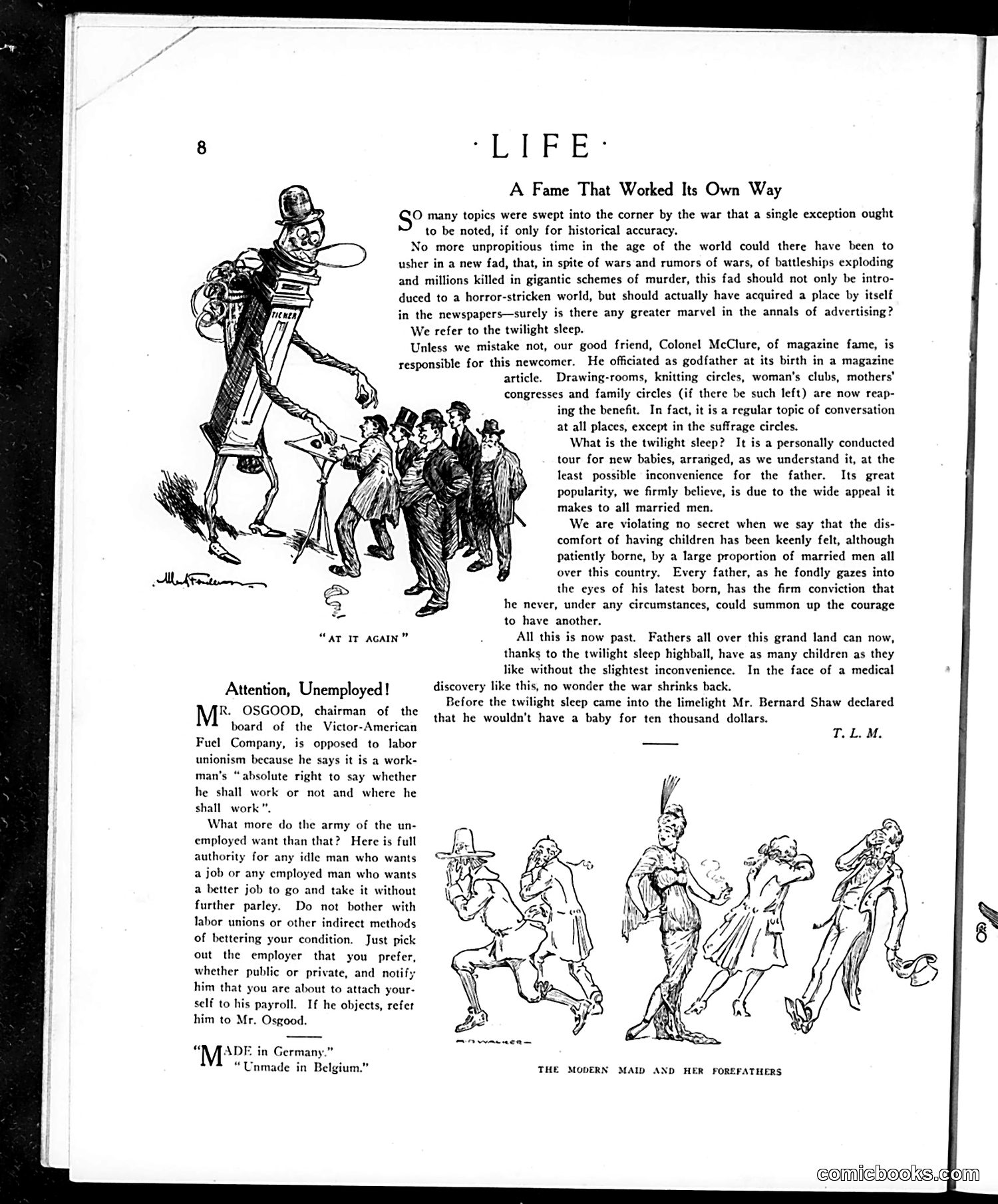
This page contains two satirical pieces from an early 20th-century Life magazine: **"At It Again"** (top cartoon): Depicts a tall figure labeled "Twilight Sleep" leading a group of men (fathers). This mocks a newfound childbirth procedure called twilight sleep that allegedly allowed women to have children painlessly and without memory of labor. The article sarcastically suggests this medical innovation has made fathers enthusiastic about having numerous children without spousal inconvenience. **"Attention, Unemployed!"** (bottom left): Chairman Osgood of the Victor-American Fuel Company advocates for workers' "absolute right" to choose their jobs without union interference—essentially anti-labor propaganda disguised as worker empowerment. **"The Modern Maid and Her Forefathers"** (bottom right): Skeletal figures illustrate servant ancestry, likely satirizing modern domestic workers' claims to respectable lineage. The page satirizes contemporary social debates around medicine, labor rights, and class pretension.
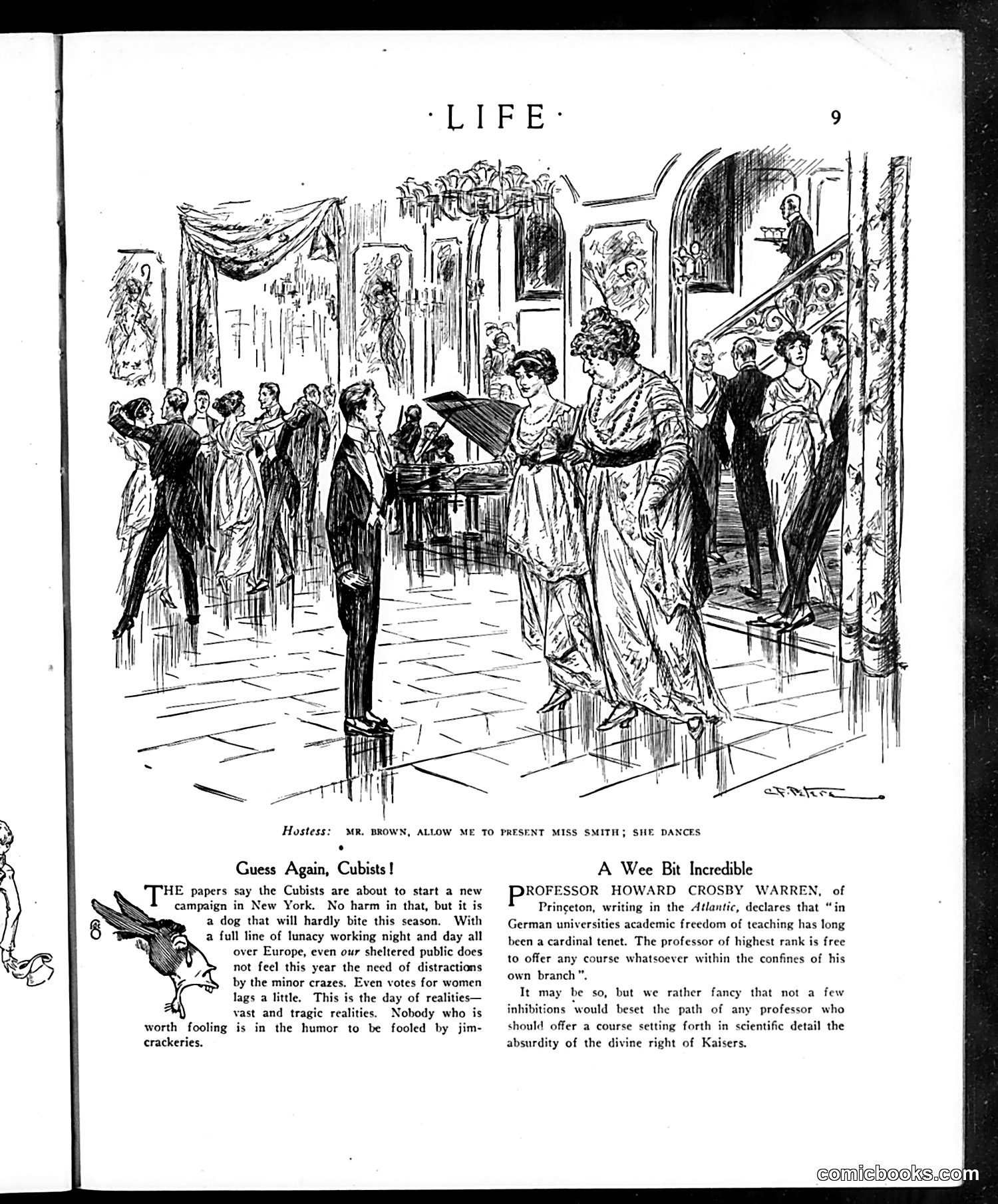
**The Main Illustration:** Shows a formal social gathering (appears to be a dance or reception) where a hostess is introducing guests. The caption reads: "Hostess: Mr. Brown, allow me to present Miss Smith; she dances." **The Satire:** This jokes about the limited social accomplishments expected of women in this era. The hostess's introduction reduces Miss Smith to a single trait—dancing ability—rather than intellectual or other qualities, reflecting how women were often defined by entertainment value or domestic skills in upper-class society. **The Two Text Articles Below:** 1. "Guess Again, Cubists!" mocks the Cubist art movement gaining popularity in New York 2. "A Wee Bit Incredible" critiques German academic freedom and university authority The page satirizes early-20th-century social conventions, artistic trends, and academic pretension typical of *Life* magazine's satirical focus.
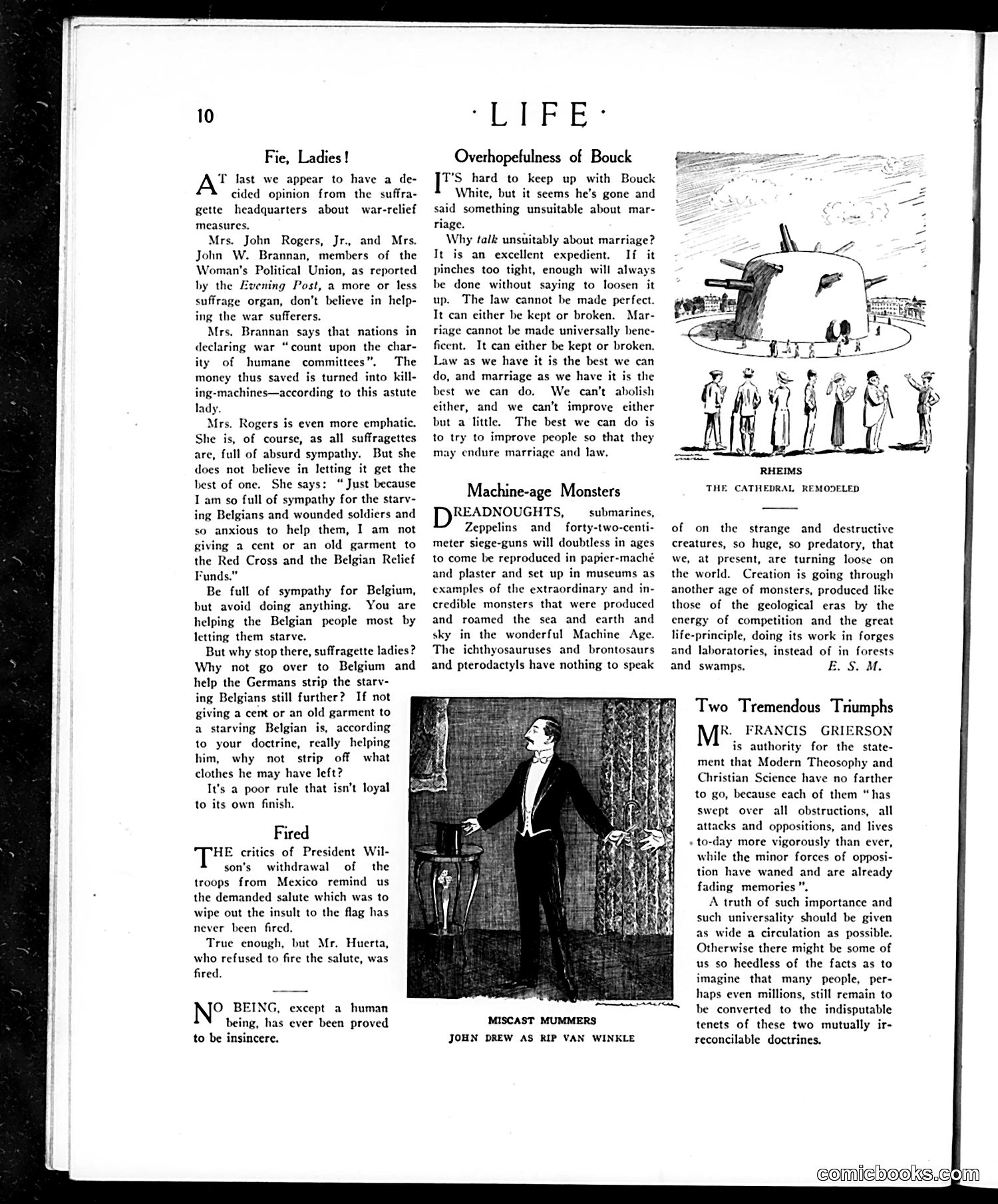
This page contains four separate satirical pieces: 1. **"Fie, Ladies!"** — Critiques suffragettes opposing WWI relief efforts. It mocks women's political activism, particularly those supporting Belgian relief funds while allegedly inconsistent in their charitable priorities. 2. **"Fired"** — A brief political jab at President Wilson's withdrawal of troops from Mexico, suggesting the military salute controversy cost someone their job. References Mr. Huerta (likely Mexican leader Victoriano Huerta). 3. **"Miscast Mummers" (cartoon)** — A John Drew illustration depicting what appears to be a theatrical scene of social pretense or miscasting. 4. **"Rheims Cathedral Remodeled"** — A cartoon showing the cathedral's destruction, satirizing German warfare in WWI France. The overall tone critiques both domestic political inconsistency and international military conduct during the Great War era.
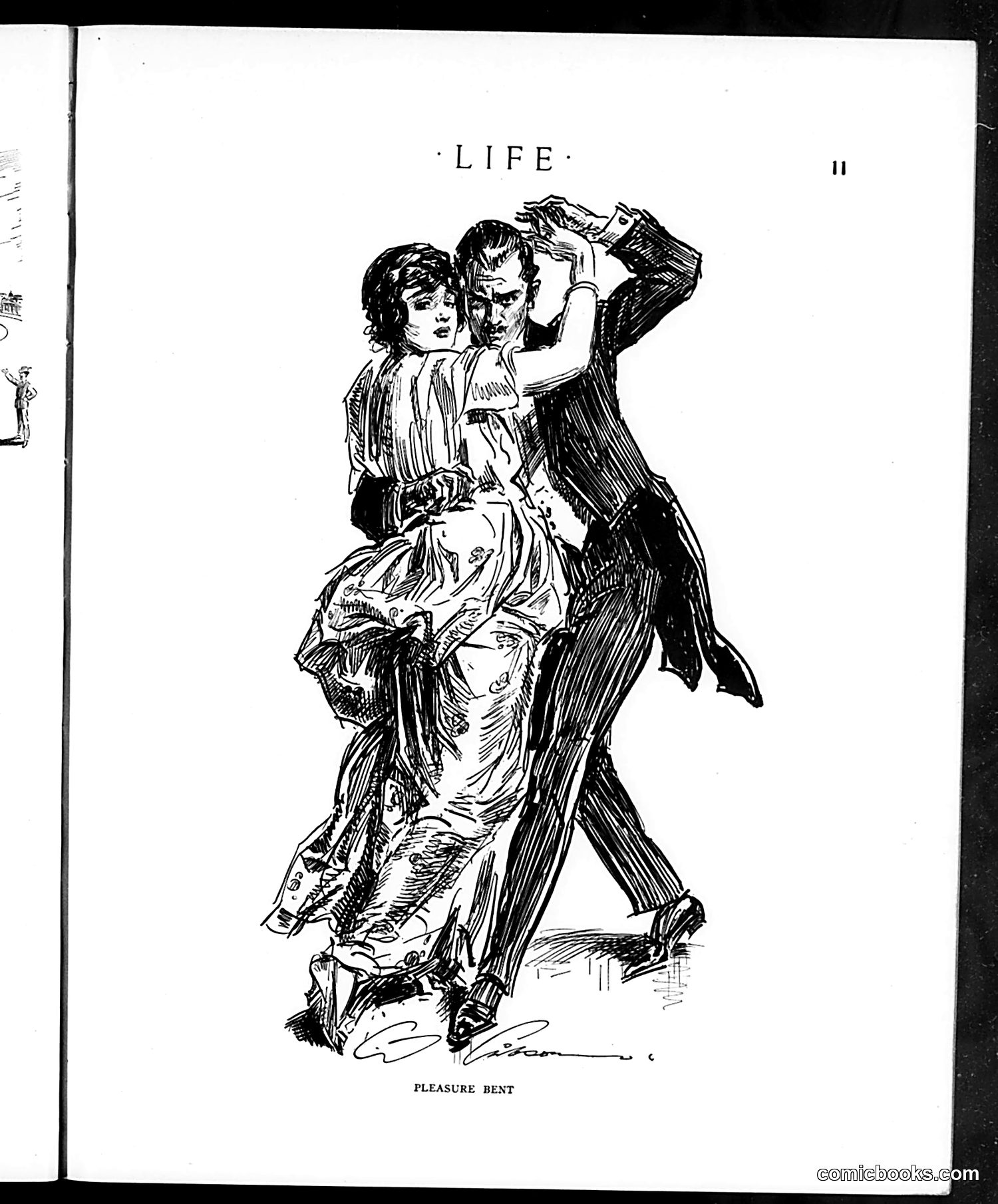
This page features a single illustration titled "Pleasure Bent" from *Life* magazine. The drawing depicts a man in formal attire (suit and striped jacket) dancing with or supporting a woman in an elaborate dress. The man's posture is exaggerated—he's bent backward dramatically while adjusting his hair, suggesting physical strain or comedic exhaustion. The satire appears to target the leisure activities and social behaviors of the wealthy or upper class. The titled "Pleasure Bent" suggests ironic commentary on how the pursuit of pleasure (here, dancing or socializing) literally bends or contorts people out of shape. The woman's ornate clothing and the man's formal dress indicate this mocks affluent society's customs and the physical toll of maintaining appearances during social obligations.
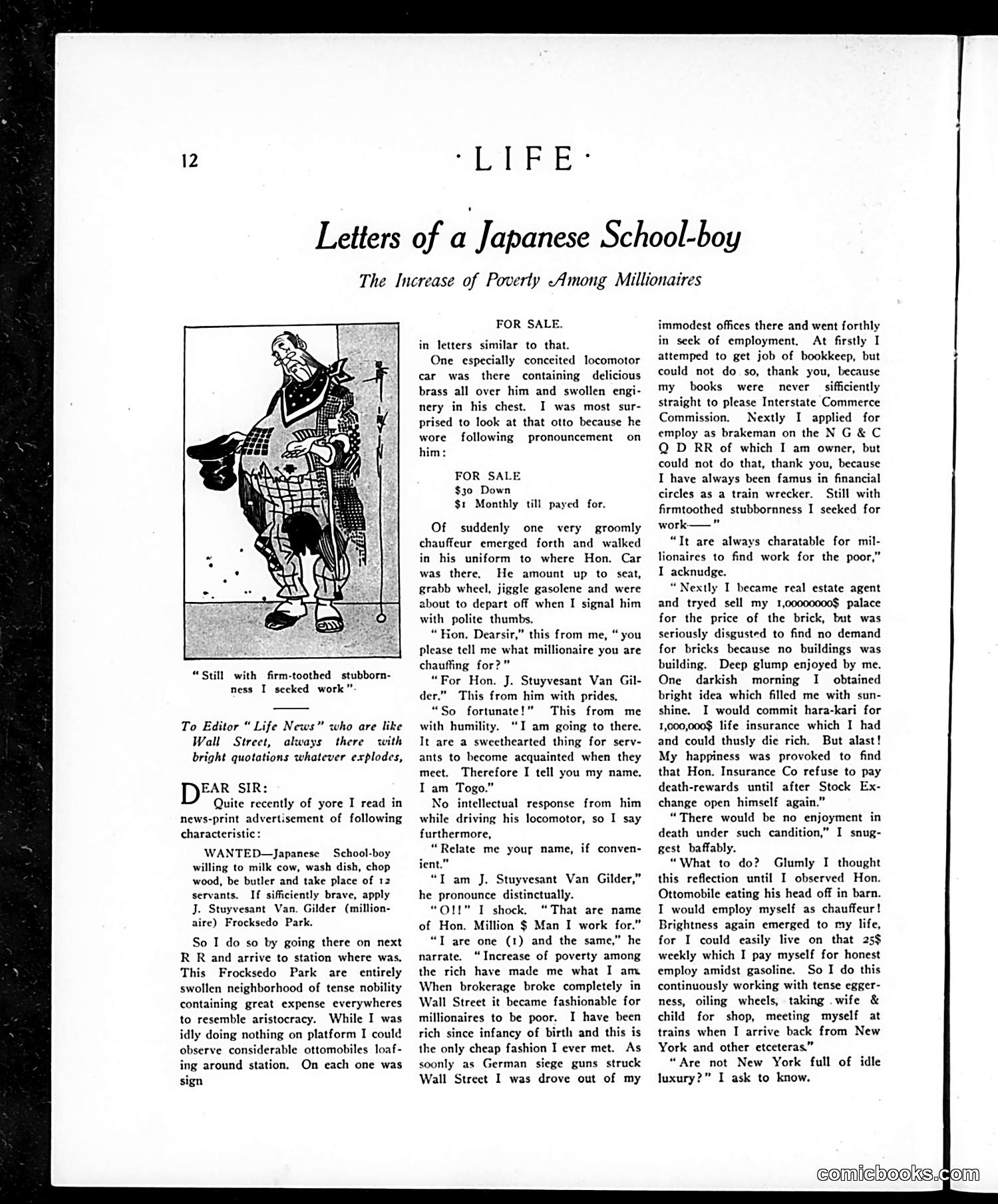
This page contains a satirical letter to *Life* magazine's editor about Japanese immigration and employment. The illustration shows a caricatured Japanese figure in traditional dress alongside modern Western elements—likely mocking the contrast between Japan's traditional image and its economic ambitions in America. The letter satirizes a wealthy Japanese businessman's attempt to hire himself as a poor worker, exploiting America's economic desperation during what appears to be a recession or depression. The joke centers on millionaires pretending poverty to secure employment, while the broader satire critiques both Japanese economic penetration into America and the desperation of unemployed Americans willing to work for anyone, regardless of authenticity. The ethnic caricature reflects early 20th-century attitudes toward Japanese immigrants.
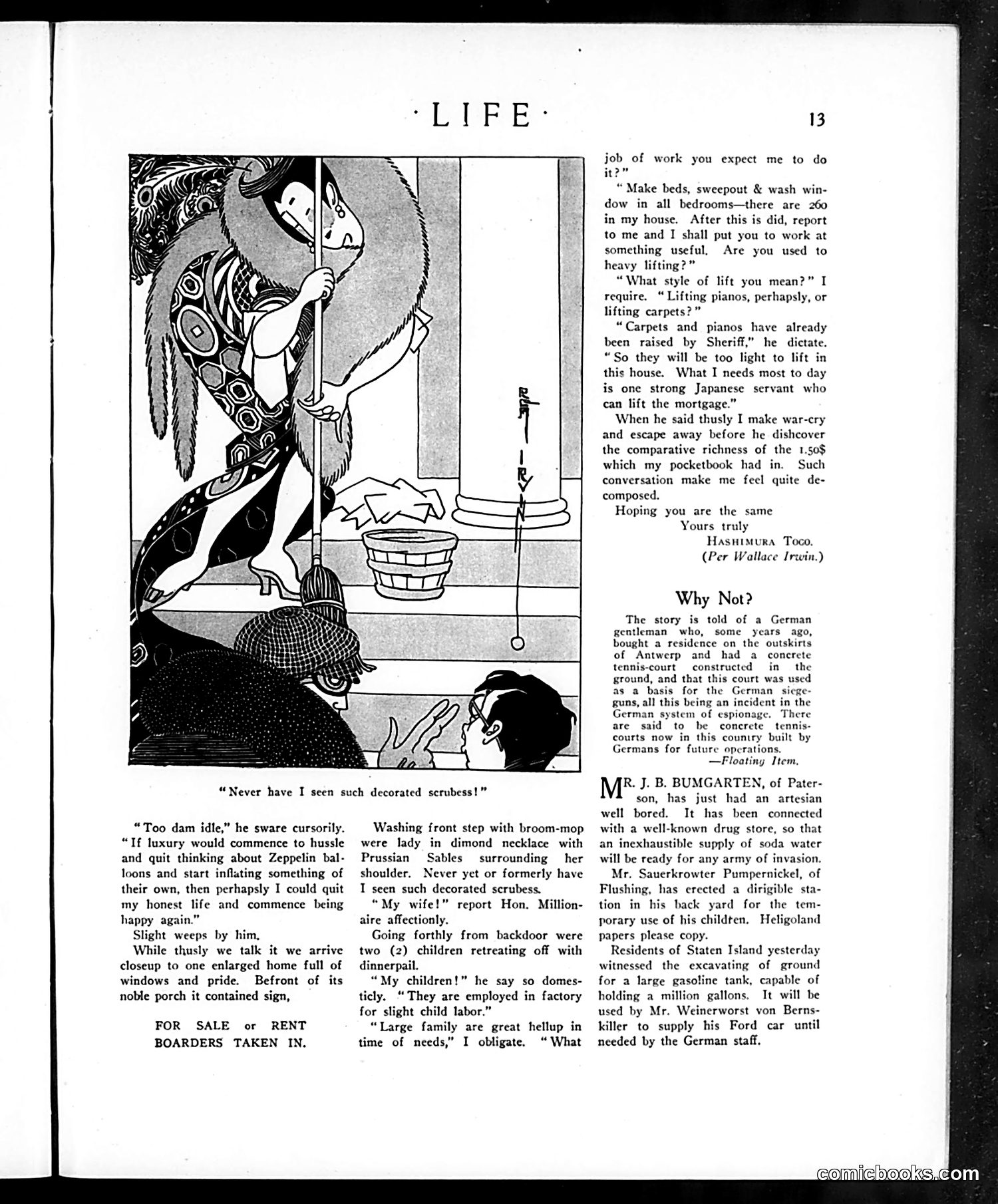
This page contains a satirical cartoon and social commentary typical of Life magazine's humor. The main illustration depicts an elaborate domestic scene with ornate, decorative elements—likely mocking the pretensions of wealthy households. The accompanying text is a letter from "Hashimura Togo" complaining about household management expectations. The character appears to be a servant or immigrant worker frustrated by demands to perform numerous cleaning tasks while maintaining household appearance. The satire targets both the unrealistic expectations of wealthy employers and the ostentatious decoration of their homes. The phrase "Never have I seen such decorated scrubbess!" (likely "scrubbs") suggests mockery of ornate household furnishings that create excessive cleaning burdens. Additional brief items address German espionage and artesian wells—typical magazine miscellany of the period.
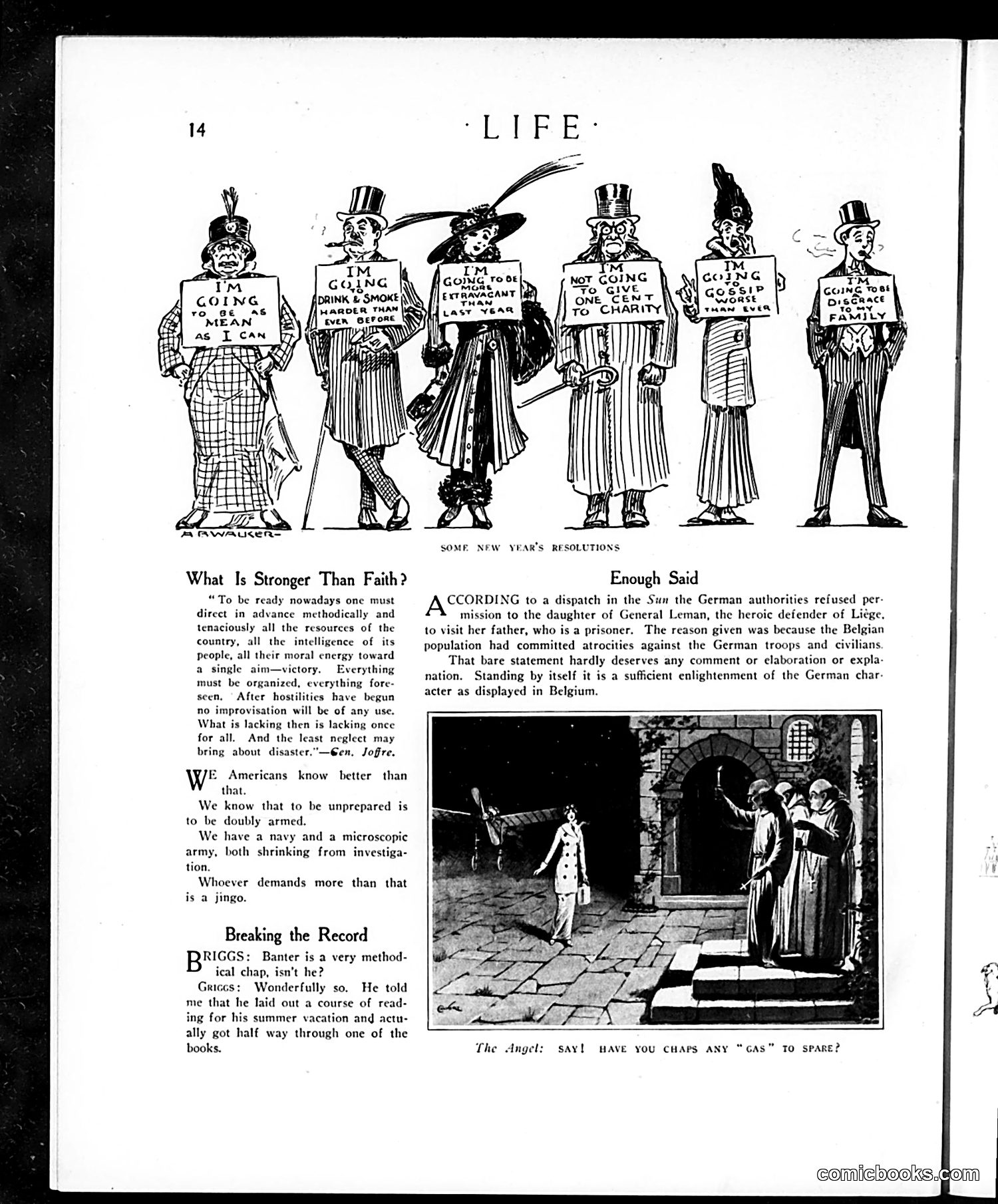
**Top Cartoon: "Some New Year's Resolutions"** Six figures hold signs with humorous New Year's pledges—satirizing hollow promises people make annually. The resolutions range from vague ("I'm going to be as lean as I can") to cynical ("Not going to give one cent to charity"). The cartoon mocks the predictable failure of self-improvement vows. **Articles Below:** "What Is Stronger Than Faith?" discusses American military preparedness, warning against complacency. "Enough Said" references German authorities refusing General Leman's daughter permission to visit her imprisoned father during WWI, presenting this as evidence of German brutality toward civilians. **Bottom: "Breaking the Record"** A brief humorous exchange between characters named Briggs and Griggs about summer reading.
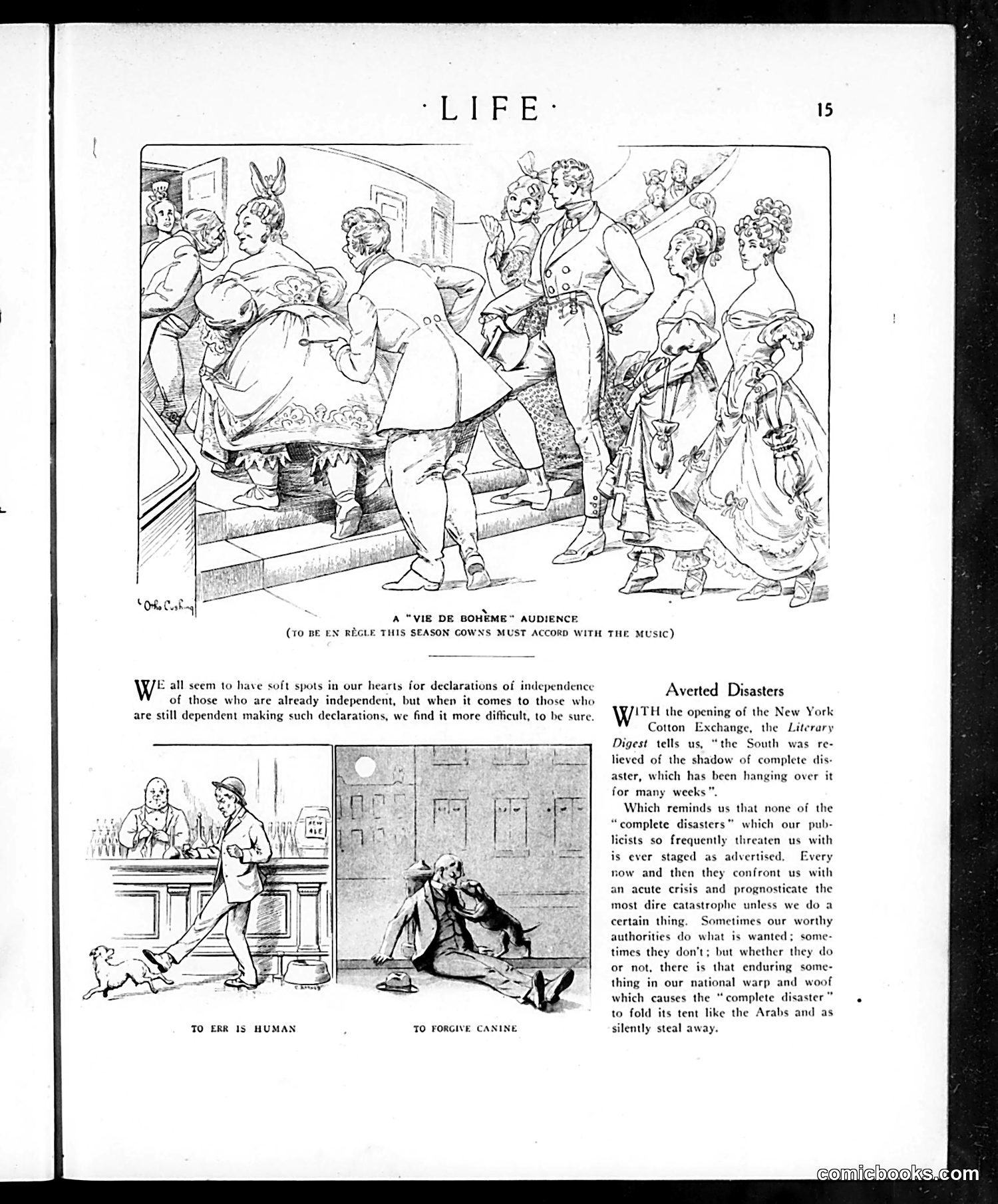
**Top Cartoon:** A satirical scene titled "A 'Vie de Boheme' Audience" depicts fashionably dressed women at what appears to be a theatrical or social event. The caption jokes that "season gowns must accord with the music"—mocking the pretension of high society, where attendees obsess over coordinating their expensive clothing to the performance rather than genuinely engaging with art. **Bottom Cartoons:** Two contrasting scenes illustrate moral philosophy: "To Err Is Human" shows a man scolding another, while "To Forgive Canine" depicts a dog forgiving its master despite mistreatment. The juxtaposition suggests humans are hypocritical—quick to judge each other but readily forgive animals. **"Averted Disasters" Essay:** Commentary on American media's tendency to predict catastrophes that never materialize. The example cites the Literary Digest claiming the New York Cotton Exchange opening "relieved" the South of disaster. The author argues that despite dire predictions from publicists and authorities, America's resilience causes predicted crises to "silently steal away"—a satirical critique of sensationalism and false alarmism.
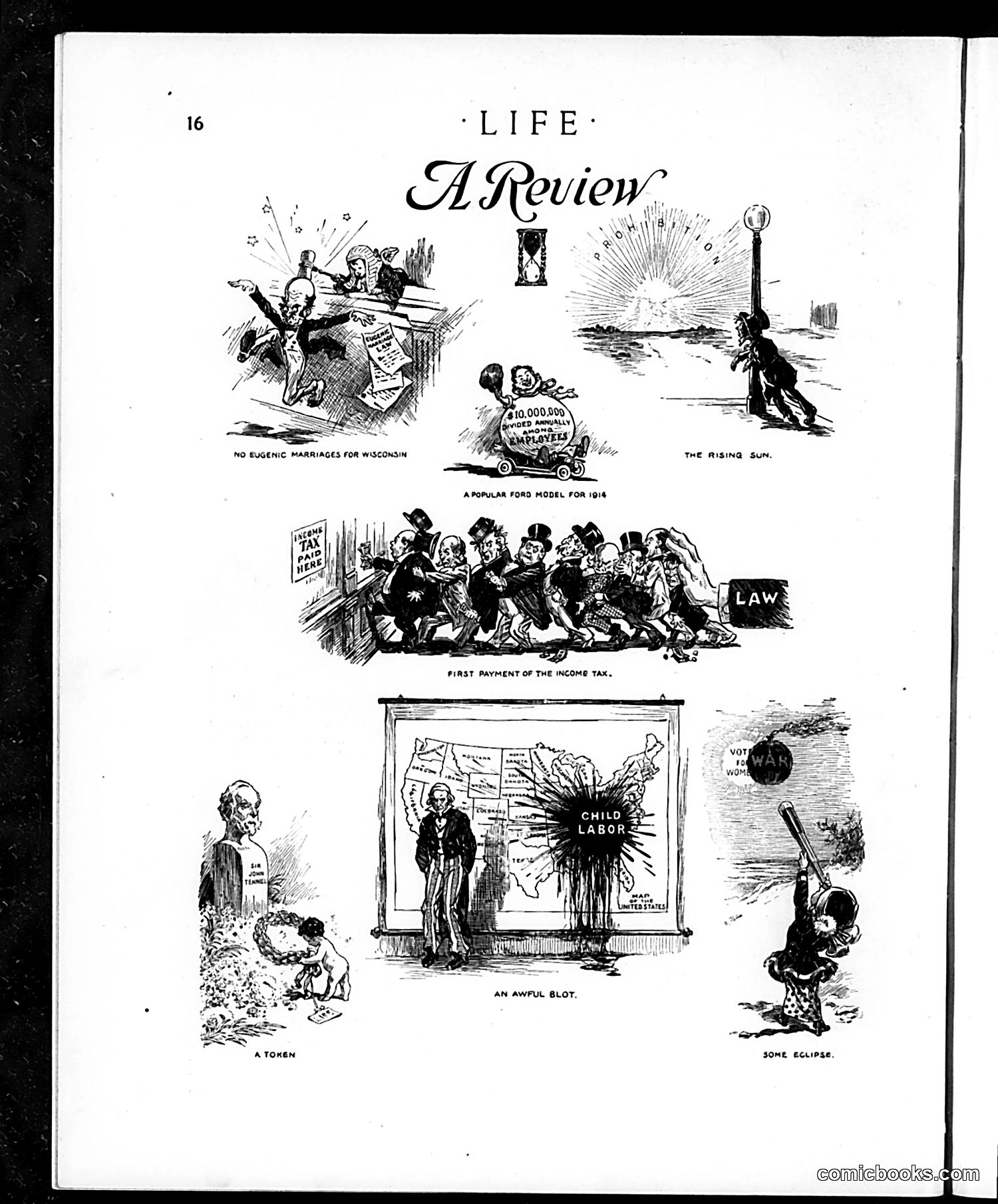
This satirical page from Life magazine presents six political cartoons critiquing early 1914 American issues: 1. **"No Eugenic Marriages for Wisconsin"** — mocks Wisconsin's eugenic marriage laws through chaotic imagery. 2. **"A Popular Ford Model for 1914"** — depicts a car labeled with "$10,000,000 WAGES ANNUALLY TO EMPLOYEES," likely satirizing Henry Ford's famous five-dollar workday announcement as performative corporate virtue. 3. **"The Rising Sum"** — unclear reference, appears to depict a figure at sunrise. 4. **"First Payment of the Income Tax"** — shows crowds confused by newly-implemented federal income tax (16th Amendment, 1913). 5. **"Child Labor" / "An Awful Blot"** — criticizes child labor practices through a map highlighting the problem. 6. **"A Token" and "Some Eclipse"** — meanings unclear from visible text and imagery alone. The page reflects Progressive Era reform debates.
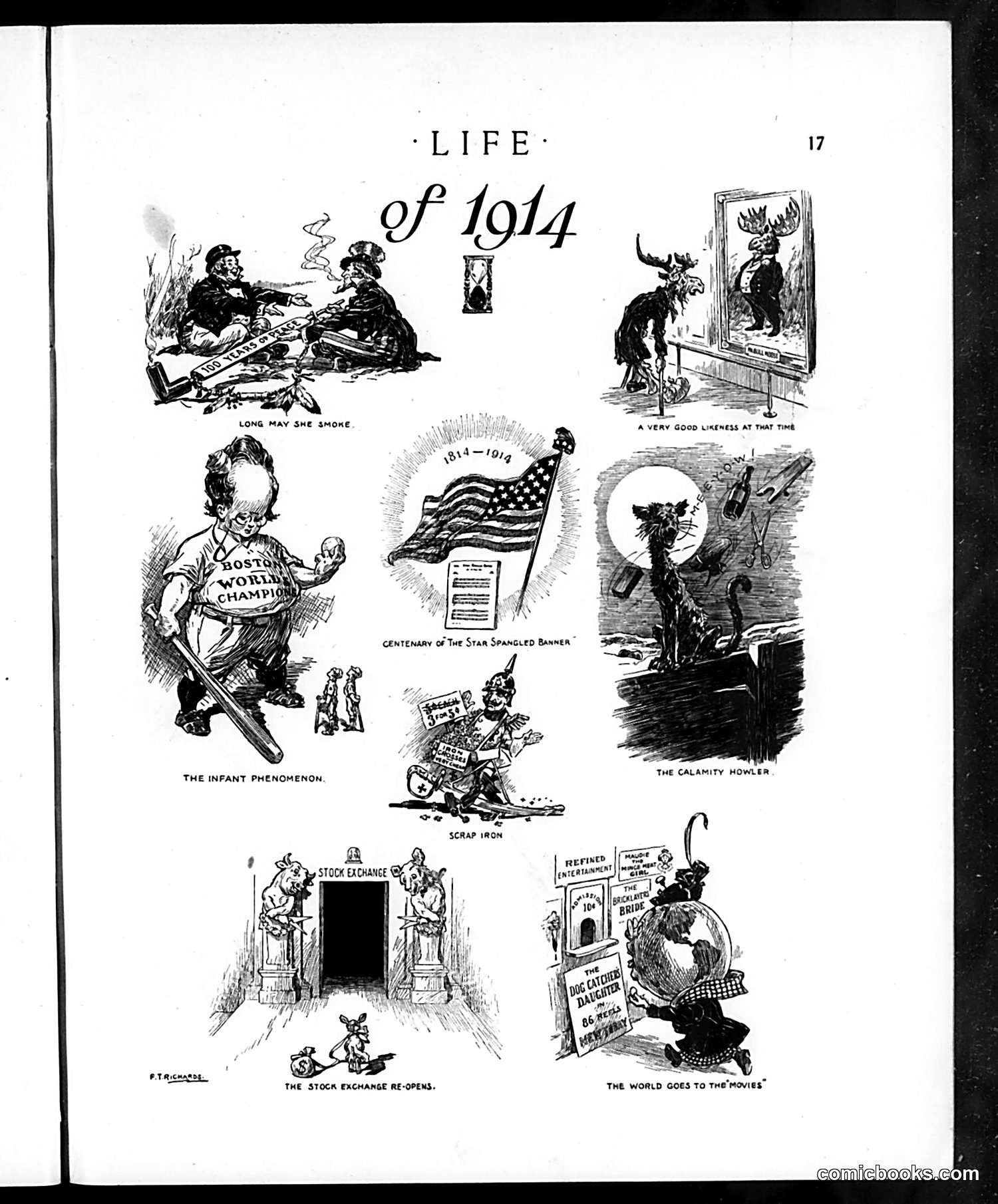
This page presents satirical cartoons about 1914 America. The cartoons mock various contemporary figures and events: **"The Infant Phenomenon"** depicts a Boston boxing champion, likely satirizing a celebrity athlete of the era. **"The Calamity Howler"** shows a figure howling at the moon—apparently mocking someone perceived as an alarmist or doomsayer about current events. **"A Very Good Likeness at That Time"** references someone's reflection, though the specific target is unclear from the image alone. **"The Stock Exchange Re-Opens"** celebrates the market's reopening, likely after closure due to World War I's outbreak that year. **"Centenary of the Star Spangled Banner"** marks the 100th anniversary of the American anthem (1814-1914). **"The World Goes to the Movies"** satirizes growing film entertainment popularity during this period. The page captures 1914's mix of American confidence, wartime anxiety, and emerging mass culture.
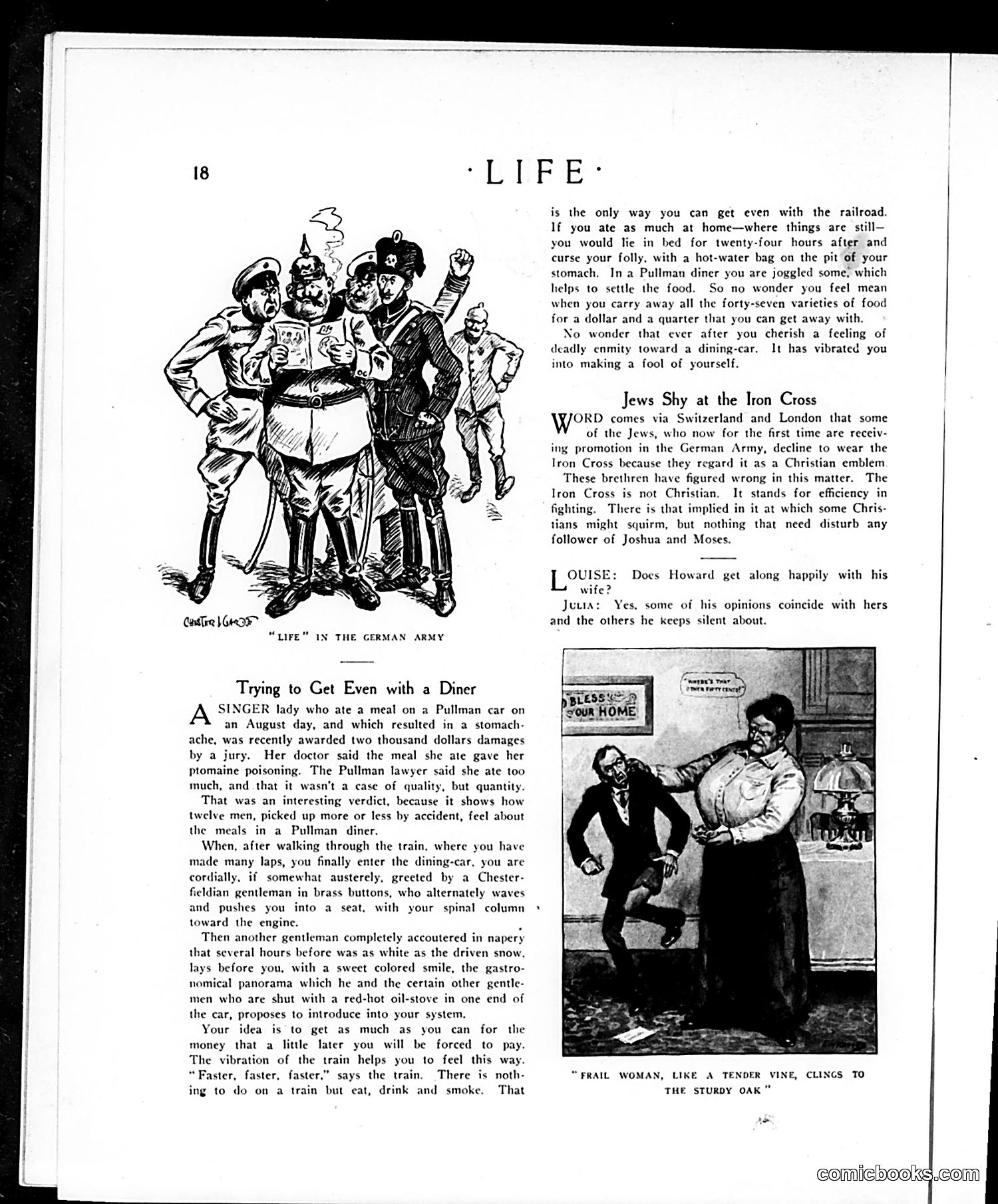
**Main Cartoon ("Life in the German Army"):** The cartoon depicts caricatured German military officers in exaggerated uniforms. This appears to satirize German militarism and the perceived pomposity of the German Army, likely from the pre-WWI or WWI era when Life frequently mocked German military culture. **"Trying to Get Even with a Diner":** This article humorously critiques Pullman railroad dining cars. It describes passengers deliberately overeating cheap food to "get even with the railroad"—framing gluttony as consumer revenge. The satire suggests travelers blame the train's vibrations for their poor digestion and overeating, using it as an excuse for their own excess. **"Jews Shy at the Iron Cross":** This brief piece addresses Jews in the German Army declining the Iron Cross decoration, viewing it as Christian symbolism. The author argues the Iron Cross represents military efficiency, not Christianity, and shouldn't concern Jewish soldiers. This reflects early-20th-century discussions of Jewish military service and assimilation in Germany. **Bottom item:** A brief exchange about marital compatibility with humorous undertones about disagreement and silence in marriage.
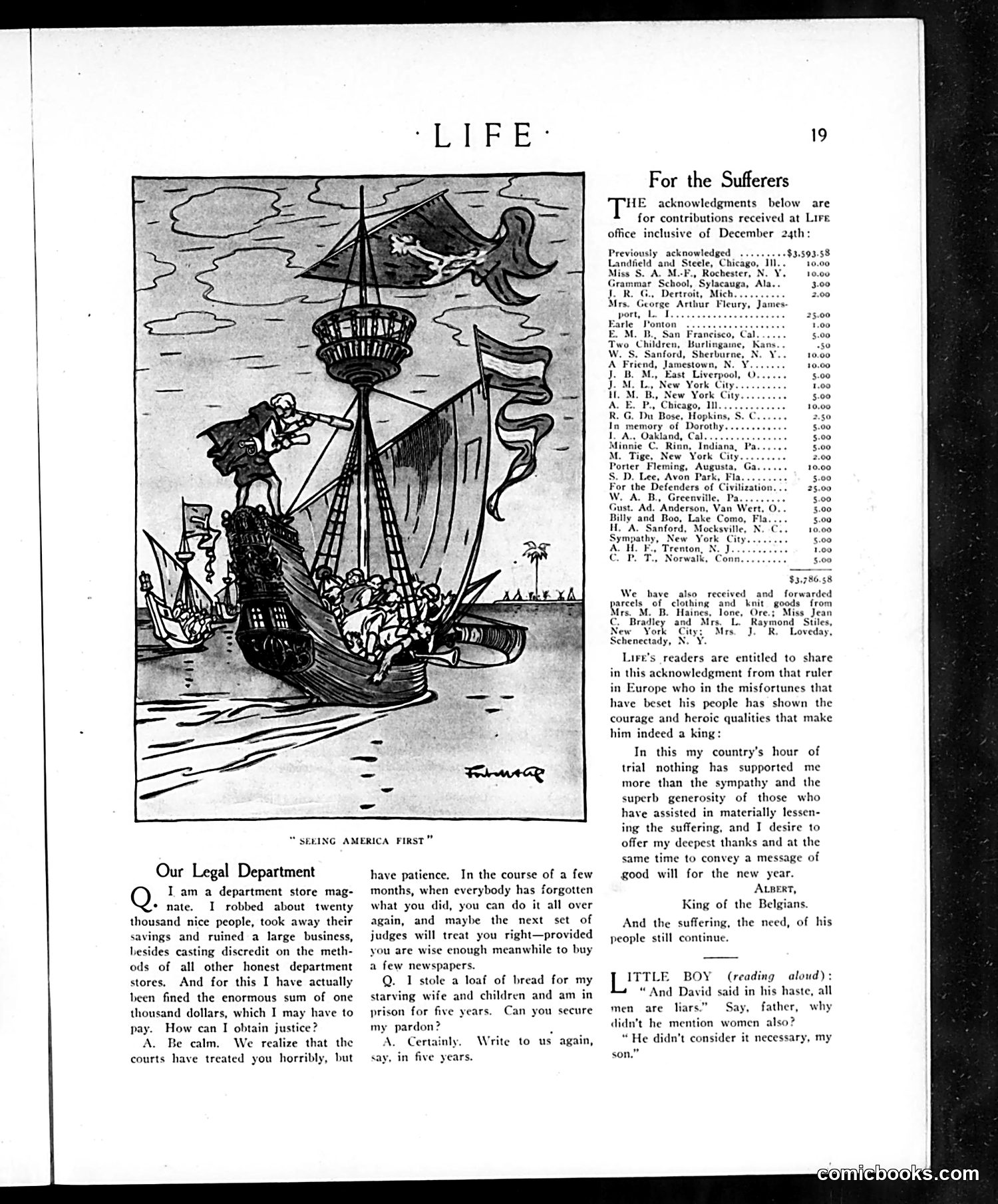
This page contains satirical commentary on class justice and charitable relief during World War I. **The "Legal Department" cartoon** mocks systemic inequality: a wealthy department-store magnate who defrauds twenty thousand people receives only a $1,000 fine, while a starving man imprisoned five years for stealing bread cannot secure pardon. The joke is bitterly ironic—the advice column suggests the rich criminal can simply repeat his crime after public memory fades, while the poor man must wait years. This satirizes how courts treat the wealthy and desperate differently. **"For the Sufferers"** acknowledges donations to relief efforts, likely for Belgian war victims (referenced by King Albert's gratitude message). The page implies readers should feel morally superior donating to distant suffering while ignoring domestic injustice. **The final joke** about David's statement that "all men are liars" plays on gender bias, with the father suggesting women weren't worth mentioning—a mild jab at male-centered perspectives.
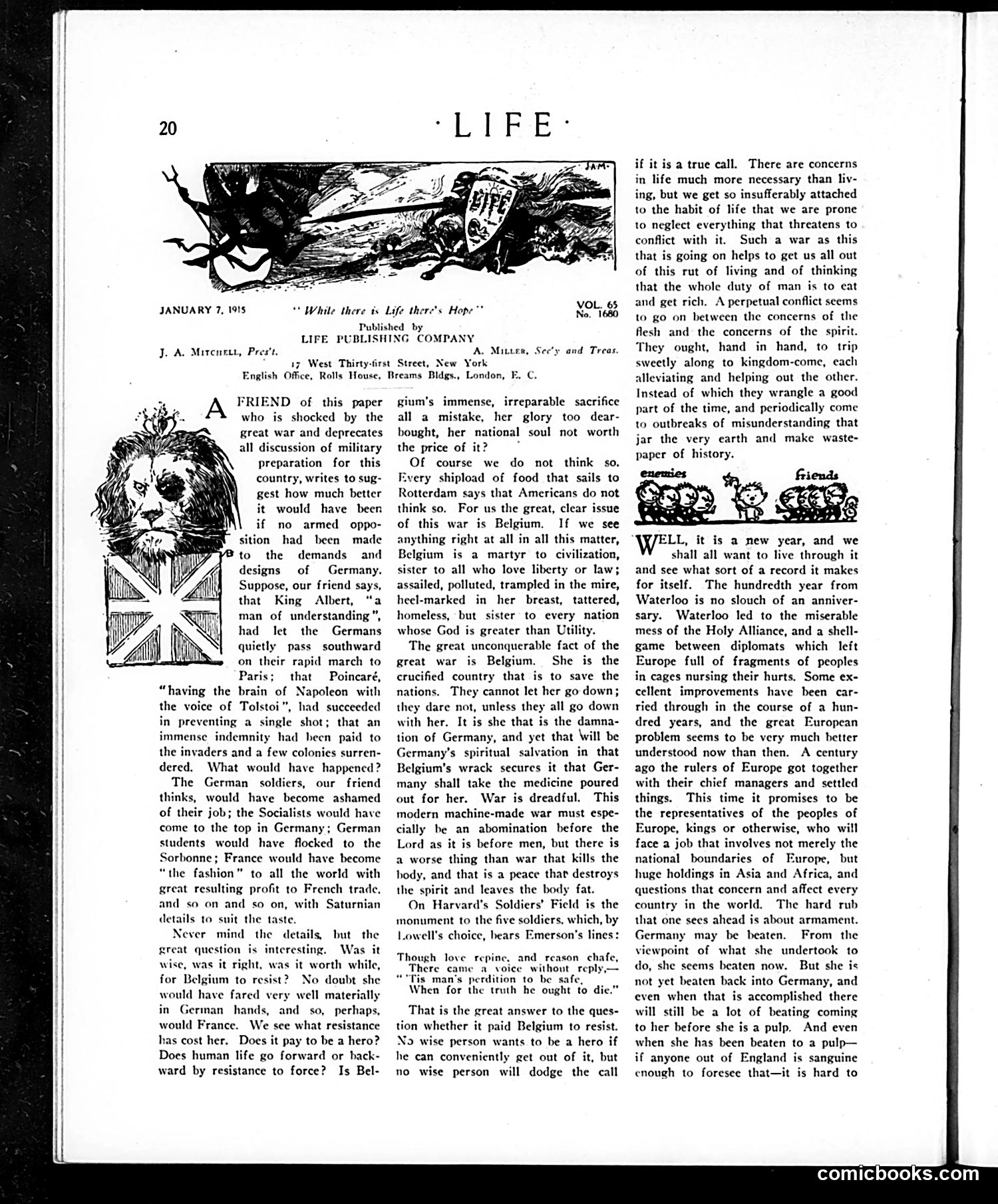
This editorial page argues passionately that Belgium's military resistance to German invasion in 1914 was morally justified, despite its devastating human and material costs. The piece responds to a pacifist reader who suggested Belgium would have fared better by surrendering without fight. Life's editors reject this logic, framing Belgium as a "martyr to civilization" whose resistance—though costly—serves a spiritual purpose greater than mere survival. They argue that some values (liberty, moral principle) matter more than physical safety or prosperity. The accompanying illustration shows a lion wearing a cross, likely symbolizing Belgium's courage and Christian sacrifice. The text references King Albert and French President Poincaré as leaders who chose principled resistance over pragmatic surrender. Published during WWI's early stages, this reflects American intellectual debate over whether the war was justified—before America's 1917 entry—and uses Belgium's plight as the moral centerpiece of pro-Allied argument.
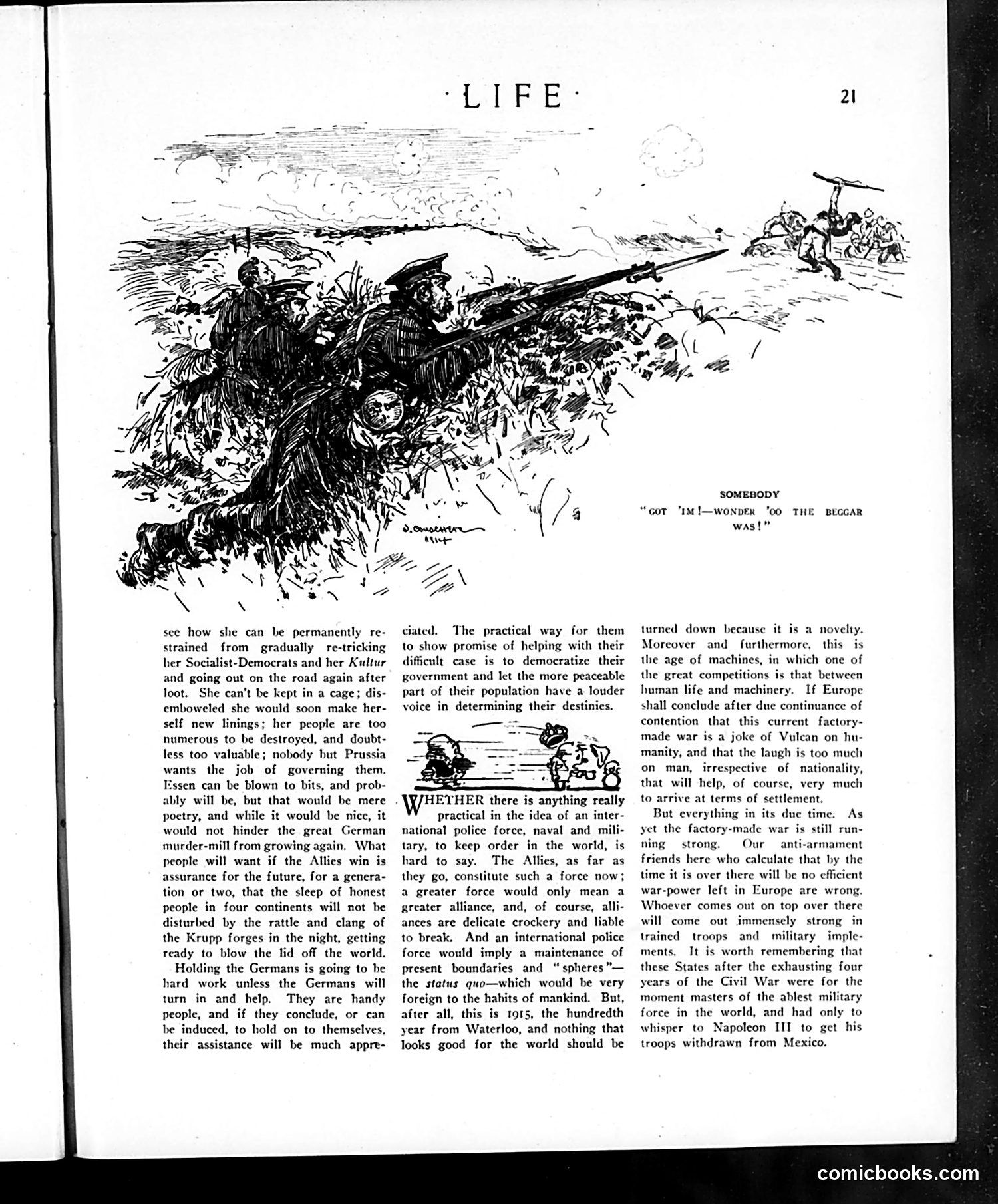
This page contains editorial commentary on World War I (then ongoing in 1915) alongside a satirical cartoon titled "Somebody." **The Cartoon:** Shows a grotesque, demonic figure labeled as Germany emerging from trenches with a rifle, while soldiers observe from a distance. The caption reads: "Got 'im!—Wonder 'oo the beggar was!" The figure appears to be a caricature representing Germany or "Prussian militarism." **The Text's Message:** The article argues that defeating Germany militarily isn't enough—the Allies must ensure Germany cannot restart wars. The writer proposes Germany democratize its government to give "peaceable" citizens more voice, preventing future aggression. The piece also discusses whether an international police force could maintain post-war peace. **Historical Context:** This reflects 1915 anxieties about industrial warfare's scale and the challenge of preventing future German aggression. The reference to the Krupp munitions works and desire to "permanently restrain" Germany foreshadows post-WWI concerns that shaped the Treaty of Versailles. **The Satire:** Mocks the notion of simply destroying Germany's military capacity while suggesting systemic change—democratization—is the real solution.
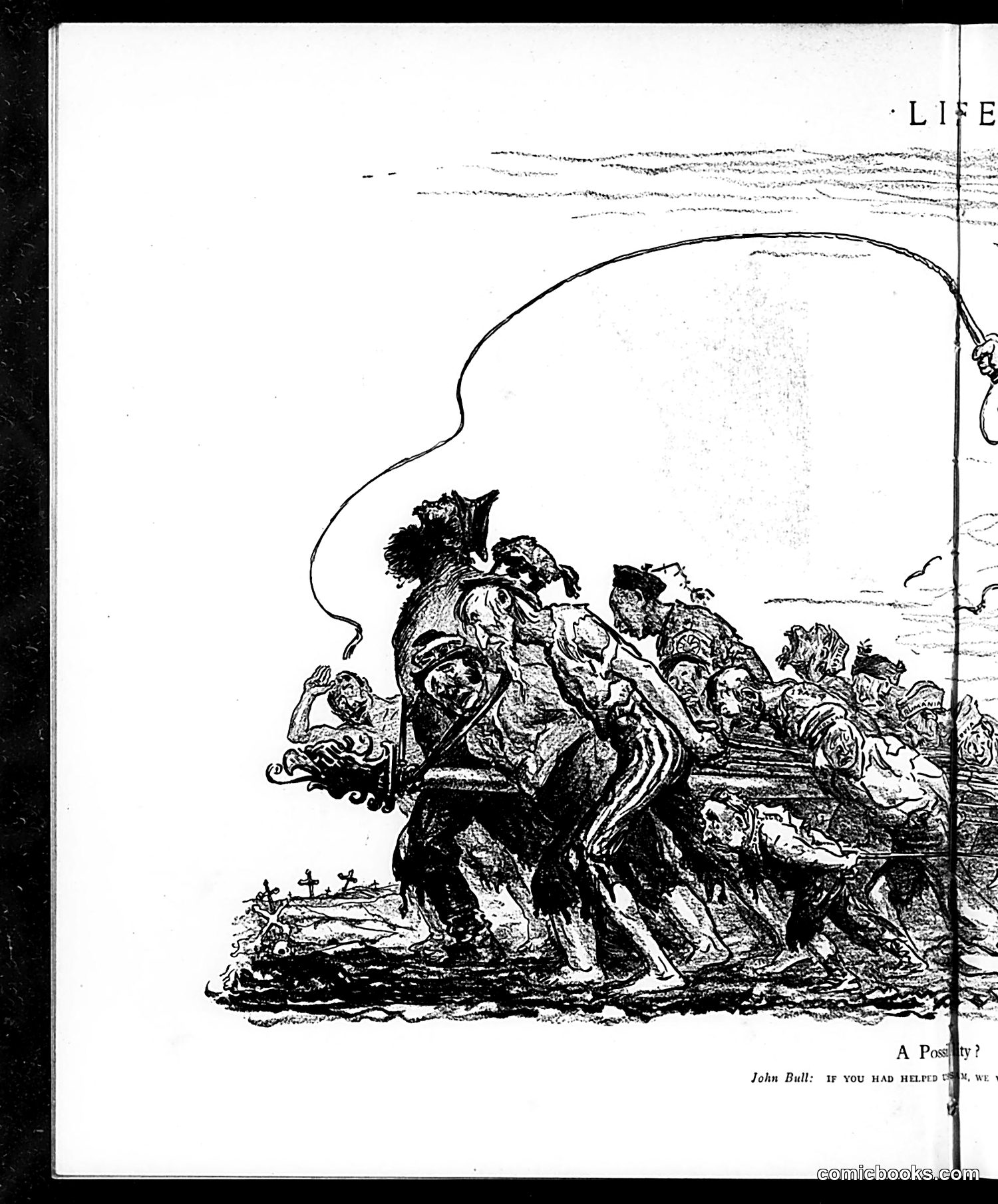
This appears to be a British satirical cartoon from *Life* magazine featuring **John Bull** (the personification of Britain, identifiable by his characteristic portly figure and period dress) addressing a crowd of soldiers or military figures. The partial caption reads: "John Bull: If you had helped [unclear], we 5..." The word "CAPS" is visible but context is incomplete. The cartoon likely critiques British military or political decisions—possibly regarding the failure to support an ally or military campaign. The crowd of armed men gesturing toward John Bull suggests collective complaint or accusation. Without the full caption and specific date, the exact historical event cannot be definitively identified, though it appears to address a controversial British military or diplomatic failure during a conflict involving multiple nations.
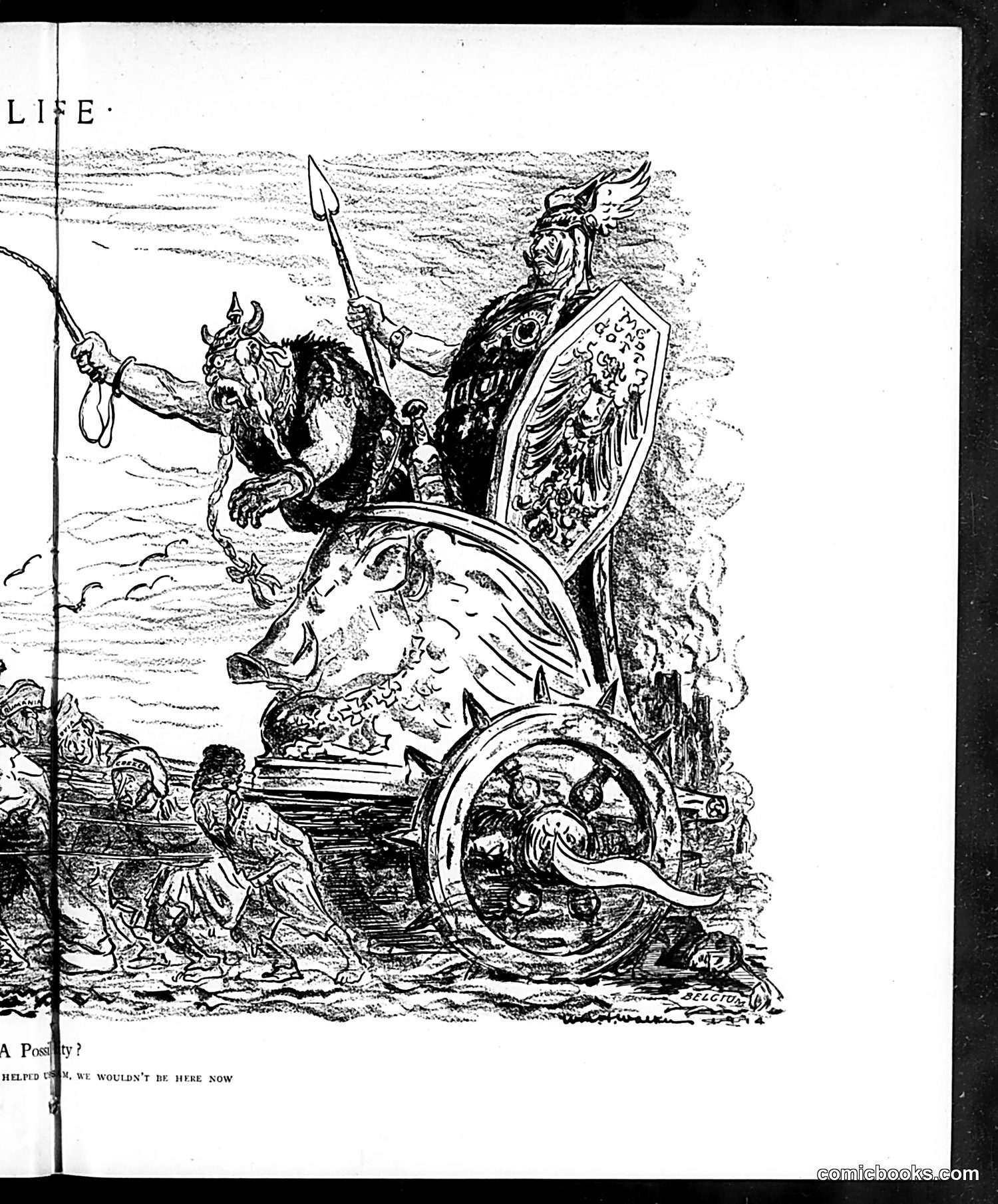
This appears to be a satirical cartoon from *Life* magazine depicting a mythological or allegorical scene. A horned, demonic figure (possibly representing a historical enemy or negative force) rides in a chariot pulled by what looks like a beast, wielding weapons and a decorative shield. Below, smaller figures appear to be soldiers or common people. The caption "A Possibility?" combined with "HELPED US[?], WE WOULDN'T BE HERE NOW" suggests a cautionary or counterfactual argument—likely warning against a specific historical decision or alliance. Without the complete OCR text and publication date, the exact political context remains unclear, but the tone suggests commentary on a controversial foreign policy choice or military decision that the cartoonist argues led to an undesirable present situation.
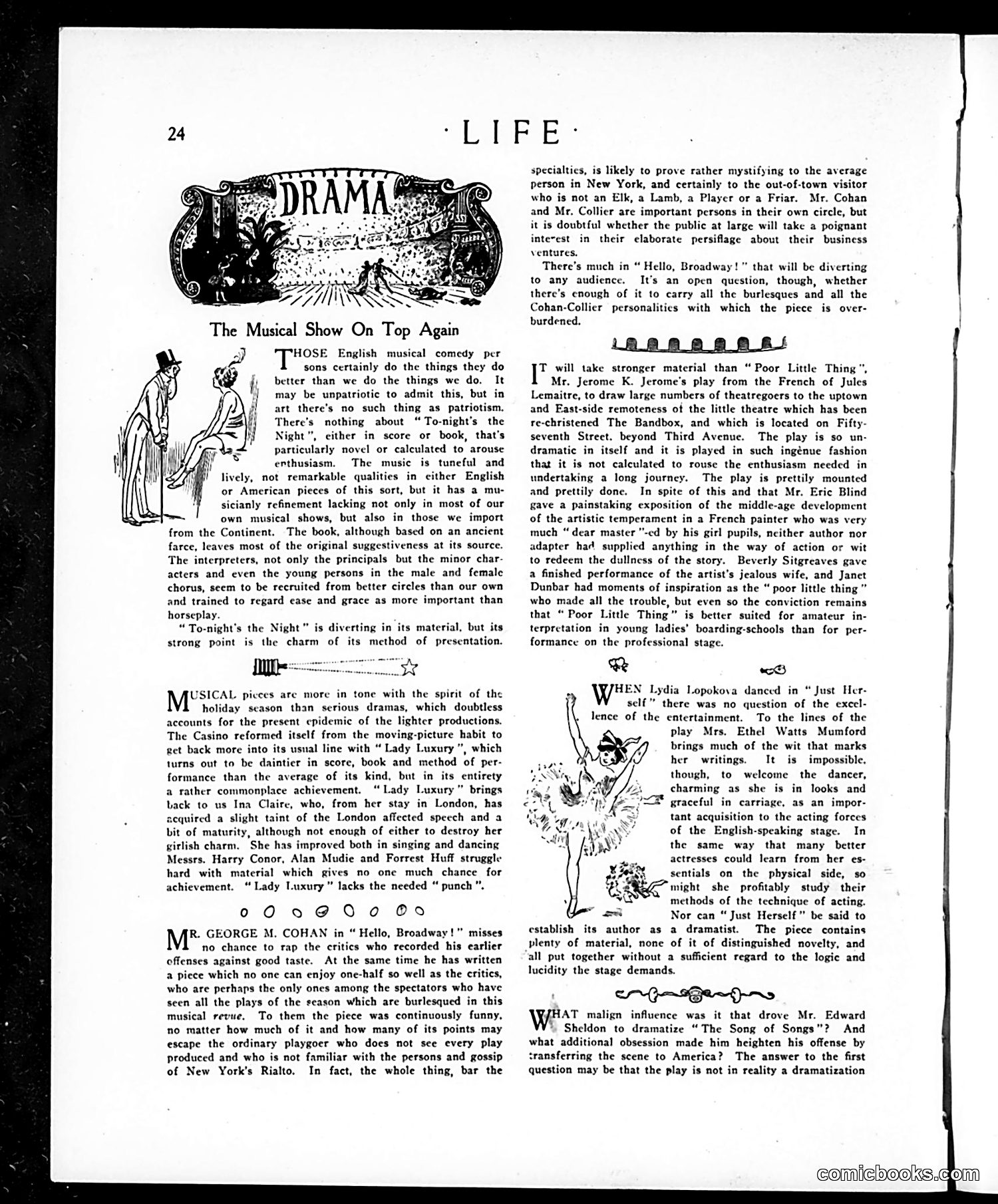
This is a theater review section critiquing several Broadway productions. The main cartoon illustrates "The Musical Show On Top Again"—depicting English musical comedies' superiority over American ones. The illustrated figures show the refinement and ease of English performers versus American theatrical roughness. The reviews discuss specific shows: "Tonight's the Night" (praised for charm and musicianly refinement), "Lady Luxury" (featuring actress Ina Claire, critiqued as commonplace), and George M. Cohan's "Hello, Broadway!" (a self-referential revue where Cohan mocks theater critics). The satire targets Cohan's inside-joke humor—the piece heavily references New York theater world figures ("Elks, Lambs, Players, Friars") and will confuse general audiences unfamiliar with Broadway gossip. The critic suggests it's primarily entertaining to theater professionals and critics who recognize the burlesqued references, not mainstream audiences.
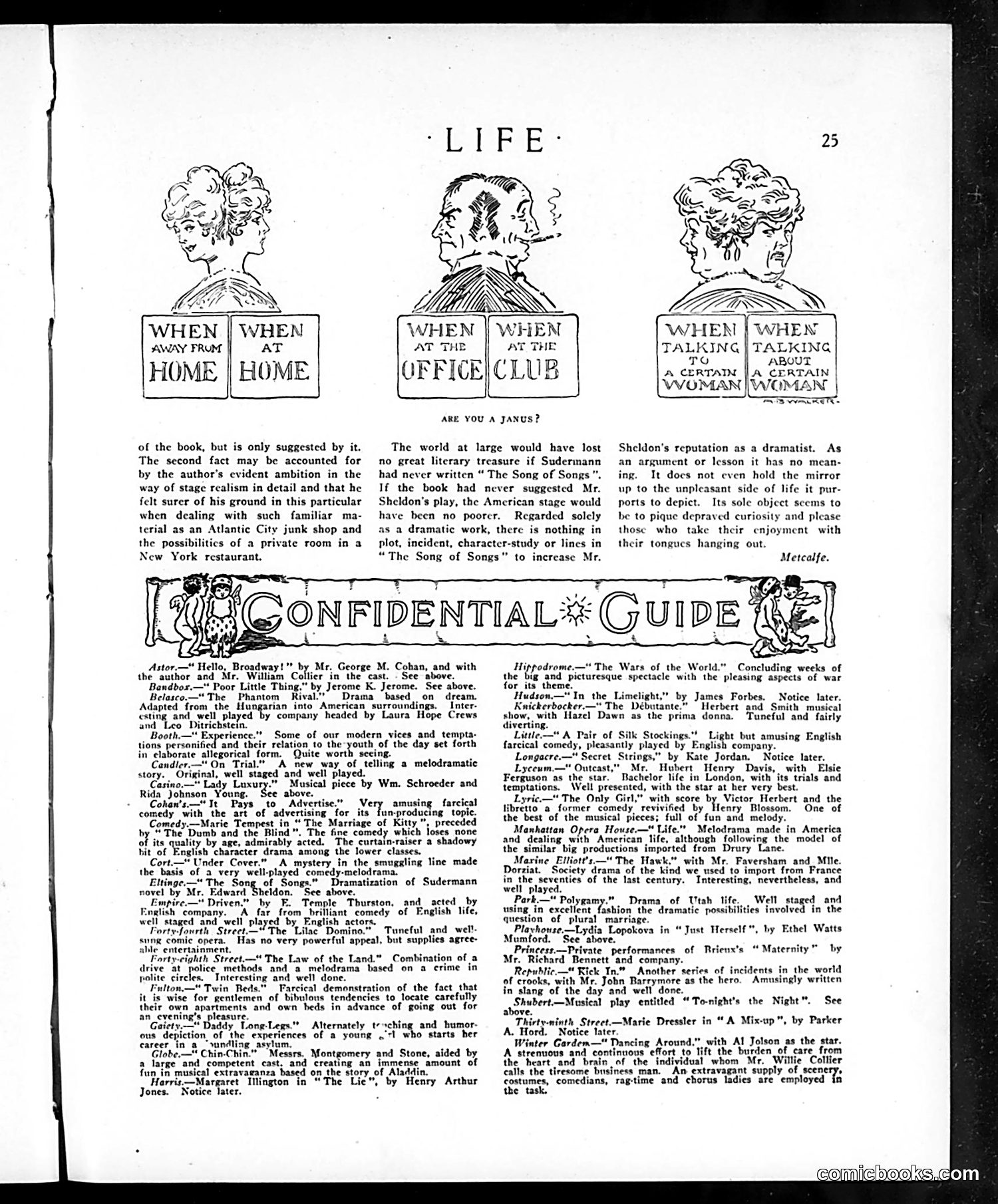
This page features a three-panel cartoon satirizing how people present different personalities in different social settings. Each panel shows a two-faced head (referencing the Roman god Janus, who had two faces looking in opposite directions). **The three scenarios:** 1. A woman "when away from home" versus "when at home" 2. A man "at the office" versus "at the club" 3. A woman "when talking to a certain woman" versus "when talking about a certain woman" **The satire:** The cartoon mocks the hypocrisy of early 20th-century social behavior — specifically how people adopt different personas depending on their audience and setting. The implication is that people are dishonest or two-faced in their social interactions, behaving differently when being observed versus when gossiping or relaxing. The page also contains theater reviews, suggesting this is from Life's entertainment section, circa 1912.
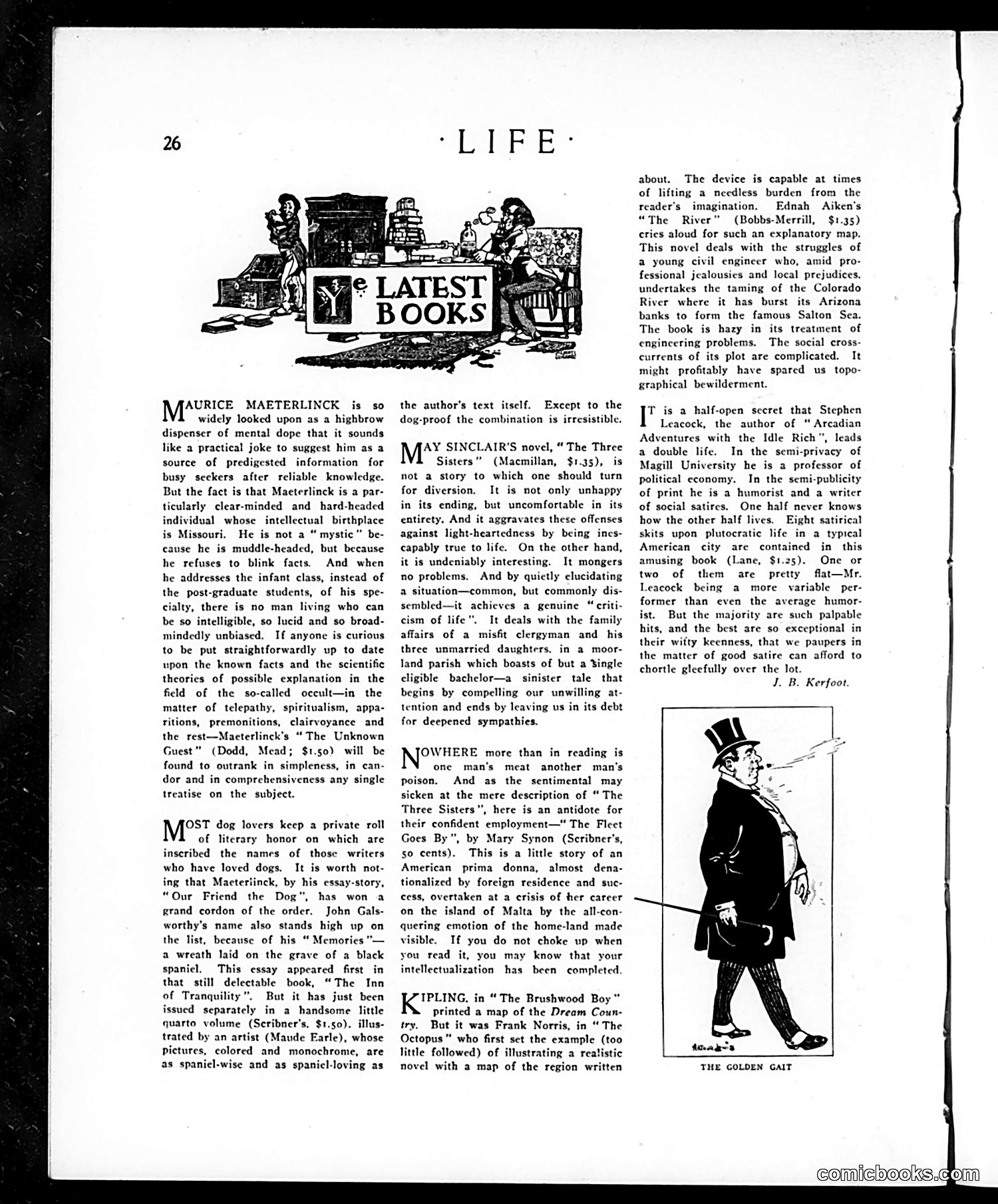
This page reviews contemporary novels and literary figures. The text praises Belgian playwright Maurice Maeterlinck as a clear-minded intellectual (despite his "highbrow" reputation) whose works on occult subjects are comprehensible and factual. It also recommends his essay "Our Friend the Dog," illustrated by Maude Earle. The page includes reviews of May Sinclair's *The Three Sisters* (described as emotionally uncomfortable but truthful) and Mary Synon's *The Fleet Goes By* (a sentimental story about an American opera singer). **The cartoon** (bottom right, labeled "THE GOLDEN GAIT") shows a well-dressed gentleman in top hat and monocle—a stock figure representing upper-class pretension or snobbery common to Life's satirical style, though the specific reference remains unclear without additional context. The overall tone is sophisticated literary criticism for an educated readership interested in contemporary fiction and intellectual discourse.
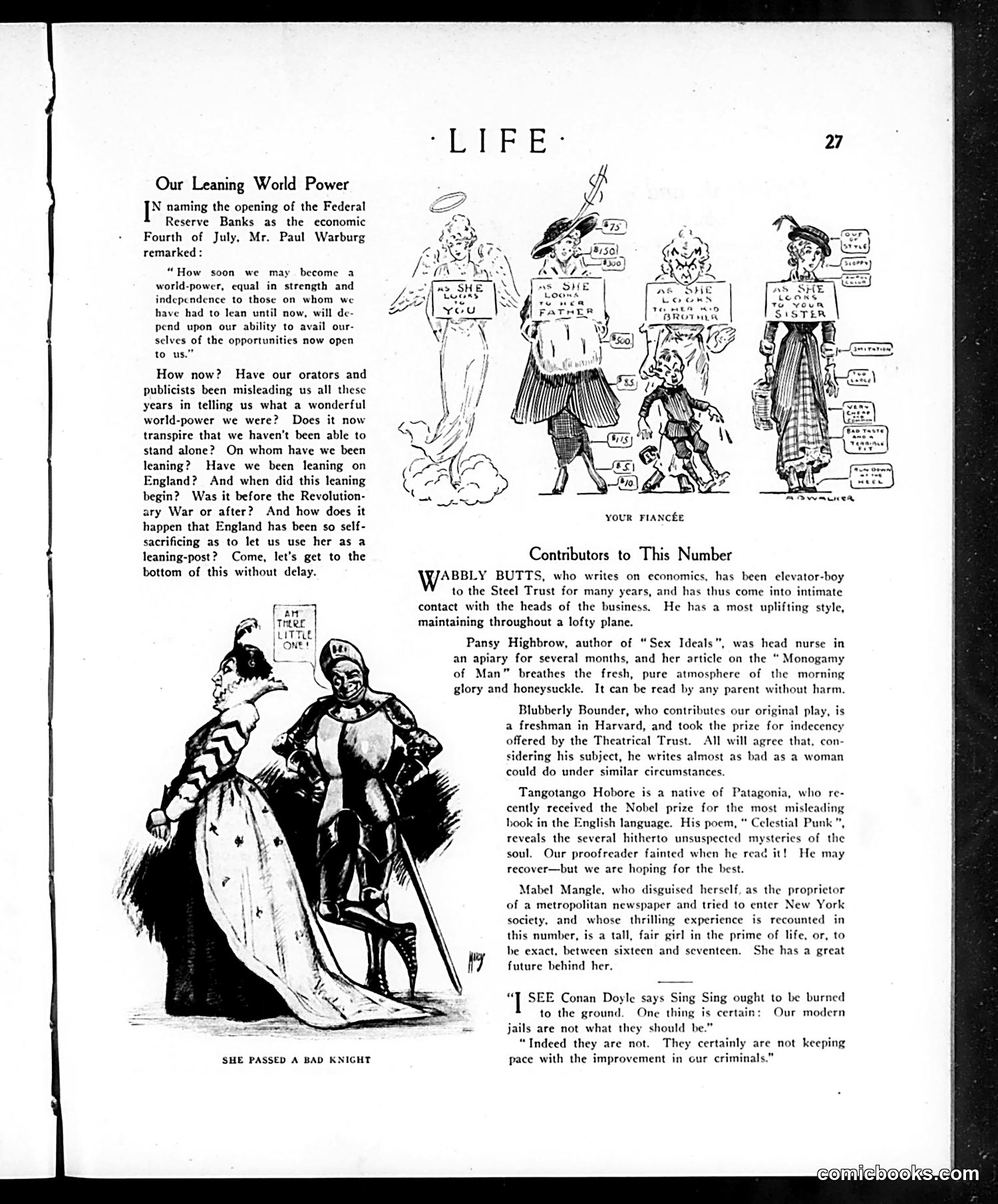
This page satirizes American economic confidence and international standing circa the Federal Reserve's founding (1913). **Main Article Satire:** The piece mocks Paul Warburg's optimistic remarks about America becoming a world power equal to Britain. The author sarcastically questions whether Americans have been deceived—if we're truly powerful, why do we need to "lean" on England? When did this dependence begin? The satire suggests American orators have oversold national strength while the country remained economically dependent on Britain. **Cartoons:** - "Your Fiancée" (top right): A humorous family tree showing a woman's relatives as personified character types ("She Loved Her Father," etc.) - "She Passed a Bad Knight" (bottom left): Shows a woman encountering an armored knight—likely a pun on "bad night" **Contributors Section:** Mock biographies hilariously discredit the writers through absurd credentials (economist "contact with Steel Trust," author trained in an apiary, playwright won prize for indecency). The overall tone ridicules both American pretensions to power and the magazine's own contributors.
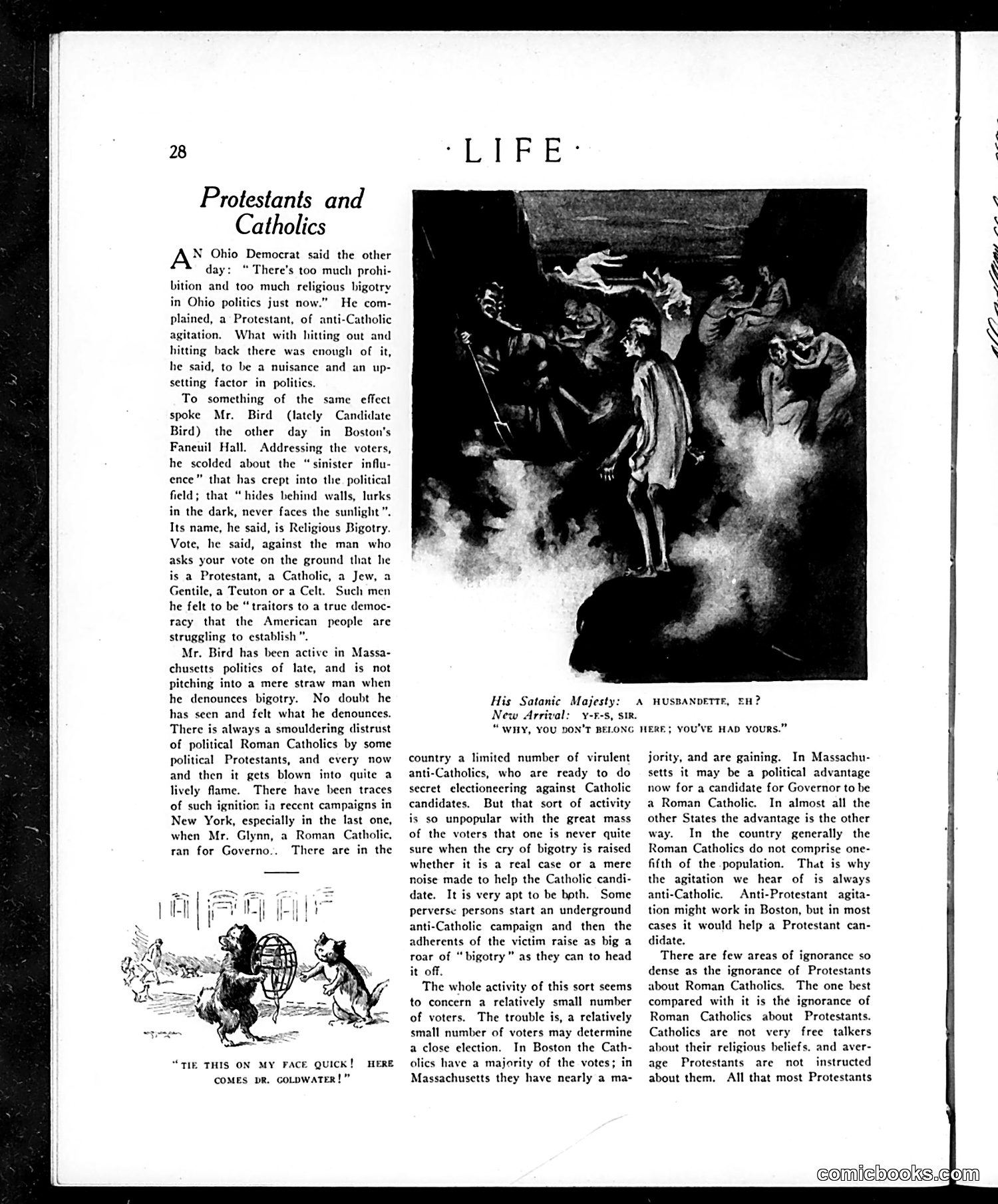
This page addresses religious bigotry in American politics, featuring two editorial cartoons. **Top cartoon**: Depicts Satan welcoming a new arrival ("a husbandette") to Hell, saying "Why, you don't belong here; you've had yours." The caption references this as "His Satanic Majesty," suggesting the cartoon critiques someone for already experiencing their personal hell—likely a politician targeted by religious attacks. **Bottom cartoon**: Shows a figure frantically saying "Tie this on my face quick! Here comes Dr. Goldwater!"—apparently mocking politicians who adopt false personas or positions when certain voters approach. **Main article**: Discusses Protestant-Catholic tensions in recent elections, particularly Massachusetts and Ohio politics. It criticizes both overt anti-Catholic campaigning and opportunistic invocations of "bigotry" charges. The article notes Catholics comprise a minority nationally but a majority in Massachusetts, making religious appeals strategically different by region. It concludes that mutual ignorance between Protestant and Catholic voters perpetuates the problem. The satire targets politicians exploiting sectarian divisions for electoral advantage.
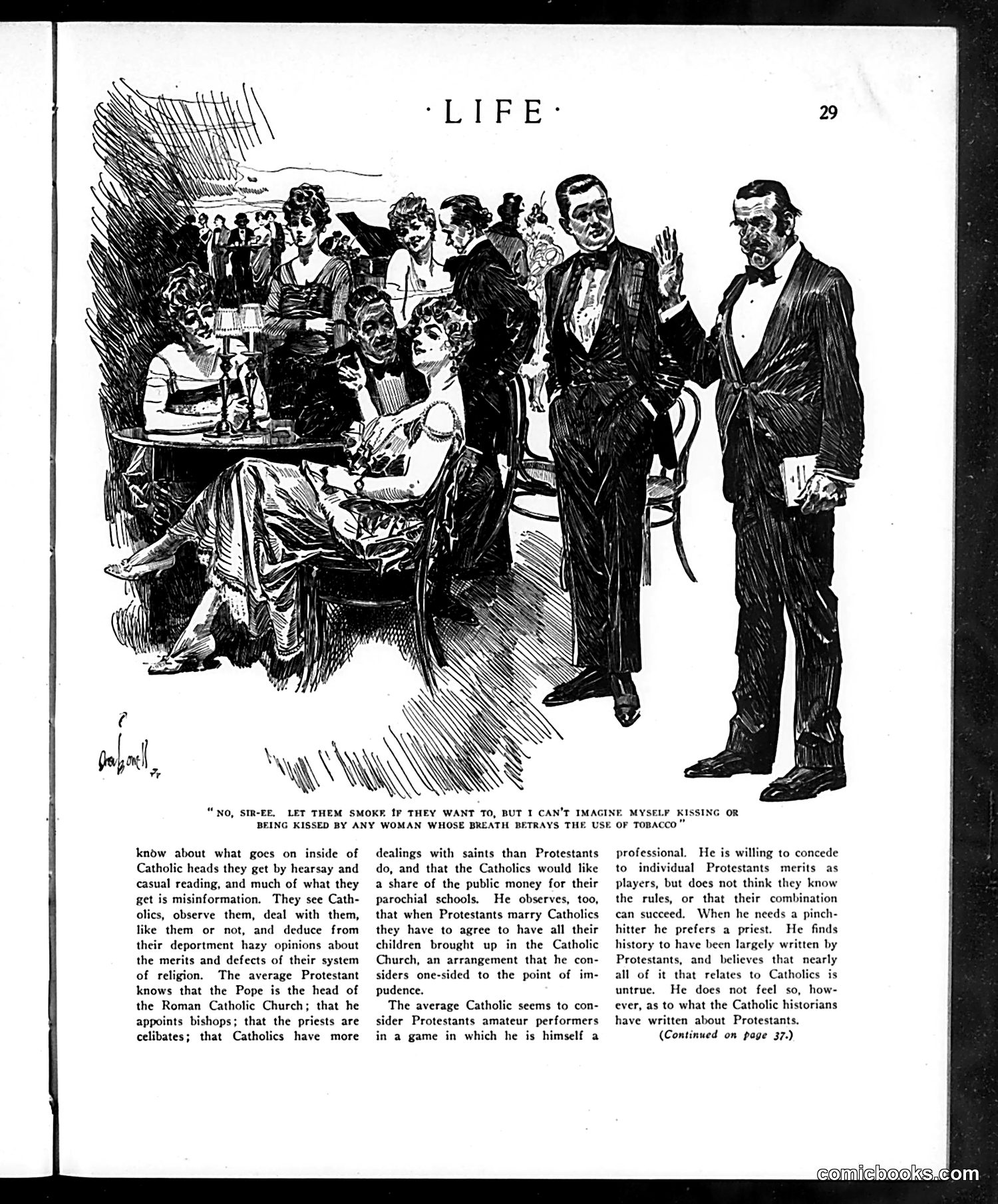
This page satirizes Protestant-Catholic tensions in early 20th-century America. The cartoon depicts a formal social gathering where a well-dressed man refuses a woman's kiss, claiming he cannot kiss someone whose breath "betrays the use of tobacco." The accompanying article discusses mutual stereotypes and misunderstandings between Protestants and Catholics. It notes that average Protestants view Catholics through hearsay and casual observation, knowing basic doctrines (papal authority, clerical celibacy, saint veneration, desire for parochial school funding). Conversely, Catholics consider themselves professionals in religious matters while viewing Protestants as amateurs. The satire likely juxtaposes the man's fastidious moral objection to tobacco with the broader religious and social divisions described in the text—suggesting that superficial propriety masks deeper sectarian prejudices. The cartoon ridicules both the affected prudishness and the underlying Protestant-Catholic animosity that characterized American society of this era.
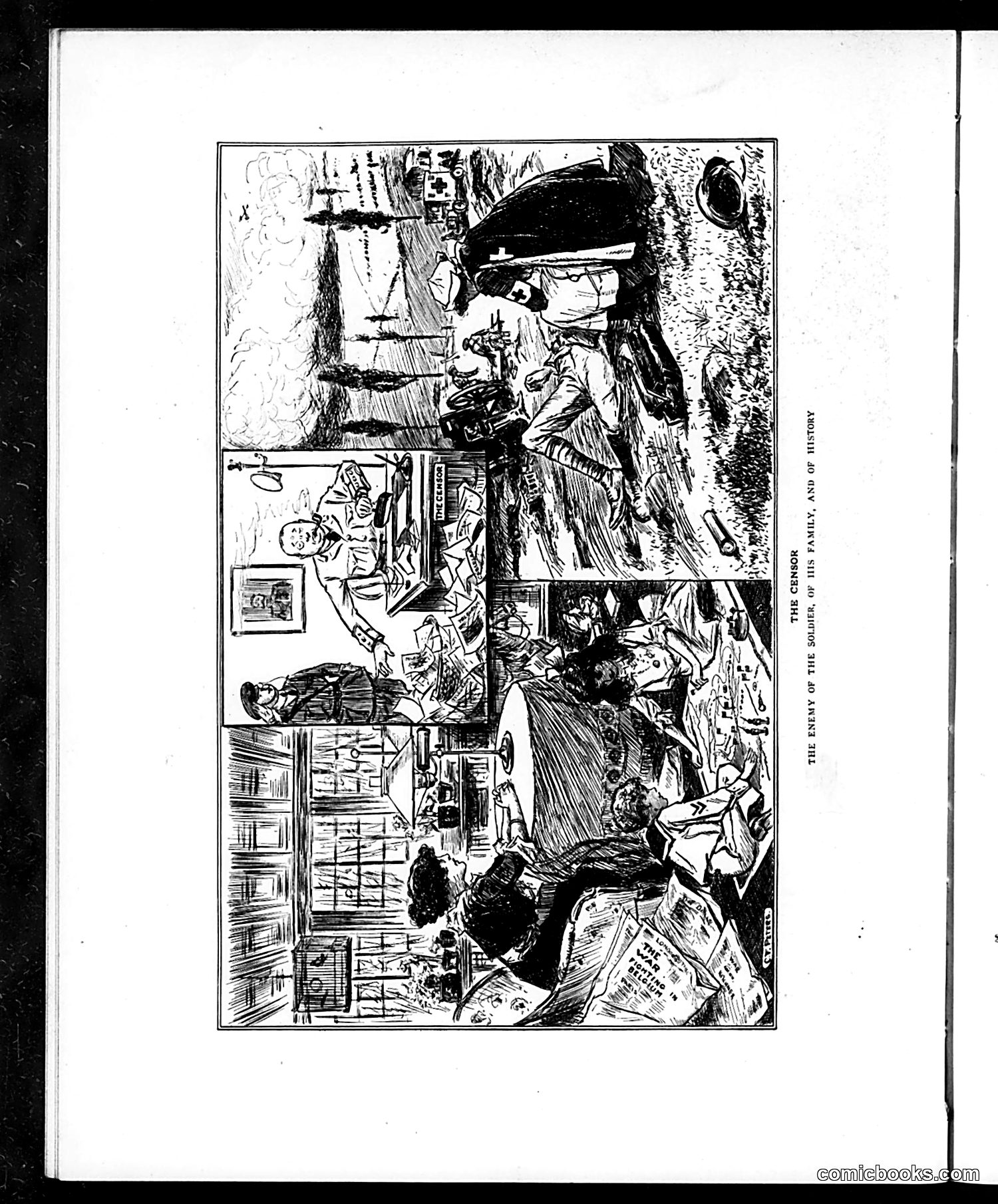
This appears to be a multi-panel satirical cartoon criticizing wartime censorship. The title "THE CENSOR" and subtitle "THE ENEMY OF THE SOLDIER, OF HIS FAMILY, AND OF HISTORY" indicate the cartoon attacks censorship authorities. The panels likely depict censors blocking or redacting soldiers' correspondence, preventing families from receiving honest information about war conditions, and obscuring historical documentation. The layout suggests sequential scenes showing how censorship affects different groups—soldiers, their families, and historians. Without clearer image resolution, I cannot identify specific figures or date this precisely, but the anti-censorship message is explicit. This reflects early-to-mid 20th-century debates about press freedom during wartime, when military censorship was standard practice.
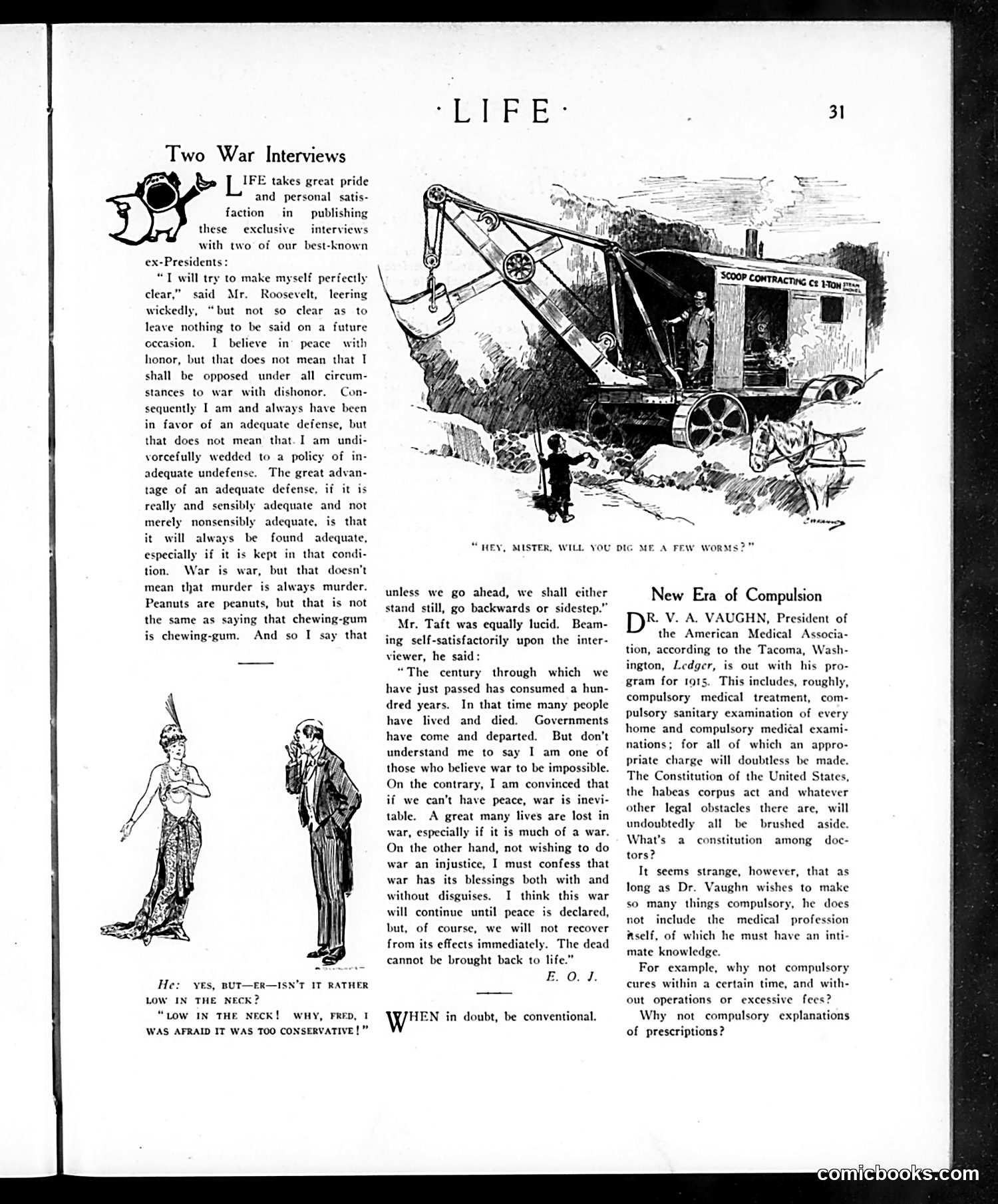
This page satirizes prominent political figures and medical overreach circa 1915. **"Two War Interviews"** mocks former Presidents Theodore Roosevelt and William Howard Taft by presenting their deliberately evasive statements about war and defense policy. Both quotes are deliberately circular and meaningless—Roosevelt admits his clarity leaves "nothing to be said on a future occasion"; Taft states obvious truisms ("if we can't have peace, war is inevitable"). The satire targets their political double-speak and unwillingness to take clear positions on entering World War I. The cartoon showing a man asking a worker to "dig me a few worms" appears to comment on meaningless activity—paralleling the politicians' empty rhetoric. **"New Era of Compulsion"** criticizes Dr. V.A. Vaughn's medical program proposing mandatory health inspections and treatment. The satire suggests doctors want authority over citizens while resisting regulation of their own profession—questioning why they won't accept compulsory cures, fee limits, or clear prescription explanations if they believe compulsion is justified for public health. Both sections attack hypocrisy and evasion by those in power.
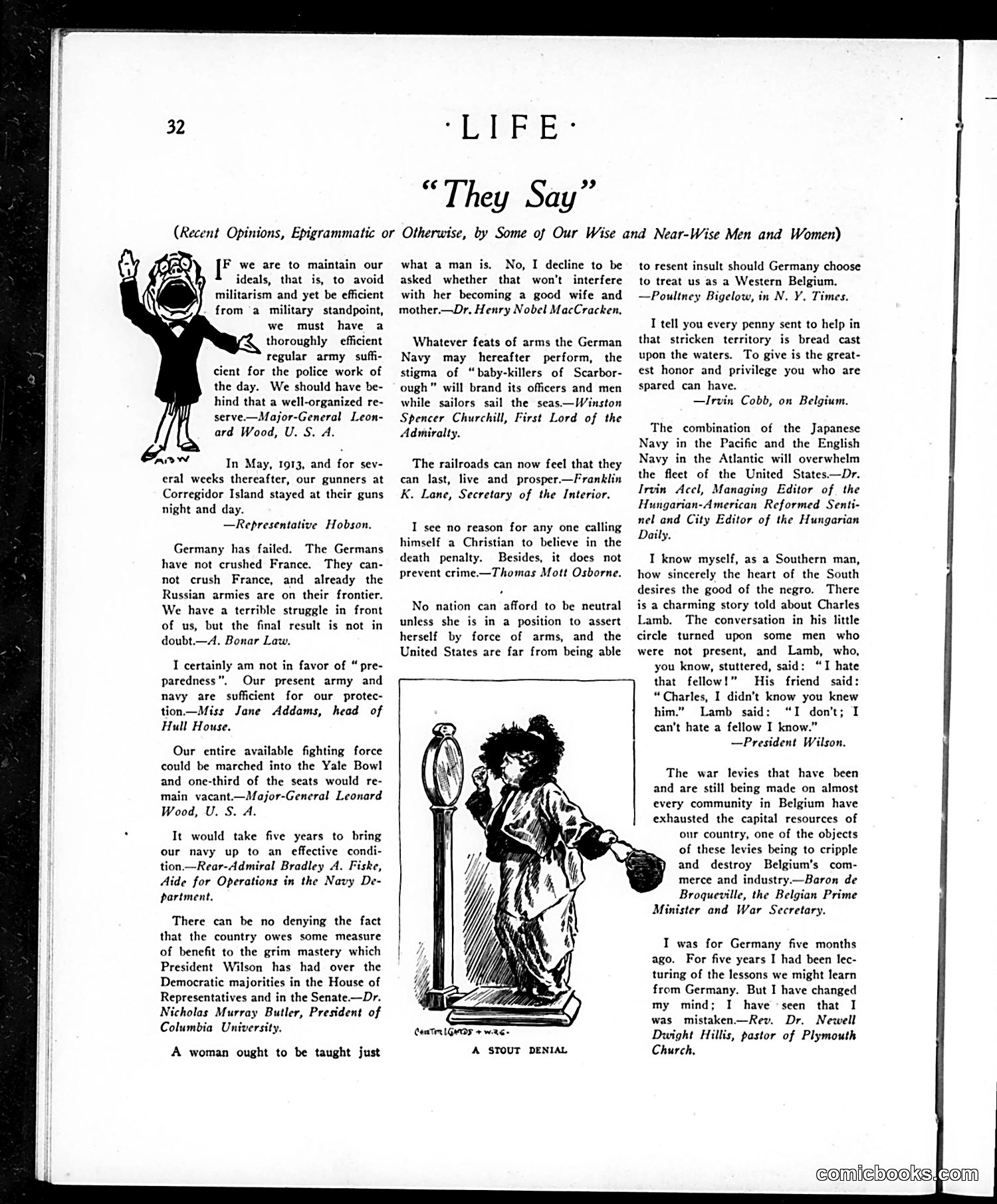
This page collects contemporary opinions on WWI preparedness and related issues, circa 1914-1915. The cartoon labeled "A Stout Denial" depicts a woman in classical dress (Liberty or Justice) firmly rejecting something—likely satirizing denials of German atrocities or pacifist resistance to military buildup. The quotes reveal deep American debate: military leaders like Leonard Wood advocated preparedness; pacifists like Jane Addams opposed it. Winston Churchill condemned German naval brutality ("baby-killers of Scarborough"). President Wilson defended the South's racial attitudes while expressing Christian opposition to capital punishment—a jarring juxtaposition. The page captures pre-U.S. entry tensions: anxiety about German and Japanese naval threats, Belgian suffering, American military weakness, and conflicting ideologies about intervention versus neutrality. The "stout denial" likely mocks either German denials of war crimes or American refusals to acknowledge unpreparedness.
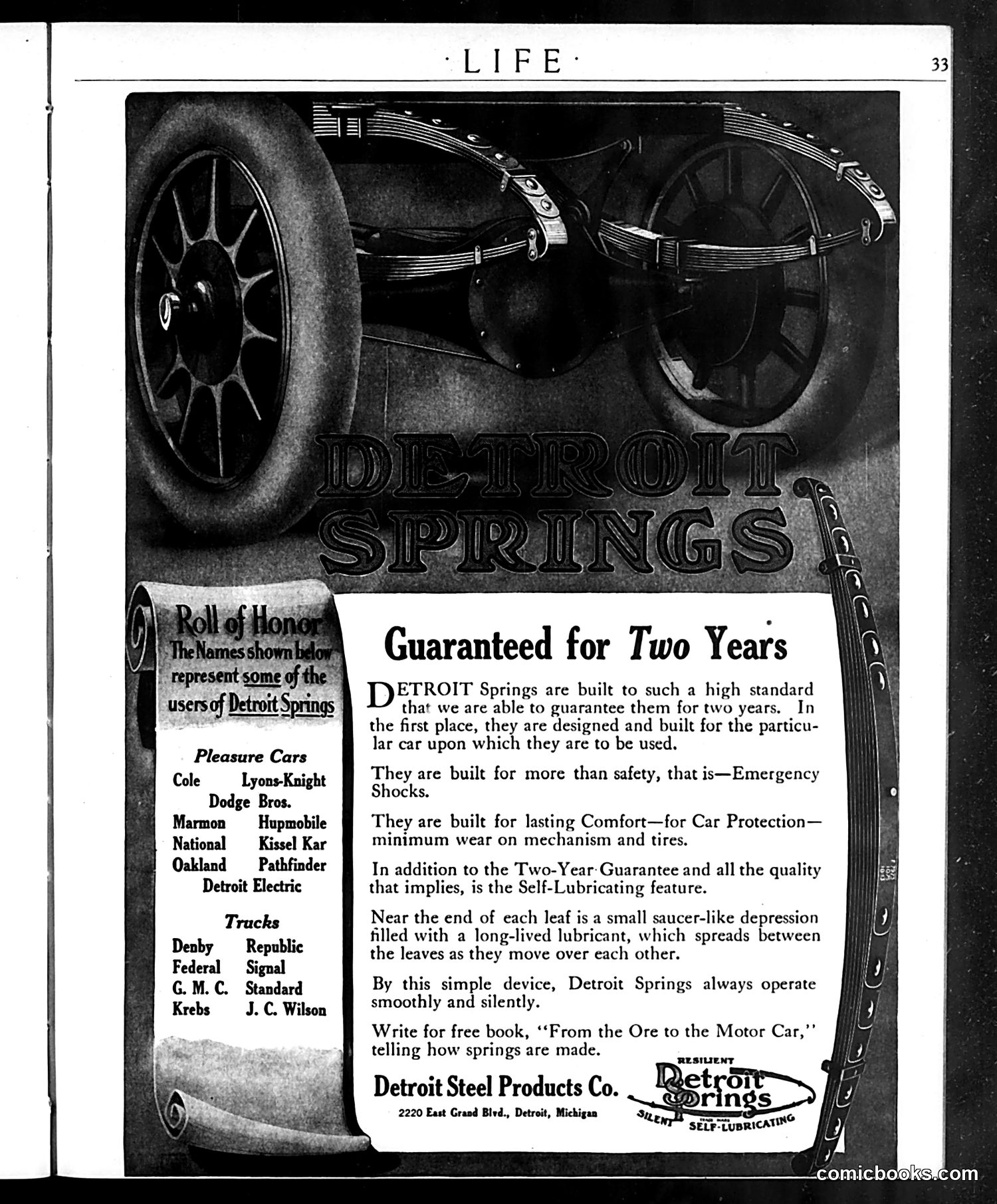
This is a **full-page advertisement**, not satire or political commentary. It promotes Detroit Springs, an automotive component manufacturer, in *Life* magazine (page 33). The ad features a large photograph of car springs and wheels, alongside a "Roll of Honor" listing automobile manufacturers who used Detroit Springs—both pleasure cars (Cole, Dodge Bros., Marmon, etc.) and trucks (Denby, Federal, G.M.C., Krebs). This served as social proof. The sales pitch emphasizes a **two-year guarantee** and highlights the product's self-lubricating feature—a small depression filled with lubricant at each leaf's end that "spreads between the leaves as they move." The ad promises safety, comfort, and silent operation, positioning Detroit Springs as a premium component. The page is straightforward industrial marketing with no satirical intent—typical of early-20th-century *Life* magazine advertising.
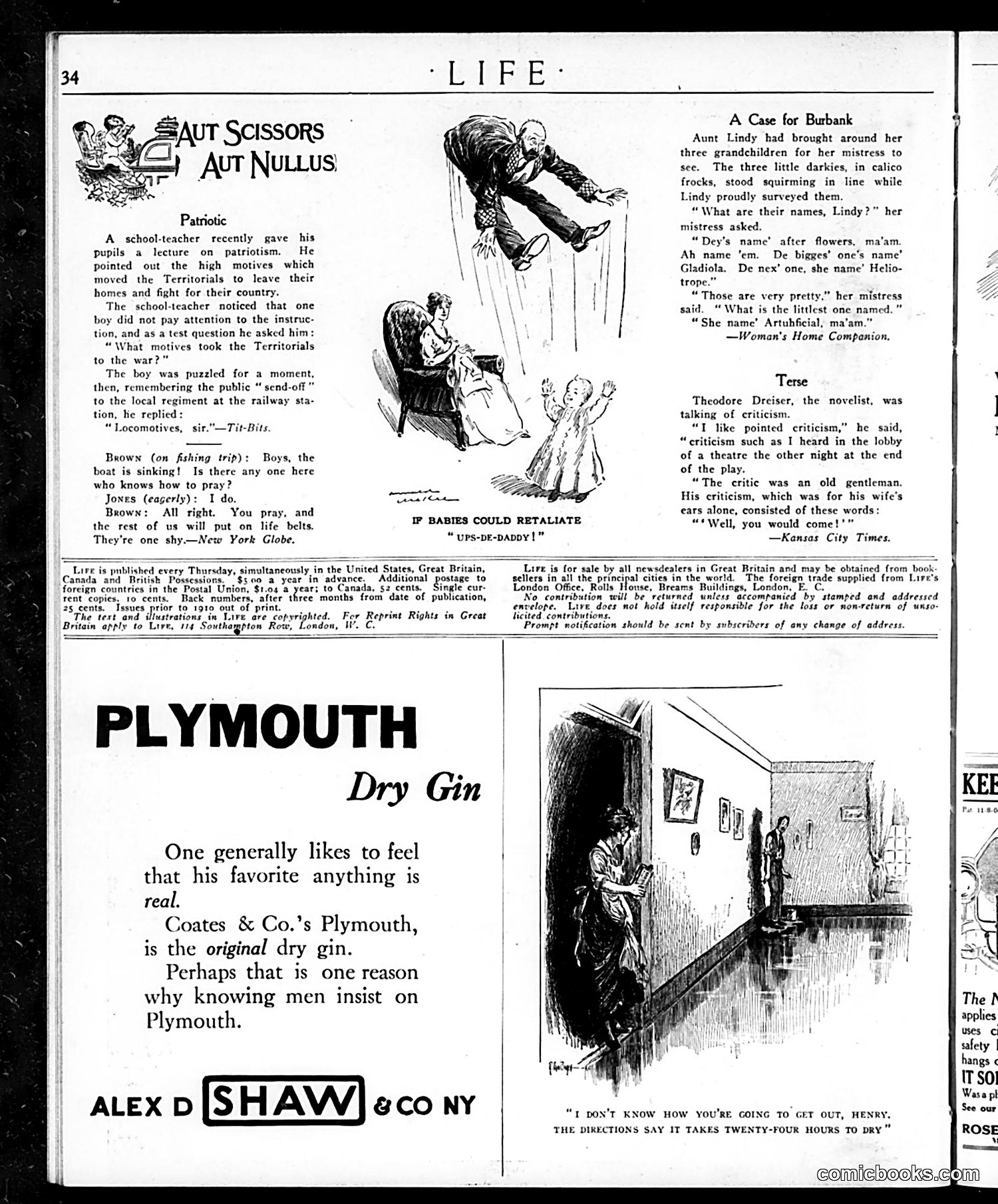
This page contains several short humorous pieces typical of early 20th-century American satire: **"Patriotic"**: A schoolteacher lectures pupils on Territorials (British military volunteers) sacrificing for country. When asked what motivated them, a boy answers "Locomotives"—having only noticed the train at the send-off ceremony. The joke mocks shallow patriotism and children's literal-minded observations. **"If Babies Could Retaliate"**: A cartoon showing frustrated parents being grabbed/attacked by infants. The caption "ups-de-daddy" suggests babies retaliating against parental treatment. Standard domestic humor about infant chaos. **"A Case for Burbank"**: A dialogue where Aunt Lindy names her three grandchildren after flowers—Gladiola, Heliotrope, and "Artubficial" (artificial). The humor relies on racial stereotypes common to the era, mocking dialect and malapropisms. **Other brief anecdotes** about fishing and theatre criticism provide light wordplay. The page is primarily editorial/humorous content with a Plymouth Gin advertisement. The racial material, while period-typical for *Life*, would be considered offensive today.
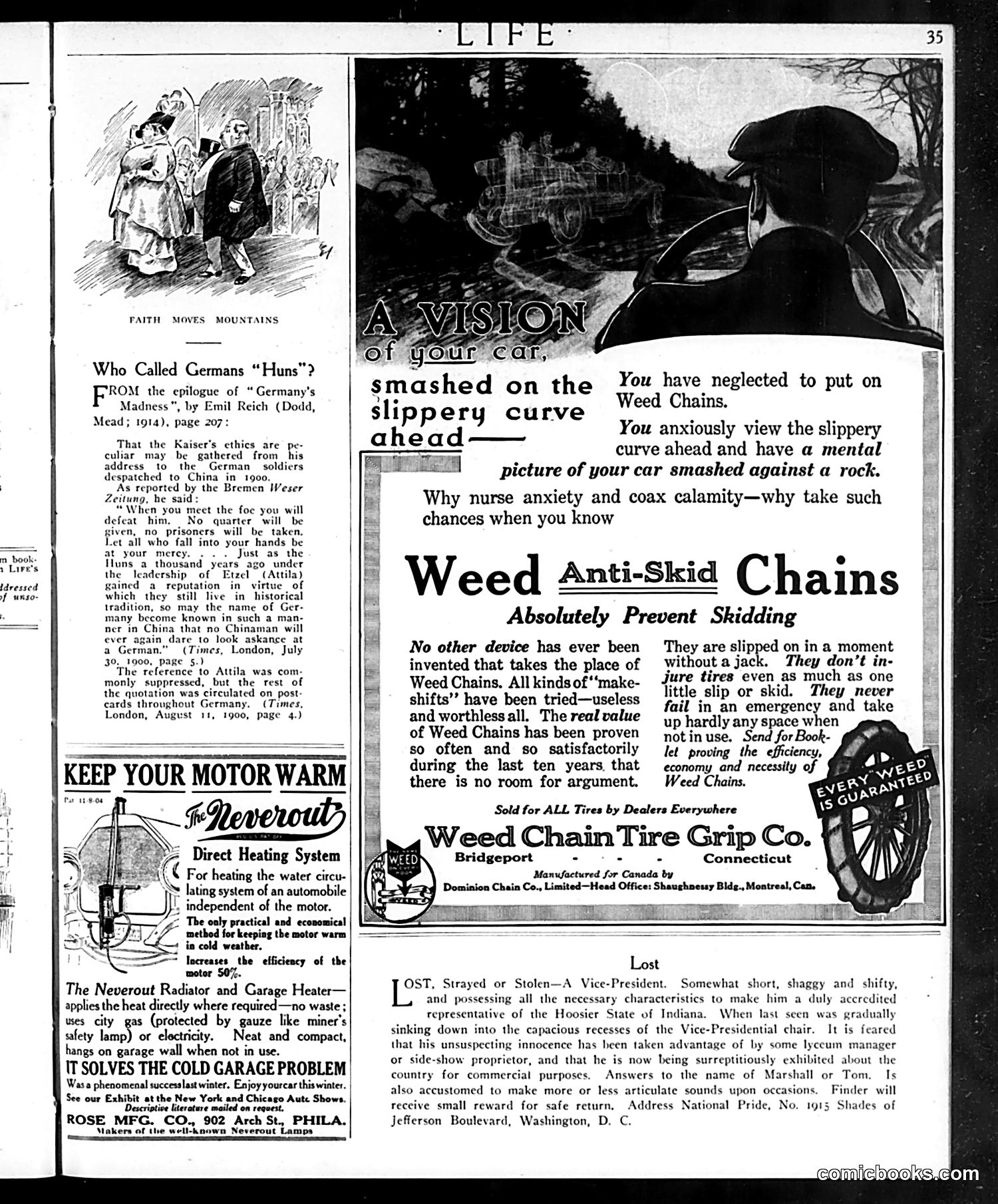
This page contains **anti-German propaganda from World War I era** (note the 1914 book citation). The "Faith Moves Mountains" cartoon mocks Germany by reprinting the Kaiser's controversial 1900 address to troops in China, where he invoked "Huns" as a model for brutal conduct. This became propaganda ammunition: the term "Hun" was weaponized to characterize Germans as barbaric, linking them to Attila's historical reputation. The page is otherwise **dominated by advertisements**—notably for Weed Chains (tire safety devices) and automotive heating systems, reflecting early 1900s automobile culture. The "Lost" section is a satirical classified ad about a missing Vice President from Indiana, mocking him as dim-witted and easily exploitable—likely referring to a contemporary political figure, though the specific identity is unclear from the text alone.
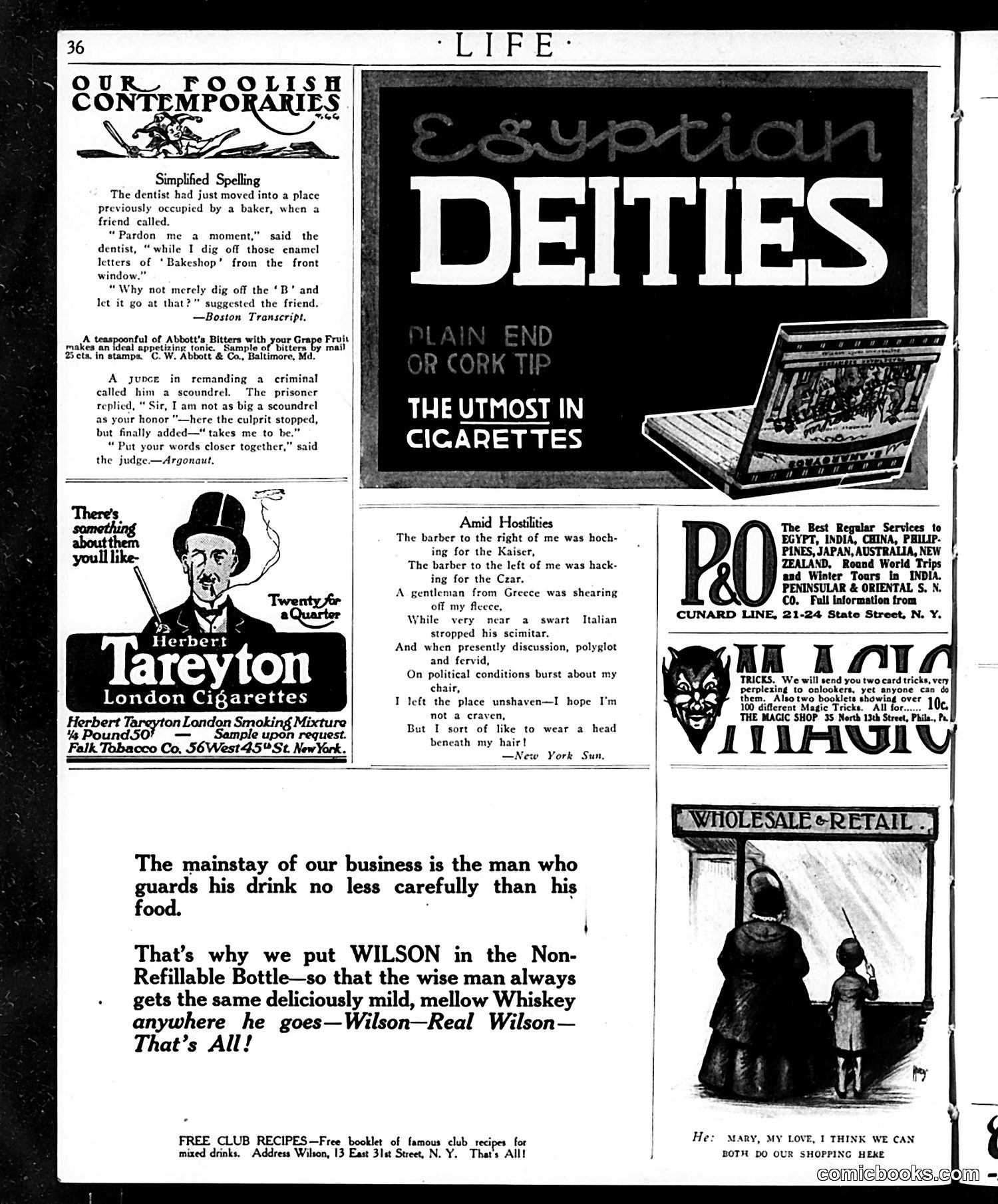
This page contains satirical humor typical of early 20th-century American magazines. The main content includes: **"Simplified Spelling"** jokes mocking linguistic reformers who wanted to simplify English spelling—a genuine movement of that era. The dentist joke suggests removing letters to turn "Bakeshop" into "Akeshop," satirizing this impulse as absurd. **"Amid Hostilities"** appears to reference World War I. The poem satirizes international tension by depicting a barbershop where workers from different nations (Kaiser-supporting German, Czar-supporting Russian, Greek, and Italian) serve a patron amid heated political debate—comedic commentary on how global conflict permeated even everyday life. The advertisements (Tareyton cigarettes, P&O steamships, Wilson whiskey) represent typical magazine revenue sources of the period. The page primarily uses wordplay and situational humor rather than visual political cartooning, reflecting Life's mid-period style focused on witty anecdotes and jokes alongside advertising.
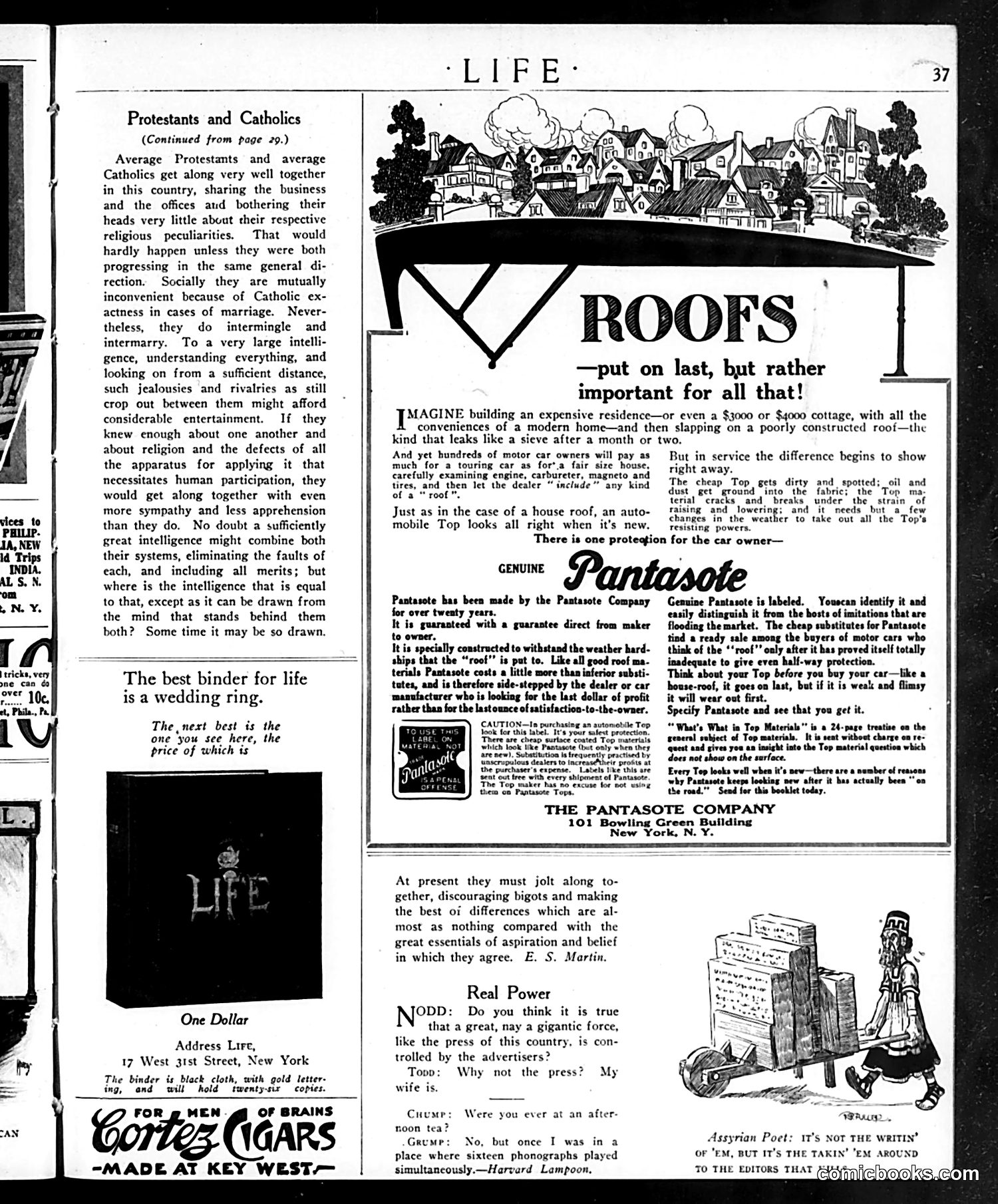
This page mixes editorial content with advertising. The main article (continued from a previous page) discusses Protestant-Catholic relations in America, arguing that ordinary members of both faiths coexist peacefully in business and social life, despite doctrinal differences. The author suggests that with greater mutual understanding, religious tensions could diminish further. The dominant content is a **Pantasote automobile Top (convertible roof) advertisement**. It uses an analogy: just as one wouldn't cheap out on a house roof, car owners shouldn't accept inferior convertible tops from dealers simply to save money. The ad warns against counterfeit substitutes and emphasizes Pantasote's durability and manufacturer guarantee. Additional advertisements include a Life magazine subscription promotion and a Cortes Cigars ad for men. The page contains no political cartoons—it's primarily advertising with editorial filler.
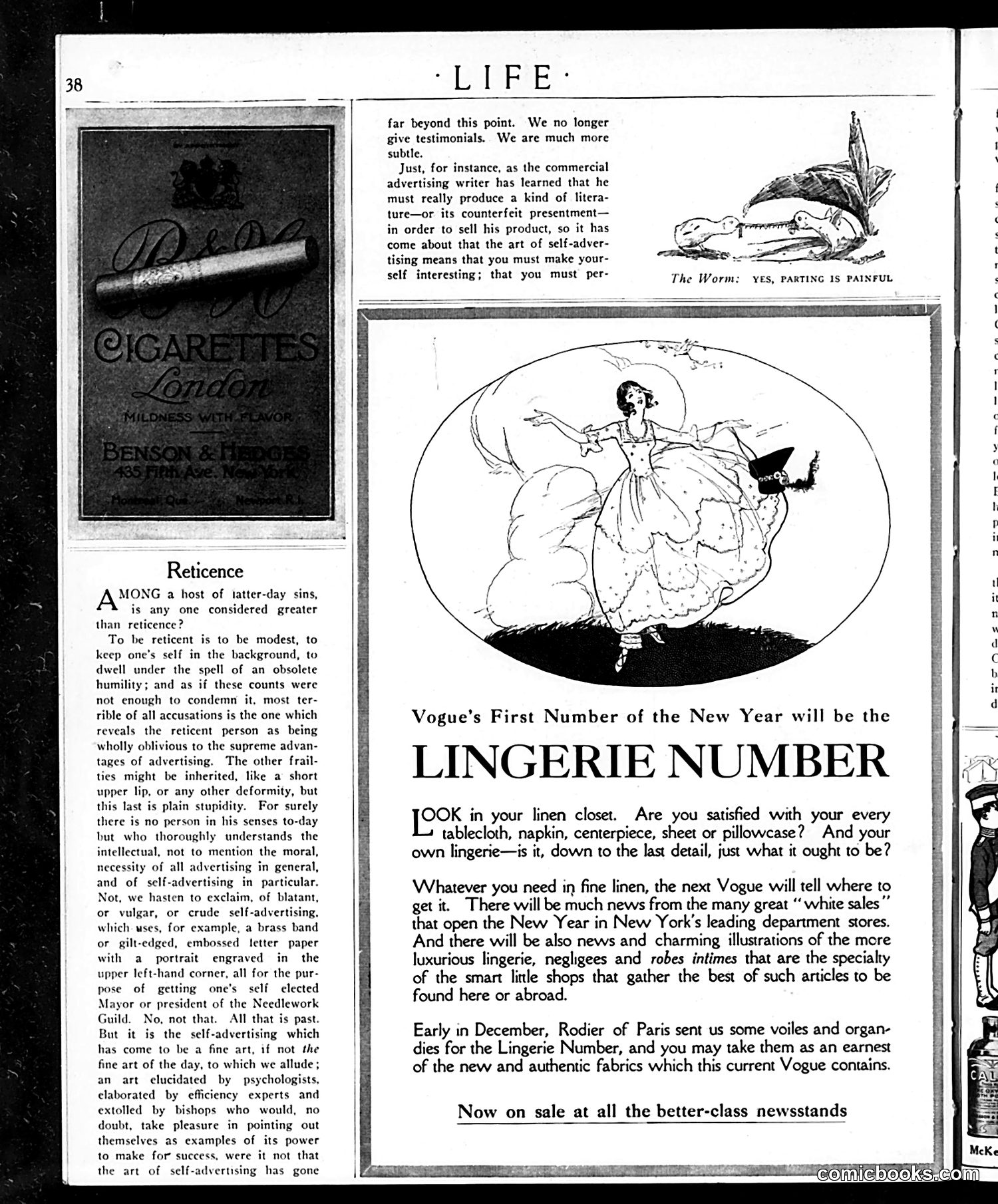
This Life magazine page satirizes the era's obsession with "self-advertising" and marketing subtlety. The editorial "Reticence" mocks how modesty has become socially unacceptable—replaced by the imperative to constantly promote oneself, but through supposedly refined, psychological means rather than crude brass-band tactics. The piece argues that even bishops and professionals now embrace this "fine art" of self-promotion. The illustrations support this theme: "The Worm" depicts a creature in pain (parting is painful), while the larger cartoon shows a woman in a giant brain, visualizing the psychological manipulation advertising employs. The page also includes advertisements—notably Benson & Hedges cigarettes and Vogue's upcoming "Lingerie Number"—which ironically exemplify the very subtle self-advertising the editorial describes. These ads don't hard-sell; they create aspirational lifestyle content, proving the essay's point about sophisticated marketing disguised as editorial content.
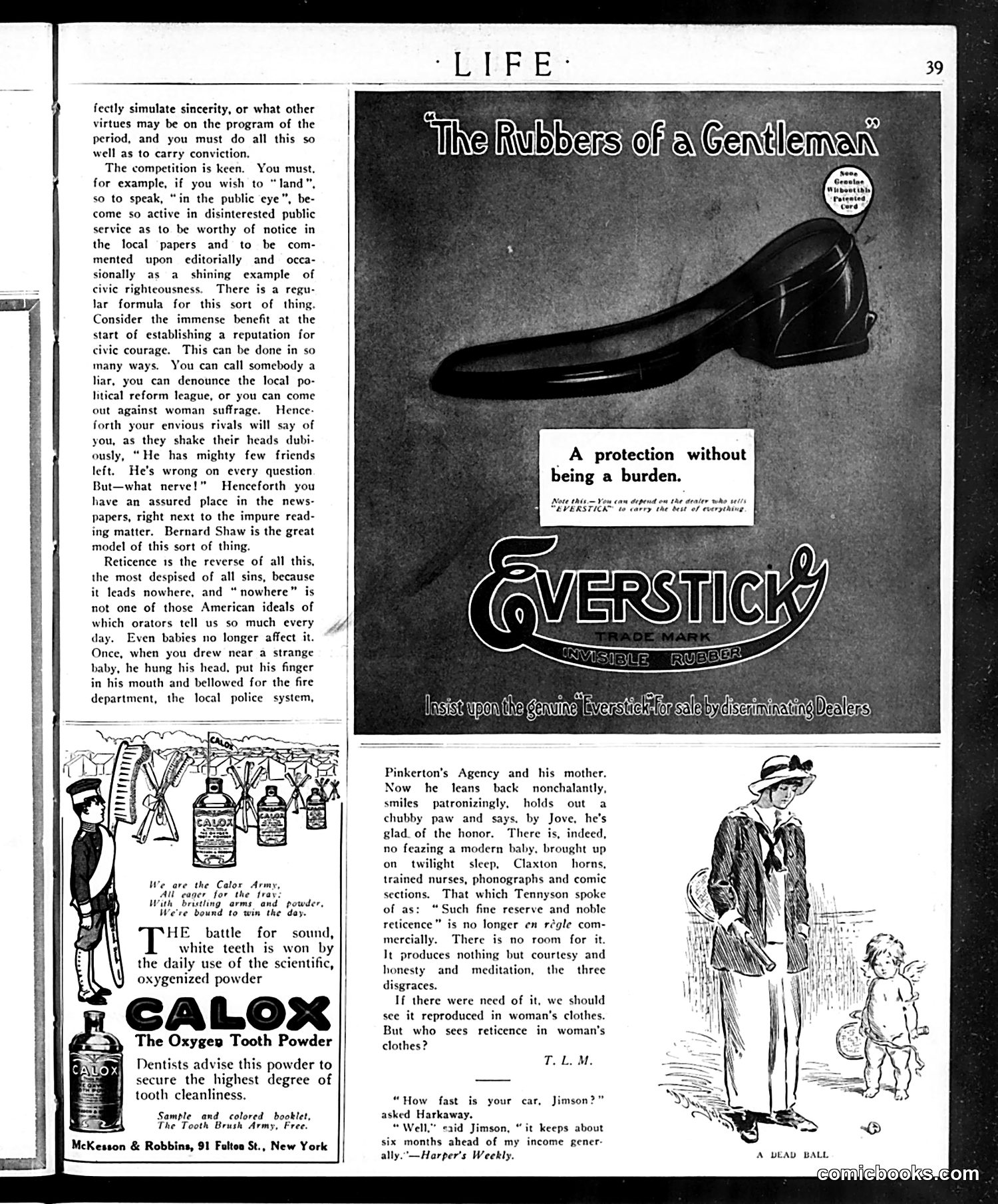
This page combines editorial commentary on social ambition with period advertisements and a cartoon. **Main Editorial Essay:** The left column satirizes American social climbing. It argues that "reticence" (quiet dignity) is dead in American culture, replaced by aggressive self-promotion. The author mocks how to gain notice: call someone a liar, denounce reform leagues, or oppose women's suffrage—anything controversial to get newspaper attention. Bernard Shaw is cited as the model of this publicity-seeking behavior. The piece laments that even babies now display shameless self-promotion rather than modest shyness. **Advertisements:** Include Everstick rubber (umbrellas) and Calox tooth powder. **Cartoon ("A Dead Ball"):** A well-dressed woman holds a child's hand while looking at a ball—likely satirizing upper-class parenting indifference or the careless treatment of childhood. **Small Joke:** A car owner admits his automobile stays "six months ahead of my income generally"—humor about living beyond one's means. The page reflects Jazz Age anxieties about authenticity, self-promotion, and changing social values.
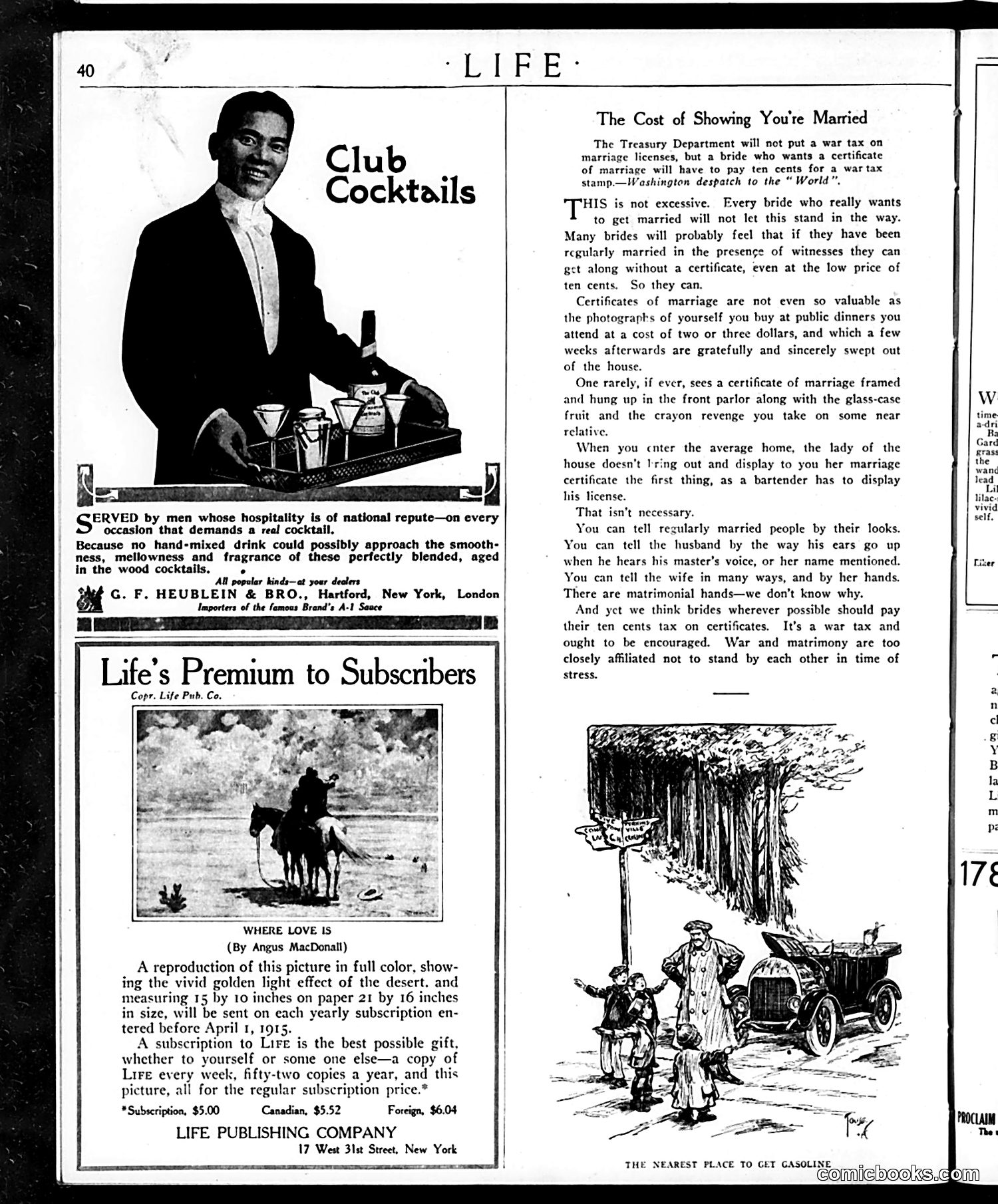
This page contains three distinct elements: **Club Cocktails Advertisement**: A standard liquor ad featuring a bartender, promoting Heublein & Bro.'s pre-mixed cocktails as superior to hand-made versions. **Life's Premium Offer**: A subscription promotion advertising a colored landscape painting titled "Where Love Is" by Angus MacDonall, sent to yearly subscribers for $5.00. **"The Cost of Showing You're Married"**: The main satirical article discusses a new ten-cent war tax stamp required for marriage certificates during WWI. The piece's humor lies in dismissing the certificate's value—arguing that married people are identifiable by appearance and behavior (husbands' ears rising "when he hears his master's voice"), and that marriage certificates are rarely displayed like bartender licenses. The satire concludes by paradoxically endorsing the tax as appropriate, since "war and matrimony are too closely affiliated." The joke conflates marital submission with wartime sacrifice.
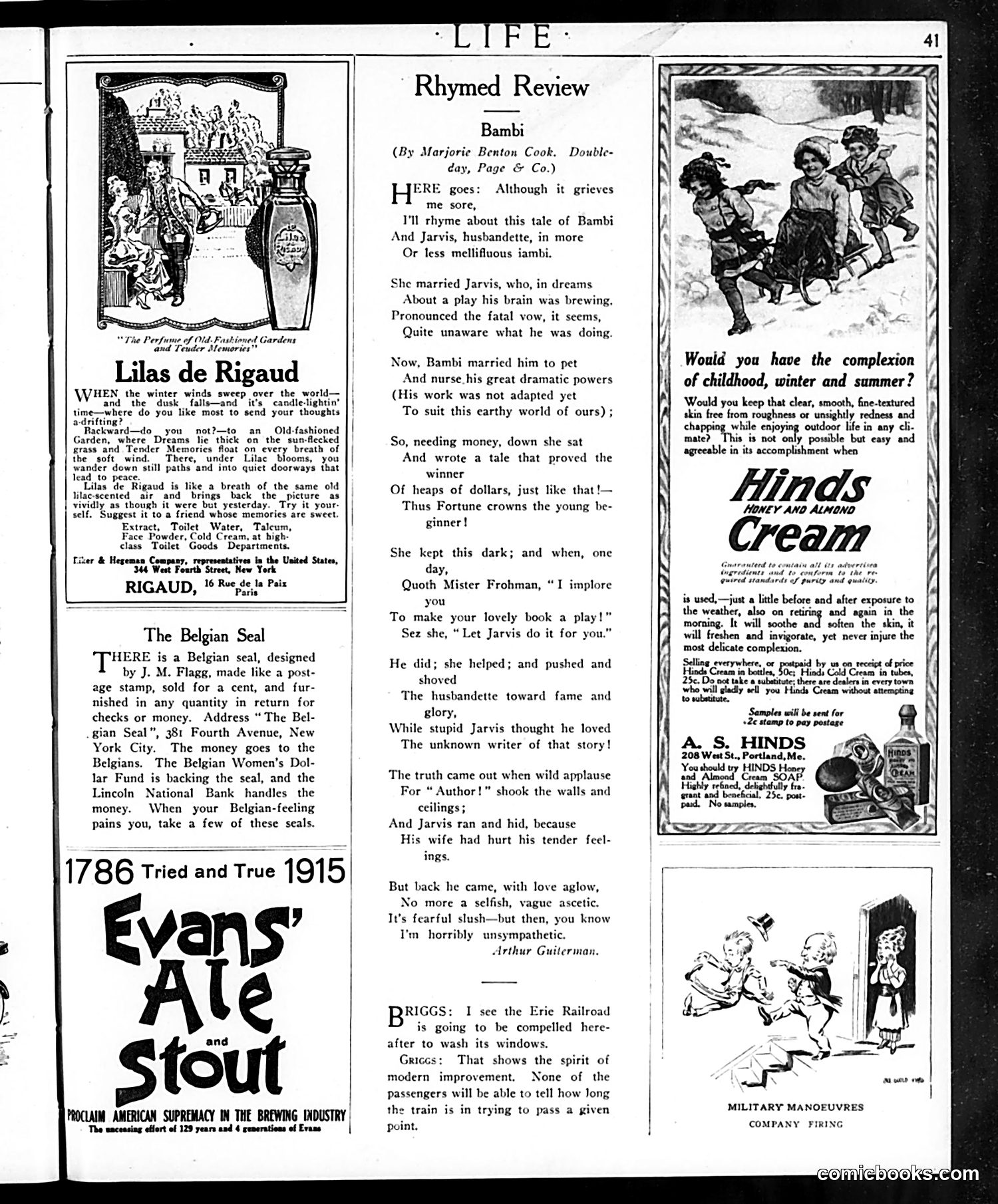
This page mixes advertisements with literary content typical of Life magazine's satirical format. **"Bambi" Rhymed Review:** Arthur Guiterman's verse satirizes a contemporary novel about a woman named Bambi who marries aspiring playwright Jarvis. The satire targets marital dynamics and artistic pretension: Bambi secretly writes a successful play, manipulates her husband into taking credit, and he only accepts her when the deception's revealed. Guiterman mocks the melodramatic "fearful slush" plot while commenting on gender dynamics in artistic collaboration—she does the real work while he receives credit. **Other Content:** - Perfume and cosmetics advertisements ("Lilas de Rigaud," "Hinds Honey and Almond Cream") - A "Belgian Seal" fundraiser for Belgian Women's Dollar Fund (WWI relief) - Evans' Ale/Stout advertisement - A brief humorous exchange about the Erie Railroad washing train windows The page reflects 1915 concerns: wartime charity, beauty standards, and social comedy about marriage and ambition.
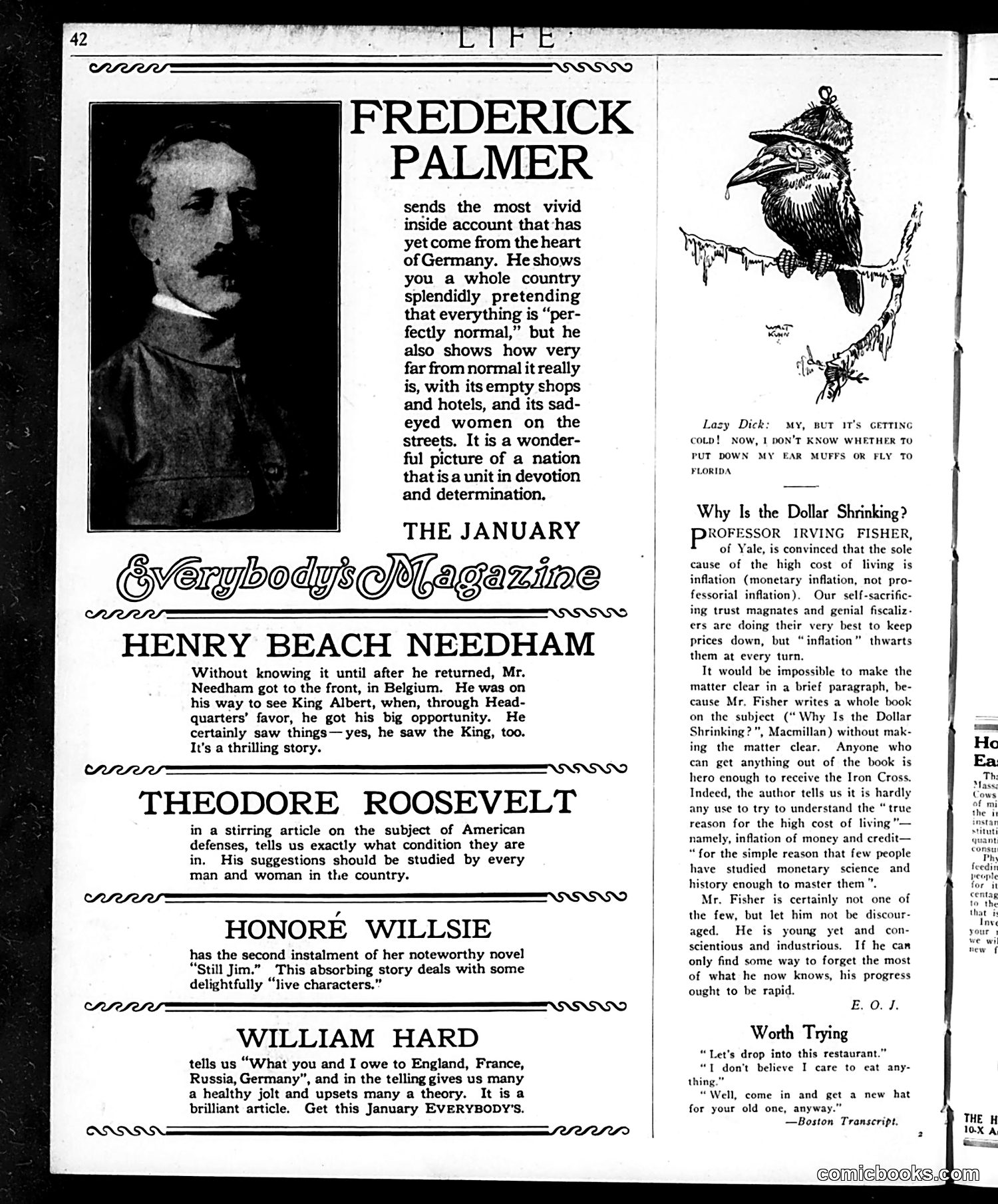
This page promotes January articles in *Everybody's Magazine*, a competing publication, likely from WWI era (references to Belgium, King Albert, American defenses suggest 1914-1917). **Key articles advertised:** - **Frederick Palmer**: A war correspondent's account of Germany pretending normalcy while suffering shortages and despair - **Theodore Roosevelt**: On American military readiness - **William Hard**: On America's obligations to Allied powers (England, France, Russia) versus Germany **The cartoon** shows "Lazy Dick" avoiding winter by choosing between ear muffs or Florida—a humorous non-sequitur. **The satire** on Professor Irving Fisher mocks his economics book on inflation as incomprehensibly written. The critic suggests Fisher himself doesn't understand monetary theory, sarcastically recommending he "forget what he knows" for better progress. This targets academic obscurantism and the era's confusion over wartime inflation causes. The page reflects American publishing during WWI's early years, promoting interventionist perspectives while satirizing intellectual pretension.
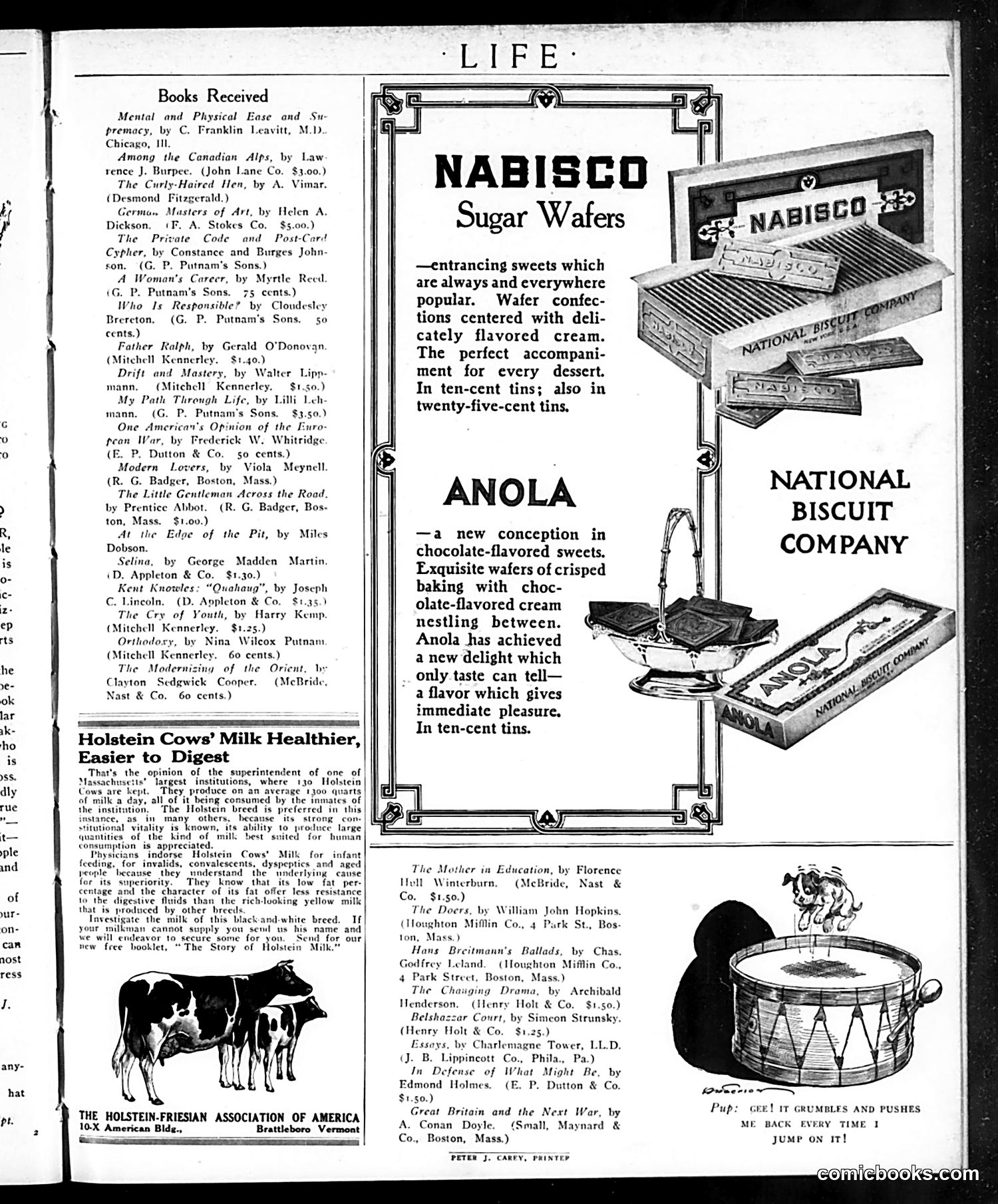
This page is primarily **advertisements and book reviews**, not political satire. It's from an early 20th-century *Life* magazine issue. The main content consists of: 1. **Books Received** (left column)—a standard literary section listing newly published books with prices and publishers. 2. **Three advertisements** promoting consumer products: - **Nabisco Sugar Wafers** and **Anola** cookies (center) - **Holstein dairy cows** (lower left)—promoting milk quality for institutions and invalids There are **no political cartoons or satirical commentary** visible on this page. The only illustration is a promotional image of Holstein cattle. This appears to be a typical *Life* magazine page from the 1910s-1920s, mixing literary content with advertising—the magazine's standard format for that era.
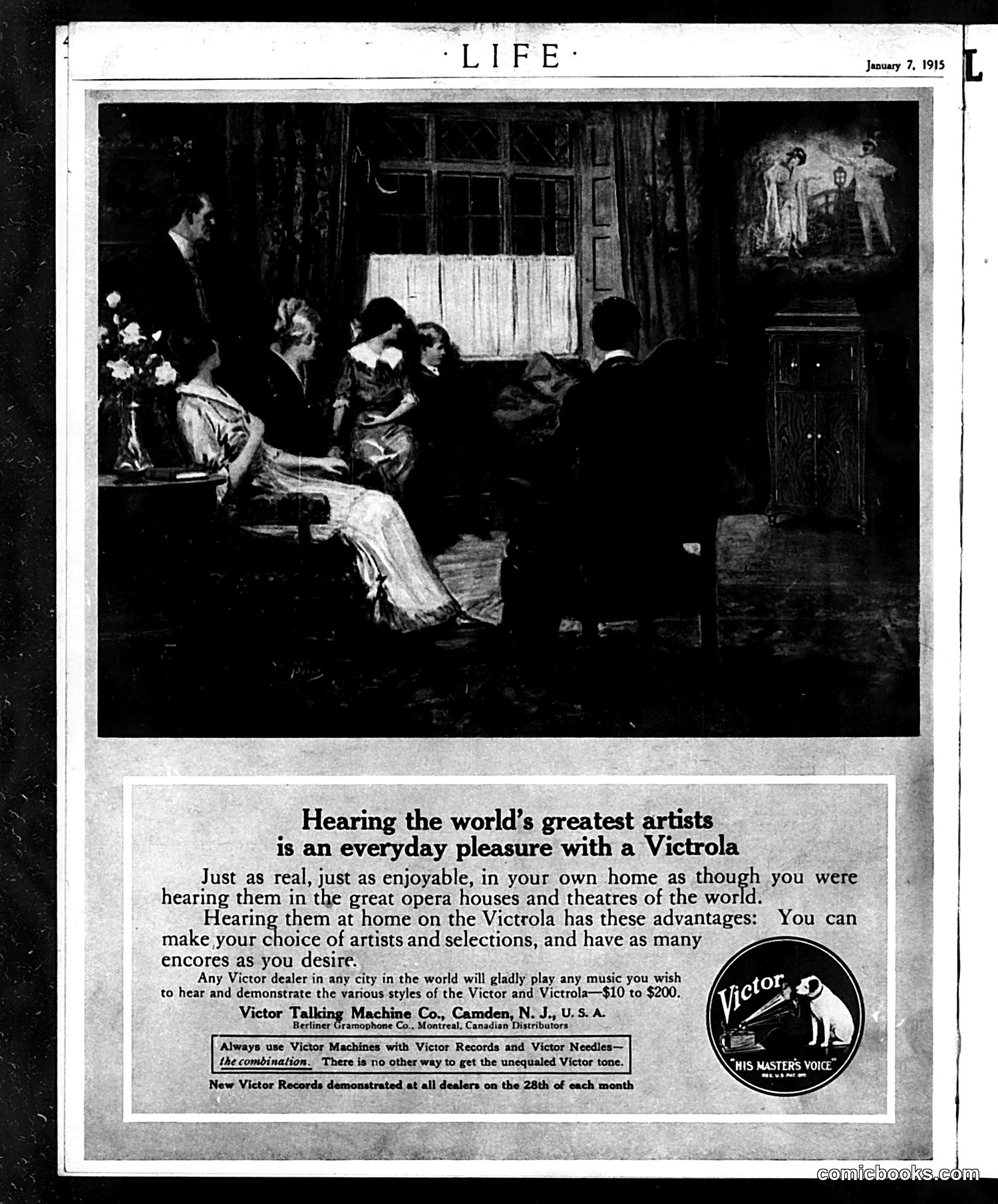
This is a **Victrola phonograph advertisement**, not a political cartoon. It depicts a well-dressed gathering of people in an elegant home listening to recorded music, with a painting visible on the wall. The ad's appeal targets early-20th-century affluence and aspirations: it promises that owning a Victrola brings the experience of world-class opera and theater into one's parlor. The messaging emphasizes luxury and control—you select the artists and encores rather than attending live performances. For modern readers: this represents how new technology (the phonograph, introduced commercially in the 1890s) was marketed as a status symbol and entertainment innovation. By 1915, the Victrola had become the dominant home music player. The advertisement assumes its audience values classical culture and can afford $10-$200 (roughly $280-$5,600 today), positioning the product as bringing cosmopolitan refinement to middle/upper-class homes.