
Life, 1915-01-07 · page 44 of 44
Life — January 7, 1915 — page 44: what you’re looking at
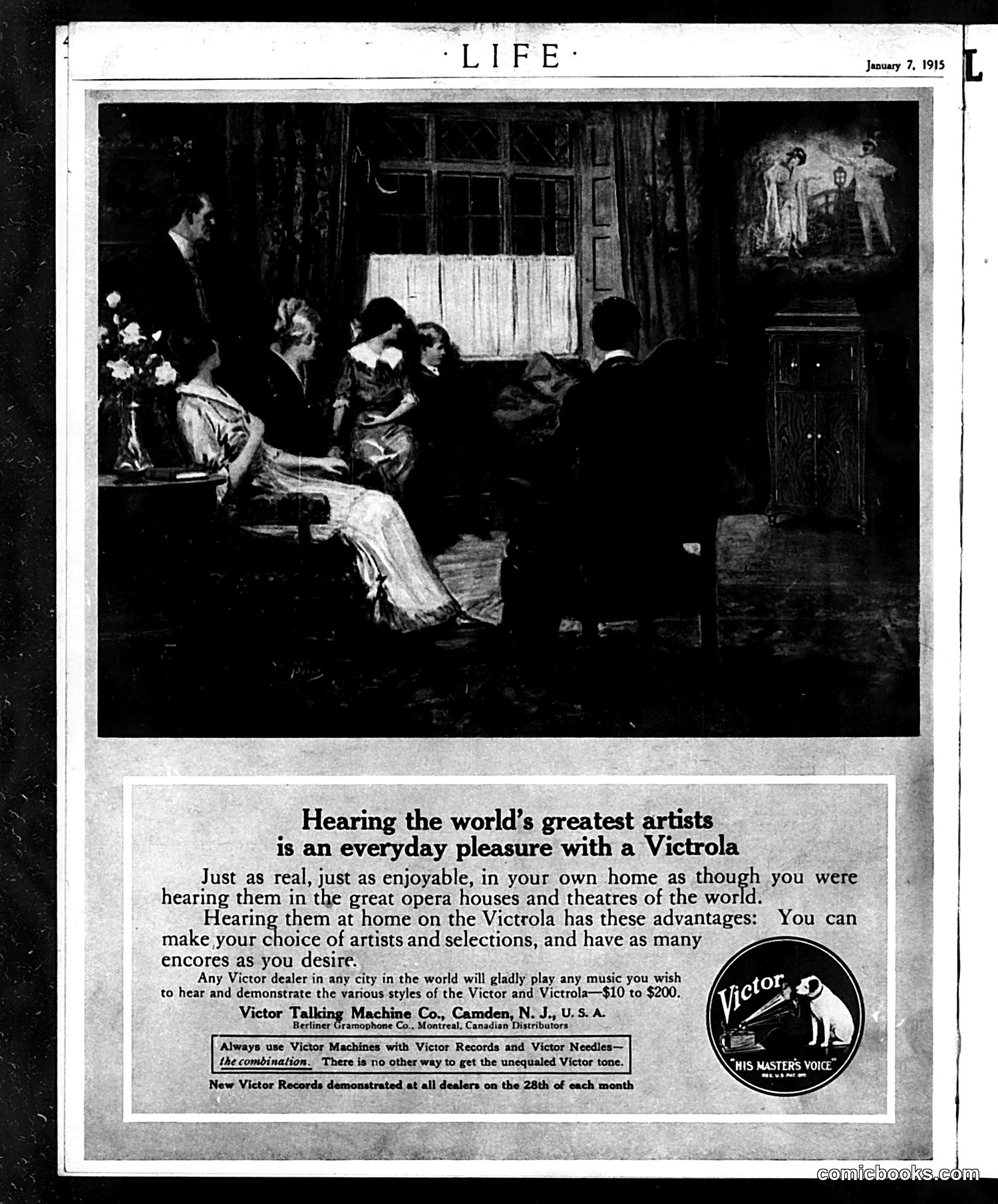
What you’re looking at
This is a **Victrola phonograph advertisement**, not a political cartoon. It depicts a well-dressed gathering of people in an elegant home listening to recorded music, with a painting visible on the wall. The ad's appeal targets early-20th-century affluence and aspirations: it promises that owning a Victrola brings the experience of world-class opera and theater into one's parlor. The messaging emphasizes luxury and control—you select the artists and encores rather than attending live performances. For modern readers: this represents how new technology (the phonograph, introduced commercially in the 1890s) was marketed as a status symbol and entertainment innovation. By 1915, the Victrola had become the dominant home music player. The advertisement assumes its audience values classical culture and can afford $10-$200 (roughly $280-$5,600 today), positioning the product as bringing cosmopolitan refinement to middle/upper-class homes.
📄 Transcribed text from this page (OCR, searchable)
Machine-transcribed from the original scan — historical spelling and the odd misread are preserved.
January 7, 1915 Hearing the world’s greatest artists is an everyday pleasure with a Victrola Just as real, just as enjoyable, in your own home as though you were hearing them in the great opera houses and theatres of the world. Hearing them at home on the Victrola has these advantages: You can make your choice of artists and selections, and have as many encores as you desire. Any Victor dealer in any city in the world will gladly play any music you wish to hear and demonstrate the various styles of the Victor and Victrola—$10 to $200. Victor Talking Machine Co., Camden, N.