
Life, 1915-01-07 · page 31 of 44
Life — January 7, 1915 — page 31: what you’re looking at
What you’re looking at
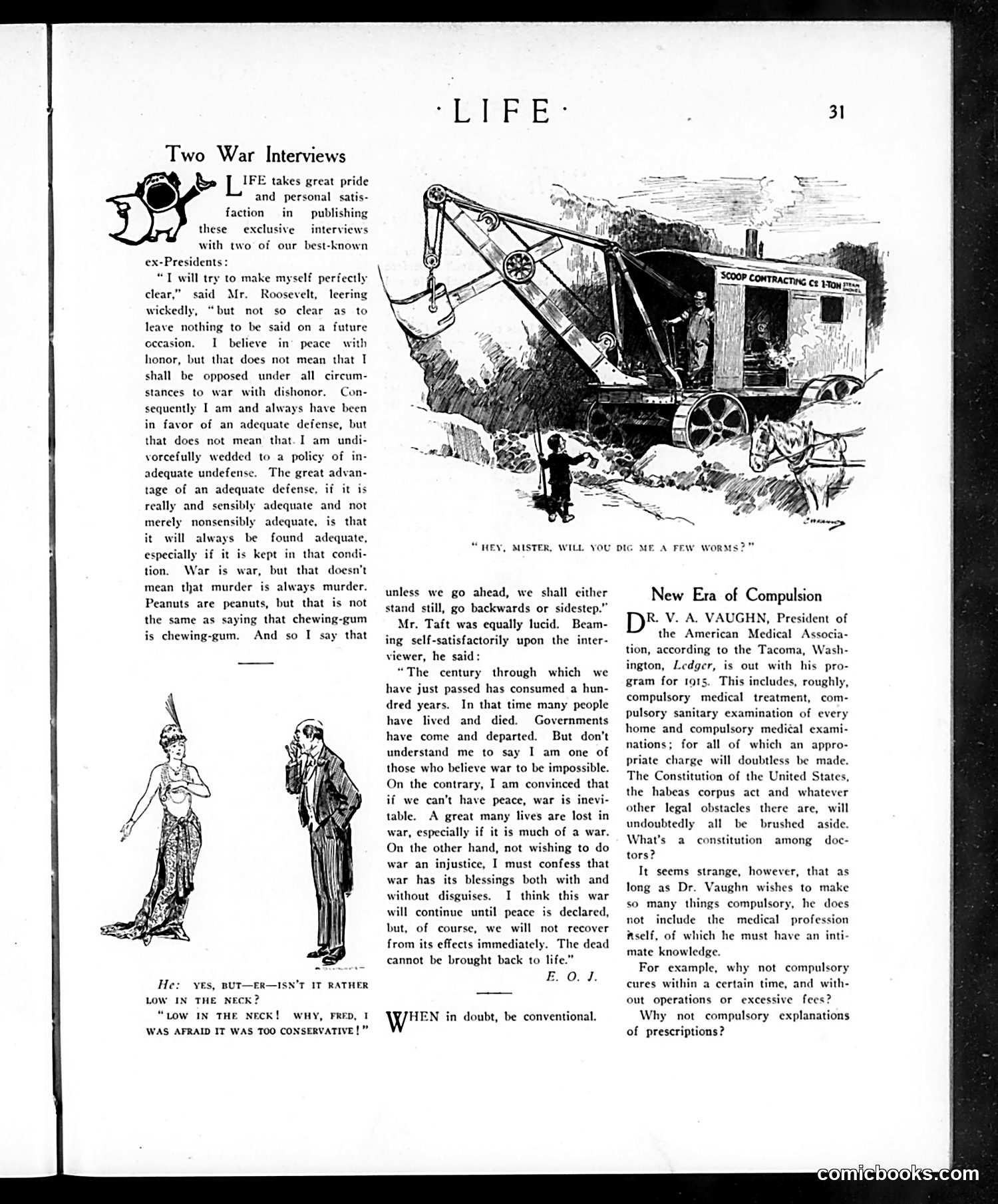
This page satirizes prominent political figures and medical overreach circa 1915. **"Two War Interviews"** mocks former Presidents Theodore Roosevelt and William Howard Taft by presenting their deliberately evasive statements about war and defense policy. Both quotes are deliberately circular and meaningless—Roosevelt admits his clarity leaves "nothing to be said on a future occasion"; Taft states obvious truisms ("if we can't have peace, war is inevitable"). The satire targets their political double-speak and unwillingness to take clear positions on entering World War I. The cartoon showing a man asking a worker to "dig me a few worms" appears to comment on meaningless activity—paralleling the politicians' empty rhetoric. **"New Era of Compulsion"** criticizes Dr. V.A. Vaughn's medical program proposing mandatory health inspections and treatment. The satire suggests doctors want authority over citizens while resisting regulation of their own profession—questioning why they won't accept compulsory cures, fee limits, or clear prescription explanations if they believe compulsion is justified for public health. Both sections attack hypocrisy and evasion by those in power.
📄 Transcribed text from this page (OCR, searchable)
Machine-transcribed from the original scan — historical spelling and the odd misread are preserved.
Two War Interviews b> IFE takes great pride and personal satis- faction in publishing these exclusive — interviews. with two of our best-known ex-Presidents : “T will try to make myself perfectly clear,” said Mr. Roosevelt, wickedly, “but not leering so clear as to leave nothing to be said on a future occasion, I believe in’ peace with honor, but that does not mean that I shall be opposed under all circum- stances to war with dishonor. Con- sequently I am and always have been in favor of an adequate defense, but that does not mean that. I am undi- vorcefully wedded to a policy of in- adequate undefense. The great advan- tage of an adequate defense, if it is really and sensibly adequate and not merely nonsensibly adequate, is that it will alw be found adequate, especially if it is kept in that condi- tion. War is war, but that doesn’t mean that murder is always murder. Peanuts are peanuts, but that is not the same as saying that chewing-gum is chewing-gum. And so I say that YES, BUT—ER—ISN'T IT RATHER “Low IN THE NECK! WHY, FRED, I WAS AFRAID IT WAS TOO CONSERVATIVE!” “HEY, MISTER, WILL YOU DIG ME A FEW Worms?” unless we go ahead, we shall cither stand still, go backwards or sidestep.” Mr. Taft was equally lucid. Beam- ing self-satisfactorily upon the inter- viewer, he said: “The century through which we have just passed has consumed a hun- dred years. In that time many people have lived and died. Governments have come and departed. But don't understand me to say I am one of those who believe war to be impossible. On the contrary, I am convinced that if we can’t have peace, war is inevi- table. A great many lives are lost in war, especially if it is much of a war. On the other hand, not wishing to do war an injustice, I must confess that war has its blessings both with and without disguises. I think this war v continue until peace is declared, but, of course, we will not recover from its effects immediately. The dead cannot be brought back to life.” E. 0. J. WHEN in doubt, be conventional. New Era of Compulsion V. A. VAUGHN, President of the American Medical Associa- tion, according to the Tacoma, Wash- ington, Ledger, is out with his pro- gram for tots. This includes, roughly, compulsory medical treatment, com- pulsory sanitary examination of every home and compulsory mediéal exami- nations; for all of which an appro- priate charge will doubtless be made. The Constitution of the United States, the habeas corpus act and whatever other legal obstacles there are, will undoubtedly all be brushed aside. What’s a constitution among doc- tors? It seems strange, however, that as long as Dr. Vaughn wishes to make so many things compulsory, he not include the medical profession Aaself, of which he must have inti- mate knowledge. For example, why not compulsory cures within a certain time, and with- out operations or excessive fees? Why not compulsory explanations of prescriptions? does