
Life, 1915-01-07 · page 29 of 44
Life — January 7, 1915 — page 29: what you’re looking at
What you’re looking at
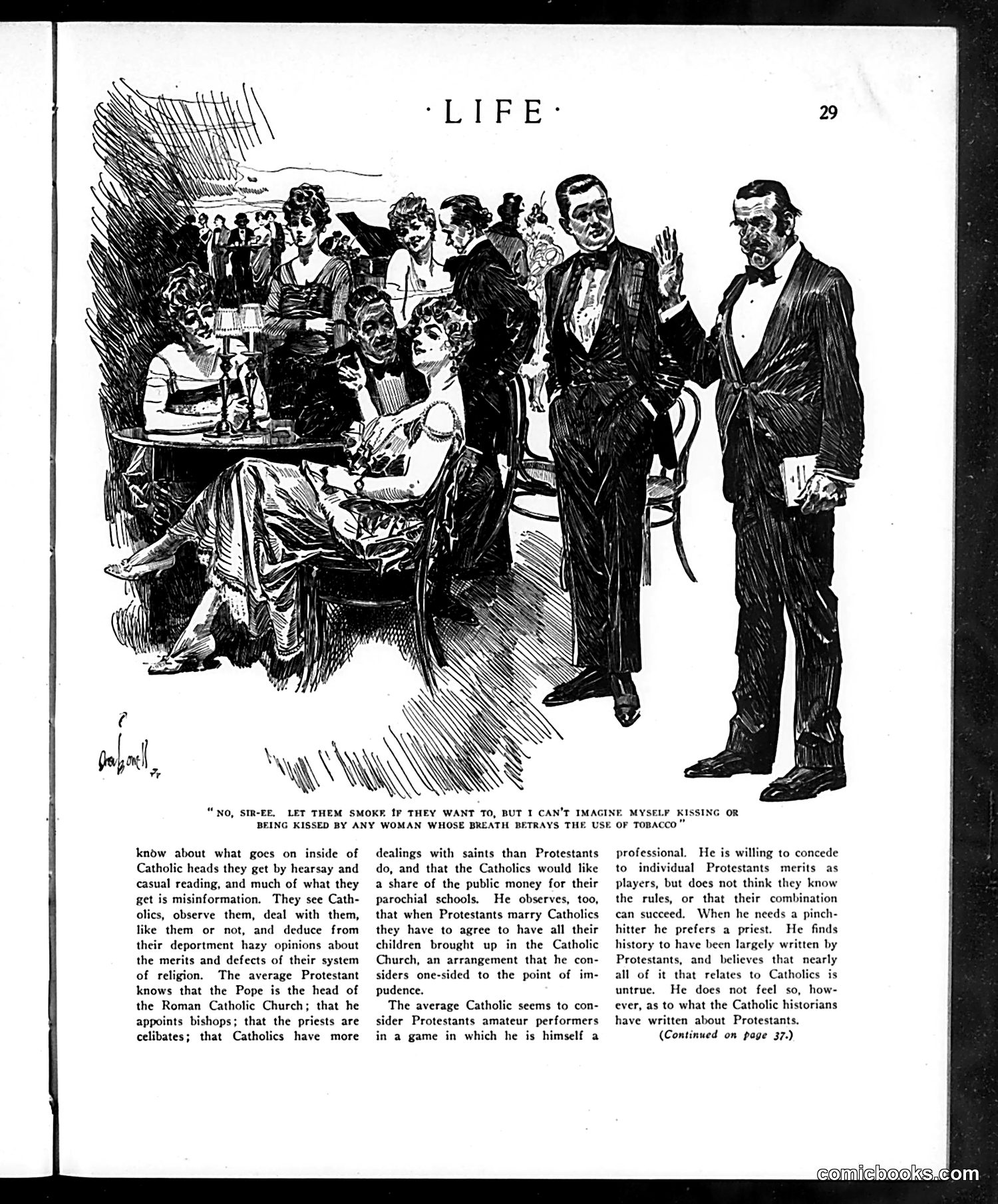
This page satirizes Protestant-Catholic tensions in early 20th-century America. The cartoon depicts a formal social gathering where a well-dressed man refuses a woman's kiss, claiming he cannot kiss someone whose breath "betrays the use of tobacco." The accompanying article discusses mutual stereotypes and misunderstandings between Protestants and Catholics. It notes that average Protestants view Catholics through hearsay and casual observation, knowing basic doctrines (papal authority, clerical celibacy, saint veneration, desire for parochial school funding). Conversely, Catholics consider themselves professionals in religious matters while viewing Protestants as amateurs. The satire likely juxtaposes the man's fastidious moral objection to tobacco with the broader religious and social divisions described in the text—suggesting that superficial propriety masks deeper sectarian prejudices. The cartoon ridicules both the affected prudishness and the underlying Protestant-Catholic animosity that characterized American society of this era.
📄 Transcribed text from this page (OCR, searchable)
Machine-transcribed from the original scan — historical spelling and the odd misread are preserved.
“NO, SIR-EE, LET THEM SMOKE fF THEY WANT TO, BUT I CAN'T IMA‘ BEING KISSED BY ANY WOMAN WHOSE BREATH BETRAYS THE U: know about what gocs on inside of Catholic heads they get by hearsay and casual reading, and much of what they get is misinformation. They see Cath- olics, observe them, deal with them, like them or not, and deduce from their deportment hazy opinions about the merits and defects of their system of religion. The average Protestant knows that the Pope is the head of the Roman Catholic Church; that he appoints bishops; that the priests are celibates; that Catholics have more dealings with saints than Protestants do, and that the Catholics would like a share of the public money for their parochial schools. He observes, too, that when Protestants marry Catholics they have to agree to have all their children brought up in the Catholic Church, an arrangement that he con- siders one-sided to the point of im- pudence. The average Catholic seems to con- sider Protestants amateur performers in a game in which he is himself a MYSELP KISSING OR OF TORACCO” professional. He is willing to concede to individual Protestants merits as players, but does not think they know the rules, or that their combination can succeed, When he needs a pinch- hitter he prefers a priest. He finds history to have been largely written by Protestants, and believes that nearly all of it that relates to Catholics is untrue. He does not feel so, how- ever, as to what the Catholic historians have written about Protestants. (Continued on page 37.)