
Life, 1915-01-07 · page 38 of 44
Life — January 7, 1915 — page 38: what you’re looking at
What you’re looking at
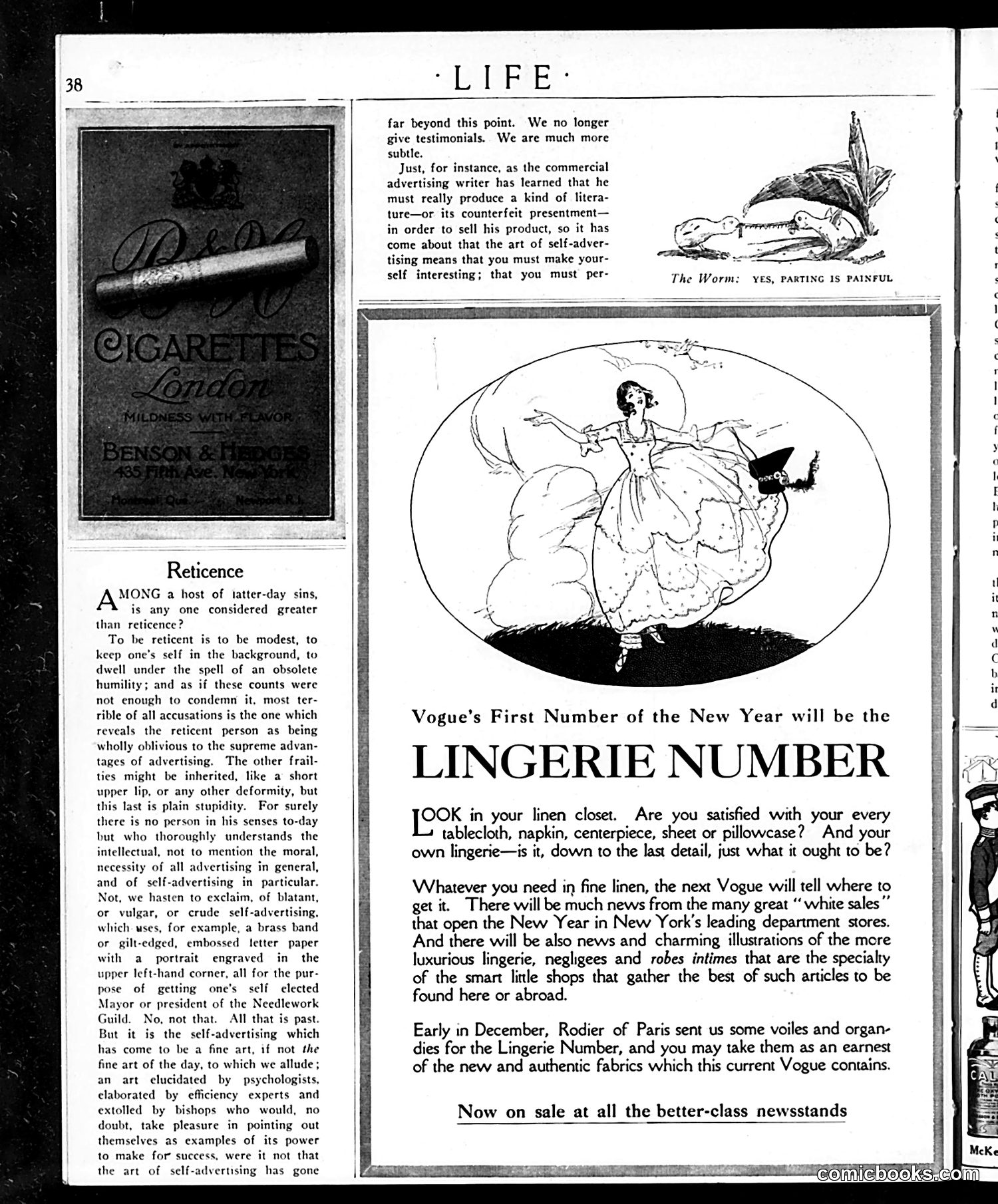
This Life magazine page satirizes the era's obsession with "self-advertising" and marketing subtlety. The editorial "Reticence" mocks how modesty has become socially unacceptable—replaced by the imperative to constantly promote oneself, but through supposedly refined, psychological means rather than crude brass-band tactics. The piece argues that even bishops and professionals now embrace this "fine art" of self-promotion. The illustrations support this theme: "The Worm" depicts a creature in pain (parting is painful), while the larger cartoon shows a woman in a giant brain, visualizing the psychological manipulation advertising employs. The page also includes advertisements—notably Benson & Hedges cigarettes and Vogue's upcoming "Lingerie Number"—which ironically exemplify the very subtle self-advertising the editorial describes. These ads don't hard-sell; they create aspirational lifestyle content, proving the essay's point about sophisticated marketing disguised as editorial content.
📄 Transcribed text from this page (OCR, searchable)
Machine-transcribed from the original scan — historical spelling and the odd misread are preserved.
“Rag Reticence MONG a host of tatter-day sins, is any one considered greater than reticence? To be reticent is to be modest, to keep one’s self in the background, to dwell under the spell of an obsolete humility; and as if these counts were not enough to condemn it, most ter- rible of all accusations is the one which reveals the reticent person as being wholly oblivious to the supreme advan- tages of advertising. The other frail- ties might be inherited, like a short upper lip, or any other deformity, but this last is plain stupidity. For surely there is no person in his senses to-day but who thoroughly understands the intellectual, not to mention the moral, necessity of all advertising in general, and of self-advertising in particular. Not, we hasten to exclaim, of blatant, or vulgar, or crude self-advertising, which uses, for example, a brass band or gilt-edged, embossed letter paper with a portrait engraved in the upper left-hand corner, all for the pur- pose of getting one's self elected Mayor or president of the Needlework Guild. No, not that. All that is past. But it is the self-advertising which has come to be a fine art, if not the fine art of the day, to which we allude; an art elucidated by psychologists, elaborated by efficiency experts and extolled by bishops who would, no doubt, take pleasure in pointing out themselves as examples of its power to make for success, were it not that the art of self-advertising has gone far beyond this point. We no longer give testimonials. We are much more subtle. Just, for instance, as the commercial advertising writer has learned that he must really produce a kind of litera- ture—or its counterfeit presentment— in order to sell his product, so it has come about that the art of self-adver- tising means that you must make your- self interesting; that you must per- The Worm: YES, PARTING 1S PAINFUL Vogue’s First Number of the New Year will be the LINGERIE NUMBER [= in your linen closet. Are you satisfied with your every tablecloth, napkin, centerpiece, sheet or pillowcase? And your own lingerie—is it, down to the last detail, just what it ought to be? Whatever you need in fine linen, the next Vogue will tell where to get it. There will be much news from the many great ‘‘ white sales” that open the New Year in New York’s leading department stores. And there will be also news and charming illustrations of the more luxurious lingerie, negligees and robes intimes that are the specialty of the smart little shops that gather the best of such articles to be found here or abroad. Early in December, Rodier of Paris sent us some voiles and organ- dies for the Lingerie Number, and you may take them as an earnest of the new and authentic fabrics which this current Vogue contains. Now on sale at all the better-class newsstands