
Life, 1915-01-07 · page 25 of 44
Life — January 7, 1915 — page 25: what you’re looking at
What you’re looking at
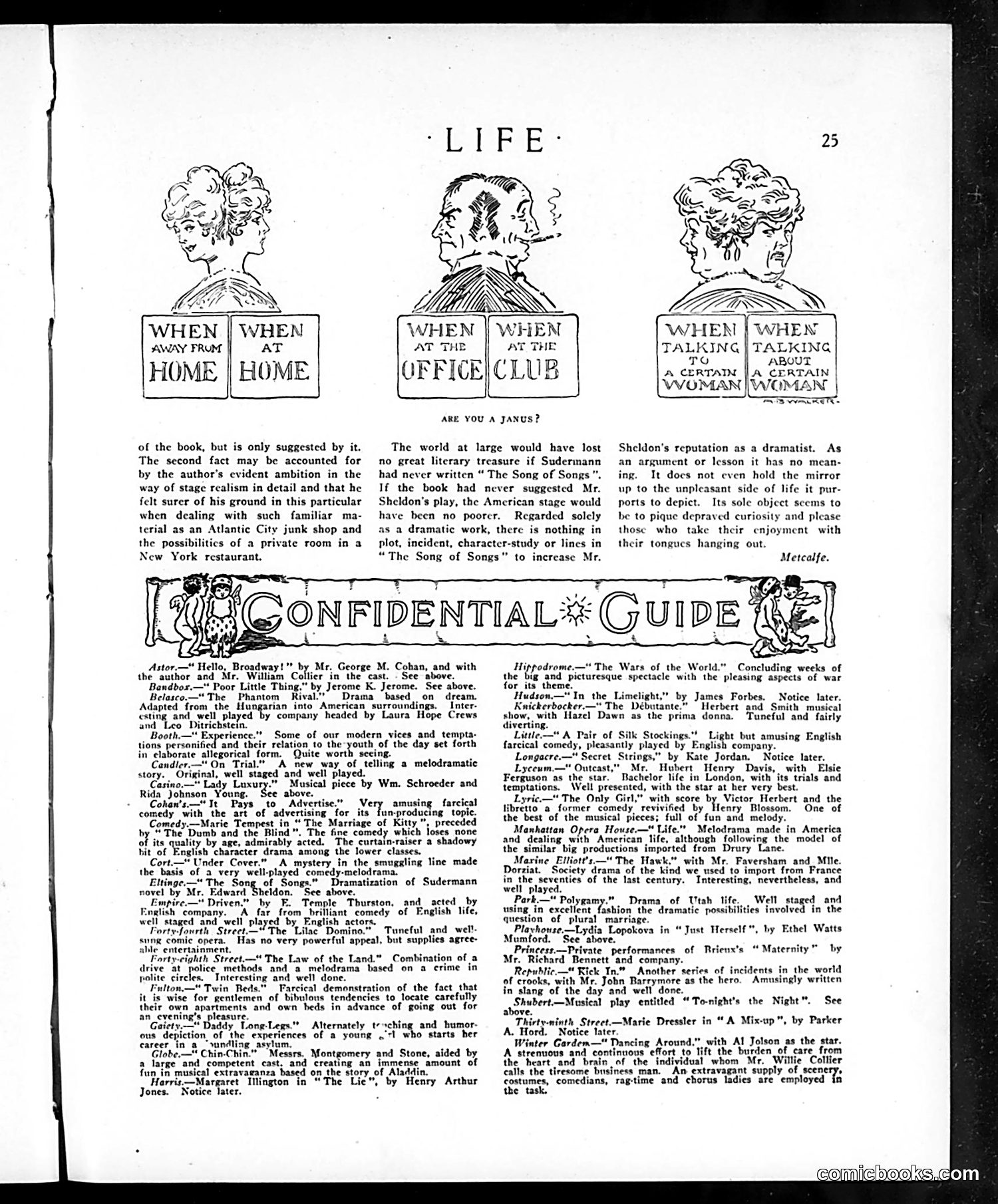
This page features a three-panel cartoon satirizing how people present different personalities in different social settings. Each panel shows a two-faced head (referencing the Roman god Janus, who had two faces looking in opposite directions). **The three scenarios:** 1. A woman "when away from home" versus "when at home" 2. A man "at the office" versus "at the club" 3. A woman "when talking to a certain woman" versus "when talking about a certain woman" **The satire:** The cartoon mocks the hypocrisy of early 20th-century social behavior — specifically how people adopt different personas depending on their audience and setting. The implication is that people are dishonest or two-faced in their social interactions, behaving differently when being observed versus when gossiping or relaxing. The page also contains theater reviews, suggesting this is from Life's entertainment section, circa 1912.
📄 Transcribed text from this page (OCR, searchable)
Machine-transcribed from the original scan — historical spelling and the odd misread are preserved.
WHEN AT THE Leo WHEN TALKING | TALKING TO ABOUT A CERTAIN | A CERTAIN AT THE ARE YOU A JANUS? of the book, but is only suggested by it. The second fact may be accounted for by the author's evident ambition in the way of stage realism in detail and that he felt surer of his ground in this particular when dealing with such familiar ma- terial as an Atlantic City junk shop and the possibilitics of a private room in a New York restaurant. Astor — Hello, Broadway!" by Mr. George M. Cohan, and with the author and Mr. William Collier in the cast. . See above. Bandbos.— Poor Little Thing,” by Jerome K. Jerome. See above. Belasco.—“ The Phantom Rival." Drama ‘based on dream. ‘Adapted from the Hungarian into American surroundings. Inter- esting and well played by company headed by Laura Hope Crews and Leo Ditrichstein. Booth.—" Ex tions personifi in elaborate al ience.”” Some of our modern vices and tempta- d their relation to the-youth of the day set forth ical form. Quite worth seeing. : Candler.—"On Trial.” A new way of telling a melodramatic story. Original, well staged and well played. Cosino.—" Lady Luxury.” Musical piece by Wm. Schroeder and Rida Johnson Young. See above. Cohan’s—" It Pays to | Advertise.” Very amusing farcical comedy with the art of advertising for its fun-producing topic. Comedy.—Marie Tempest in The Marriage of Kitty", preceded by “The Dumb and the Blind”. The fine comedy which loses none of its quality by age, admirably acted. The curtain-raiser a shadowy Fit-of English character drama among the lower classes Cort.—" Under Cover.” A mystery in the smuggling line made the basis of a very well-played comedy-melodrama. Eltinge.—" The Song of Songs.” Dramatization of Sudermann novel by Mr. Edward Sheldon. See above. mpire.—" Driven.’ FE. Temple Thurston, and acted by nglish company. nt comedy of English life, well staged and well pla h actors. Forty-fourth Street Domino.” Tuneful and _well- sung comic opera. Has no very powerful appeal, but supplies agree- inment. Mth Street.—" The Law of the Land.” Combination of a methods and a melodrama based on a crime in polite circles. Interesting and well done. ulton.—" Twin Reds.” Farcical demonstration of the fact that is wise for gentlemen of bibulons tendencies to locate carefully their own apartments and own beds in advance of going out for an evening's pleasure. Gaiety.—" Daddy Long-Legs.” Alternately tv yching and bumor- ous depiction, of the experiences of a young ,-1 who starts her career in a ‘sundling, asylum, Globe.—" Chin-Chin.” Messrs. Montgomery and Stone, aided by a large and competent cast. and creating an immense amount of fun in musical extravaganza based on the story of Aladdin. oltre Marearet IMington in “The Lie", by Henry Arthur jones. The world at large would have lost no great literary treasure if Sudermann had never written “ The Song of Songs”. ing. If the book had never suggested Mr. Sheldon’s play, the American stage would have been no poorer. as a dramatic work, there is nothing in plot, incident, charact “The Song of Songs Sheldon’s reputation as a dramatist. As an argument or lesson it has no mean- Tt docs not even hold the mirror up to the unpleasant side of life it pur- ports to depict. Its sole object scems to be to pique depraved curiosity and please those who take their enjoyment with their tongucs hanging out. Regarded solely study or lines in to increase Mr. Metcalfe. Higpodrome-—" The Wars of the World.” | Concluding weeks of the big and picturesque spectacle with the pleasing aspects of war for its theme. Hudson.—"In the Limelight,” by James Forbes. Notice later. Knickerbocker—" The Débutante.” “Herbert and Smith musical show, with Hazel Dawn as the prima donna. Tuneful and fairly diverting. Little.—" A Pair of Silk Stockings.” Light but amu farcical comedy, pleasantly played by English company. Secret Strings,” by Kate Jordan. Notice later. Lyceum.—" Outcast,” Mr. Hubert Henry Davis, with Elsie Ferguson as the star.” Bachelor life in London, with its trials and temptations. Well presented, with the star at her very best. Lyric —" The Only Girl.” with score by Victor Herbert and the libretto a former comedy’ revivified by Henry Blossom. One of the best of the musical pieces; full of fun and melody. Manhattan Opera House—" Life.” Melodrama made in America and dealing with American life, although following the model of the similar big productions imported from Drury Lane. The Hawk,” with Mr. Faversham and Mille. I ty drama of the kind we used to import from France in the seventies of the last century. Interesting, nevertheless, and well played. Park.—“ Polygamy.” Drama, of Utah life. Well staged and using in excellent fashion the dramatic possibilities involved in the question of plural marriage. Plavhonse.—Lydia Lopokova in “Just Herself", by Ethel Watts Mumford. See above. Princess.—Private performances of Rrienx's “ Maternity" by Mr. Richard Bennett and company. Republic.— Rick In.” Another series of incidents in the world of crooks, with Mr. Jobn Barrymore as the hero. Amusingly written in slang of the day and well done. ,Shubert—Mesical play entitled “Tonight's the Night". See above. Thirty-ninth Street—Marie Dressler in “A Mix-up”, by Parker A. Hord. Notice later. Winter Gardem—" Dancing Around.” with Al Jolson as the star. A strenuous and continuous effort to lift the burden of care from the heart and brain of the individual whom Mr. Willie Collier calls the tiresome business man. An extravagant supply of scenery. fy costumes, comedians, ragtime and chorus ladies are employed the task, 1 English