
Life, 1915-01-07 · page 32 of 44
Life — January 7, 1915 — page 32: what you’re looking at
What you’re looking at
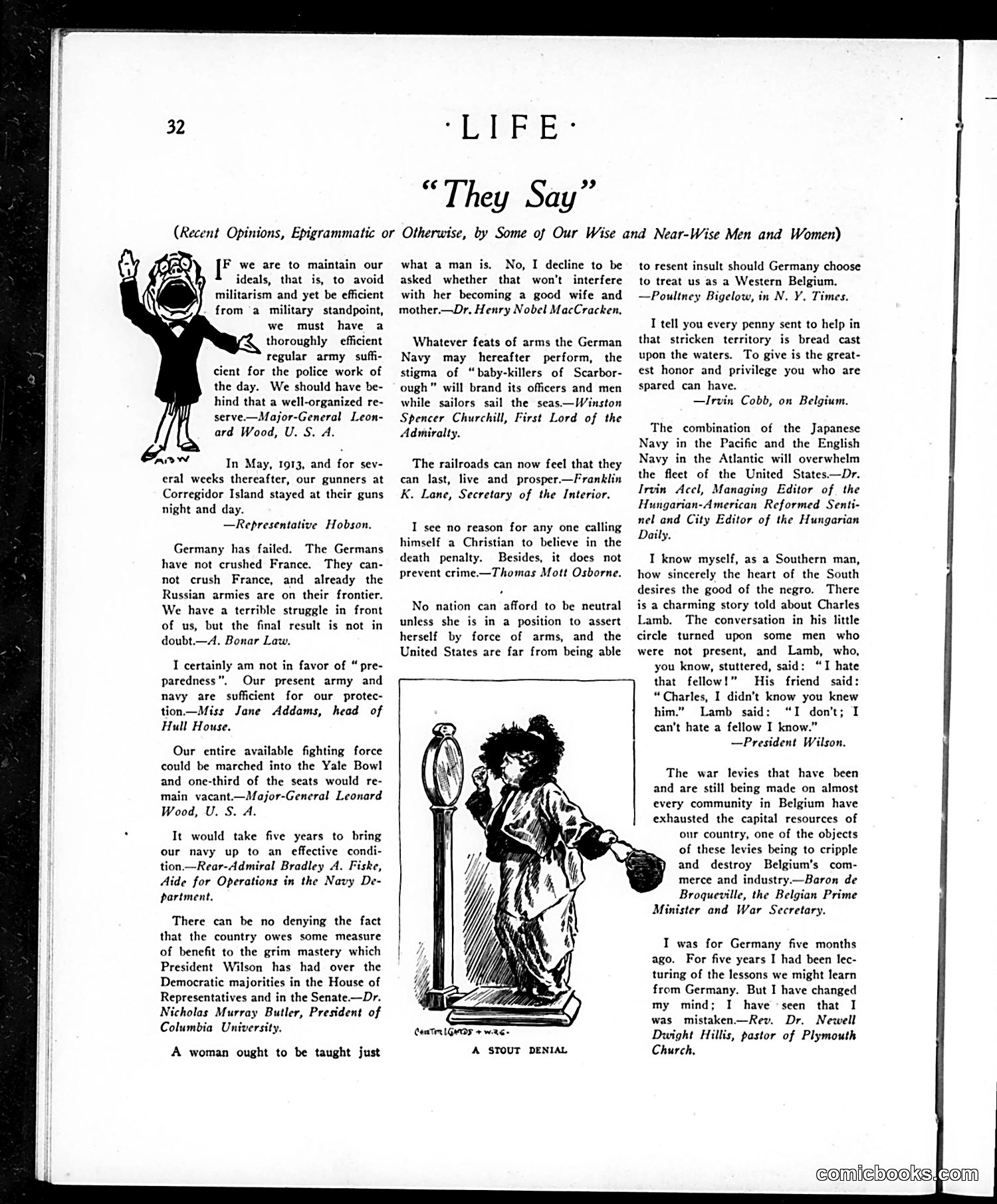
This page collects contemporary opinions on WWI preparedness and related issues, circa 1914-1915. The cartoon labeled "A Stout Denial" depicts a woman in classical dress (Liberty or Justice) firmly rejecting something—likely satirizing denials of German atrocities or pacifist resistance to military buildup. The quotes reveal deep American debate: military leaders like Leonard Wood advocated preparedness; pacifists like Jane Addams opposed it. Winston Churchill condemned German naval brutality ("baby-killers of Scarborough"). President Wilson defended the South's racial attitudes while expressing Christian opposition to capital punishment—a jarring juxtaposition. The page captures pre-U.S. entry tensions: anxiety about German and Japanese naval threats, Belgian suffering, American military weakness, and conflicting ideologies about intervention versus neutrality. The "stout denial" likely mocks either German denials of war crimes or American refusals to acknowledge unpreparedness.
📄 Transcribed text from this page (OCR, searchable)
Machine-transcribed from the original scan — historical spelling and the odd misread are preserved.
“le RaB “They Say” (Recent Opinions, Epigrammatic or Otherwise, by Some of Our Wise and Near-Wise Men and Women) F we are to maintain our ideals, that is, to avoid militarism and yet be efficient from a military standpoint, we must have a (< thoroughly efficient regular army suffi- cient for the police work of the day. We should have be- hind that a well-organized re- serve.—Major-General Leon- ard Wood, U.S. A. In May, 1913, and for sev- eral weeks thereafter, our gunners at Corregidor Island stayed at their guns night and day. —Representative Hobson. Germany has failed. The Germans have not crushed France. They can- not crush France, and already the Russian armies are on their frontier. We have a terrible struggle in front of us, but the final result is not in doubt.—A. Bonar Law. I certainly am not in favor of “ pre- paredness”. Our present army and navy are sufficient for our protec- tion —Miss Jane Addams, head of Hull House. Our entire available fighting force could be marched into the Yale Bowl and one-third of the seats would re- main vacant.—Major-General Leonard Wood, U. S. A. It would take five years to bring our navy up to an effective condi- tion—Rear-Admiral Bradley A. Fiske, Aide for Operations in the Navy De- partment. There can be no denying the fact that the country owes some measure of benefit to the grim mastery which President Wilson has had over the Democratic majorities in the House of Representatives and in the Senate.—Dr. Nicholas Murray Butler, President of Columbia University. A woman ought to be taught just what a man is. No, I decline to be asked whether that won't interfere with her becoming a good wife and mother.—Dr. Henry Nobel MacCracken, Whatever feats of arms the German Navy may hereafter perform, the stigma of “baby-killers of Scarbor- ough” will brand its officers and men while sailors sail the seas.—Wéinston Spencer Churchill, First Lord of the Admiralty. The railroads can now feel that they can last, live and prosper.—Franklin K. Lane, Secretary of the Interior. I see no reason for any one calling himself a Christian to believe in the death penalty. Besides, it does not prevent crime.—Thomas Mott Osborne. No nation can afford to be neutral unless she is in a position to assert herself by force of arms, and the United States are far from being able Centre GMOF + WRG A STOUT DENIAL to resent insult should Germany choose to treat us as a Western Belgium. —Poultney Bigelow, in N. Y. Times. T tell you every penny sent to help in that stricken territory is bread cast upon the waters. To give is the great- est honor and privilege you who are spared can have. —Irvin Cobb, on Belgium. The combination of the Japanese Navy in the Pacific and the English Navy in the Atlantic will overwhelm the fleet of the United States.—Dr. Irvin Accel, Managing Editor of the Hungarian-American Reformed Senti- nel and City Editor of the Hungarian Daily. I know myself, as a Southern man, how sincerely the heart of the South desires the good of the negro. There is a charming story told about Charles Lamb. The conversation in his little circle turned upon some men who were not present, and Lamb, who, you know, stuttered, said: “I hate that fellow!” His friend said: “Charles, I didn’t know you knew him.” Lamb said: “I don’t; I can't hate a fellow I know.” —President Wilson. The war levies that have been and are still being made on almost every community in Belgium have exhausted the capital resources of our country, one of the objects of these levies being to cripple and destroy Belgium’s com- merce and industry.—Baron de Broqueville, the Belgian Prime Minister and War Secretary. I was for Germany five months ago. For five years I had been lec- turing of the lessons we might learn from Germany. But I have changed my mind; I have ‘seen that I was mistaken—Rev. Dr. Newell Dwight Hillis, pastor of Plymouth Church. comichooks, conn