
Life, 1915-01-07 · page 26 of 44
Life — January 7, 1915 — page 26: what you’re looking at
What you’re looking at
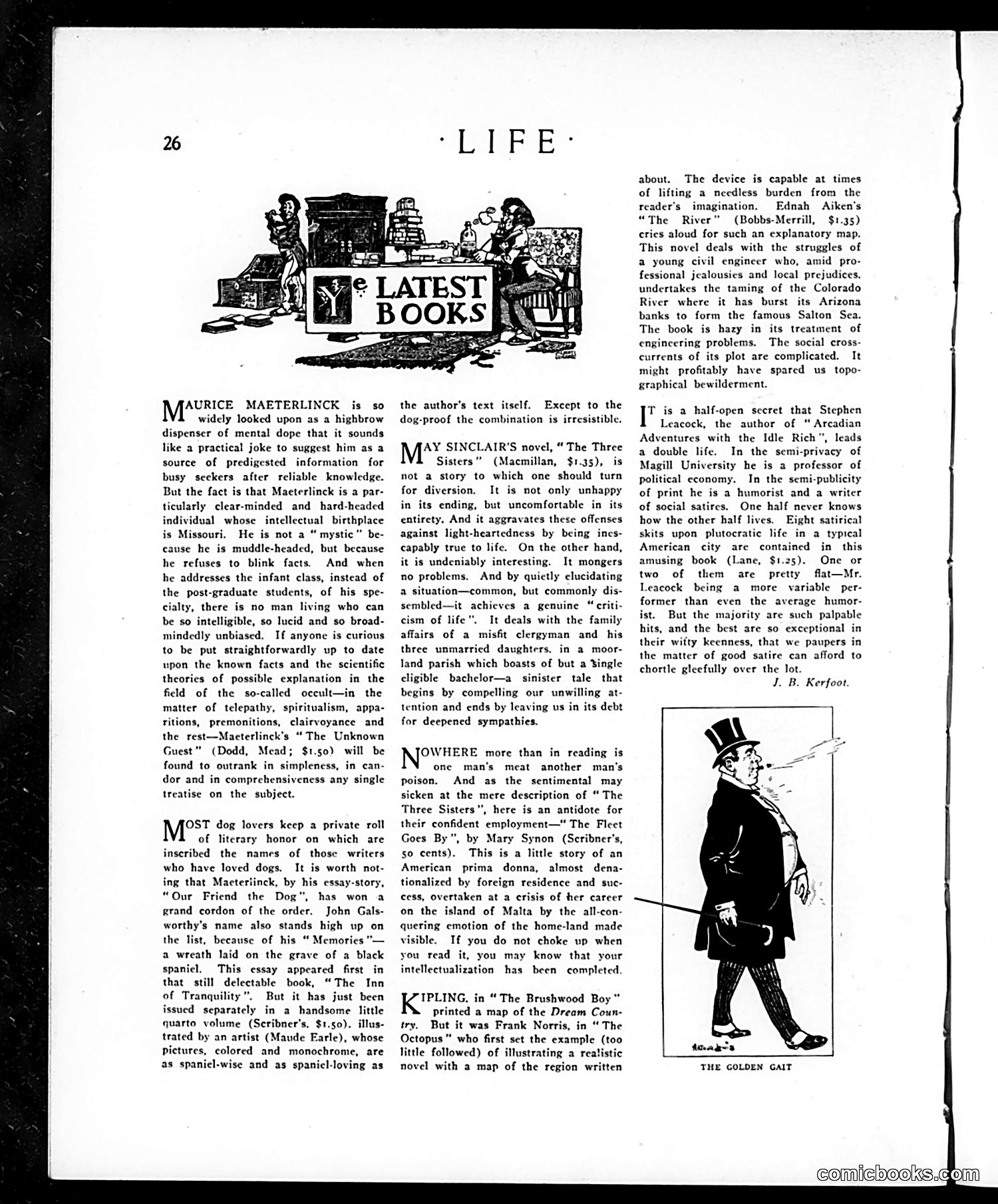
This page reviews contemporary novels and literary figures. The text praises Belgian playwright Maurice Maeterlinck as a clear-minded intellectual (despite his "highbrow" reputation) whose works on occult subjects are comprehensible and factual. It also recommends his essay "Our Friend the Dog," illustrated by Maude Earle. The page includes reviews of May Sinclair's *The Three Sisters* (described as emotionally uncomfortable but truthful) and Mary Synon's *The Fleet Goes By* (a sentimental story about an American opera singer). **The cartoon** (bottom right, labeled "THE GOLDEN GAIT") shows a well-dressed gentleman in top hat and monocle—a stock figure representing upper-class pretension or snobbery common to Life's satirical style, though the specific reference remains unclear without additional context. The overall tone is sophisticated literary criticism for an educated readership interested in contemporary fiction and intellectual discourse.
📄 Transcribed text from this page (OCR, searchable)
Machine-transcribed from the original scan — historical spelling and the odd misread are preserved.
[aAURICE MAETERLINCK is so widely looked upon as a highbrow dispenser of mental dope that it sounds like a practical joke to suggest him as a source of predigested information for busy seekers after reliable knowledge. But the fact is that Maeterlinck is a par- ticularly clear-minded and hard-headed individual whose intellectual birthplace is Missouri. He is not a “ mystic” be- cause he is muddle-headed, but because he refuses to blink facts. And when he addresses the infant class, instead of the post-graduate students, of his spe- cialty, there is no man living who can be so intelligible, so lucid and so broad- mindedly unbiased. If anyone is curious to be put straightforwardly up to date upon the known facts and the scientific theorics of possible explanation in the field of the so-called occult—in the matter of telepathy, spiritualism, appa- ritions, premonitions, clairvoyance and the rest—Maeterlinck’s “The Unknown Guest” (Dodd, Mead; $1.50) will be found to outrank in simpleness, in can- dor and in comprehensiveness any single treatise on the subject. OST dog lovers keep a private roll of literary honor on which are inscribed the names of those writers who have loved dogs, It is worth not- ing that Maeteriinck, by his essay-story, “Our Friend the Dog”, has won a grand cordon of the order. John Gals- worthy’s name also stands high up on the list, because of his “ Memories "— a wreath laid on the grave of a black spaniel. This essay appeared first in that still delectable book, “The Inn of Tranquility”. But it has just been issued separately in a handsome little quarto volume (Scribner's, $1.50). illus- trated by an artist (Maude Earle), whose Pictures, colored and monochrome, are as spaniel-wise and as spanicl-loving as the author's text itself. Except to the dog-proof the combination is irresistible. AY SINCLAIR'S novel, “ The Three Sisters” (Macmillan, $1.35), is not a story to which one should turn for diversion. It is not only unhappy in its ending, but uncomfortable in its entirety, And it aggravates these offenses against light-heartedness by being incs- capably true to life. On the other hand, it is undeniably interesting. It mongers no problems. And by quietly elucidating a situation—common, but commonly dis- sembled—it achieves a genuine “ criti- cism of life". It deals with the family affairs of a misfit clergyman and his three unmarricd daughters. in a moor- land parish which boasts of but a Single cligible bachelor—a sinister tale that begins by compelling our unwilling at- tention and ends by leaving us in its debt for deepened sympathies. NOWHERE more than in reading is o1 ne man’s meat another man’s poison, And as the sentimental may sicken at the mere description of “ The Three Sisters", here is an antidote for their confident employment— The Fleet Goes By”, by Mary Synon (Scribner's, so cents). This is a little story of an American prima donna, almost dena- tionalized by foreign residence and suc- cess, overtaken at a crisis of her career on the island of Malta by the all-con- quering emotion of the home-land made visible. Tf you do not choke up when you read it, you may know that your intellectualization has been completed. IPLING, in “The Brushwood Boy“ printed a map of the Dream Coun- try, But it was Frank Norris, in “ The Octopus” who first set the example (too little followed) of illustrating a rea! novel with a map of the region written about. The device is capable at times of lifting a needless burden from the reader's imagination. Ednah Aiken's “The River” (Bobbs-Merrill, $1.35) cries aloud for such an explanatory map. This novel deals with the struggles of a young engineer who, amid pro- fessional jealousies and local prejudices. undertakes the taming of the Colorado River where it has burst its Arizona banks to form the famous Salton Sea. The book is hazy in its treatment of engincering problems. The social cross- currents of its plot are complicated. It might profitably have spared us topo- graphical bewilderment. is a half-open secret that Stephen Leacock, the author of “ Arcadian Adventures with the Idle Rich”, leads a double life. In the semi-privacy of Magill University he is a professor of political economy. In the semi-publicity of print he is a humorist and a writer of social satires. One half never knows how the other half lives. Eight satirical skits upon plutocratic life in a typical American city are contained in this amusing book (Lane, $1.25). One or two of them are pretty flat—Mr. Leacock being a more variable per- former than even the average humor- ist. But the majority are such palpable hits, and the best are so exceptional in their witty keenness, that we paupers in the matter of good satire can afford to chortle gleefully over the lot. J. B. Kerfoot. Nenad THE GOLDEN GAIT comichooks.com