
Life, 1915-01-07 · page 27 of 44
Life — January 7, 1915 — page 27: what you’re looking at
What you’re looking at
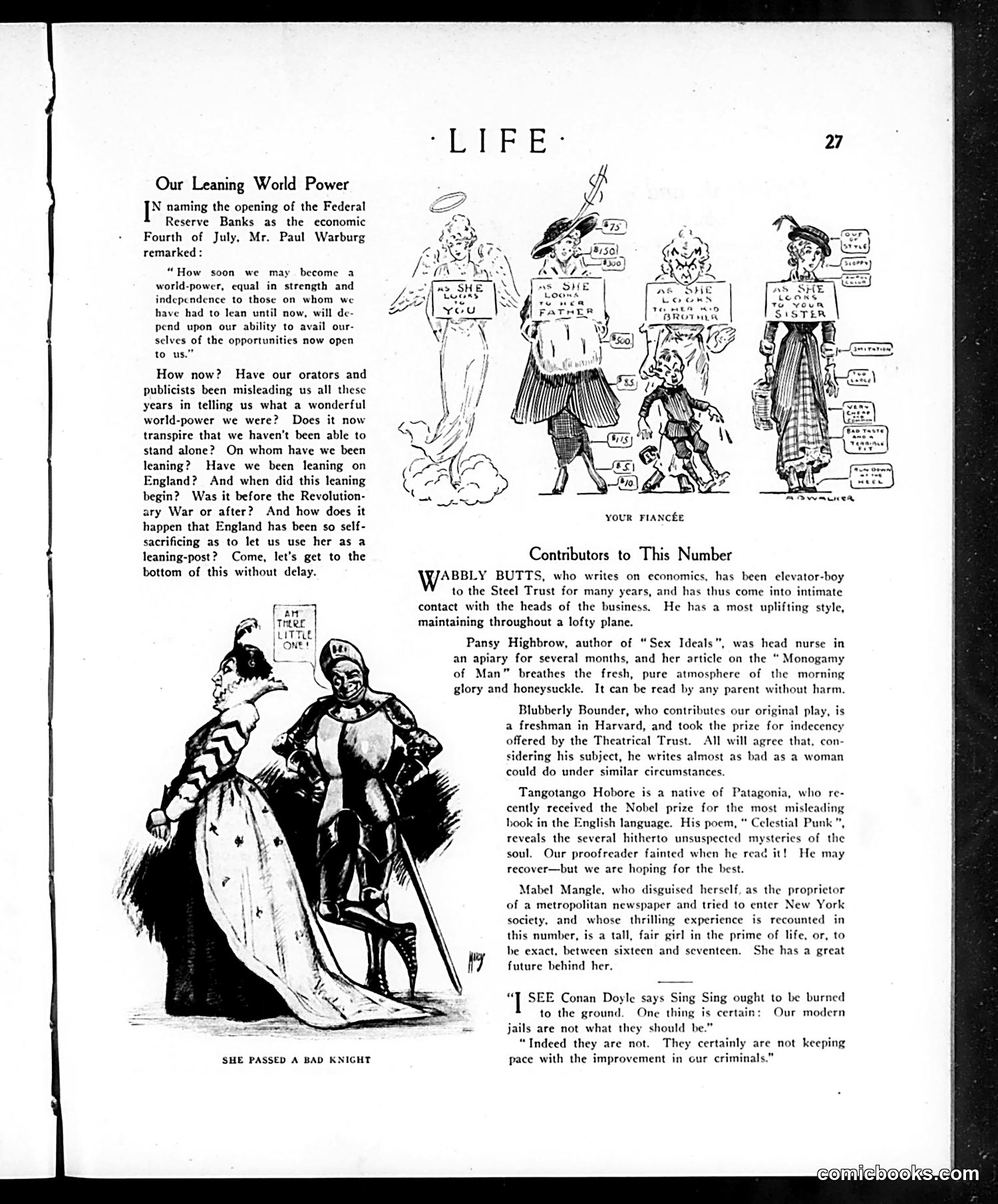
This page satirizes American economic confidence and international standing circa the Federal Reserve's founding (1913). **Main Article Satire:** The piece mocks Paul Warburg's optimistic remarks about America becoming a world power equal to Britain. The author sarcastically questions whether Americans have been deceived—if we're truly powerful, why do we need to "lean" on England? When did this dependence begin? The satire suggests American orators have oversold national strength while the country remained economically dependent on Britain. **Cartoons:** - "Your Fiancée" (top right): A humorous family tree showing a woman's relatives as personified character types ("She Loved Her Father," etc.) - "She Passed a Bad Knight" (bottom left): Shows a woman encountering an armored knight—likely a pun on "bad night" **Contributors Section:** Mock biographies hilariously discredit the writers through absurd credentials (economist "contact with Steel Trust," author trained in an apiary, playwright won prize for indecency). The overall tone ridicules both American pretensions to power and the magazine's own contributors.
📄 Transcribed text from this page (OCR, searchable)
Machine-transcribed from the original scan — historical spelling and the odd misread are preserved.
Our Leaning World Power I8 naming the opening of the Federal Reserve Banks as the economic Fourth of July, Mr. Paul Warburg remarked : “How soon we may become a world-power, equal in strength and independence to those on whom we have had to lean until now, will de- pend upon our ability to avail our- selves of the opportunities now open to us.” How now? Have our orators and publicists been misleading us all these years in telling us what a wonderful world-power we were? Does it now transpire that we haven't been able to stand alone? On whom have we been leaning? Have we been leaning on England? And when did this leaning begin? Was it before the Revolution- ary War or after? And how does it happen that England has been so self- sacrificing as to let us use her as a leaning-post? Come, let's get to the Contributors to This Number bottom of this without delay. \WaAseLy BUTTS, who writes on economics, has been eleva to the Steel Trust for many years, and has thus come into intimate YOUR FIANCEE ay, \Thtee LITTLE] maintaining throughout a lofty plane. f eg contact with the heads of the business. He has a most uplifting style, Pansy Highbrow, author of “Sex Ideals”, was head nurse in an apiary for several months, and her article on the “ Monogamy of Man” breathes the fresh, pure atmosphere of the morning glory and honeysuckle. It can be read by any parent without harm. Blubberly Bounder, who contributes our original play, is a freshman in Harvard, and took the prize for indecency offered by the Theatrical Trust. All will agree that, con- sidering his subject, he writes almost as bad as a woman could do under similar circumstances. Tangotango Hobore is a native of Patagonia, who re- cently received the Nobel prize for the most misleading hook in the English language. His poem, “ Celestial Punk", reveals the several hitherto unsuspected mysteries of the soul. Our proofreader fainted when he read it! He may recover—but we are hoping for the best. Mabel Mangle, who disguised herself, as the proprietor of a metropolitan newspaper and tried to enter New York society, and whose thrilling experience is recounted in this number, is a tall, fair girl in the prime of life, or, to he exact, between sixteen and seventeen. She has a great future behind her. “I SEE Conan Doyle says Sing Sing ought to be burned to the ground. One thing is certain: Our modern jails are not what they should be.” “Indeed they are not. They certainly are not keeping SHE PASSED A BAD KNIGHT pace with the improvement in our criminals.”