
Life, 1915-01-07 · page 21 of 44
Life — January 7, 1915 — page 21: what you’re looking at
What you’re looking at
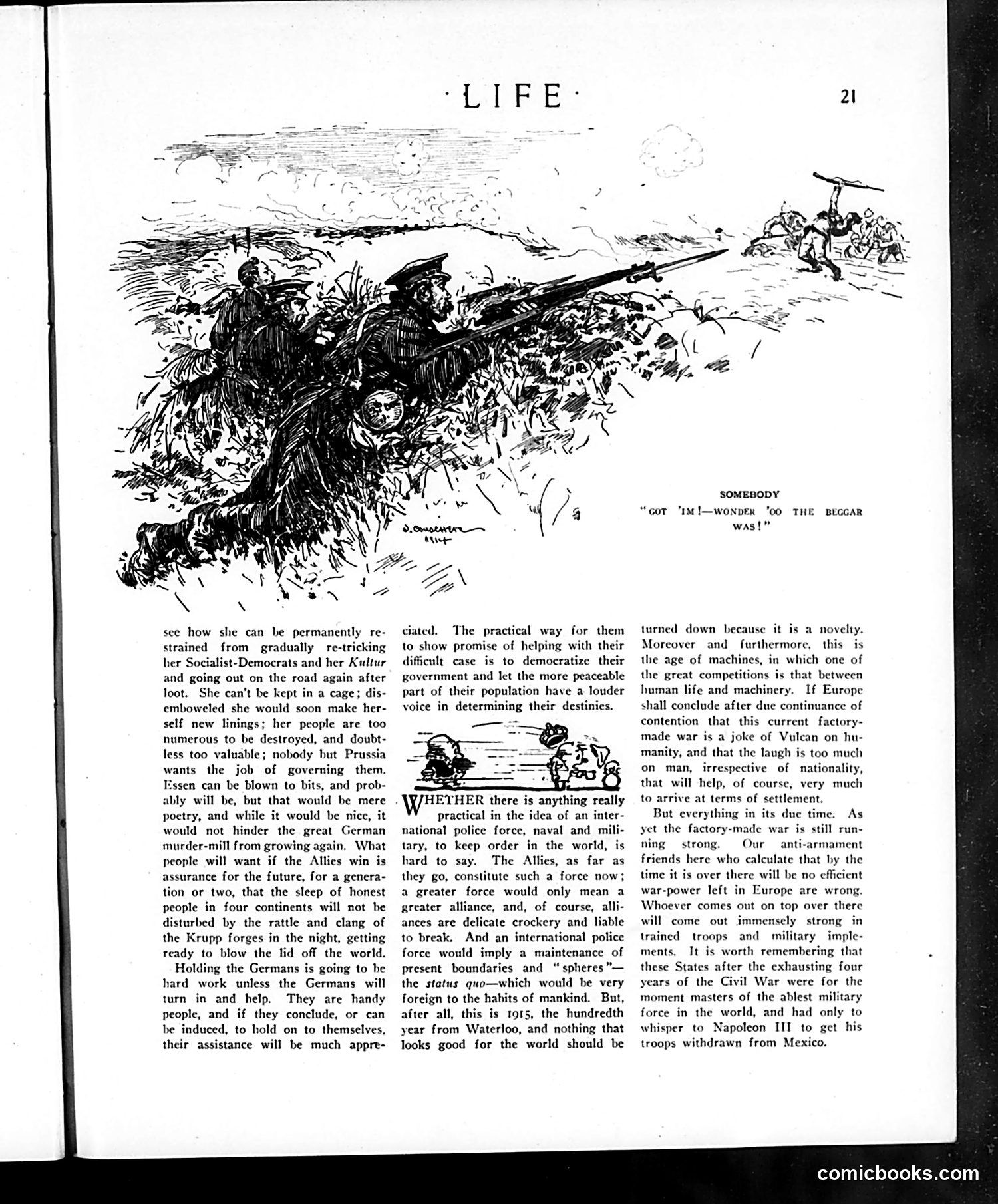
This page contains editorial commentary on World War I (then ongoing in 1915) alongside a satirical cartoon titled "Somebody." **The Cartoon:** Shows a grotesque, demonic figure labeled as Germany emerging from trenches with a rifle, while soldiers observe from a distance. The caption reads: "Got 'im!—Wonder 'oo the beggar was!" The figure appears to be a caricature representing Germany or "Prussian militarism." **The Text's Message:** The article argues that defeating Germany militarily isn't enough—the Allies must ensure Germany cannot restart wars. The writer proposes Germany democratize its government to give "peaceable" citizens more voice, preventing future aggression. The piece also discusses whether an international police force could maintain post-war peace. **Historical Context:** This reflects 1915 anxieties about industrial warfare's scale and the challenge of preventing future German aggression. The reference to the Krupp munitions works and desire to "permanently restrain" Germany foreshadows post-WWI concerns that shaped the Treaty of Versailles. **The Satire:** Mocks the notion of simply destroying Germany's military capacity while suggesting systemic change—democratization—is the real solution.
📄 Transcribed text from this page (OCR, searchable)
Machine-transcribed from the original scan — historical spelling and the odd misread are preserved.
see how she can be permanently re- strained from gradually _re-tricking her Socialist-Democrats and her Kultur and going out on the road again after loot. She can’t be kept in a cage; dis- emboweled she would soon make her- self new linings; her people are too numerous to be destroyed, and doubt- less too valuable; nobody but Prussia wants the job of governing them. Essen can be blown to bits, and prob- ably will be, but that would be mere . poetry, and while it would be nice, it would not hinder the great German murder-mill from growing again. What people will want if the Allies win is assurance for the future, for a genera- tion or two, that the sleep of honest people in four continents will not be disturbed by the rattle and clang of the Krupp forges in the night, getting ready to blow the lid off the world. Holding the Germans is going to be hard work unless the Germans will turn in and help. They are handy people, and if they conclude, or can be induced, to hold on to themselves, their assistance will be much appre- ciated. The practical way for them to show promise of helping with their difficult case is to democratize their government and let the more peaceable part of their population have a louder voice in determining their destinies. HETHER there is anything really Practical in the idea of an inter- national police force, naval and mili- tary, to keep order in the world, is hard to say. The Allies, as far as they go, constitute such a force now; a greater force would only mean a greater alliance, and, of course, alli- ances are delicate crockery and liable to break. And an international police force would imply a maintenance of present boundaries and “ spheres”— the status quo—which would be very foreign to the habits of mankind. But, after all, this is 1915, the hundredth year from Waterloo, and nothing that looks good for the world should be SOMEBODY "im !—WwonveR '00 THE was!" “cor BEGGAR turned down because it is a novelty. Moreover and furthermore, this is the age of machines, in which one of the great competitions is that between human life and machinery. If Europe shall conclude after due continuance of contention that this current factory- made war is a joke of Vulcan on hu- manity, and that the laugh is too much on man, irrespective of nationality, that will help, of course, very much to arrive at terms of settlement. But everything in its due time. As yet the factory-made war is still run- ning — strong. Our — anti-armament friends here who calculate that by the time it is over there will be no efficient war-power left in Europe are wrong. Whoever comes out on top over there will come out immensely strong in trained troops and military imple- ments. It is worth remembering that these States after the exhausting four years of the Civil War were for the moment masters of the ablest military force in the world, and had only to whisper to Napoleon III to get his troops withdrawn from Mexico, comicbooks.com