
Life, 1915-01-07 · page 24 of 44
Life — January 7, 1915 — page 24: what you’re looking at
What you’re looking at
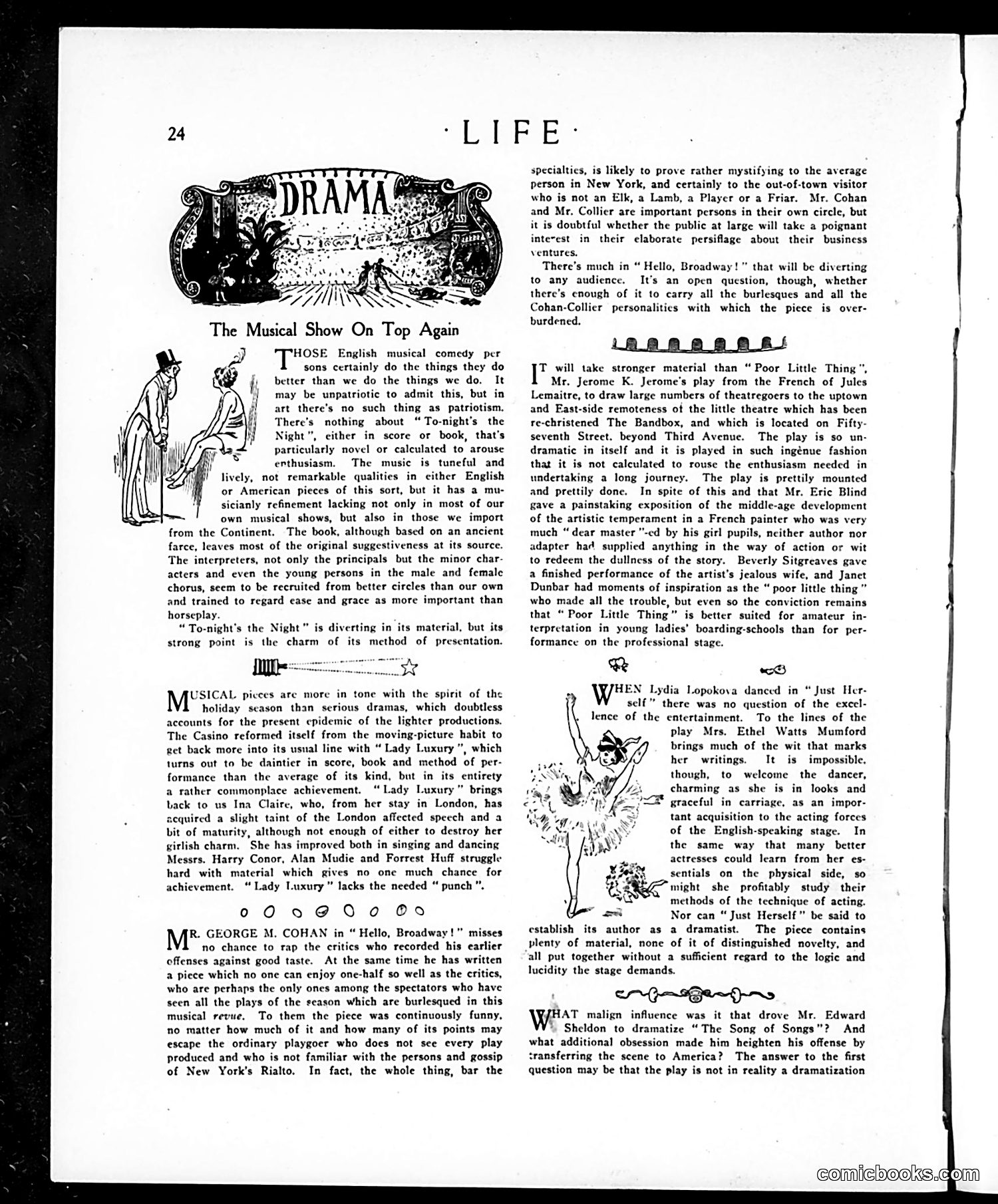
This is a theater review section critiquing several Broadway productions. The main cartoon illustrates "The Musical Show On Top Again"—depicting English musical comedies' superiority over American ones. The illustrated figures show the refinement and ease of English performers versus American theatrical roughness. The reviews discuss specific shows: "Tonight's the Night" (praised for charm and musicianly refinement), "Lady Luxury" (featuring actress Ina Claire, critiqued as commonplace), and George M. Cohan's "Hello, Broadway!" (a self-referential revue where Cohan mocks theater critics). The satire targets Cohan's inside-joke humor—the piece heavily references New York theater world figures ("Elks, Lambs, Players, Friars") and will confuse general audiences unfamiliar with Broadway gossip. The critic suggests it's primarily entertaining to theater professionals and critics who recognize the burlesqued references, not mainstream audiences.
📄 Transcribed text from this page (OCR, searchable)
Machine-transcribed from the original scan — historical spelling and the odd misread are preserved.
aE nleaE HOSE English musical comedy per sons certainly do the things they do better than we do the things we do, It may be unpatriotic to admit this, but in art there's no such thing as patriotism. There's nothing about “ To-night’s the Night”, either in score or book, that’s particularly novel or calculated to arouse erthusiasm. The music is tuneful and lively, not remarkable qualities in cither English or American pieces of this sort, but it has a mu- sicianly refinement lacking not only in most of our own musical shows, but also in those we import from the Continent. The book, although based on an ancient farce, leaves most of the original suggestiveness at its source. The interpreters, not only the principals but the minor char- acters and even the young persons in the male and female chorus, seem to be recruited from better circles than our own and trained to regard ease and grace as more important than horseplay. “To-night’s the Night” is diverting in its material, but its strong point is the charm of its method of presentation. M23 USICAL picces are more in tone with the spirit of the holiday season than serious dramas, which doubtless accounts for the present cpidemic of the lighter productions. The Casino reformed itself from the moving-picture habit to get back more into its usual line with “ Lady Luxury ", which turns out to be daintier in score, book and method of per- formance than the average of its kind, but in its entirety a rather commonplace achievement. “Lady Luxury” brings back to us Ina Claire, who, from her stay in London, has zequired a slight taint of the London affected speech and a bit of maturity, although not enough of either to destroy her girlish charm. ‘She has improved both in singing and dancing Messrs. Harry Conor, Alan Mudie and Forrest Huff struggle hard with material which gives no one much chance for achievement. “Lady Luxury” lacks the needed “ punch”. 0009000098 R. GEORGE M. COHAN in “ Hello, Broadway!” misses no chance to rap the critics who recorded his earlier offenses against good taste. At the same time he has written a piece which no one can enjoy one-half so well as the critics, who are perhaps the only ones among the spectators who have seen all the plays of the season which are burlesqued in this musical revue. To them the piece was continuously funny, no matter how much of it and how many of its points may escape the ordinary playgoer who does not see every play produced and who is not familiar with the persons and gossip of New York's Rialto. In fact, the whole thing, bar the specialties, is likely to prove rather mystifying to the average person in New York, and certainly to the out-of-town visitor who is not an Elk, a Lamb, a Player or a Friar. Mr. Cohan and Mr. Collier are important persons in their own circle, but it is doubtful whether the public at large will take a poignant interest in their elaborate persiflage about their business ventures, There’s much in “ Hello, Broadway!" that will be diverting to any audience. It’s an open question, though, whether there's cnough of it to carry all the burlesques and all the Cohan-Collicr personalities with which the piece is over- burdened. T will take stronger material than “ Poor Little Thing”, Mr. Jerome K. Jerome's play from the French of Jules Lemaitre, to draw large numbers of theatregoers to the uptown and East-side remoteness of the little theatre which has been re-christened The Bandbox, and which is located on Fifty- seventh Strect, beyond Third Avenue. The play is so un- dramatic in itself and it is played in such ingénue fashion that it is not calculated to rouse the enthusiasm needed in undertaking a long journey. The play is prettily mounted and prettily done. In spite of this and that Mr. Eric Blind gave a painstaking exposition of the middle-age development of the artistic temperament in a French painter who was very much “dear master "-ed by his girl pupils, neither author nor adapter had supplied anything in the way of action or wit to redeem the dullness of the story. Beverly Sitgreaves gave a finished performance of the artist's jealous wife, and Janet Dunbar had moments of inspiration as the “ poor little thing” who made all the trouble, but even so the conviction remains that “ Poor Little Thing” is better suited for amateur in- terpretation in young ladies’ boarding-schools than for per- formance on the professional stage. KS HEN Lydia Lopokova danced in “ Just Her- self” there was no question of the exccl- lence of the entertainment. To the lines of the play Mrs. Ethel Watts Mumford brings much of the wit that marks her writings. It is impossible, though, to welcome the dancer, charming as she is in looks and graceful in carriage, as an impor- tant acquisition to the acting forces of the English-speaking stage. In the same way that many better actresses could learn from her es- sentials on the physical side, so might she profitably study their methods of the technique of acting. Nor can “ Just Herself" be said to establish its author as a dramatist. The piece contains plenty of material, none of it of distinguished novelty, and all put together without a sufficient regard to the logic and lucidity the stage demands. eG —SGe~g-n> AT malign influence was it that drove M Sheldon to dramatize “The Song of Songs And what additional obsession made him heighten his offense by transferring the scene to America? The answer to the first question may be that the play is not in reality a dramatization comichooks.com