
Life, 1915-01-07 · page 20 of 44
Life — January 7, 1915 — page 20: what you’re looking at
What you’re looking at
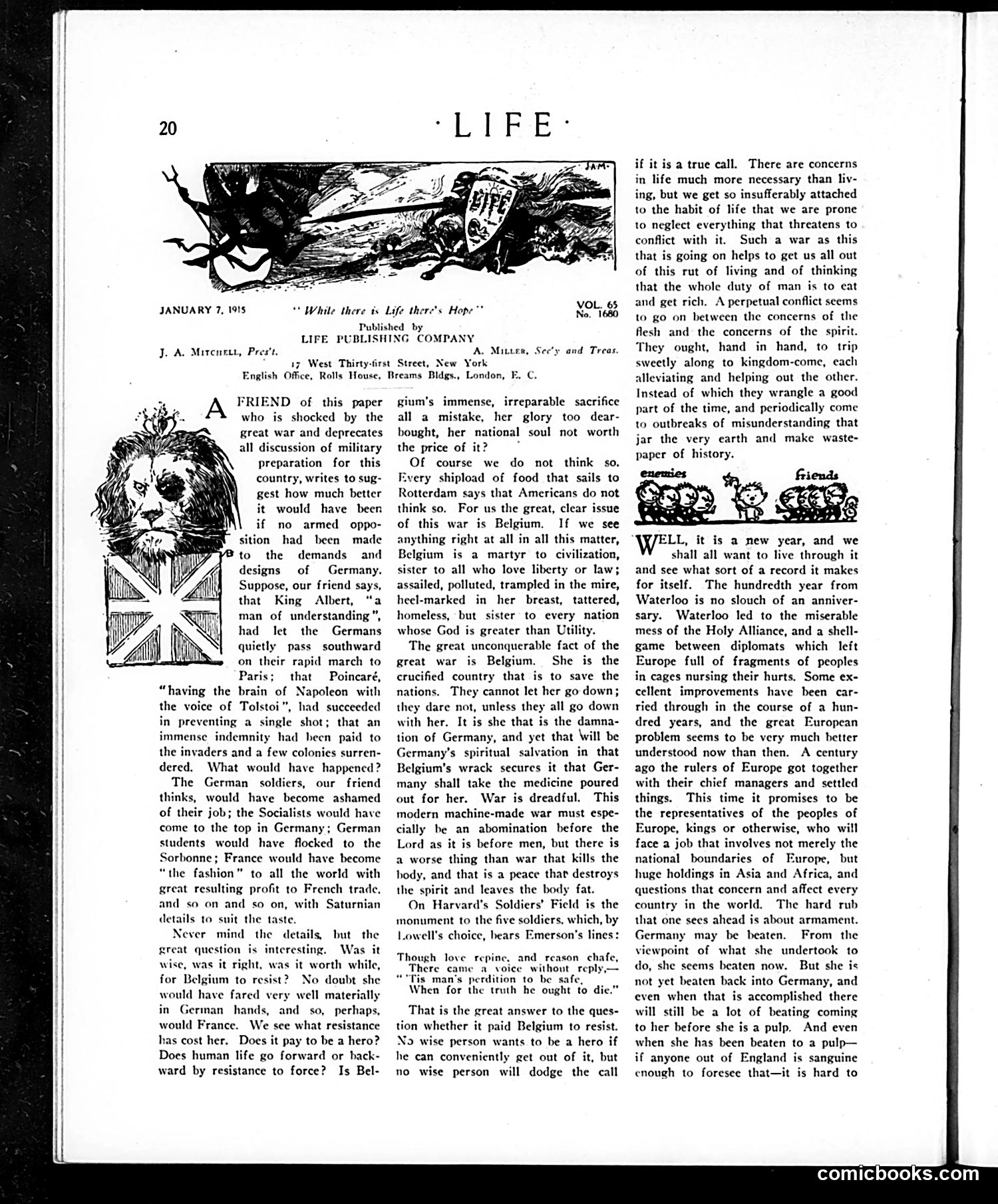
This editorial page argues passionately that Belgium's military resistance to German invasion in 1914 was morally justified, despite its devastating human and material costs. The piece responds to a pacifist reader who suggested Belgium would have fared better by surrendering without fight. Life's editors reject this logic, framing Belgium as a "martyr to civilization" whose resistance—though costly—serves a spiritual purpose greater than mere survival. They argue that some values (liberty, moral principle) matter more than physical safety or prosperity. The accompanying illustration shows a lion wearing a cross, likely symbolizing Belgium's courage and Christian sacrifice. The text references King Albert and French President Poincaré as leaders who chose principled resistance over pragmatic surrender. Published during WWI's early stages, this reflects American intellectual debate over whether the war was justified—before America's 1917 entry—and uses Belgium's plight as the moral centerpiece of pro-Allied argument.
📄 Transcribed text from this page (OCR, searchable)
Machine-transcribed from the original scan — historical spelling and the odd misread are preserved.
JANUARY 7, 1915 “While there ts Life there’ VOL. 65 No. 1680 Published by LIFE J. A. Mitcnett, Pres‘t. PUBLISHING COMPANY A. Miter, Sec’y and Treas 17 West Thirty-first Street, New York English Office, Rolls House, Breams Bldgs., London, E. C. FRIEND of this paper who is shocked by the great war and deprecates all discussion of military preparation for this country, writes to sug- gest how much better it would have been if no armed oppo- sition had been made Bto the demands and designs of Germany. Suppose, our friend say: that King Albert, “a man of understanding”, had let the Germans quietly pass southward on their rapid march to Paris; that Poincaré, “having the brain of Napoleon with the voice of Tolstoi”, had succeeded in preventing a single shot; that an immense indemnity had been paid to the invaders and a few colonies surren- dered. What would have happened? The German soldiers, our friend thinks, would have become ashamed of their job; the Socialists would have come to the top in Germany; German students would have flocked to the Sorbonne; France would have become “the fashion” to all the world with great resulting profit to French trade, and so on and so on, with Saturnian details to suit the taste. Never mind the details, but the great question is interesting. Was it wise, was it right, was it worth while, for Belgium to resist? No doubt she would have fared very well materially in German hands, and so, perhaps, would France. We see what resistance has cost her. Does it pay to be a hero? Does human life go forward or back- ward by resistance to force? Is Bel- gium’s immense, irreparable sacrifice all a mistake, her glory too dear- bought, her national soul not worth the price of it? 7 Of course we do not think so, Every shipload of food that sails to Rotterdam says that Americans do not think so. For us the great, clear issue of this war is Belgium. If we see anything right at all in all this matter, Belgium is a martyr to civilization, sister to all who love liberty or law; assailed, polluted, trampled in the mire, heel-marked in her breast, tattered, homeless, but sister to every nation whose God is greater than Utility. The great unconquerable fact of the great war is Belgium. She is the crucified country that is to save the nations. They cannot let her go down; they dare not, unless they all go down with her. It is she that is the damna- tion of Germany, and yet that Will be Germany’s spiritual salvation in that Belgium's wrack secures it that Ger- many shall take the medicine poured out for her. War is dreadful. This modern machine-made war must espe- cially be an abomination before the Lord as it is before men, but there is a worse thing than war that kills the hody, and that is a peace thar destroys the spirit and leaves the body fat. On Harvard's Soldiers’ Field is the monument to the five soldiers, which, by Lowell's choice, hears Emerson's lines: Though love repine, and reason chafe, There came a voice without repl: “Tis man's perdition to be safe, When for the truth he ought to die.” That is the great answer to the ques- tion whether it paid Belgium to resist. No wise person wants to be a hero if he can conveniently get out of it, but no wise person will dodge the call if it is a true call. There are concerns in life much more necessary than liv- ing, but we get so insufferably attached to the habit of life that we are prone to neglect everything that threatens to conflict with it. Such a war as this that is going on helps to get us all out of this rut of living and of thinking that the whole duty of man is to cat and get rich. A perpetual conflict seems to go on between the concerns of the flesh and the concerns of the spirit. They ought, hand in hand, to trip sweetly along to kingdom-come, cach alleviating and helping out the other. Instead of which they wrangle a good part of the time, and periodically come to outbreaks of misunderstanding that jar the very earth and make waste- paper of history. LL, it is a mew year, and we shall all want to live through it and see what sort of a record it makes for itself. The hundredth year from Waterloo is no slouch of an anniver- sary. Waterloo led to the miserable mess of the Holy Alliance, and a shell- game between diplomats which left Europe full of fragments of peoples in cages nursing their hurts. Some ex- cellent improvements have been car- ried through in the course of a hun- dred years, and the great European problem seems to be very much better understood now than then. A century ago the rulers of Europe got together with their chief managers and settled things. This time it promises to be the representatives of the peoples of Europe, kings or otherwise, who will face a job that involves not merely the national boundaries of Europe, but huge holdings in Asia and Africa, and questions that concern and affect every country in the world. The hard rub that one sees ahead is about armament. Germany may be beaten. From the viewpoint of what she undertook to do, she seems beaten now. But she is not yet beaten back into Germany, and even when that is accomplished there will still be a lot of beating coming to her before she is a pulp. And even when she has been beaten to a pulp— if anyone out of England is sanguine enough to foresee that—it is hard to comicbooks.com