
A complete issue · 44 pages · 1914
Life — October 22, 1914
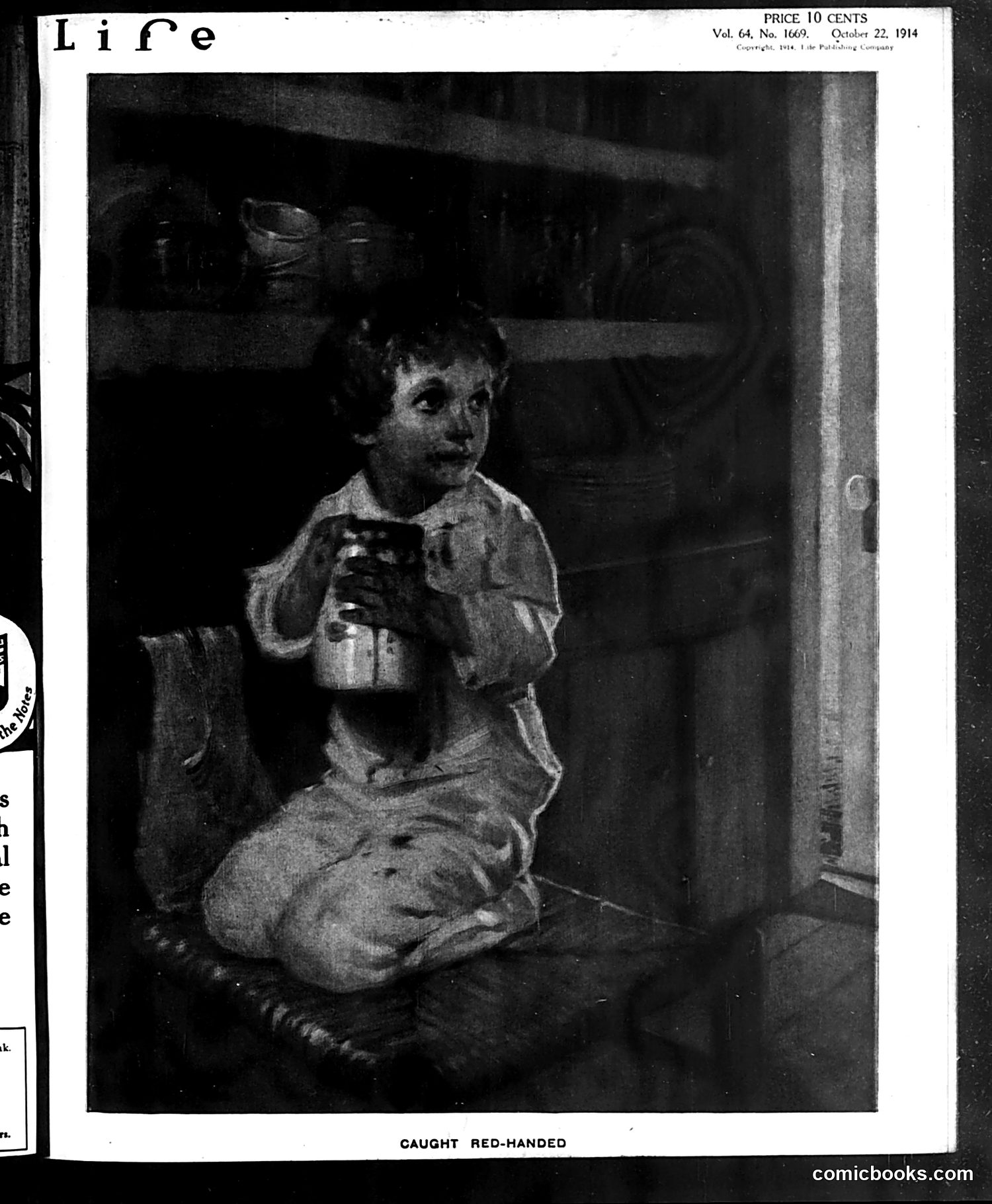
This Life magazine cover from October 22, 1914 shows a young child sitting alone, holding what appears to be a dark object in their hands. The caption reads "Caught Red-Handed." The image appears to be a humorous domestic scene—likely satirizing childhood mischief. The phrase "caught red-handed" (meaning caught in the act of wrongdoing) is being applied literally to a child who has apparently gotten their hands dirty or stained. Without additional context from the magazine's text, the specific social commentary remains unclear, but this was typical of Life's satirical approach: using domestic scenes and children to comment on human nature, parental discipline, or contemporary social behaviors in a lighthearted manner.
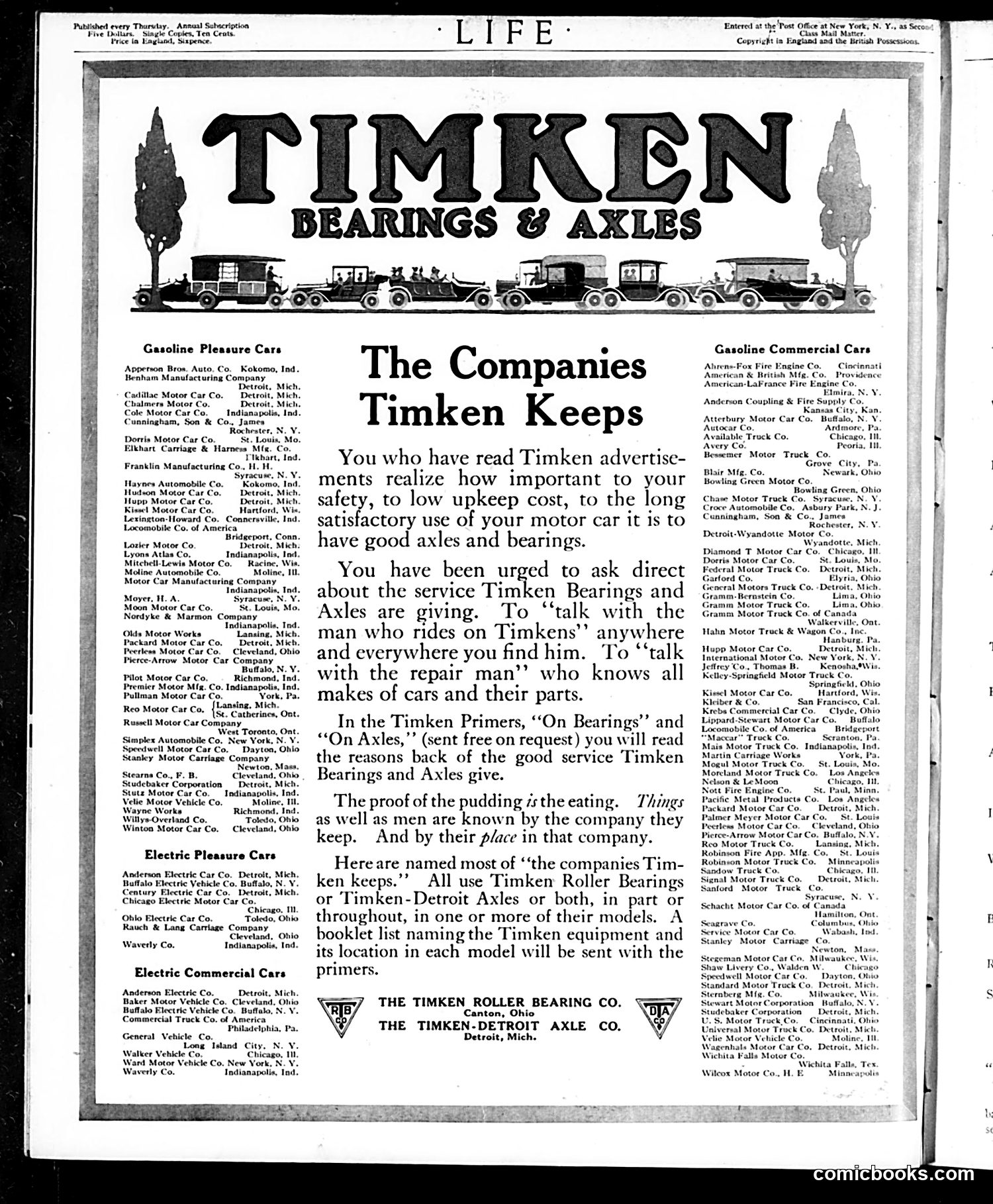
This page is **entirely advertising**, not satire or political commentary. It's a full-page advertisement for Timken Bearings & Axles, published in *Life* magazine. The ad lists dozens of American automobile manufacturers—both pleasure car makers (like Cadillac, Studebaker) and commercial vehicle producers—that use Timken products. The header illustrates various trucks and cars in silhouette. The copy emphasizes Timken's reputation for quality and safety, urging readers to specify Timken bearings and axles when purchasing vehicles. The phrase "the proof of the pudding is the eating" suggests reliability through widespread adoption. This represents typical early-20th-century trade advertising: leveraging brand trust and listing satisfied customers to build consumer confidence in industrial components.
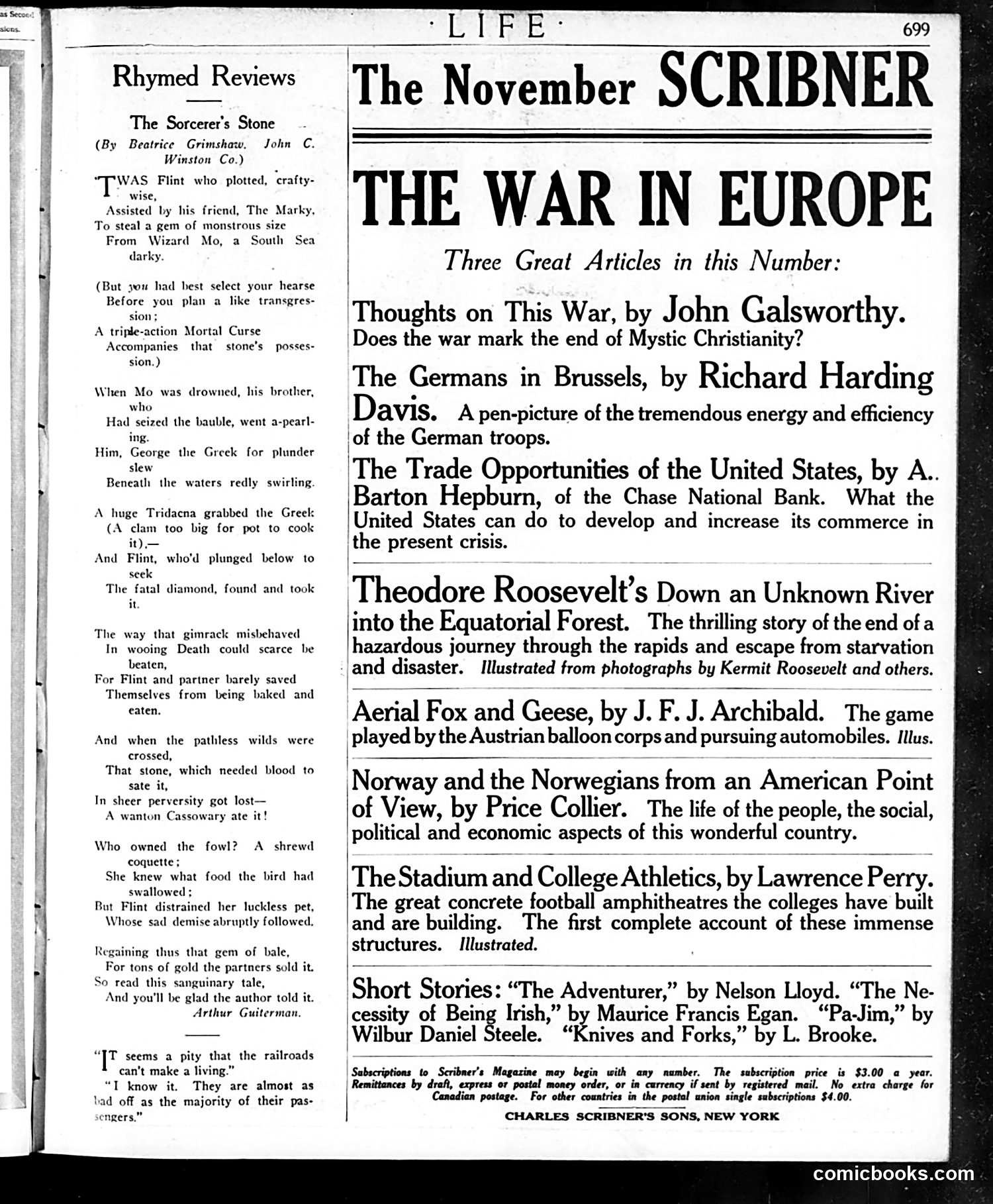
This page is primarily a **table of contents for The November Scribner's Magazine**, not a satirical cartoon page. It advertises articles about World War I in Europe, including pieces by John Galsworthy on the war's spiritual implications and Richard Harding Davis describing German military efficiency in Brussels. On the left is a **rhymed book review** of "The Sorcerer's Stone" by Beatrice Grimshaw, a fantasy adventure tale involving characters like Flint and the Marky stealing a gem from underwater. The verse summary is humorous but not overtly political satire—it's simply a playful poetic synopsis of the plot. This appears to be a content advertisement rather than satirical editorial content.
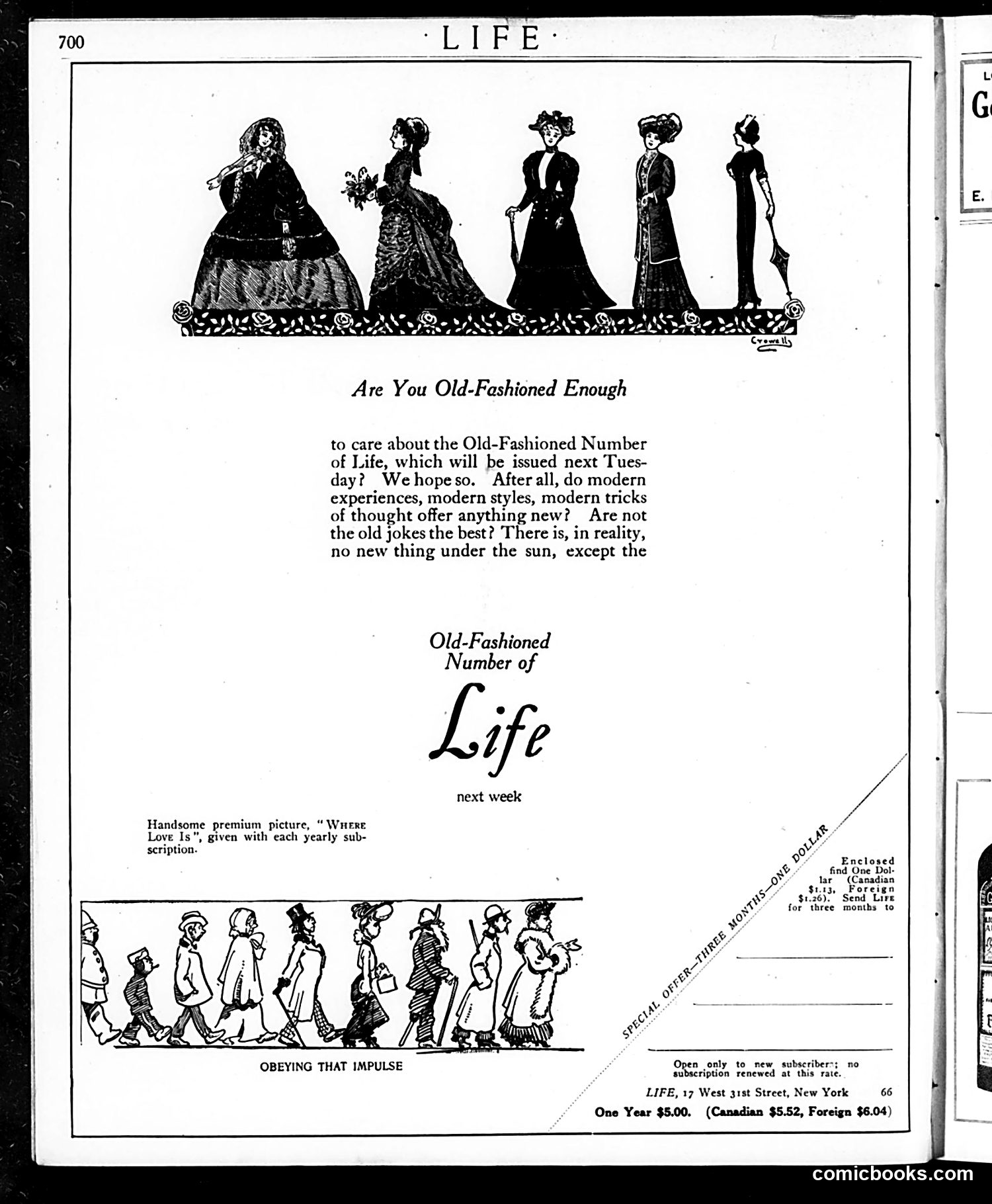
This is primarily **advertising copy** for Life magazine's "Old-Fashioned Number," promoting an upcoming special issue. The **top illustration** shows five women in progressively old-fashioned dress, from Victorian-era styles to contemporary 1920s fashion, establishing the "old vs. new" theme. The **satirical premise** argues that modern experiences and styles offer nothing genuinely new—"there is, in reality, no new thing under the sun." The copy suggests old jokes and traditional approaches remain superior, appealing to readers nostalgic for earlier eras. The **bottom cartoon**, labeled "OBEYING THAT IMPULSE," depicts a line of people following one another, likely satirizing conformist herd behavior—a common modernist-era critique of mass society and fashion trends. The page promotes subscriptions at $5.00 yearly ($5.52 Canadian; $6.04 foreign).
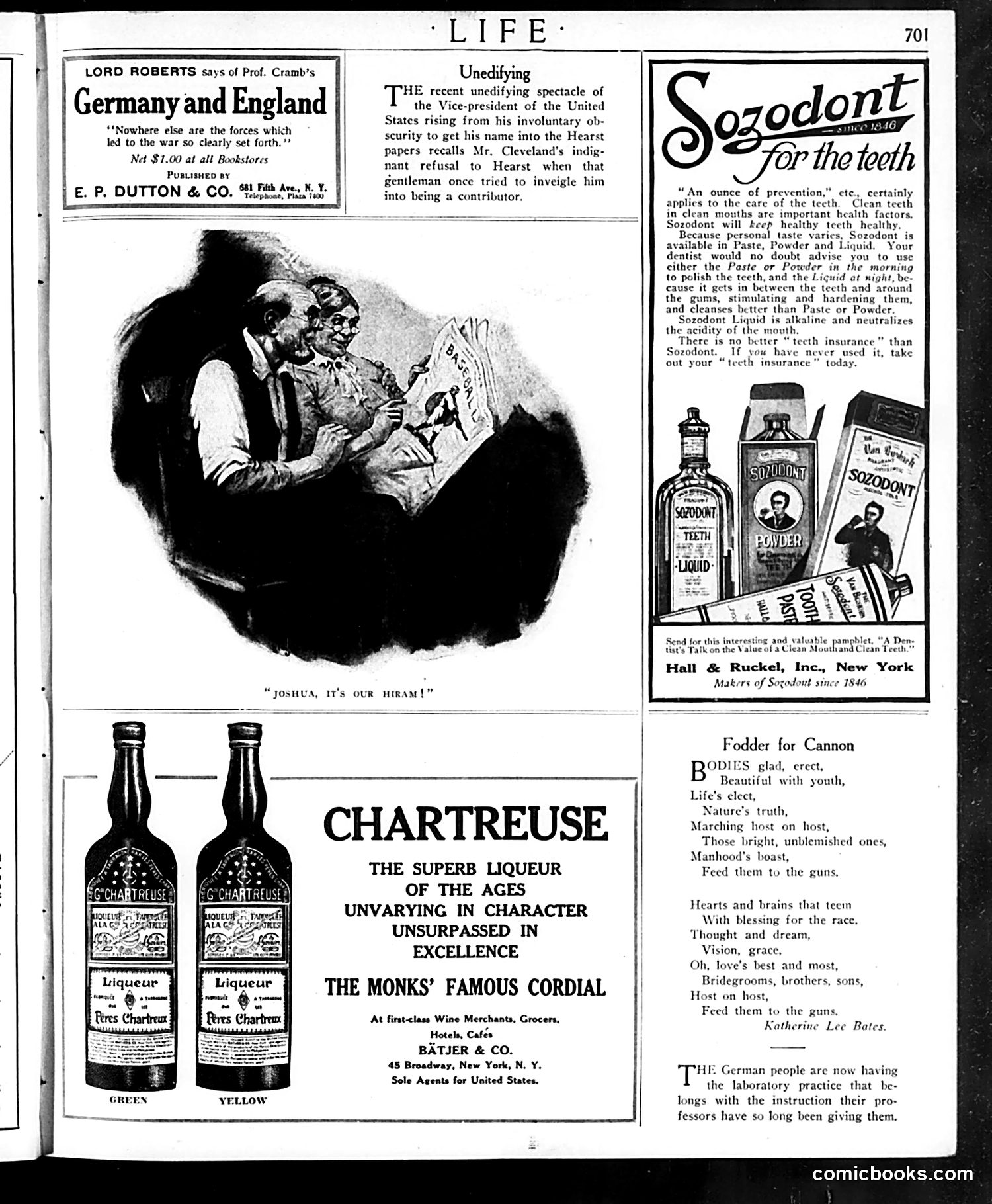
The main cartoon satirizes German-English relations, captioned "Joshua, it's our hiram!" The image depicts two figures (likely representing Germany and England) examining a map together, suggesting they're plotting strategy or dividing territory—a common WWI-era satirical trope about European power conflicts. Lord Roberts's quoted text references forces that "led to the war so clearly set forth," indicating this commentary concerns World War I's origins and the complex alliance dynamics between these nations. The remainder of the page consists primarily of period advertisements: Sozodont toothpaste, Chartreuse liqueur, and a poem titled "Fodder for Cannon"—the latter grimly referencing soldiers sent to their deaths in the war, creating dark juxtaposition between commercial pitches and wartime tragedy.
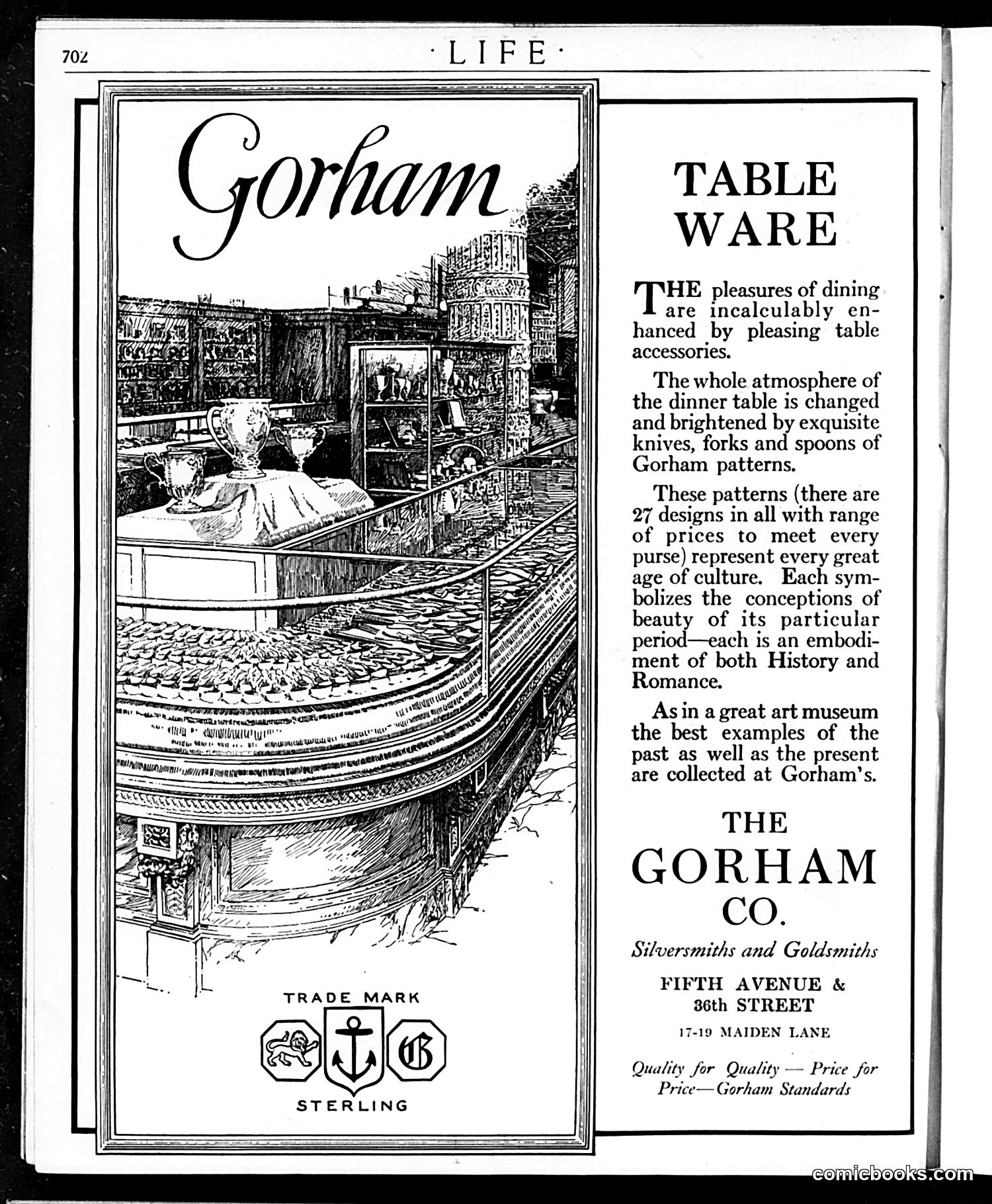
This page is **primarily an advertisement**, not a political cartoon. It promotes Gorham Company tableware—specifically sterling silver knives, forks, and spoons. The left side features an illustration of an elegant dining room display showcasing Gorham's products. The right side is descriptive advertising copy emphasizing that Gorham offers 27 designs spanning different historical periods and price points, positioning their silverware as combining both "History and Romance." The advertisement includes Gorham's trade mark (anchor and monogram) and lists locations: Fifth Avenue & 36th Street in New York, plus a London address at Maiden Lane. This reflects early 20th-century luxury marketing targeting affluent consumers through appeals to taste, history, and social sophistication rather than through satire or political commentary.
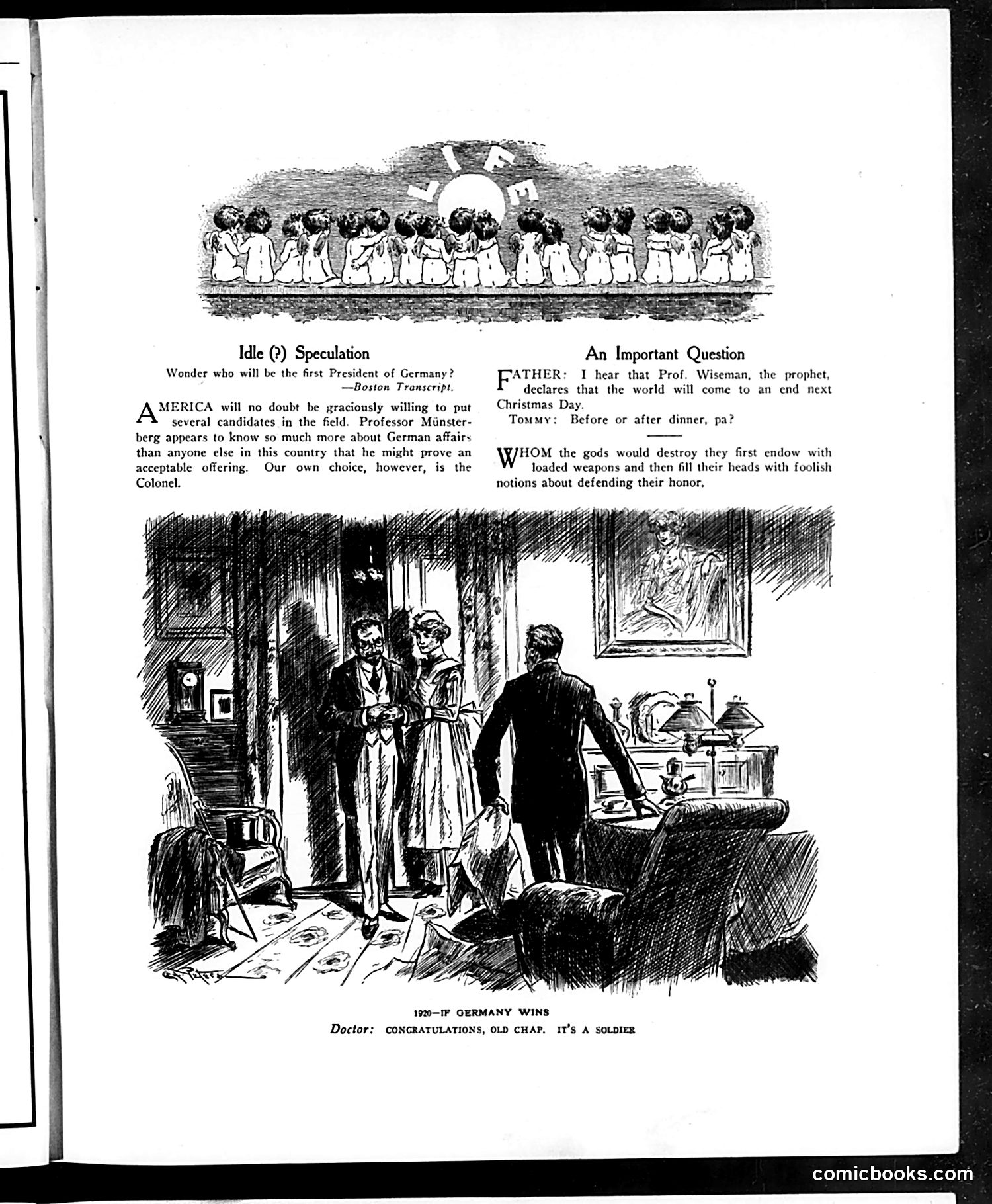
This page contains three satirical pieces from *Life* magazine, likely from the early 20th century: 1. **"Idle (?) Speculation"** references Professor Munsterberg (likely Hugo Munsterberg, a prominent German-American psychologist), speculating who might become Germany's next president. The piece sarcastically suggests a Colonel would be America's "acceptable offering." 2. **"An Important Question"** is a brief joke where Tommy asks his father whether Professor Wiseman's prophecy of the world ending on Christmas will happen before or after dinner—prioritizing the meal. 3. **"If Germany Wins"** is a cartoon showing a doctor congratulating an elderly man on a newborn soldier, satirizing militaristic German society's obsession with producing military personnel. The page reflects pre-WWI American anxieties about Germany's military ambitions.
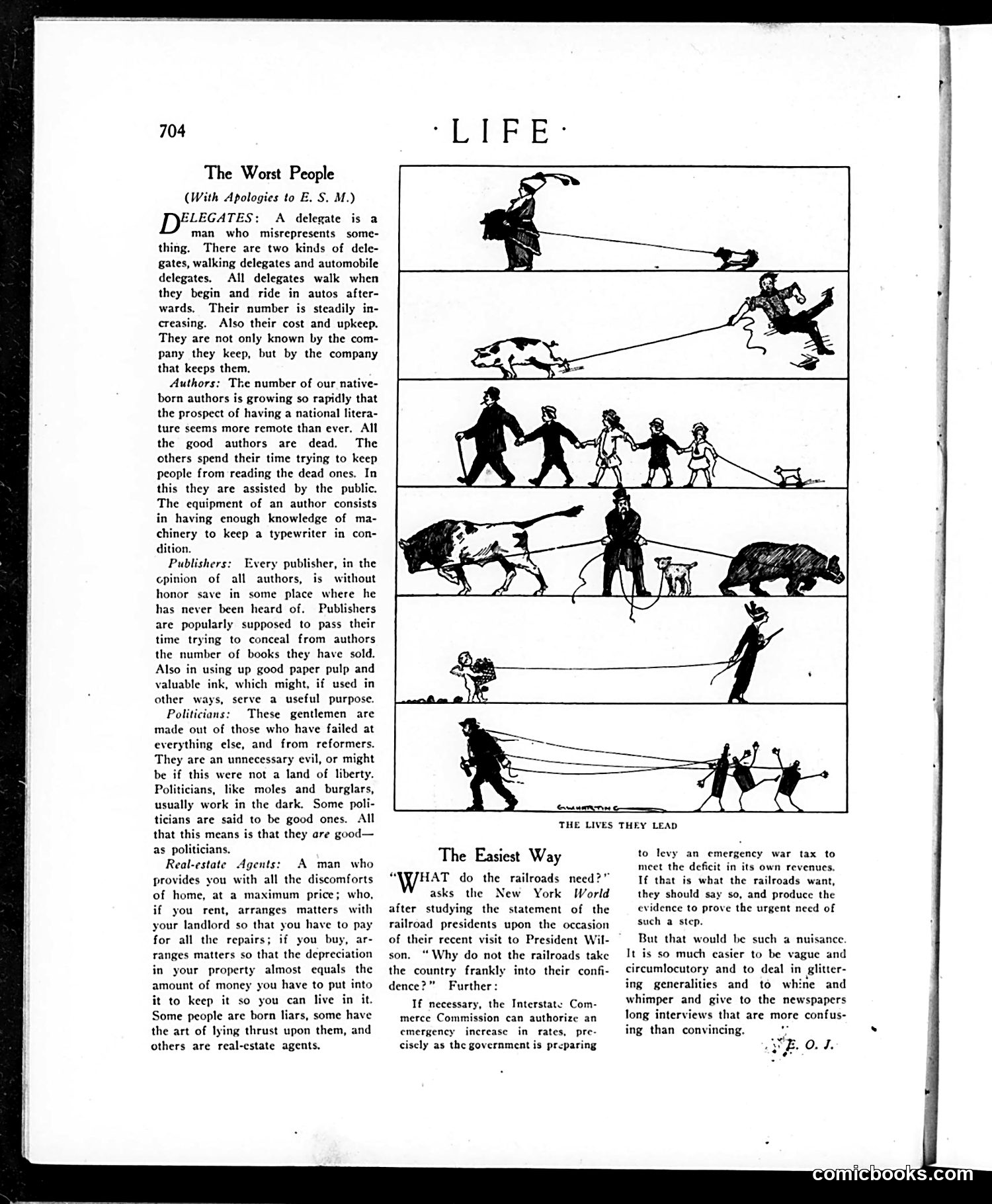
This page satirizes various professional groups through illustrated caricatures. The left column defines targets: **Delegates** (misrepresenters who walk and ride in automobiles), **Authors** (whose works are dying out), **Publishers** (who conceal actual book sales), **Politicians** (failed at everything else), and **Real-estate Agents** (who overcharge renters). The cartoon panels on the right ("The Lives They Lead") humorously depict these figures literally being dragged, pulled, or struggling—visualizing the satirical point that these professions exploit or manipulate others. Below, "The Easiest Way" discusses railroad presidents' need for emergency war tax increases, arguing they should simply request approval rather than make vague public appeals. The satire targets institutional dishonesty and professional malfeasance common to early 20th-century America.
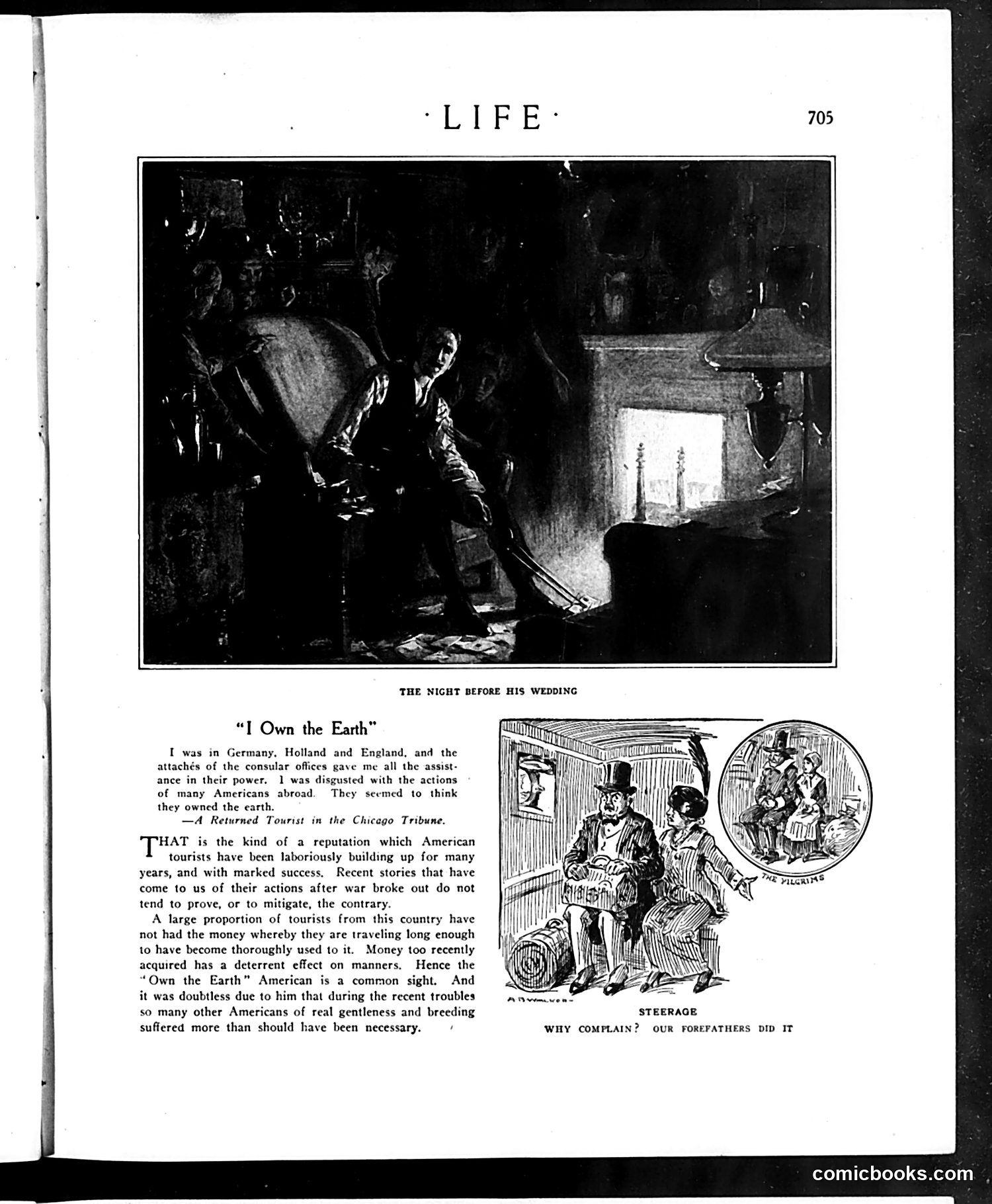
This page satirizes wealthy American tourists abroad, particularly those who behave arrogantly. The main article, "I Own the Earth," quotes a Chicago Tribune piece criticizing Americans traveling overseas who act as though they own the world. The text argues such tourists lack "thoroughly used" money—they've recently acquired wealth without proper refinement, leading to poor manners. The accompanying illustrations mock this behavior: one shows well-dressed men on a ship, likely depicting the stereotypical "ugly American" traveler; another sketch titled "Steerage" (right) contrasts wealthy tourists with poorer passengers. The critique reflects early 20th-century anxiety about newly wealthy Americans embarrassing their nation through crude behavior and entitlement while traveling internationally, a common satirical target during the era of American economic expansion.
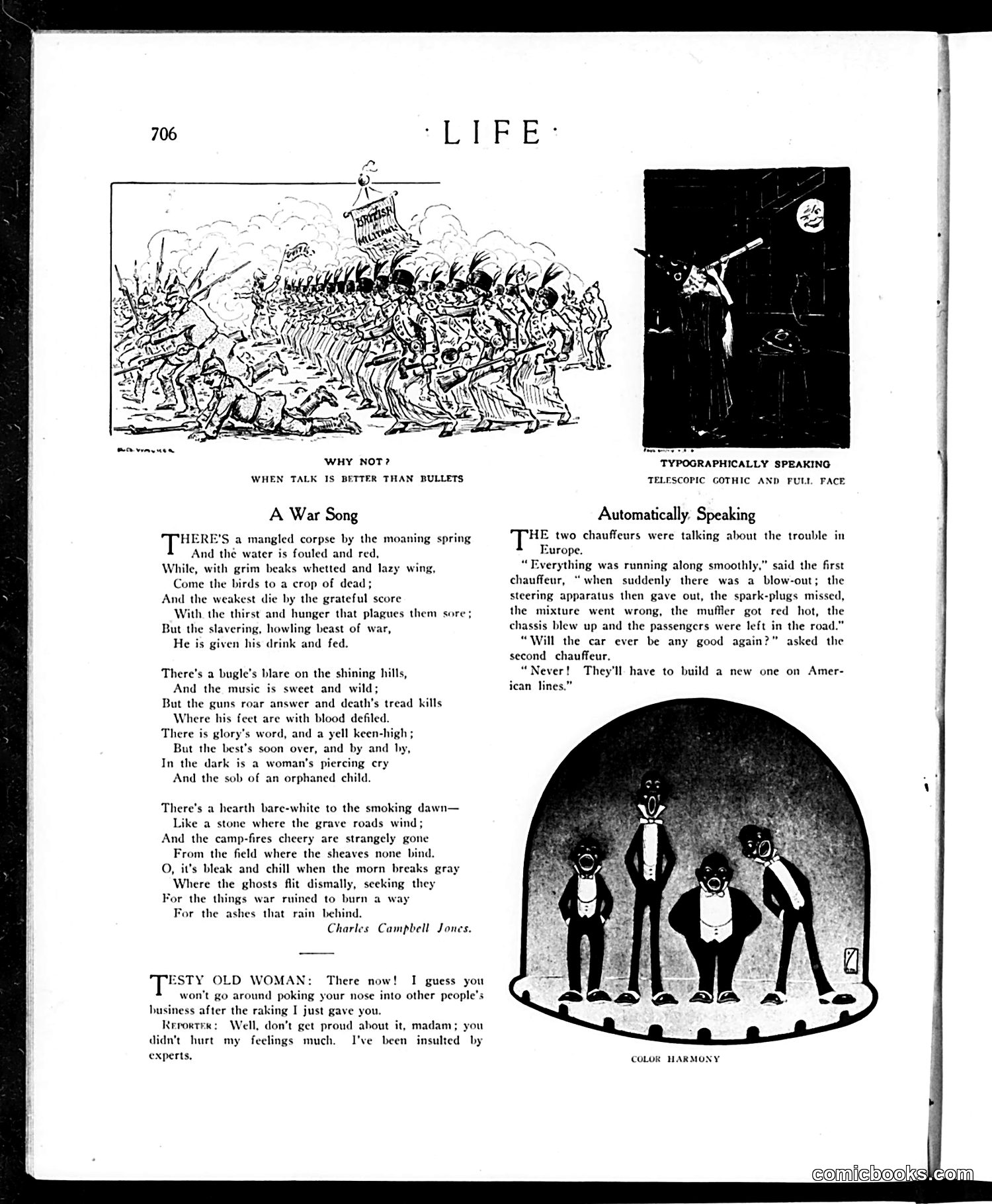
**Top Left - "A War Song":** This poem by Charles Campbell Jones depicts the brutal realities of World War I, contrasting romantic notions of war (bugles, glory) with the actual horrors (mangled corpses, graves, orphaned children, ash). It's anti-war satire criticizing the gap between propaganda and reality. **Top Right - "Automatically Speaking":** Two chauffeurs discuss a car breakdown. The joke satirizes the over-reliance on new automotive technology—the driver assumes complex machinery will require buying a new car rather than simple repair. It's social commentary on consumer culture and mechanical dependency. **Bottom - "Color Harmony":** A cartoon showing three formally-dressed men in formal wear, likely satirizing high society or diplomatic gatherings, though the specific reference is unclear without additional context.
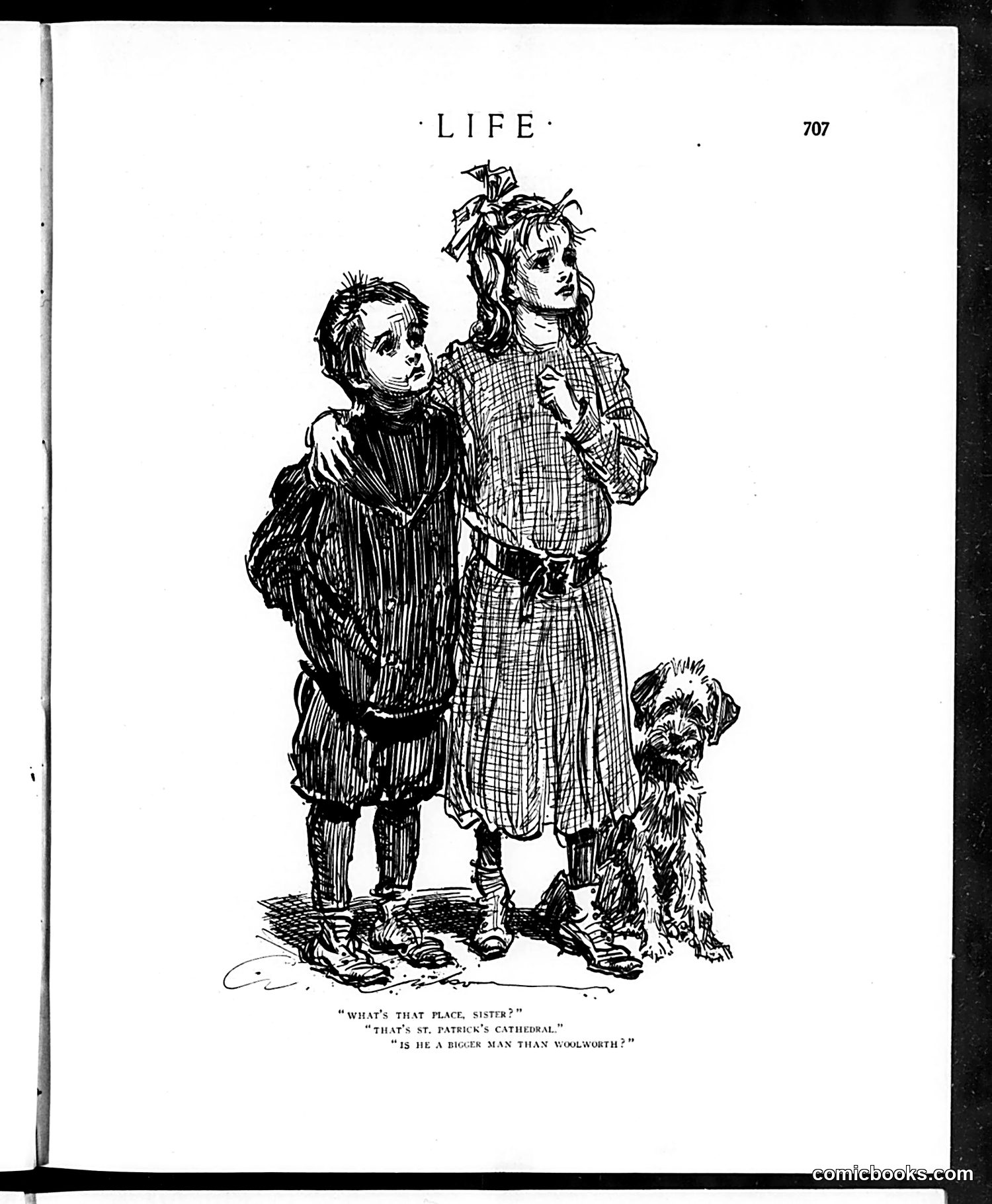
This appears to be a satirical cartoon from *Life* magazine (page 707) depicting two children and a dog. The dialogue reads: - "What's that place, sister?" - "That's St. Patrick's Cathedral." - "Is he a bigger man than Woolworth?" The satire targets the relative prominence of religious versus commercial landmarks in early 20th-century New York City. St. Patrick's Cathedral was a major Catholic institution, while Frank Woolworth had recently completed the Woolworth Building (1913), a prominent skyscraper. The joke mocks how commercial success and architectural scale had become measures of importance in American society, with a child naively comparing a religious figure to a wealthy businessman. It's commentary on materialism displacing traditional religious values in the modern American consciousness.
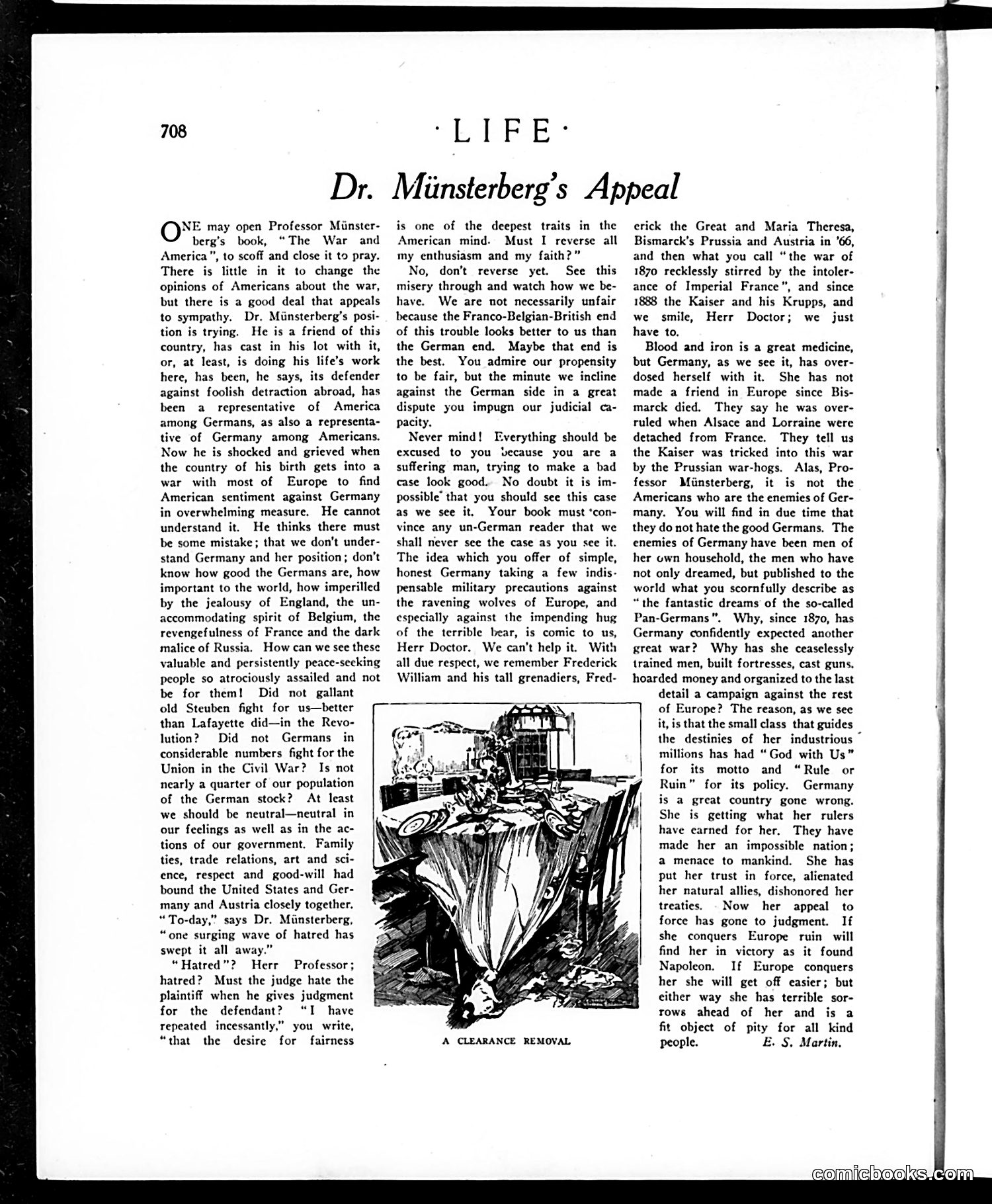
This page addresses Professor Hugo Münsterberg, a German-American academic whom Life presents as defending Germany's role in World War I. The article satirizes his attempt to convince Americans that Germany's military actions were justified—mocking his appeals to "fairness" while Germany has allegedly committed atrocities across Europe. The cartoon labeled "A CLEARANCE REMOVAL" (center) depicts what appears to be bodies or destruction being swept/removed, visualizing the human cost of German military operations that the article criticizes. The satire's point: Münsterberg's academic arguments cannot excuse Germany's conduct. The author (E.S. Martin) argues Germany is "a menace to mankind" and deserves no American sympathy, regardless of eloquent defenses from prominent German-Americans.
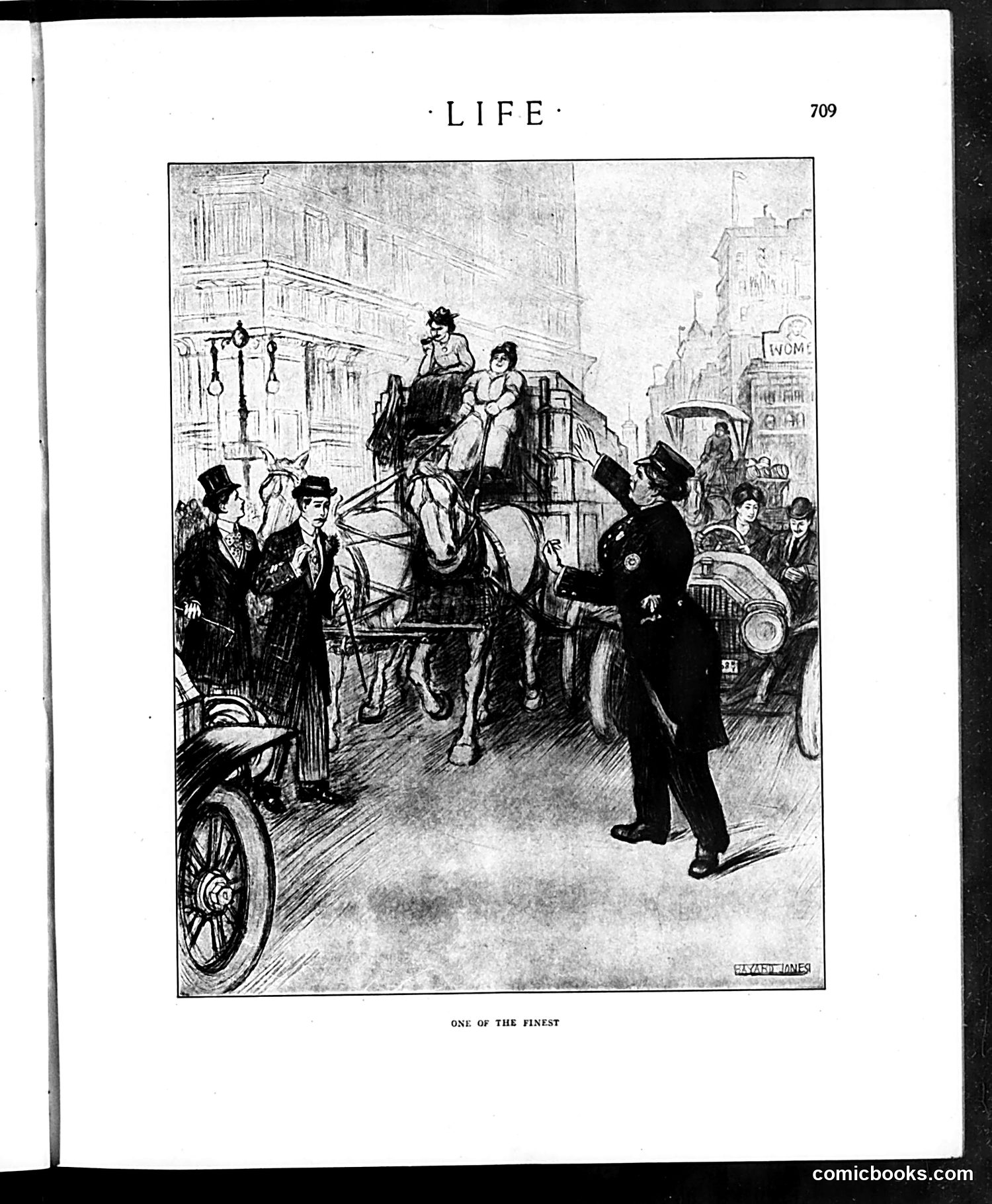
This is a satirical illustration titled "ONE OF THE FINEST" showing a street scene with early automobiles and horse-drawn carriages. A well-dressed policeman or traffic officer in the center appears to be directing or stopping traffic, while pedestrians and vehicles surround him. The satire likely mocks either traffic enforcement or urban congestion during the early automobile era (given the car designs visible). The caption's irony—calling this "one of the finest"—suggests criticism of how traffic or public order is being managed. The mix of old (horse carriages) and new (automobiles) transportation reflects the transitional period, and the officer's prominent positioning implies commentary on authority's attempts to control modern urban chaos. The specific target of satire remains unclear without additional historical context.
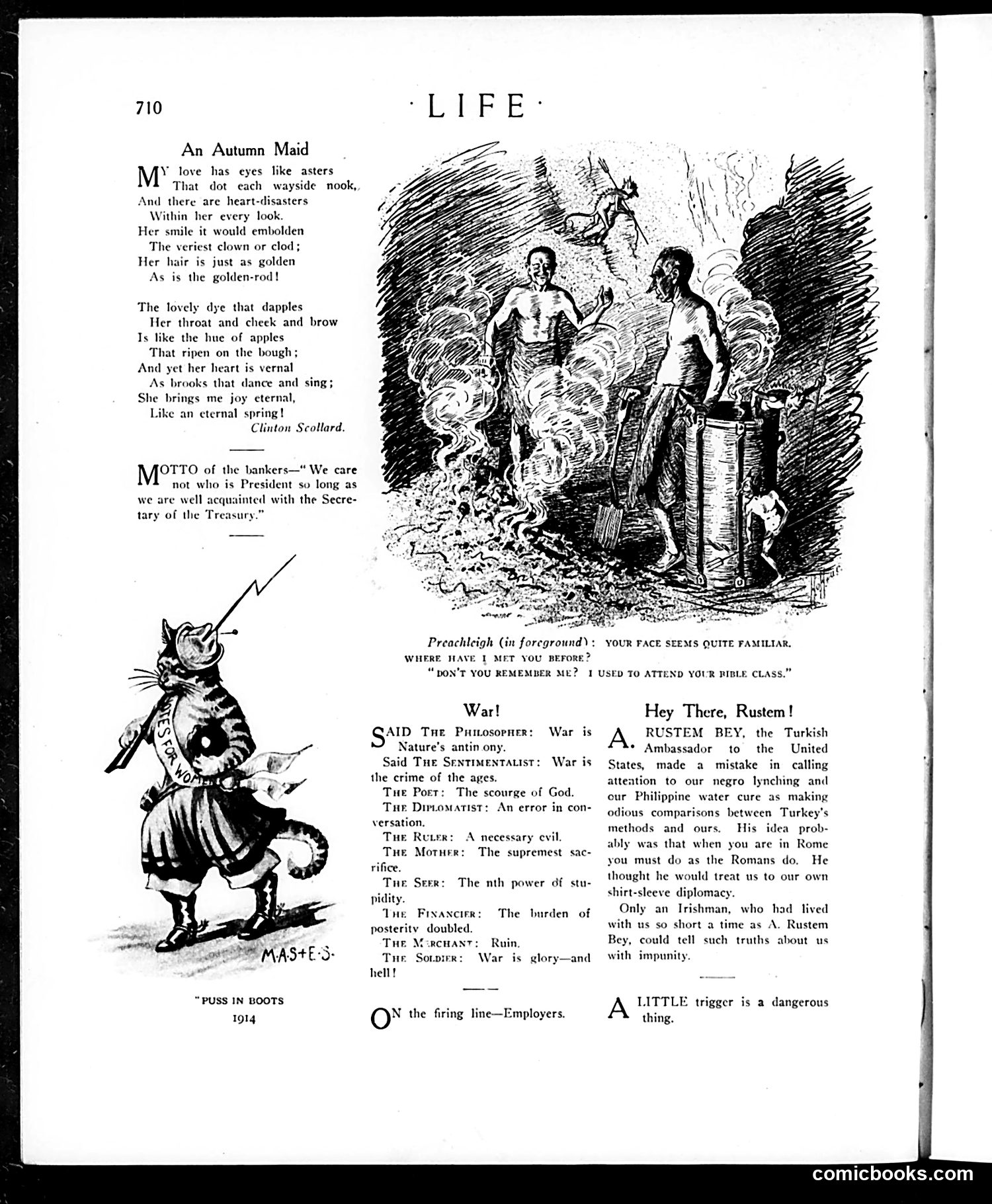
This page contains several satirical pieces from 1914. The main cartoon features **Puss in Boots** (labeled "1914"), a character anthropomorphized as a cat-soldier commenting on war through various perspectives—philosopher, sentimentalist, poet, diplomat, etc.—each offering different cynical takes on warfare's justifications. The "Hey There, Rustem!" section discusses **A. Rustem Bey**, a Turkish ambassador to the United States, who allegedly made inappropriate comparisons between Turkish and American treatment of Black Americans ("negro lynching"). The satire criticizes his hypocrisy in lecturing America on morality. The page also includes a romantic poem, "An Autumn Maid," and brief aphorisms. The overall tone reflects pre-WWI anxieties about war's rhetoric and diplomatic pretense.
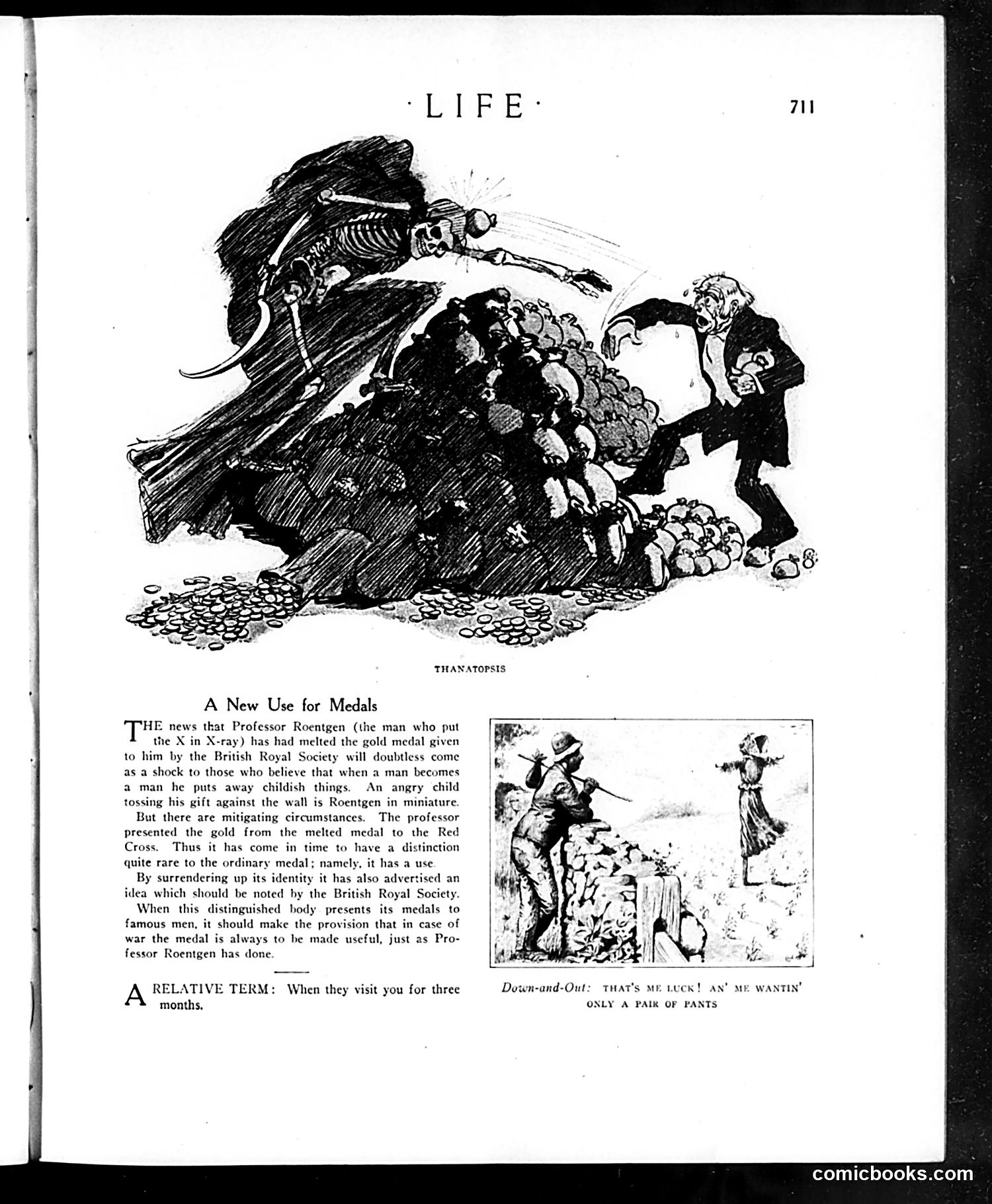
**Main Cartoon (top):** Labeled "Thanatopsis," this depicts Death (skeleton figure in robes) looming over a wealthy man being robbed by street urchins. The satire critiques wealth inequality—Death comes for everyone equally, yet the rich man is simultaneously victimized by poverty-stricken children scrambling for coins scattered on the ground. The point: death renders material possessions meaningless, yet desperation persists. **Article & Bottom Cartoon:** The text satirizes Professor Wilhelm Röntgen (X-ray discoverer) who melted down his British Royal Society gold medal to donate it to the Red Cross during wartime. The article mocks this as childish tantrum masked by charity, while suggesting medals should contractually serve humanitarian purposes in wartime. The bottom cartoon's caption about "a pair of pants" appears a separate, unrelated joke about visiting relatives. The overall page critiques both mortality's indifference to wealth and the performative nature of scientific honors.
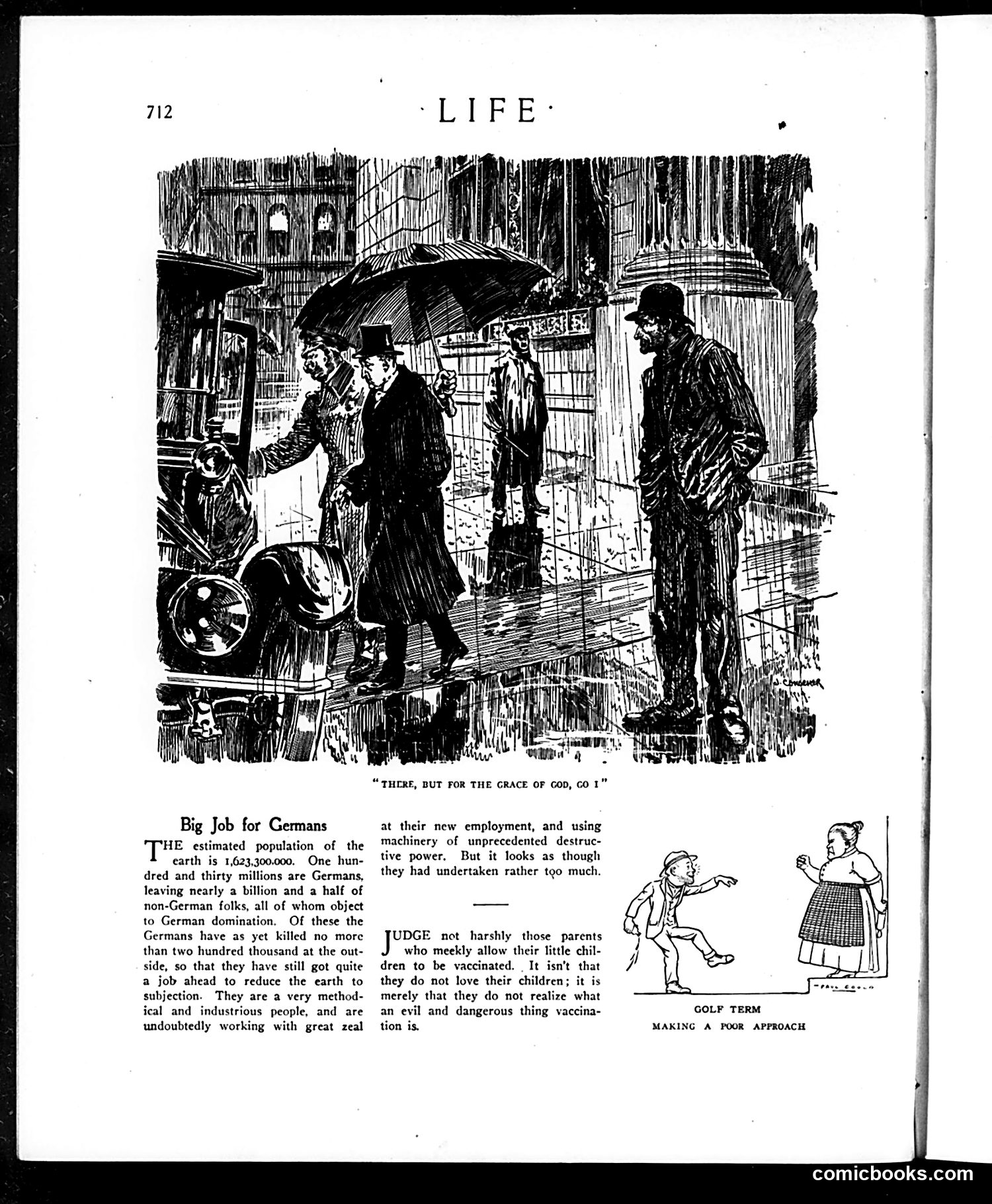
**Top Cartoon:** A street scene showing well-dressed people with umbrellas encountering a shabby man. The caption "There, but for the grace of God, go I" is a famous phrase expressing humility—suggesting the speaker could easily have suffered the same misfortune. The cartoon illustrates class disparity and the precariousness of social standing. **"Big Job for Germans":** This satirical article mocks German imperial ambitions during WWI. It notes that Germans comprise only ~130 million of earth's 1.6 billion people, yet have killed "only" 200,000 so far—sarcastically suggesting they have "quite a job ahead" to subjugate the rest of humanity through their "machinery of unprecedented destructive power." The satire highlights the absurdity and hubris of German domination aspirations. **Vaccination Section:** A brief anti-vaccination screed—reflecting early 20th-century vaccine skepticism among some parents who viewed vaccination as dangerous despite public health evidence. **Bottom Right:** A small golf cartoon labeled "Making a Poor Approach"—a golf term joke unrelated to the page's other content.
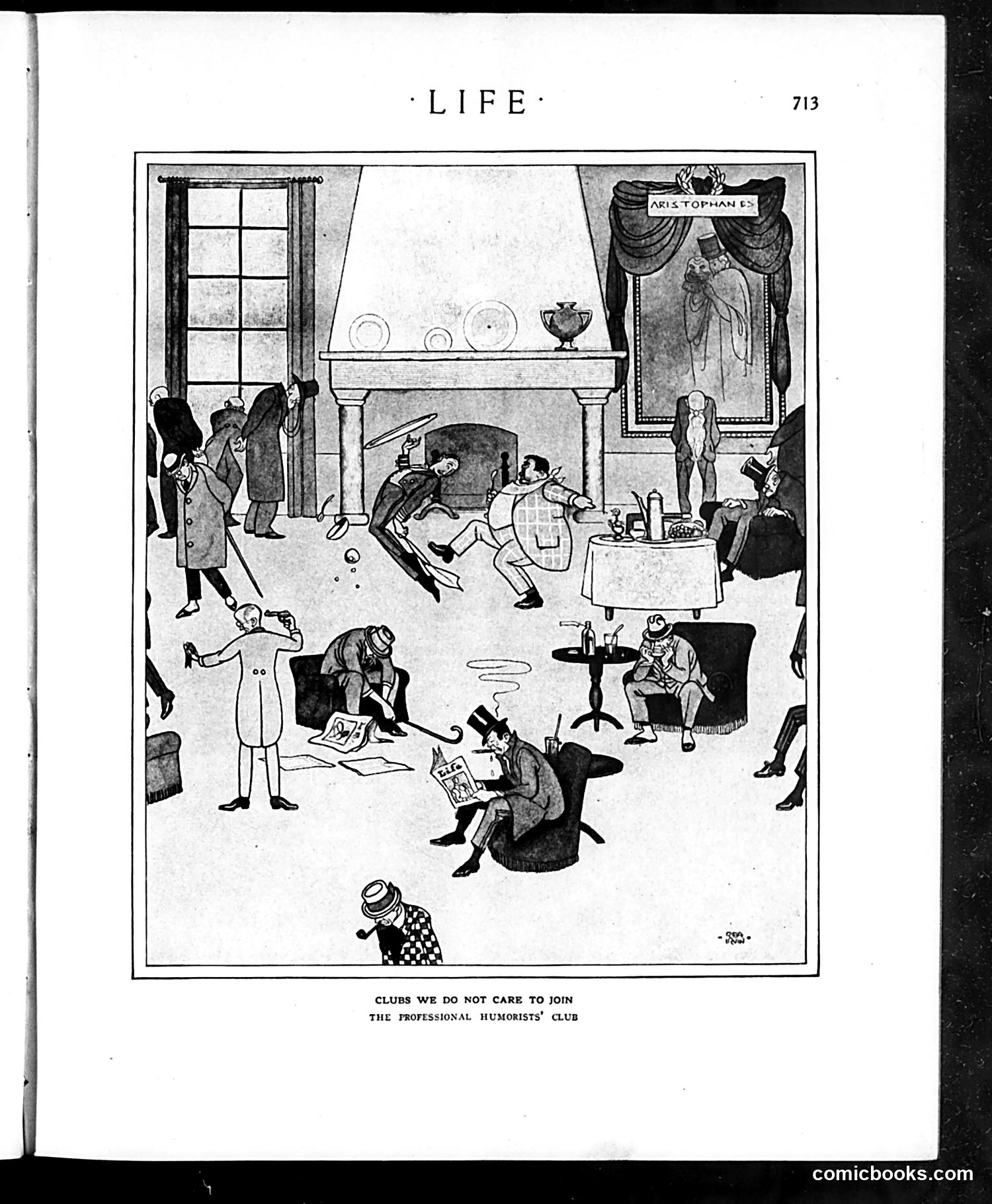
This satirical cartoon depicts a chaotic gathering labeled "The Professional Humorists' Club." The scene shows various people engaged in absurd, slapstick behavior—fighting, sprawling on the floor, gesturing wildly—within an elegant parlor setting with a fireplace, artwork, and classical bust. The satire's point, indicated by the caption "Clubs We Do Not Care to Join," is that professional humorists are themselves undisciplined, ridiculous, and lacking in decorum. Rather than being clever or refined, they behave like buffoons, contradicting the intellectual sophistication one might expect from people in the humor business. This appears to be self-aware satire within Life magazine itself, likely poking fun at its own industry and the gap between humorists' pretensions and their actual conduct.
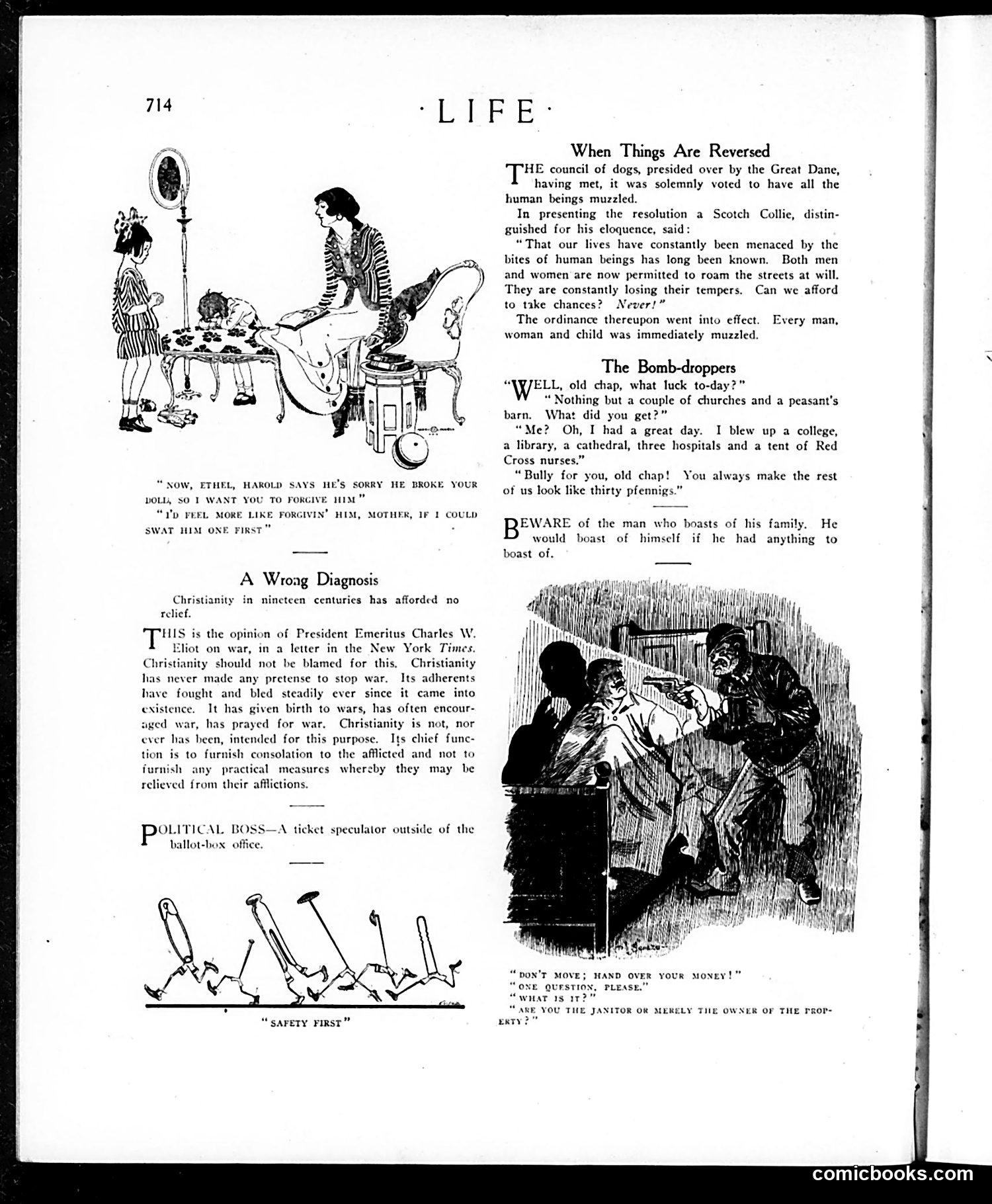
This page contains several distinct satirical pieces, likely from World War I era: **"When Things Are Reversed"**: A fantasy where dogs council to muzzle humans for their dangerous behavior—inverting the usual power dynamic to mock human irrationality and violence. **"The Bomb-droppers"**: A dark satire of aerial warfare. Pilots casually compare destruction tallies (churches, hospitals, Red Cross tents), treating mass killing as sport. The phrase "thirty pfennigs" (German currency) suggests this mocks WWI bombing campaigns, presenting aviators as detached from the human cost of their actions. **"A Wrong Diagnosis"**: Critiques President Charles W. Eliot's statement that Christianity hasn't prevented war. The author argues Christianity was never intended to stop war—only to console victims—sarcastically exposing the inadequacy of religious consolation against systematic violence. **"Political Boss"** and other brief items provide lighter social satire about corruption and class distinctions. The overarching theme: modern warfare and social institutions fail moral obligations to humanity.
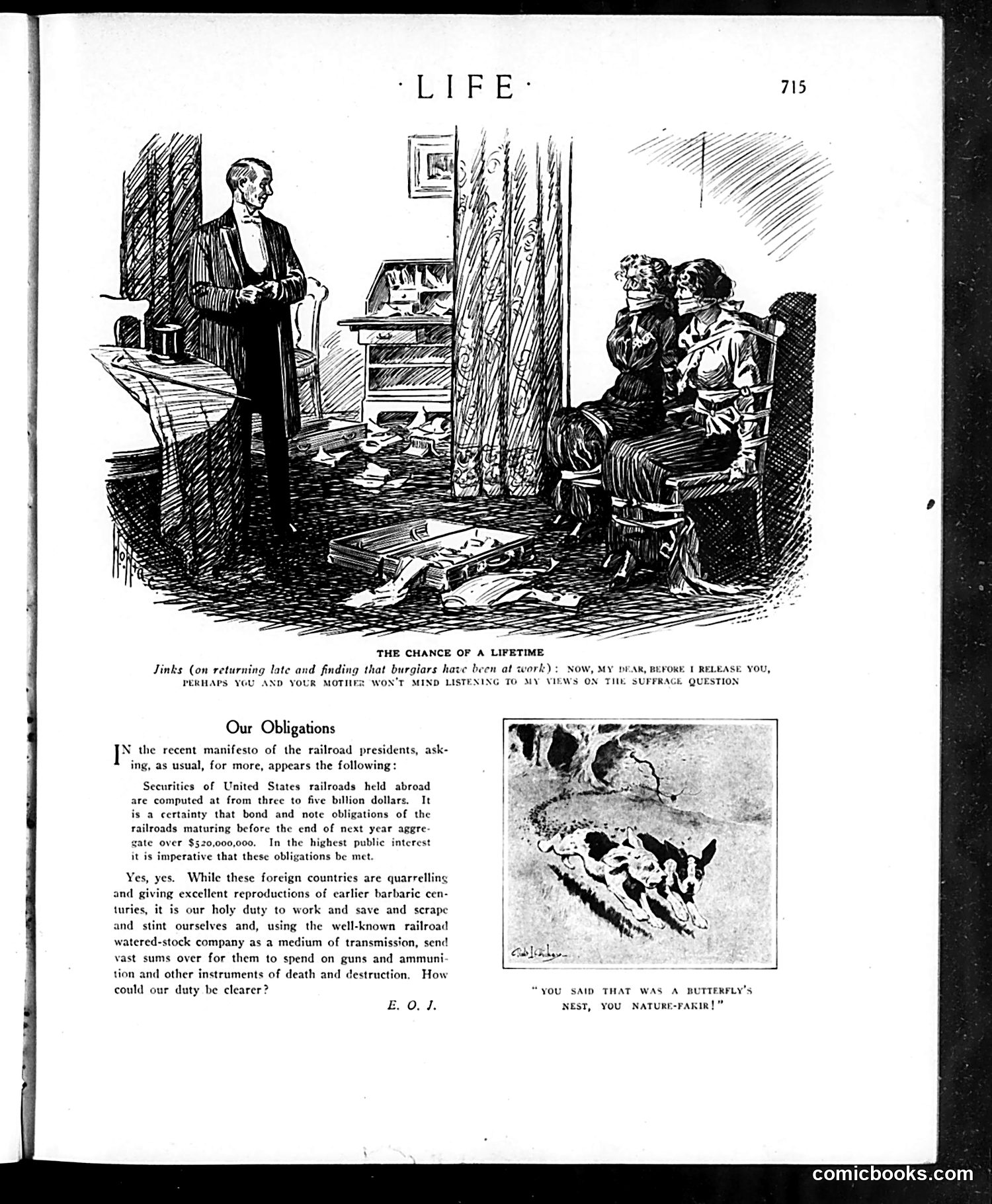
**Top Cartoon ("The Chance of a Lifetime"):** A man named Jinks has caught burglars in his home. Rather than releasing them, he attempts to hold them captive to lecture them about women's suffrage—a topical political issue of the era. The satire mocks men (like Jinks) who oppose voting rights for women by suggesting they're so obsessed with the suffrage question that they'd use any captive audience to preach against it. The caption's dark humor implies he sees the burglary as an opportunity, not a crisis. **Lower Section ("Our Obligations"):** An editorial attack on railroad companies requesting government financial support. The author (E.O.J.) sarcastically criticizes U.S. railroads for demanding money ostensibly to meet foreign obligations while those nations wage war—suggesting railroads will simply use funds for weapons abroad rather than domestic needs. The piece condemns corporate profiteering during wartime. **Bottom Cartoon:** A brief nature-themed joke about mistaking something for a butterfly's nest; unrelated to political content.
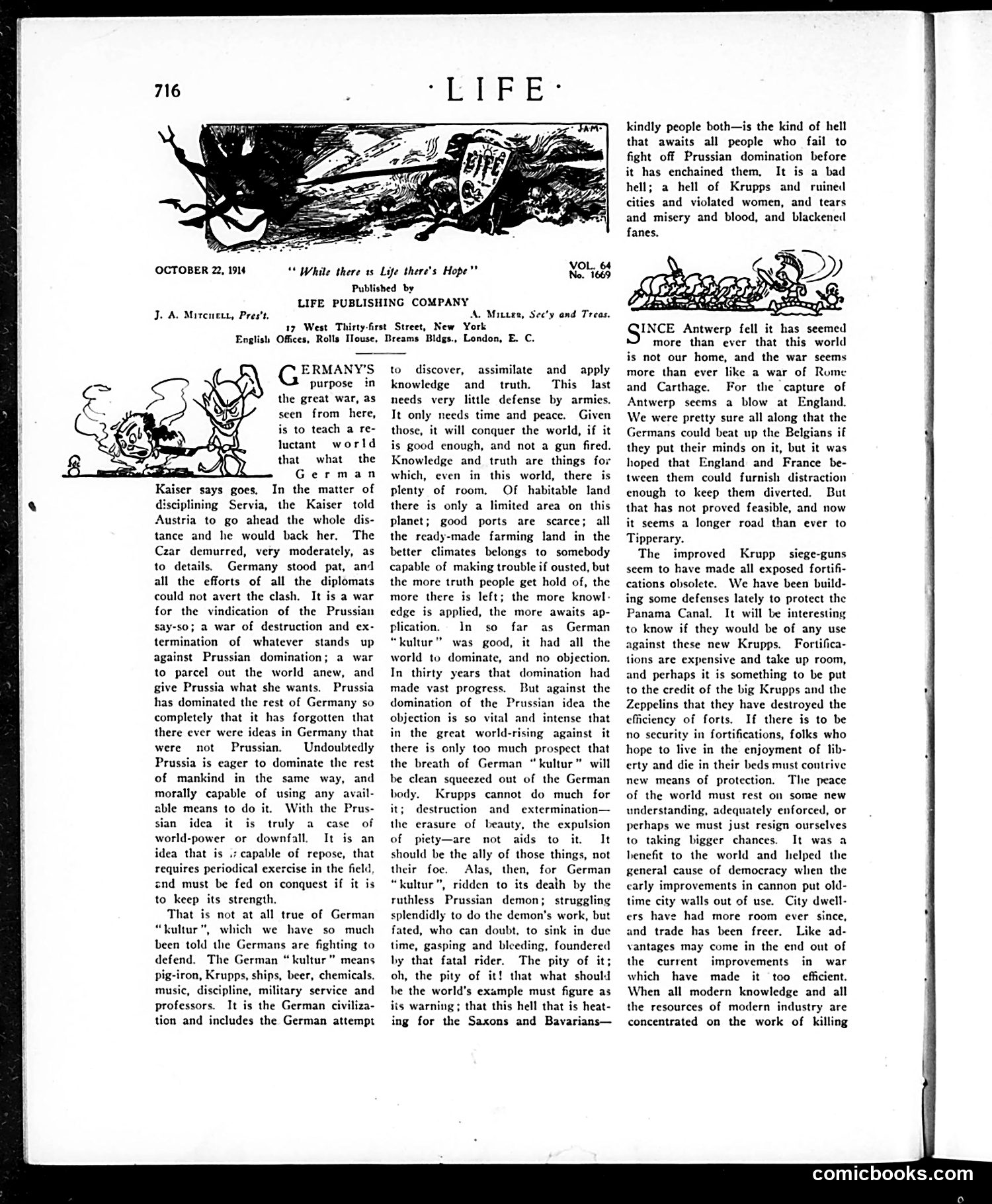
This editorial page distinguishes between German "kultur" (culture, knowledge, industry) and Prussian militarism, arguing they are fundamentally incompatible. **The Argument:** The author contends Germany's war aim is Prussian domination—forcing the world to obey the Kaiser's commands. While German culture (represented by philosophy, music, science, manufacturing) could peacefully conquer the world through merit, Prussian militarism requires constant conquest to survive. The two are at odds: Prussian aggression will destroy German culture in pursuit of world power. **The Satire:** The piece mocks the contradiction that Germany claims to defend its civilization while using methods (destruction, violence) that will inevitably extinguish it. Prussia's ruthless ambition, the author suggests, will strangle the very culture it claims to protect. **Historical Context:** Written early in WWI, this reflects American skepticism about German war justifications, distinguishing between admirable German achievements and despised Prussian militarism—a common contemporary rhetorical distinction.
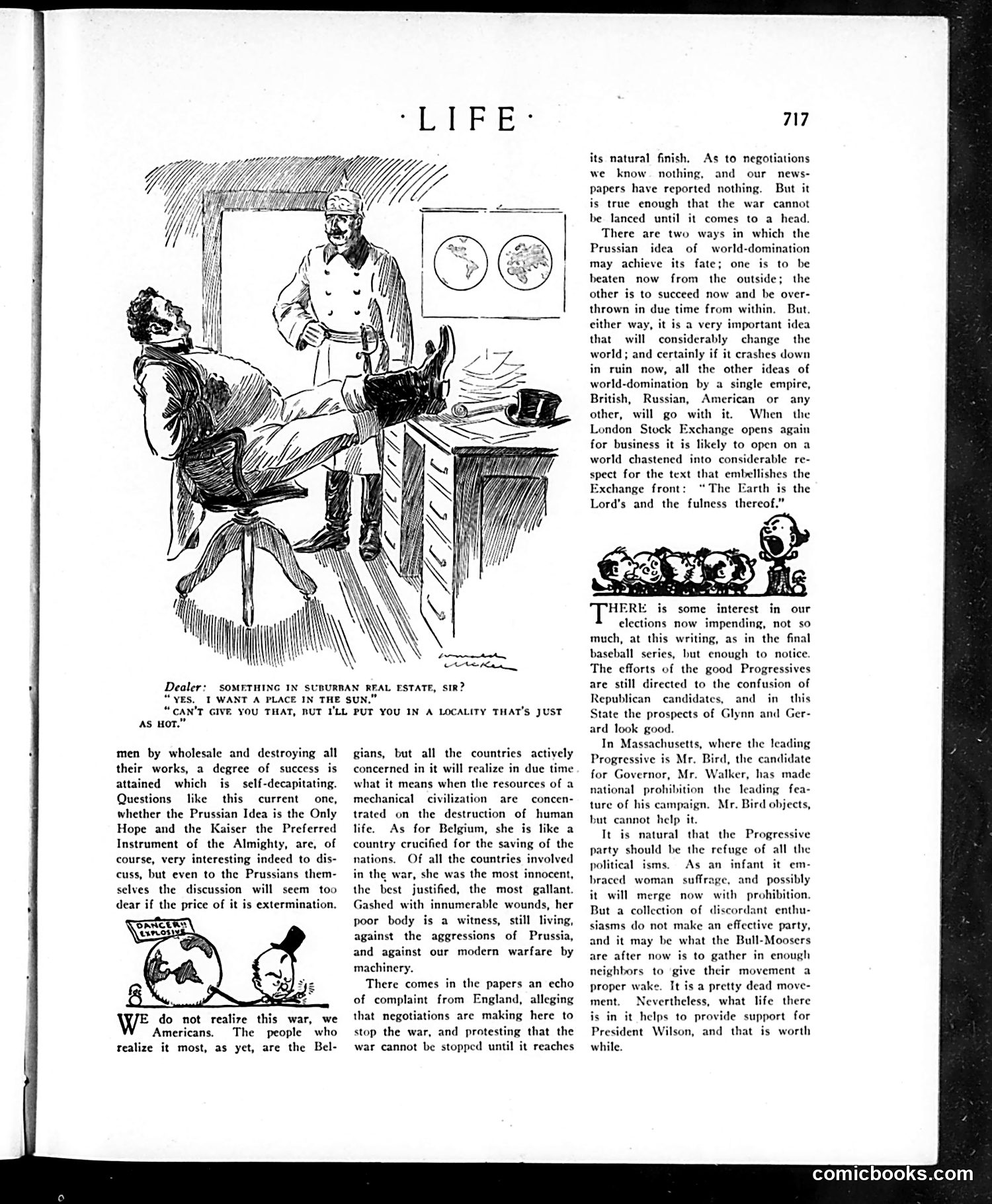
**Main Cartoon (Top):** A real estate dealer sits at his desk facing a client. The client requests "a place in the sun"—a reference to Kaiser Wilhelm II's famous 1890s phrase about German imperial ambitions ("a place in the sun"). The dealer sarcastically responds he can't offer that, but will put him "in a locality that's just as hot," implying the client will end up in warfare instead. This mocks Prussian/German expansionist ideology during World War I. **Context:** The surrounding text discusses whether the "Prussian Idea" of world-domination can be stopped. Belgium is praised as a tragic victim of German aggression. The editorial argues the war's outcome will reshape global power dynamics. **Political Message:** The satire suggests German imperial ambitions—couched in flowery language about destiny—actually deliver only death and destruction, not the promised glory. It's anti-German wartime propaganda supporting the Allied cause.
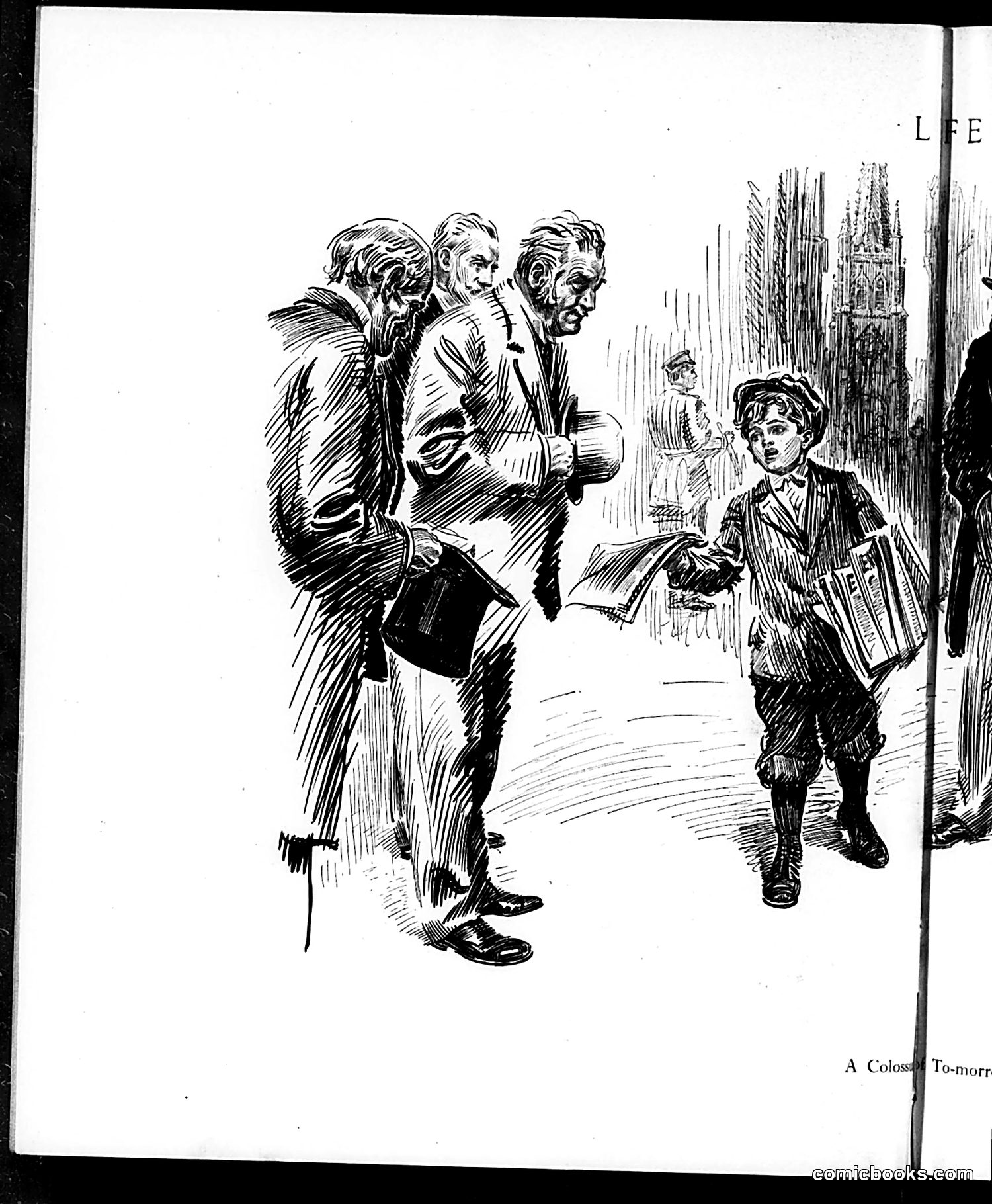
This page contains a single ink illustration titled "A Colossal To-morr[ow]" (caption cut off). The image shows three adult men in suits and hats clustered together on a street, appearing to carry or support something unseen. A young newsboy or street child approaches them from the right, carrying what appears to be newspapers or papers. The cartoon's meaning is unclear without the complete caption. The title suggests commentary on a future event or consequence ("to-morrow"), but the specific political or social reference cannot be reliably identified from the visible elements alone. The composition implies the adults are burdened by something they're concealing from or inflicting upon the younger generation, a common satirical motif in turn-of-the-century American editorial cartooning.
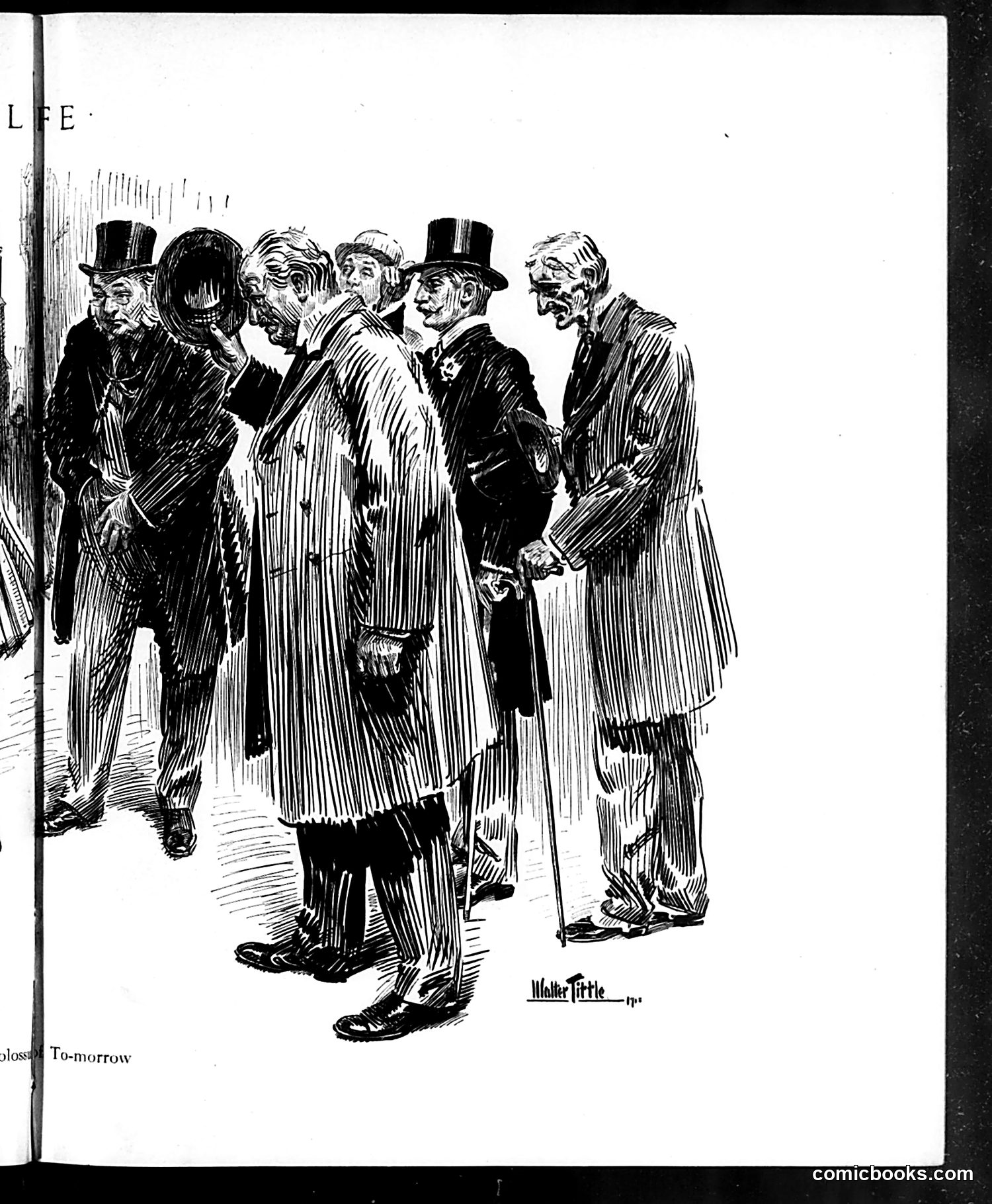
This is a political cartoon by Walter Tittle depicting a group of well-dressed men in formal attire (top hats and overcoats) engaged in conversation or negotiation on a street. The exaggerated facial features and caricatured expressions suggest these are public figures or political personalities of the era. The caption reads "To-morrow," implying the cartoon comments on upcoming events or decisions. Without additional context about the specific date and publication, the exact identities and political situation remain unclear. However, the formal dress and serious demeanor suggest this likely depicts businessmen, politicians, or diplomats discussing matters of public importance. The satirical tone typical of Life magazine suggests criticism of their actions or proposed plans.
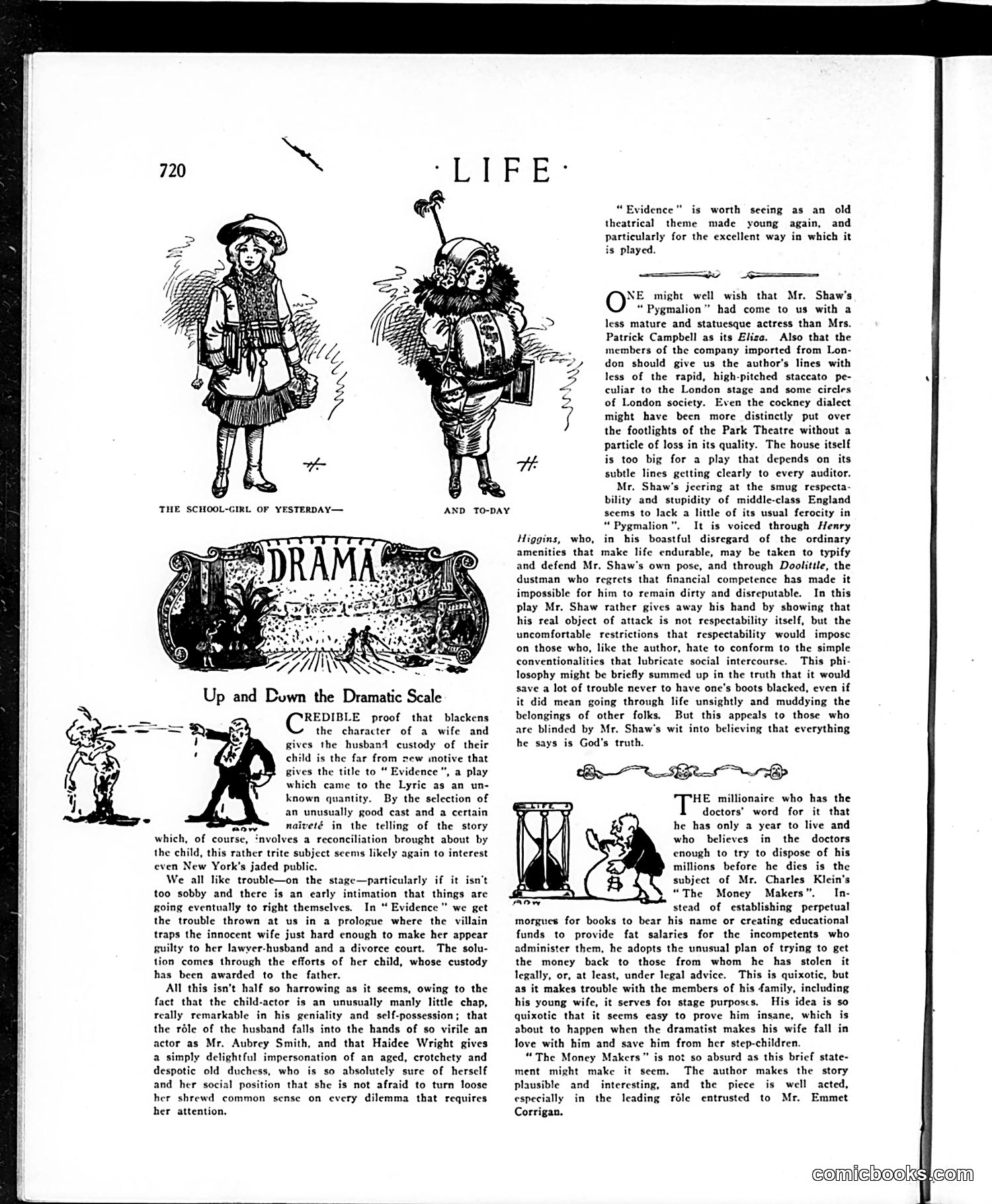
This page reviews two plays: "Evidence" and Shaw's "Pygmalion." **"Evidence"** is praised as a competent revival of a familiar plot device—a wife falsely accused, leading to divorce and reconciliation through their child's intervention. The reviewer notes the play succeeds mainly because of strong casting, particularly child actor (unnamed here), Aubrey Smith as the husband, and Haidee Wright as "an aged, crotchety and despotic old duchess." **"Pygmalion"** receives sharper critique. The reviewer criticizes Mrs. Patrick Campbell as too mature for Eliza, and complains the London-imported cast delivers Shaw's lines with "rapid, high-pitched staccato" delivery unsuitable for the Park Theatre's size. Most pointedly, the critic argues Shaw's satire of middle-class respectability lacks force because his real target isn't respectability itself, but rather society's expectations that would restrict people like Shaw from living as they wish—essentially, Shaw attacks rules that prevent people from being disheveled and unconventional.
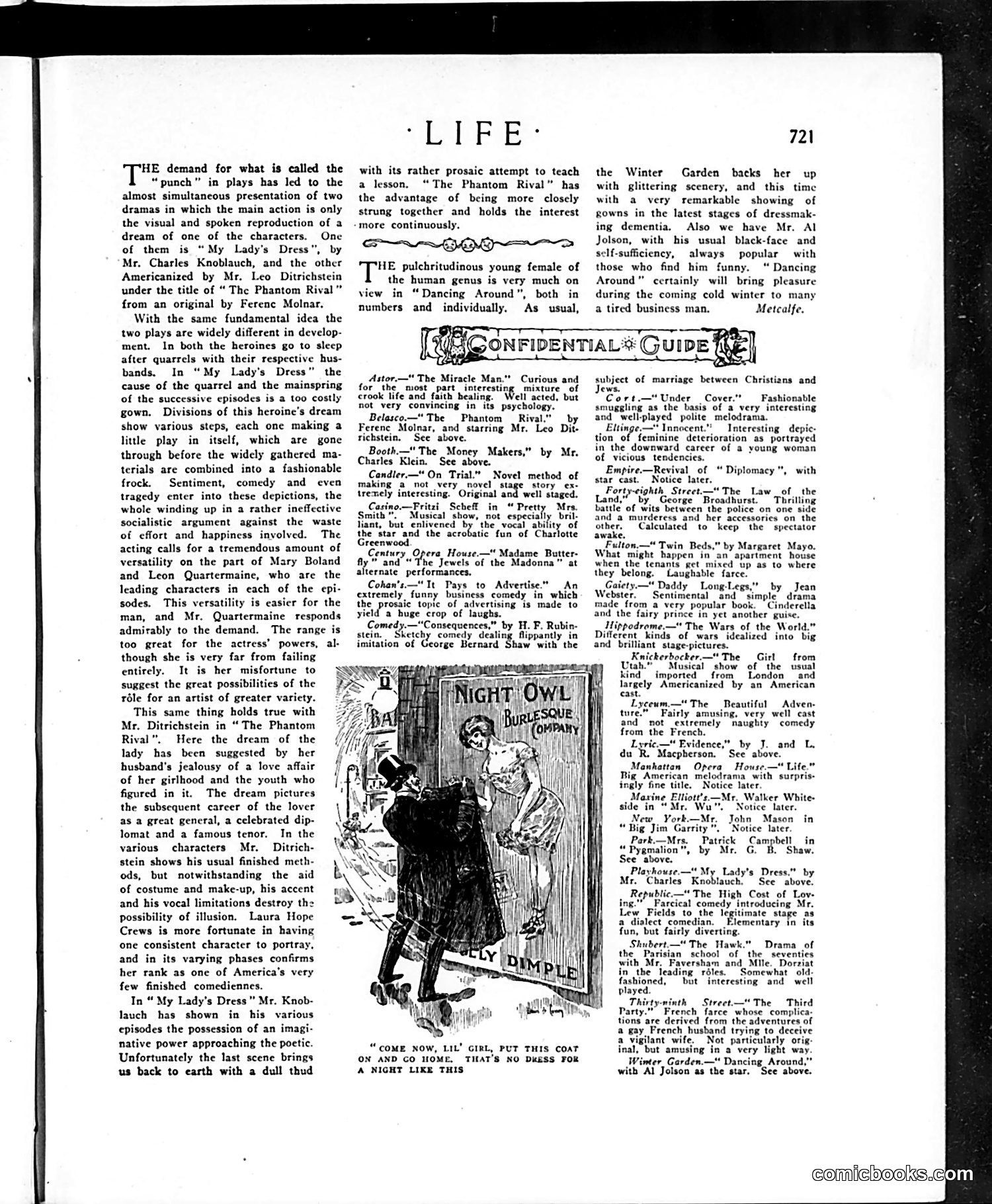
This page reviews several Broadway theatrical productions from the early 20th century. The main content discusses two dream-sequence plays: "My Lady's Dress" by Charles Knoblauch and "The Phantom Rival" (adapted by Leo Ditrichstein from Ferenc Molnár). The reviewer praises the imaginative dream sequences in both works but critiques their execution—particularly actress Mary Boland's limited range in handling the varied emotional demands of "My Lady's Dress," while praising actor Leon Quartermaine's versatility. For "The Phantom Rival," the reviewer finds Ditrichstein's accent and vocal limitations undermine the illusion, though Laura Hope Crews excels in her more consistent role. The accompanying cartoon illustration depicts a "Night Owl" burlesque company scene, with the caption mocking a woman being sent home from a night performance without proper dress—likely satirizing the theatrical world's casual attitudes toward propriety.
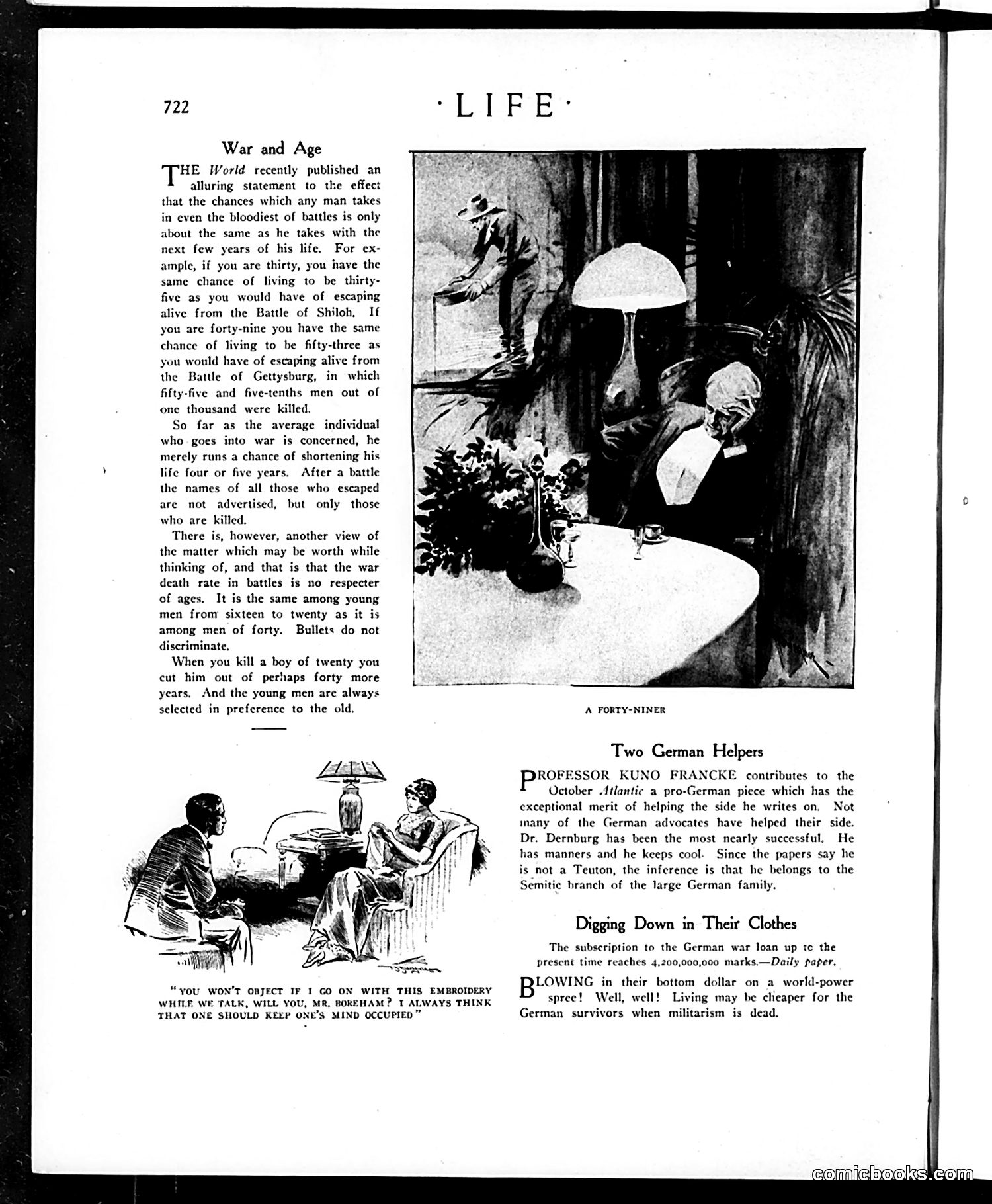
This Life magazine page contains three distinct pieces of WWI-era commentary: **"War and Age"** argues that soldiers face statistical death risks comparable to peacetime mortality, but makes a darker point: war kills young men disproportionately, cutting short decades of potential life, whereas older soldiers lose fewer remaining years. The satire critiques how casualty statistics can obscure this human cost. **The cartoon** shows a woman doing embroidery while chatting with "Mr. Boreham," cheerfully insisting on keeping her mind occupied during conversation—social satire about superficial wartime civility masking deeper anxieties. **"Two German Helpers"** and **"Digging Down in Their Clothes"** are pro-Allied polemics mocking German war financing and propaganda efforts. The references to Professor Kuno Francke and Dr. Dernburg identify German intellectuals attempting to build American support. The final section sarcastically attacks Germany's massive war loan subscription (4.2 billion marks), predicting that only "German survivors" will afford living expenses after militarism's collapse. The overall tone reflects American skepticism toward German war aims during the conflict.
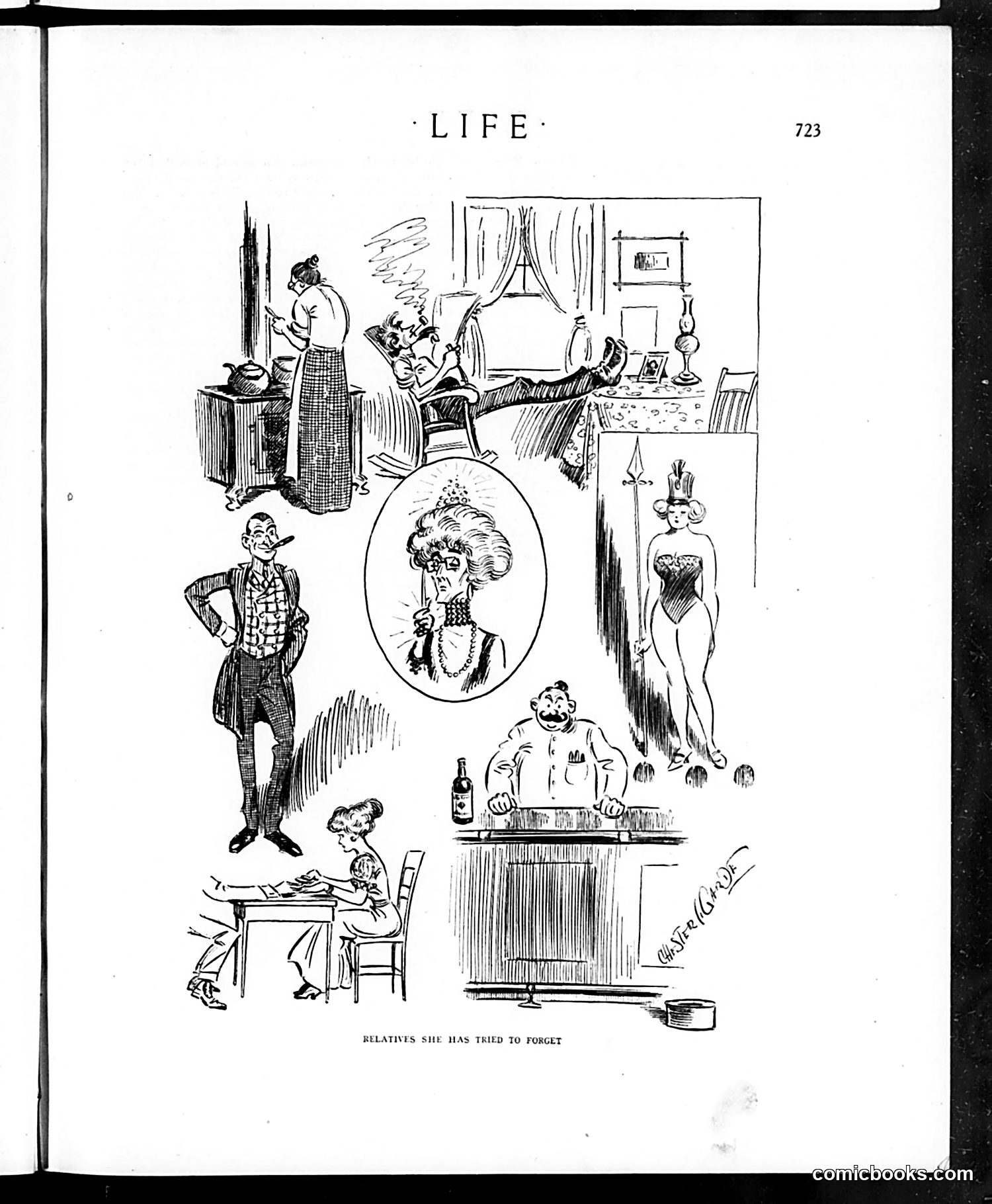
This satirical cartoon depicts various types of people a woman might wish to disassociate from socially. The central oval portrait shows an elegant, well-dressed woman with elaborate hair and jewelry—presumably the subject trying to maintain respectability. Surrounding her are figures representing undesirable "relatives": a man in working-class plaid clothing, a sailor or military man at a table with a bottle, a woman in theatrical/revealing costume, a man in formal dress, and a lower-class couple at a table. The cartoon satirizes social climbing and class anxiety—specifically, how people try to distance themselves from relatives of lower social status or questionable professions (performers, laborers, drunkards). It mocks the pretension of aspiring to higher social standing by literally hiding embarrassing family connections.
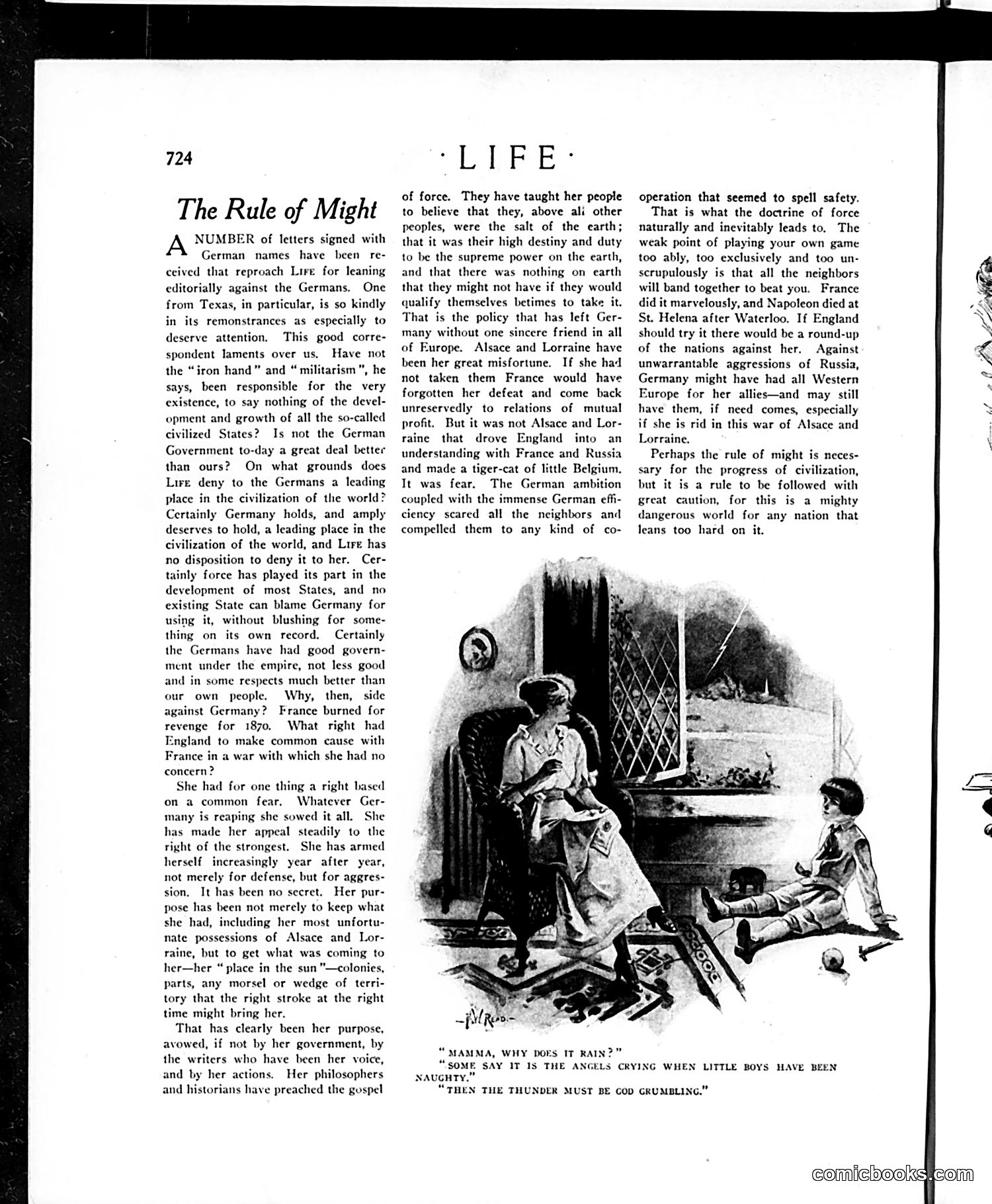
This editorial and accompanying illustration address a defense of Allied opposition to Germany during World War I (the page references 1870, implying post-WWI perspective). The article responds to German-American letter-writers defending Germany's military power and territorial ambitions. Life's editor argues that while Germany deserves credit for efficient governance and force's historical role in nation-building, Germany's explicit ideology of "might makes right"—preaching racial superiority and aggressive expansion—frightened all neighboring nations into alliance *against* her. The "doctrine of force," the editor contends, naturally provokes unified opposition. The cartoon depicts a woman (likely representing Germany or militarism) telling a child the rain is "angels crying when little boys have been naughty," then attributing thunder to "God grumbling." The satire suggests Germany's aggressive doctrine produces predictable consequences—like a child's misbehavior inviting punishment—yet Germany mystifies these natural results.
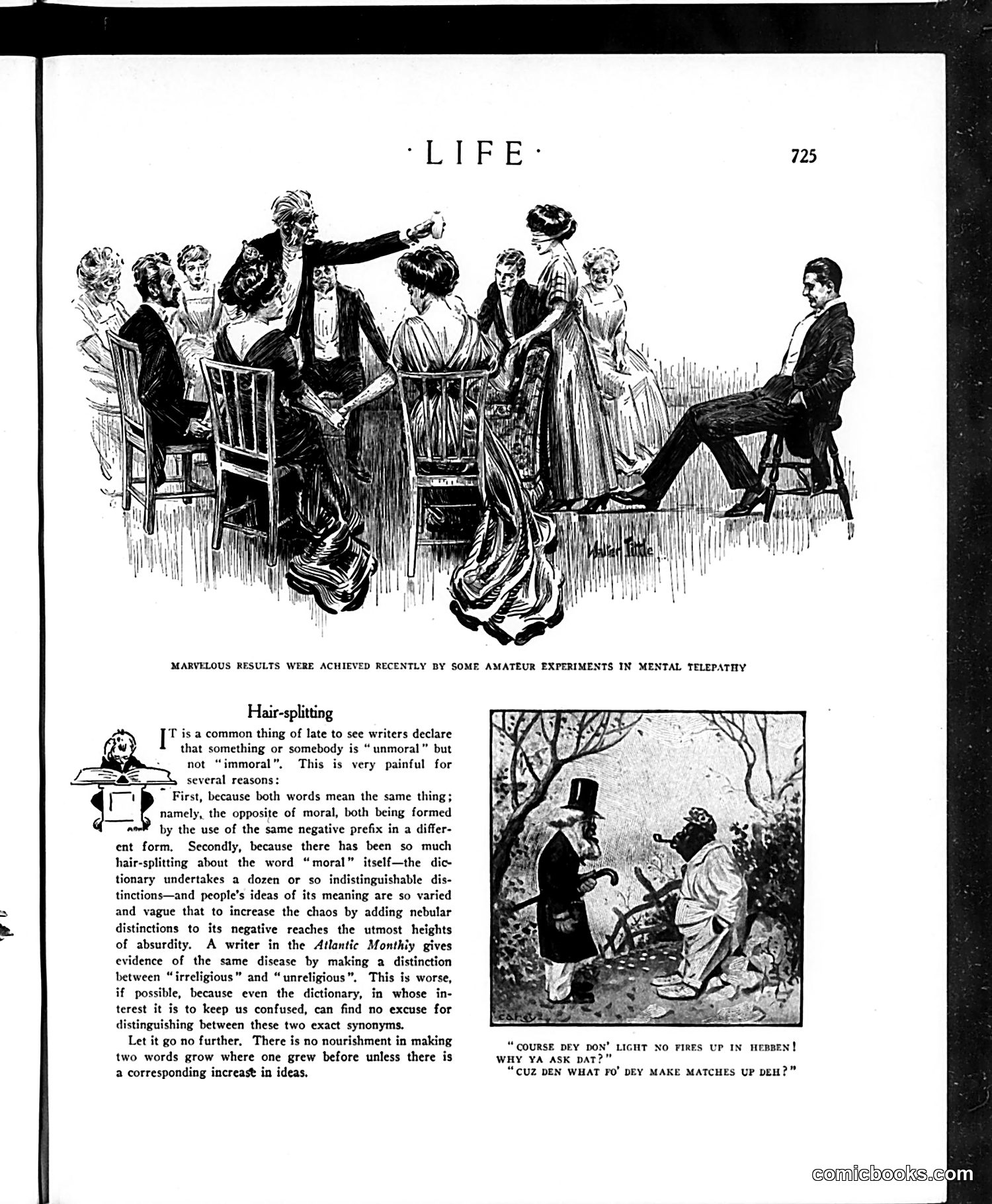
This page contains two distinct pieces of satire: **Top illustration**: Shows a group at a séance or spiritualist gathering attempting "mental telepathy." The satire appears to mock the pseudoscientific fads of the era—spiritualism and claims of supernatural communication were popular entertainment, especially among the upper classes shown here. **"Hair-splitting" article**: A written critique of linguistic pedantry. The author ridicules writers who distinguish between "unmoral" and "immoral" (or "irreligious" and "unreligious"), arguing these are synonymous and that such distinctions add confusion without adding meaningful ideas. The satire targets intellectuals and dictionary makers who complicate language unnecessarily. **Bottom cartoon**: Depicts two Black figures in dialogue about matches in Heaven, presented in dialect. This reflects the period's common use of racial caricature in humor, though the specific joke's satirical intent is unclear from context alone. The page overall satirizes intellectual pretension and pseudoscientific trends of its time.
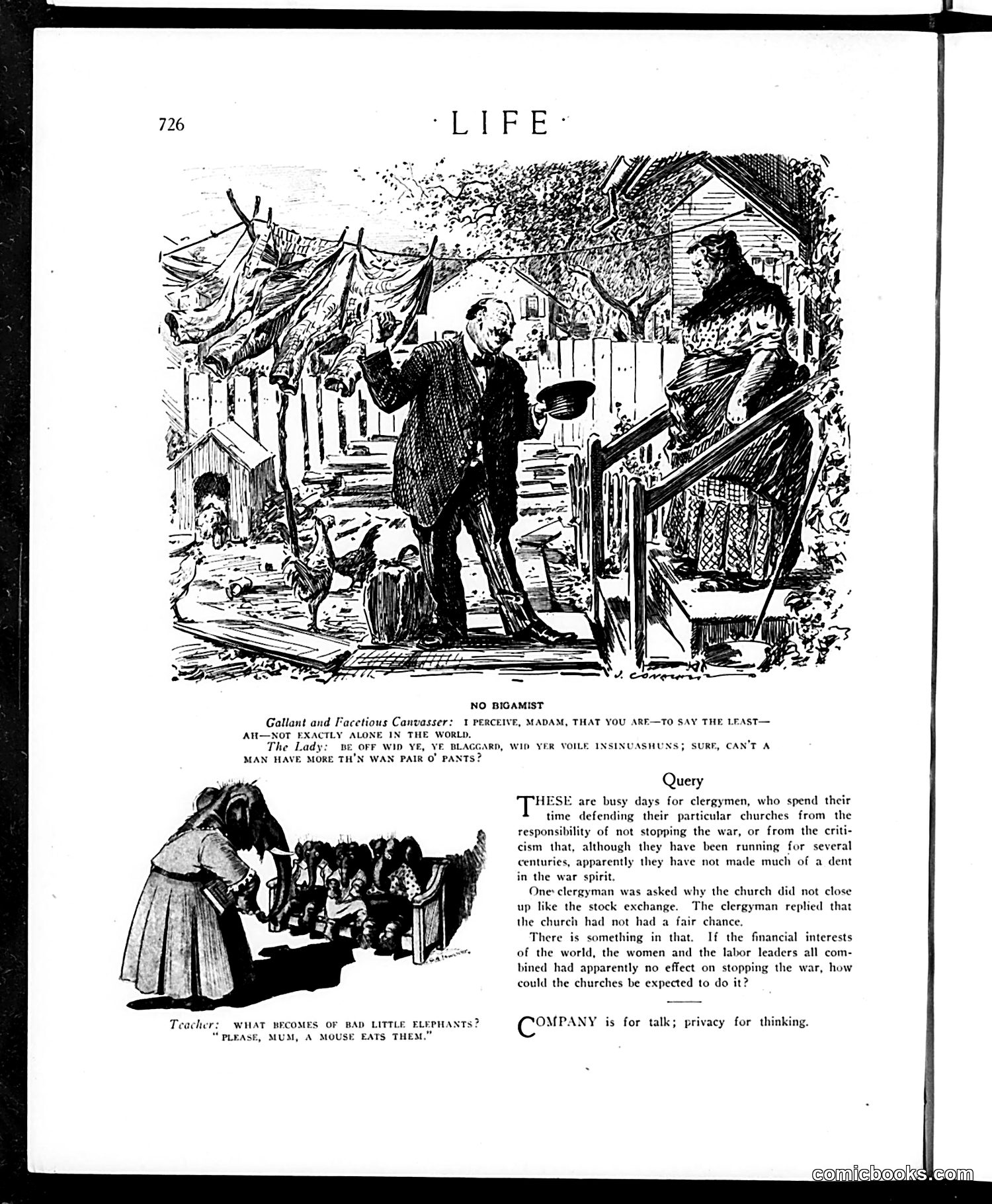
**Top Cartoon ("No Bigamist"):** A door-to-door canvasser (political campaigner) makes an insinuating remark to a woman, suggesting she has a man living with her. Her angry response—in Irish dialect—reveals he's simply commenting on the multiple pairs of pants visible on her clothesline. The satire mocks political canvassers who make presumptuous or inappropriate remarks while campaigning. **Main Article ("Query"):** Written during World War I, this piece criticizes churches for defending their inaction regarding the war. It sarcastically argues that if financial interests, women, and labor leaders couldn't stop the war, churches shouldn't be blamed either. The article questions institutional religion's moral authority and effectiveness during the conflict. **Bottom Cartoon:** A teacher-student exchange about what eats bad elephants is a simple children's joke, unrelated to the political content above. The page overall satirizes both petty campaigning and institutional failures to address war.
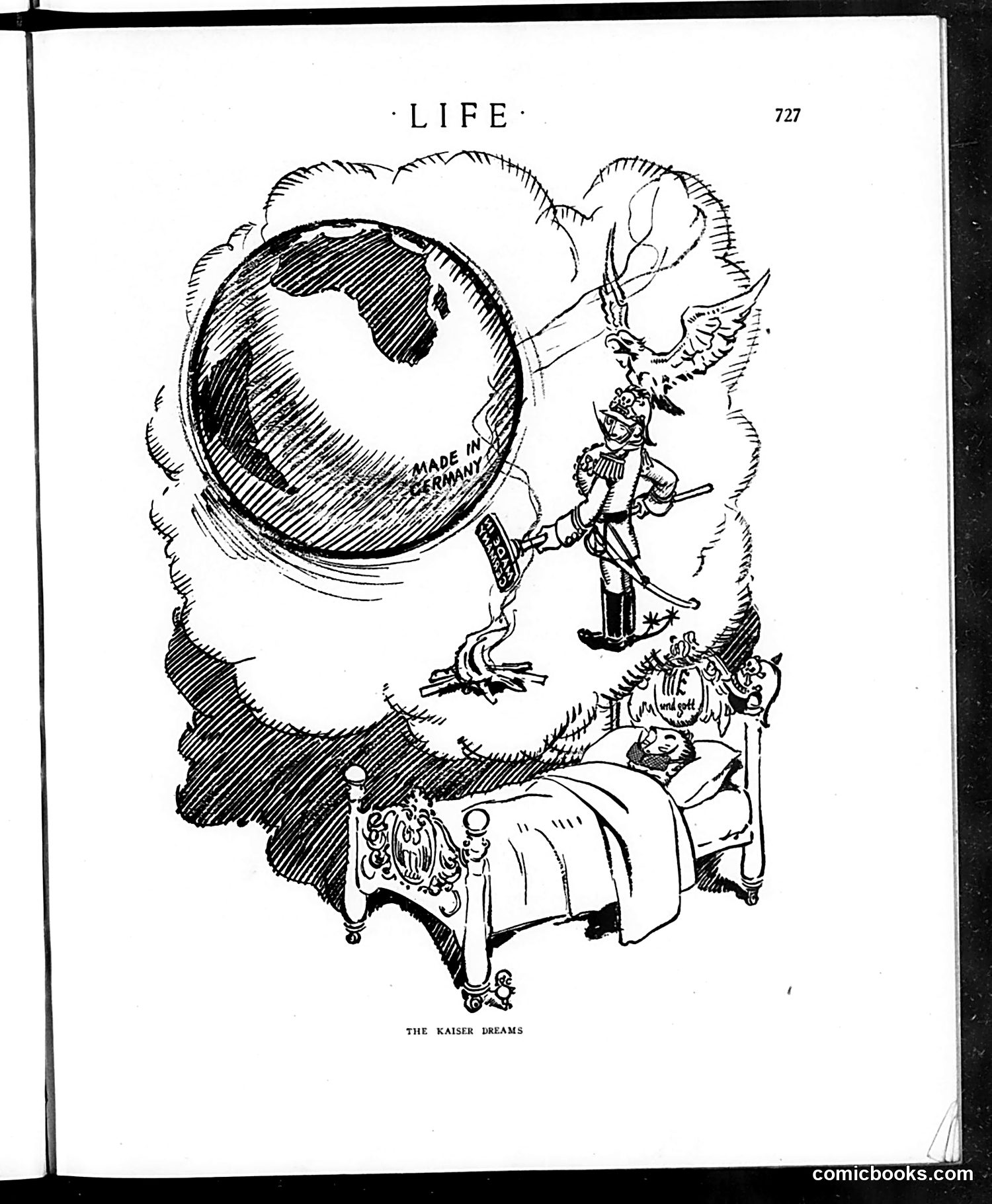
This political cartoon depicts **German Kaiser Wilhelm II** asleep in bed, dreaming of global conquest. The large globe labeled "MADE IN GERMANY" dominates the composition, representing his imperial ambitions. A military figure (likely representing the Kaiser or German militarism) appears to be pulling or manipulating the world like a balloon. The satire critiques German expansionism and the Kaiser's aggressive foreign policy ambitions during the pre-World War I era. The "dreams" framing suggests these territorial aspirations are fantastical delusions rather than realistic possibilities. The cartoon uses sleeping imagery to mock the grandiosity of German imperial dreams while contemporary readers would recognize the genuine threat such ambitions posed to European stability.
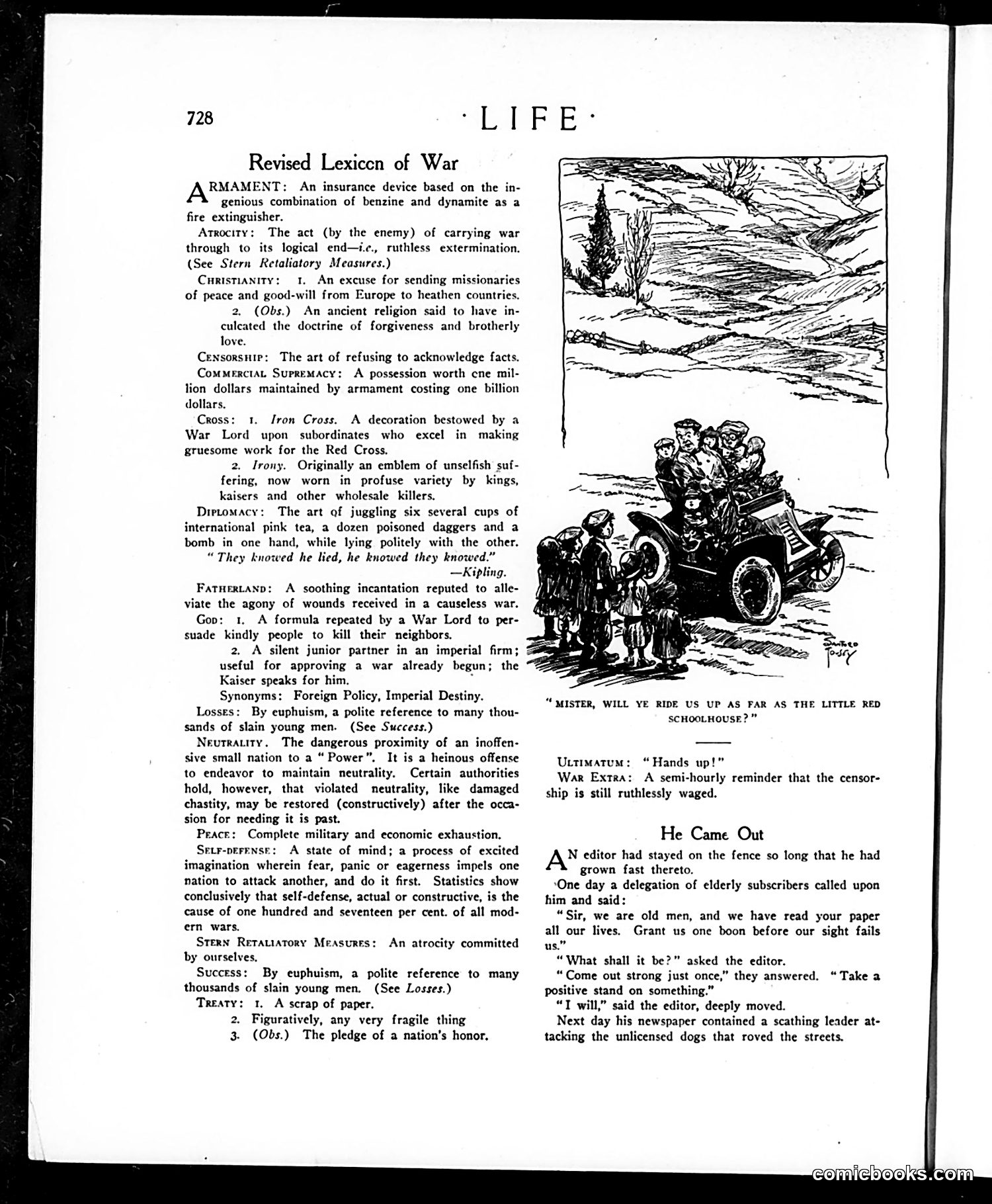
This is a "Revised Lexicon of War"—a satirical dictionary mocking World War I rhetoric and hypocrisy. Each definition inverts jingoistic language to expose propaganda: - **"Armament"** as "fire extinguisher" and **"Losses"** as euphemism for dead soldiers mock how leaders sanitize war's brutality - **"God"** definition attacks religious justification for killing - **"Neutrality"** and **"Treaty"** definitions reference violated Belgian neutrality and broken international promises - **"The Kaiser speaks for Him"** directly blames German leadership - **"Self-defense"** causes "117% of modern wars"—absurdist math ridiculing false justifications The cartoon below shows wealthy figures in a car asking a poor child about directions—likely satirizing class divides during wartime. The story "He Came Out" mocks editorial cowardice: an editor finally takes a "strong stand"—attacking *unlicensed dogs*—rather than addressing actual war issues. **Context**: This reflects American anti-war sentiment or criticism of war profiteering during WWI.
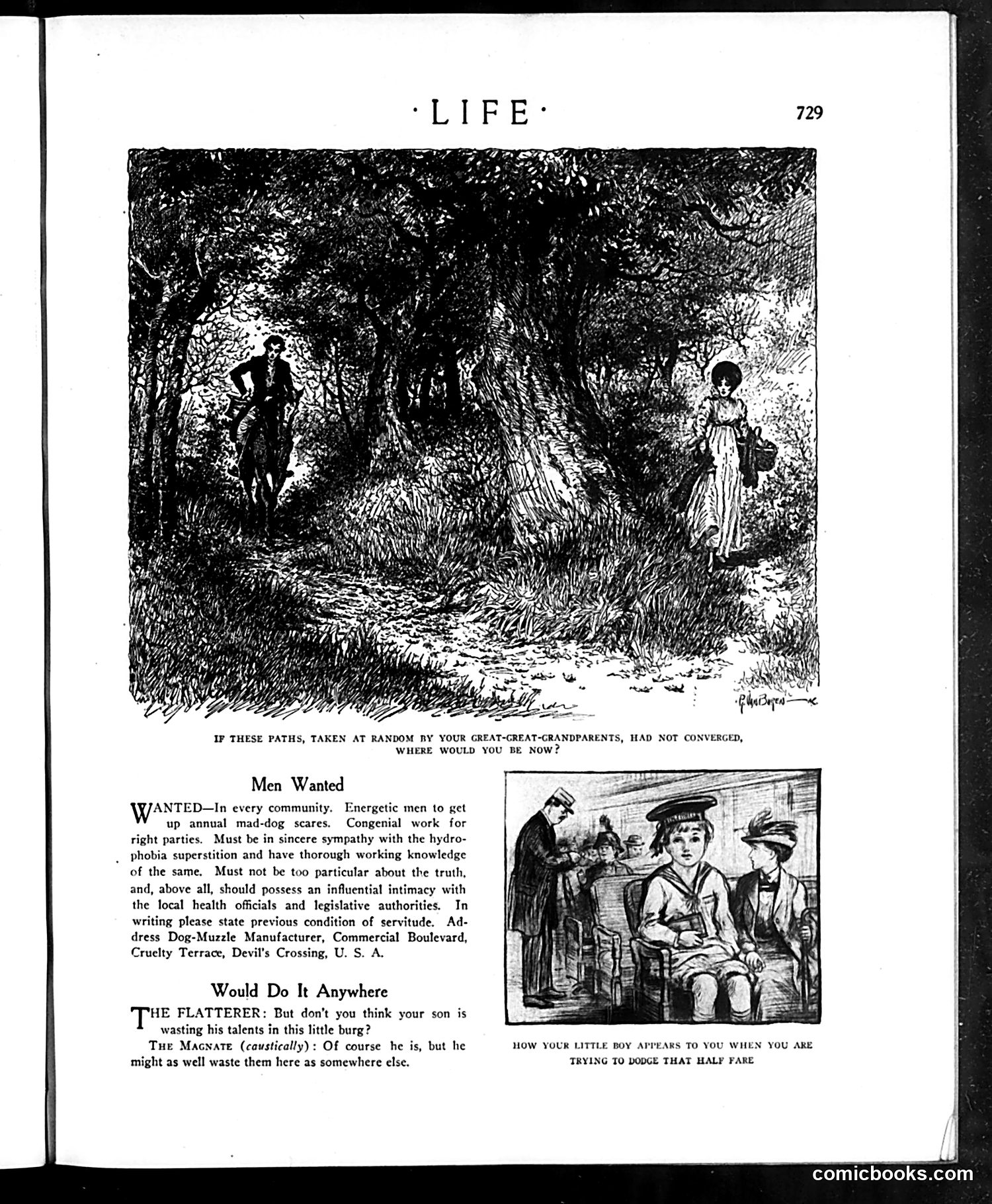
This page contains three separate satirical pieces: **Top illustration**: A philosophical cartoon about fate—two figures meeting in a forest path, questioning whether chance encounters by ancestors determined their existence. It's existential humor about life's randomness. **"Men Wanted" advertisement**: A mock job listing satirizing public hysteria about rabid dogs. Life ridicules the "mad-dog scare" as manufactured panic, accusing opportunists of spreading unfounded fears about rabies to manipulate health officials and legislators. The absurd fake address (Devil's Crossing, Cruelty Terrace) underscores the cynicism—suggesting someone profits from promoting dog-muzzle ordinances through scaremongering. **"Would Do It Anywhere" dialogue**: A brief joke where a father tells a flatterer his son isn't wasting talent in their small town—he'd waste it anywhere. It's mild social commentary about provincial limitation versus opportunity, or simply about mediocrity. The page satirizes public manipulation, institutional corruption, and small-town futility through humor typical of early 20th-century American magazines.
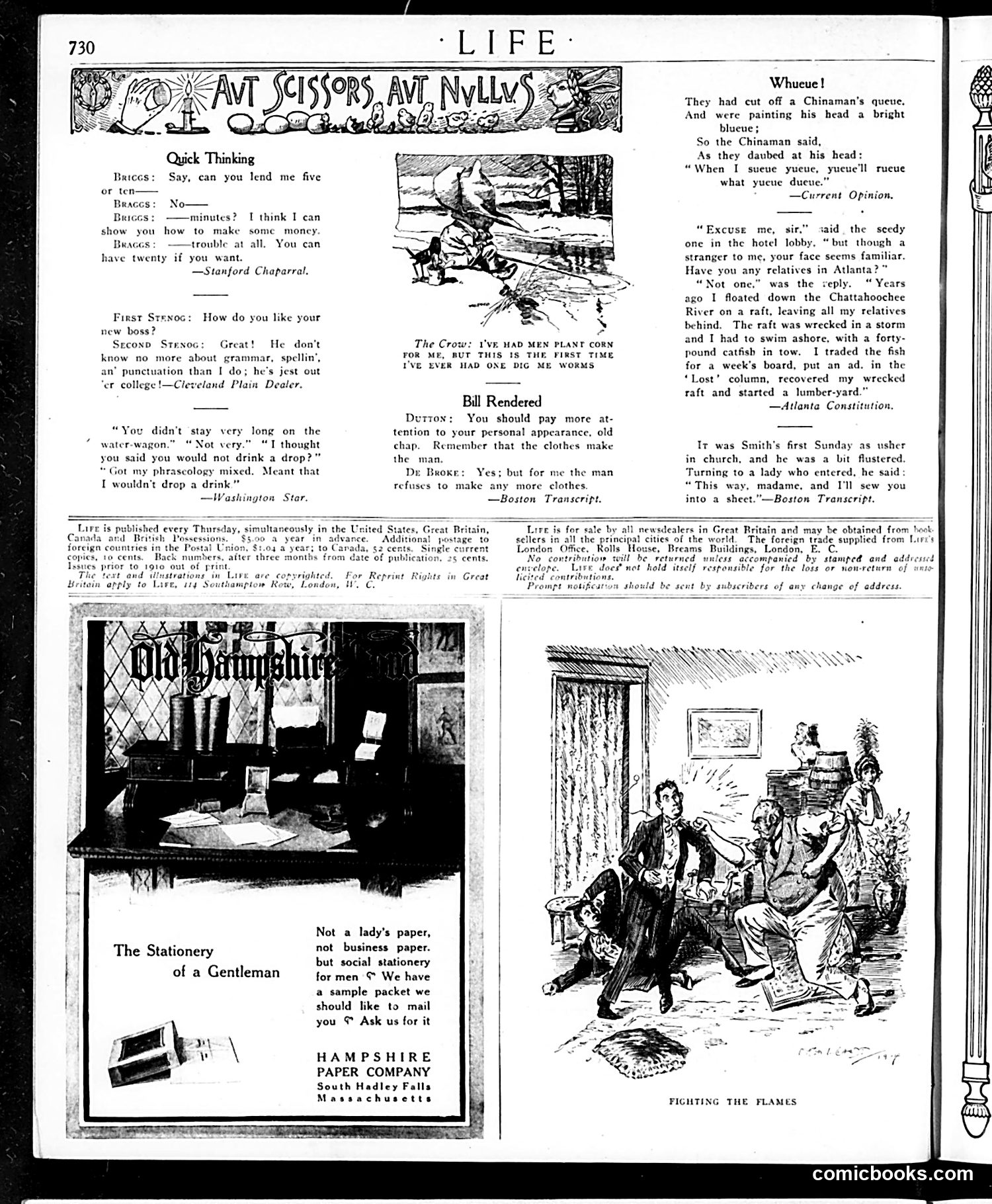
This page contains several short humorous jokes and sketches typical of early 20th-century American satirical magazines: **The main cartoons/jokes satirize:** 1. **Social pretension and money** — A character offers financial advice he can't follow himself 2. **Educational gaps** — A new boss lacks basic grammar despite college education 3. **Drinking culture** — A man misunderstands "water wagon" temperance language 4. **Class and appearance** — A poor man can't afford clothes matching his tailor's philosophy that "clothes make the man" 5. **Chinese immigrants** — A racist poem mocking a Chinese man's queue (traditional braid) being cut and dyed blue, with exaggerated "Chinese" speech patterns 6. **Tall tales** — An implausible story about surviving a shipwreck with a catfish 7. **Social awkwardness** — A new church usher misspeaks to a lady The page also features ads for Hampshire Paper Company stationery. Most humor relies on wordplay, malapropisms, and social observation rather than political commentary.
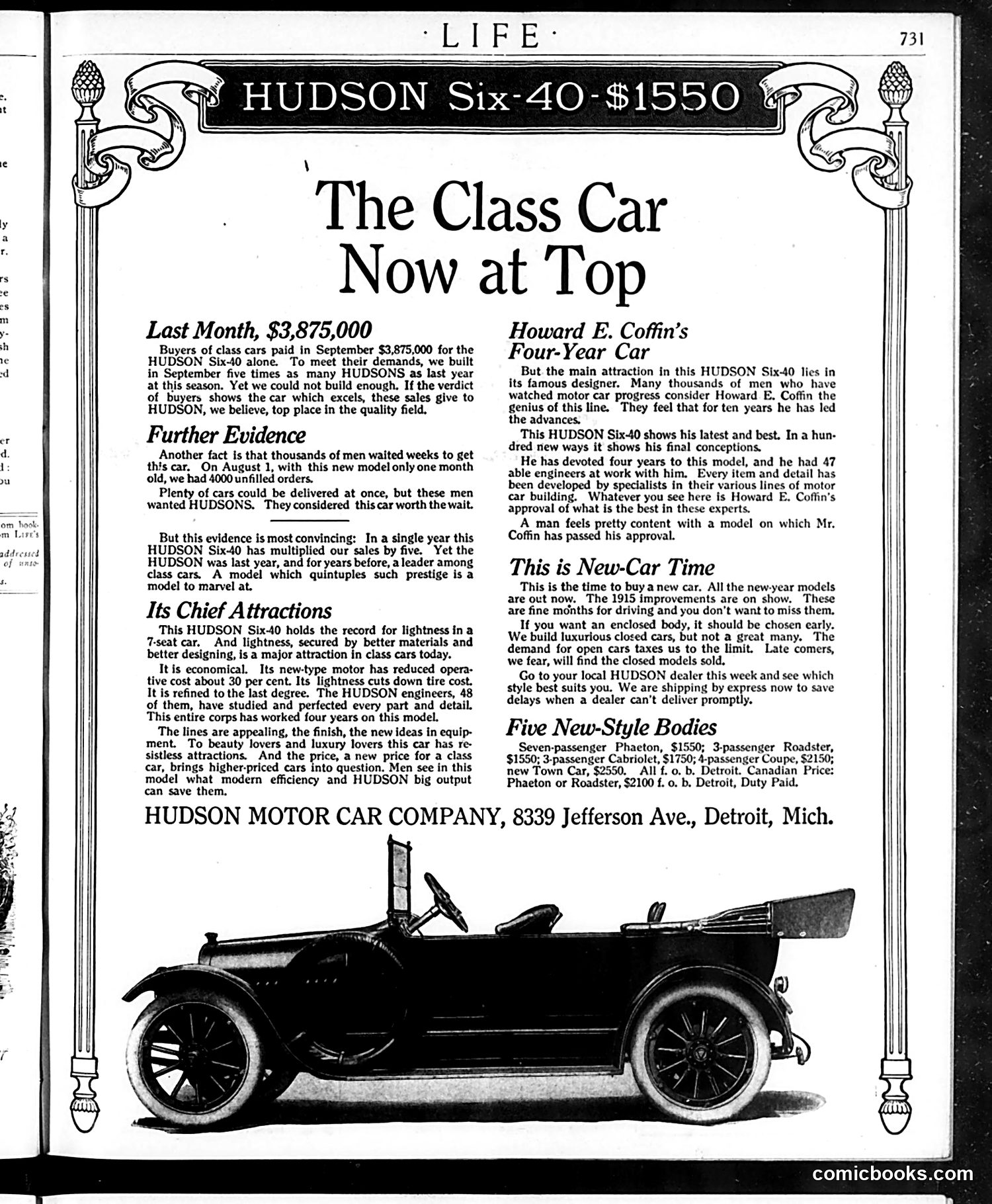
This is **not a cartoon or satire**, but rather a straightforward advertisement for the Hudson Motor Car Company from *Life* magazine (circa 1914-1915, based on the "1915 improvements" reference). The ad promotes the Hudson Six-40 automobile, priced at $1550, emphasizing its market dominance: September sales of $3.875 million, a fivefold increase in annual sales, and 4,000 unfilled orders. The key selling points are: lightness (using superior materials), economy (30% cost reduction), refinement, and design—notably crediting engineer **Howard E. Coffin**, portrayed as the genius behind the vehicle who spent four years developing it with 47 engineers. The ad positions the Six-40 as the premium "class car" now outselling competitors, urging readers to purchase quickly before closed-body models sell out. Pricing and body styles are listed at bottom.
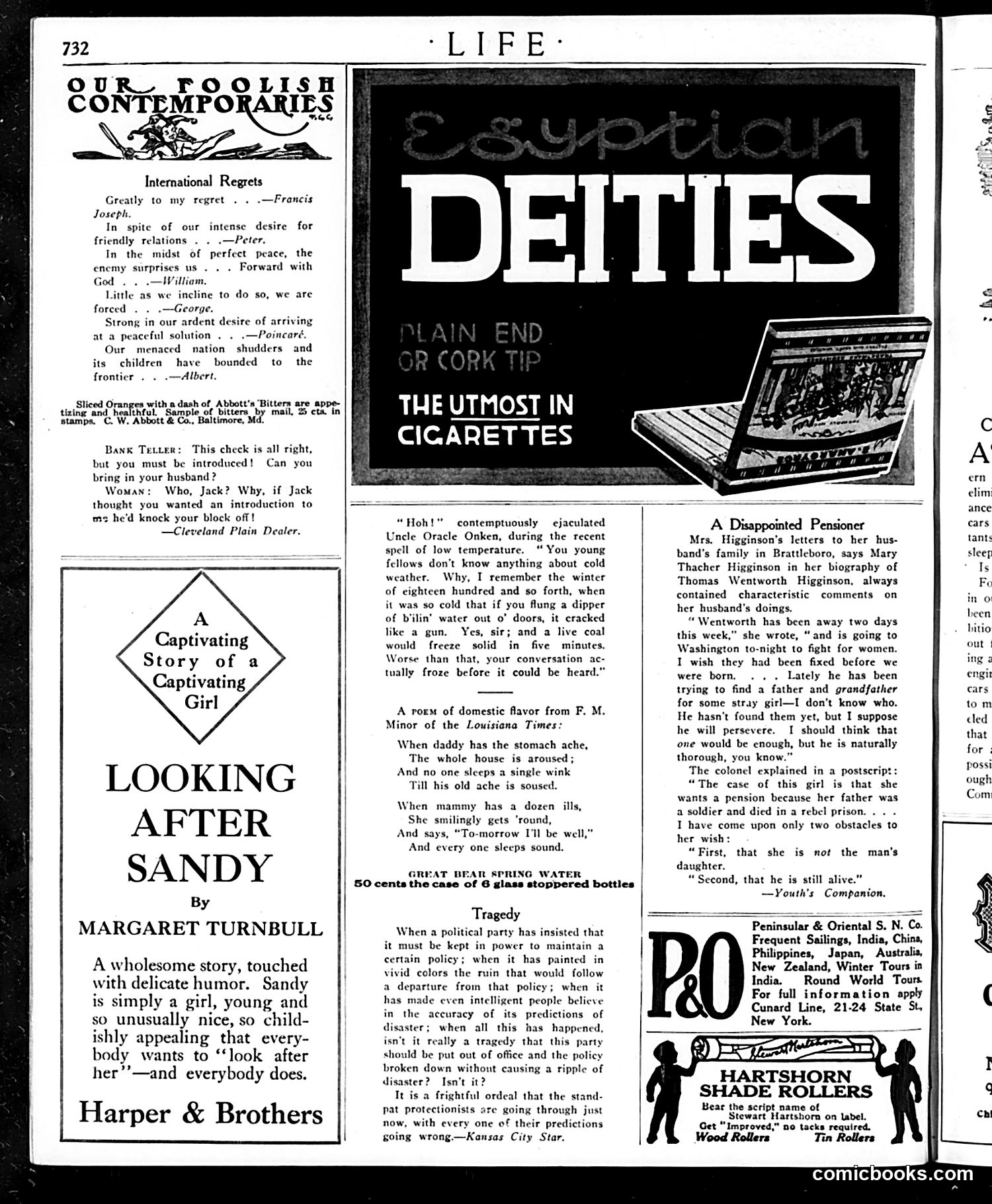
**"International Regrets"** (top left): A satirical poem featuring mock statements from European leaders—Francis Joseph, Peter, William, George, Poincaré, and Albert—each expressing regret about war while claiming peaceful intentions. This appears to reference World War I-era diplomacy, mocking how various national leaders publicly maintained they sought peace while preparing for or conducting warfare. The juxtaposition of their noble-sounding phrases with the reality of conflict creates the satire. **"Tragedy"** (bottom): A political commentary on American protectionist politicians. The piece mocks "stand-pat protectionists" whose dire predictions about abandoning protective tariff policies proved wrong, yet they remained in power. The satire suggests these politicians created unnecessary panic through false prophecies, making their eventual electoral defeat ironic rather than catastrophic. Both pieces exemplify *Life* magazine's characteristic political satire targeting powerful figures' hypocrisy and incompetence.
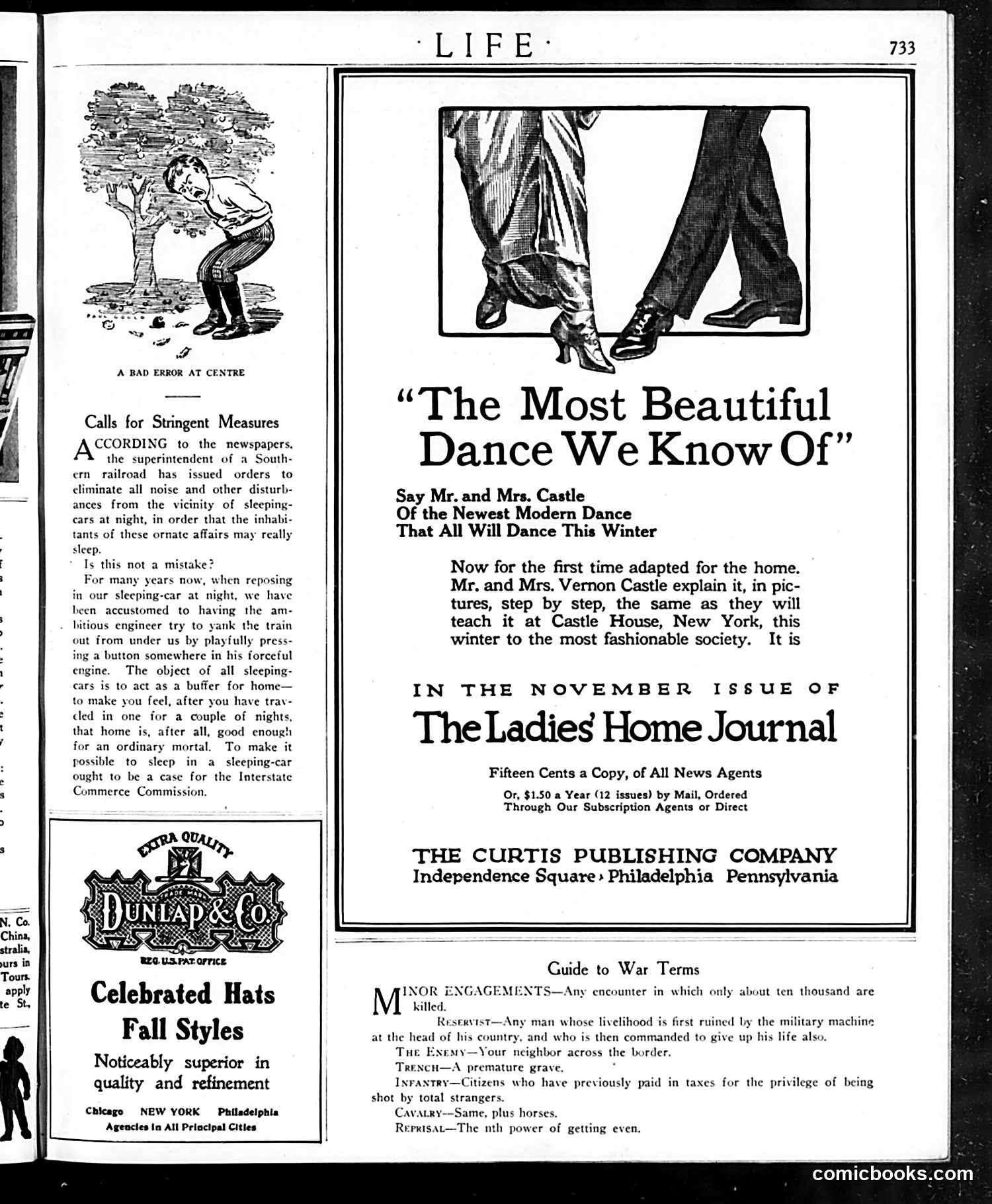
**Left side ("A Bad Error at Centre"):** A satirical complaint about a Southern railroad superintendent's new noise-reduction policy for sleeping cars. The author argues this is misguided—the whole point of sleeping cars is their *discomfort*, which makes home seem better by comparison. The joke mocks both railroad management and travelers' resigned acceptance of poor conditions. **Right side:** An advertisement for *The Ladies' Home Journal* featuring Mr. and Mrs. Vernon Castle, famous ballroom dancers of the era, promoting their new modern dance being taught at their New York studio and featured in the magazine. **Bottom ("Guide to War Terms"):** Darkly satirical definitions mocking World War I military terminology—"minor engagements" kill thousands, "reservists" lose livelihoods then lives, "the enemy" is your neighbor, and "infantry" are citizens taxed to be shot by strangers. This reflects contemporary American skepticism about the war (pre-U.S. entry or early involvement). The page blends humor, advertisement, and anti-war commentary typical of Life's satirical approach.
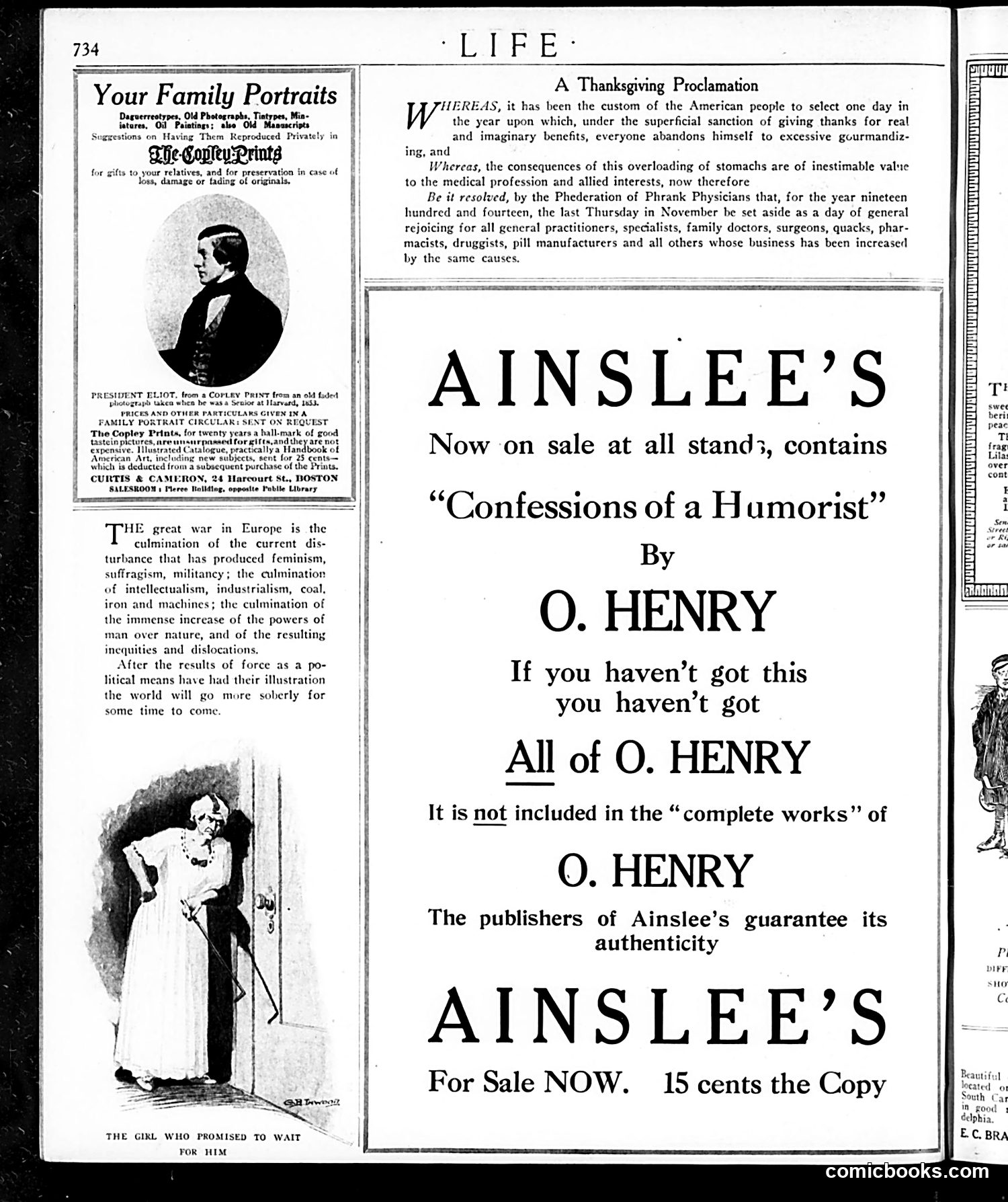
This page combines satirical content with advertising. The main satire is "A Thanksgiving Proclamation," a mock-formal document that cynically inverts the holiday's meaning. Rather than celebrating gratitude, it presents Thanksgiving as beneficial primarily to doctors and medical professionals—since overeating causes digestive problems requiring their services. The proclamation humorously lists beneficiaries: "general practitioners, specialists, family doctors, surgeons, quacks, pharmacists, druggists, pill manufacturers." The satire critiques both American excess and the commercialization of health. By addressing physicians as a group profiting from holiday gluttony, it mocks both consumer culture and the medical establishment's financial interests. The page also includes illustrations (a portrait and "The Girl Who Promised to Wait for Him") and substantial advertising for Ainslee's Magazine promoting O. Henry's "Confessions of a Humorist"—typical of Life's revenue model combining satire with paid content.
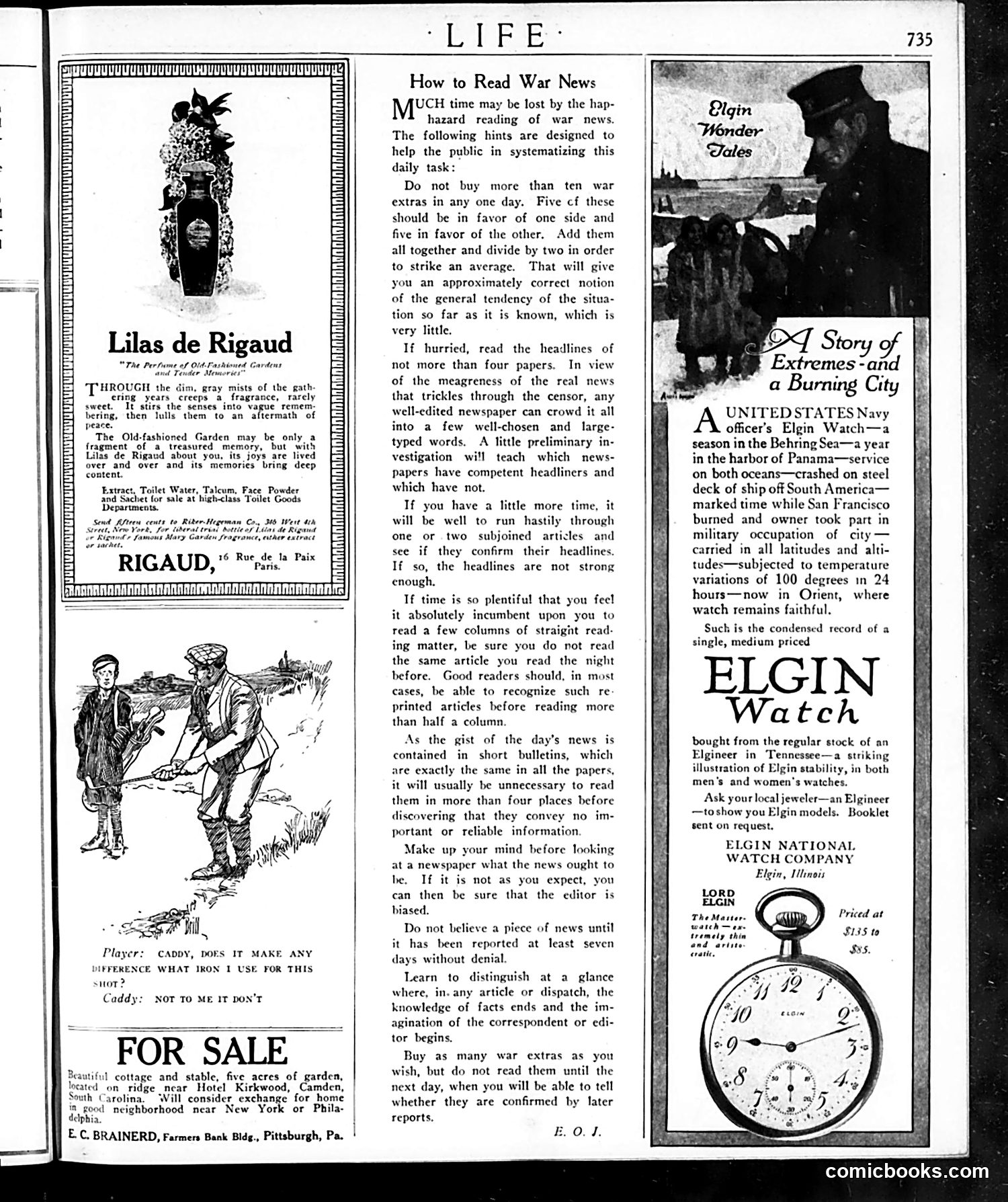
This page contains satirical advice on reading wartime news, likely from World War I era. The central piece, "How to Read War News," mocks the unreliability and bias of contemporary war reporting. The satire targets: - **Newspaper bias**: readers are advised to buy five extras favoring each side, then average them to get approximate truth - **Sensationalism**: papers recycle identical bulletins across outlets; readers needn't read the same content more than four times - **Reader gullibility**: people should decide what news "ought to be" before reading, then assume biased editors if reality differs - **Censorship**: the author notes little reliable information "trickles through the censor" The joke's bite comes from treating absurd practices (averaging contradictory reports, ignoring news until confirmed days later) as practical guidance. This reflects genuine WWI-era frustrations with propaganda, competing narratives, and official information control that made determining facts nearly impossible for ordinary citizens. The other content—perfume ads, real estate, watch advertisements—comprises typical period magazine filler.
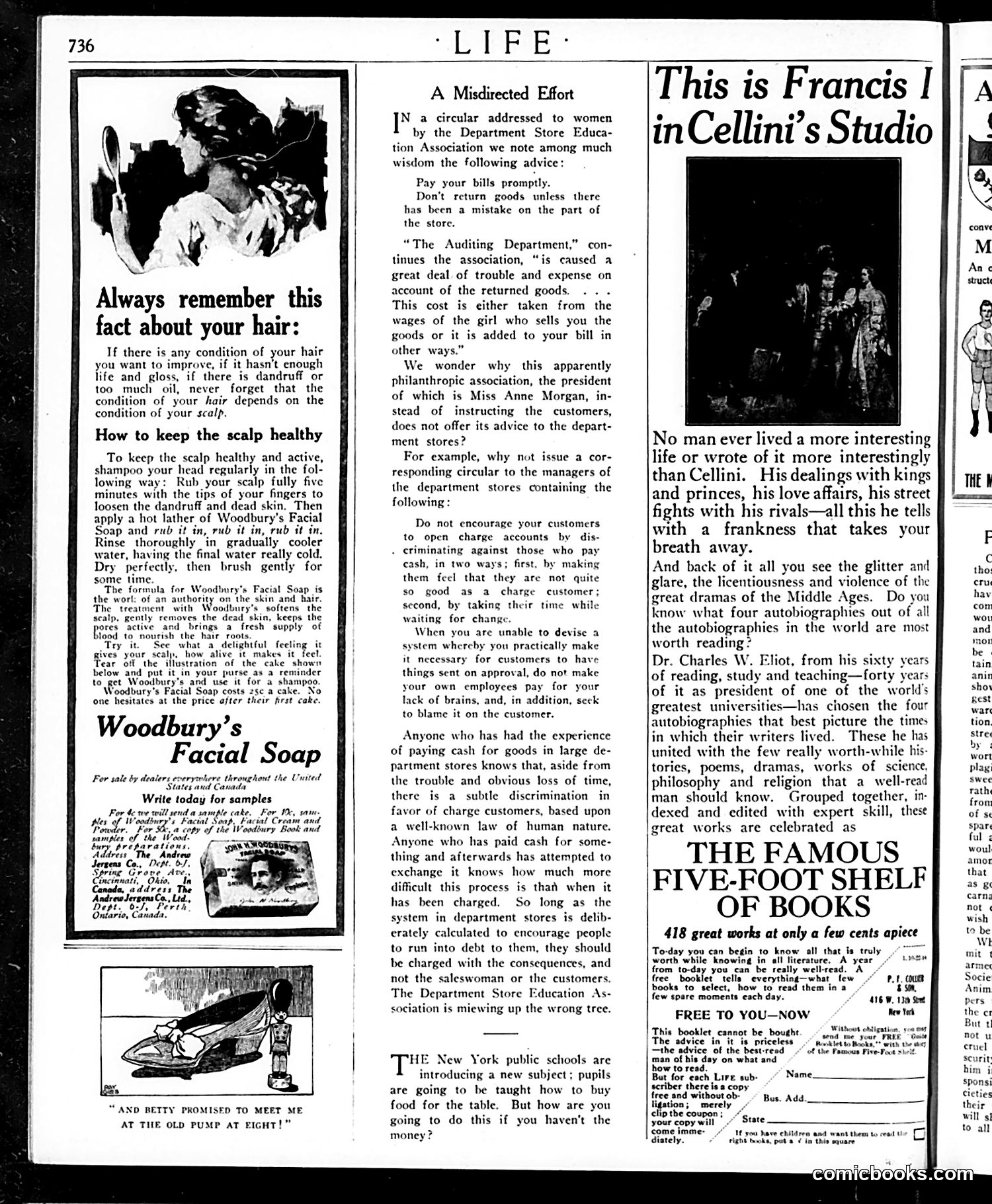
This page contains **advertising and social criticism**, not political cartoons. The main content critiques a Department Store Education Association circular that instructs female customers to pay bills promptly and avoid returns—claiming this protects store employees' wages. Life's editors sarcastically ask: **why advise customers instead of department store managers?** The satire points out the hypocrisy: stores deliberately encourage charge accounts over cash purchases, discriminate against cash customers, and then blame *customers* (and employees) for the resulting costs. Life argues stores practice deliberate inefficiency to maximize charge accounts, then seek to shift blame downward rather than fix their own systems. This reflects early 20th-century labor and consumer tensions—particularly concerns about how workers (especially women sales clerks) bore the costs of corporate practices. The rest of the page features a **Woodbury's Facial Soap advertisement** and a humorous cartoon about two characters meeting at a pump, unrelated to the main article.
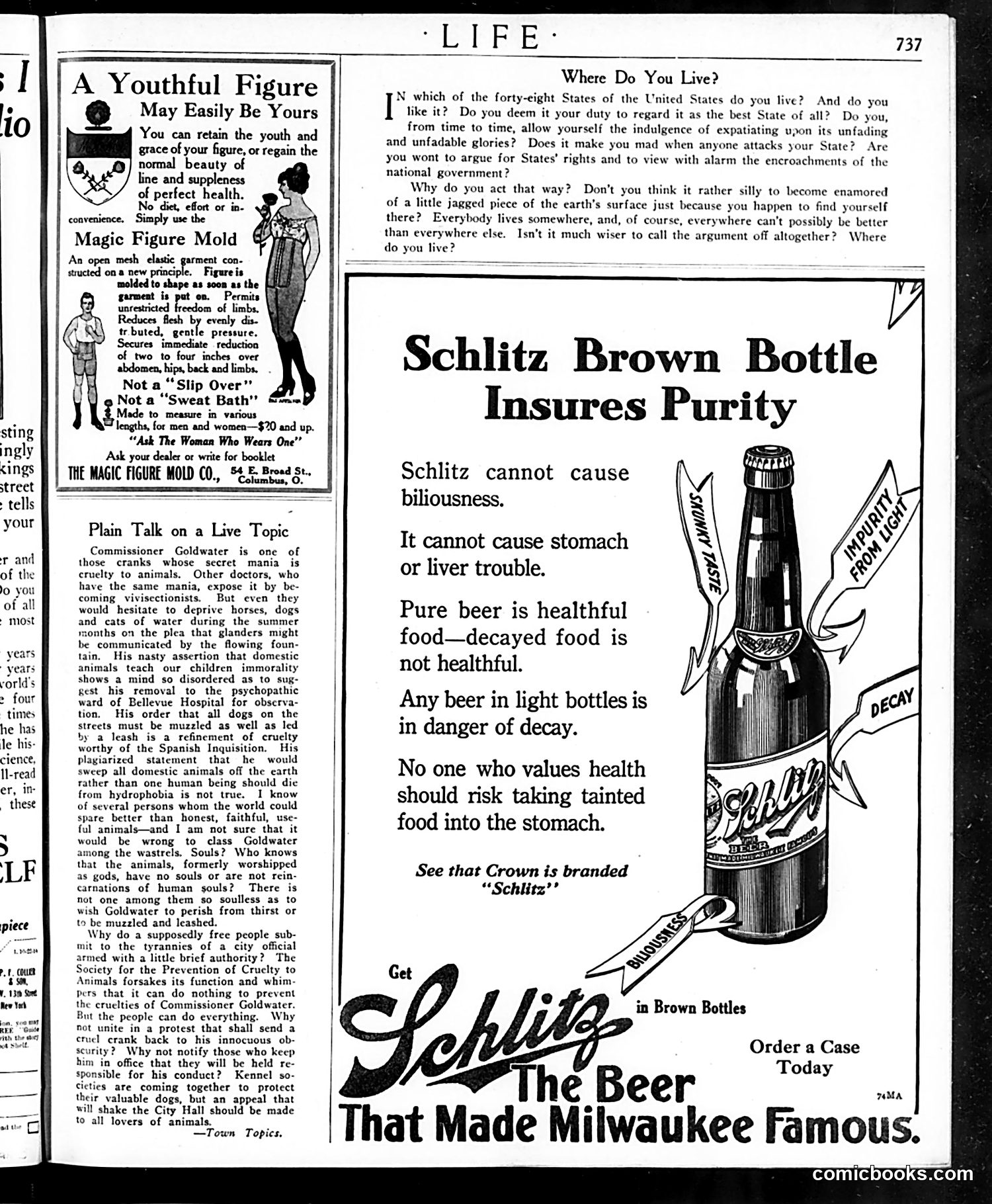
This page contains **mostly advertising** alongside opinion pieces, typical of Life's format. **Main content:** - A "Magic Figure Mold" corset ad promoting youth and slimness for women - A lengthy "Plain Talk on a Live Topic" column attacking Commissioner Goldwater for his cruelty to animals—the author argues Goldwater's vivisectionist views and orders to muzzle dogs are tyrannical overreach, urging citizens to protest - A substantial **Schlitz beer advertisement** claiming brown bottles preserve purity and health, asserting pure beer is "healthful food" while light bottles risk "decay" **Context for modern readers:** The Goldwater criticism likely refers to a NYC official; the beer ad reflects pre-Prohibition era marketing when alcohol was marketed as health tonic. The ad's emphasis on brown bottles preventing "decay" suggests beer spoilage was a genuine concern before refrigeration. The page illustrates Life's mix of progressive social commentary with commercial interests.
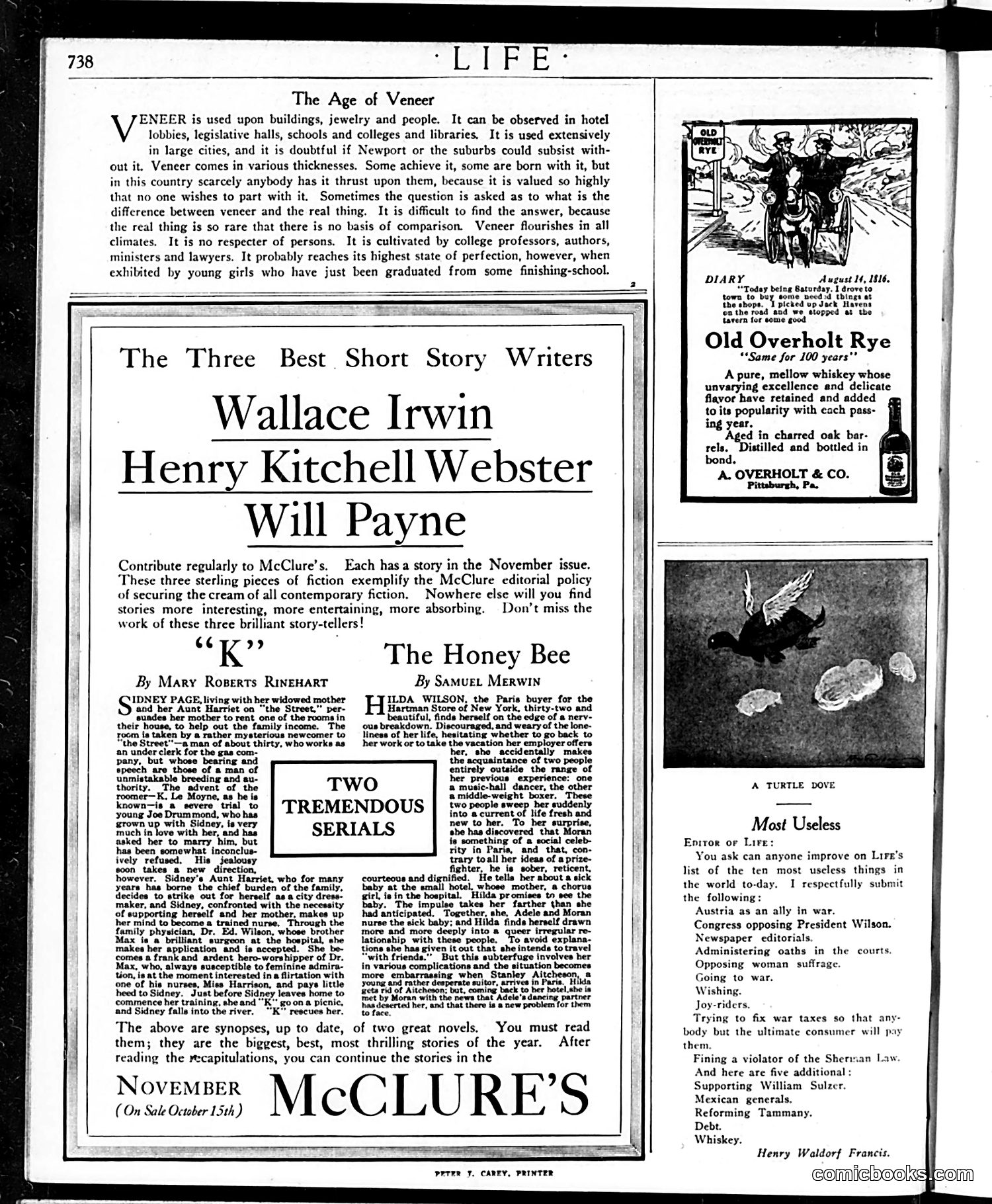
This page is primarily **advertising and editorial promotion** for McClure's Magazine, not political satire. The top essay "The Age of Veneer" is a social commentary—not a cartoon—mocking American superficiality. It observes that "veneer" (artificial polish) pervades American society among the wealthy, professionals, and especially finishing-school graduates, yet "the real thing is so rare that there is no basis of comparison." The small cartoon in the upper right corner appears to be a diary illustration showing people at a tavern or inn, but lacks clear political content—it's generic period humor about rural life. The page's main function is promoting three acclaimed short story writers (Irwin, Webster, Payne) and advertising serialized novels in McClure's, including works by Mary Roberts Rinehart and Samuel Merwin. This reflects Life's role as a cultural arbiter recommending quality fiction to readers.
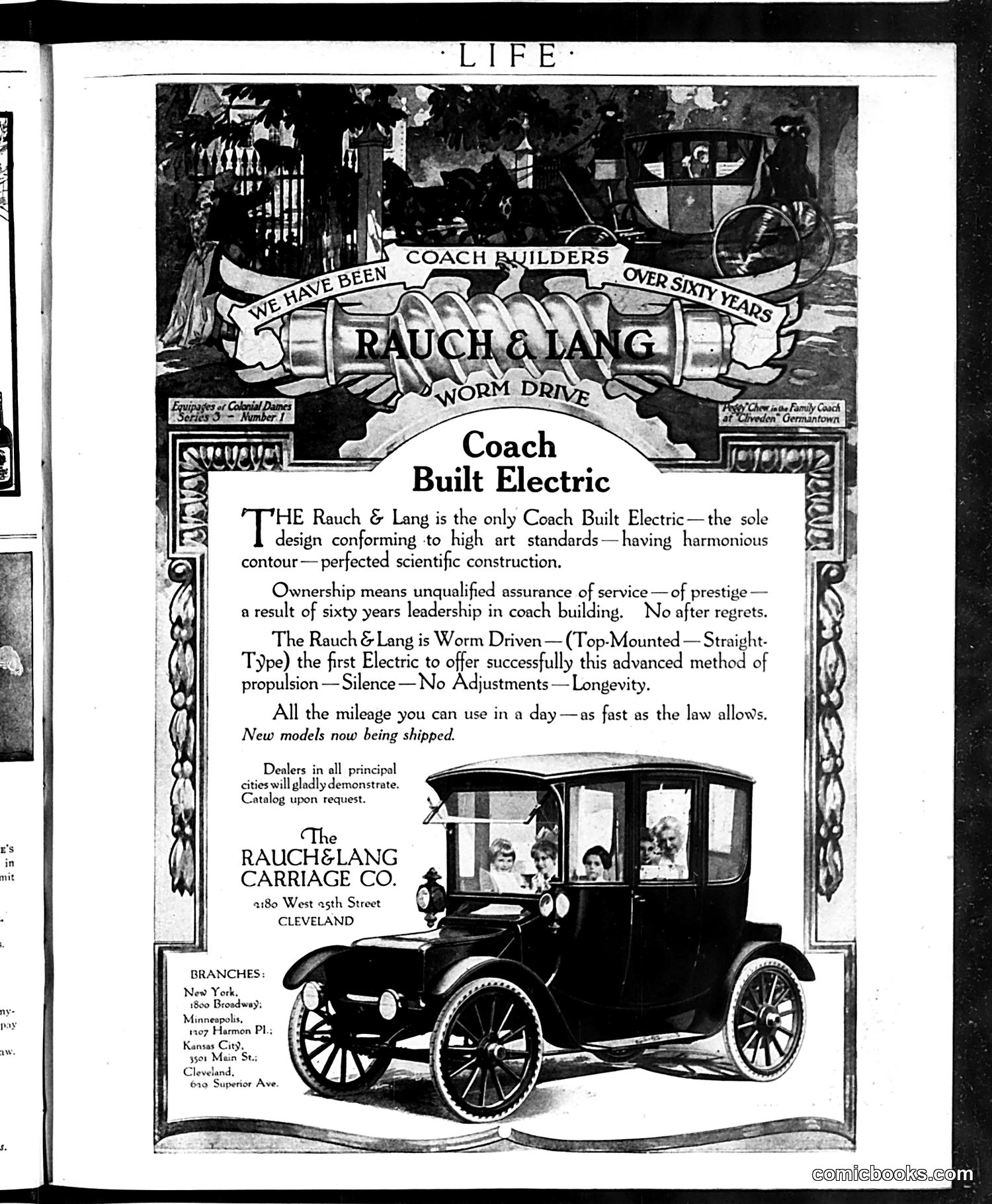
This is **not a cartoon or satire**—it's a straightforward advertisement for the Rauch & Lang electric carriage, placed in *Life* magazine. The ad promotes an early **electric automobile** (not horse-drawn), emphasizing its luxury and technological sophistication: it's "Coach Built Electric," features a worm-drive transmission, operates silently, and requires no adjustments. The company claims 60 years of coach-building expertise. For a modern reader, the significance is historical: this represents the **pre-Model T era** when electric vehicles competed seriously with gasoline cars. The emphasis on silence, reliability, and prestige reflects that electrics were actually considered the more refined option for wealthy urban drivers before mass-produced gasoline cars became dominant. The Cleveland-based manufacturer lists branches nationwide, indicating substantial distribution. This advertisement captures a moment when electric vehicles seemed poised to dominate American transportation—before they were displaced by cheaper, more practical gasoline alternatives.
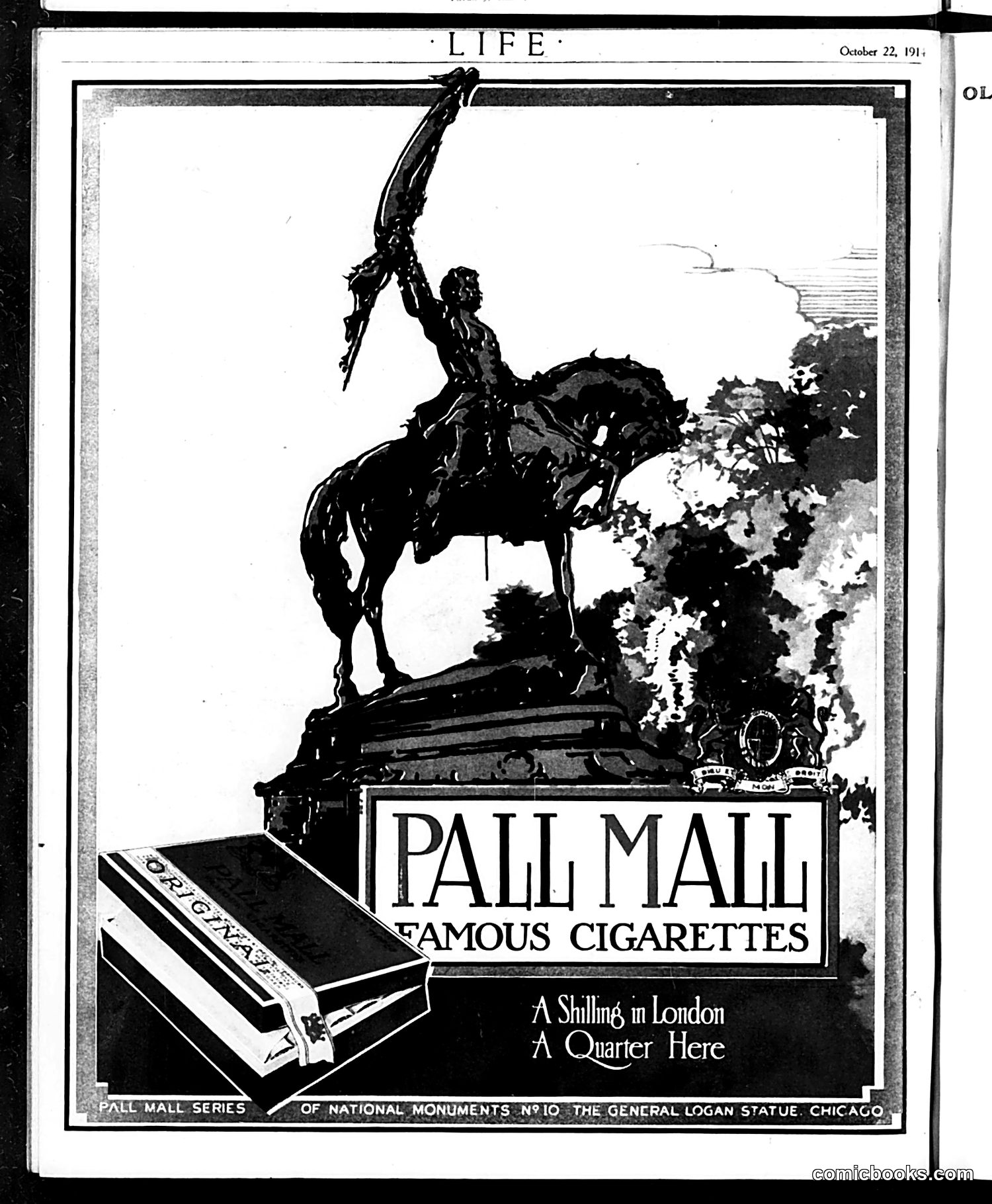
This is an advertisement for Pall Mall cigarettes, not a political cartoon. The image shows a silhouetted equestrian statue of General Logan in Chicago, which appears to be part of a series called "National Monuments" (#10). The ad's humor relies on a price comparison: Pall Mall cigarettes cost "a shilling in London" but "a quarter here" (in America), suggesting the product offers better value in the U.S. market. The juxtaposition of an American military monument with pricing in British currency plays on transatlantic commerce and the appeal of getting quality goods at competitive American prices. The cigarette pack is shown in the lower left corner as product placement.