
Life, 1914-10-22 · page 29 of 44
Life — October 22, 1914 — page 29: what you’re looking at
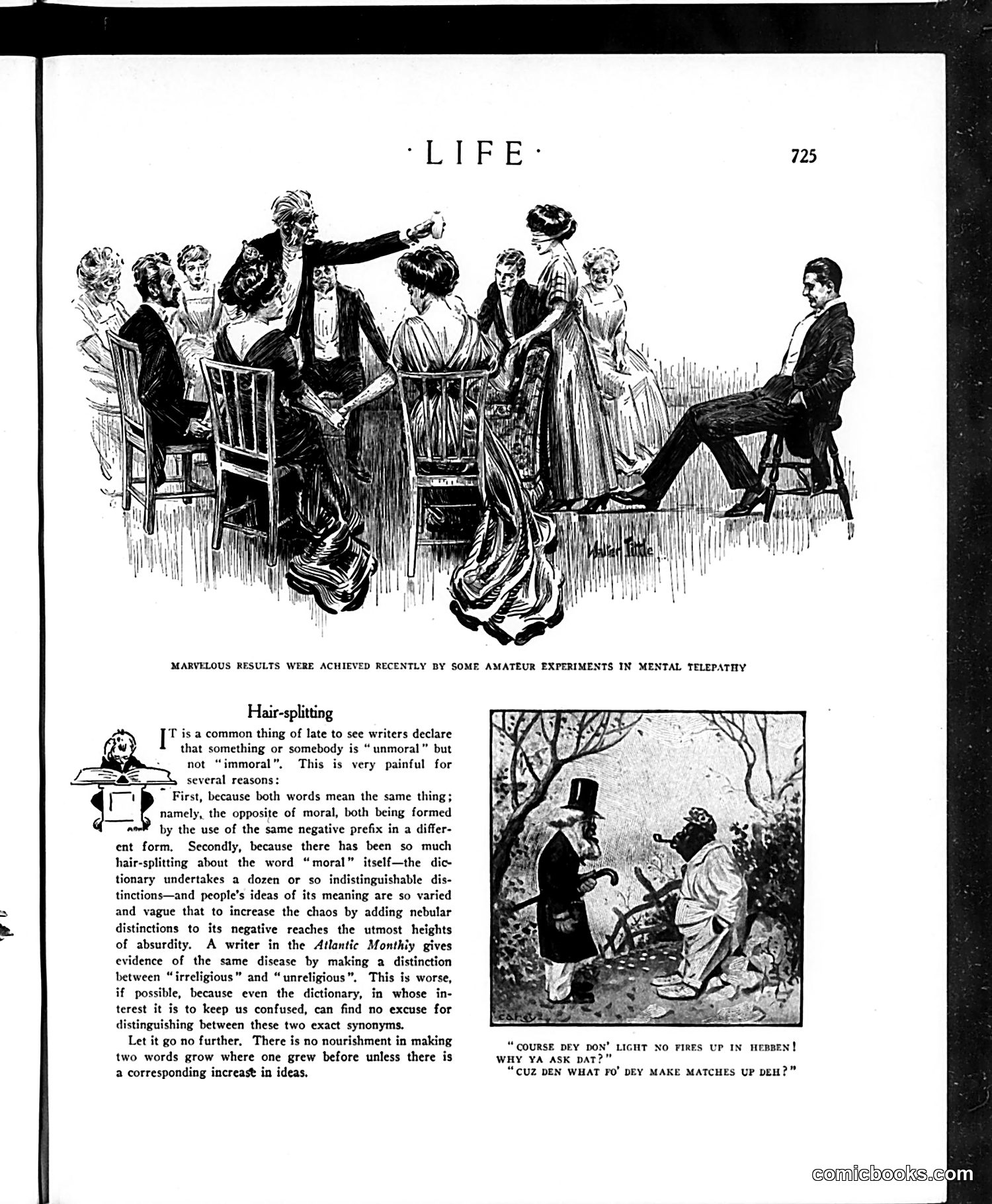
What you’re looking at
This page contains two distinct pieces of satire: **Top illustration**: Shows a group at a séance or spiritualist gathering attempting "mental telepathy." The satire appears to mock the pseudoscientific fads of the era—spiritualism and claims of supernatural communication were popular entertainment, especially among the upper classes shown here. **"Hair-splitting" article**: A written critique of linguistic pedantry. The author ridicules writers who distinguish between "unmoral" and "immoral" (or "irreligious" and "unreligious"), arguing these are synonymous and that such distinctions add confusion without adding meaningful ideas. The satire targets intellectuals and dictionary makers who complicate language unnecessarily. **Bottom cartoon**: Depicts two Black figures in dialogue about matches in Heaven, presented in dialect. This reflects the period's common use of racial caricature in humor, though the specific joke's satirical intent is unclear from context alone. The page overall satirizes intellectual pretension and pseudoscientific trends of its time.
📄 Transcribed text from this page (OCR, searchable)
Machine-transcribed from the original scan — historical spelling and the odd misread are preserved.
MARVELOUS RESULTS WERE ACHIEVED RECENTLY BY SOME AMATEUR EXPERIMENTS IN MENTAL TELEPATHY Hair-splitting T is a common thing of late to see writers declare that something or somebody is “ unmoral” but not “immoral”, This is very painful for several reasons: ~ First, because both words mean the same thing ; namely, the opposite of moral, both being formed by the use of the same negative prefix in a differ- ent form, Secondly, because there has been so much hair-splitting about the word “moral” itself—the dice tionary undertakes a dozen or so indistinguishable dis- tinctions—and people’s ideas of its meaning are so varied and vague that to increase the chaos by adding nebular distinctions to its negative reaches the utmost heights of absurdity. A writer in the Atlantic Monthiy gives evidence of the same disease by making a distinction between “irreligious” and “unreligious”. This is worse, if possible, because even the dictionary, in whose in- terest it is to keep us confused, can find no excuse for distinguishing between these two exact synonyms. Let it go no further. There is no nourishment in making two words grow where one grew before unless there is a corresponding increast in ideas, “COURSE DEY DON’ LIGHT NO FIRES UP IN HEBBEN! WHY YA ASK DAT?” “CUZ DEN WHAT FO’ DEY MAKE MATCHES UP DEH?” comichooks,