
Life, 1914-10-22 · page 32 of 44
Life — October 22, 1914 — page 32: what you’re looking at
What you’re looking at
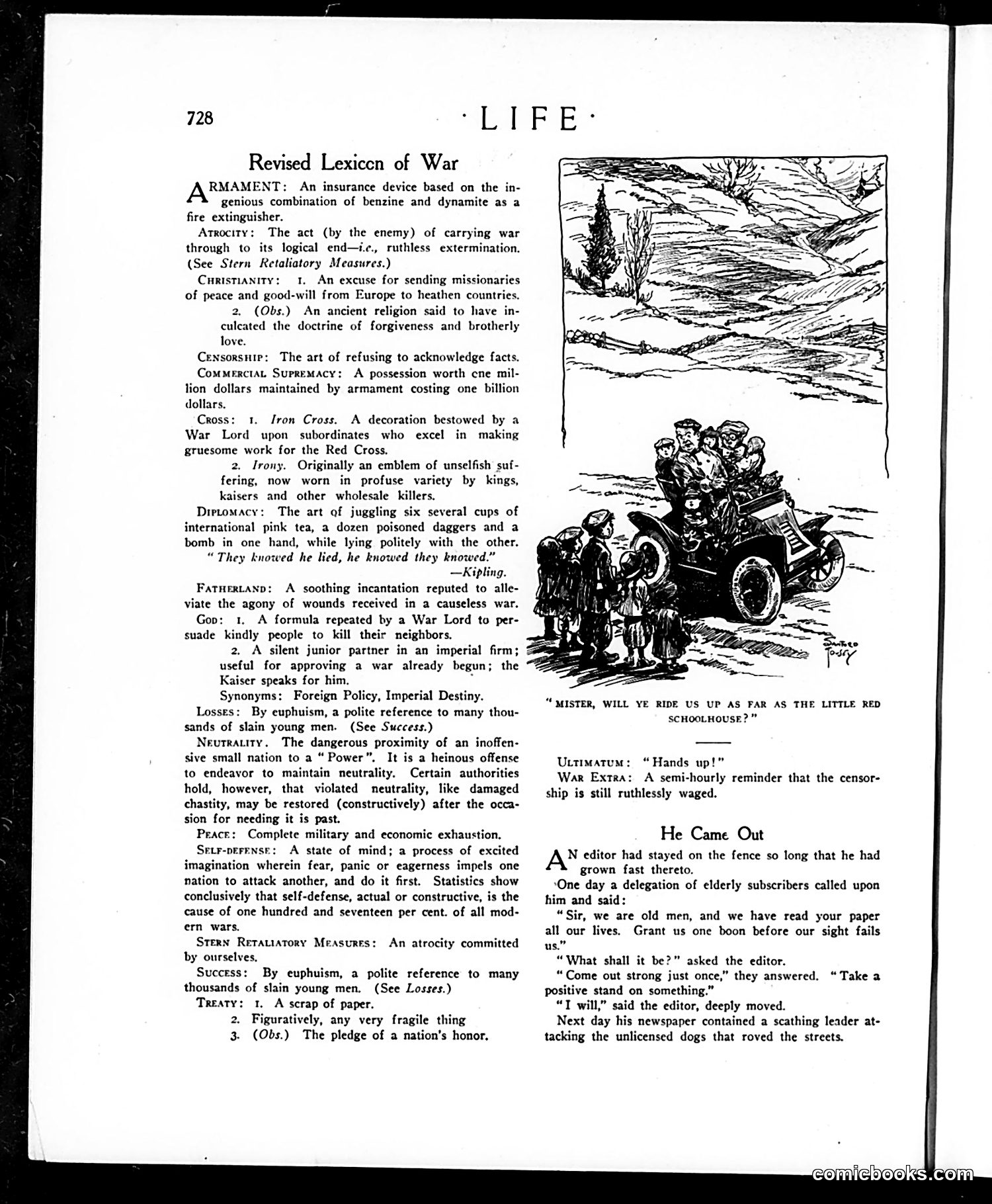
This is a "Revised Lexicon of War"—a satirical dictionary mocking World War I rhetoric and hypocrisy. Each definition inverts jingoistic language to expose propaganda: - **"Armament"** as "fire extinguisher" and **"Losses"** as euphemism for dead soldiers mock how leaders sanitize war's brutality - **"God"** definition attacks religious justification for killing - **"Neutrality"** and **"Treaty"** definitions reference violated Belgian neutrality and broken international promises - **"The Kaiser speaks for Him"** directly blames German leadership - **"Self-defense"** causes "117% of modern wars"—absurdist math ridiculing false justifications The cartoon below shows wealthy figures in a car asking a poor child about directions—likely satirizing class divides during wartime. The story "He Came Out" mocks editorial cowardice: an editor finally takes a "strong stand"—attacking *unlicensed dogs*—rather than addressing actual war issues. **Context**: This reflects American anti-war sentiment or criticism of war profiteering during WWI.
📄 Transcribed text from this page (OCR, searchable)
Machine-transcribed from the original scan — historical spelling and the odd misread are preserved.
SINDRE* Revised Lexiccn of War RMAMENT: An insurance device based on the in- genious combination of benzine and dynamite as a fire extinguisher. Atrocity: The act (by the enemy) of carrying war through to its logical end—i.c., ruthless extermination. (See Stern Retaliatory Measures.) Curistianity: 1, An excuse for sending missionaries of peace and good-will from Europe to heathen countries, 2, (Obs.) An ancient religion said to have in- culcated the doctrine of forgiveness and brotherly love. Censorsuip: The art of refusing to acknowledge facts. CommerctaL Supremacy: A possession worth cne mil- lion dollars maintained by armament costing one billion dollars. Cross: 1. Jron Cross. A decoration bestowed by a War Lord upon subordinates who excel in making gruesome work for the Red Cross. 2, Irony. Originally an emblem of unselfish suf- fering, now worn in profuse variety by kings, kaisers and other wholesale killers. Diptomacy: The art of juggling six several cups of international pink tea, a dozen poisoned daggers and a bomb in one hand, while lying politely with the other. “They knowed he lied, he knowed they knowed.” —Kipling. FatHertanp: A soothing incantation reputed to alle- viate the agony of wounds received in a causeless war. Gop: 1. A formula repeated by a War Lord to per- suade kindly people to kill their neighbors. 2. A silent junior partner in an imperial firm; useful for approving a war already begun; the Kaiser speaks for him. ' Synonyms: Foreign Policy, Imperial Destiny. Losses: By euphuism, a polite reference to many thou- sands of slain young men. (See Success.) Nevutraity. The dangerous proximity of an inoffen- sive small nation to a “ Power”. It is a heinous offense to endeavor to maintain neutrality. Certain authorities hold, however, that violated neutrality, like damaged chastity, may be restored (constructively) after the occa- sion for needing it is past. Peace: Complete military and economic exhaustion, Setr-pereNse: A state of mind; a process of excited imagination wherein fear, panic or eagerness impels one nation to attack another, and do it first. Statistics show conclusively that self-defense, actual or constructive, is the cause of one hundred and seventeen per cent. of all mod- ern wars. Stern ReTaviatory Measures: by ourselves, Success: By euphuism, a polite reference to many thousands of slain young men. (See Losses.) Treaty: 1. A scrap of paper. 2. Figuratively, any very fragile thing 3. (Obs.) The pledge of a nation’s honor. An atrocity committed “MISTER, WILL YE RIDE US UP AS FAR AS THE LITTLE RED SCHOOLHOUSE?” Uttimatum: “Hands up!” War Extra: A semi-hourly reminder that the censor- ship is still ruthlessly waged. He Came Out AN editor had stayed on the fence so long that he had grown fast thereto. ‘One day a delegation of elderly subscribers called upon him and said: “Sir, we are old men, and we have read your paper all our lives. Grant us one boon before our sight fails us.” “What shall it be?” asked the editor. “Come out strong just once,” they answered. positive stand on something.” “T will,” said the editor, deeply moved. Next day his newspaper contained a scathing leader at- tacking the unlicensed dogs that roved the streets. “Take a