
Life, 1914-10-22 · page 26 of 44
Life — October 22, 1914 — page 26: what you’re looking at
What you’re looking at
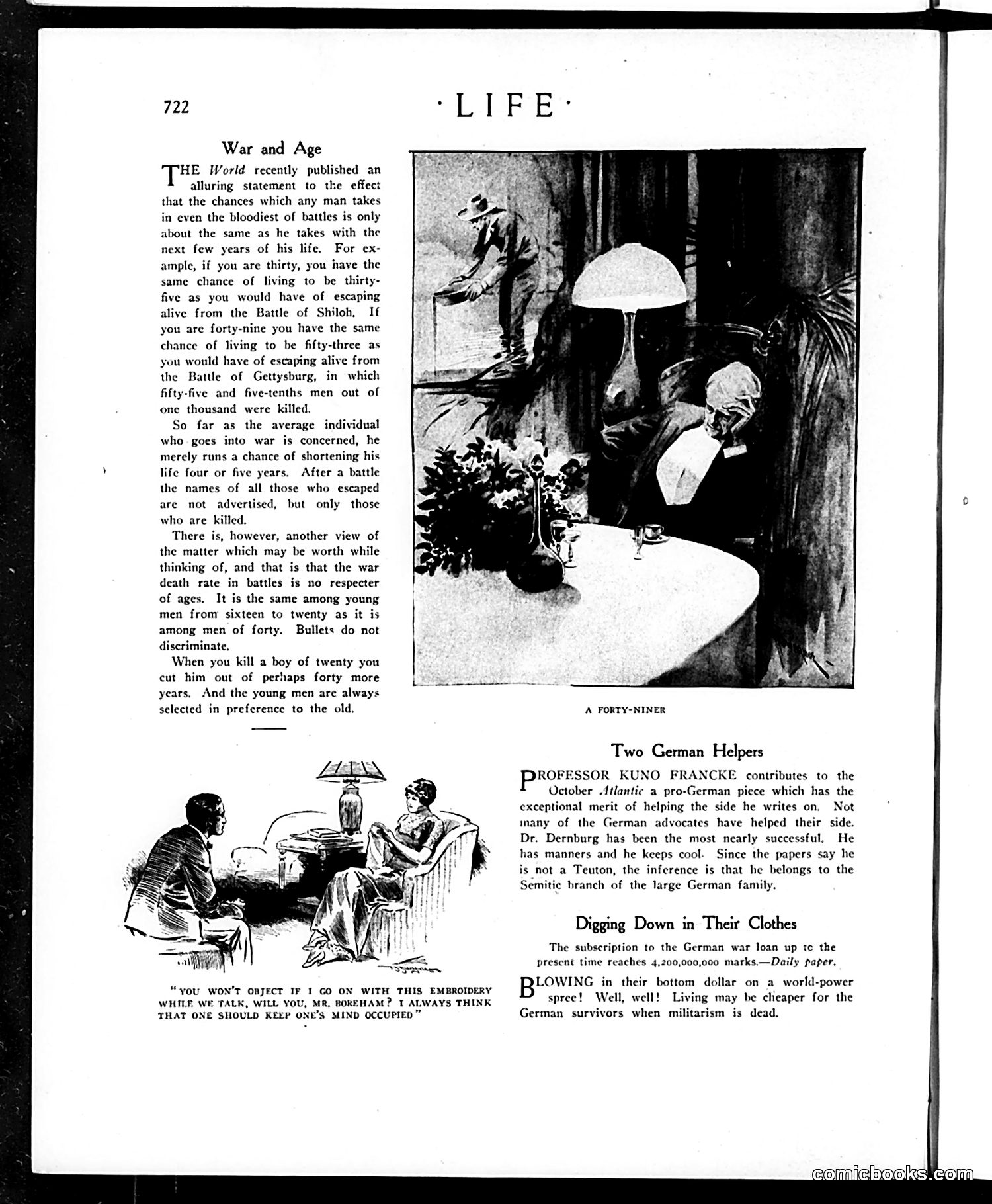
This Life magazine page contains three distinct pieces of WWI-era commentary: **"War and Age"** argues that soldiers face statistical death risks comparable to peacetime mortality, but makes a darker point: war kills young men disproportionately, cutting short decades of potential life, whereas older soldiers lose fewer remaining years. The satire critiques how casualty statistics can obscure this human cost. **The cartoon** shows a woman doing embroidery while chatting with "Mr. Boreham," cheerfully insisting on keeping her mind occupied during conversation—social satire about superficial wartime civility masking deeper anxieties. **"Two German Helpers"** and **"Digging Down in Their Clothes"** are pro-Allied polemics mocking German war financing and propaganda efforts. The references to Professor Kuno Francke and Dr. Dernburg identify German intellectuals attempting to build American support. The final section sarcastically attacks Germany's massive war loan subscription (4.2 billion marks), predicting that only "German survivors" will afford living expenses after militarism's collapse. The overall tone reflects American skepticism toward German war aims during the conflict.
📄 Transcribed text from this page (OCR, searchable)
Machine-transcribed from the original scan — historical spelling and the odd misread are preserved.
722 War and Age HE World recently published an alluring statement to the effect that the chances which any man takes in even the bloodiest of battles is only about the same as he takes with the next few years of his life. For ex- ample, if you are thirty, you have the same chance of living to be thirty- five as you would have of escaping alive from the Battle of Shiloh. If you are forty-nine you have the same chance of living to be fifty-three as you would have of escaping alive from the Battle of Gettysburg, in which fifty-five and five-tenths men out of one thousand were killed. So far as the average individual who goes into war is concerned, he merely runs a chance of shortening his life four or five years. After a battle the names of all those who escaped are not advertised, but only those who are killed. There is, however, another view of the matter which may be worth while thinking of, and that is that the war death rate in battles is no respecter of ages. It is the same among young men from sixteen to twenty as it is among men of forty. Bullets do not discriminate. When you kill a boy of twenty you cut him out of perhaps forty more years, And the young men are always selected in preference to the old. “YoU WON'T OBJECT IF I GO ON WITH THIS EMBROIDERY WHILE WE TALK, WILL YOU, MR. BOREHAM? T ALWAYS THINK THAT ONE SHOULD KEEP ONE'S MIND OCCUPIED” A FORTY-NINER Two German Helpers ROFESSOR KUNO FRANCKE contributes to the October .{tlantic a pro-German piece which has the exceptional merit of helping the side he writes on. Not many of the German advocates have helped their side. Dr. Dernburg has been the most nearly successful. He has manners and he keeps cool. Since the papers say he is not a Teuton, the inference is that he belongs to the Semitic branch of the large German family, Digging Down in Their Clothes The subscription to the German war loan up tc the present time reaches 4,200,000,000 marks.—Daily paper. BLowine in their bottom dollar on a world-power spree! Well, well! Living may be cheaper for the German survivors when militarism is dead.