
Life, 1914-10-22 · page 39 of 44
Life — October 22, 1914 — page 39: what you’re looking at
What you’re looking at
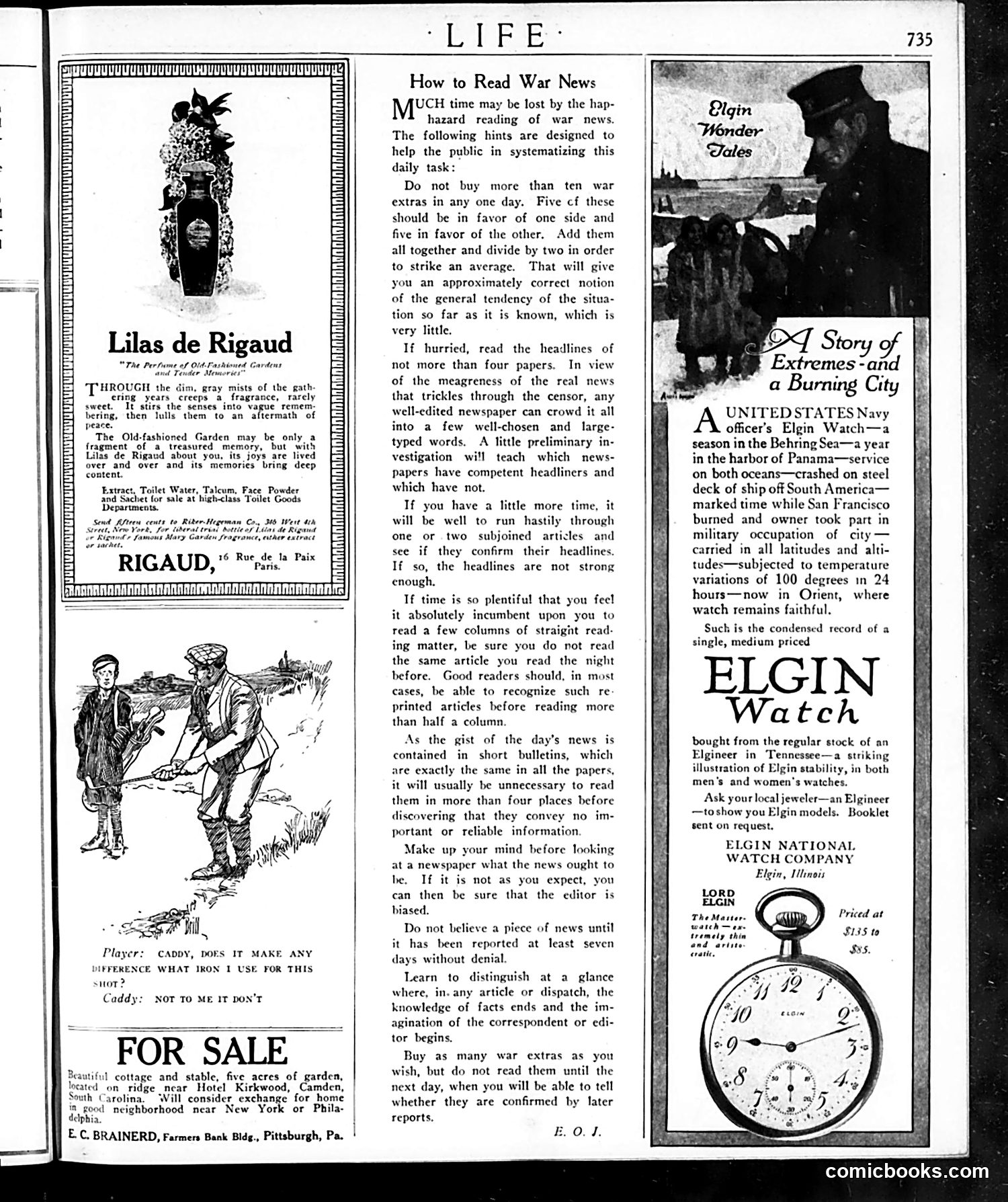
This page contains satirical advice on reading wartime news, likely from World War I era. The central piece, "How to Read War News," mocks the unreliability and bias of contemporary war reporting. The satire targets: - **Newspaper bias**: readers are advised to buy five extras favoring each side, then average them to get approximate truth - **Sensationalism**: papers recycle identical bulletins across outlets; readers needn't read the same content more than four times - **Reader gullibility**: people should decide what news "ought to be" before reading, then assume biased editors if reality differs - **Censorship**: the author notes little reliable information "trickles through the censor" The joke's bite comes from treating absurd practices (averaging contradictory reports, ignoring news until confirmed days later) as practical guidance. This reflects genuine WWI-era frustrations with propaganda, competing narratives, and official information control that made determining facts nearly impossible for ordinary citizens. The other content—perfume ads, real estate, watch advertisements—comprises typical period magazine filler.
📄 Transcribed text from this page (OCR, searchable)
Machine-transcribed from the original scan — historical spelling and the odd misread are preserved.
Cal eal Lilas de Rigaud “Tne Perfume of OldF and Tender a THROUGH the dim, gray mists of the gath- ering years creeps a. fragrance, rarely sweet. It stirs the senses into vague remem: bering, then lulls them to an aftermath of peace. The Old-fashioned Garden may be only. a fragment of a treasured memory, but with Lilas de Rigaud about you, its joys are lived over and over and its memories bring deep content. Extract, Toilet Water, Talcum, Face Powder and Sachet for sale at’high<lass Toilet Goods Departments. Send Afton cent to Rideregoman Coa 318 Wait Wh “ber aoetceo od (ragramce, ether extract RIGAUD,“ Roeide le Paix Player: CADDY, DOFS IT MAKE ANY DIFFERENCE WHAT IRON I USE FOR THIS smo? Caddy: NOT TO ME IT DON’T iful cottage and stable, five acres of garden, ated on ridge near Hotel Kirkwood, Camden, South Carolina. Will consider exchange’ for home Reet neighborhood near New York or Phila- EC. BRAINERD, Farmers Bank Bldg., Pittsburgh, Pa. How to Read War News Mu time may be lost by the hap- hazard reading of war news. The following hints are designed to help the public in systematizing this daily task: Do not buy more than ten war extras in any one day. Five cf these should be in favor of one side and five in favor of the other, Add them all together and divide by two in order to strike an average. That will give you an approximately correct notion of the general tendency of the situa- tion so far as it is known, which is very little. If hurried, read the headlines of not more than four papers. In view of the meagreness of the real news that trickles through the censor, any well-edited newspaper can crowd it all into a few well-chosen and large- typed words. A little preliminary in- vestigation will teach which news- papers have competent headliners and which have not. If you have a little more time, it will be well to run hastily through one or two subjoined articles and see if they confirm their headlines. If so, the headlines are not strong enough, If time is so plentiful that you feel it absolutely incumbent upon you to read a few columns of straight read- ing matter, be sure you do not read the same article you read the night before. Good readers should, in most cases, be able to recognize such re printed articles before reading more than half a column. As the gist of the day's news is contained in short bulletins, which are exactly the same in all the papers, it will usually be unnecessary to read them in more than four places before discovering that they convey no im- portant or reliable information. Make up your mind before looking at a newspaper what the news ought to he. If it is not as you expect, you can then be sure that the editor is biased. Do not believe a piece of news until it has been reported at least seven days without denial. Learn to distinguish at a glance where, in. any article or dispatch, the knowledge of facts ends and the im- agination of the correspondent or edi- tor begins. Buy as many war extras as you wish, but do not read them until the next day, when you will be able to tell whether they are confirmed by later reports, EB. 0. 4. rg. Extremes *=and a Burning City UNITED STATES Navy officer's Elgin Watch—a season in the Behring Sea—a year in the harbor of Panama—service on both oceans—crashed on steel deck of ship off South America— marked time while San Francisco burned and owner took part in military occupation of city — carried in all latitudes and alti- tudes—subjected to temperature variations of 100 degrees in 24 hours—now in Orient, where watch remains faithful, Such is the condensed record of a single, medium priced ELGIN Watch bought from the regular stock of an Elgineer in Tennessee—a striking illustration of Elgin stability, in both men’s and women’s watches. Ask your local jeweler—an Elgineer —to show you Elgin models. Booklet sent on request, ELGIN NATIONAL WATCH COMPANY Mhnois Priced at SIS to tremely th and arise cratic. comicbooks.com se == Be sh 5