
Life, 1914-10-22 · page 24 of 44
Life — October 22, 1914 — page 24: what you’re looking at
What you’re looking at
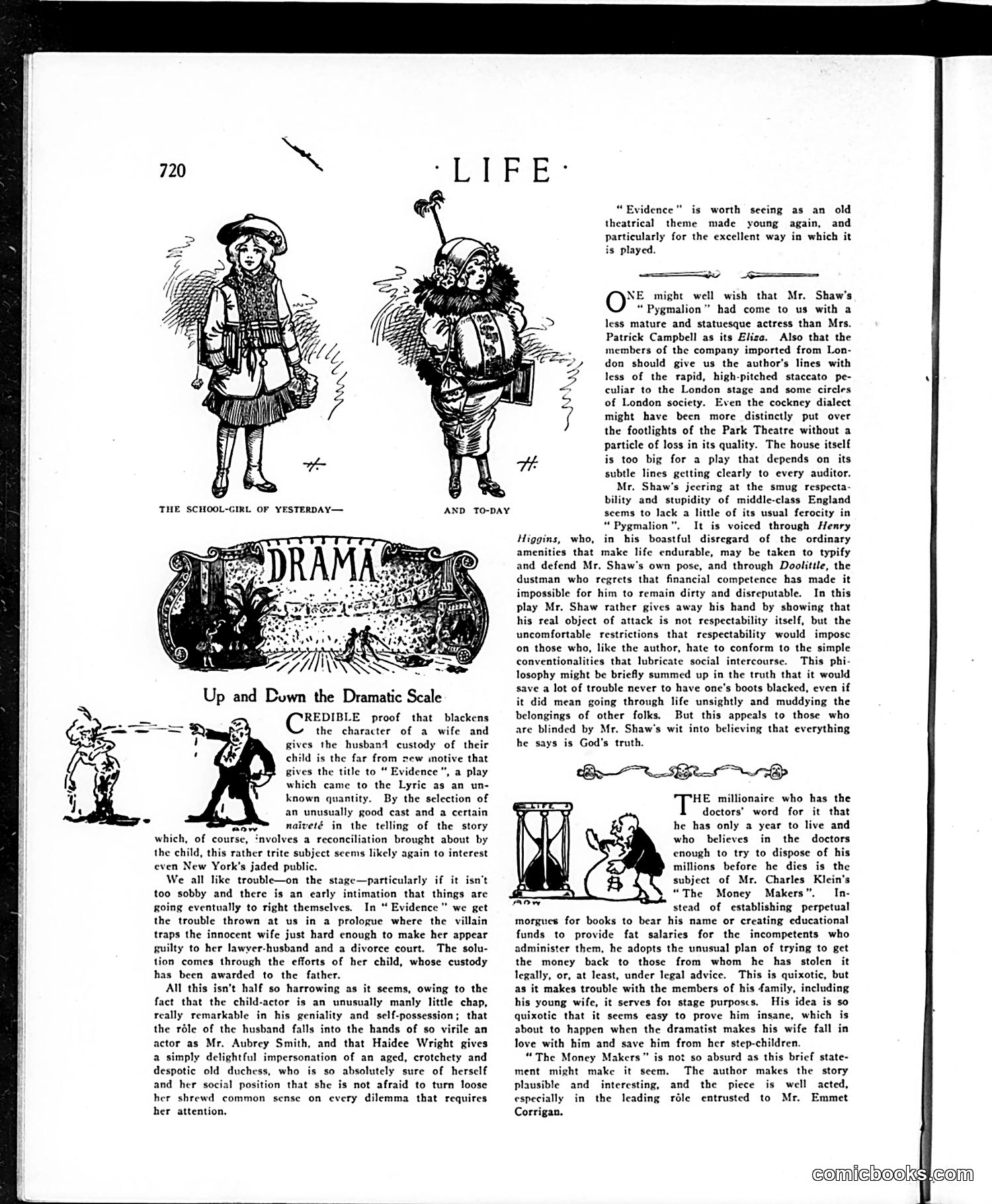
This page reviews two plays: "Evidence" and Shaw's "Pygmalion." **"Evidence"** is praised as a competent revival of a familiar plot device—a wife falsely accused, leading to divorce and reconciliation through their child's intervention. The reviewer notes the play succeeds mainly because of strong casting, particularly child actor (unnamed here), Aubrey Smith as the husband, and Haidee Wright as "an aged, crotchety and despotic old duchess." **"Pygmalion"** receives sharper critique. The reviewer criticizes Mrs. Patrick Campbell as too mature for Eliza, and complains the London-imported cast delivers Shaw's lines with "rapid, high-pitched staccato" delivery unsuitable for the Park Theatre's size. Most pointedly, the critic argues Shaw's satire of middle-class respectability lacks force because his real target isn't respectability itself, but rather society's expectations that would restrict people like Shaw from living as they wish—essentially, Shaw attacks rules that prevent people from being disheveled and unconventional.
📄 Transcribed text from this page (OCR, searchable)
Machine-transcribed from the original scan — historical spelling and the odd misread are preserved.
TRA Pid bas AND TO-DAY REDIBLE proof that blackens the character of a wife and gives the husband custody of their child is the far from sew im ¢ that gives the title to “ Evidence”, a play which came to the Lyric as an un- known quantity. By the selection of an unusually good cast and a certain me naiveté in the telling of the story which, of course, ‘nvolves a reconciliation brought about by the child, this rather trite subject seems likely again to interest even New York's jaded public. We all like trouble—on the stage—particularly if it isn’t too sobby and there is an early intimation that things are going eventually to right themselves. In “ Evidence” we get the trouble thrown at us in a prologue where the villain traps the innocent wife just hard enough to make her appear guilty to her lawyer-husband and a divorce court. The solu- tion comes through the efforts of her child, whose custody has been awarded to the father. All this isn’t half so harrowing as it seems, owing to the fact that the child-actor is an unusually manly little chap, really remarkable in his geniality and self-possession; that the réle of the husband falls into the hands of so virile an actor as Mr. Aubrey Smith, and that Haidee Wright gives a simply delightful impersonation of an aged, crotchety and despotic old duchess, who is so absolutely sure of herself and her social position that she is not afraid to turn loose her shrewd common sense on every dilemma that requires her attention, “Evidence” is worth seeing as an old theatrical theme made young again, and particularly for the excellent way in which it is played. O might well wish that Mr. Shaw's “ Pygmalion” had come to us with a less mature and statuesque actress than Mrs. Patrick Campbell as its Eliza. Also that the members of the company imported from Lon- don should give us the author's lines with less of the rapid, high-pitched staccato pe- culiar to the London stage and some circles of London society. Even the cockney dialect might have been more distinctly put over the footlights of the Park Theatre without a particle of loss in its quality. The house itself is too big for a play that depends on its subtle lines getting clearly to every auditor. Mr. Shaw’s jecring at the smug respecta- bility and stupidity of middle-class England scems to lack a little of its usual ferocity in “Pygmalion”. It is voiced through Henry Higgins, who, in his boastful disregard of the ordinary amenities that make life endurable, may be taken to typify and defend Mr. Shaw's own pose, and through Doolittle, the dustman who regrets that financial competence has made it impossible for him to remain dirty and disreputable. In this play Mr. Shaw rather gives away his hand by showing that his real object of attack is not respectability itself, but the uncomfortable restrictions that respectability would impose on those who, like the author, hate to conform to the simple conventionalities that lubricate social intercourse. This phi- losophy might be briefly summed up in the truth that it would save a lot of trouble never to have one's boots blacked, even if it did mean going through life unsightly and muddying the belongings of other folks. But this appeals to those who are blinded by Mr. Shaw's wit into believing that everything he says is God's truth. By Sa o> HE millionaire who has the doctors’ word for it that he has only a year to live and who believes in the doctors enough to try to dispose of his millions before he dies is the subject of Mr. Charles Klein's “The Money Makers”. In- stead of establishing perpetual morgues for books to bear his name or creating educational funds to provide fat salaries for the incompetents who administer them, he adopts the unusual plan of trying to get the money back to those from whom he has stolen it legally, or, at least, under legal advice. This is quixotic, but as it makes trouble with the members of his family, including his young wife, it serves for stage purposcs. His idea is so quixotic that it seems easy to prove him insane, which is about to happen when the dramatist makes his wife fall in love with him and save him from her step-children. “The Money Makers” is not so absurd as this brief state- ment might make it seem, The author makes the story plausible and interesting, and the piece is well acted, especially in the leading réle entrusted to Mr. Emmet Corrigan. —= comichoo!