
Life, 1914-10-22 · page 12 of 44
Life — October 22, 1914 — page 12: what you’re looking at
What you’re looking at
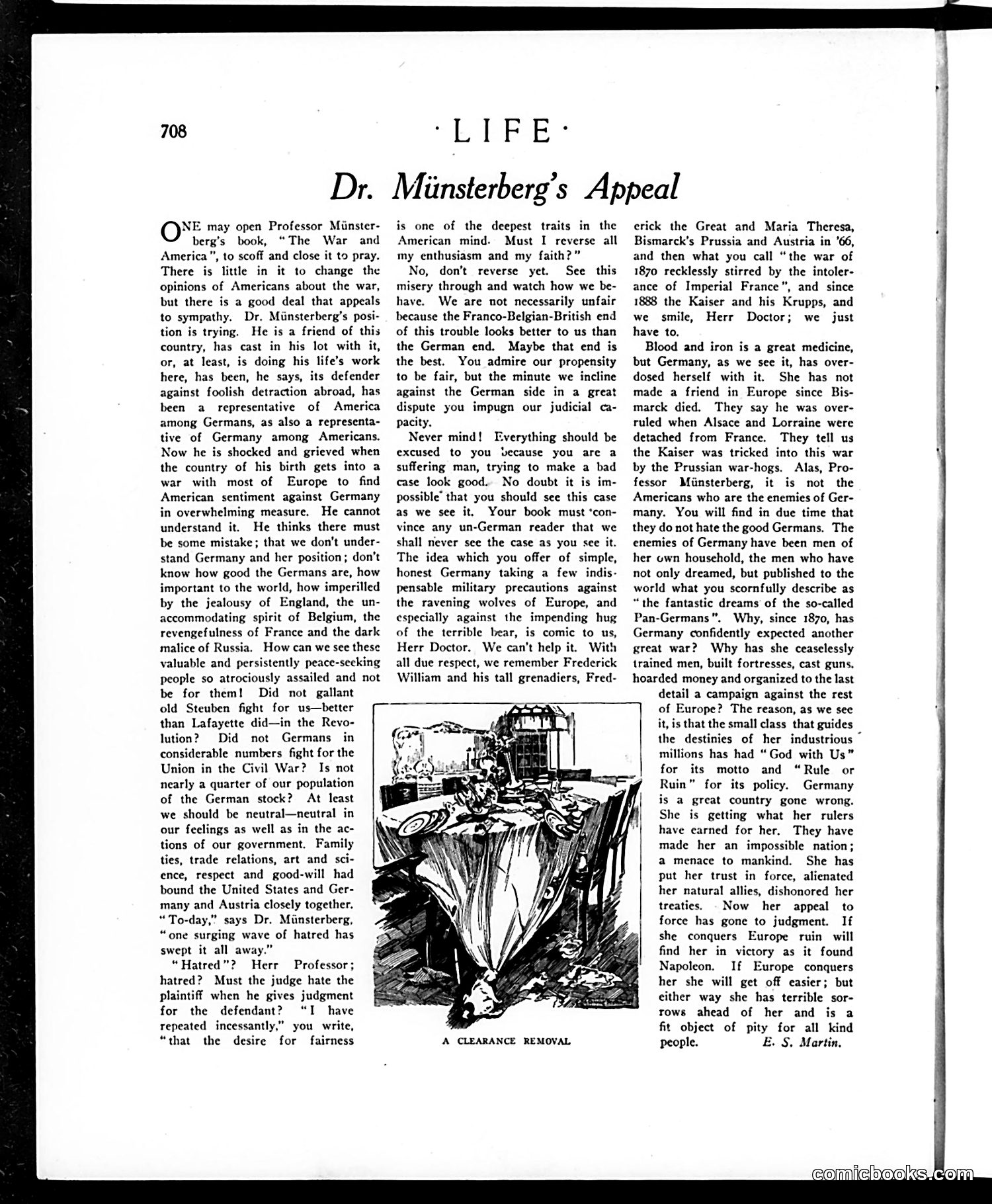
This page addresses Professor Hugo Münsterberg, a German-American academic whom Life presents as defending Germany's role in World War I. The article satirizes his attempt to convince Americans that Germany's military actions were justified—mocking his appeals to "fairness" while Germany has allegedly committed atrocities across Europe. The cartoon labeled "A CLEARANCE REMOVAL" (center) depicts what appears to be bodies or destruction being swept/removed, visualizing the human cost of German military operations that the article criticizes. The satire's point: Münsterberg's academic arguments cannot excuse Germany's conduct. The author (E.S. Martin) argues Germany is "a menace to mankind" and deserves no American sympathy, regardless of eloquent defenses from prominent German-Americans.
📄 Transcribed text from this page (OCR, searchable)
Machine-transcribed from the original scan — historical spelling and the odd misread are preserved.
‘TebiP EB * Dr. Minsterberg’s Appeal O*E may open Professor Miinster- berg’s book, “The War and America”, to scoff and close it to pray. There is little in it to change the opinions of Americans about the war, but there is a good deal that appeals to sympathy. Dr. Miinsterberg’s posi- tion is trying. He is a friend of this country, has cast in his lot with it, or, at least, is doing his life’s work here, has been, he says, its defender against foolish detraction abroad, has been a representative of America among Germans, as also a representa- tive of Germany among Americans. Now he is shocked and grieved when the country of his birth gets into a war with most of Europe to find American sentiment against Germany in overwhelming measure. He cannot understand it. He thinks there must be some mistake ; that we don’t under- stand Germany and her position; don’t know how good the Germans are, how important to the world, how imperilled by the jealousy of England, the un- accommodating spirit of Belgium, the revengefulness of France and the dark malice of Russia. How can we see these valuable and persistently peace-secking people so atrociously assailed and not be for them! Did not gallant old Steuben fight for us—better than Lafayette did—in the Revo- lution? Did not Germans in considerable numbers fight for the Union in the Civil War? Is not nearly a quarter of our population of the German stock? At least we should be neutral—neutral in our feelings as well as in the ac- tions of our government. Family ties, trade relations, art and sci- ence, respect and good-will had bound the United States and Ger- many and Austria closely together. “To-day,” says Dr. Miinsterberg, “one surging wave of hatred has swept it all away.” “Hatred”? Herr Professor; hatred? Must the judge hate the plaintiff when he gives judgment for the defendant? “I have repeated incessantly,” you write, “that the desire for fairness is one of the deepest traits in the American mind. Must I reverse all my enthusiasm and my faith?” No, don’t reverse yet. See this misery through and watch how we be- have. We are not necessarily unfair because the Franco-Belgian-British end of this trouble looks better to us than the German end. Maybe that end is the best. You admire our propensity to be fair, but the minute we incline against the German side in a great dispute you impugn our judicial ca- pacity, Never mind! Everything should be excused to you ULecause you are a suffering man, trying to make a bad case look good. No doubt it is im- possible’ that you should see this case as we see it. Your book must ‘con- vince any un-German reader that we shall never see the case as you see it. The idea which you offer of simple, honest Germany taking a few indis- pensable military precautions against the ravening wolves of Europe, and especially against the impending hug of the terrible bear, is comic to us, Herr Doctor. We can't help it. With all due respect, we remember Frederick William and his tall grenadiers, Fred- A CLEARANCE REMOVAL erick the Great and Maria Theresa, Bismarck’s Prussia and Austria in '66, and then what you call “the war of 1870 recklessly stirred by the intoler- ance of Imperial France”, and since 1888 the Kaiser and his Krupps, and we smile, Herr Doctor; we just have to. Blood and iron is a great medicine, but Germany, as we see it, has over- dosed herself with it. She has not made a friend in Europe since Bis- marck died. They say he was over- ruled when Alsace and Lorraine were detached from France. They tell us the Kaiser was tricked into this war by the Prussian war-hogs. Alas, Pro- fessor Minsterberg, it is not the Americans who are the enemies of Ger- many. You will find in due time that they do not hate the good Germans. The enemies of Germany have been men of her own household, the men who have not only dreamed, but published to the world what you scornfully describe as “the fantastic dreams of the so-called Pan-Germans”. Why, since 1870, has Germany confidently expected another great war? Why has she ceaselessly trained men, built fortresses, cast guns. hoarded money and organized to the last detail a campaign against the rest of Europe? The reason, as we see it, is that the small class that guides the destinies of her industrious millions has had “God with Us” for its motto and “Rule or Ruin” for its policy. Germany is a great country gone wrong. She is getting what her rulers have earned for her. They have made her an impossible nation; a menace to mankind. She has put her trust in force, alienated her natural allies, dishonored her treaties. _Now her appeal to force has gone to judgment. If she conquers Europe ruin will find her in victory as it found Napoleon. If Europe conquers her she will get off easier; but either way she has terrible sor- rows ahead of her and is a fit object of pity for all kind people. E. S. Martin,