
Life, 1914-10-22 · page 25 of 44
Life — October 22, 1914 — page 25: what you’re looking at
What you’re looking at
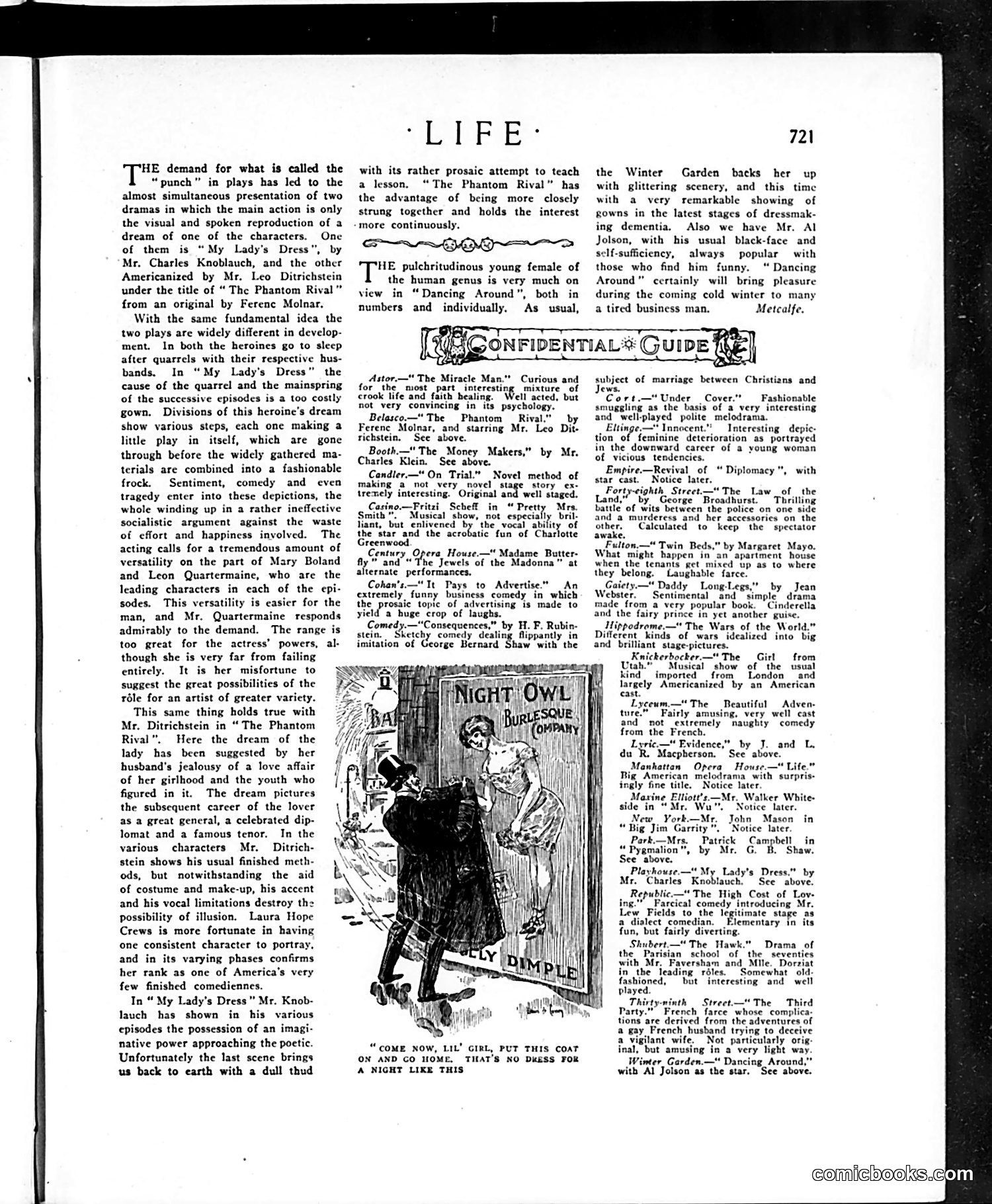
This page reviews several Broadway theatrical productions from the early 20th century. The main content discusses two dream-sequence plays: "My Lady's Dress" by Charles Knoblauch and "The Phantom Rival" (adapted by Leo Ditrichstein from Ferenc Molnár). The reviewer praises the imaginative dream sequences in both works but critiques their execution—particularly actress Mary Boland's limited range in handling the varied emotional demands of "My Lady's Dress," while praising actor Leon Quartermaine's versatility. For "The Phantom Rival," the reviewer finds Ditrichstein's accent and vocal limitations undermine the illusion, though Laura Hope Crews excels in her more consistent role. The accompanying cartoon illustration depicts a "Night Owl" burlesque company scene, with the caption mocking a woman being sent home from a night performance without proper dress—likely satirizing the theatrical world's casual attitudes toward propriety.
📄 Transcribed text from this page (OCR, searchable)
Machine-transcribed from the original scan — historical spelling and the odd misread are preserved.
'HE demand for what is called the “punch” in plays has led to the almost simultaneous presentation of two dramas in which the main action is only the visual and spoken reproduction of a dream of one of the characters. One of them is “My Lady’s Dress", by Mr. Charles Knoblauch, and the other Americanized by Mr. Leo Ditrichstei under the title of “ Thc Phantom Rival from an original by Ferenc Molnar. With the same fundamental idea the two plays are widely different in develop- ment. In both the heroines go to sleep after quarrels with their respective hus- bands. In “My Lady's Dress" the cause of the quarrel and the mainspring of the successive episodes is a too costly gown, Divisions of this heroine's dream show various steps, each one making a little play in itself, which are gone through before the widely gathered ma- terials are combined into a fashionable frock. Sentiment, comedy and even tragedy enter into these depictions, the whole winding up in a rather ineffective socialistic argument against the waste of effort and happiness involved. The acting calls for a tremendous amount of versatility on the part of Mary Boland and Leon Quartermaine, who are the leading characters in each of the epi- sodes, This versatility is easier for the man, and Mr. Quartermaine responds admirably to the demand. The range is too great for the actress’ powers, al- though she is very far from failing entirely. It is her misfortune to suggest the great possibilities of the réle for an artist of greater variety. This same thing holds true with Mr. Ditrichstein in “The Phantom Rival”. Here the dream of the lady has been suggested by her husband's jealousy of a love affair of her girlhood and the youth who figured in it. The dream pictures the subsequent career of the lover as a great general, a celebrated dip- lomat and a famous tenor. In the various characters Mr. Ditrich- stein shows his usual finished meth- ods, but notwithstanding the aid of costume and make-up, his accent and his vocal limitations destroy the possibility of illusion. Laura Hope Crews is more fortunate in having one consistent character to portray, and in its varying phases confirms her rank as one of America’s very few finished comediennes. In “ My Lady's Dress” Mr. Knob- lauch has shown in his various episodes the possession of an imagi- native power approaching the poetic. Unfortunately the last scene brings us back to earth with a dull thud gE FS with its rather prosaic attempt to teach a lesson, “The Phantom Rival” has the advantage of being more closely strung together and holds the interest more continuously, HE pulchritudinous young female of the human genus is very much on view in “Dancing Around”, both in numbers and individually, As usual, Astor.—" The Miracle 3 nd for the most part interesting mixture of crook life and faith bealing. Well acted, but not very convincing in its psychology. Belasco.—"" The Phantom — Rival.” _ by Ferenc Molnar, and starring Mr. Leo Dit- richstein. See’ above. Booth—" The Money Makers,” by Mr. Charles ‘Klein. See above Candler.—" On Trial.” Novel method of making a not very novel stage story ex- tremely interesting. Original well staged. Fritzi Scheff? in “Pretty Mrs. Musical show, not especiall bril- liant, but enlivened by the vocal abilit of the and the acrobatic fun of Charlotte Greenwood. Century Opera House—" Madame Butter- fly” and’ The Jewels of the Madonna” at alternate performances. Cohan's.—""It Pays to Advertise.” An extremely funny business comedy in which the prosaic topic of advertising is made to yield a huge crop of laughs. Comedy.—"Consequences,” by H. F. Rubin- stein. Sketchy comedy dealing flippantly in ion of George Bernard Shaw with the “COME NOW, LIL’ GIRL, PUT THIS COAT ON AND CO MOME. THAT'S NO DKESS FOR A NIGHT LIKE THIS 721 the Winter Garden backs her up with glittering scenery, and this time with a very remarkable showing of gowns in the latest stages of dressmak- ing dementia. Also we have Mr. Al Jolson, with his usual black-face and self-sufficiency, always popular with those who find him funny. “ Dancing Around” certainly will bring pleasure during the coming cold winter to many a tired business man. Metcalfe. subject of marriage between Christians and Tews. Cort Under — Cover. Fashionable smuggling as the basis of a very interesting and well-played polite melodrama. " Eltinge Interesting depic- tion of feminine deterioration as portrayed in the downward career of a young woman of vicious. tendencies. Empire—Revival of star cast. Notice later. Forty-eighth Street.—" The Law of the Land,” by. George Broadhurst. Thrilling battle of wits between the police on one side and a murderess and her accessories on the other, Calculated to keep the spectator awake, Fulton.—*“ Twin Beds,” by Margaret Mayo. What ‘might happen in'an apartment house when the tenants get mixed up as to where they belong. Laughable farce. Gaiety." Daddy Long-Legs,” by Jean Webster. Sentimental and simple drama made from a very popular book. Cinderella and the fairy prince in yet another guise. Hippodrome—" The Wars of the World.” Different kinds of wars idealized into. big and brilliant stage-pictures. Knickerbocker—" The Girl Utah.” Musical show. of the usual Kind” imported from London and largely Americanized by an American cast Lyceum—"The Beautiful Adven- ture.” Fairly amusing, very well cast and not extremely naughty comedy from the French. vric.—" Evidence." by J. and La du Ro Macpherson." See’ above. Manhatten Opera House—" Life.” American melodrama with surpris- gly fine title. Notice later. Mr. Walker White- Notice later. John Mason in Notice later. Patrick Campbell in Mr. G. Shaw. “ Diplomacy", with from a Pork Mrs I -yemalion”, by See above. Playhouse.—" My Lady's Dress." b Mr. Charles Knoblauch) See above. Republic" The High Cost of Lov- ing.” Farcical comedy introducing Mr. Lew Fields to the legitimate stage as a dialect comedian. Elementary in its fun, but fairly diverting. Shubert—"The Hawk." Drama of the Parisian school of the seventies with Mr. Faversham and Mlle. Dorziat in the jeading rdles. Somewhat old- fashioned, but interesting and well minth — Street.— The Third French farce whose complica- tions are derived from the adventures of a gay French husband trying to deceive vigilant wife. Not particularly orig- inal, but amusing in a very light way. Winter Garden.— Dancing Around,” with Al Jolson as the star. See above. comichooks.