
Life, 1914-10-22 · page 28 of 44
Life — October 22, 1914 — page 28: what you’re looking at
What you’re looking at
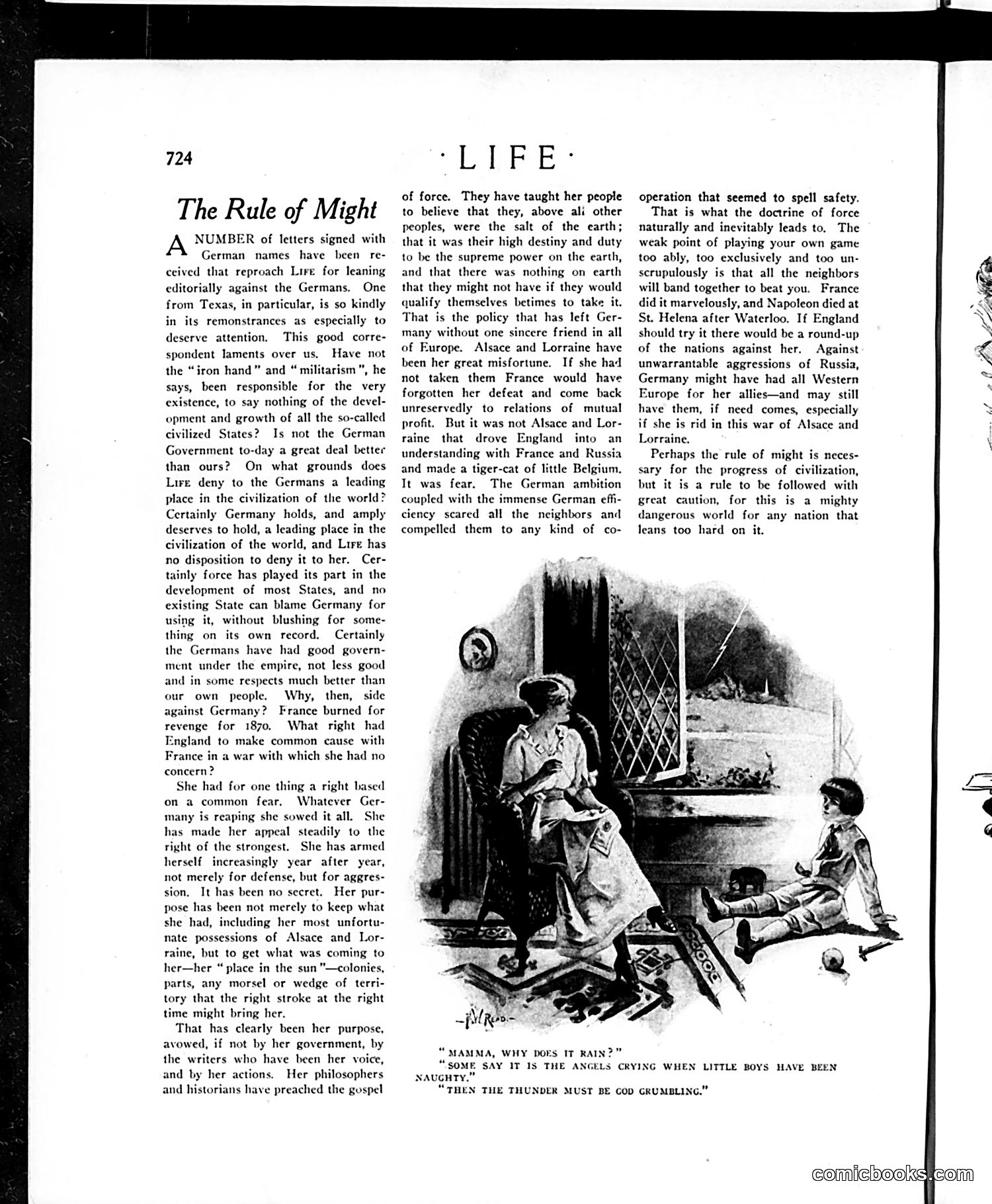
This editorial and accompanying illustration address a defense of Allied opposition to Germany during World War I (the page references 1870, implying post-WWI perspective). The article responds to German-American letter-writers defending Germany's military power and territorial ambitions. Life's editor argues that while Germany deserves credit for efficient governance and force's historical role in nation-building, Germany's explicit ideology of "might makes right"—preaching racial superiority and aggressive expansion—frightened all neighboring nations into alliance *against* her. The "doctrine of force," the editor contends, naturally provokes unified opposition. The cartoon depicts a woman (likely representing Germany or militarism) telling a child the rain is "angels crying when little boys have been naughty," then attributing thunder to "God grumbling." The satire suggests Germany's aggressive doctrine produces predictable consequences—like a child's misbehavior inviting punishment—yet Germany mystifies these natural results.
📄 Transcribed text from this page (OCR, searchable)
Machine-transcribed from the original scan — historical spelling and the odd misread are preserved.
724 The Rule of Might A NUMBER of letters signed with German names have been re- ceived that reproach Lire for leaning editorially against the Germans. One from Texas, in particular, is so kindly in its remonstrances as especially to deserve attention, This good corre- spondent laments over us. Have not the “iron hand” and “ militarism”, he says, been responsible for the very existence, to say nothing of the devel- opment and growth of all the so-called civilized States? Is not the German Government to-day a great deal better than ours? On what grounds does Lire deny to the Germans a leading place in the civilization of the world? Certainly Germany holds, and amply deserves to hold, a leading place in the civilization of the world, and Lire has no disposition to deny it to her. Cer- tainly force has played its part in the development of most States, and no existing State can blame Germany for using it, without blushing for some- thing on its own record. Certainly the Germans have had good govern- ment under the empire, not less good and in some respects much better than our own people. Why, then, side against Germany? France burned for revenge for 1870, What right had England to make common cause with France in a war with which she had no concern? She had for one thing a right based on a common fear. Whatever Ger- many is reaping she sowed it all. She has made her appeal steadily to the right of the strongest. She has armed herself increasingly year after year, not merely for defense, but for aggres- sion. It has been no secret. Her pur- pose has been not merely to keep what she had, including her most unfortu- nate possessions of Alsace and Lor- raine, but to get what was coming to her—her “place in the sun "—colonies, parts, any morsel or wedge of terri- tory that the right stroke at the right time might bring her. That has clearly been her purpose, avowed, if not by her government, by the writers who have been her voice, and by her actions. Her philosophers and historians have preached the gospel ‘LEP E® of force. They have taught her people to believe that they, above ali other peoples, were the salt of the earth; that it was their high destiny and duty to be the supreme power on the earth, and that there was nothing on earth that they might not have if they would qualify themselves betimes to take it. That is the policy that has left Ger- many without one sincere friend in all of Europe. Alsace and Lorraine have been her great misfortune, If she had not taken them France would have forgotten her defeat and come back unreservedly to relations of mutual profit. But it was not Alsace and Lor- raine that drove England into an understanding with France and Russia and made a tiger-cat of little Belgium. It was fear. The German ambition coupled with the immense German effi- ciency scared all the neighbors and compelled them to any kind of co- NAUGHTY.” “THEN THE THUNDER MUST BE GOD GRUMBLID operation that seemed to spell safety. That is what the doctrine of force naturally and inevitably leads to. The weak point of playing your own game too ably, too exclusively and too un- scrupulously is that all the neighbors will band together to beat you. France did it marvelously, and Napoleon died at St. Helena after Waterloo. If England should try it there would be a round-up of the nations against her. Against unwarrantable aggressions of Russia, Germany might have had all Western Europe for her allies—and may still have them, if need comes, especially if she is rid in this war of Alsace and Lorraine, Perhaps the rule of might is neces- sary for the progress of civilization, but it is a rule to be followed with great caution, for this is a mighty dangerous world for any nation that leans too hard on it.